XRP Ledger Hard Fork In 8 Days? Upgrade Deadline Sparks Network Split Debate

bitcoinistPublicado a 2026-05-19Actualizado a 2026-05-19

Resumen

The XRP Ledger community is debating whether the mandatory v3.1.3 software upgrade constitutes a hard fork, with critics warning that nodes not updated before the May 27 deadline will be cut off from the network. The update includes a critical fix amendment, which, according to network rules, will automatically activate after a set period. Early data showed a majority of nodes had not upgraded, sparking concerns about a potential network split. Proponents argue the process is not a contentious fork but a standard "amendment blocking" security feature designed to protect network integrity by isolating outdated software. They emphasize that responsible node maintenance is required, and the mechanism ensures all participants correctly interpret transaction rules. Infrastructure experts also note that raw node counts may overstate the risk, as many inactive or non-critical nodes could update last-minute. The debate centers on governance and the operational health of the decentralized network.

The XRP Ledger community is debating whether an approaching v3.1.3 upgrade amounts to a hard fork after infrastructure operators warned that nodes failing to update before the fix amendment activates will no longer be able to communicate with the network.

The dispute erupted after XRPL validator operator Vet said version 3.1.3 of rippled had been available for more than a week, with 40% of the network upgraded at the time of his post (May 18). He warned that the fix amendment included in the release would become active in nine days and that “every node that hasn’t been updated to 3.1.3 will be unable to communicate to the network.”

In a later update, RippleX head of engineering J. Ayo Akinyele said 44% of the XRPL network had upgraded and urged node operators to move quickly, adding: “Only 8 days left before the fix amendment activates — don’t be left out!”

XRPL Hard Fork Debate Heats Up

According to XRPL.org, rippled is the reference server implementation of the XRP Ledger protocol. The 3.1.3 release introduces the fixCleanup3_1_3 amendment, a package of fixes for NFTs, Permissioned Domains, Vaults and the Lending Protocol. Because of the importance of those fixes, XRPL.org said the amendment’s default vote is set to “Yes.”

The “hard fork” framing came from critics who argued that, as of the early upgrade figures, a majority of network nodes were still on the path to being cut off. X user ScamDaddy wrote: “The XRPL will hard fork in 9 days. As of this moment, 60% of the network will be forked off.” The post then turned the argument into a governance challenge: “But who’s to say 3.1.3 should be XRP mainnet, Ripple? Vet? 60% is the majority after all!”

That framing drew pushback from XRPL community members who argued the mechanism is better understood as amendment blocking, not an accidental or contentious chain split. XRPL’s amendment system uses validator voting to approve protocol changes that affect transaction processing. According to XRPL.org, an amendment passes if it receives more than 80% support from trusted validators for two weeks, after which the change applies permanently to future ledger versions.

The technical consequence for outdated servers is still material. XRPL.org says amendment blocking is a security feature intended to protect data accuracy when old software no longer understands the active rules of the network. Servers running earlier versions without the amendment code cannot determine ledger validity, submit or process transactions, participate in consensus, or vote on future amendments; upgrading to a newer rippled version unblocks them.

Daniel Keller, Chief Technology Officer (CTO) for Eminence, a blockchain infrastructure company that runs a Full History Node for the XRP Ledger, argued that raw node counts may overstate the operational risk. “The only question is: how many of them actually matter to XRPL operations?” he wrote. “How many are abandoned? How many would just update a few hours late? How many are actually relevant infrastructure?”

Keller framed the cutoff as maintenance discipline rather than a decentralization failure: “Decentralisation does not mean dead weight gets carried. Running a node is a responsibility, not a participation trophy. If you can’t maintain infrastructure, you should get filtered out. That is network hygiene.”

Krippenreiter made a similar case, saying the negative connotation around “forking” can obscure XRPL’s design. “Forking has a negative connotation because it sounds like the network is less secure because of it, when in reality, at least on the XRP Ledger, the amendment block mechanism itself, ironically, is a security feature,” he wrote. “It is a security mechanism so that no transaction data or rules on XRPL are interpreted wrongly by any node that didn’t already update.”

At press time, XRP traded at $1.38.
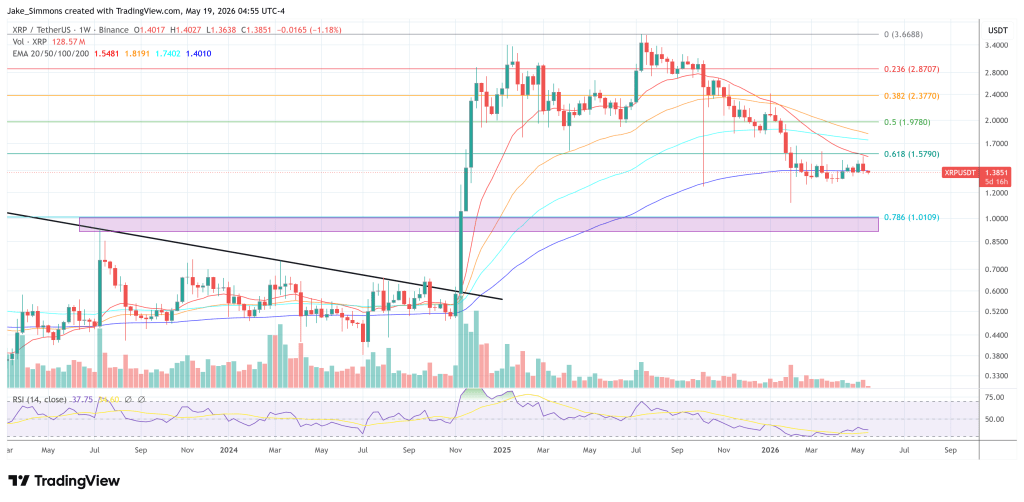
XRP bulls must break the 0.618 Fib, 1-week chart | Source: XRPUSDT on TradingView.com

Preguntas relacionadas

QWhat is the main debate in the XRP Ledger community regarding the v3.1.3 upgrade?

AThe debate is over whether the approaching v3.1.3 upgrade constitutes a hard fork that could split the network, or if it is better understood as a standard amendment blocking process, which is a security feature to protect data accuracy.

QWhat happens to nodes that fail to update to rippled version 3.1.3 before the fix amendment activates?

ANodes that have not been updated to version 3.1.3 will be unable to communicate with the network. They cannot determine ledger validity, submit or process transactions, participate in consensus, or vote on future amendments.

QWhat is the purpose of the fixCleanup3_1_3 amendment included in the rippled 3.1.3 release?

AThe fixCleanup3_1_3 amendment is a package of fixes for NFTs, Permissioned Domains, Vaults, and the Lending Protocol on the XRP Ledger.

QAccording to critics, why was the situation framed as a 'hard fork'?

ACritics framed it as a 'hard fork' because, based on early upgrade figures, a majority (60%) of network nodes were on a path to being cut off, which they argued could create a governance challenge about which chain should be considered the mainnet.

QHow do defenders of the process, like Daniel Keller, view the potential cutoff of outdated nodes?

ADefenders like Daniel Keller view the cutoff as necessary maintenance discipline and 'network hygiene,' arguing that decentralization does not mean carrying 'dead weight.' Running a node is a responsibility, and outdated infrastructure that cannot be maintained should be filtered out.

Lecturas Relacionadas

Must-Watch Events Next Week|CLARITY Act Could Face Senate Vote; SpaceX, Circle to Report Earnings (8.3-8.9)

**Summary: Key Events and Developments to Watch (August 3-9)** The upcoming week is marked by significant financial disclosures, key legislative deadlines, and notable product updates. **Major Financial Events:** Several companies are scheduled to release their Q2 2026 earnings. American Bitcoin (ABTC) will report on August 3, followed by SpaceX and Hut 8 Mining Corp. on August 4, and Circle on August 5. Notably, a significant portion of SpaceX shares (up to 12% of total shares) will be unlocked on August 6 following their earnings release. **Key Legislative Deadline:** The U.S. Senate faces an August 7 deadline to secure 60 votes for the CLARITY Act, a bipartisan bill aiming to establish a federal regulatory framework for cryptocurrencies. The Senate may hold a full vote on the bill during the week. **Economic Data:** The U.S. July Non-Farm Payrolls report will be released on August 7, providing crucial labor market data. **Technology & Product Updates:** * **Shutdowns:** DeFi portfolio tracker Zapper and wallet app Ctrl Wallet will cease operations on August 3. * **Upgrades:** LayerZero will deprecate its v1 relayers on August 3. XRP Ledger's new version 3.3.0, featuring five new functions, is expected next week. * **AI:** Elon Musk announced that the advanced Grok 4.6 AI model is set for release around August 7. * **Bitcoin:** The BIP-110 forced signaling for a potential Bitcoin network change is scheduled to begin around August 8. **Other Notable Events:** Chinese robotics firm Unitree Tech has set its preliminary price inquiry for its IPO for August 5. South Korean exchange Upbit will delist AQT and AERGO tokens on August 3.

marsbitHace 1 hora(s)

Must-Watch Events Next Week|CLARITY Act Could Face Senate Vote; SpaceX, Circle to Report Earnings (8.3-8.9)

marsbitHace 1 hora(s)

Stocks Are Plummeting More Sharply Than Cryptocurrencies. Where Has the Money Gone?

Stock Markets Plunge Deeper Than Cryptocurrencies: Where Did the Money Go? In late July, Seoul's Kospi index triggered circuit breakers for two consecutive days, plummeting over 40% from its June high. The collapse was led by heavyweight stocks like SK Hynix, whose record profits still disappointed investors, and devastating leveraged ETFs, with one major product losing over 83% of its value. This signaled a global, forced deleveraging targeting the most crowded trades. Interestingly, while stocks exhibited extreme volatility akin to crypto markets, Bitcoin rose nearly 15% in July after a prior steep drop. Analysis shows the money fleeing equities did not flow into Bitcoin. Instead, Bitcoin had already absorbed its sell-off in May-June, when U.S. spot Bitcoin ETFs saw historic outflows. The true safe-haven beneficiary was gold, whose price rose over 20% year-on-year, highlighting a decoupling between Bitcoin and gold as "digital gold." The sell-off was a targeted unwinding of leveraged positions in tech and semiconductors, accelerated by broker-dealer risk management and shifts in the AI narrative, including new competition from Chinese memory chipmakers. The retreat path was clear: from high-valuation tech stocks to cash and U.S. Treasuries, then to gold. For Bitcoin to attract sustained institutional inflows, conditions like eased global liquidity pressure, a "soft-landing" Fed rate cut, and U.S. regulatory clarity via legislation like the stalled CLARITY Act are needed. Currently, Bitcoin is not a safe haven but an already-cleared asset. Its low correlation with tech stocks, however, makes it a potential diversification play for institutional portfolios once the storm passes. The money isn't here yet, but the positioning is underway.

marsbitHace 1 hora(s)

Stocks Are Plummeting More Sharply Than Cryptocurrencies. Where Has the Money Gone?

marsbitHace 1 hora(s)

In Conversation with Ray Dalio: We Are Currently in an AI Bubble, with 1% of My Portfolio in Bitcoin

Ray Dalio, founder of Bridgewater Associates, warns in an interview that the current AI boom shows classic bubble characteristics, which could lead to significant economic downturns as seen in past cycles like 1929 or 2000. He explains that speculative enthusiasm, fueled by debt and overvaluation, often precedes a crash when rising rates or taxation force asset sales, causing widespread losses and recession. Dalio also outlines his "Big Cycle" theory, describing an approximate 80-year pattern where widening wealth gaps, massive government deficits, and shifting geopolitical power (like China's rise) create internal conflict and global instability. He emphasizes that we are in a late-cycle, transitional phase where traditional powers like the US and UK face decline. For personal wealth protection, Dalio advises diversification beyond cash into assets like stocks, bonds, real estate, and particularly gold, which he prefers over Bitcoin. While he holds about 1% of his portfolio in Bitcoin as a non-printable hard asset, he views gold as more secure from technological or governmental threats. Regarding AI's impact, Dalio believes it will disproportionately benefit capital owners, worsening inequality by replacing both physical and cognitive labor. He suggests that human intuition and emotional intelligence, combined with AI, will be key for future workers. On taxation, Dalio argues that wealth taxes are impractical and risk triggering asset sell-offs, reducing productive investment. He points to the UK as a cautionary example of debt, low productivity, and political strife. Geopolitically, Dalio foresees a more regionalized world, with the US showing weakness in prolonged conflicts like with Iran, akin to past imperial declines. The ideal outcome, he suggests, is coexisting powerful blocs (e.g., Americas, China-Asia Pacific) without major war.

marsbitHace 5 hora(s)

In Conversation with Ray Dalio: We Are Currently in an AI Bubble, with 1% of My Portfolio in Bitcoin

marsbitHace 5 hora(s)

Trading

Spot
活动图片





