XRP Ledger Hard Fork In 8 Days? Upgrade Deadline Sparks Network Split Debate

bitcoinistPublicado a 2026-05-19Actualizado a 2026-05-19

Resumen

The XRP Ledger community is debating whether the mandatory v3.1.3 software upgrade constitutes a hard fork, with critics warning that nodes not updated before the May 27 deadline will be cut off from the network. The update includes a critical fix amendment, which, according to network rules, will automatically activate after a set period. Early data showed a majority of nodes had not upgraded, sparking concerns about a potential network split. Proponents argue the process is not a contentious fork but a standard "amendment blocking" security feature designed to protect network integrity by isolating outdated software. They emphasize that responsible node maintenance is required, and the mechanism ensures all participants correctly interpret transaction rules. Infrastructure experts also note that raw node counts may overstate the risk, as many inactive or non-critical nodes could update last-minute. The debate centers on governance and the operational health of the decentralized network.

The XRP Ledger community is debating whether an approaching v3.1.3 upgrade amounts to a hard fork after infrastructure operators warned that nodes failing to update before the fix amendment activates will no longer be able to communicate with the network.

The dispute erupted after XRPL validator operator Vet said version 3.1.3 of rippled had been available for more than a week, with 40% of the network upgraded at the time of his post (May 18). He warned that the fix amendment included in the release would become active in nine days and that “every node that hasn’t been updated to 3.1.3 will be unable to communicate to the network.”

In a later update, RippleX head of engineering J. Ayo Akinyele said 44% of the XRPL network had upgraded and urged node operators to move quickly, adding: “Only 8 days left before the fix amendment activates — don’t be left out!”

XRPL Hard Fork Debate Heats Up

According to XRPL.org, rippled is the reference server implementation of the XRP Ledger protocol. The 3.1.3 release introduces the fixCleanup3_1_3 amendment, a package of fixes for NFTs, Permissioned Domains, Vaults and the Lending Protocol. Because of the importance of those fixes, XRPL.org said the amendment’s default vote is set to “Yes.”

The “hard fork” framing came from critics who argued that, as of the early upgrade figures, a majority of network nodes were still on the path to being cut off. X user ScamDaddy wrote: “The XRPL will hard fork in 9 days. As of this moment, 60% of the network will be forked off.” The post then turned the argument into a governance challenge: “But who’s to say 3.1.3 should be XRP mainnet, Ripple? Vet? 60% is the majority after all!”

That framing drew pushback from XRPL community members who argued the mechanism is better understood as amendment blocking, not an accidental or contentious chain split. XRPL’s amendment system uses validator voting to approve protocol changes that affect transaction processing. According to XRPL.org, an amendment passes if it receives more than 80% support from trusted validators for two weeks, after which the change applies permanently to future ledger versions.

The technical consequence for outdated servers is still material. XRPL.org says amendment blocking is a security feature intended to protect data accuracy when old software no longer understands the active rules of the network. Servers running earlier versions without the amendment code cannot determine ledger validity, submit or process transactions, participate in consensus, or vote on future amendments; upgrading to a newer rippled version unblocks them.

Daniel Keller, Chief Technology Officer (CTO) for Eminence, a blockchain infrastructure company that runs a Full History Node for the XRP Ledger, argued that raw node counts may overstate the operational risk. “The only question is: how many of them actually matter to XRPL operations?” he wrote. “How many are abandoned? How many would just update a few hours late? How many are actually relevant infrastructure?”

Keller framed the cutoff as maintenance discipline rather than a decentralization failure: “Decentralisation does not mean dead weight gets carried. Running a node is a responsibility, not a participation trophy. If you can’t maintain infrastructure, you should get filtered out. That is network hygiene.”

Krippenreiter made a similar case, saying the negative connotation around “forking” can obscure XRPL’s design. “Forking has a negative connotation because it sounds like the network is less secure because of it, when in reality, at least on the XRP Ledger, the amendment block mechanism itself, ironically, is a security feature,” he wrote. “It is a security mechanism so that no transaction data or rules on XRPL are interpreted wrongly by any node that didn’t already update.”

At press time, XRP traded at $1.38.
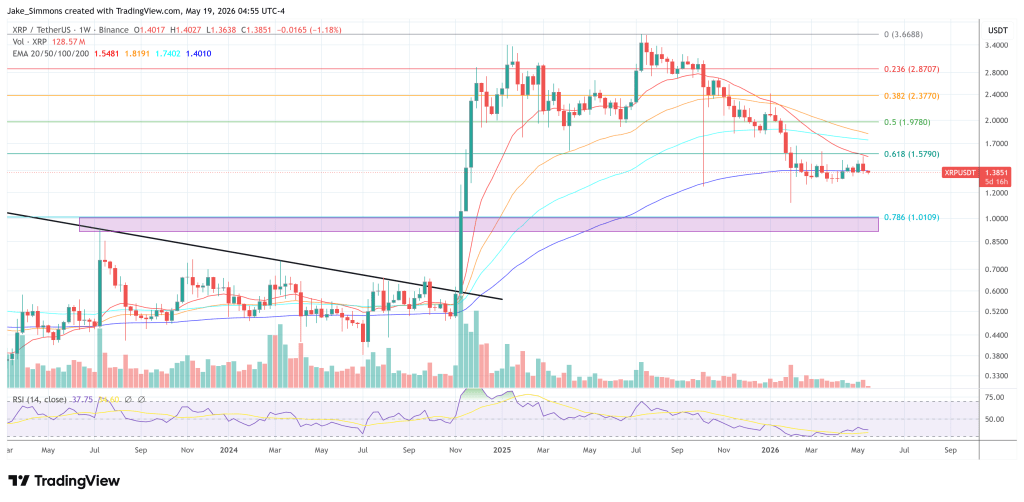
XRP bulls must break the 0.618 Fib, 1-week chart | Source: XRPUSDT on TradingView.com

Preguntas relacionadas

QWhat is the main debate in the XRP Ledger community regarding the v3.1.3 upgrade?

AThe debate is over whether the approaching v3.1.3 upgrade constitutes a hard fork that could split the network, or if it is better understood as a standard amendment blocking process, which is a security feature to protect data accuracy.

QWhat happens to nodes that fail to update to rippled version 3.1.3 before the fix amendment activates?

ANodes that have not been updated to version 3.1.3 will be unable to communicate with the network. They cannot determine ledger validity, submit or process transactions, participate in consensus, or vote on future amendments.

QWhat is the purpose of the fixCleanup3_1_3 amendment included in the rippled 3.1.3 release?

AThe fixCleanup3_1_3 amendment is a package of fixes for NFTs, Permissioned Domains, Vaults, and the Lending Protocol on the XRP Ledger.

QAccording to critics, why was the situation framed as a 'hard fork'?

ACritics framed it as a 'hard fork' because, based on early upgrade figures, a majority (60%) of network nodes were on a path to being cut off, which they argued could create a governance challenge about which chain should be considered the mainnet.

QHow do defenders of the process, like Daniel Keller, view the potential cutoff of outdated nodes?

ADefenders like Daniel Keller view the cutoff as necessary maintenance discipline and 'network hygiene,' arguing that decentralization does not mean carrying 'dead weight.' Running a node is a responsibility, and outdated infrastructure that cannot be maintained should be filtered out.

Lecturas Relacionadas

VanEck's Bitcoin Forecasts: They Predicted the Month When Growth Could Begin

VanEck's latest analysis indicates Bitcoin's market capitulation may be in its advanced stages, with 8 of its 12 tracked capitulation indicators currently active. The report notes Bitcoin traded within a very narrow range recently, with realized volatility falling to unusually low levels. While the price decline since the October 2025 peak has lasted about 10 months, historical cycles averaging 11-12.7 months suggest a potential bottom could form between September and November 2026. Key developments include a recent net inflow of approximately $663 million into U.S. spot Bitcoin ETFs, a sharp reversal from the prior month's significant outflows. However, spot trading volumes remain low, falling to levels seen during the 2023 bear market. On derivatives markets, there's a notable defensive shift, with put option premiums surging and funding rates remaining below long-term averages. Forced liquidations have also slowed significantly. A notable change is the movement of approximately 356,000 BTC that had been dormant for over a year, reducing the long-term holder supply share to below 60% for the first time in months. VanEck cautions that while intense capitulation signals historically haven't led to significant short-term outperformance (3-6 months), buying during such periods has yielded better returns over a one-year horizon. The firm emphasizes considering a potential bottoming range rather than predicting a single date.

cryptonews.ruHace 44 min(s)

VanEck's Bitcoin Forecasts: They Predicted the Month When Growth Could Begin

cryptonews.ruHace 44 min(s)

Michael Saylor, Founder of MicroStrategy, and CEO Phong Le Have Made Some Interesting Announcements! They Publicly Disclosed Their Bitcoin Price Forecast

During a Q&A session moderated by Natalie Brunell, Michael Saylor, founder of MicroStrategy, and CEO Phong Le discussed the company's strategy regarding its balance sheet, stock dynamics, and Bitcoin's role in the global financial ecosystem. Saylor described Bitcoin as the fundamental "capital asset" of the digital world, stating the company is building its future growth plans directly on this foundation. He argued that Bitcoin is not a traditional payment method or everyday currency, but digital capital, and that attracting capital from traditional finance is key to Bitcoin's growth. The company's digital credit instruments are designed to facilitate this capital inflow. CEO Phong Le addressed investor concerns about stock dilution and price volatility, asserting that capital raises and new instruments create shareholder value if they increase the amount of Bitcoin per share. He noted that a 50% drop in Bitcoin naturally leads to stock price fluctuations of up to 75%, emphasizing that MicroStrategy employs a long-term model of debt and equity financing, not short-term Bitcoin trading. The company also outlined its treasury management approach, stating it may dynamically buy BTC, repurchase credit instruments, or accumulate dollar reserves based on market conditions. Saylor reiterated his belief that Bitcoin could eventually reach $1 to $10 million as the company accumulates a larger share of its supply. He dismissed the idea of paying Bitcoin dividends as financially illogical, advocating instead for borrowing in low-cost, inflation-resistant fiat currencies (like dollars or yen) to invest in Bitcoin, which he views as the strongest appreciating asset. *This is not investment advice.

cryptonews.ruHace 1 hora(s)

Michael Saylor, Founder of MicroStrategy, and CEO Phong Le Have Made Some Interesting Announcements! They Publicly Disclosed Their Bitcoin Price Forecast

cryptonews.ruHace 1 hora(s)

Trading

Spot
活动图片