XRP Ledger Gets AI Agent Payments Through Virtuals And t54

bitcoinistPublicado a 2026-03-21Actualizado a 2026-03-21

Resumen

Virtuals Protocol and t54 have integrated "agent commerce" into the XRP Ledger, enabling AI agents to autonomously transact using XRP and RLUSD. The system combines Virtuals' Agent Commerce Protocol (ACP) for commercial workflows—including escrowed jobs, evaluator-based verification, and programmable settlement—with t54's x402 facilitator, which handles payment verification and settlement without traditional API keys or custodial wallets. This infrastructure allows AI agents to programmatically pay for services via standard web requests, leveraging the HTTP 402 payment standard. The collaboration, supported by RippleX, aims to create a native financial environment for autonomous agents, addressing needs like verifiable identity and real-time risk assessment.

Virtuals Protocol and t54 have announced that they are bringing “agent commerce” to the XRP Ledger, a move that would let AI agents transact natively using escrowed jobs, evaluator-based verification and programmable settlement.

The announcement was delivered through coordinated posts from Virtuals, t54 and RippleX rather than a visible standalone press release. Virtuals wrote via X:

“Virtuals is powering agent commerce on XRPL. $95B+ in cumulative transaction volume. 75+ regulatory licenses across global markets. The ledger built from day one for payments is now extending into agent commerce. Together with t54, Virtuals is bringing the commerce infrastructure for agents to transact natively on the XRPL.”

While RippleX only commented: “Agent Commerce is Coming,” t54 added: “Agent commerce is coming to the XRPL. With Virtuals, agents can transact autonomously: escrowed jobs, verification through evaluators, and programmable settlement. Using t54’s x402 facilitator, agents can already natively pay in XRP and RLUSD.”

AI Agents Can Now Pay In XRP And RLUSD

Under the hood, the architecture appears to split cleanly across two layers. Virtuals brings the commerce logic through its Agent Commerce Protocol, or ACP. t54 brings the payment rail through its x402 facilitator, which its documentation describes as infrastructure that “verifies and settles presigned payment transactions” so an API can charge per request “without API keys, custodial wallets, or custom payment glue.” In the same documentation set, t54 shows support for XRP payments and IOU-style assets, including RLUSD.

That matters because x402 is not just a product name inside this announcement. Coinbase describes x402 as an open payment protocol built around the dormant HTTP 402 “Payment Required” status code, designed to let APIs, websites and autonomous agents pay programmatically for access over standard web requests.

In practice, this means an agent can hit a paid endpoint, receive payment requirements, sign a transaction, and have the facilitator submit and settle it on-ledger without the old account-and-session model that most API monetization still relies on.

Virtuals’ role is to give those payments a commercial workflow instead of a raw transfer. In its whitepaper, the protocol describes ACP as a framework for “secure, transparent, and verifiable commerce between autonomous AI agents.”

The mechanics line up closely with RippleX’s summary on X: buyer and provider agents can create jobs, lock payment into smart-contract escrow, route approval through either the buyer or an optional evaluator, and release funds only after successful evaluation.

t54 has been making a broader institutional case for this market since its February seed round, which included strategic participation from Ripple and Virtuals Ventures. At the time, founder Chandler Fang said existing finance rails were built around human actors and now need “agent-native financial primitives” such as verifiable identity, real-time risk assessment and programmable accountability.

At press time, XRP traded at $1.44.
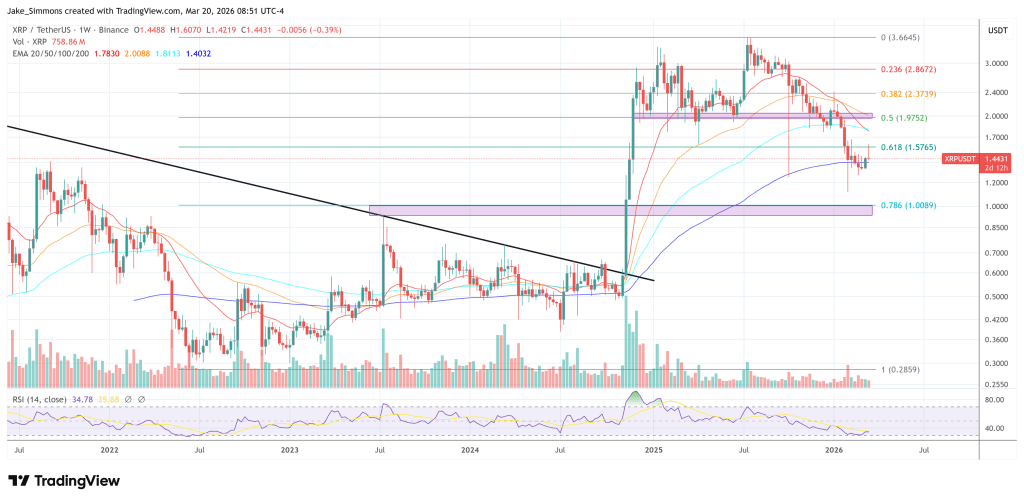
XRP must rise above the 0.618 Fib, 1-week chart | Source: XRPUSDT on TradingView.com

Preguntas relacionadas

QWhat is the main announcement made by Virtuals Protocol and t54 regarding the XRP Ledger?

AVirtuals Protocol and t54 are bringing 'agent commerce' to the XRP Ledger, enabling AI agents to transact natively using escrowed jobs, evaluator-based verification, and programmable settlement.

QWhich two key technologies are involved in this new agent commerce infrastructure on XRPL?

AVirtuals provides the commerce logic through its Agent Commerce Protocol (ACP), and t54 provides the payment rail through its x402 facilitator.

QWhat cryptocurrencies can AI agents use to pay natively via the t54 x402 facilitator?

AAI agents can natively pay in XRP and RLUSD using the t54 x402 facilitator.

QWhat is the purpose of the x402 payment protocol as described by Coinbase?

ACoinbase describes x402 as an open payment protocol built around the HTTP 402 'Payment Required' status code, designed to allow APIs, websites, and autonomous agents to pay programmatically for access over standard web requests without traditional account-and-session models.

QWhat was Ripple's involvement in t54's February seed round?

ARipple, along with Virtuals Ventures, participated strategically in t54's seed round in February.

Lecturas Relacionadas

a16z: AI's 'Amnesia', Can Continuous Learning Cure It?

The article "a16z: AI's 'Amnesia' – Can Continual Learning Cure It?" explores the limitations of current large language models (LLMs), which, like the protagonist in the film *Memento*, are trapped in a perpetual present—unable to form new memories after training. While methods like in-context learning (ICL), retrieval-augmented generation (RAG), and external scaffolding (e.g., chat history, prompts) provide temporary solutions, they fail to enable true internalization of new knowledge. The authors argue that compression—the core of learning during training—is halted at deployment, preventing models from generalizing, discovering novel solutions (e.g., mathematical proofs), or handling adversarial scenarios. The piece introduces *continual learning* as a critical research direction to address this, categorizing approaches into three paths: 1. **Context**: Scaling external memory via longer context windows, multi-agent systems, and smarter retrieval. 2. **Modules**: Using pluggable adapters or external memory layers for specialization without full retraining. 3. **Weights**: Enabling parameter updates through sparse training, test-time training, meta-learning, distillation, and reinforcement learning from feedback. Challenges include catastrophic forgetting, safety risks, and auditability, but overcoming these could unlock models that learn iteratively from experience. The conclusion emphasizes that while context-based methods are effective, true breakthroughs require models to compress new information into weights post-deployment, moving from mere retrieval to genuine learning.

marsbitHace 2 hora(s)

a16z: AI's 'Amnesia', Can Continuous Learning Cure It?

marsbitHace 2 hora(s)

Can a Hair Dryer Earn $34,000? Deciphering the Reflexivity Paradox in Prediction Markets

An individual manipulated a weather sensor at Paris Charles de Gaulle Airport with a portable heat source, causing a Polymarket weather market to settle at 22°C and earning $34,000. This incident highlights a fundamental issue in prediction markets: when a market aims to reflect reality, it also incentivizes participants to influence that reality. Prediction markets operate on two layers: platform rules (what outcome counts as a win) and data sources (what actually happened). While most focus on rules, the real vulnerability lies in the data source. If reality is recorded through a specific source, influencing that source directly affects market settlement. The article categorizes markets by their vulnerability: 1. **Single-point physical data sources** (e.g., weather stations): Easily manipulated through physical interference. 2. **Insider information markets** (e.g., MrBeast video details): Insiders like team members use non-public information to trade. Kalshi fined a剪辑师 $20,000 for insider trading. 3. **Actor-manipulated markets** (e.g., Andrew Tate’s tweet counts): The subject of the market can control the outcome. Evidence suggests Tate’sociated accounts coordinated to profit. 4. **Individual-action markets** (e.g., WNBA disruptions): A single person can execute an event to profit from their pre-placed bets. Kalshi and Polymarket handle these issues differently. Kalshi enforces strict KYC, publicly penalizes insider trading, and reports to regulators. Polymarket, with its anonymous wallet-based system, has historically been more permissive, arguing that insider information improves market accuracy. However, it cooperated with authorities in the "Van Dyke case," where a user traded on classified government information. The core paradox is reflexivity: prediction markets are designed to discover truth, but their financial incentives can distort reality. The more valuable a prediction becomes, the more likely participants are to influence the event itself. The market ceases to be a mirror of reality and instead shapes it.

marsbitHace 3 hora(s)

Can a Hair Dryer Earn $34,000? Deciphering the Reflexivity Paradox in Prediction Markets

marsbitHace 3 hora(s)

Trading

Spot
Futuros
活动图片