XRP Ledger DEX Metrics Flash Strong Growth As Activity Touches New Key Levels

bitcoinistPublicado a 2026-01-31Actualizado a 2026-01-31

Resumen

The XRP Ledger's decentralized exchange (DEX) activity has surged to a 13-month high, with its 14-day moving average of transactions reaching approximately 1.014 million, breaking previous records. This growth reflects sustained user engagement and increased liquidity, signaling deeper adoption beyond speculative spikes. The milestone coincides with the rollout of the new Lending Protocol (XLS-66), which introduces institutional-grade credit capabilities to the network, including fixed-term, fixed-rate, and uncollateralized loans held in risk-isolated vaults. The protocol has already gained institutional support, with companies like Evernorth backing it to transition a $100 billion market into a yield-bearing ecosystem, further establishing the XRP Ledger as a growing hub for decentralized finance.

Even years after its inception, the XRP Ledger, one of the leading networks in the crypto space, continues to attract robust adoption and real-world usage. With thousands of transactions being conducted on the leading network’s DEX on a daily basis, it has now reached a historical level that marks its growing role in decentralized trading.

Decentralized Trading On XRP Ledger Accelerates

XRP is experiencing heightened interest not just in buying activity from traders; the XRP Ledger has been seeing significant usage over the past few weeks. While adoption has increased toward the network, the Ledger’s Decentralized Exchange (DEX) activity is breaking past prior highs.

Xaif Crypto, a market expert and investor on the X platform, reported that the Ledger DEX activity has surged to new levels. Specifically, data shows that the activity recently reached a 13-month high, signaling a sharp uptick in on-chain trading across the network.

As more liquidity and transactions move over XRPL’s native DEX infrastructure, the increase is indicative of increasing user involvement. Sustained growth in DEX activity frequently indicates deeper adoption and expanding use cases, in contrast to brief spikes caused solely by speculation.

According to the chart shared by the expert, the number of transactions on the 14-day MA rose to approximately 1.014 million, breaking the ceiling that held throughout all of 2025. With this level of DEX transactions, the XRP Ledger is becoming a more active center for decentralized trade within the larger cryptocurrency ecosystem.
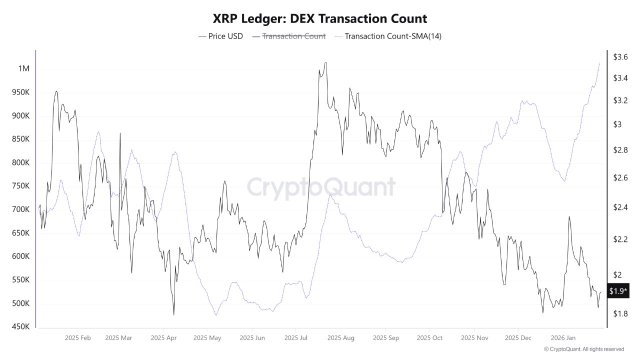
Source: Chart from Xaif Crypto on X

Xaif Crypto stated that this massive transaction count is not just a mere spike; it signals sustained momentum for the Ledger. Currently, the network is witnessing a fresh wave of liquidity and real user engagement. As a result, the expert declares that the Ledger is heating up in 2026.

This milestone comes as the XRP Ledger rolls out a new Lending Protocol (XLS-66), which is attracting institutional-grade credit to the network. With the new Lending Protocol, the Ledger is now evolving into a full financial layer with Rippled 3.1.0.

The protocol includes the ability to create loans on the Ledger, with loan brokers being able to generate fixed-term and fixed-rate, uncollateralized loans. These loans are predictable for professional use.

In addition, these loans are held in a Single Asset Vault, allowing risk-isolated liquidity. Another feature is the off-chain underwriting for uncollateralized options. It boasts native efficiency, which offers low-cost lending without a middleman or intermediaries. In the meantime, Decentralized Finance (DeFi) on the Ledger has just undergone a boost.

The Lending Protocol Gains Institutional Support

Following its historical launch a few days ago, the new XRP Lending Protocol is now experiencing significant support from institutional-level investors. One of the earliest companies to interact with the new protocol is Evernorth, a leading public treasury company.

According to BankXRP, the company is backing the native lending protocol to help transition a $100 billion market cap into a productive, yield-bearing ecosystem. These kinds of moves are an indication that the future of institutional DeFi is becoming native-driven.

XRP trading at $1.75 on the 1D chart | Source: XRPUSDT on Tradingview.com

Preguntas relacionadas

QWhat key milestone did the XRP Ledger DEX recently achieve according to the article?

AThe XRP Ledger DEX activity recently reached a 13-month high, with the number of transactions on the 14-day moving average rising to approximately 1.014 million, breaking the ceiling that held throughout all of 2025.

QWho reported the surge in XRP Ledger DEX activity and on which platform?

AThe surge was reported by Xaif Crypto, a market expert and investor, on the X platform.

QWhat major new protocol has the XRP Ledger recently rolled out that is attracting institutional interest?

AThe XRP Ledger has rolled out a new Lending Protocol (XLS-66), which is attracting institutional-grade credit to the network.

QWhat is one of the key features of the new XRP Lending Protocol mentioned in the article?

AOne key feature is the ability to create fixed-term and fixed-rate, uncollateralized loans that are held in a Single Asset Vault, allowing for risk-isolated liquidity.

QWhich company was mentioned as one of the earliest institutional supporters of the new XRP Lending Protocol?

AEvernorth, a leading public treasury company, was one of the earliest companies to interact with and back the new XRP Lending Protocol.

Lecturas Relacionadas

Macroeconomic Origins of the African Payments Market Structure

Africa’s payment landscape exhibits the world’s highest mobile money penetration and fastest cryptocurrency adoption. This is not a market anomaly but a macroeconomic inevitability driven by deep structural factors: a vast, young population, heavy reliance on commodity exports and remittances generating massive cross‑border payment needs, and a chronically underdeveloped formal banking system plagued by de‑risking, high inflation, and currency instability. This vacuum has allowed mobile money (e.g., M‑Pesa) to become the primary payment channel domestically, while cryptocurrencies—particularly stablecoins—serve as a store of value against local‑currency depreciation and a lower‑cost cross‑border medium. The key divide is the Sahara: North Africa integrates with the MENA oil‑centric financial system, while Sub‑Saharan Africa, facing acute dollar shortages and fragmented currencies, is the epicenter of this fintech surge. Structural reliance on dollars, driven by trade deficits and weak local currency credibility, creates persistent dollar scarcity, which crypto and mobile payments effectively address. Efforts like the Pan‑African Payment and Settlement System (PAPSS) aim at de‑dollarization, but these alternatives will remain essential as long as underlying economic constraints—commodity dependence, limited industrialization, and financial exclusion—persist.

marsbitHace 4 min(s)

Macroeconomic Origins of the African Payments Market Structure

marsbitHace 4 min(s)

AAOI Defies Trend with Over 10% Surge, 'New Stock God' Serenity Predicts Potential to Double Again

On June 4th, despite a significant sell-off in the broader AI and semiconductor sector triggered by Broadcom's disappointing guidance, Applied Optoelectronics (AAOI) surged over 11%, showcasing a sharp divergence in market sentiment. Broadcom's warning about potential supply chain diversification by key customer Google and a weaker-than-expected outlook punctured the high-flying AI valuation narrative. This led to heavy selling in names like Broadcom (-12.6%) and Micron (-7%), with funds rotating into traditional industrial stocks. AAOI defied this trend. The stock has experienced high volatility recently, driven by bullish analyst coverage, notably from Rosenblatt which raised its price target to $220. Key catalysts include initial 800G optical module revenue from Amazon, potential certification from Oracle, and strong demand across its product portfolio. The company has reported cumulative orders for 800G/1.6T modules exceeding $324 million and is aggressively expanding manufacturing capacity in Texas, targeting an annualized run-rate of $1.4 billion for its module business by Q3 2027. However, AAOI's fundamentals present a mixed picture. Its Q1 2026 results missed expectations, showing a GAAP net loss, and Q2 guidance points to merely breakeven adjusted EPS. Risks include a delayed 800G production ramp to the second half of the year and high dependence on a few key cloud customers. Recent stock sales by company executives near price highs also noted. The article suggests AAOI's rally reflects a market beginning to differentiate within the AI ecosystem. While Broadcom's issues prompted a reassessment of custom ASIC and customer concentration risks, funds flowing into AAOI indicate a belief that the "physical bottleneck" narrative for optical connectivity—where supply remains tight—remains intact and is somewhat decoupled from the current sector weakness. The sustainability of AAOI's premium valuation now hinges on the successful execution of its production plans and upcoming quarterly results.

marsbitHace 11 min(s)

AAOI Defies Trend with Over 10% Surge, 'New Stock God' Serenity Predicts Potential to Double Again

marsbitHace 11 min(s)

Worried about AI's Self-Evolution, Anthropic Intends to Stop Training?

In early 2026, Anthropic signaled a significant shift in its public narrative regarding AI development timelines and safety. In June, its Anthropic Institute published a detailed article, "When AI builds itself," presenting internal data suggesting accelerating AI self-improvement. Key figures included over 80% of merged code being written by Claude and a 52x speedup in certain optimization tasks. The article outlined three future scenarios, with the most speculative being full recursive self-improvement (RSI), where AI autonomously builds better successors. Anthropic stated RSI is "possible" and may arrive faster than most institutions are prepared for. This narrative pivot followed a series of strategic moves. In January, CEO Dario Amodei wrote about a powerful self-improvement feedback loop. In February, Anthropic revised its Responsible Scaling Policy, removing a core commitment to pause training if capabilities outstripped safety controls, citing the risk of falling behind competitors. This change coincided with reported pressure from the US Department of Defense. By May, Anthropic's valuation had soared to $965 billion. Anthropic's stance was mirrored by other industry leaders. DeepMind CEO Demis Hassabis adjusted his AGI timeline to "by 2029" and admitted to using provocative language like "foothills of the singularity" to create urgency. OpenAI also released a model claiming a key role in its own creation process. The article's carefully calibrated tone—presenting dramatic data alongside qualifying footnotes—exemplifies a balancing act between signaling technological acceleration and managing commercial, regulatory, and safety imperatives. External experts offered contrasting interpretations of the same data, from warnings of catastrophic risk akin to Chernobyl to skepticism that current automation merely handles "grunt work," not genius. The coordinated narrative shift among top labs highlights the complex interplay between perceived technical inflection points and strategic communication aimed at investors, regulators, and the public.

marsbitHace 13 min(s)

Worried about AI's Self-Evolution, Anthropic Intends to Stop Training?

marsbitHace 13 min(s)

Trading

Spot
Futuros

Artículos destacados

Cómo comprar T

¡Bienvenido a HTX.com! Hemos hecho que comprar Threshold Network Token (T) sea simple y conveniente. Sigue nuestra guía paso a paso para iniciar tu viaje de criptos.Paso 1: crea tu cuenta HTXUtiliza tu correo electrónico o número de teléfono para registrarte y obtener una cuenta gratuita en HTX. Experimenta un proceso de registro sin complicaciones y desbloquea todas las funciones.Obtener mi cuentaPaso 2: ve a Comprar cripto y elige tu método de pagoTarjeta de crédito/débito: usa tu Visa o Mastercard para comprar Threshold Network Token (T) al instante.Saldo: utiliza fondos del saldo de tu cuenta HTX para tradear sin problemas.Terceros: hemos agregado métodos de pago populares como Google Pay y Apple Pay para mejorar la comodidad.P2P: tradear directamente con otros usuarios en HTX.Over-the-Counter (OTC): ofrecemos servicios personalizados y tipos de cambio competitivos para los traders.Paso 3: guarda tu Threshold Network Token (T)Después de comprar tu Threshold Network Token (T), guárdalo en tu cuenta HTX. Alternativamente, puedes enviarlo a otro lugar mediante transferencia blockchain o utilizarlo para tradear otras criptomonedas.Paso 4: tradear Threshold Network Token (T)Tradear fácilmente con Threshold Network Token (T) en HTX's mercado spot. Simplemente accede a tu cuenta, selecciona tu par de trading, ejecuta tus trades y monitorea en tiempo real. Ofrecemos una experiencia fácil de usar tanto para principiantes como para traders experimentados.

599 Vistas totalesPublicado en 2024.12.10Actualizado en 2026.06.02

Cómo comprar T

Discusiones

Bienvenido a la comunidad de HTX. Aquí puedes mantenerte informado sobre los últimos desarrollos de la plataforma y acceder a análisis profesionales del mercado. A continuación se presentan las opiniones de los usuarios sobre el precio de T (T).

活动图片