XRP Is No Longer Dormant: Flare Data Reveals Over 120 Billion Baht Locked in DeFi

bitcoinistPublicado a 2025-12-31Actualizado a 2025-12-31

Resumen

The article highlights a significant shift in the perception of XRP, moving away from being seen as a passive asset. Data from the Flare Network reveals that over 80% of FXRP (a 1:1 representation of XRP) is now locked in DeFi protocols, representing over $125.8 million in value. This indicates a substantial increase in user activity, deeper liquidity, and renewed positive momentum for both XRP and the XRP Ledger (XRPL). Key metrics show nearly 67.8 million FXRP tokens are utilized in DeFi, with over 5,800 active users. Transaction activity is robust, exceeding 1.2 million DeFi transactions, including over 1.12 million FXRP swaps. This engagement is described as being driven by long-term conviction rather than short-term yield chasing, as capital remains locked and user numbers grow steadily even in a weak market. The article argues that XRP's historical lack of DeFi adoption was due to a lack of infrastructure, not demand. Flare's FAssets system is unlocking this previously inaccessible utility by allowing XRP to interact with EVM-compatible DeFi applications without requiring trusted custodians. Additionally, the piece introduces "Bitcoin Hyper" as a new Layer-2 solution designed to bring Bitcoin into practical DeFi use. It aims to solve Bitcoin's limitations in speed and fees by leveraging the Solana Virtual Machine, positioning itself as a crucial bridge between Bitcoin and the growing DeFi ecosystem.

Data indicates that XRP is shedding its image as a dormant asset, with the majority of FXRP being locked in DeFi. This is a sign of increasing user activity, deeper liquidity, and a return of positive momentum for XRP and the XRP Ledger via the Flare network.

Data from the Flare Network supports the hypothesis of a stronger upward trend for XRP and XRPL.

Momentum around XRP and the XRP Ledger (XRPL) is strengthening, as on-chain data reinforces the case for continued DeFi adoption. Blockchain infrastructure provider Flare Network shared insights on social media platform X on December 29th, arguing that XRP holders are actively engaging in DeFi, citing detailed FXRP metrics that point to increased usage, higher user activity, and deeper liquidity tied to XRPL-linked assets.

XRP holders are often perceived as a passive group and not DeFi users, but FXRP data tells a different story, and it remains a compelling cryptocurrency investment.

Over 80% of FXRP is locked in DeFi, representing over $124 million in real utility deployed on Flare. More interestingly, this growth occurred during a weak market. The number of users is still increasing, capital remains locked, and adoption is growing steadily, not driven by a chase for short-term returns. Ultimately, the issue was never about demand, but about infrastructure. Flare is unlocking XRP's DeFi, the team added.
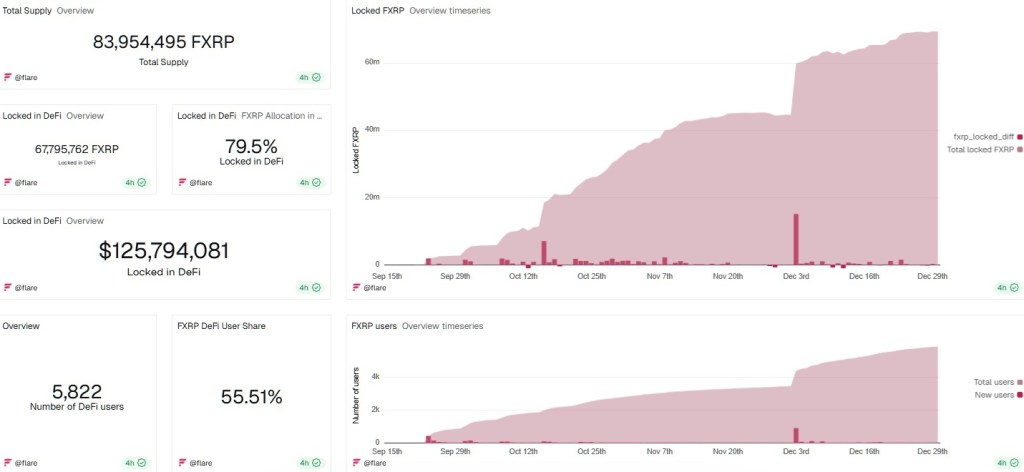
According to Flare's data as of December 30th, roughly 80% of the total FXRP supply is locked in decentralized finance, representing approximately $125.8 million in utility deployed in protocols on Flare. In a weak market environment, the network dashboard shows the total FXRP supply is about 83.95 million tokens, with nearly 67.8 million FXRP tokens tied up in DeFi applications.

User participation continues to expand, with over 5,800 DeFi users, and FXRP users account for more than 55.5% of all FXRP holders. Transaction activity also remains strong, exceeding 1.2 million DeFi transactions, including over 1.12 million FXRP swaps, alongside tens of thousands of liquidity additions and withdrawals. Flare's message frames this behavior as conviction-driven engagement, not opportunistic yield chasing, emphasizing that capital remains consistently locked while the number of users shows a steady upward trend.

Additional data further supports a positive outlook for XRP and the XRP Ledger by showing that the infrastructure has unlocked previously inaccessible utility. FXRP serves as a 1:1 representation of XRP minted through Flare's FAssets system, enabling interaction with EVM-compatible DeFi applications without the need for a custodian, while remaining economically linked to the liquidity of the XRP Ledger.

Beyond core DeFi, related products like stXRP are also gaining traction, with over $4.17 million locked in Sparkdex, over $1 million in Enosys, and additional allocations in Kinetic and other platforms. Within the Kinetic protocol alone, FXRP liquidity exceeds 37.4 million tokens, the total FXRP supply is valued at over $72 million, and lending activity is approaching $2.7 million. These figures reflect growing interoperability and capital efficiency directly tied to XRP. The data clearly reiterates that XRP's historical DeFi limitations stemmed from a lack of infrastructure, not a lack of demand. As the Flare Network expands smart contract capabilities and DeFi access, XRP and the XRP Ledger are increasingly positioned as a scalable liquidity layer capable of supporting the sustainable growth of decentralized finance.

Bitcoin Hyper: A New Shortcut for Bitcoin to a Functional DeFi World

Bitcoin Hyper is designed to unlock Bitcoin's traditional limitations regarding speed and fees. With its Layer 2 structure harnessing the power of the Solana Virtual Machine, Bitcoin can support fast, low-cost transactions and genuinely expand into dApps and DeFi, not just as a concept on paper. The HYPER token acts as the heart of the system, facilitating transactions, staking, and network governance, helping to transform Bitcoin's role from merely a store of value to a ready-to-use financial infrastructure in the decentralized world.
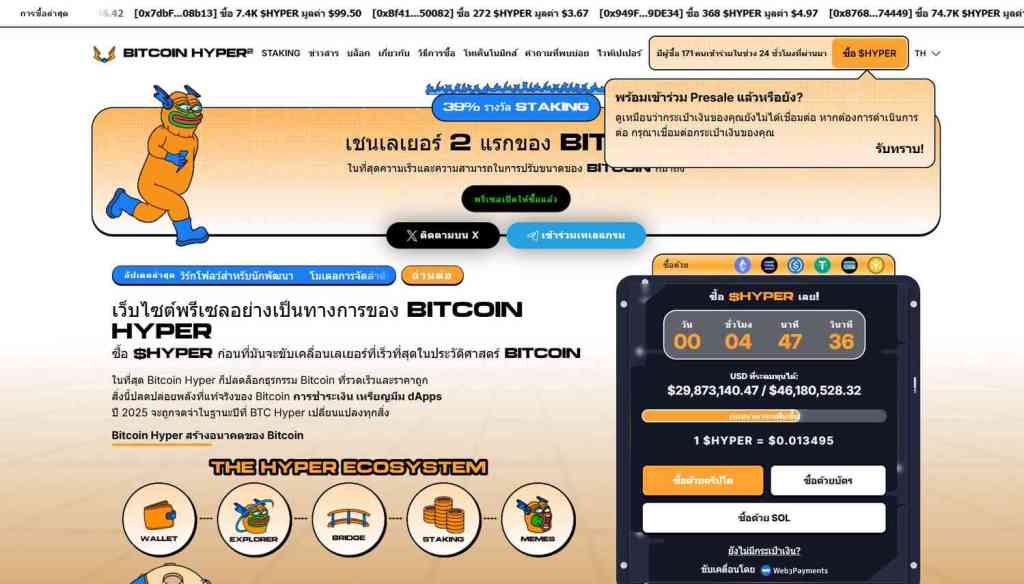
Looking at the DeFi trend where real capital is flowing in, as seen with XRP on Flare, it's clear the problem is not user demand, but the unprepared infrastructure. Bitcoin Hyper is stepping in to fill that gap, paving the way for Bitcoin's liquidity to enter DeFi more efficiently. For investors looking for projects that play into the real demand of the market, not just temporary trends, Bitcoin Hyper is one option to watch, as it is positioning itself as a crucial bridge between Bitcoin and the continuously growing world of DeFi.

Go to Bitcoin Hyper

Preguntas relacionadas

QWhat percentage of FXRP is currently locked in DeFi according to the Flare Network data?

AApproximately 80% of the total FXRP supply is locked in decentralized finance (DeFi).

QWhat is the estimated total value of FXRP that is being utilized in protocols on Flare?

AThe estimated total value of FXRP being utilized is over $124 million USD.

QHow does FXRP function on the Flare Network in relation to the native XRP asset?

AFXRP is a 1:1 representation of XRP minted through Flare's FAssets system, allowing it to interact with EVM-compatible DeFi applications without requiring a custodian, while remaining economically linked to the liquidity of the XRP Ledger.

QWhat key limitation of XRP in the DeFi space does the Flare Network claim to be solving?

AFlare Network is solving the historical limitation of XRP in DeFi, which was a lack of infrastructure (like smart contract capabilities), not a lack of user demand.

QBesides the main DeFi protocols, what other FXRP-related product is mentioned as gaining popularity, and what is its locked value on Sparkdex?

AThe product stXRP is mentioned as gaining popularity, with a locked value of over $4.17 million USD on Sparkdex.

Lecturas Relacionadas

Google and Amazon Simultaneously Invest Heavily in a Competitor: The Most Absurd Business Logic of the AI Era Is Becoming Reality

In a span of four days, Amazon announced an additional $25 billion investment, and Google pledged up to $40 billion—both direct competitors pouring over $65 billion into the same AI startup, Anthropic. Rather than a typical venture capital move, this signals the latest escalation in the cloud wars. The core of the deal is not equity but compute pre-orders: Anthropic must spend the majority of these funds on AWS and Google Cloud services and chips, effectively locking in massive future compute consumption. This reflects a shift in cloud market dynamics—enterprises now choose cloud providers based on which hosts the best AI models, not just price or stability. With OpenAI deeply tied to Microsoft, Anthropic’s Claude has become the only viable strategic asset for Google and Amazon to remain competitive. Anthropic’s annualized revenue has surged to $30 billion, and it is expanding into verticals like biotech, positioning itself as a cross-industry AI infrastructure layer. However, this funding comes with constraints: Anthropic’s independence is challenged as it balances two rival investors, its safety-first narrative faces pressure from regulatory scrutiny, and its path to IPO introduces new financial pressures. Globally, this accelerates a "tri-polar" closed-loop structure in AI infrastructure, with Microsoft-OpenAI, Google-Anthropic, and Amazon-Anthropic forming exclusive model-cloud alliances. In contrast, China’s landscape differs—investments like Alibaba and Tencent backing open-source model firm DeepSeek reflect a more decoupled approach, though closed-source models from major cloud providers still dominate. The $65 billion bet is ultimately about securing a seat at the table in an AI-defined future—where missing the model layer means losing the cloud war.

marsbitHace 3 hora(s)

Google and Amazon Simultaneously Invest Heavily in a Competitor: The Most Absurd Business Logic of the AI Era Is Becoming Reality

marsbitHace 3 hora(s)

Computing Power Constrained, Why Did DeepSeek-V4 Open Source?

DeepSeek-V4 has been released as a preview open-source model, featuring 1 million tokens of context length as a baseline capability—previously a premium feature locked behind enterprise paywalls by major overseas AI firms. The official announcement, however, openly acknowledges computational constraints, particularly limited service throughput for the high-end DeepSeek-V4-Pro version due to restricted high-end computing power. Rather than competing on pure scale, DeepSeek adopts a pragmatic approach that balances algorithmic innovation with hardware realities in China’s AI ecosystem. The V4-Pro model uses a highly sparse architecture with 1.6T total parameters but only activates 49B during inference. It performs strongly in agentic coding, knowledge-intensive tasks, and STEM reasoning, competing closely with top-tier closed models like Gemini Pro 3.1 and Claude Opus 4.6 in certain scenarios. A key strategic product is the Flash edition, with 284B total parameters but only 13B activated—making it cost-effective and accessible for mid- and low-tier hardware, including domestic AI chips from Huawei (Ascend), Cambricon, and Hygon. This design supports broader adoption across developers and SMEs while stimulating China's domestic semiconductor ecosystem. Despite facing talent outflow and intense competition in user traffic—with rivals like Doubao and Qianwen leading in monthly active users—DeepSeek has maintained technical momentum. The release also comes amid reports of a new funding round targeting a valuation exceeding $10 billion, potentially setting a new record in China’s LLM sector. Ultimately, DeepSeek-V4 represents a shift toward open yet realistic infrastructure development in the constrained compute landscape of Chinese AI, emphasizing engineering efficiency and domestic hardware compatibility over pure model scale.

marsbitHace 4 hora(s)

Computing Power Constrained, Why Did DeepSeek-V4 Open Source?

marsbitHace 4 hora(s)

Trading

Spot
Futuros

Artículos destacados

Qué es XRP 2.0

XRP 2.0: Una Nueva Frontera en el Panorama de las Criptomonedas Introducción a XRP 2.0 En el siempre cambiante ámbito de las criptomonedas, nuevos proyectos surgen continuamente, compitiendo por atención y adopción. Una de estas iniciativas prometedoras es XRP 2.0, un nuevo proyecto de criptomoneda diseñado para aprovechar la tecnología blockchain avanzada y metodologías de encriptación robustas. Aunque el nombre establece paralelismos con el XRP de Ripple, es crucial señalar que XRP 2.0 opera de manera independiente, enfocándose en mejorar la seguridad de las transacciones, la privacidad y la escalabilidad. A medida que el panorama financiero digital abraza cada vez más soluciones descentralizadas, XRP 2.0 busca contribuir de manera significativa a web3 y a la expansión general de los proyectos de criptomonedas. ¿Qué es XRP 2.0? En esencia, XRP 2.0 es un proyecto de criptomoneda que busca crear un ecosistema de moneda digital seguro y descentralizado. Su tecnología fundamental integra principios avanzados de blockchain con técnicas de encriptación de vanguardia. El objetivo principal de XRP 2.0 es establecerse como una plataforma confiable y eficiente que permita la ejecución rápida de transacciones mientras prioriza la protección de la privacidad de sus usuarios. El proyecto se promociona como una solución a muchas limitaciones enfrentadas por las criptomonedas existentes, proponiendo un sistema que puede manejar un mayor volumen de transacciones con mejor velocidad y privacidad. Esta versatilidad posiciona a XRP 2.0 como un competidor significativo en un mercado plagado de diversas monedas digitales. ¿Quién es el Creador de XRP 2.0? La identidad del creador detrás de XRP 2.0 ha sido señalada como 'Wilbur.' Sin embargo, los detalles completos sobre Wilbur o su entidad asociada siguen siendo elusivos. La anonimidad de muchos creadores de criptomonedas no es un fenómeno poco común en la industria, a menudo diseñado para mantener un grado de privacidad y seguridad. ¿Quiénes son los Inversores de XRP 2.0? Hasta ahora, la información específica relacionada con las fundaciones o organizaciones de inversión que apoyan a XRP 2.0 no está disponible públicamente. En el sector de las criptomonedas, el respaldo de inversores respetables puede influir significativamente en la credibilidad y el éxito de un proyecto, sin embargo, la transparencia sobre los patrocinadores financieros de XRP 2.0 no se ha establecido. ¿Cómo Funciona XRP 2.0? XRP 2.0 se destaca al emplear una combinación de tecnología blockchain y algoritmos de encriptación avanzados que aseguran transacciones seguras y descentralizadas. Su estructura innovadora incluye características únicas diseñadas para fomentar el compromiso del usuario y ampliar las funcionalidades más allá de las transacciones convencionales de criptomonedas. Entre estas características, XRP 2.0 incorpora capacidades impulsadas por IA, como funcionalidades de texto a imagen y de texto a voz. Estas adiciones están diseñadas para mejorar la experiencia interactiva de los usuarios, promoviendo una mayor aplicabilidad en diversos sectores. Al unir avances tecnológicos con un diseño centrado en el usuario, XRP 2.0 busca captar la atención de una amplia gama de individuos y empresas que buscan integrar soluciones de criptomonedas en sus marcos operativos. Cronología de XRP 2.0 Entender XRP 2.0 requiere examinar los hitos que han definido su viaje hasta ahora: 23 de julio de 2023: Se presenta XRP 2.0 como un nuevo proyecto de criptomonedas, con el objetivo de revolucionar las capacidades de transacciones seguras y descentralizadas en el ámbito de blockchain. 8 de septiembre de 2023: Se lanza otro proyecto, XRP20, marcando la aparición de un token ERC-20 en la blockchain de Ethereum que no guarda relación con XRP 2.0. 13 de noviembre de 2023: El Libro Mayor de XRP experimenta una actualización significativa con el lanzamiento de la versión 2.0.0 del software del servidor rippled. Es esencial señalar que este desarrollo está desconectado del proyecto de criptomonedas XRP 2.0. Puntos Clave sobre XRP 2.0 Para destilar la esencia de XRP 2.0, surgen varios factores críticos: Características Únicas: La inclusión de características como texto a imagen y texto a voz impulsadas por IA diversifica aún más las aplicaciones potenciales de XRP 2.0. Tecnología Blockchain: El marco utiliza mecanismos avanzados de blockchain y protocolos de encriptación, asegurando un entorno seguro y descentralizado para las transacciones. Escalabilidad y Privacidad: XRP 2.0 prioriza la protección mejorada de la privacidad en los procesos de transacción y la escalabilidad necesaria para acomodar una base de usuarios creciente. No Afiliación con Ripple: Es importante destacar que, a pesar de su nombre, XRP 2.0 no tiene ninguna lealtad ni colaboración con el XRP de Ripple, diferenciando su marco operativo y objetivos dentro del ecosistema de criptomonedas. Conclusión XRP 2.0 representa una ambiciosa aventura en la esfera de las criptomonedas, buscando ofrecer una combinación de seguridad, privacidad y eficiencia en las transacciones digitales. Al integrar tecnologías sofisticadas y características amigables para el usuario, el proyecto se propone ampliar los horizontes de lo que la criptomoneda puede lograr en la economía digital de hoy. Si bien la anonimidad de su creador y la falta de inversores revelados pueden generar cuestionamientos para algunos, el enfoque de XRP 2.0 en funcionalidades avanzadas y descentralización realza su atractivo en un mercado de criptomonedas cada vez más abarrotado. A medida que el paisaje de las criptomonedas sigue evolucionando, XRP 2.0 podría emerger como un jugador crucial en la expansión de soluciones blockchain seguras y escalables.

174 Vistas totalesPublicado en 2024.04.05Actualizado en 2024.12.03

Qué es XRP 2.0

Cómo comprar XRP

¡Bienvenido a HTX.com! Hemos hecho que comprar XRP (XRP) sea simple y conveniente. Sigue nuestra guía paso a paso para iniciar tu viaje de criptos.Paso 1: crea tu cuenta HTXUtiliza tu correo electrónico o número de teléfono para registrarte y obtener una cuenta gratuita en HTX. Experimenta un proceso de registro sin complicaciones y desbloquea todas las funciones.Obtener mi cuentaPaso 2: ve a Comprar cripto y elige tu método de pagoTarjeta de crédito/débito: usa tu Visa o Mastercard para comprar XRP (XRP) al instante.Saldo: utiliza fondos del saldo de tu cuenta HTX para tradear sin problemas.Terceros: hemos agregado métodos de pago populares como Google Pay y Apple Pay para mejorar la comodidad.P2P: tradear directamente con otros usuarios en HTX.Over-the-Counter (OTC): ofrecemos servicios personalizados y tipos de cambio competitivos para los traders.Paso 3: guarda tu XRP (XRP)Después de comprar tu XRP (XRP), guárdalo en tu cuenta HTX. Alternativamente, puedes enviarlo a otro lugar mediante transferencia blockchain o utilizarlo para tradear otras criptomonedas.Paso 4: tradear XRP (XRP)Tradear fácilmente con XRP (XRP) en HTX's mercado spot. Simplemente accede a tu cuenta, selecciona tu par de trading, ejecuta tus trades y monitorea en tiempo real. Ofrecemos una experiencia fácil de usar tanto para principiantes como para traders experimentados.

1.3k Vistas totalesPublicado en 2024.12.10Actualizado en 2025.03.21

Cómo comprar XRP

Discusiones

Bienvenido a la comunidad de HTX. Aquí puedes mantenerte informado sobre los últimos desarrollos de la plataforma y acceder a análisis profesionales del mercado. A continuación se presentan las opiniones de los usuarios sobre el precio de XRP (XRP).

活动图片