XRP Exchange Balances Just Set A Brand-New Record Since Its Launch

bitcoinistPublicado a 2025-12-11Actualizado a 2025-12-11

Resumen

Recent data from Glassnode reveals that XRP exchange balances have hit a record low since the cryptocurrency's launch in 2012, dropping sharply from around 3.95 billion XRP in November 2025 to 2.6 billion XRP by December—a 45% decrease in under 60 days. This decline suggests investors are withdrawing tokens from exchanges, potentially reducing sell-side liquidity. Despite the drop in supply, XRP’s price has remained weak, trading around $2.00 with significant monthly losses. Additionally, on-chain activity has cooled, with daily fees plunging 89% since February, reaching their lowest level since December 2020. The divergence between exchange balances and price action highlights unusual market behavior amid ongoing volatility.

New reports reveal that XRP exchange balances have experienced an uncharacteristic decline in recent weeks, recording a brand new low since the cryptocurrency’s launch in June 2012. While XRP’s price action has posted notable losses this year, the decline in exchange-held tokens appears to be much greater.

XRP Supply On Exchanges Falls To Historic Lows

Crypto market expert Chad Steingraber drew attention this week to fresh data from Glassnode, highlighting an unusual divergence in XRP’s market behavior. The analytics firm shared a chart tracking the amount of XRP held on crypto exchanges alongside the asset’s market price.

According to Steingraber, the chart’s readings show that exchange balances have fallen well below the XRP’s price structure for the first time since the cryptocurrency’s inception. Glassnode highlighted XRP’s exchange supply with a green line on the chart and its price with a black line. At the start of the year, the supply on exchanges was around 3.8-4 billion XRP. However, through the middle, reserves gradually trended downward but mostly stayed within the 3.2-3.6 billion range.
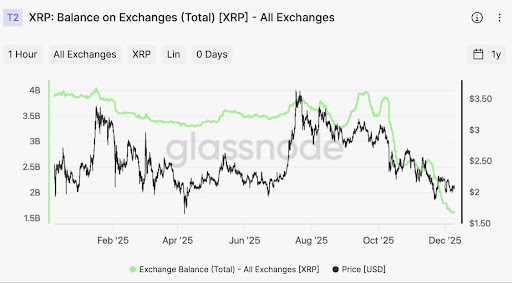
Source: Chart from Chad Steingraber on X

Notably, a Glassnode chart shared by crypto analyst ChartNerd reveals that XRP exchange balances dropped sharply from around 3.95 billion XRP to 2.6 billion XRP from November to December 2025. About 1.35 billion XRP was removed from public order books recently, representing a staggering 45% decrease in under 60 days.

Usually, exchange supply and price move together without significant divergence because the former tends to influence sell-side liquidity, which, in turn, can affect market movements. When more XRP is held on these crypto platforms, traders have a larger pool of tokens to sell, which can increase market pressure.

Conversely, when reserves shrink, it often signals that investors are withdrawing their assets, either for long-term storage or profit-taking after recent price moves. While the vast gap between XRP’s exchange balances and its price action raises concerns, whales have reportedly been selling off their holdings amid ongoing market volatility and as prices struggle to stage a meaningful rebound.

Glassnode Reports Massive Collapse In Daily XRP Fees

In addition to the collapse in XRP exchange balances, Glassnode’s data shows a steep drop in the cryptocurrency’s network activity, with average total fees falling dramatically. Since early February, the 90-day SMA of daily fees paid has decreased from about 5,900 XRP to only 650 XRP. This marks an estimated 89% drop and brings activity to its lowest point since December 2020.

The decline in daily fees suggests a cooling in on-chain demand for XRP transactions, even as the price has remained weak amid broader market uncertainty. The cryptocurrency is currently trading around $2.00, reflecting a 7.7% weekly decline and a much larger 18% crash over the past month, according to CoinMarketCap.

XRP trading at $2.01 on the 1D chart | Source: XRPUSDT on Tradingview.com

Lecturas Relacionadas

Data Theft at Will! Major Vulnerability Exposed in This Popular AI Programming Tool

A critical vulnerability in Anthropic's Claude Code AI programming tool allowed attackers to bypass its network sandbox for over five months, enabling potential data exfiltration. Independent researcher Aonan Guan discovered a second complete bypass exploiting a null-byte injection in the SOCKS5 proxy. This flaw, present since the sandbox's launch in October 2025, let processes inside the sandbox access any host, contrary to user-configured domain whitelists. The attack chain involved manipulating hostnames (e.g., `attacker.com\x00.google.com`). JavaScript's `endsWith()` check would pass `.google.com`, while the underlying C `getaddrinfo()` function would only parse `attacker.com` due to the null byte, creating a parser discrepancy. Combined with a previously disclosed prompt injection method, this could leak API keys, credentials, and internal data. Anthropic silently fixed the issue in April 2026 without a security advisory, CVE, or user notification. The researcher noted that Claude Code itself confirmed the vulnerability's severity when tested. This incident highlights broader industry issues, as similar vulnerabilities found in Google's Gemini CLI and GitHub's Copilot Agent also lacked public disclosures. The report criticizes the false sense of security created by a broken sandbox and emphasizes the need for defense-in-depth and transparency in AI tool security.

marsbitHace 2 hora(s)

Data Theft at Will! Major Vulnerability Exposed in This Popular AI Programming Tool

marsbitHace 2 hora(s)

Under the squeeze between giants Tether and Circle, how can foreign exchange stablecoins break through?

In the face of dominance by Tether (USDT) and Circle (USDC), new entrants in the stablecoin space face significant challenges competing directly, especially in the foreign exchange (FX) market. A more viable and efficient path forward is the adoption of synthetic foreign exchange (Forex) built atop existing USD stablecoin rails. The rise of stablecoin neo-banks represents the next major growth area for mass crypto adoption, with FX becoming a core component. However, replicating the vast liquidity, distribution channels, and network effects of USDT/USDC is extremely difficult for new FX stablecoin issuers. The total market cap of all FX stablecoins is a fraction (roughly 1/700th) of USD stablecoins, leading to issues like poor liquidity, peg instability, limited acceptance, and complex compliance hurdles. Instead of issuing spot FX stablecoins, the article advocates for a model inspired by traditional finance's non-deliverable forwards (NDFs). Users would continue to hold underlying USDT/USDC, while their account balances are displayed and economically settled in their preferred local currency through MtM (Mark-to-Market) NDF structures. This approach leverages the deep liquidity and infrastructure of USD stablecoins while providing synthetic forex exposure. Key advantages include strong peg stability via oracles, retained access to USD stablecoin yields and liquidity, high capital efficiency, and easy scalability to new currencies. Primary use cases for this on-chain NDF forex include: 1. Neo-banks, custodians, and wallets offering multi-currency accounts to attract international users and increase deposits. 2. Forex carry trade strategies, potentially offering more stable and scalable yields compared to crypto-native products like Ethena. 3. Global corporate payments, allowing businesses to receive payments in local currencies while hedging forex risk on-chain, similar to services offered by Stripe in traditional finance. This synthetic forex model presents a pragmatic solution to overcome the network effects of incumbents and unlock the next wave of stablecoin utility for global consumers and businesses.

marsbitHace 3 hora(s)

Under the squeeze between giants Tether and Circle, how can foreign exchange stablecoins break through?

marsbitHace 3 hora(s)

$2 Billion Write-Off: Manus Plans Hong Kong IPO for a Comeback?

The $2 billion acquisition of Chinese AI startup Manus by Meta was officially blocked by Chinese regulators in April 2026, citing national security concerns under foreign investment review rules. Despite the deal being completed months prior, with Manus integrated into Meta, the unprecedented "prohibited" ruling forced a reversal. In response, Manus's founders are now negotiating a $1 billion funding round to buy back the company from Meta at a valuation matching the original $2 billion, followed by plans to establish a Chinese joint venture and pursue a Hong Kong IPO. The article details Manus's rapid rise to $100 million in annual recurring revenue within eight months, leading to Meta's swift acquisition. However, regulators deemed its core technology and data too strategically linked to China, regardless of its Singapore headquarters. The forced unwind is complex, as Manus's team and tech are deeply embedded within Meta. Facing a reshaped competitive landscape in China's AI Agent sector with rivals like Zhipu and MiniMax, Manus sees an IPO as essential for survival and future funding. Hong Kong is presented as the ideal venue, given its recent boom in AI listings, investor appetite for high-growth tech firms, and favorable mechanisms for ongoing capital raises. The move symbolizes Manus's shift from dependence on a foreign giant to seeking independent, market-driven growth.

marsbitHace 3 hora(s)

$2 Billion Write-Off: Manus Plans Hong Kong IPO for a Comeback?

marsbitHace 3 hora(s)

Trading

Spot
Futuros

Artículos destacados

Qué es GENIUS

I. Introducción al Proyecto1. ¿Qué es Genius?Genius (GENIUS) se posiciona como el “terminal en cadena definitivo”, una plataforma de trading descentralizada enfocada en la privacidad y la velocidad. Al integrar tecnología de privacidad de primer nivel, busca construir una infraestructura de trading privado de próxima generación en redes como BNB Chain, permitiendo a los usuarios interactuar en cadena con una experiencia fluida comparable a los intercambios centralizados.2. ¿Cómo Funciona Genius?La arquitectura técnica central de Genius está estructurada de la siguiente manera:(1) Invisible en la cadena: Los usuarios no necesitan manejar manualmente aprobaciones de múltiples pasos para operaciones entre cadenas, envoltura de activos o gestión compleja de gas.(2) Trading sin firma: A través de integraciones como Turnkey, Genius permite el trading instantáneo sin confirmaciones emergentes o autorización por transacción.(3) Agregador de Agregadores: Genius está impulsado por una pila de agregación de clase mundial integrada con más de 150 DEXs, reclamando una eficiencia de cotización superior en comparación con productos competidores.(4) Gestión de Cuentas: La plataforma adopta una arquitectura no custodial y aprovecha Turnkey y Lit Protocol para la gestión de claves, permitiendo a los usuarios acceder de manera segura a sus cuentas a través de claves de acceso.3. ¿Quién Creó Genius?Según sus Términos de Servicio oficiales, Genius fue desarrollado por Shuttle Labs, Inc. Basado en la cuenta oficial de X del proyecto, Ryan Myher es uno de los contribuyentes clave que impulsa la iteración del producto, incluyendo desarrollos como el lanzamiento del protocolo Ghost, así como un mayor compromiso con la comunidad.El fundador de Binance, CZ, se ha unido oficialmente al proyecto como asesor, con el objetivo de ayudar al equipo a construir una experiencia de trading en cadena más rápida y que preserve la privacidad.Además, el proyecto ha recibido un fuerte respaldo de YZi Labs, que ha invertido en Genius y trabaja junto a la Fundación Genius, responsable de mantener el Protocolo Genius Bridge (GBP).4. Tokenómica de GeniusGENIUS es el token nativo del ecosistema Genius. Hasta ahora, el proyecto no ha publicado un documento completo de tokenómica.Según las últimas divulgaciones oficiales, Genius incorpora un mecanismo deflacionario, y el 4.6% del suministro total de tokens ya había sido quemado durante la fase de lanzamiento inicial.Sistema de Puntos Genius (GP):(1) Comercio para Ganar: La plataforma ha establecido un fondo de recompensas de 200 millones de Puntos Genius, y los usuarios ganan GP por cada comercio ejecutado a través del terminal.(2) Clasificación y Insignias: Genius cuenta con un sistema de insignias basado en progresión que va desde Inteligente hasta Dios, con niveles más altos desbloqueando beneficios y ventajas adicionales.(3) Rendimiento Nativo: Los usuarios que posean activos designados como usdGG en el panel pueden ganar rendimiento nativo directamente sin pasar por un staking complejo.(4) Incentivos por Referidos: Los referidores pueden ganar reembolsos de tarifas de más del 45% pagados en USDC, junto con GP adicionales.5. Cronograma & Hitos ClaveMarzo 2020: Se creó la cuenta oficial de X del proyecto, marcando el inicio de su fase de preparación temprana.13 de enero de 2026: Genius anunció una inversión de varios millones de dólares de YZi Labs y simultáneamente confirmó a CZ como asesor para acelerar la construcción de su infraestructura de trading privado.18 de abril de 2026: El proyecto anunció que el protocolo de privacidad Ghost se lanzaría pronto.29 de abril de 2026: El protocolo Ghost se abrió oficialmente a sus primeros 50 testers, marcando el comienzo de una nueva era para el trading privado en BNB Chain. Al mismo tiempo, el equipo confirmó que el 4.6% de los tokens han sido quemados.​II. Información del Token1) Información BásicaNombre del token: GENIUS (Genius)III. Enlaces RelacionadosSitio web:https://www.tradegenius.com/homeExploradores:https://bscscan.com/address/0x1f12b85aac097e43aa1555b2881e98a51090e9a6Redes Sociales:https://x.com/GeniusTerminalNota: La introducción del proyecto proviene de los materiales publicados o proporcionados por el equipo oficial del proyecto, que es solo para referencia y no constituye asesoramiento de inversión. HTX no se hace responsable de ninguna pérdida directa o indirecta resultante.

265 Vistas totalesPublicado en 2026.04.29Actualizado en 2026.05.12

Qué es GENIUS

Cómo comprar GENIUS

¡Bienvenido a HTX.com! Hemos hecho que comprar Genius (GENIUS) sea simple y conveniente. Sigue nuestra guía paso a paso para iniciar tu viaje de criptos.Paso 1: crea tu cuenta HTXUtiliza tu correo electrónico o número de teléfono para registrarte y obtener una cuenta gratuita en HTX. Experimenta un proceso de registro sin complicaciones y desbloquea todas las funciones.Obtener mi cuentaPaso 2: ve a Comprar cripto y elige tu método de pagoTarjeta de crédito/débito: usa tu Visa o Mastercard para comprar Genius (GENIUS) al instante.Saldo: utiliza fondos del saldo de tu cuenta HTX para tradear sin problemas.Terceros: hemos agregado métodos de pago populares como Google Pay y Apple Pay para mejorar la comodidad.P2P: tradear directamente con otros usuarios en HTX.Over-the-Counter (OTC): ofrecemos servicios personalizados y tipos de cambio competitivos para los traders.Paso 3: guarda tu Genius (GENIUS)Después de comprar tu Genius (GENIUS), guárdalo en tu cuenta HTX. Alternativamente, puedes enviarlo a otro lugar mediante transferencia blockchain o utilizarlo para tradear otras criptomonedas.Paso 4: tradear Genius (GENIUS)Tradear fácilmente con Genius (GENIUS) en HTX's mercado spot. Simplemente accede a tu cuenta, selecciona tu par de trading, ejecuta tus trades y monitorea en tiempo real. Ofrecemos una experiencia fácil de usar tanto para principiantes como para traders experimentados.

190 Vistas totalesPublicado en 2026.04.29Actualizado en 2026.05.12

Cómo comprar GENIUS

Cómo comprar MEGA

¡Bienvenido a HTX.com! Hemos hecho que comprar MegaETH (MEGA) sea simple y conveniente. Sigue nuestra guía paso a paso para iniciar tu viaje de criptos.Paso 1: crea tu cuenta HTXUtiliza tu correo electrónico o número de teléfono para registrarte y obtener una cuenta gratuita en HTX. Experimenta un proceso de registro sin complicaciones y desbloquea todas las funciones.Obtener mi cuentaPaso 2: ve a Comprar cripto y elige tu método de pagoTarjeta de crédito/débito: usa tu Visa o Mastercard para comprar MegaETH (MEGA) al instante.Saldo: utiliza fondos del saldo de tu cuenta HTX para tradear sin problemas.Terceros: hemos agregado métodos de pago populares como Google Pay y Apple Pay para mejorar la comodidad.P2P: tradear directamente con otros usuarios en HTX.Over-the-Counter (OTC): ofrecemos servicios personalizados y tipos de cambio competitivos para los traders.Paso 3: guarda tu MegaETH (MEGA)Después de comprar tu MegaETH (MEGA), guárdalo en tu cuenta HTX. Alternativamente, puedes enviarlo a otro lugar mediante transferencia blockchain o utilizarlo para tradear otras criptomonedas.Paso 4: tradear MegaETH (MEGA)Tradear fácilmente con MegaETH (MEGA) en HTX's mercado spot. Simplemente accede a tu cuenta, selecciona tu par de trading, ejecuta tus trades y monitorea en tiempo real. Ofrecemos una experiencia fácil de usar tanto para principiantes como para traders experimentados.

191 Vistas totalesPublicado en 2026.04.30Actualizado en 2026.04.30

Cómo comprar MEGA

Discusiones

Bienvenido a la comunidad de HTX. Aquí puedes mantenerte informado sobre los últimos desarrollos de la plataforma y acceder a análisis profesionales del mercado. A continuación se presentan las opiniones de los usuarios sobre el precio de A (A).

活动图片














