XRP Dev Predicts Market Cap To Hit $300 Billion Soon, What Would The Price Be?

bitcoinistPublicado a 2026-02-17Actualizado a 2026-02-17

Resumen

A pseudonymous XRP Ledger developer and analyst known as Bird has projected that XRP's market capitalization will soon surge to $300 billion. This would represent a significant increase of over 239% from its current valuation of approximately $88.38 billion. Based on XRP's circulating supply of 60.91 billion tokens, this market cap would translate to a price of around $5 per token—a 271% increase from its current trading price of $1.47. Bird's technical analysis, shared on X, includes a TradingView chart indicating a potential breakout after a prolonged period of selling pressure. The chart uses Fibonacci extension levels, with the 1.618 level aligning with the $300 billion target. While this is a highly optimistic forecast, some members of the crypto community have expressed that even this projection is too low, believing XRP could eventually reach a multi-trillion dollar valuation. The prediction reflects growing optimism despite recent market downturns.

A new technical projection is circulating in the crypto market after pseudonymous analyst and XRP Ledger (XRPL) developer Bird forecast a sharp rise in the cryptocurrency’s market capitalization. The analyst predicts that the altcoin could soon reach a valuation of $300 billion, accompanied by a significant price increase from current levels.

XRP Market Cap Forecasted To Surge To $300 Billion

In a post on X, Bird boldly declared that a “$300 billion XRP market cap is coming very soon.” The assertive forecast clearly shows his strong confidence in the token’s near-term growth potential, suggesting a major increase from current levels and reflecting growing optimism around the token despite recent price swings and a broader market downtrend.

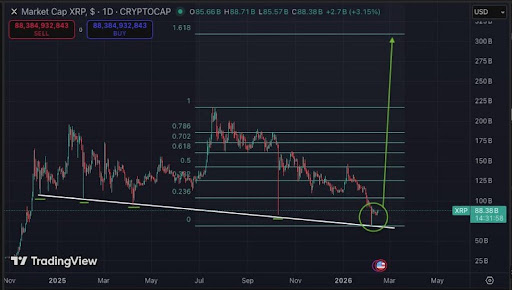
Bird’s forecasts were accompanied by a detailed TradingView chart illustrating a potential breakout scenario for XRP’s market capitalization. At the time of the analysis, its valuation stood at $88.38 billion. Technical levels on the chart highlight a prolonged downturn stretching from early 2025 into early 2026. Additionally, a descending white trendline can be seen connecting multiple lower lows, indicating sustained selling pressure over several months.
Source: Chart from Bird on X

The most recent price action shows the market cap revisiting a long-term support zone between $100 billion and $80 billion, an area circled on the chart to emphasize its significance. Fibonacci retracement and extension levels are plotted from a price swing high to a major now, marking key levels at 0.236, 0.382, 0.5, 0.618, 0.702, 0.786, 1, and 1.618.

The 1 level aligns near the $225 billion region, while the 1.618 extension points above toward Bird’s projected $300 billion market cap. The chart illustrates a large upward green arrow extending from $88.38 billion valuation at the time of the analysis toward $300 billion, representing an increase of more than $211 billion. This suggests that Bird expects its valuation to skyrocket by more than 239%.

Price At A $300 Billion Market Cap

Analysts calculate XRP’s price by dividing its market capitalization by its circulating supply. Based on its current circulating supply of approximately 60.91 billion tokens and a projected market cap of $300 billion, this would imply a price increase to approximately $5 per token. At the time of writing, the cryptocurrency is trading near $1.47, meaning a surge to this level would represent a rally of approximately 271%.

Although $5.45 is a big jump from present lows, many in the crypto community have expressed dissatisfaction with the bullish projection. Some say it’s too low, voicing out frustration and criticizing XRP’s slow price growth over the past decade.

Others believe the altcoin is still undervalued at a $300 billion market cap, with some members projecting that the cryptocurrency’s valuation could eventually reach trillions of dollars.

XRP trading at $1.47 on the 1D chart | Source: XRPUSDT on Tradingview.com

Preguntas relacionadas

QWhat is the projected market cap for XRP as predicted by the developer Bird?

ABird predicts that XRP's market cap will reach $300 billion very soon.

QHow much would the price of XRP be if it reaches a $300 billion market cap?

ABased on the current circulating supply of approximately 60.91 billion tokens, the price would be around $5 per token.

QWhat is the current market cap of XRP as mentioned in the analysis?

AAt the time of the analysis, XRP's market cap was $88.38 billion.

QWhat percentage increase does the $300 billion market cap represent from the current valuation?

AA $300 billion market cap would represent an increase of more than 239% from the $88.38 billion valuation at the time of the analysis.

QHow are some members of the crypto community reacting to the $300 billion market cap projection?

ASome community members expressed dissatisfaction, believing the projection is too low, and think XRP is still undervalued, with some projecting it could eventually reach a valuation in the trillions of dollars.

Lecturas Relacionadas

In Jinjiang, Fujian, a Storage Super Unicorn Lies Quiet

In Fujian's Jinjiang, a city known for sportswear, lies a quiet semiconductor giant: Fujian Jinhua Integrated Circuit Co. (JHICC). Once a promising domestic DRAM manufacturer alongside Yangtze Memory and ChangXin Memory Technologies (CXMT), its journey was derailed in 2018 when the U.S. placed it on an Entity List and filed criminal charges for alleged trade secret theft. This halted production for years. A turning point came in February 2024 when a U.S. federal court found JHICC not guilty. However, it had lost crucial time. While CXMT soared to become a top-valued A-share company in 2024, JHICC, with an estimated valuation of 80 billion RMB, was just restarting. Its current output is primarily customized DDR4 chips, not the advanced DDR5/HBM demanded for AI, but it still benefits from the broader memory chip upcycle. JHICC's story is tied to Chen Zhengkun, a veteran engineer who left Micron to lead the venture. Founded in 2016 with state-backed funding, JHICC partnered with Taiwan's UMC to develop DRAM technology. Rapid progress was cut short by the U.S. actions, which Micron initiated, partly due to its heavy reliance on the Chinese market. Post-sanctions, Chen's team worked to rebuild the production line with reduced reliance on U.S. technology. According to its records, JHICC achieved small-scale production and revenue growth under immense pressure. It now focuses on the stable "niche" DRAM market (e.g., TVs, routers) with a monthly capacity of ~40,000 wafers, aiming for 60,000 by 2026. It holds over 1,000 patents but remains on the Entity List. For Jinjiang, investing in JHICC was a bold industrial leap. The local government provided unwavering financial and logistical support during the crisis, helping the company survive. JHICC has become the anchor for a growing local semiconductor cluster. Though its scale lags behind domestic peers, JHICC's persistence symbolizes a hard-won foothold in a global market long dominated by Samsung, SK Hynix, and Micron. Having missed one boom, it seeks a place in the new AI-driven memory supercycle.

marsbitHace 2 hora(s)

In Jinjiang, Fujian, a Storage Super Unicorn Lies Quiet

marsbitHace 2 hora(s)

Trading

Spot
活动图片





