XRP Bull-Bear Showdown Imminent: Downtrend Shows Cracks—Is This a Last Stand or the Final Drop?

金色财经Publicado a 2025-12-11Actualizado a 2025-12-11

Resumen

XRP remains constrained by a long-term bearish trend, but recent price movements suggest that selling pressure may be weakening. While the overall market structure is still defined by a steep descending red trendline, internal momentum is shifting. Bullish rallies are becoming stronger and more decisive, while bearish declines are losing intensity and duration—a sign that buyers are accumulating at lower levels. Key resistance lies near $2.48; a decisive break above this level could trigger a strong upward move as accumulated bullish energy is released. Important support is found in the $1.88–$1.95 zone, aligned with Fibonacci retracement levels. Failure to break above resistance, however, could lead to further downside toward the $1.40 region. In summary, XRP is at a critical juncture: either it breaks out into a new uptrend or remains trapped within the larger bearish structure. The outcome depends on whether it can sustainably overcome key resistance and convert it into support.

Article Source: WeChat Official Account Mama Encryption Talk
XRP remains constrained by a long-term downtrend, but recent price movements suggest that bears may be losing control. The upward moves are becoming stronger and more forceful, while the downward momentum is slowing, indicating that buyers are quietly entering the market. Once key resistance levels are breached, bulls may be preparing to launch a powerful counterattack.

Overall Bearish Structure: The Upper Limit of the Red Trendline

According to the latest XRP chart from MakroVision Research, the overall market structure remains in a downtrend, with the steep descending red trendline clearly outlining this trend. These trendlines continue to hinder every rebound attempt, keeping the overall technical picture unchanged and biased toward bearish.

Although the internal market structure has begun to show clear signs of improvement, short-term price movements indicate that upward moves are becoming more rapid, forceful, and distinct. Meanwhile, the momentum during downward phases is gradually weakening, with longer durations and reduced kinetic energy.

This shift is typical of waning selling pressure and increased buyer activity at lower levels. The market may still be below key resistance levels, but its internal dynamics are no longer as weak as before.
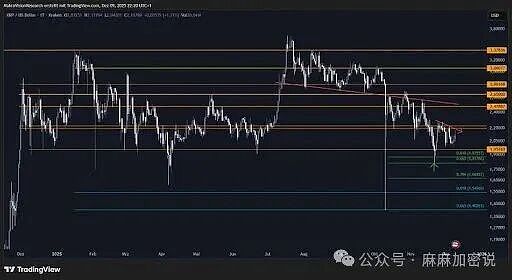
If XRP can decisively break through the red trendline near $2.48, it will unleash the upward potential that has been quietly accumulating. If it fails to break through, the token will technically remain under pressure, but the foundation for a potential reversal is clearly forming.

Key price levels to watch include the resistance zone at $2.20 to $2.22, the major breakout level at $2.48, and the support area around $1.95 to $1.88, which aligns with Fibonacci retracement levels and recent reaction points.

Dual-Track Conflict: Bearish Trend vs. Bullish Internal Structure

In summary, MakroVision Research points out that XRP is currently experiencing a dual-track movement. While the technical picture shows that the broader trend remains downward, its internal price structure is increasingly exhibiting bullish characteristics. This weakening of downward momentum makes the current chart dynamics exciting.

XRP's current fate hinges entirely on its ability to sustainably break through the aforementioned key resistance levels, particularly the $2.48 trendline. Analysts warn that if XRP successfully converts this major resistance level into support, the accumulated upward momentum could be rapidly unleashed, leading to a sharp price surge.

For now, the key question remains whether XRP can achieve a lasting trend reversal and leverage its internal strengths, or whether the overall bearish pressure will ultimately prevail, forcing prices lower toward the significant $1.4 low.
Preguntas relacionadas

QWhat is the main resistance level that XRP needs to break for a potential trend reversal according to the article?

AThe main resistance level that XRP needs to break is $2.48, which is the key trendline.

QWhat does the article suggest about the internal market structure of XRP despite the overall bearish trend?

AThe article suggests that the internal price structure is becoming increasingly bullish, with stronger rallies and weakening sell-offs, indicating that buyers are becoming more active.

QWhich price zone is mentioned as a support area for XRP in the analysis?

AThe support area mentioned is around $1.95 to $1.88, which aligns with Fibonacci retracement levels and recent reaction points.

QWhat could happen if XRP fails to break the key resistance at $2.48?

AIf XRP fails to break the $2.48 resistance, it will remain technically pressured, and the overall bearish pressure might push the price down further towards the $1.4 low.

QWhat is the 'dual-track conflict' described in the article regarding XRP's price action?

AThe 'dual-track conflict' refers to the situation where the overall market structure is still bearish (controlled by the descending red trendline), but the internal price structure is showing signs of strengthening bullish momentum.

Lecturas Relacionadas

In-Depth Report on the On-Chain Lending Market: When Off-Chain Credit Meets On-Chain Liquidation

The on-chain lending market has evolved from a peripheral DeFi niche into core financial infrastructure. As of early 2026, total value locked (TVL) in on-chain lending protocols has reached $64.3 billion, accounting for 53.54% of total DeFi TVL, making it the largest and most mature vertical within decentralized finance. Aave dominates the sector with approximately $32.9 billion in TVL, commanding nearly half of the market—a leadership position that is unlikely to be challenged in the foreseeable future. However, the path of on-chain lending forward is not without risk. Liquidation cascades, credit defaults, and cross-chain vulnerabilities remain systemic threats hanging over the industry. At the same time, a deeper structural transformation is underway: on-chain lending is shifting from a “leverage tool for crypto-native users” to a “compliant gateway for institutional capital”. The scale of RWA (Real World Asset) lending has surpassed $18.5 billion, with U.S. Treasuries and government securities increasingly serving as core collateral. Institutional capital inflows are reshaping both the user base and risk appetite of the sector. This report systematically analyzes the evolution of on-chain lending definitions, competitive dynamics, core risks, and future trends, providing a comprehensive industry outlook for investors and trade practitioners. Key findings suggest that the “one dominant player with several strong challengers” structure will persist in the short term, while fixed-rate lending, compliant collateral, and institutional credit underwriting will define the next phase of competition. For investors focused on DeFi infrastructure, three key opportunity tracks stand out, namely, the Aave ecosystem (Morpho, Spark), RWA lending protocols (Ondo, Maple) and fixed-rate innovation (Notional, Pendle).

HTX LearnHace 43 min(s)

In-Depth Report on the On-Chain Lending Market: When Off-Chain Credit Meets On-Chain Liquidation

HTX LearnHace 43 min(s)

Fu Peng's First Public Speech in 2026: What Exactly Are Crypto Assets? Why Did I Join the Crypto Asset Industry?

Fu Peng, a renowned macroeconomist and now Chief Economist at New火 Group, delivered his first public speech of 2026 at the Hong Kong Web3 Festival. He explained his perspective on crypto assets and why he joined the industry, framing it within the context of macroeconomic trends and financial evolution. Fu emphasized that crypto assets are transitioning from an early, belief-driven phase to a mature, institutionally integrated asset class. He drew parallels to the 1970s-80s, when technological advances (like computing) revolutionized traditional finance, leading to the rise of FICC (Fixed Income, Currencies, and Commodities). Similarly, current advancements in AI, data, and blockchain are reshaping finance, with crypto assets becoming part of a new "FICC + C" (C for Crypto) framework. He noted that institutional capital, including traditional hedge funds, avoided early crypto due to its speculative nature but are now engaging as regulatory clarity emerges (e.g., stablecoin laws, CFTC classifying crypto as a commodity). Fu predicted that 2025-2026 marks a turning point where crypto becomes a standardized, financially viable asset for diversified portfolios, akin to commodities or derivatives in traditional finance. Fu defined Bitcoin not as "digital gold" in a simplistic sense but as a value-preserving, financially tradable asset. He highlighted that crypto's future lies in regulated, institutional adoption, moving away from retail-dominated trading. His entry into crypto signals this maturation, where traditional finance integrates crypto into mainstream asset management.

marsbitHace 1 hora(s)

Fu Peng's First Public Speech in 2026: What Exactly Are Crypto Assets? Why Did I Join the Crypto Asset Industry?

marsbitHace 1 hora(s)

Justin Sun Sues Trump Family: What $75 Million Bought Was Only a Blacklist

Justin Sun, founder of Tron, has filed a lawsuit in federal court against World Liberty Financial (WLF), alleging he was made the "primary target of a fraudulent scheme" after investing $75 million. Sun claims the investment secured him an advisor title and WLFI tokens, which were later frozen by WLF, causing "hundreds of millions in losses." The dispute began in late 2024 when Sun's investment helped revive WLF's struggling token sale, which ultimately raised $550 million. Shortly after, the SEC dropped its lawsuit against Sun following Donald Trump's inauguration. However, relations soured when Sun refused WLF's demands for additional funding. In August 2025, WLF added a "blacklist" function to its smart contract, allowing it to unilaterally freeze tokens. Sun's holdings, worth approximately $107 million, were frozen, and he was threatened with token destruction. The lawsuit highlights WLF's structure, which directs 75% of token sale profits to the Trump family, who had earned $1 billion by December 2025. WLF's CEO is Zach Witkoff, son of U.S. Middle East envoy Steve Witkoff. The project faces scrutiny for opaque operations, including a controversial loan arrangement on the Dolomite platform, co-founded by a WLF advisor. Despite Sun's history with the SEC, the case underscores centralization risks within DeFi, as WLF controls governance and holds powers to freeze assets arbitrarily. Sun's tokens remain frozen as legal proceedings begin.

marsbitHace 2 hora(s)

Justin Sun Sues Trump Family: What $75 Million Bought Was Only a Blacklist

marsbitHace 2 hora(s)

Trading

Spot
Futuros

Artículos destacados

Cómo comprar CFG

¡Bienvenido a HTX.com! Hemos hecho que comprar Centrifuge (CFG) sea simple y conveniente. Sigue nuestra guía paso a paso para iniciar tu viaje de criptos.Paso 1: crea tu cuenta HTXUtiliza tu correo electrónico o número de teléfono para registrarte y obtener una cuenta gratuita en HTX. Experimenta un proceso de registro sin complicaciones y desbloquea todas las funciones.Obtener mi cuentaPaso 2: ve a Comprar cripto y elige tu método de pagoTarjeta de crédito/débito: usa tu Visa o Mastercard para comprar Centrifuge (CFG) al instante.Saldo: utiliza fondos del saldo de tu cuenta HTX para tradear sin problemas.Terceros: hemos agregado métodos de pago populares como Google Pay y Apple Pay para mejorar la comodidad.P2P: tradear directamente con otros usuarios en HTX.Over-the-Counter (OTC): ofrecemos servicios personalizados y tipos de cambio competitivos para los traders.Paso 3: guarda tu Centrifuge (CFG)Después de comprar tu Centrifuge (CFG), guárdalo en tu cuenta HTX. Alternativamente, puedes enviarlo a otro lugar mediante transferencia blockchain o utilizarlo para tradear otras criptomonedas.Paso 4: tradear Centrifuge (CFG)Tradear fácilmente con Centrifuge (CFG) en HTX's mercado spot. Simplemente accede a tu cuenta, selecciona tu par de trading, ejecuta tus trades y monitorea en tiempo real. Ofrecemos una experiencia fácil de usar tanto para principiantes como para traders experimentados.

257 Vistas totalesPublicado en 2026.03.19Actualizado en 2026.03.19

Cómo comprar CFG

Qué es WL

I. Introducción al ProyectoWorldLand es una L2 o cadena lateral de Ethereum, diseñada como una solución de abajo hacia arriba para mejorar el ecosistema de Ethereum.II. Información del Token1) Información BásicaNombre del token: WL (WorldLand)III. Enlaces RelacionadosSitio web:https://worldland.foundation/Exploradores:https://bscscan.com/address/0x8aaB31fbc69C92fa53f600910Cf0f215531F8239Redes Sociales:https://x.com/WorldLand_space Nota: La introducción del proyecto proviene de los materiales publicados o proporcionados por el equipo oficial del proyecto, que es solo para referencia y no constituye asesoramiento de inversión. HTX no se hace responsable de ninguna pérdida directa o indirecta resultante.

133 Vistas totalesPublicado en 2026.03.28Actualizado en 2026.03.28

Qué es WL

Cómo comprar WL

¡Bienvenido a HTX.com! Hemos hecho que comprar WorldLand (WL) sea simple y conveniente. Sigue nuestra guía paso a paso para iniciar tu viaje de criptos.Paso 1: crea tu cuenta HTXUtiliza tu correo electrónico o número de teléfono para registrarte y obtener una cuenta gratuita en HTX. Experimenta un proceso de registro sin complicaciones y desbloquea todas las funciones.Obtener mi cuentaPaso 2: ve a Comprar cripto y elige tu método de pagoTarjeta de crédito/débito: usa tu Visa o Mastercard para comprar WorldLand (WL) al instante.Saldo: utiliza fondos del saldo de tu cuenta HTX para tradear sin problemas.Terceros: hemos agregado métodos de pago populares como Google Pay y Apple Pay para mejorar la comodidad.P2P: tradear directamente con otros usuarios en HTX.Over-the-Counter (OTC): ofrecemos servicios personalizados y tipos de cambio competitivos para los traders.Paso 3: guarda tu WorldLand (WL)Después de comprar tu WorldLand (WL), guárdalo en tu cuenta HTX. Alternativamente, puedes enviarlo a otro lugar mediante transferencia blockchain o utilizarlo para tradear otras criptomonedas.Paso 4: tradear WorldLand (WL)Tradear fácilmente con WorldLand (WL) en HTX's mercado spot. Simplemente accede a tu cuenta, selecciona tu par de trading, ejecuta tus trades y monitorea en tiempo real. Ofrecemos una experiencia fácil de usar tanto para principiantes como para traders experimentados.

223 Vistas totalesPublicado en 2026.03.28Actualizado en 2026.03.28

Cómo comprar WL

Discusiones

Bienvenido a la comunidad de HTX. Aquí puedes mantenerte informado sobre los últimos desarrollos de la plataforma y acceder a análisis profesionales del mercado. A continuación se presentan las opiniones de los usuarios sobre el precio de A (A).

活动图片