XRP Builder Funding Shifts In 2026 As Ripple Backs New Model

bitcoinistPublicado a 2026-02-28Actualizado a 2026-02-28

Resumen

Ripple is shifting its funding model for the XRP Ledger (XRPL) ecosystem in 2026, moving from a centralized structure to a more distributed network involving DAOs, independent hubs, universities, and venture partners. Over $550 million has been deployed since 2017 to support nearly 200 projects. The new approach includes the FinTech Builder Program for institutional-grade financial applications, expanded accelerator partnerships, and community-led initiatives like XAO DAO. Regional expansion includes a dedicated APAC hub and university collaborations. The goal is to provide builders with diverse funding channels and reduce reliance on Ripple as the sole gatekeeper.

Ripple is reshaping how builders on the XRP Ledger get funded in 2026, arguing that the ecosystem has reached a point where support needs to flow through more than Ripple-linked programs alone. The change matters because it signals a deliberate move away from a relatively centralized funding structure toward a broader network of DAOs, independent hubs, universities and venture partners.

In its latest ecosystem update, Ripple said more than $550 million has already been deployed into XRPL initiatives since 2017, spanning non-equity grants, builder incentives, strategic partnerships and growth programs. Since 2021, those efforts have included hackathons, builder bounties, XRPL Grants and the XRPL Accelerator, with nearly 200 projects supported across areas including payments, DeFi, tokenization, AI, gaming, e-commerce and enterprise finance.

XRP Ledger Enters New Phase

The core message is that 2026 marks a structural pivot. Ripple said ecosystem funding has historically flowed through Ripple-supported channels, but that the next phase will lean on a “more distributed model” in which independent organizations, regional hubs, venture firms and community-led initiatives take on a larger role. The company framed the objective as giving builders “multiple channels” to access capital and support, rather than relying on a single gatekeeper.

At the center of that shift is a new FinTech Builder Program aimed at startups building institutional-grade financial applications on XRPL. Ripple said the program will focus on use cases including stablecoin payments, credit infrastructure, tokenization and regulated financial services, while offering more than a traditional grants track. According to the post, founders will get support “across the entire development lifecycle,” from product design through market launch, with help on XRPL integration, strategy and partnerships.

Ripple also outlined a wider support stack around that program. That includes expanded accelerator partnerships with venture firms and startup platforms, regional startup competitions, and builder awards meant to help projects after hackathons or competitions, when early traction still needs a bridge to something durable. The emphasis throughout is less on one-off experimentation and more on getting teams to production-ready financial products.

The more interesting signal, though, may be where decision-making starts to move. Ripple highlighted XAO DAO as a hybrid DAO built for XRPL that will fund developers, community builders and early-stage ideas through microgrants. It said the DAO is designed to “amplify community voice” and create feedback loops where members submit proposals, vote on priorities and help steer the ecosystem’s direction.

In parallel, XRPL Commons is positioned as an independent pillar of support, with Ripple explicitly saying the aim is to ensure that “no single organization becomes the sole gatekeeper” for ecosystem funding.

Other pieces of the 2026 map point to geographic and institutional expansion. Ripple said XRP Asia is being developed as a dedicated APAC hub with a long-term plan for localized funding and regional ecosystem growth.

UDAX, first launched with UC Berkeley in fall 2025, is set to expand this year to Fundação Getulio Vargas in São Paulo, Oxford in the summer, and Berkeley again in the fall. Ripple also pointed to growing venture participation from firms including Dragonfly, Pantera, Franklin Templeton and Tenity as another sign that XRPL is trying to mature from grant-backed experimentation into a venue for fundable, production-scale startups.

At press time, XRP traded at $1.3773.
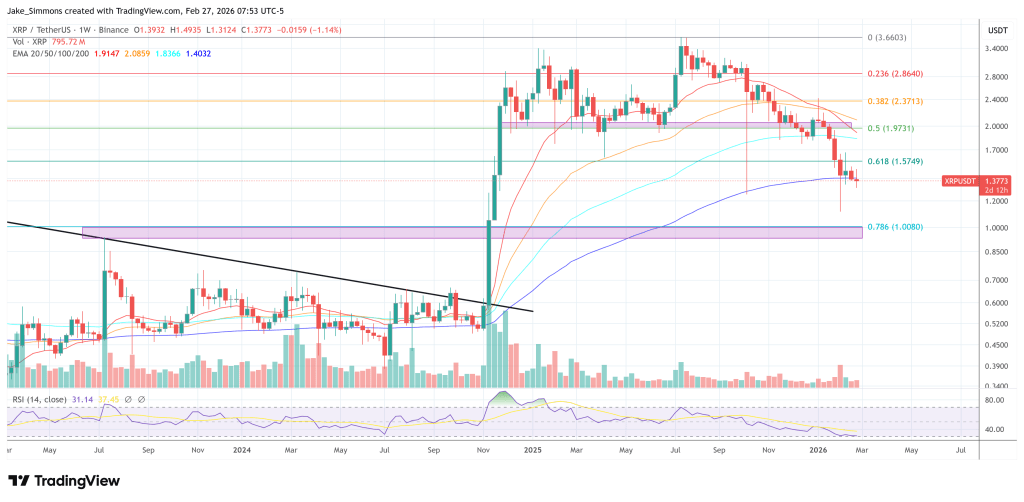
XRP falls below the 200-week EMA agan, 1-week chart | Source: XRPUSDT on TradingView.com

Criptos en tendencia

Lecturas Relacionadas

Within Strategy's Framework, STRC's Dividend Yield Remains at 12% as Share Price Stays Below Par Value

Michael Saylor, Executive Chairman of Strategy (MSTR), confirmed that the dividend rate for its STRC perpetual preferred shares will remain at 12.00% through August 2026. The rate has increased from 9% at its July 2025 launch to the current high via a "ratchet" mechanism, which permanently raises the rate by 0.5% whenever the share price falls below $95. This mechanism is intended to push the price back toward its $100 par value and support Strategy's "at-the-market" (ATM) program for issuing new shares to fund Bitcoin purchases. However, the mechanism has not worked as intended. STRC shares closed at $89.46 on July 31, remaining about 10-11% below par value despite the record-high dividend. Competition from rival Strive's higher-yielding SATA securities has pressured demand. The persistent discount has forced Strategy to suspend new STRC issuances via its ATM program, limiting this funding channel for Bitcoin acquisitions. STRC's struggles reflect Bitcoin's own volatility, as the preferred shares historically move in tandem. Analysts have warned the ratchet structure carries long-term, one-way risk. A law firm is investigating Strategy's ability to maintain dividend payments if Bitcoin's price stays low. Retail investors own roughly 83% of outstanding STRC shares, a group seen as prone to panic selling during downturns. In response, Strategy has established financial reserves, including a liquidity cushion covering about 26 months of dividend/interest obligations, and a $2 billion share buyback program alongside a Bitcoin monetization framework, though the company emphasized it is not obligated to sell any Bitcoin.

cryptonews.ruHace 19 min(s)

Within Strategy's Framework, STRC's Dividend Yield Remains at 12% as Share Price Stays Below Par Value

cryptonews.ruHace 19 min(s)

Analyst: Bitcoin's Price Will Drop to $60k in August, Then Rebound to $70k

Financial analyst Andrey Poroshin has provided a new forecast for Bitcoin's price dynamics in August. Poroshin, an analyst at the Bitbanker exchange, expects the cryptocurrency market to experience a downturn this month, with prices retesting the $60,000 level due to a lack of supportive macroeconomic catalysts. He noted that the recent US Federal Reserve decision to hold interest rates did not significantly impact the market, while inflation remains above the 2% target. Poroshin stated that Bitcoin is ending July under pressure from moderate volatility and a lack of new macroeconomic stimuli, leading to continued market caution. According to his base scenario, Bitcoin will drop to a range of $60,000 to $62,000 before recovering to $70,000. He pointed out that even $70,000 remains below the cost of mining in the US, which has prompted some miners to shift towards AI data center operations. Poroshin cited the winding down of BitMEX's operations as a potential catalyst for a price rebound, suggesting the exit of weaker players often coincides with market reversals and reduced short-term selling pressure. He believes Bitcoin is currently less susceptible to geopolitical shocks, such as the Iran-US conflict, and does not expect significant market changes in August related to the pending CLARITY Act. Looking ahead, Poroshin forecasts that September will bring more active price fluctuations driven by potential Fed rate decisions and possible discussions or approval of the CLARITY Act.

cryptonews.ruHace 19 min(s)

Analyst: Bitcoin's Price Will Drop to $60k in August, Then Rebound to $70k

cryptonews.ruHace 19 min(s)

Trading

Spot

Artículos destacados

Cómo comprar T

¡Bienvenido a HTX.com! Hemos hecho que comprar Threshold Network Token (T) sea simple y conveniente. Sigue nuestra guía paso a paso para iniciar tu viaje de criptos.Paso 1: crea tu cuenta HTXUtiliza tu correo electrónico o número de teléfono para registrarte y obtener una cuenta gratuita en HTX. Experimenta un proceso de registro sin complicaciones y desbloquea todas las funciones.Obtener mi cuentaPaso 2: ve a Comprar cripto y elige tu método de pagoTarjeta de crédito/débito: usa tu Visa o Mastercard para comprar Threshold Network Token (T) al instante.Saldo: utiliza fondos del saldo de tu cuenta HTX para tradear sin problemas.Terceros: hemos agregado métodos de pago populares como Google Pay y Apple Pay para mejorar la comodidad.P2P: tradear directamente con otros usuarios en HTX.Over-the-Counter (OTC): ofrecemos servicios personalizados y tipos de cambio competitivos para los traders.Paso 3: guarda tu Threshold Network Token (T)Después de comprar tu Threshold Network Token (T), guárdalo en tu cuenta HTX. Alternativamente, puedes enviarlo a otro lugar mediante transferencia blockchain o utilizarlo para tradear otras criptomonedas.Paso 4: tradear Threshold Network Token (T)Tradear fácilmente con Threshold Network Token (T) en HTX's mercado spot. Simplemente accede a tu cuenta, selecciona tu par de trading, ejecuta tus trades y monitorea en tiempo real. Ofrecemos una experiencia fácil de usar tanto para principiantes como para traders experimentados.

742 Vistas totalesPublicado en 2024.12.10Actualizado en 2026.06.02

Cómo comprar T

Discusiones

Bienvenido a la comunidad de HTX. Aquí puedes mantenerte informado sobre los últimos desarrollos de la plataforma y acceder a análisis profesionales del mercado. A continuación se presentan las opiniones de los usuarios sobre el precio de T (T).

活动图片













