XRP at a Critical Juncture: Stagnating Before Strong Resistance - Will It Break Through or Plummet?

金色财经Publicado a 2025-12-12Actualizado a 2025-12-12

Resumen

XRP price has initiated a fresh decline after falling below the $2.080 and $2.050 support levels. It is currently trading below $2.050 and the 100-hour Simple Moving Average, showing signs of weakness near the $2.040 resistance area. A descending trend line is forming with resistance near $2.040 on the hourly chart. Key support levels are identified at $2.00 and $1.9850. A break below $2.00 could lead to further declines toward $1.920 and possibly $1.880. On the upside, immediate resistance is near $2.040, followed by major hurdles at $2.080 and $2.150. A close above $2.080 might initiate a move toward $2.1850 and $2.220. Technical indicators show the hourly MACD is losing momentum in the bearish zone, while the RSI is above 50. The market remains at a critical juncture, with the potential for either an upward breakout or further downside movement.

Article Source: WeChat Official Account Miao Jie Trading Diary

XRP price started a new decline after breaking below $2.080. The current price action is weak, facing resistance near the $2.040 level.

  • XRP price started a new decline after breaking below the $2.050 zone.

  • The price is currently below $2.050 and the 100-hour Simple Moving Average.

  • A descending trend line is forming on the XRP/USD hourly chart with resistance near $2.040 (data source: Kraken).

  • The pair could extend its decline if it breaks below $2.00.

XRP Price Hovers Near Resistance

XRP price attempted a recovery wave above $2.150 but failed to continue higher, unlike Bitcoin and Ethereum. Subsequently, the price started a new decline, breaking below $2.080 and $2.050.

The price broke below the $2.00 support and formed a low near $1.993 before starting a recovery correction. There was a move above the 23.6% Fib retracement level of the downward move from the $2.177 high to the $1.993 low.

However, bears were active near $2.040 and $2.050. A descending trend line is also forming with resistance near $2.040 on the hourly chart of XRP/USD. The price is now below $2.050 and the 100-hour Simple Moving Average.

If there is another increase, the price might face resistance near $2.040. The first major resistance is near $2.080 or the 50% Fib retracement level of the downward move from the $2.177 high to the $1.993 low.
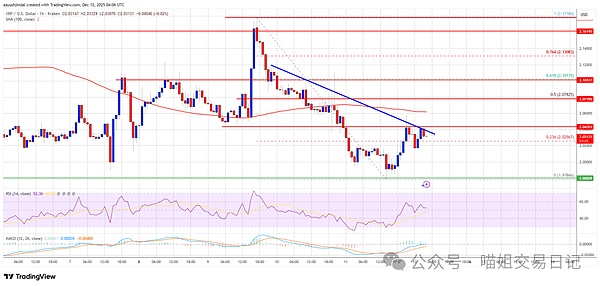
A close above $2.080 could push the price toward $2.012. The next resistance sits at $2.150. A clear move above the $2.150 resistance might send the price toward the $2.1850 resistance. Further gains could lead the price toward the $2.220 resistance. The next major resistance for the bulls could be near $2.250.

Another Decline?

If XRP fails to clear the $2.040 resistance, it could start another decline. Initial support on the downside is near $2.00. The next major support is near $1.9880.

If the price breaks below the $1.9880 level and closes below it, it could continue to move down toward $1.920. The next major support is near $1.880, below which the price might test $1.820.

Technical Indicators

Hourly MACD – The MACD for XRP/USD is now losing pace in the bearish zone.

Hourly RSI (Relative Strength Index) – The RSI for XRP/USD is now above the 50 level.

Major Support Levels – $2.00 and $1.9850.

Major Resistance Levels – $2.040 and $2.080.

Preguntas relacionadas

QWhat is the current resistance level that XRP is struggling to break above?

AXRP is currently facing resistance near the $2.040 level, where a descending trend line is forming on the hourly chart.

QWhat key support level could trigger another decline if broken?

AA break below the $2.00 support level could trigger another decline, with the next major support located near $1.9850.

QWhat was the high point from which the recent decline to $1.993 began?

AThe recent decline began from a high of $2.177 before dropping to the $1.993 low.

QWhat are the two major technical indicators mentioned and what are their current signals?

AThe hourly MACD is accelerating in the bearish zone, while the hourly RSI is currently above the 50 level.

QWhat price must XRP close above to start a potential rally towards $2.120?

AA close above the $2.080 resistance level is needed for XRP to start a potential rally towards $2.120 and higher.

Lecturas Relacionadas

When Hyperliquid Takes Away Solana's "Internet Capital Markets" Script

The article discusses how Solana's vision of becoming the "Internet Capital Markets" is being challenged, primarily by the rise of Hyperliquid. While Solana positioned itself as a high-performance blockchain for tokenizing all global assets, its native token SOL has significantly underperformed, and its core narrative faces pressure. Hyperliquid, initially a perpetual contracts platform, has evolved into a specialized Layer 1 financial network. Its focused, trading-optimized design is attracting users and capital, suggesting a vertical L1 may be better suited for a core capital market than a general-purpose chain like Solana. This external competition was compounded by an internal $200M+ exploit on Solana's key derivatives protocol, Drift, creating a strategic vacuum. In response, Solana founder Anatoly Yakovenko heavily promoted the Phoenix protocol as a decentralized, composable alternative. However, Phoenix's trading volume remains far behind leading platforms. Solana supporters also launched critiques against Hyperliquid's decentralization, citing its limited validators and closed-source code. Critics countered that Solana's own decentralization metrics have weakened, and the foundation's overt backing of Phoenix caused friction with other ecosystem builders. The piece concludes that Solana risks losing the "Internet Capital Markets" race if it cannot regain dominance in derivatives, potentially remaining a meme coin hub rather than achieving its grand ambition of hosting all global assets.

marsbitHace 1 hora(s)

When Hyperliquid Takes Away Solana's "Internet Capital Markets" Script

marsbitHace 1 hora(s)

Trump Signs Executive Order, Kraken, Coinbase and Others May Gain Access to Fed Payment Channels

President Trump has signed an executive order, "Incorporating Financial Technology Innovation into the Regulatory Framework," pressuring the Federal Reserve to reassess its rules on granting non-bank financial companies—including crypto and fintech firms—access to its payment systems, specifically master accounts that connect to the Fedwire settlement system. Currently, such accounts are primarily reserved for depository institutions. The order mandates a review to determine if broader access is permissible and to establish an application process. This move, supported by figures like Senator Cynthia Lummis, aims to reduce barriers to innovation and lower public payment costs by fostering fairer competition. It does not grant immediate access but could pave the way for companies like Kraken, Coinbase, Ripple, and Circle to reduce reliance on intermediary banks, lowering costs and speeding up settlements. A key precedent is the Kansas City Fed granting Kraken's parent company a restricted master account in March, offering limited payment services without interest or credit privileges. This model is seen as a potential template for allowing controlled access while mitigating systemic risk. Other firms like Anchorage, Paxos, and BitGo, which hold specialized banking charters, are also well-positioned to apply. The banking industry, represented by the American Bankers Association, opposes easing access, arguing any institution handling bank-like payments must meet the same stringent regulatory, consumer protection, and risk-management standards as traditional banks. Their core concerns include potential systemic risks, compliance gaps in areas like anti-money laundering, and the diversion of liquidity from the traditional banking system. The outcome of the Fed's review will be crucial in determining whether and how crypto and fintech firms can integrate more directly into the core U.S. financial infrastructure, balancing innovation with financial stability.

marsbitHace 1 hora(s)

Trump Signs Executive Order, Kraken, Coinbase and Others May Gain Access to Fed Payment Channels

marsbitHace 1 hora(s)

The First Large-Scale Strike in the AI Era Comes from the Factories That Build AI

The article describes a potential large-scale strike at Samsung Electronics, narrowly averted in May 2026 after a temporary agreement. The strike, planned by the company's union, would have been the first major labor action in the AI era targeting a core AI supply chain player. Samsung, alongside SK Hynix, produces roughly two-thirds of the world's memory chips, critical components for AI training and data centers like HBM. An 18-day strike could have disrupted global supply, affecting prices and production for tech companies and cloud providers. For South Korea, where semiconductors constitute about 35% of exports and Samsung represents a quarter of the stock market's value, such an action threatens national economic stability. The union's demands include a 7% base wage increase and, crucially, a clear, substantial profit-sharing model. They want 15% of annual operating profit as an employee bonus pool and the removal of the existing cap (about 50% of annual salary). This frustration is amplified by seeing rival SK Hynix successfully negotiate a deal granting employees 10% of operating profit as bonuses, with reports suggesting some workers could receive bonuses equivalent to hundreds of thousands of dollars. The conflict stems from deeper issues in South Korea's chaebol (conglomerate) system, where rapid national industrialization often prioritized corporate growth over labor rights. Samsung long maintained a "no union" policy until a 2020 apology from its leader. The article argues this strike highlights a fundamental tension in the AI age: as technology advances and corporate profits soar—often driven by AI—the workers who build the infrastructure are demanding a fair share and dignity, rejecting the notion that they are mere expendable components in a machine that "must not stop." The piece concludes that the true test of the AI era isn't just computational power, but whether the people who build the future can secure a stable and valued place within it.

marsbitHace 2 hora(s)

The First Large-Scale Strike in the AI Era Comes from the Factories That Build AI

marsbitHace 2 hora(s)

Ripple’s Fed Master Account Bid Gains Momentum After Trump Order

President Donald Trump has signed an executive order directing financial regulators and the Federal Reserve to review expanding fintech and crypto firms' access to core payment infrastructure. This order significantly advances the industry's push for direct Fed connectivity, a central issue for Ripple. The company has been seeking a Federal Reserve master account as part of its strategy for its RLUSD stablecoin, which would allow it to hold reserves directly with the central bank and access its payment rails. The order, titled "Integrating Financial Technology Innovation into Regulatory Frameworks," mandates a Fed review within 120 days on allowing access for entities like uninsured depository institutions and non-bank financial companies, including those in digital assets. This creates a formal policy timeline for resolving whether crypto payment firms must rely on traditional bank intermediaries. Ripple's application for a national bank charter and a master account is part of this broader landscape. The issue gained precedent when Kraken Financial received a limited-purpose master account, while Custodia Bank's application was denied after a legal battle. The Fed has also proposed a more restricted "payment account" option. Trump's order does not guarantee approval for Ripple but forces a high-level examination of the regulatory barriers, bringing the company's long-running effort to the forefront of Washington's financial policy agenda.

bitcoinistHace 2 hora(s)

Ripple’s Fed Master Account Bid Gains Momentum After Trump Order

bitcoinistHace 2 hora(s)

Trading

Spot
Futuros

Artículos destacados

Cómo comprar HPP

¡Bienvenido a HTX.com! Hemos hecho que comprar House Party Protocol (HPP) sea simple y conveniente. Sigue nuestra guía paso a paso para iniciar tu viaje de criptos.Paso 1: crea tu cuenta HTXUtiliza tu correo electrónico o número de teléfono para registrarte y obtener una cuenta gratuita en HTX. Experimenta un proceso de registro sin complicaciones y desbloquea todas las funciones.Obtener mi cuentaPaso 2: ve a Comprar cripto y elige tu método de pagoTarjeta de crédito/débito: usa tu Visa o Mastercard para comprar House Party Protocol (HPP) al instante.Saldo: utiliza fondos del saldo de tu cuenta HTX para tradear sin problemas.Terceros: hemos agregado métodos de pago populares como Google Pay y Apple Pay para mejorar la comodidad.P2P: tradear directamente con otros usuarios en HTX.Over-the-Counter (OTC): ofrecemos servicios personalizados y tipos de cambio competitivos para los traders.Paso 3: guarda tu House Party Protocol (HPP)Después de comprar tu House Party Protocol (HPP), guárdalo en tu cuenta HTX. Alternativamente, puedes enviarlo a otro lugar mediante transferencia blockchain o utilizarlo para tradear otras criptomonedas.Paso 4: tradear House Party Protocol (HPP)Tradear fácilmente con House Party Protocol (HPP) en HTX's mercado spot. Simplemente accede a tu cuenta, selecciona tu par de trading, ejecuta tus trades y monitorea en tiempo real. Ofrecemos una experiencia fácil de usar tanto para principiantes como para traders experimentados.

142 Vistas totalesPublicado en 2026.04.29Actualizado en 2026.04.29

Cómo comprar HPP

Qué es GENIUS

I. Introducción al Proyecto1. ¿Qué es Genius?Genius (GENIUS) se posiciona como el “terminal en cadena definitivo”, una plataforma de trading descentralizada enfocada en la privacidad y la velocidad. Al integrar tecnología de privacidad de primer nivel, busca construir una infraestructura de trading privado de próxima generación en redes como BNB Chain, permitiendo a los usuarios interactuar en cadena con una experiencia fluida comparable a los intercambios centralizados.2. ¿Cómo Funciona Genius?La arquitectura técnica central de Genius está estructurada de la siguiente manera:(1) Invisible en la cadena: Los usuarios no necesitan manejar manualmente aprobaciones de múltiples pasos para operaciones entre cadenas, envoltura de activos o gestión compleja de gas.(2) Trading sin firma: A través de integraciones como Turnkey, Genius permite el trading instantáneo sin confirmaciones emergentes o autorización por transacción.(3) Agregador de Agregadores: Genius está impulsado por una pila de agregación de clase mundial integrada con más de 150 DEXs, reclamando una eficiencia de cotización superior en comparación con productos competidores.(4) Gestión de Cuentas: La plataforma adopta una arquitectura no custodial y aprovecha Turnkey y Lit Protocol para la gestión de claves, permitiendo a los usuarios acceder de manera segura a sus cuentas a través de claves de acceso.3. ¿Quién Creó Genius?Según sus Términos de Servicio oficiales, Genius fue desarrollado por Shuttle Labs, Inc. Basado en la cuenta oficial de X del proyecto, Ryan Myher es uno de los contribuyentes clave que impulsa la iteración del producto, incluyendo desarrollos como el lanzamiento del protocolo Ghost, así como un mayor compromiso con la comunidad.El fundador de Binance, CZ, se ha unido oficialmente al proyecto como asesor, con el objetivo de ayudar al equipo a construir una experiencia de trading en cadena más rápida y que preserve la privacidad.Además, el proyecto ha recibido un fuerte respaldo de YZi Labs, que ha invertido en Genius y trabaja junto a la Fundación Genius, responsable de mantener el Protocolo Genius Bridge (GBP).4. Tokenómica de GeniusGENIUS es el token nativo del ecosistema Genius. Hasta ahora, el proyecto no ha publicado un documento completo de tokenómica.Según las últimas divulgaciones oficiales, Genius incorpora un mecanismo deflacionario, y el 4.6% del suministro total de tokens ya había sido quemado durante la fase de lanzamiento inicial.Sistema de Puntos Genius (GP):(1) Comercio para Ganar: La plataforma ha establecido un fondo de recompensas de 200 millones de Puntos Genius, y los usuarios ganan GP por cada comercio ejecutado a través del terminal.(2) Clasificación y Insignias: Genius cuenta con un sistema de insignias basado en progresión que va desde Inteligente hasta Dios, con niveles más altos desbloqueando beneficios y ventajas adicionales.(3) Rendimiento Nativo: Los usuarios que posean activos designados como usdGG en el panel pueden ganar rendimiento nativo directamente sin pasar por un staking complejo.(4) Incentivos por Referidos: Los referidores pueden ganar reembolsos de tarifas de más del 45% pagados en USDC, junto con GP adicionales.5. Cronograma & Hitos ClaveMarzo 2020: Se creó la cuenta oficial de X del proyecto, marcando el inicio de su fase de preparación temprana.13 de enero de 2026: Genius anunció una inversión de varios millones de dólares de YZi Labs y simultáneamente confirmó a CZ como asesor para acelerar la construcción de su infraestructura de trading privado.18 de abril de 2026: El proyecto anunció que el protocolo de privacidad Ghost se lanzaría pronto.29 de abril de 2026: El protocolo Ghost se abrió oficialmente a sus primeros 50 testers, marcando el comienzo de una nueva era para el trading privado en BNB Chain. Al mismo tiempo, el equipo confirmó que el 4.6% de los tokens han sido quemados.​II. Información del Token1) Información BásicaNombre del token: GENIUS (Genius)III. Enlaces RelacionadosSitio web:https://www.tradegenius.com/homeExploradores:https://bscscan.com/address/0x1f12b85aac097e43aa1555b2881e98a51090e9a6Redes Sociales:https://x.com/GeniusTerminalNota: La introducción del proyecto proviene de los materiales publicados o proporcionados por el equipo oficial del proyecto, que es solo para referencia y no constituye asesoramiento de inversión. HTX no se hace responsable de ninguna pérdida directa o indirecta resultante.

250 Vistas totalesPublicado en 2026.04.29Actualizado en 2026.05.12

Qué es GENIUS

Cómo comprar GENIUS

¡Bienvenido a HTX.com! Hemos hecho que comprar Genius (GENIUS) sea simple y conveniente. Sigue nuestra guía paso a paso para iniciar tu viaje de criptos.Paso 1: crea tu cuenta HTXUtiliza tu correo electrónico o número de teléfono para registrarte y obtener una cuenta gratuita en HTX. Experimenta un proceso de registro sin complicaciones y desbloquea todas las funciones.Obtener mi cuentaPaso 2: ve a Comprar cripto y elige tu método de pagoTarjeta de crédito/débito: usa tu Visa o Mastercard para comprar Genius (GENIUS) al instante.Saldo: utiliza fondos del saldo de tu cuenta HTX para tradear sin problemas.Terceros: hemos agregado métodos de pago populares como Google Pay y Apple Pay para mejorar la comodidad.P2P: tradear directamente con otros usuarios en HTX.Over-the-Counter (OTC): ofrecemos servicios personalizados y tipos de cambio competitivos para los traders.Paso 3: guarda tu Genius (GENIUS)Después de comprar tu Genius (GENIUS), guárdalo en tu cuenta HTX. Alternativamente, puedes enviarlo a otro lugar mediante transferencia blockchain o utilizarlo para tradear otras criptomonedas.Paso 4: tradear Genius (GENIUS)Tradear fácilmente con Genius (GENIUS) en HTX's mercado spot. Simplemente accede a tu cuenta, selecciona tu par de trading, ejecuta tus trades y monitorea en tiempo real. Ofrecemos una experiencia fácil de usar tanto para principiantes como para traders experimentados.

182 Vistas totalesPublicado en 2026.04.29Actualizado en 2026.05.12

Cómo comprar GENIUS

Discusiones

Bienvenido a la comunidad de HTX. Aquí puedes mantenerte informado sobre los últimos desarrollos de la plataforma y acceder a análisis profesionales del mercado. A continuación se presentan las opiniones de los usuarios sobre el precio de A (A).

活动图片