Xiaomi and MiniMax Unleash Major Upgrades Simultaneously, Officially Kicking Off the Agent Pricing War

marsbitPublicado a 2026-03-20Actualizado a 2026-03-20

Resumen

Chinese AI companies MiniMax and Xiaomi's MiMo have both launched major Agent-focused models, M2.7 and V2-Pro, respectively, within two days in March. Both models rank in the top tier globally on Agent benchmarks but are priced significantly lower than leading Western models—MiniMax at $1.2 per million tokens (1/21 of Claude Opus) and MiMo at $3 (1/8 of Claude Opus). The two represent divergent technical strategies. MiMo-V2-Pro adopts a scale-driven approach with over 1 trillion parameters and a hybrid attention mechanism optimized for long-context and multi-tool agent tasks. In contrast, MiniMax’s M2.7 uses a self-iterative optimization method, autonomously refining its architecture over 100+ cycles to improve performance without disclosing parameter count. Their release rhythms also differ: MiniMax iterates rapidly with four versions in five months, while Xiaomi releases fewer but more substantial upgrades. Notably, Xiaomi debuted V2-Pro anonymously on OpenRouter as "Hunter Alpha," topping the platform’s usage chart before revealing its identity—a first for a Chinese AI model gaining global developer traction through pure performance.

On March 18 and 19, two Chinese companies successively released their major models in the Agent direction. Domestic AI startup MiniMax launched M2.7, while Xiaomi's large model team MiMo introduced V2-Pro. Both models have entered the global top tier on the Agent benchmark, but their API output pricing is 1/21 and 1/8 of Claude Opus 4.6, respectively.

They played their cards in the same week, but with completely different hands. They represent two截然不同的 technical routes, betting on two different futures for the Agent era.

The Same Exam, 1/17 the Tuition

First, let's look at the most直观 comparison.
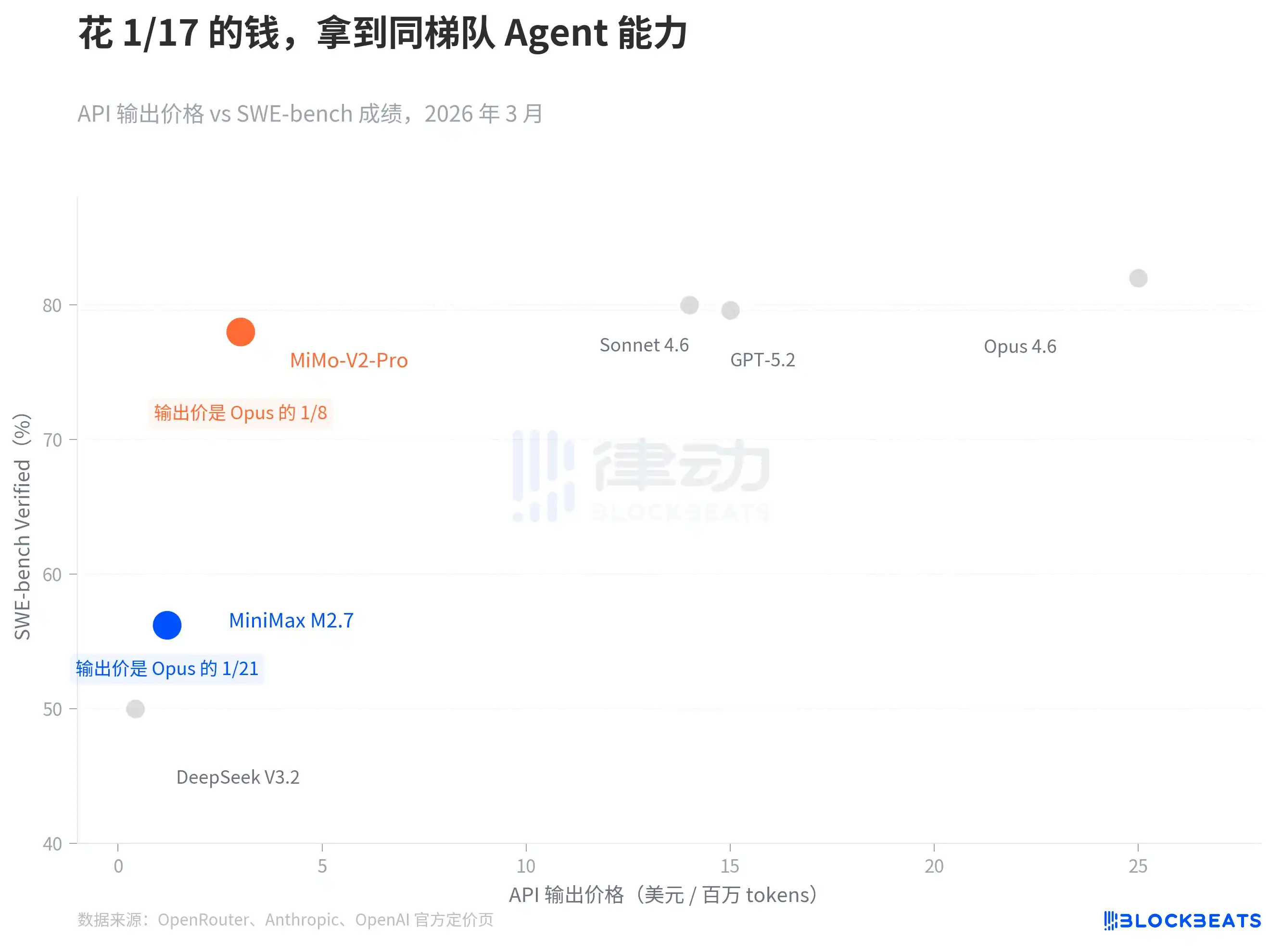
According to data from OpenRouter and the official pricing pages of various companies, based on API output price (per million tokens), MiniMax M2.7 is $1.2, and MiMo-V2-Pro is $3. As a reference, Claude Opus 4.6's output price is $25, GPT-5.2 is $14, and Claude Sonnet 4.6 is $15.

The price gap is by an order of magnitude, but the capability gap is not. On SWE-bench Verified (the current mainstream benchmark for measuring code engineering capabilities), MiMo-V2-Pro scored 78%, while Sonnet 4.6 scored 79.6%, a difference of less than two percentage points. M2.7's SWE-Pro score was 56.22%, on par with GPT-5.3-Codex. On VIBE-Pro (end-to-end project delivery capability), M2.7 scored 55.6%,接近 the level of Opus 4.6.

The key point of this chart is not who is higher or lower—the benchmark systems of various companies are not fully aligned, so direct comparisons should be made cautiously. The key point is that "price-performance剪刀差": domestic Agent models have already挤进 the same capability band but stand in completely different price ranges.

Trillion Parameters vs. Self-Evolution

Price is only the表象. The two companies have revealed two completely different底牌.

MiMo-V2-Pro follows the "more is better" route. According to Xiaomi's official announcement, V2-Pro has over 1 trillion total parameters, 42B activated parameters, and supports an ultra-long context of 1 million tokens. Its core innovation is the Hybrid Attention mechanism, adjusting the ratio of Sliding Window Attention (SWA) to Global Attention (GA) to 7:1—the previous generation V2-Flash was 5:1. This architecture makes the model more stable when handling long documents and multi-tool parallel calling Agent scenarios. On PinchBench (Agent tool calling capability evaluation), MiMo-V2-Pro scored 84%.

M2.7 takes a completely different path. According to the official technical blog released by MiniMax on March 18, M2.7's parameter count is not公开, but it demonstrates a "self-iterative evolution" mechanism: the model autonomously runs over 100 rounds of optimization cycles, including analyzing failure trajectories, planning modifications, modifying its own code architecture, running evaluations, and cycling again, ultimately achieving a 30% performance improvement on the internal evaluation set. On the MLE Bench Lite (machine learning competition difficulty evaluation) with 22 high-difficulty problems, M2.7 won 9 gold, 5 silver, and 1 bronze, with an average medal rate of 66.6%.
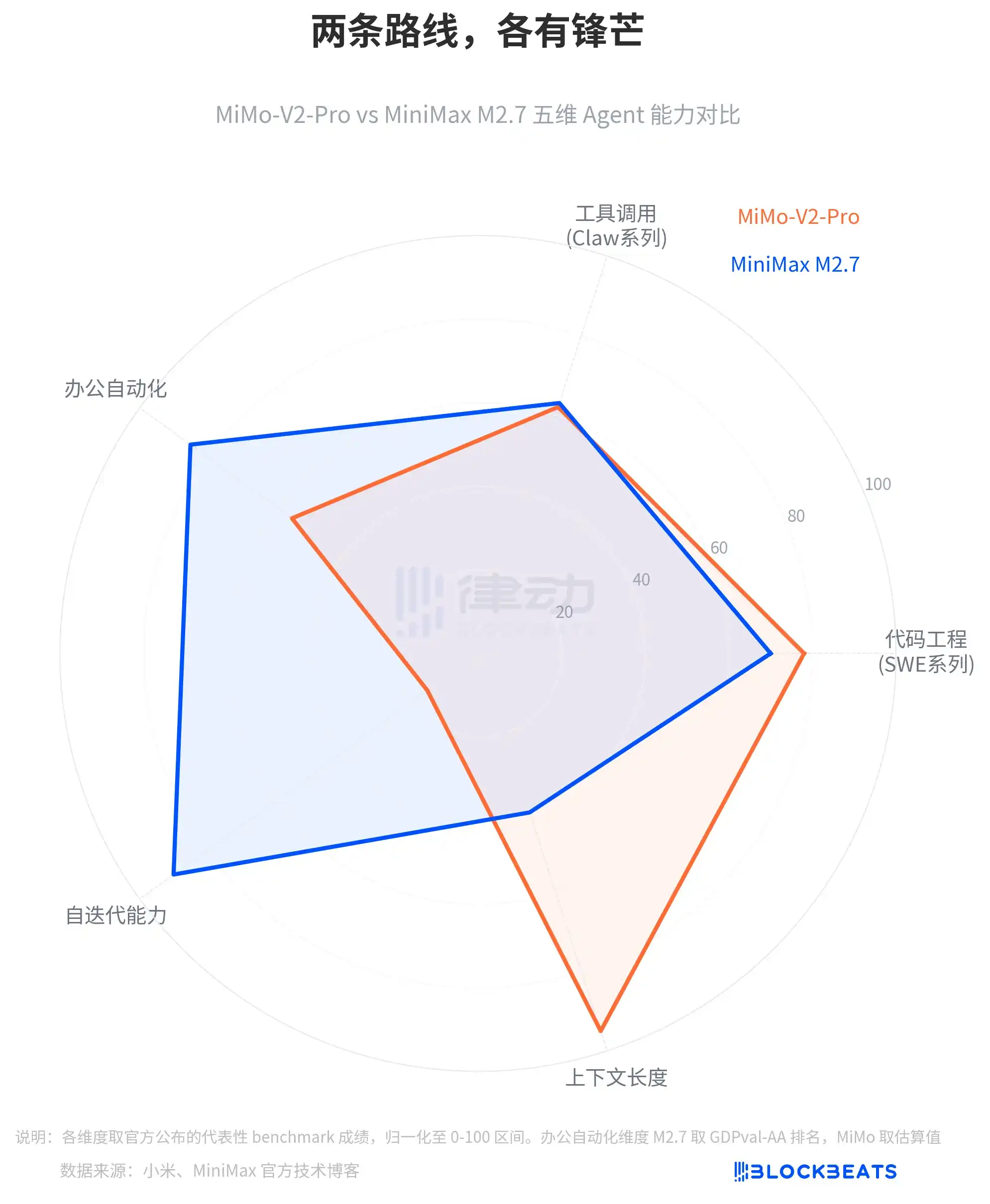
Looking from five dimensions, the锋芒 of the two routes朝向 completely different directions: MiMo-V2-Pro has obvious advantages in context length and code engineering dimensions, while M2.7 pulls ahead in office automation and self-iterative capabilities. According to the same MiniMax technical blog, M2.7 scored ELO 1495 on GDPval-AA (office document processing evaluation), ranking first among open-source models, and maintained a 97% skill adherence rate in the MM-Claw test covering over 40 complex skills.

Four Versions in Five Months

The two companies not only have different technical routes but also completely different iteration rhythms.

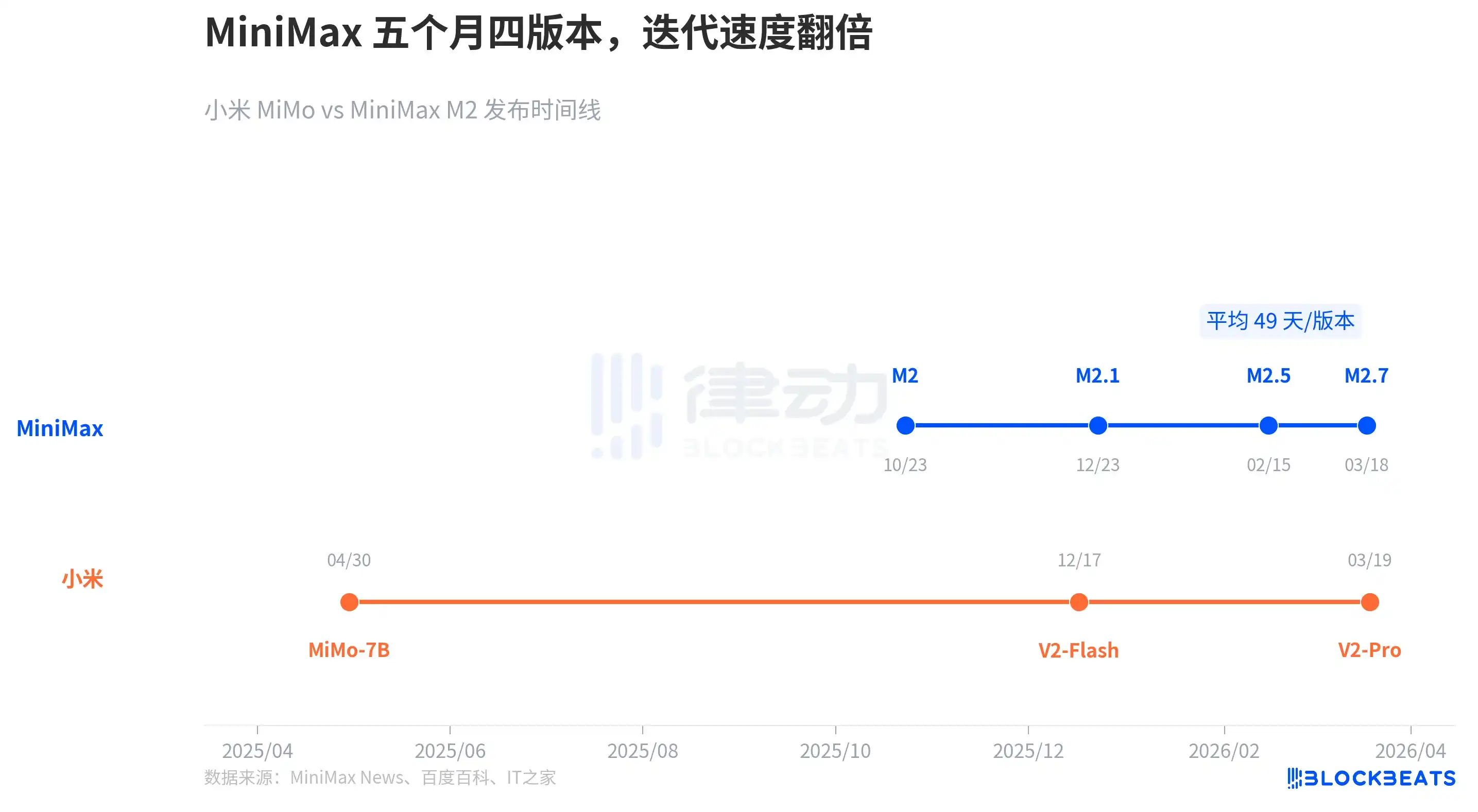
According to public release records, MiniMax iterated four major versions from the release of M2 in October 2025 to the release of M2.7 in March 2026—a new version every 49 days on average. The interval between M2.5 and M2.7 was only about 30 days.

Xiaomi MiMo's rhythm is different: MiMo-7B (a 7B parameter open-source inference model) was released in April 2025, V2-Flash (309B total parameters) in December 2025, and V2-Pro (1T total parameters) in March 2026. The parameter scale leap between each generation is larger, but the version intervals are also longer.

MiniMax chose small steps and quick runs, with small iteration amplitudes but extremely high frequency; M2.7's self-iterative mechanism is itself designed for "continuous evolution." Xiaomi chose蓄力一击, with each version representing a major leap in parameter scale and architecture.
Anonymous for 8 Days, Topping OpenRouter

Beyond the technical route, Xiaomi's release strategy also broke industry conventions.

According to a Reuters report, on March 11, an anonymous model named Hunter Alpha appeared on OpenRouter, the world's largest API aggregation platform. No brand endorsement, no launch event, no technical blog. Its API pricing was extremely low, yet its performance was surprisingly strong.

The community began speculating about its origin. According to Republic World and multiple tech media reports, the most mainstream guess was DeepSeek V4, as MiMo team leader Luo Fuli had previously conducted research at DeepSeek. Call volume surged rapidly, exceeding 1 trillion tokens during the anonymous period, topping the OpenRouter weekly chart.
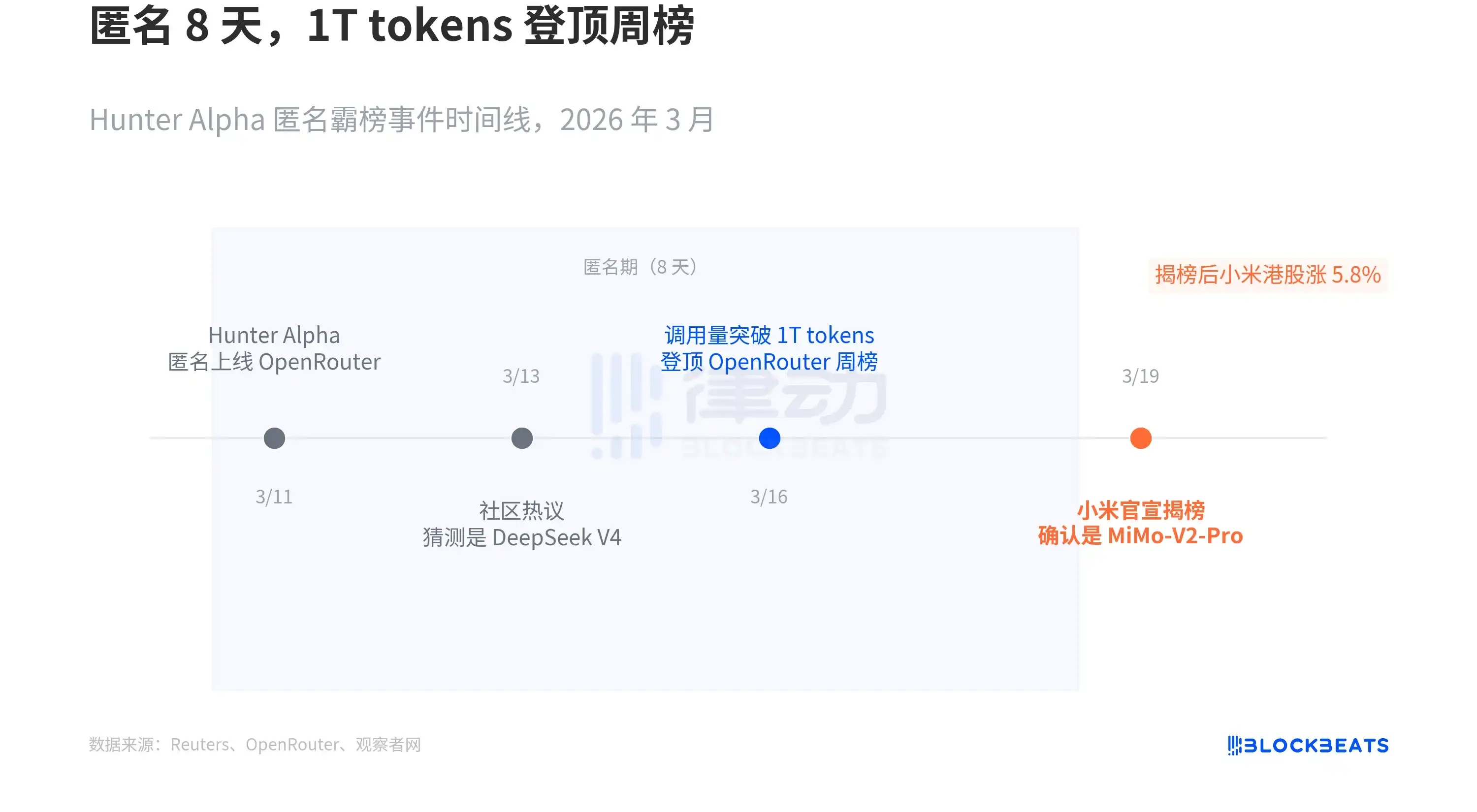
In the early hours of March 19, Xiaomi revealed the answer: Hunter Alpha was MiMo-V2-Pro. According to the same Reuters report, Xiaomi's Hong Kong stock saw a gain of up to 5.8% after the reveal.

This was the first time a domestic large model proved itself on a global platform through pure blind testing. Relying not on brand or宣传, but letting developers vote with their feet over 8 days.


Preguntas relacionadas

QWhat are the two Chinese companies that recently released their Agent-oriented large models, and what are the model names?

AMiniMax released the M2.7 model, and Xiaomi's MiMo team released the V2-Pro model.

QHow does the API output pricing of MiniMax M2.7 and MiMo-V2-Pro compare to Claude Opus 4.6?

AThe API output price for MiniMax M2.7 is $1.2 per million tokens, which is 1/21 of Claude Opus 4.6's $25. MiMo-V2-Pro is $3 per million tokens, which is 1/8 of Claude Opus 4.6's price.

QWhat are the core technical approaches of MiMo-V2-Pro and MiniMax M2.7?

AMiMo-V2-Pro follows a 'scale-up' approach with over 1 trillion total parameters and a Hybrid Attention mechanism. MiniMax M2.7 uses a 'self-iterative evolution' mechanism where the model autonomously runs optimization cycles to improve its own performance.

QWhat was unique about Xiaomi's release strategy for the MiMo-V2-Pro model?

AXiaomi first released the model anonymously on OpenRouter under the name 'Hunter Alpha' for 8 days. It gained significant developer traction and topped the OpenRouter weekly chart before Xiaomi revealed it was their model.

QHow did the iteration rhythms of MiniMax and Xiaomi's MiMo team differ?

AMiniMax iterated rapidly, releasing four versions in five months (approx. every 49 days). Xiaomi's MiMo team had longer release intervals with larger parameter scale jumps between versions, such as from 7B parameters to 309B, and then to 1T.

Lecturas Relacionadas

AI Agent Completely Transforms Web3 Gaming: From the Rugpull Bakery Bot Controversy to the New 2026 Agent Paradigm

This article explores how the AI Agent paradigm is fundamentally transforming Web3 gaming, moving from a disruptive force to a core, legitimized element. It begins with the controversy in the competitive baking game Rugpull Bakery, where automated scripts caused fairness issues. Instead of banning them, the developers integrated AI Agents into the official gameplay by providing technical documentation (skill.md, agent.json), marking a shift towards "Agentic Gaming." The piece outlines three primary implementation models for AI Agents in Web3 games by 2026: 1. **Autonomous Competitors & Economic Entities:** AI Agents act as independent players with unique strategies. Examples include TEN Protocol's poker agents, AI Arena's trainable NFT fighters, and Satoshi Strike Force's "Digital Athletes" trained on player data. The Somnia blockchain is highlighted as a dedicated "Agentic L1" infrastructure supporting this model at scale. 2. **Modular Infrastructure & Programmable Environments:** This model, exemplified by EVE Frontier, allows AI Agents to program game world logic itself. Using "Smart Assemblies" (e.g., Smart Turrets, Smart Gates), Agents can modify shared economic and physical rules on-chain, creating dynamic, player/AI-built worlds. The ERC-8183 standard further enables these automated entities to hire other AI services for complex tasks. 3. **Hybrid Companions & Dynamic Adaptation:** Here, AI serves as a collaborative partner. In Parallel Colony, highly autonomous AI Avatars work alongside human players who provide high-level guidance. Illuvium plans to use AI to make NPCs dynamic and responsive, creating personalized, emergent narratives for each player. The conclusion posits that Web3 gaming has reached a "post-human" inflection point. Blockchains' transparency and programmability, combined with new standards and infrastructure like Somnia, make integrating and governing AI Agents not just viable but essential. The future lies in a symbiotic digital order where players transition from manual laborers to commanders and partners of algorithmic intelligence.

marsbitHace 17 min(s)

AI Agent Completely Transforms Web3 Gaming: From the Rugpull Bakery Bot Controversy to the New 2026 Agent Paradigm

marsbitHace 17 min(s)

Saylor's Purchase of 1550 Bitcoin Is a Bad Trade

**Title: Saylor's Purchase of 1,550 Bitcoins Was a Bad Trade** The article critically analyzes Strategy's recent move of selling 32 bitcoins followed by a much larger purchase of 1,550 bitcoins. While appearing bullish, the author argues this trade is detrimental to MSTR shareholders. The core argument revolves around the concept of "breakeven modified Net Asset Value (mNAV)," a key metric for Strategy. To increase Bitcoin per share (BPS) for MSTR holders, Strategy must issue new shares at a premium high enough that the funds raised can buy more bitcoin than the bitcoin backing each existing share. Currently, this breakeven mNAV is estimated at 1.30. The recent trade failed on two counts: 1. The shares for the $181 million raise were issued at an mNAV *below* the 1.30 breakeven point. Selling "cheap" shares to buy bitcoin actually *reduces* BPS. 2. Only $101.3 million of the raised funds were used to buy bitcoin; the rest went to boost the company's dollar reserves. The breakeven mNAV calculation assumes *100%* of proceeds are used for bitcoin purchases. Diverting funds, even if mNAV were high, dilutes BPS. The result is an estimated 0.19% decrease in Bitcoin per share for MSTR holders. In exchange, Strategy merely extended its operational runway for its dollar reserves from ~6.3 months to 7 months. The author interprets this as Strategy prioritizing the survival and development of its STRC business over its stated core goal of increasing MSTR's BPS. This constitutes a gamble: if sacrificing MSTR value leads to improved market sentiment and a recovery in STRC's price (and thus mNAV), the whole system could work. If not, Strategy may be forced into a cycle of further diluting MSTR to stay afloat, potentially leading to deferred STRC dividends or corporate decline. The article concludes with a hope for price recovery for Bitcoin, MSTR, and STRC.

Foresight NewsHace 28 min(s)

Saylor's Purchase of 1550 Bitcoin Is a Bad Trade

Foresight NewsHace 28 min(s)

The AI Bear Market Lasting Two Days Is Over; Why Did Funds Buy Back Storage Stocks First?

After a severe two-day selloff in early June that erased over $1 trillion from U.S. chip stock market value, capital is flowing back first to the memory sector. The correction was not driven by a collapse in AI demand but rather a market reassessment of high expectations. Stocks like Broadcom faced selling pressure despite strong AI revenue guidance, signaling a shift in focus from who has an "AI story" to who can most rapidly translate AI demand into verifiable profits and earnings per share (EPS). Memory companies, such as Micron and SK Hynix, are leading the recovery because their EPS growth is more immediately verifiable. The AI server boom directly increases demand for high-bandwidth memory (HBM) and high-capacity server DRAM, tightening supply and driving up contract prices for conventional DRAM and NAND Flash. This price increase, coupled with a shift to higher-margin products, flows directly into near-term revenue and profitability, as evidenced in recent earnings reports. In contrast, other AI semiconductor segments like GPUs, ASICs, and optical modules, while central to the long-term AI infrastructure story, face longer and less certain paths to EPS validation. Their growth depends more on future product cycles, customer adoption timelines, and capital expenditure plans. The rebound in memory stocks highlights a market preference for assets with shorter, more transparent EPS conversion cycles following the recent de-risking phase. However, this does not negate the potential of other AI hardware segments should they provide clearer near-term order visibility. The episode has raised the validation bar for all AI-related investments.

marsbitHace 28 min(s)

The AI Bear Market Lasting Two Days Is Over; Why Did Funds Buy Back Storage Stocks First?

marsbitHace 28 min(s)

Trading

Spot
Futuros

Artículos destacados

Cómo comprar WAR

¡Bienvenido a HTX.com! Hemos hecho que comprar WAR (WAR) sea simple y conveniente. Sigue nuestra guía paso a paso para iniciar tu viaje de criptos.Paso 1: crea tu cuenta HTXUtiliza tu correo electrónico o número de teléfono para registrarte y obtener una cuenta gratuita en HTX. Experimenta un proceso de registro sin complicaciones y desbloquea todas las funciones.Obtener mi cuentaPaso 2: ve a Comprar cripto y elige tu método de pagoTarjeta de crédito/débito: usa tu Visa o Mastercard para comprar WAR (WAR) al instante.Saldo: utiliza fondos del saldo de tu cuenta HTX para tradear sin problemas.Terceros: hemos agregado métodos de pago populares como Google Pay y Apple Pay para mejorar la comodidad.P2P: tradear directamente con otros usuarios en HTX.Over-the-Counter (OTC): ofrecemos servicios personalizados y tipos de cambio competitivos para los traders.Paso 3: guarda tu WAR (WAR)Después de comprar tu WAR (WAR), guárdalo en tu cuenta HTX. Alternativamente, puedes enviarlo a otro lugar mediante transferencia blockchain o utilizarlo para tradear otras criptomonedas.Paso 4: tradear WAR (WAR)Tradear fácilmente con WAR (WAR) en HTX's mercado spot. Simplemente accede a tu cuenta, selecciona tu par de trading, ejecuta tus trades y monitorea en tiempo real. Ofrecemos una experiencia fácil de usar tanto para principiantes como para traders experimentados.

185 Vistas totalesPublicado en 2024.12.11Actualizado en 2026.06.02

Cómo comprar WAR

Discusiones

Bienvenido a la comunidad de HTX. Aquí puedes mantenerte informado sobre los últimos desarrollos de la plataforma y acceder a análisis profesionales del mercado. A continuación se presentan las opiniones de los usuarios sobre el precio de WAR (WAR).

活动图片