X Tightens Promotion Rules: Is the Wild West Era of Crypto Twitter Marketing Over?

marsbitPublicado a 2026-02-25Actualizado a 2026-02-25

Resumen

X, the platform formerly known as Twitter, is systematically tightening its rules on promotional content and automated activity, particularly targeting the crypto community. Over the past five months, it has implemented six major policy changes. These include removing 1.7 million spam bots, banning "InfoFi" applications that reward users for posting, cracking down on accounts using automation/AI, and introducing a mandatory "Paid Promotion" disclosure label for sponsored content. It has specifically prohibited undisclosed ads for prediction markets and restricted automated API replies. These actions dismantle key, previously free, marketing channels for crypto: incentivized posting, undisclosed influencer promotions, and automated engagement. Consequently, user acquisition costs are expected to rise as organic reach diminishes. The platform is simultaneously favoring paid advertising, having relaxed its policies for crypto ads in many regions. This shift forces a recalibration of the crypto influencer economy, moving from hidden endorsements to transparent, performance-based advertising. While this may lead to a cleaner information environment for users, it signals the end of an era of unregulated "wild" marketing on the platform, making visibility a paid privilege.

Author: David, Deep Tide TechFlow

On February 21, X's product lead Nikita Bier publicly demanded in a post that the poster add a disclaimer stating it was a paid promotion, otherwise the account would be suspended.

This post came from the account @infodexx, with content ranking the "Most Valuable Startups in 2025," placing the prediction market platform Kalshi second with an $11 billion valuation.

The post garnered over 420,000 views, but the poster's bio stated "Kalshi partner," and the post itself initially had no paid promotion label.
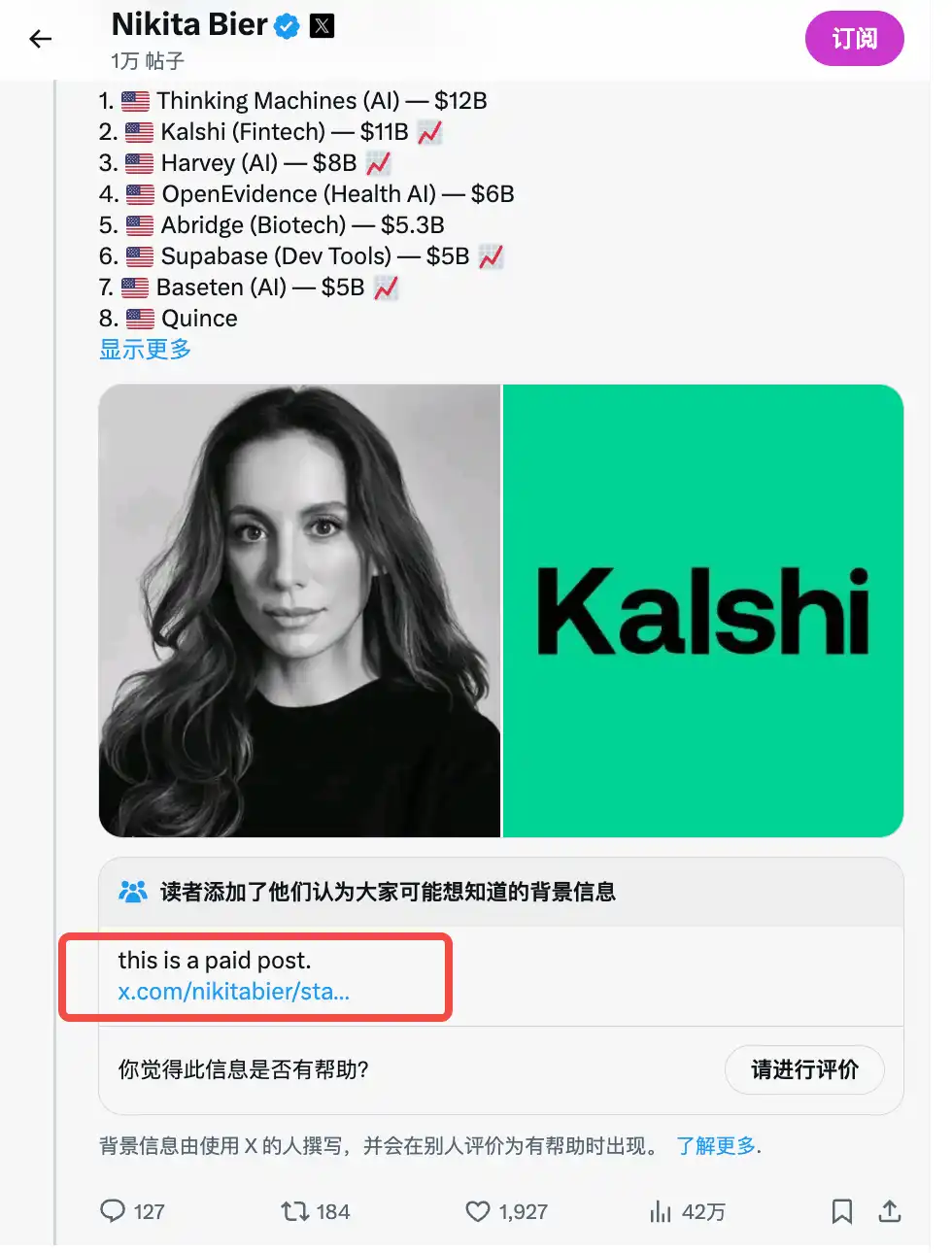
Subsequently, a user flagged it as commercial promotion content—essentially an ad—through X's Community Notes feature (a user-collaborative fact-checking mechanism where approved notes are displayed directly below the post).

Bier then announced that X would launch a set of paid promotion disclosure features the following week, requiring all posts with paid partnerships to be labeled, with violators facing account suspension.

The poster later added a context note to the original post, indicating it was a paid promotion.

Mandatory disclosure is just the latest step in this round of adjustments.

Over the past five months, X has successively cleaned up 1.7 million spam bot accounts, banned API access for InfoFi-type applications, launched anti-automation detection mechanisms, and restricted programmatic reply interfaces...

Although these actions occurred at different points in time, when pieced together, they form a clear timeline.

The wild marketing era on Crypto Twitter is perhaps being ended by the platform itself.

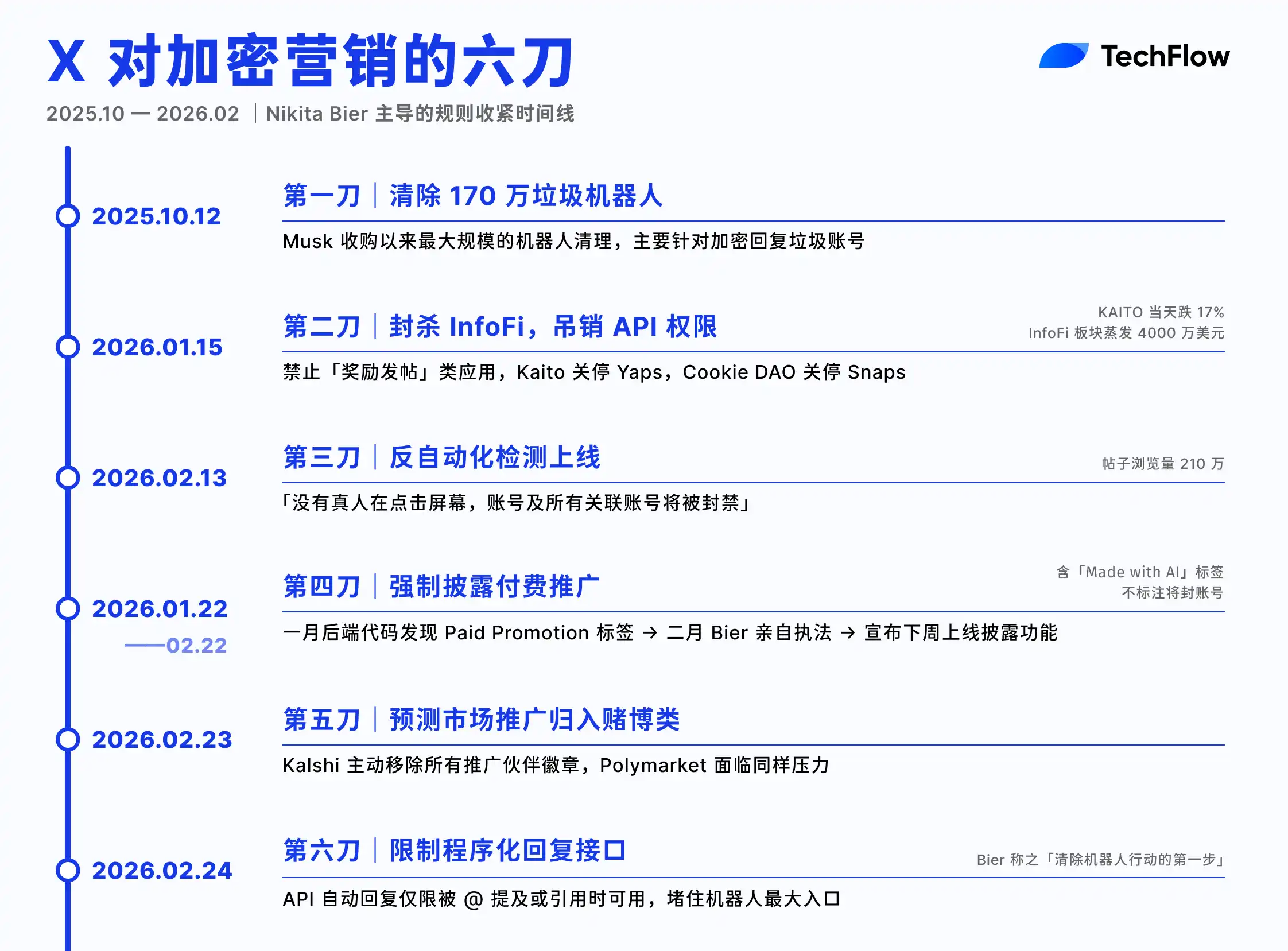
6 Major Cuts in 5 Months, Hitting the Artery of Crypto Marketing

X's changes to marketing rules have delivered six significant, overt blows over the past 5 months. We have compiled the key timeline and major events of these rule changes as follows:
First Cut: Spam Bots

In October 2025, Bier announced that X had removed 1.7 million reply spam bots in one week, the largest cleanup since Musk's acquisition. The primary targets were crypto-related automated accounts, familiar to anyone who has scrolled through crypto posts on X:

Scam links instantly replying under popular posts, fake accounts impersonating Elon Musk, and repetitive "gm" bots.

Removing 1.7 million was just the first step; the underlying issue was much larger.

Second Cut: InfoFi and the "Post-to-Earn" Model

The proliferation of these bots was largely due to InfoFi.

Third-party platforms tracked users' posts and interactions on X and rewarded them with tokens or points. The original intent was to incentivize valuable information production, but when posting itself could earn money, it evolved into quantity over quality. Bot farms and AI-generated批量 replies quickly dominated the leaderboards.

At its peak, the largest project, Kaito, had over 157,000 active users on its Yaps product. By January 9, 2026, CryptoQuant detected 7.75 million crypto-related posts on X in a single day, 12 times the normal level.

On January 15, 2026, Bier announced changes to the developer API policy, prohibiting all applications that "reward users for posting on X," immediately revoking relevant API access.

Kaito subsequently shut down Yaps, its token KAITO fell about 17% that day; Cookie DAO shut down a similar product, Snaps; the entire InfoFi sector lost approximately $40 million in market cap in one day.

(Reference reading: X Pulls the Rug, the Era of 'Farming with Your Mouth' Ends)

Third Cut: Accounts Simulating Human Operations

On February 13, Bier announced the launch of a new round of automation detection.

If no real person is clicking the screen, the account and all associated accounts may be banned. This cut is aimed not just at traditional bots, but at all accounts operated via scripts, automation tools, or AI agents.

Bier stated that X would support compliant agent use cases in the future, but recommended developers pause integrations until rules are clear, using the official API if necessary.

Fourth Cut: Stealth Ads

The first three cuts dealt with automation and spam. The fourth cut targeted a larger gray area: paid promotions without disclosure.

Anyone familiar with Crypto Twitter knows this has been an industry standard in the crypto space.

In September 2025, on-chain investigator ZachXBT publicly released a spreadsheet listing the promotion rates and receiving wallet addresses of over 200 crypto KOLs. About 160 had accepted promotions, but fewer than 5 had labeled their posts as "ad."
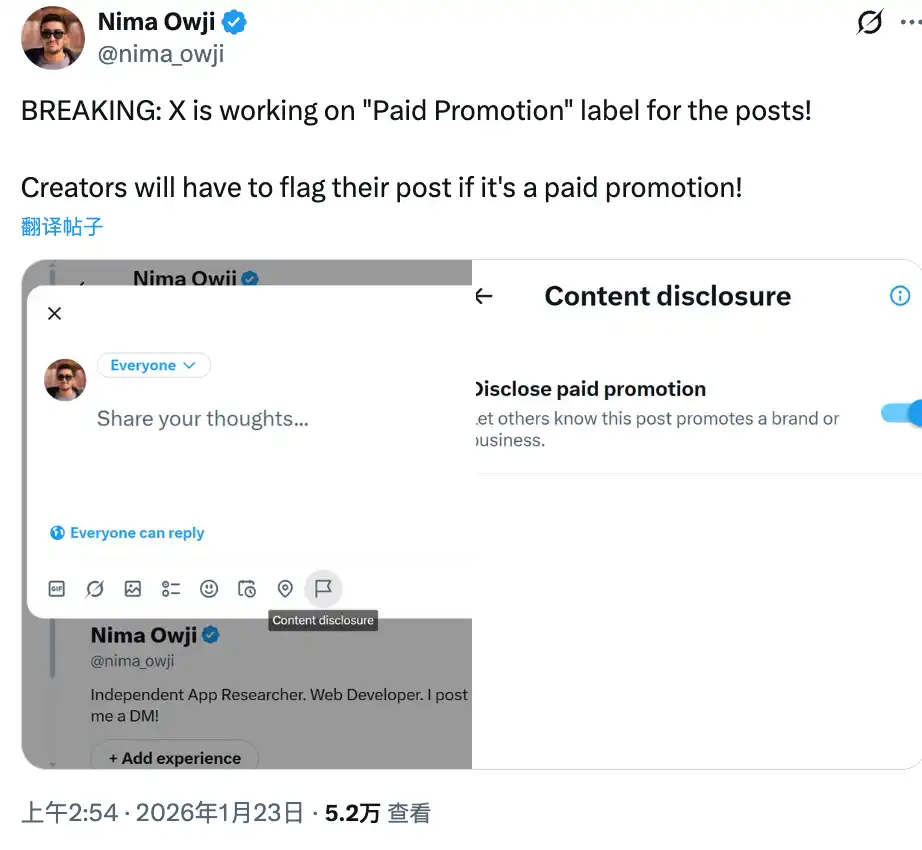
On January 22, app researcher Nima Owji discovered a Paid Promotion label feature under development in X's backend code. Creators would need to check if a post was a paid promotion when posting, and the label would be displayed directly on the post.

By February 21, when Bier personally intervened in the Kalshi post, this feature was ready for launch. He also announced a "Made with AI" label, requiring AI-generated content to be labeled.

Fifth Cut: Prediction Market Promotion

Following the disclosure feature announcement, X updated its paid partnership policy, explicitly categorizing prediction markets (like Kalshi and Polymarket) as gambling products, and comprehensively banning undisclosed related advertising.

Kalshi proactively removed its promotion partner badge on X on February 23, its spokesperson stating the enforcement was too difficult, as users easily misinterpreted accounts with the badge as being officially endorsed by Kalshi.

Sixth Cut: Programmatic Replies

The final cut landed on February 24. The X developer platform announced restrictions on automated replies sent via API.

Programmatic replies are only permitted if the original post @mentions or quotes the account. Product lead Bier called this the first step in clearing out bots, first plugging the biggest entry point.

After these six cuts—targeting bots, incentive mechanisms, automation tools, stealth ads, specific category promotions, and programmatic interfaces—X's control over crypto content has progressed layer by layer.

Combined, the entire marketing infrastructure that Crypto Twitter has relied on for operation over the past few years has been systematically dismantled.

X Rejects Free Riders, Welcomes Paying Customers

These rule changes combined are altering the cost structure of crypto marketing. In recent years, the main ways crypto projects acquired customers on X were through three free channels:

  1. InfoFi platforms incentivizing users to post for visibility,
  2. KOLs accepting stealth promotions without ad labels,
  3. Automation tools批量引流 under hot posts.

Now, all three channels are restricted or closed. Meanwhile, X's algorithm is widening the visibility gap between paid and free accounts.

Premium users receive a 2x to 4x weighting boost in the For You feed and reply排序. Some creators testing found that after March 2025, the median interaction for non-Premium accounts posting links had dropped to nearly zero.

The organic reach of crypto content萎缩 earlier. Crypto trader Lisa Edwards posted an analysis in December 2025 stating that after an algorithm update that month, the reach rate of posts containing symbols like BTC and ETH dropped by about 80%.

Simultaneously, as free channels are blocked, paid channels are opening.

X's policy on crypto ads has actually been loosening. According to X's official ad policy update log, since 2024, DeFi product ads have been approved, blockchain game ads opened in the US and Brazil, and the applicable markets for crypto exchange and wallet ads expanded from over a dozen original countries to include Denmark, Israel, Netherlands, Portugal, Ghana, Kenya, etc.

According to AWISEE statistics, X's crypto ad approval rate is about 60%, the highest among major platforms; Meta's is about 50%, and Google's is lower and explicitly bans DeFi ads.

On one side, free distribution is being systematically compressed; on the other, paid advertising categories and markets are continuously expanding. This is the monetization path all content platforms have taken:

First, cultivate a free content ecosystem to attract users and creators. Once network effects are established and creators become dependent on the platform, gradually tighten organic distribution, directing traffic to paid channels.

Facebook did the exact same thing to brand pages in 2014, with organic reach plummeting from double digits to single digits, forcing brands to shift from content operations to ad spending.

What X is doing to crypto content is essentially the same playbook.

Who Pays the Bill? Who Gets Eliminated?

With free channels cut, the bill will ultimately be分摊 across every role in the industry. This has at least three layers of impact on crypto marketing.

First, customer acquisition costs rise.

Before, a crypto project could rely on InfoFi points to incentivize tens of thousands of people to create buzz for it on X. Now that path is gone.

Formal KOL promotions will become more transparent with the disclosure feature, but posts labeled "ad" will have lower trust and engagement rates. Project teams will either increase budgets to compensate or accept reduced effectiveness.

Second, the KOL economy is repriced.

Data exposed by ZachXBT last year showed over 160 KOLs accepted promotions but almost none disclosed, with single post rates ranging from hundreds to $60,000. After mandatory disclosure, the room for operations that "look like organic content but are actually ads" is compressed. KOL pricing logic will shift from "I can help you伪装成 organic content" to "How much conversion can my labeled ad still drive?".

The former is priced on information asymmetry, the latter on performance.

For the industry, this might not be a bad thing, but短期内 a batch of KOLs and agencies surviving in the gray area will be eliminated.

Third, platform dependency risk is repriced.

Bier's exact words when banning InfoFi were,建议被封的开发者 "go to Threads and Bluesky to pivot."

A platform's product lead openly advising developers to go to competitors indicates X doesn't mind crypto projects分流, and might even be actively pushing them. After this round of changes, for project teams and KOLs, putting all social assets on X alone is no longer conservative, but risky.

For ordinary users, this isn't all bad news.

Before, scrolling through Crypto Twitter, six out of ten posts might have been paid for, but none would tell you. After the disclosure feature launches, users can at least distinguish between promotions and genuine opinions. The information environment becomes cleaner, and the cost of judgment decreases.

Of course, the timing of the rule tightening also coincides with a bear market.

Bear markets themselves compress marketing budgets; fewer projects are willing to spend on promotion, so the information flow naturally quiets down. Whether the clean environment is due to the rules or the冷清 will only be truly tested when the bull market returns.

Regardless, whether for project teams, KOLs, or ordinary creators, the price of admission to be seen on Crypto Twitter is now rising.

The logic of this business was "whoever is loudest wins"; in the future, it will become "whoever is willing to pay gets a voice."


Criptos en tendencia

Preguntas relacionadas

QWhat major actions has X taken in the past five months to tighten its promotion rules, particularly affecting crypto marketing?

AX has implemented six key changes: 1) Cleared 1.7 million spam bot accounts in October 2025; 2) Banned 'earn-to-post' applications (InfoFi) by revoking their access in January 2026; 3) Introduced new automation detection targeting scripted or AI-operated accounts in February 2026; 4) Enforced mandatory disclosure for paid promotions; 5) Classified prediction markets as gambling and banned undisclosed ads for them; 6) Restricted automated API replies unless the original post mentions the account.

QHow did the crackdown on InfoFi applications impact the crypto market?

AThe ban on InfoFi applications, which rewarded users for content creation with tokens or points, led to the shutdown of major platforms like Kaito's Yaps and Cookie DAO's Snaps. The entire InfoFi sector lost approximately $40 million in market capitalization in a single day, with Kaito's token (KAITO) dropping around 17%.

QWhat is the new requirement for paid promotions on X, and what are the consequences for non-compliance?

AX now requires all posts involving paid partnerships to be clearly labeled as 'Paid Promotion.' Failure to disclose such partnerships will result in account suspension. This policy aims to increase transparency and reduce undisclosed advertising, particularly prevalent in crypto marketing.

QHow has X's algorithm change affected the visibility of free versus paid accounts?

AX's algorithm now gives Premium accounts a 2 to 4 times weighting boost in the 'For You' feed and reply rankings. Non-Premium accounts posting links have seen their median engagement drop to nearly zero since March 2025. Additionally, posts containing crypto symbols like BTC or ETH experienced an 80% decrease in organic reach after a December 2025 algorithm update.

QWhat broader implications do these rule changes have for crypto marketers and KOLs?

AThe changes are increasing customer acquisition costs by closing free marketing channels like InfoFi and undisclosed KOL promotions. KOLs must now shift from pricing based on disguising ads as organic content to pricing based on measurable conversion rates. This transparency may push out KOLs and agencies that relied on ambiguous practices, while encouraging a more honest and effect-based marketing economy.

Lecturas Relacionadas

The "Impossible Triad" Is Fundamentally a Pseudo-Problem

The article argues that blockchain's fundamental limitation is not the scalability trilemma (decentralization, scalability, security), which has been largely solved, but the lack of **privacy** and, until recently, clear **legitimacy**. Blockchain is described as a slow, expensive, globally shared computer whose core value is censorship resistance and verifiability. While ideal for native digital assets like money (e.g., stablecoins), its default transparency acts as a **tax**, exposing all transactions and enabling MEV extraction, which deters serious institutional capital. Simultaneously, its permissionless nature created regulatory ambiguity. The piece contends that **privacy** is the missing critical feature. It rejects the false choice between total transparency and complete anonymity. Modern cryptography (like zero-knowledge proofs) enables **compliant privacy**: users can prove facts (solvency, KYC status, compliance) without revealing the underlying sensitive data (specific holdings, identities). This preserves auditability for regulators and eliminates the leak of financial information. With recent regulatory progress (e.g., the GENIUS Act) addressing legitimacy, adding default, provably compliant privacy becomes a pure upgrade. It transforms blockchain from a costly, public ledger into a confidential settlement layer, finally bridging the gap to mainstream institutional and individual adoption of on-chain finance.

链捕手Hace 7 hora(s)

The "Impossible Triad" Is Fundamentally a Pseudo-Problem

链捕手Hace 7 hora(s)

Optical Chips: Collective Capacity Expansion

The global optical chip industry is experiencing a massive wave of expansion driven by surging AI data center demand. Major players across the US, Japan, Europe, and China are aggressively investing to ramp up production capacity. In the US, Coherent is expanding its 6-inch Indium Phosphide (InP) semiconductor fab in Texas, supported by CHIPS Act funding and a $2 billion strategic investment from NVIDIA. Lumentum is building a new factory for InP optical devices, and Nokia is scaling its advanced photonic chip packaging and testing capabilities. NVIDIA's investments aim to secure future supply of critical lasers and optical interconnect products for AI infrastructure. Japan's JX Advanced Metals, a leading InP substrate supplier, plans a multi-billion yen investment to increase its capacity 7-10 times, strengthening its grip on the crucial upstream materials market. In Europe, IQE and Tower Semiconductor settled a patent dispute and signed a multi-year InP epitaxial wafer supply agreement, highlighting that next-generation silicon photonics platforms will integrate high-performance InP components. STMicroelectronics and Sivers Semiconductors are also expanding silicon photonics production and partnerships. China is rapidly building out its domestic supply chain. Dongshan Precision's subsidiary, Source Photonics, announced a $12 billion project to expand optical chip and module production. Companies like Sanan Optoelectronics and Yunnan Germanium are scaling up InP chip manufacturing and substrate production, moving towards vertical integration from materials to modules. While debate continues around the exact future architecture—whether CPO (Co-Packaged Optics), NPO, or pluggables will dominate—analysts like Morgan Stanley argue the underlying driver is unchangeable: the explosive growth in bandwidth demand. This will inevitably increase the volume of optical engines, lasers, and related content per GPU, regardless of the final technical path. The competition for "more light" in the AI era has intensified into a global, full-chain capacity race.

marsbitHace 10 hora(s)

Optical Chips: Collective Capacity Expansion

marsbitHace 10 hora(s)

Stablecoins Finally Find Real Yield: An In-Depth Look at On-Chain Reinsurance Re | A Conversation with Re Founder Karan Saroya

Stablecoin Real Yield Found: A Deep Dive into On-Chain Reinsurance with Re's Karan Saroya As stablecoin supply exceeds $170 billion, the search for sustainable, non-speculative yield intensifies. Re, an on-chain reinsurance platform, provides an answer: connecting stablecoin capital to the trillion-dollar traditional reinsurance market. Re operates as a regulated reinsurer, accepting stablecoin deposits as collateral to back US insurance companies. These insurers pay premiums, generating yield that flows back to on-chain depositors. Currently supporting 35 insurers and underwriting $500 million, Re projects scaling to over $1 billion soon. Key insights from a Bankless podcast with founder Karan Saroya and investor Avichal of Electric Capital: 1. **Uncorrelated, Real-World Yield:** Re offers stablecoin holders access to reinsurance returns (targeting 12-14%+), an asset class entirely separate from crypto or equity markets. 2. **Operational Efficiency via Smart Contracts:** Re replaces traditional, labor-intensive capital fundraising with smart contracts, allowing a ~12-person team to compete with industry giants. 3. **Regulatory Leverage:** For every $1 of collateral, regulations allow backing $5-7 in written premiums. This leverage amplifies returns from the underlying risk-free rate. 4. **DeFi Integration:** Depositors receive receipt tokens, which can be used in protocols like Morpho for "looping," potentially pushing yields to 18-20%+. 5. **The "DeFi Mullet" Model:** A compliant front-end (regulated reinsurer) paired with a decentralized back-end (smart contracts, DeFi capital markets). 6. **RE Governance Token:** Modeled on Lloyd's of London, the token governs the central capital pool's allocation, counterparty acceptance, and parameters. 7. **Real Economic Impact:** Capital funds real-world productivity (factories, clinics, businesses) via insurance, moving beyond crypto's internal loops. The discussion highlights a pivotal moment: DeFi's supply-side infrastructure is now met by real demand for productive yield, potentially kickstarting a flywheel where vast on-chain stablecoin capital seeks these real-world returns.

链捕手Hace 11 hora(s)

Stablecoins Finally Find Real Yield: An In-Depth Look at On-Chain Reinsurance Re | A Conversation with Re Founder Karan Saroya

链捕手Hace 11 hora(s)

1996 or 1999? Walsh's First Test is 'How to View AI'

"1996 or 1999? Wall's First Big Test Is 'How to View AI'" Federal Reserve Chairman Wall's initial challenge is not whether to raise or cut rates, but a more fundamental judgment: what kind of boom is the current AI boom? This will determine the Fed's policy path and define his legacy. Economics is split between two opposing views, according to reporter Nick Timiraos. One sees imminent productivity gains that will increase supply and cool inflation, allowing the Fed to hold steady. The other argues that while productivity benefits are distant, demand shocks are here now, and waiting for data confirmation risks missing the intervention window, forcing sharper rate hikes later. Wall has signaled a leaning toward the first view, echoing 1996-era Alan Greenspan, who embraced strong, productivity-driven growth without fear of inflation. However, Wall faces a different macro environment than Greenspan did, with tariff pressures, expanding fiscal deficits, and diminishing globalization benefits, which could force more significant inflation pressures even if AI benefits materialize. Wall's logic, expressed before taking office, is that AI-driven productivity gains won't show in official data for years. If the Fed waits for confirmation, it might mistakenly tighten policy and choke off the very growth that could suppress inflation. This argues for using forward-looking narratives over lagging data. Chicago Fed President Austan Goolsbee presents a key counter-argument. He distinguishes between expected and unexpected productivity booms. A widely anticipated boom, like the current AI wave, can cause people to spend future wealth gains in advance, overheating the economy before productivity actually rises, thus requiring preemptive rate hikes. He cites rising costs for AI data centers as evidence of such overheating. Fed Governor Christopher Waller offers a rebuttal to Goolsbee, noting the "expected spending" mechanism only works if people can borrow against future income, which many households cannot do due to borrowing constraints. Wall also faces a paradox related to his desire to reduce the Fed's use of "forward guidance" (pre-announcing policy moves). This practice was established in 1999 when Greenspan began signaling hikes to avoid market shocks. If the economy follows a less optimistic path, Wall may be forced to choose between using the guidance he wants to abolish or risking market volatility by staying silent. The ultimate question defining Wall's first major test remains: Is this 1996 or 1999?

marsbitHace 12 hora(s)

1996 or 1999? Walsh's First Test is 'How to View AI'

marsbitHace 12 hora(s)

Trading

Spot
Futuros

Artículos destacados

Cómo comprar ERA

¡Bienvenido a HTX.com! Hemos hecho que comprar Caldera (ERA) sea simple y conveniente. Sigue nuestra guía paso a paso para iniciar tu viaje de criptos.Paso 1: crea tu cuenta HTXUtiliza tu correo electrónico o número de teléfono para registrarte y obtener una cuenta gratuita en HTX. Experimenta un proceso de registro sin complicaciones y desbloquea todas las funciones.Obtener mi cuentaPaso 2: ve a Comprar cripto y elige tu método de pagoTarjeta de crédito/débito: usa tu Visa o Mastercard para comprar Caldera (ERA) al instante.Saldo: utiliza fondos del saldo de tu cuenta HTX para tradear sin problemas.Terceros: hemos agregado métodos de pago populares como Google Pay y Apple Pay para mejorar la comodidad.P2P: tradear directamente con otros usuarios en HTX.Over-the-Counter (OTC): ofrecemos servicios personalizados y tipos de cambio competitivos para los traders.Paso 3: guarda tu Caldera (ERA)Después de comprar tu Caldera (ERA), guárdalo en tu cuenta HTX. Alternativamente, puedes enviarlo a otro lugar mediante transferencia blockchain o utilizarlo para tradear otras criptomonedas.Paso 4: tradear Caldera (ERA)Tradear fácilmente con Caldera (ERA) en HTX's mercado spot. Simplemente accede a tu cuenta, selecciona tu par de trading, ejecuta tus trades y monitorea en tiempo real. Ofrecemos una experiencia fácil de usar tanto para principiantes como para traders experimentados.

397 Vistas totalesPublicado en 2025.07.17Actualizado en 2026.06.02

Cómo comprar ERA

Discusiones

Bienvenido a la comunidad de HTX. Aquí puedes mantenerte informado sobre los últimos desarrollos de la plataforma y acceder a análisis profesionales del mercado. A continuación se presentan las opiniones de los usuarios sobre el precio de ERA (ERA).

活动图片