X Personally Terminates InfoFi Incentive Model, The Era of 'Mouth Farming' Comes to an End

Odaily星球日报Publicado a 2026-01-16Actualizado a 2026-01-16

Resumen

X, the platform formerly known as Twitter, has officially terminated the API access for InfoFi applications that reward users for posting, effectively ending the "post-to-earn" model. This decisive move, announced by X product lead Nikita Bier, targets what the company identifies as a primary source of AI-generated spam and low-quality replies flooding the platform. The policy shift immediately impacted several prominent InfoFi projects. Tokens like KAITO and COOKIE experienced significant double-digit price drops. Projects such as Cookie DAO's Snaps platform have ceased operations, while Kaito has shut down its Yaps incentive program and is pivoting to a new, more traditional creator marketing model called Kaito Studio. X's core objection was not to the content itself, but to the fundamental structure of external, unpermissioned incentives directly driving platform engagement. This model was seen as compromising content quality and, crucially, undermining X's sovereignty over its own content ecosystem and user experience. The platform emphasized that it does not need the revenue generated from these API fees. The event signals a major recalibration, forcing InfoFi projects to either retreat to a pure data/tooling role or completely reinvent their business models to align with platform policies. The era of easily farming rewards for social media posts ("嘴撸时代") is over, as content control is firmly reclaimed by the platform itself.

Original | Odaily Planet Daily (@OdailyChina)

Author | Ethan (@ethanzhang_web3)

Last night, a product update from X's official channels caused quite a stir within the InfoFi community.

At 22:39 on January 15th, platform X announced the revocation of API access permissions for InfoFi applications, immediately affecting multiple apps reliant on "posting incentives." As the API was cut off, some projects announced the suspension of related functions or adjustments to their business directions. InfoFi-related tokens saw significant declines, with multiple InfoFi-related tokens (KAITO, COOKIE) recording double-digit percentage drops in a short period. Community members offered a rather straightforward summary – "The era of 'mouth farming' is over."
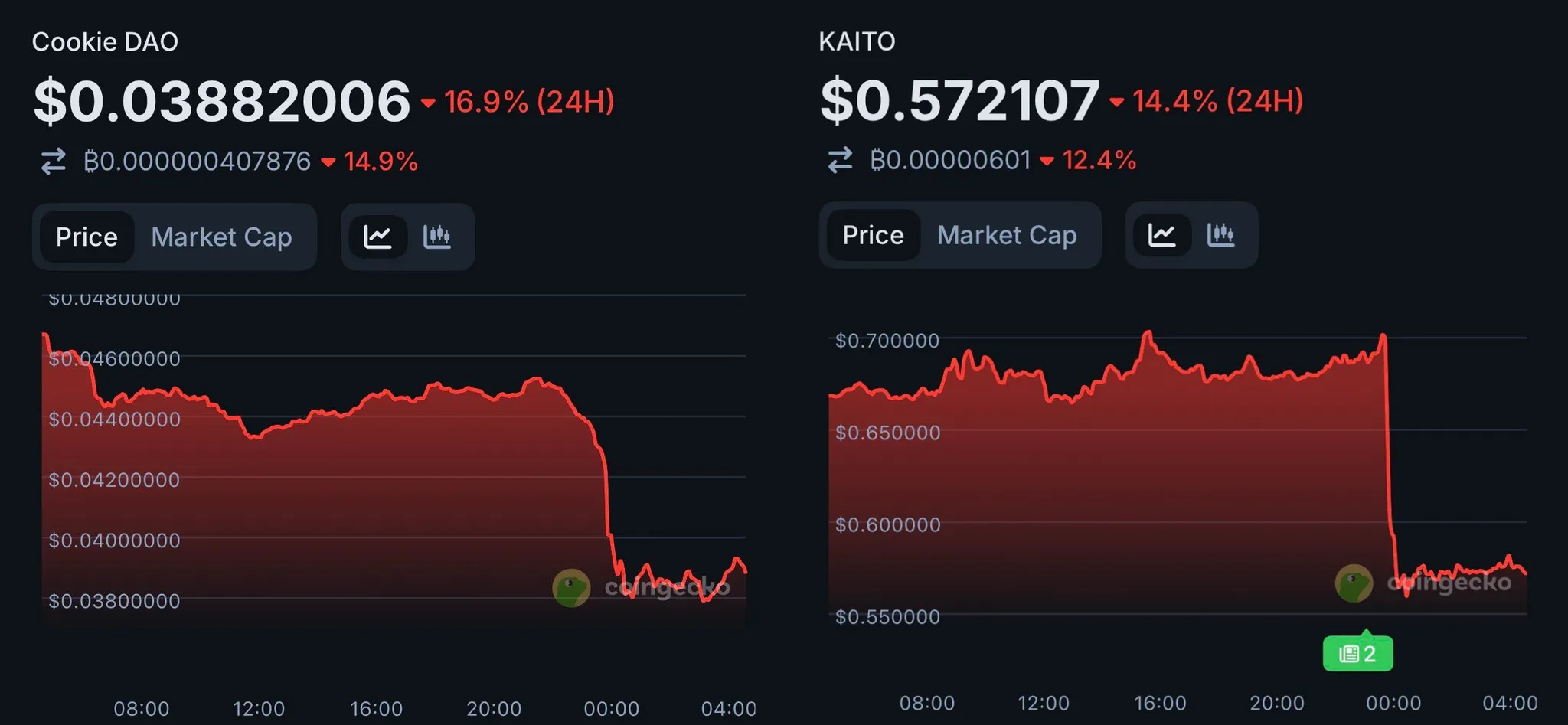
The strong reaction from InfoFi-related applications and tokens indicates that the impact of this change far exceeds a routine rule adjustment. It has altered the operational foundation of related applications and triggered a chain reaction in the market. This is not a minor tweak but a clear statement from X regarding a specific category of application models.

What Happened: X Formally Rejects the InfoFi Incentive Model

This time, X did not leave much room for explanation for InfoFi.

X's Product Lead, Nikita Bier, posted on the platform stating that X is revising its developer API policy and will no longer allow any applications that "reward users for posting on X" to continue accessing the API. In his statement, these applications were directly labeled as infofi and identified as a primary source of the recent AI spam content and reply pollution on the platform.
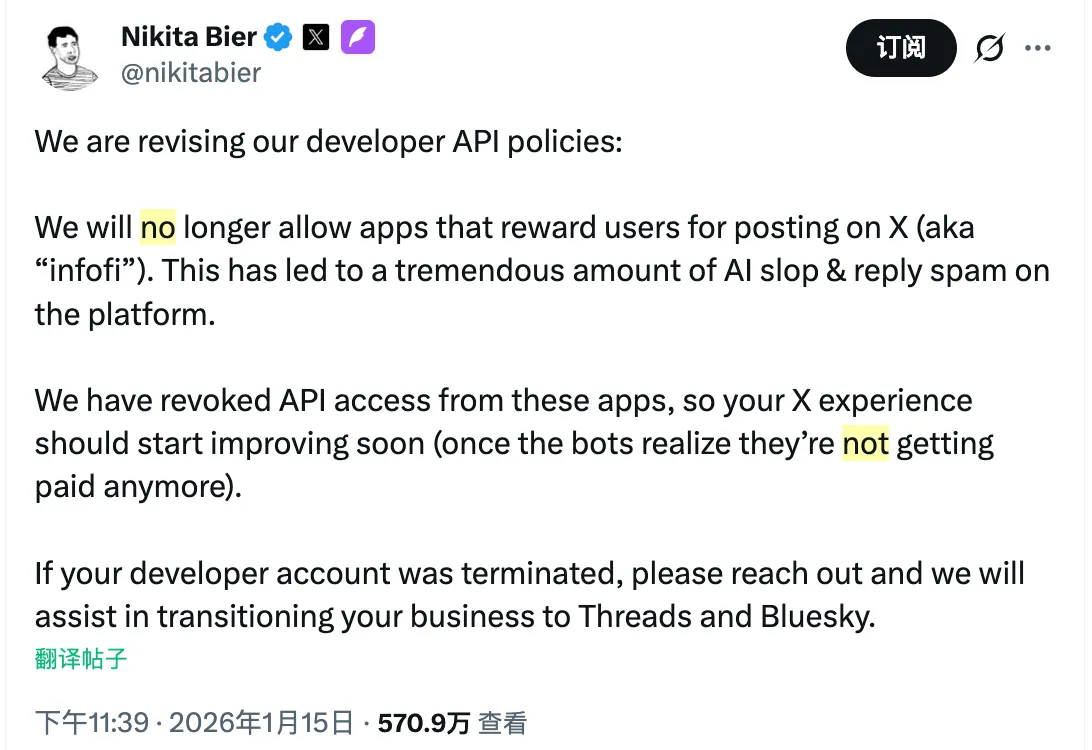
Unlike the "announce first, observe later" approach of previous platform governance, X's action this time was quite direct – API access permissions for related InfoFi applications have been revoked. The official reason given is also not complicated: external incentive mechanisms are driving a flood of task-oriented, templated content into the information feed, severely impacting the platform experience. X believes that once bots realize "there's no more money to be made from posting," the content environment will quickly self-correct.

It is worth noting that Nikita Bier specifically added a rather weighty statement: InfoFi applications had previously paid millions of dollars for API access, but X does not need this revenue.

This statement itself almost serves as a qualitative judgment on InfoFi's business model. Judging from the execution force and official wording, this adjustment is not targeting individual projects abusing the API but is rather a clear and unavoidable negative answer from X regarding the core InfoFi model of "external incentives directly intervening in platform content production."

The "aftermath solution" offered by X's official channels for teams whose developer accounts were terminated is equally telling: the platform will assist their business transition to Threads and Bluesky. In other words, X did not attempt to reform or absorb this incentive mechanism but clearly chose to remove it entirely from its own ecosystem.

What's Being Rejected is Not Content, But InfoFi's Incentive Path

If we only look at the official statement, this adjustment might seem like routine governance targeting AI spam content. But in the context of InfoFi, this reason is clearly insufficient to explain X's resolute stance.

The key issue might not be "whether the content has value," but rather who produces the content and why. The core logic of InfoFi is to directly drive users to perform actions like posting, replying, and interacting on the platform through external token or point incentives. While this model确实 boosts activity in the short term, it also rapidly alienates content production into "task execution." Posting is no longer about expressing opinions but a necessary step to claim rewards.

When the incentive itself is detached from the platform's governance system, the platform inevitably loses control over the motivation and quality of content. InfoFi applications don't care if a reply adds informational value; they only care if it meets the conditions for "settlement." For X, this means the information feed is being taken over by an external economic system.

From this perspective, AI spam is a consequence, not the cause. What truly crosses X's bottom line is the structural problem of "a third-party incentive layer being directly embedded into the platform's content distribution system." Once this model is tacitly approved, the platform's content order, recommendation logic, and even user relationships will gradually be influenced by the incentive designers.

This also explains why X, in this adjustment, left almost no room for InfoFi to reform. It implies that, in X's judgment, InfoFi is not an ecological participant that needs correction but rather a content production path that is no longer permitted to exist.

It is also why this API purge is an active reclamation of X's content sovereignty: when external incentives conflict with the platform experience, X chooses to cut off the former rather than cede control of the information feed.

From "Shutdown" to "Restructuring": The Collective Pivot of InfoFi Projects

X's API revocation did not remain at the policy level; it quickly triggered a chain reaction on the InfoFi project side.

According to Odaily Planet Daily's understanding, the first to provide a clear response was Cookie DAO. After communicating with the X team regarding the API and usage policy, the team announced the official shutdown of the Snaps platform and the termination of all ongoing creator incentive activities. Cookie stated bluntly in the announcement that this was a "difficult and sudden" decision, but the出发点 was not to abandon InfoFi but to ensure its data layer and core products remain compliant.
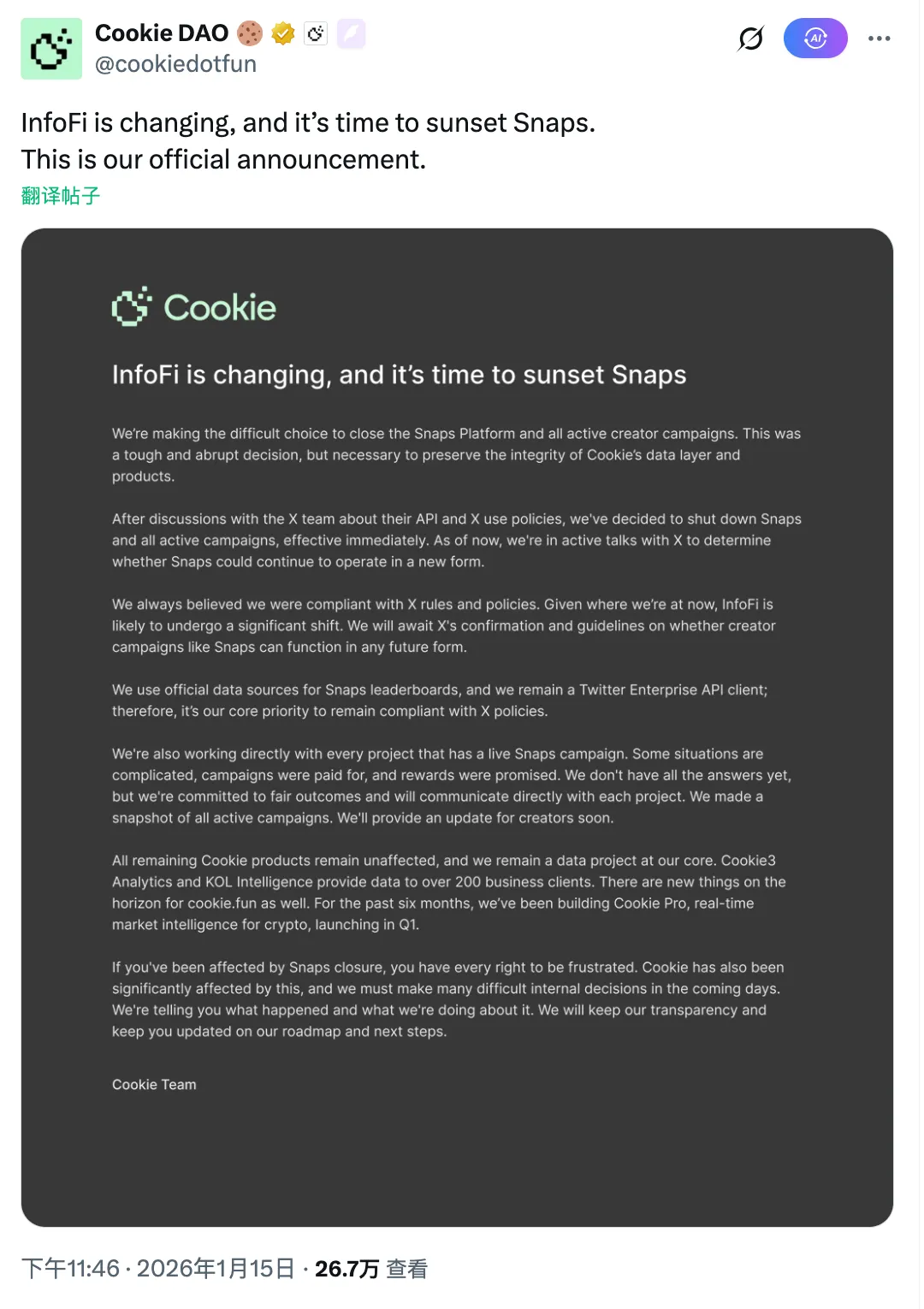
Judging from the wording, the shutdown of Snaps seems more like a passive choice to mitigate losses under the impact of the event. On one hand, Cookie emphasized that it always uses official data sources and remains an enterprise-level API client of X; on the other hand, the team also clearly stated that InfoFi is undergoing structural changes, and whether Snaps can exist in a "new form" still depends on further guidance from X. This wording itself reveals high uncertainty about the sustainability of the original incentive model.

In contrast, Kaito's adjustment appears more proactive. Kaito announced the cessation of Yaps and the incentive leaderboard, simultaneously launching a new Kaito Studio, explicitly bidding farewell to the "open, permissionless incentive distribution" path. According to the official statement, Kaito Studio will be closer to a traditional tiered marketing platform, where brands select creators for collaboration based on established criteria, covering platforms extending from X to YouTube, TikTok, and other social channels.
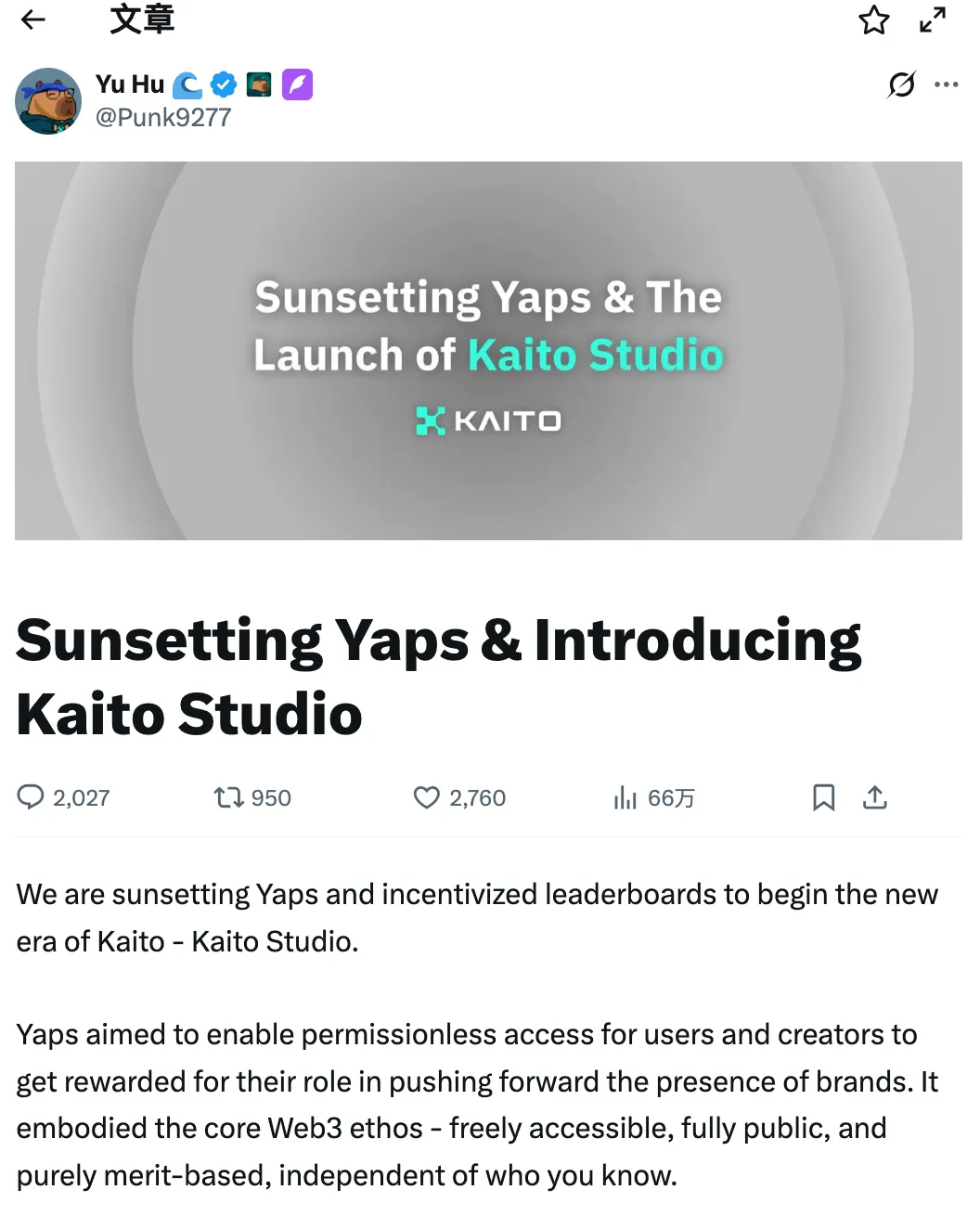
In explaining the reason for the pivot, Kaito did not avoid the problems of the InfoFi model itself. It pointed out that even after continuously raising thresholds and introducing screening mechanisms, low-quality content and刷量行为 (brushing/artificial inflation) were still hard to avoid; after communicating with X, the team also agreed that a "completely permissionless incentive distribution system" no longer meets the common needs of the platform, brands, and creators. Reading between the lines, it can be inferred that the end of Yaps is an active abandonment of the original InfoFi路线 (path).

But in any case, looking at both events together, a clear trend emerges: as the platform layer clearly tightens interface and incentive boundaries, InfoFi projects either choose to pause激进玩法 (aggressive playstyles) and return to data and tool attributes, or simply restructure their business logic, moving closer to models more akin to traditional marketing and content cooperation.

Currently, although token prices have fluctuated, a "collective collapse" of InfoFi projects has not yet occurred. What is certain is that the set of strategies reliant on platform APIs, driving posts and interactions directly through external incentives, can hardly continue to operate.

Conclusion: The Era of 'Mouth Farming' Ends, But InfoFi's Problems Remain

Judging from the reactions of the InfoFi projects, this change is not simply a "ban" or a "failure." Whether it's Cookie returning to its data layer positioning or Kaito pivoting to a Studio model closer to traditional marketing, it indicates that: InfoFi has not disappeared; it just can no longer exist in the form of "in-platform incentive arbitrage."

The so-called "end of the mouth farming era" does not mean the end of content being quantified or influence being priced, but rather the end of that open incentive path reliant on APIs, where the act of posting and replying itself was the settlement object. Against the backdrop of platforms reasserting sovereignty, the marginal space for this model is rapidly shrinking.

As for migrating to Threads or Bluesky, it seems more like a buffer solution than an answer itself. The real question is whether future InfoFi can find an irreplaceable value position without taking over the platform's content production rights.

X is just the first platform to explicitly press the button, but the signal it sends is clear enough: Content sovereignty is returning to the platforms.


Preguntas relacionadas

QWhat was the main announcement made by X that impacted the InfoFi community?

AX revoked API access for InfoFi applications that rewarded users for posting on the platform, effectively ending the 'post-to-earn' incentive model.

QWho is Nikita Bier and what role did they play in this update?

ANikita Bier is X's Product Lead who announced the revision of the developer API policy, stating that applications incentivizing users to post on X would no longer be allowed API access.

QWhat reason did X provide for revoking API access from InfoFi applications?

AX cited that these applications were a major source of AI-generated spam and low-quality content, which degraded the platform's user experience.

QHow did InfoFi-related tokens like KAITO and COOKIE react to the news?

AInfoFi-related tokens such as KAITO and COOKIE experienced significant price drops, with some falling by double digits shortly after the announcement.

QWhat alternative platforms did X suggest for affected InfoFi applications?

AX suggested that affected InfoFi applications transition their operations to Threads and Bluesky as alternative platforms.

Lecturas Relacionadas

The Shutdown of Claude Mythos Revealed the True Cost of Renting AI to Me

The sudden shutdown of Claude Mythos this week starkly highlights a critical, often overlooked risk for founders: when your core capability relies entirely on someone else's platform, your fate is not in your own hands. The key question becomes: who truly owns the intelligence your product depends on? For years, the debate around open-source models focused on cost. Now, the evidence is clear: fine-tuned open-source models can achieve frontier-level quality for specific, mission-critical tasks at a fraction of the cost. However, the deeper issue is control. Relying on a third-party API is like renting; it works until the landlord changes the rules, raises the rent, or asks you to leave—as Mythos experienced. The lesson is not to stop using frontier models—they are incredible infrastructure. The goal is ownership. Ownership means starting with a powerful open-source model and shaping it around what makes your company unique: your data, workflows, domain expertise, and definition of "good." Over time, the model becomes less generic and more reflective of your business, creating durable value. The optimistic conclusion is that AI's future doesn't hinge on one superior model. There is no single frontier. The frontier includes proprietary models, models fine-tuned on company-specific knowledge, specialized models for narrow problems, and intelligent routers orchestrating model ensembles. The most interesting development is not models getting smarter, but intelligence becoming increasingly customizable. The winning companies will be those that transform intelligence into a unique, owned asset. Looking ahead, the vision is not one model dominating all, but many teams owning the part of the frontier that matters most to them.

marsbitHace 23 min(s)

The Shutdown of Claude Mythos Revealed the True Cost of Renting AI to Me

marsbitHace 23 min(s)

Tiger Research: U.S. Strategic Bitcoin Reserve - Should the Market Be Happy or Disappointed?

Tiger Research analyzes the evolution of U.S. legislative efforts regarding a strategic Bitcoin reserve, concluding the market impact is limited in the short term but potentially positive long-term. The core event was a March 2025 executive order by former President Trump, which designated confiscated Bitcoin as a strategic reserve and promised not to sell existing holdings (approx. 190k BTC). As it contained no mandate to purchase new Bitcoin, the market reacted negatively, with prices dropping 5.7%. Legislative history shows a significant retreat from initial ambitions. The 2024 "BITCOIN Act" proposed mandatory purchases of 1 million BTC over five years. Reintroduced in 2025, it stalled due to high fiscal costs, concerns over dollar hegemony, and opposition from the Treasury Secretary. The current frontrunner, the 2026 "American Retirement and Monetary Advancement (ARMA) Act," is a compromise. It lacks any purchase requirement, instead focusing on consolidating existing government-held Bitcoin and legally prohibiting its sale for at least 20 years. While ARMA has higher passage odds due to bipartisan support and no purchase mandate, its immediate market effect is neutral. It eliminates potential government selling pressure but creates no new demand. The long-term significance is that formally establishing Bitcoin as a national reserve asset in law could later reignite debates on mandatory purchases. Therefore, the path to a government buyer is longer than initially priced by the market, but the directional narrative remains intact.

marsbitHace 26 min(s)

Tiger Research: U.S. Strategic Bitcoin Reserve - Should the Market Be Happy or Disappointed?

marsbitHace 26 min(s)

US Stock Market Trend (June 16): SpaceX Rises 42% in Two Days, New Fed Chairman Takes Office Today

**U.S. Stocks Trend (June 16): SpaceX Soars 42% in Two Days, New Fed Chair Takes Office Today** Markets surged on Monday following former President Trump's social media announcement of a completed U.S.-Iran deal to reopen the Strait of Hormuz, pending a June 19 signing. The news triggered a broad risk-on rally: oil prices crashed, tech stocks soared, bond yields fell, and defensive sectors lagged. **Market Performance:** The Nasdaq jumped 3.07%, led by semiconductor stocks like Micron (+9.2%). The S&P 500 gained 1.65%, and the Dow rose 0.92% to a record high. However, the Russell 2000 small-cap index underperformed (+0.72%). SpaceX continued its hot streak, rising another 5% pre-market after disclosures of large buys by an Australian billionaire and Cathie Wood's ARK. Boeing also rallied on the transportation optimism. Conversely, energy stocks like Chevron fell over 3% on the oil price plunge, with other defensive sectors also selling off. The day's action showed a clear rotation of funds from energy/defensive plays into AI and tech narratives. **Macro & Outlook:** The VIX fear index fell 8.37%. Treasury yields declined, and WTI crude dropped over 5%. Attention now shifts to a packed schedule: the Bank of Japan is widely expected to hike rates to 1.0% on Tuesday. The Fed's June meeting concludes Wednesday, marking new Chair Wash's debut. While rates are expected to hold, his tone on stubborn inflation and the "dot plot" will be crucial for gauging the 2024 rate path. The formal Iran deal signing is set for Friday. **Trend Perspective:** While the peace deal is a genuine positive, Monday's explosive rally may have gotten ahead of itself, pricing in a swift resolution to inflation concerns. The shortened trading week faces a triple test: BoJ tightening, the Fed's policy stance, and deal implementation details. Tech and semiconductors, which led the surge, remain vulnerable to any disappointment from these key events. The real price discovery begins with the central banks' communications this week.

marsbitHace 47 min(s)

US Stock Market Trend (June 16): SpaceX Rises 42% in Two Days, New Fed Chairman Takes Office Today

marsbitHace 47 min(s)

Trading

Spot
Futuros

Artículos destacados

Cómo comprar ERA

¡Bienvenido a HTX.com! Hemos hecho que comprar Caldera (ERA) sea simple y conveniente. Sigue nuestra guía paso a paso para iniciar tu viaje de criptos.Paso 1: crea tu cuenta HTXUtiliza tu correo electrónico o número de teléfono para registrarte y obtener una cuenta gratuita en HTX. Experimenta un proceso de registro sin complicaciones y desbloquea todas las funciones.Obtener mi cuentaPaso 2: ve a Comprar cripto y elige tu método de pagoTarjeta de crédito/débito: usa tu Visa o Mastercard para comprar Caldera (ERA) al instante.Saldo: utiliza fondos del saldo de tu cuenta HTX para tradear sin problemas.Terceros: hemos agregado métodos de pago populares como Google Pay y Apple Pay para mejorar la comodidad.P2P: tradear directamente con otros usuarios en HTX.Over-the-Counter (OTC): ofrecemos servicios personalizados y tipos de cambio competitivos para los traders.Paso 3: guarda tu Caldera (ERA)Después de comprar tu Caldera (ERA), guárdalo en tu cuenta HTX. Alternativamente, puedes enviarlo a otro lugar mediante transferencia blockchain o utilizarlo para tradear otras criptomonedas.Paso 4: tradear Caldera (ERA)Tradear fácilmente con Caldera (ERA) en HTX's mercado spot. Simplemente accede a tu cuenta, selecciona tu par de trading, ejecuta tus trades y monitorea en tiempo real. Ofrecemos una experiencia fácil de usar tanto para principiantes como para traders experimentados.

386 Vistas totalesPublicado en 2025.07.17Actualizado en 2026.06.02

Cómo comprar ERA

Discusiones

Bienvenido a la comunidad de HTX. Aquí puedes mantenerte informado sobre los últimos desarrollos de la plataforma y acceder a análisis profesionales del mercado. A continuación se presentan las opiniones de los usuarios sobre el precio de ERA (ERA).

活动图片












