Wuhan is About to Witness Its Largest IPO in History

marsbitPublicado a 2026-08-24Actualizado a 2026-08-24

Resumen

Wuhan is poised for its largest-ever IPO as Yangtze Memory Technologies Co., Ltd. (YMTC) has officially applied for a listing on the Shanghai Stock Exchange's STAR Market, seeking to raise 33 billion yuan. The domestic leader in 3D NAND flash memory chips completed its IPO辅导 (tutoring) process in a record three months, with market expectations valuing the company at 300 billion yuan or higher. YMTC's roots trace back to 2006 with the founding of Wuhan Xinxin. After surviving the global financial crisis and periods of operational difficulty, the company was formally established in 2016 through a joint investment involving Tsinghua Unigroup, the National Integrated Circuit Industry Investment Fund (the "Big Fund"), and local Hubei government funds. With a distinct "national team" background, its major shareholders include provincial and municipal state-owned assets committees and the Big Fund. Based in Wuhan's Optics Valley (East Lake High-tech Development Zone), YMTC's potential listing highlights the region's rise as a tech hub. Optics Valley is already home to 72 listed companies and has ambitious plans to exceed 100 by 2030. The zone recently established four industry-focused母基金 (mother funds) totaling 18 billion yuan to further boost sectors like integrated circuits and optoelectronics. YMTC's IPO would complete the "Optics Valley Seven Stars," a group of leading local optoelectronic and communication giants.

By Rongzhong Finance

Another super IPO is on the way.

Recently, the Shanghai Stock Exchange website showed that the IPO review status of Yangtze Memory Technologies Co., Ltd. on the STAR Market has changed to "Accepted." The company plans to raise 33 billion yuan, with CITIC Securities and China Securities as its sponsors.
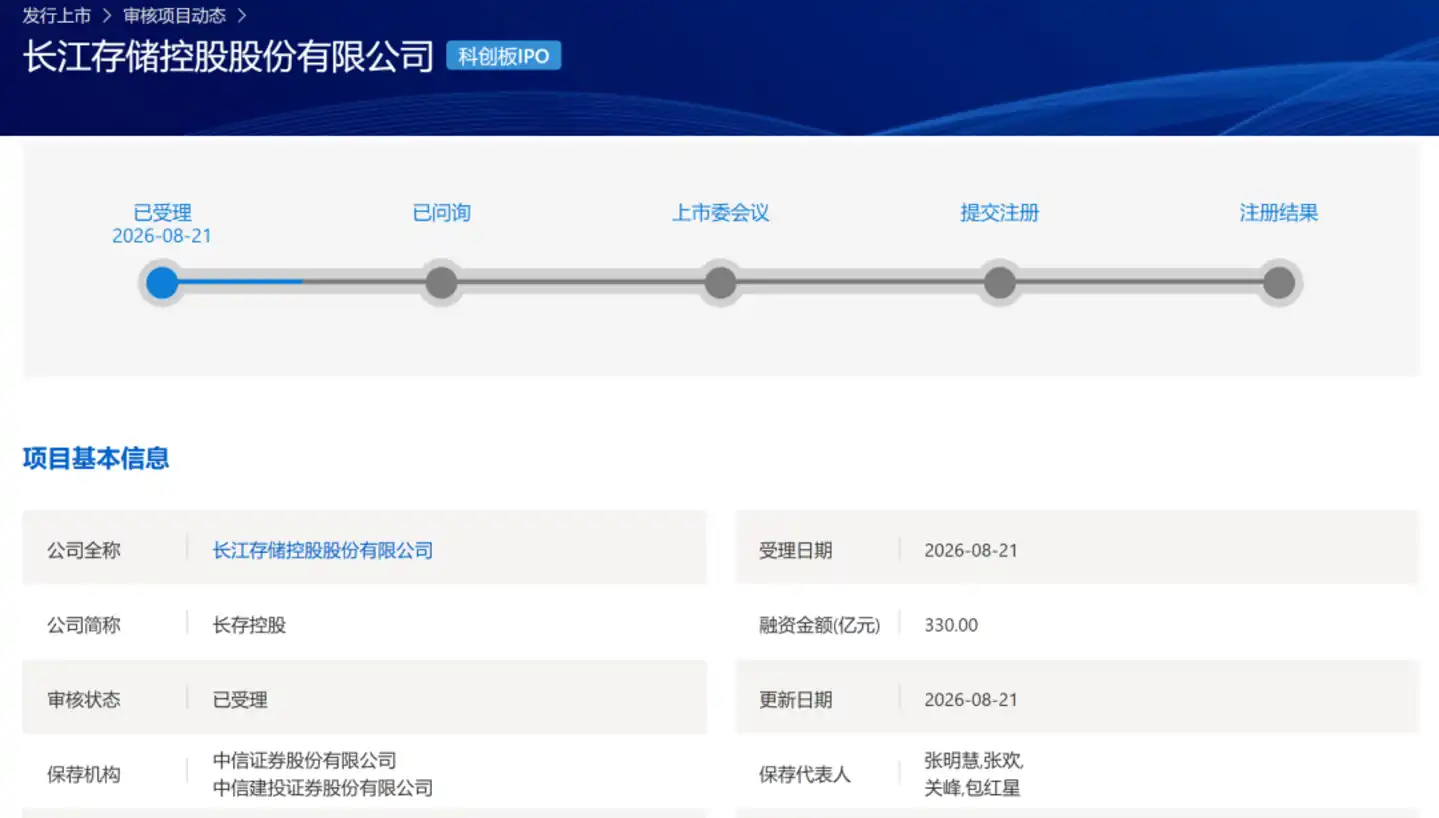
From completing the tutoring filing on May 19th to passing the tutoring acceptance on August 19th, Yangtze Memory took only three months, setting a record for the speed of IPO tutoring in the semiconductor industry. At the same time, this brings it closer to the title of "Wuhan's largest IPO in history." Previously, the Hurun Research Institute's "2025 Global Unicorn List" showed Yangtze Memory's valuation at 160 billion yuan. With the IPO process advancing, market expectations have been revised upwards to 300 billion yuan or even higher.

As we can see, this domestic-only 3D NAND flash memory IDM manufacturer is pushing Wuhan's Optics Valley into the spotlight of the capital market.

A Decade Sharpening the 'Memory Chip'

The story of Yangtze Memory is generally considered to have begun in 2016, but to understand where this hundred-billion behemoth unicorn came from, the clock needs to be turned back to 2000.

That year, the State Council issued the "No. 18 Document" on the integrated circuit industry, triggering the first wave of chip entrepreneurship in China. The landmark event was the return of "the father of Chinese chips," Zhang Rujing, to mainland China to found SMIC. Around the same time, Wuhan began planning to develop its integrated circuit industry.

The difficulty was considerable. Back then, Wuhan's traditional industry was dominated by steel. As a central city, it urgently needed to find an industrial engine for the next decade. Wuhan's leaders ambitiously looked toward this unfamiliar track. Zou Xuecheng, Director of the Research Center for Very Large Scale Integrated Circuits and Systems at Huazhong University of Science and Technology, later told the Yangtze River Daily, "If we don't do this, Hubei and Wuhan will have no name on the map of China's future semiconductor industry."

So, Wuhan spent two years fully preparing, contacting over a dozen well-known domestic and international chip manufacturers seeking cooperation. In 2006, an opportunity arose when SMIC executives were invited to inspect Wuhan. After repeated studies and expert evaluations, it was finally decided that the provincial, municipal, and East Lake High-tech Development Zone governments would jointly invest to establish XMC (Wuhan Xinxin Semiconductor Manufacturing Corp.), with the goal of building the first 12-inch integrated circuit production line in central China. Initially, it was fully managed by SMIC.

Looking back from a god's-eye perspective, this plan was not unanimously approved at the expert evaluation meeting at the time. The reason for opposition was simple: "An investment scale of tens of billions of yuan is too small, lacking economies of scale to be profitable, and the full-process management model is not conducive to subsequent independent development."

But amid such controversy, Phase I of XMC—the first 12-inch integrated circuit production line in central China—was established. According to statistics, provincial and municipal government investments at the time totaled 10.7 billion yuan, accounting for nearly one-tenth of Hubei Province's total state-owned economic investment that year. This production line, which started operations in 2008, coincidentally hit the global financial crisis. Affected by it, the semiconductor industry fell into a downturn, and XMC was severely hit upon its debut.

To survive, the company once shifted to manufacturing for the American flash memory manufacturer Spansion, relying on China's manufacturing cost advantages to secure orders. However, Spansion soon went bankrupt, plunging XMC back into dire straits. At that time, SMIC itself was struggling and unable to continue injecting capital. International giants like TSMC and Micron once eyed this production line, intending to take advantage of the situation.

As the saying goes, "No destruction, no construction." At the last critical moment, the Wuhan government chose to persist, deciding to develop XMC independently. In 2011, both parties established a joint venture; in 2013, SMIC officially withdrew. Wuhan East Lake High-tech Development Zone strongly invited Yang Shining, who had served as SMIC's COO and worked at Intel for over a decade, to become XMC's CEO. The company began to explore the market independently, and its 3D flash memory technology gradually caught up with international giants like SK Hynix, Micron, and Toshiba.

Thus, with the support of the new CEO and Wuhan's "national team," XMC secured orders from important clients like GigaDevice and gradually gained a foothold. In 2014, the National Integrated Circuit Industry Investment Fund launched a second round of large-scale investment in the domestic semiconductor industry. Wuhan decided to "gamble once more" in the memory track. After multiple efforts, in March 2016, the National Memory Base, with a total investment of approximately $24 billion, officially landed in Wuhan Optics Valley. Local media press releases described it as "the largest single high-tech industry investment project in our province since the founding of the People's Republic of China."

On July 26th of the same year, based on XMC, Yangtze Memory Technologies Co., Ltd. was established through joint investment by Tsinghua Unigroup, the National Integrated Circuit Industry Investment Fund, Hubei Guoxin Industry Investment Fund, and Hubei Provincial Science & Technology Investment Group.

Counting from the establishment of XMC in 2006 to the birth of Yangtze Memory in 2016, Wuhan's layout in the memory industry took a full decade.

Massive 'National Team' Background

Looking at the equity structure, Yangtze Memory currently has no controlling shareholder or actual controller.

Before the issuance, Hubei Changsheng is the largest shareholder, holding 26.54%; Xinfei Technology holds 25.35%; the National Integrated Circuit Industry Investment Fund Phase I and Phase II hold 11.97% and 11.38%, respectively; Optics Valley Industry Investment and Guoxin Fund hold 9.25% and 5.90%, respectively.

The prospectus states that the shareholding ratios of the four major shareholders holding more than 10% are relatively close, and none exceed 30%, meaning no single shareholder can significantly influence shareholder meeting resolutions. "During the reporting period, the main capital contributors behind the upward tracing of the company's major shareholders are the Hubei Provincial State-owned Assets Supervision and Administration Commission, Wuhan Municipal State-owned Assets Supervision and Administration Commission, East Lake High-tech Development Zone Management Committee, Big Fund Phase I, and Big Fund Phase II."

Reviewing Yangtze Memory's financing history, one can directly see its distinct "national team" colors.
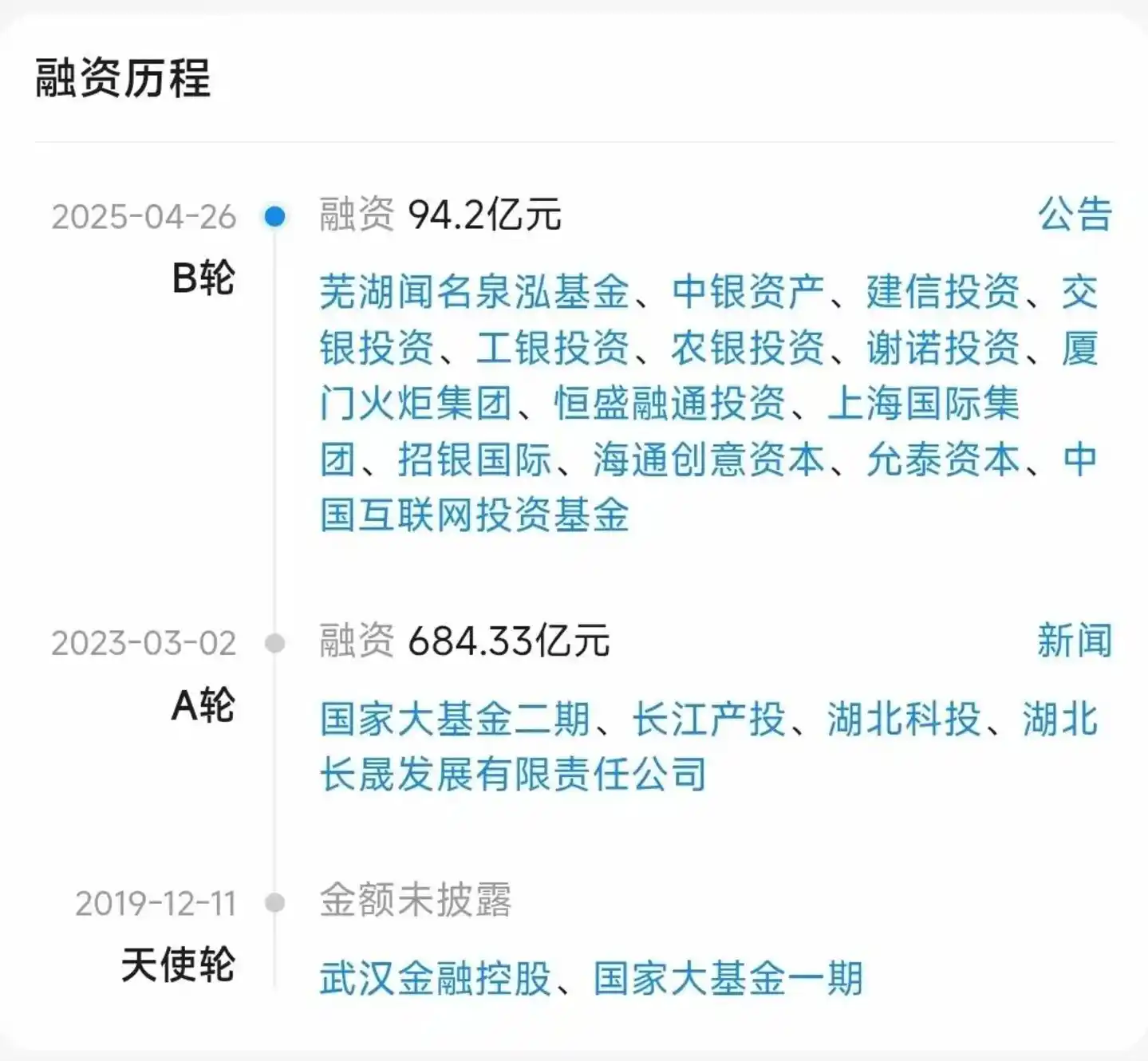
Qichacha data shows that in December 2019, the company completed its Angel round of financing, with Wuhan Financial Holdings and the National Big Fund Phase I investing. In March 2023, the company completed its Series A financing, raising 68.433 billion yuan, with the National Big Fund Phase II, Changjiang Industry Investment, Hubei Science & Technology Investment, and Hubei Changsheng entering successively. In April 2025, the company completed its Series B financing of 9.42 billion yuan. The investor lineup further expanded to include over ten institutions such as Wuhu Wenming Quanhong Fund, BOC Asset Management, CCB Investment, BoCom Investment, ICBC Investment, ABC Investment, Xienuo Investment, Xiamen Torch Group, Hengsheng Rongtong Investment, Shanghai International Group, CMBI, Haitong Creative Capital, Yuntai Capital, and China Internet Investment Fund.

The combined scale of these three rounds of financing far exceeds that of general market-oriented projects, also indirectly confirming the national-team nature of this company's capital structure. The aforementioned employee持股 platforms "Wuhan Zhixin Plan No. 1" to "No. 6" were implemented alongside the shareholding system reform around the Series B round, binding the core technical team to the company's long-term development.

Behind this continuously bolstered shareholder list is the direct financial support from the provincial, municipal, and East Lake High-tech Development Zone governments over a decade, on multiple occasions. Now, as the IPO enters the acceptance stage, this early investment spanning ten years is about to be priced by the capital market. According to estimates, the shares held by Wuhan's state-owned assets through various platforms alone, once Yangtze Memory successfully goes public, are expected to be worth hundreds of billions of yuan on paper, with paper gains being incalculable.

Optics Valley, More IPOs Are on the Way

Undoubtedly, if all goes smoothly, Wuhan will reap the city's largest IPO in history. For this enterprise, whose every step of growth bears the imprint of its locality, its location, "Optics Valley," is also pushed into the spotlight of the capital market.

As of June this year, Optics Valley has gathered 72 listed companies. The total market value of domestic and foreign listed companies has exceeded 1.8 trillion yuan, accounting for about one-third of Hubei Province's and over 60% of Wuhan's total.

Optics Valley authorities have stated more than once, "Listed companies are the main force of technological innovation, the strong engine of industrial development, and the spokesperson of urban vitality in Optics Valley." Centered on this positioning, Optics Valley has successively introduced special policies in recent years such as the "Action Plan for High-quality Development of Listed Companies," the "New 15 Articles for IPOs," and the "10 Articles for Venture Capital," established the Central China Service Base of the Beijing Stock Exchange, and launched the "IPO Seedling Loan" for technology-based SMEs, with single loans up to 50 million yuan supported by financing. The government sets up a risk compensation fund for financial institutions, with the proportion reaching up to 30%.

Currently, this report card is only a阶段性 achievement, as Optics Valley's latest goal has been updated—by 2030, the total number of listed enterprises in Optics Valley aims to exceed 100, and the number of companies with a market value of 100 billion yuan aims to double compared to the current number, reaching 8.

The liveliness of the secondary market cannot be sustained without the接力 of primary market investment; it is also a consensus that the source of活水 must first flow into early-stage projects. The latest move occurred at the World Optics Valley Science and Technology Financial Ecology Co-construction Conference held on June 27th.

At this conference, Optics Valley established four industrial-focused mother funds in one go, with a total scale of 18 billion yuan, targeting four major directions: optoelectronics information, life health, integrated circuits, and future industries. According to the plan, by 2030, these four mother funds will leverage a new fund cluster of no less than 100 billion yuan, driving total investment exceeding 300 billion yuan.

It is worth noting that tracks that sound distant, such as photonic integration, embodied intelligence, and quantum technology, have already been提前布局 by Optics Valley. Among them, Liuxin Optoelectronics' 8-inch wafer photonic integration chip technology is industry-leading; Yuwei Optics' full-spectrum industrial LiDAR and high-precision ranging products are already among the top domestic enterprises; Langyi Robot specializes in the "embodied cerebellum" for humanoid robots, and its products have become the first choice for many national robotics companies... The list goes on and on.

Moreover, new candidates are continuously being produced under this system. According to disclosures from Optics Valley, since 2026, there have been at least 40公开融资 events for tech companies in the region, covering seed rounds from the million-yuan level to industrial rounds in the billion-yuan level. In the past three years, Optics Valley's technology credit has累计 provided support exceeding 300 billion yuan to nearly 6,000 enterprises, with 426 registered funds in the region. These enterprises that have received financial support are the reserve army for the "Optics Valley sector."

Currently, the "Optics Valley Seven Stars," represented by seven optical communication giants including Yangtze Memory, Changfei Fiber, Huagong Tech, Accelink, FiberHome, Guide Infrared, and CITIC Mobile, are整链崛起 at an unprecedented speed and姿态. Among them, Yangtze Memory is the only unlisted company among the "Optics Valley Seven Stars." As its IPO process advances further, Optics Valley will also welcome the团圆时刻 of the "Seven Stars" in the capital market.


Criptos en tendencia

Preguntas relacionadas

QWhat is the current status of Yangtze Memory Technologies Co., Ltd.'s IPO application on the Shanghai Stock Exchange?

AThe IPO application of Yangtze Memory Technologies Co., Ltd. on the Shanghai Stock Exchange has been updated to 'accepted'.

QHow much capital does Yangtze Memory Technologies Co., Ltd. plan to raise through its IPO?

AYangtze Memory Technologies Co., Ltd. plans to raise 33 billion yuan through its IPO.

QWhat is Yangtze Memory's business focus and its significance in the domestic market?

AYangtze Memory is China's only 3D NAND flash memory IDM (Integrated Device Manufacturer).

QWhich are the major state-backed shareholders in Yangtze Memory Technologies Co., Ltd. prior to the IPO?

AMajor state-backed shareholders include Hubei Changsheng (26.54%), Xinfei Technology (25.35%), National Integrated Circuit Industry Investment Fund Phase I (11.97%) and Phase II (11.38%), Optics Valley Industry Investment (9.25%), and Guoxin Fund (5.90%).

QWhat is the future goal for the number of listed companies in Optics Valley by 2030?

AOptics Valley aims to have the total number of listed companies exceed 100 by 2030.

Lecturas Relacionadas

Bessent's True Agenda

U.S. Treasury Secretary Besant's recent interventions in the bond market are seen by some as an attempt to artificially trigger a massive short squeeze before the midterm elections. The alleged goal is to push the 10-year yield toward 5% initially, then use covering by short sellers to drive it down to around 4.3%, providing political breathing room for the Trump administration. Analysts point to near-record short positions held by CTA trend-following funds. According to Goldman Sachs data, a price rally of two standard deviations could trigger historically large short-covering. Besant's tactics reportedly include bond buybacks, shifting issuance toward shorter-term debt, and potentially canceling ultra-long bond auctions to pressure these market positions. So far, interventions like modest buybacks have had limited effect on yields, with the Treasury later hinting at using its General Account (TGA) cash for support. Critics argue these measures cannot address structural pressures like large deficits and high inflation. Instead, the strategy appears tactical—aimed at buying time and exploiting technical market vulnerabilities rather than reversing the underlying yield trend. The political timeline is clear: achieve lower yields ahead of the midterms to help lower mortgage rates and craft a favorable narrative. However, analysts warn that once the election passes, structural upward pressure on yields and equity valuations could reassert themselves more forcefully. Market signals suggest this potential short-squeeze dynamic could intensify in the coming days.

marsbitHace 47 min(s)

Bessent's True Agenda

marsbitHace 47 min(s)

Jackson Hole Speech Preview: Is the Fed Seeking Justification for a Rate Hike?

"Jackson Hole Speech Preview: Is the Fed Looking for Reasons to Raise Rates?" Ahead of the key Jackson Hole symposium, Federal Reserve officials and the IMF are signaling heightened concern over persistent inflation, with some advocating for tighter policy. Boston Fed President Susan Collins, in a recent article, supported holding rates steady only if evidence of falling inflation continues. Otherwise, she argues for prompt tightening, noting inflation has been above target for over five years and warning that prolonged deviation could entrench consumer expectations. Although not a voting member this year, her stance aligns with several officials; three FOMC voters dissented in July, favoring a rate hike. Richmond Fed's Tom Barkin warned of a future "reckoning" regarding the $40 trillion public debt, while IMF Managing Director Kristalina Georgieva urged central banks to maintain a laser focus on price stability. The core dilemma lies in the sources of inflation: Trump-era tariffs, Middle East conflict-driven oil prices, and surging AI investment. Collins believes the first two factors are fading, but identifies AI infrastructure spending as exerting "upward pressure" on core goods inflation. The problem is that interest rate hikes primarily curb demand, not these supply-side shocks. Georgieva framed it as a "tug of war" between negative supply shocks from the Middle East and positive demand shocks from AI. Meanwhile, economic data shows strain. The August Consumer Confidence Index fell to a seven-month low of 89.4. While the present situation index improved, future expectations plummeted. Consumers expect higher inflation (5.8% vs. 5.6% last month), likely influenced by high gas prices. Other data points are weak: July retail sales saw the largest drop in over a year, and job growth stalled. Key upcoming events include the July PCE inflation data (expected to remain well above the 2% target) and new Fed Chair Kevin Warsh's first major speech at Jackson Hole. Market pricing remains conflicted, showing a high probability of a December hike but expecting no move in September. Gold prices, however, have surged over 7% to near three-month highs, signaling market anxiety.

marsbitHace 1 hora(s)

Jackson Hole Speech Preview: Is the Fed Seeking Justification for a Rate Hike?

marsbitHace 1 hora(s)

Today, HYPE Activates Its Second Buyback Engine

"Hyperliquid Activates Second Buyback Engine with AQAv2 Launch" On August 26th, Hyperliquid officially activated its Aligned Quote Assets v2 (AQAv2) mechanism, introducing a major new source of revenue and buyback power for its native token, HYPE. Unlike the existing revenue stream from trading fees, AQAv2 generates income by sharing approximately 90% of the adjusted reserve earnings from stablecoins (primarily USDC) circulating on the Hyperliquid chain. This income is settled every 30 days and automatically funneled into the Assistance Fund for HYPE buybacks, with the first expected distribution on October 3rd. Through a partnership with Circle (issuer of USDC) and Coinbase (treasury manager), Hyperliquid leverages its user base and financial infrastructure to share in the yield generated by stablecoin reserves. This transforms its liquidity and distribution capabilities into a scalable business model. Initial estimates project AQAv2 could generate $150-200 million in annual buyback funds, based on the current ~$6.43 billion USDC supply on Hyperliquid and an assumed reserve yield. Crucially, this revenue is weakly correlated with trading activity and grows directly with the platform's stablecoin adoption. With HYPE recently reaching an all-time high, AQAv2 provides a new fundamental support layer. It shifts Hyperliquid's value capture beyond just transaction fees, anchoring HYPE's long-term buyback potential to the expanding scale of its stablecoin ecosystem.

marsbitHace 1 hora(s)

Today, HYPE Activates Its Second Buyback Engine

marsbitHace 1 hora(s)

NVIDIA Earnings Preview: The Market No Longer Expects a Positive Surprise

NVIDIA's upcoming earnings report has seen market expectations shift from anticipating big positive surprises to seeking clarity on capital allocation and future growth sustainability. While analysts forecast Q2 revenue near doubling year-over-year to $92.18 billion, option markets are pricing in a relatively muted post-earnings stock move of around 5.4%—the lowest implied volatility in two years. This reflects a growing sense that the phase of massive AI-driven earnings beats and stock surges may be ending. This year, NVIDIA's stock has slightly underperformed the S&P 500 and significantly lagged the semiconductor index. Analysts now emphasize the need for more than just beating estimates. Key investor focuses include details on how NVIDIA will deploy its capital, maintain its exceptional gross margins amid rising costs, and use its substantial free cash flow for investments and share buybacks. The forward P/E ratio of about 21x suggests the market is already pricing in a growth deceleration. NVIDIA's recent strategic moves—like facilitating massive AI financing, guaranteeing loans for data center projects (including a major one for OpenAI), and investing in power infrastructure—have positioned it beyond a mere chipmaker. However, this raises questions about potential "circular financing," where revenue might be artificially supported by lending to customers. The health of its AI clients, like OpenAI which reported slowing revenue growth, is now crucial. The report arrives amid a challenging backdrop: political pushback against AI data centers, rising borrowing costs, and massive debt-funded spending by cloud giants. Investors are keenly watching for signals on the transition to the new Blackwell and upcoming Vera Rubin architectures and, ultimately, whether the explosive demand for AI is losing momentum.

marsbitHace 1 hora(s)

NVIDIA Earnings Preview: The Market No Longer Expects a Positive Surprise

marsbitHace 1 hora(s)

Trading

Spot

Artículos destacados

Qué es $S$

Entendiendo SPERO: Una Visión General Completa Introducción a SPERO A medida que el panorama de la innovación continúa evolucionando, la aparición de tecnologías web3 y proyectos de criptomonedas juega un papel fundamental en la configuración del futuro digital. Un proyecto que ha atraído la atención en este campo dinámico es SPERO, denotado como SPERO,$$s$. Este artículo tiene como objetivo reunir y presentar información detallada sobre SPERO, para ayudar a entusiastas e inversores a comprender sus fundamentos, objetivos e innovaciones dentro de los dominios web3 y cripto. ¿Qué es SPERO,$$s$? SPERO,$$s$ es un proyecto único dentro del espacio cripto que busca aprovechar los principios de descentralización y tecnología blockchain para crear un ecosistema que promueva la participación, la utilidad y la inclusión financiera. El proyecto está diseñado para facilitar interacciones de igual a igual de nuevas maneras, proporcionando a los usuarios soluciones y servicios financieros innovadores. En su esencia, SPERO,$$s$ tiene como objetivo empoderar a los individuos al proporcionar herramientas y plataformas que mejoren la experiencia del usuario en el espacio de las criptomonedas. Esto incluye habilitar métodos de transacción más flexibles, fomentar iniciativas impulsadas por la comunidad y crear caminos para oportunidades financieras a través de aplicaciones descentralizadas (dApps). La visión subyacente de SPERO,$$s$ gira en torno a la inclusividad, buscando cerrar brechas dentro de las finanzas tradicionales mientras aprovecha los beneficios de la tecnología blockchain. ¿Quién es el Creador de SPERO,$$s$? La identidad del creador de SPERO,$$s$ sigue siendo algo oscura, ya que hay recursos públicos limitados que proporcionan información de fondo detallada sobre su(s) fundador(es). Esta falta de transparencia puede derivarse del compromiso del proyecto con la descentralización, una ética que muchos proyectos web3 comparten, priorizando las contribuciones colectivas sobre el reconocimiento individual. Al centrar las discusiones en torno a la comunidad y sus objetivos colectivos, SPERO,$$s$ encarna la esencia del empoderamiento sin señalar a individuos específicos. Como tal, comprender la ética y la misión de SPERO sigue siendo más importante que identificar a un creador singular. ¿Quiénes son los Inversores de SPERO,$$s$? SPERO,$$s$ cuenta con el apoyo de una diversa gama de inversores que van desde capitalistas de riesgo hasta inversores ángeles dedicados a fomentar la innovación en el sector cripto. El enfoque de estos inversores generalmente se alinea con la misión de SPERO, priorizando proyectos que prometen avances tecnológicos sociales, inclusión financiera y gobernanza descentralizada. Estas fundaciones de inversores suelen estar interesadas en proyectos que no solo ofrecen productos innovadores, sino que también contribuyen positivamente a la comunidad blockchain y sus ecosistemas. El respaldo de estos inversores refuerza a SPERO,$$s$ como un contendiente notable en el dominio de proyectos cripto que evoluciona rápidamente. ¿Cómo Funciona SPERO,$$s$? SPERO,$$s$ emplea un marco multifacético que lo distingue de los proyectos de criptomonedas convencionales. Aquí hay algunas de las características clave que subrayan su singularidad e innovación: Gobernanza Descentralizada: SPERO,$$s$ integra modelos de gobernanza descentralizada, empoderando a los usuarios para participar activamente en los procesos de toma de decisiones sobre el futuro del proyecto. Este enfoque fomenta un sentido de propiedad y responsabilidad entre los miembros de la comunidad. Utilidad del Token: SPERO,$$s$ utiliza su propio token de criptomoneda, diseñado para servir diversas funciones dentro del ecosistema. Estos tokens permiten transacciones, recompensas y la facilitación de servicios ofrecidos en la plataforma, mejorando la participación y la utilidad general. Arquitectura en Capas: La arquitectura técnica de SPERO,$$s$ apoya la modularidad y escalabilidad, permitiendo la integración fluida de características y aplicaciones adicionales a medida que el proyecto evoluciona. Esta adaptabilidad es fundamental para mantener la relevancia en el cambiante paisaje cripto. Participación de la Comunidad: El proyecto enfatiza iniciativas impulsadas por la comunidad, empleando mecanismos que incentivan la colaboración y la retroalimentación. Al nutrir una comunidad sólida, SPERO,$$s$ puede abordar mejor las necesidades de los usuarios y adaptarse a las tendencias del mercado. Enfoque en la Inclusión: Al ofrecer tarifas de transacción bajas e interfaces amigables para el usuario, SPERO,$$s$ busca atraer a una base de usuarios diversa, incluyendo a individuos que anteriormente pueden no haber participado en el espacio cripto. Este compromiso con la inclusión se alinea con su misión general de empoderamiento a través de la accesibilidad. Cronología de SPERO,$$s$ Entender la historia de un proyecto proporciona información crucial sobre su trayectoria de desarrollo y hitos. A continuación se presenta una cronología sugerida que mapea eventos significativos en la evolución de SPERO,$$s$: Fase de Conceptualización e Ideación: Las ideas iniciales que forman la base de SPERO,$$s$ fueron concebidas, alineándose estrechamente con los principios de descentralización y enfoque comunitario dentro de la industria blockchain. Lanzamiento del Whitepaper del Proyecto: Tras la fase conceptual, se lanzó un whitepaper completo que detalla la visión, los objetivos y la infraestructura tecnológica de SPERO,$$s$ para generar interés y retroalimentación de la comunidad. Construcción de Comunidad y Primeras Interacciones: Se realizaron esfuerzos de divulgación activa para construir una comunidad de primeros adoptantes y posibles inversores, facilitando discusiones en torno a los objetivos del proyecto y obteniendo apoyo. Evento de Generación de Tokens: SPERO,$$s$ llevó a cabo un evento de generación de tokens (TGE) para distribuir sus tokens nativos a los primeros seguidores y establecer liquidez inicial dentro del ecosistema. Lanzamiento de la dApp Inicial: La primera aplicación descentralizada (dApp) asociada con SPERO,$$s$ se puso en marcha, permitiendo a los usuarios interactuar con las funcionalidades centrales de la plataforma. Desarrollo Continuo y Alianzas: Actualizaciones y mejoras continuas a las ofertas del proyecto, incluyendo alianzas estratégicas con otros actores en el espacio blockchain, han moldeado a SPERO,$$s$ en un jugador competitivo y en evolución en el mercado cripto. Conclusión SPERO,$$s$ se erige como un testimonio del potencial de web3 y las criptomonedas para revolucionar los sistemas financieros y empoderar a los individuos. Con un compromiso con la gobernanza descentralizada, la participación comunitaria y funcionalidades diseñadas de manera innovadora, allana el camino hacia un paisaje financiero más inclusivo. Como con cualquier inversión en el espacio cripto que evoluciona rápidamente, se anima a los posibles inversores y usuarios a investigar a fondo y participar de manera reflexiva con los desarrollos en curso dentro de SPERO,$$s$. El proyecto muestra el espíritu innovador de la industria cripto, invitando a una mayor exploración de sus innumerables posibilidades. Mientras el viaje de SPERO,$$s$ aún se desarrolla, sus principios fundamentales pueden, de hecho, influir en el futuro de cómo interactuamos con la tecnología, las finanzas y entre nosotros en ecosistemas digitales interconectados.

452 Vistas totalesPublicado en 2024.12.17Actualizado en 2024.12.17

Qué es $S$

Qué es AGENT S

Agent S: El Futuro de la Interacción Autónoma en Web3 Introducción En el paisaje en constante evolución de Web3 y las criptomonedas, las innovaciones están redefiniendo constantemente cómo los individuos interactúan con las plataformas digitales. Uno de estos proyectos pioneros, Agent S, promete revolucionar la interacción humano-computadora a través de su marco agente abierto. Al allanar el camino para interacciones autónomas, Agent S busca simplificar tareas complejas, ofreciendo aplicaciones transformadoras en inteligencia artificial (IA). Esta exploración detallada profundizará en las complejidades del proyecto, sus características únicas y las implicaciones para el dominio de las criptomonedas. ¿Qué es Agent S? Agent S se presenta como un marco agente abierto innovador, diseñado específicamente para abordar tres desafíos fundamentales en la automatización de tareas informáticas: Adquisición de Conocimiento Específico del Dominio: El marco aprende inteligentemente de diversas fuentes de conocimiento externas y experiencias internas. Este enfoque dual le permite construir un rico repositorio de conocimiento específico del dominio, mejorando su rendimiento en la ejecución de tareas. Planificación a Largo Plazo de Tareas: Agent S emplea planificación jerárquica aumentada por la experiencia, un enfoque estratégico que facilita la descomposición y ejecución eficiente de tareas complejas. Esta característica mejora significativamente su capacidad para gestionar múltiples subtareas de manera eficiente y efectiva. Manejo de Interfaces Dinámicas y No Uniformes: El proyecto introduce la Interfaz Agente-Computadora (ACI), una solución innovadora que mejora la interacción entre agentes y usuarios. Utilizando Modelos de Lenguaje Multimodal de Gran Escala (MLLMs), Agent S puede navegar y manipular diversas interfaces gráficas de usuario sin problemas. A través de estas características pioneras, Agent S proporciona un marco robusto que aborda las complejidades involucradas en la automatización de la interacción humana con las máquinas, preparando el terreno para una multitud de aplicaciones en IA y más allá. ¿Quién es el Creador de Agent S? Si bien el concepto de Agent S es fundamentalmente innovador, la información específica sobre su creador sigue siendo elusiva. El creador es actualmente desconocido, lo que resalta ya sea la etapa incipiente del proyecto o la elección estratégica de mantener a los miembros fundadores en el anonimato. Independientemente de la anonimidad, el enfoque sigue siendo en las capacidades y el potencial del marco. ¿Quiénes son los Inversores de Agent S? Dado que Agent S es relativamente nuevo en el ecosistema criptográfico, la información detallada sobre sus inversores y patrocinadores financieros no está documentada explícitamente. La falta de información disponible públicamente sobre las bases de inversión u organizaciones que apoyan el proyecto plantea preguntas sobre su estructura de financiamiento y hoja de ruta de desarrollo. Comprender el respaldo es crucial para evaluar la sostenibilidad del proyecto y su posible impacto en el mercado. ¿Cómo Funciona Agent S? En el núcleo de Agent S se encuentra una tecnología de vanguardia que le permite funcionar de manera efectiva en diversos entornos. Su modelo operativo se basa en varias características clave: Interacción Humano-Computadora Similar a la Humana: El marco ofrece planificación avanzada de IA, esforzándose por hacer que las interacciones con las computadoras sean más intuitivas. Al imitar el comportamiento humano en la ejecución de tareas, promete elevar las experiencias de los usuarios. Memoria Narrativa: Empleada para aprovechar experiencias de alto nivel, Agent S utiliza memoria narrativa para hacer un seguimiento de las historias de tareas, mejorando así sus procesos de toma de decisiones. Memoria Episódica: Esta característica proporciona a los usuarios una guía paso a paso, permitiendo que el marco ofrezca apoyo contextual a medida que se desarrollan las tareas. Soporte para OpenACI: Con la capacidad de ejecutarse localmente, Agent S permite a los usuarios mantener el control sobre sus interacciones y flujos de trabajo, alineándose con la ética descentralizada de Web3. Fácil Integración con APIs Externas: Su versatilidad y compatibilidad con varias plataformas de IA aseguran que Agent S pueda encajar sin problemas en ecosistemas tecnológicos existentes, convirtiéndolo en una opción atractiva para desarrolladores y organizaciones. Estas funcionalidades contribuyen colectivamente a la posición única de Agent S dentro del espacio cripto, ya que automatiza tareas complejas y de múltiples pasos con una intervención humana mínima. A medida que el proyecto evoluciona, sus posibles aplicaciones en Web3 podrían redefinir cómo se desarrollan las interacciones digitales. Cronología de Agent S El desarrollo y los hitos de Agent S pueden encapsularse en una cronología que resalta sus eventos significativos: 27 de septiembre de 2024: El concepto de Agent S fue lanzado en un documento de investigación integral titulado “Un Marco Agente Abierto que Usa Computadoras Como un Humano”, mostrando las bases del proyecto. 10 de octubre de 2024: El documento de investigación fue puesto a disposición del público en arXiv, ofreciendo una exploración profunda del marco y su evaluación de rendimiento basada en el benchmark OSWorld. 12 de octubre de 2024: Se lanzó una presentación en video, proporcionando una visión visual de las capacidades y características de Agent S, involucrando aún más a posibles usuarios e inversores. Estos marcadores en la cronología no solo ilustran el progreso de Agent S, sino que también indican su compromiso con la transparencia y la participación comunitaria. Puntos Clave Sobre Agent S A medida que el marco Agent S continúa evolucionando, varios atributos clave destacan, subrayando su naturaleza innovadora y potencial: Marco Innovador: Diseñado para proporcionar un uso intuitivo de las computadoras similar a la interacción humana, Agent S aporta un enfoque novedoso a la automatización de tareas. Interacción Autónoma: La capacidad de interactuar de manera autónoma con las computadoras a través de GUI significa un salto hacia soluciones informáticas más inteligentes y eficientes. Automatización de Tareas Complejas: Con su metodología robusta, puede automatizar tareas complejas y de múltiples pasos, haciendo que los procesos sean más rápidos y menos propensos a errores. Mejora Continua: Los mecanismos de aprendizaje permiten a Agent S mejorar a partir de experiencias pasadas, mejorando continuamente su rendimiento y eficacia. Versatilidad: Su adaptabilidad en diferentes entornos operativos como OSWorld y WindowsAgentArena asegura que pueda servir a una amplia gama de aplicaciones. A medida que Agent S se posiciona en el paisaje de Web3 y criptomonedas, su potencial para mejorar las capacidades de interacción y automatizar procesos significa un avance significativo en las tecnologías de IA. A través de su marco innovador, Agent S ejemplifica el futuro de las interacciones digitales, prometiendo una experiencia más fluida y eficiente para los usuarios en diversas industrias. Conclusión Agent S representa un audaz avance en la unión de la IA y Web3, con la capacidad de redefinir cómo interactuamos con la tecnología. Aunque aún se encuentra en sus primeras etapas, las posibilidades para su aplicación son vastas y atractivas. A través de su marco integral que aborda desafíos críticos, Agent S busca llevar las interacciones autónomas al primer plano de la experiencia digital. A medida que nos adentramos más en los reinos de las criptomonedas y la descentralización, proyectos como Agent S sin duda desempeñarán un papel crucial en la configuración del futuro de la tecnología y la colaboración humano-computadora.

843 Vistas totalesPublicado en 2025.01.14Actualizado en 2025.01.14

Qué es AGENT S

Cómo comprar S

¡Bienvenido a HTX.com! Hemos hecho que comprar Sonic (S) sea simple y conveniente. Sigue nuestra guía paso a paso para iniciar tu viaje de criptos.Paso 1: crea tu cuenta HTXUtiliza tu correo electrónico o número de teléfono para registrarte y obtener una cuenta gratuita en HTX. Experimenta un proceso de registro sin complicaciones y desbloquea todas las funciones.Obtener mi cuentaPaso 2: ve a Comprar cripto y elige tu método de pagoTarjeta de crédito/débito: usa tu Visa o Mastercard para comprar Sonic (S) al instante.Saldo: utiliza fondos del saldo de tu cuenta HTX para tradear sin problemas.Terceros: hemos agregado métodos de pago populares como Google Pay y Apple Pay para mejorar la comodidad.P2P: tradear directamente con otros usuarios en HTX.Over-the-Counter (OTC): ofrecemos servicios personalizados y tipos de cambio competitivos para los traders.Paso 3: guarda tu Sonic (S)Después de comprar tu Sonic (S), guárdalo en tu cuenta HTX. Alternativamente, puedes enviarlo a otro lugar mediante transferencia blockchain o utilizarlo para tradear otras criptomonedas.Paso 4: tradear Sonic (S)Tradear fácilmente con Sonic (S) en HTX's mercado spot. Simplemente accede a tu cuenta, selecciona tu par de trading, ejecuta tus trades y monitorea en tiempo real. Ofrecemos una experiencia fácil de usar tanto para principiantes como para traders experimentados.

1.6k Vistas totalesPublicado en 2025.01.15Actualizado en 2026.06.02

Cómo comprar S

Discusiones

Bienvenido a la comunidad de HTX. Aquí puedes mantenerte informado sobre los últimos desarrollos de la plataforma y acceder a análisis profesionales del mercado. A continuación se presentan las opiniones de los usuarios sobre el precio de S (S).

活动图片