‘Wrong approach’ – Crypto lobby rejects Wall Street’s tighter DeFi rules for tokenized securities

ambcryptoPublicado a 2026-04-08Actualizado a 2026-04-08

Resumen

The Blockchain Association (BA) has strongly opposed a proposal from Citadel Securities and traditional finance (SIFMA) calling for stricter regulation of DeFi protocols that handle tokenized securities. In a letter to the SEC, the BA argued that applying existing securities laws, which are designed for intermediaries, to neutral decentralized infrastructure is the "wrong approach." While affirming that tokenized securities are still securities, the BA emphasized that the SEC should consider how modern blockchain technology works before regulating, rather than automatically classifying DeFi infrastructure as exchanges or brokers. This pushback aligns with earlier criticism from the DeFi Education Fund (DEF). Citadel and SIFMA, however, maintain that all platforms handling tokenized securities must be under regulatory oversight to ensure a level playing field and investor protection, regardless of whether they are custodial or decentralized. The outcome hinges on the SEC's decision, which could potentially be challenged in court if it is not codified by the CLARITY Act.

The DeFi sector is doubling down on its pushback against the Citadel-led call for barring decentralized protocols from blanket regulatory exemption.

In a letter to the U.S SEC on Monday, the Blockchain Association (BA) termed Citadel’s proposed regulation of DeFi protocols handling tokenized assets as a “wrong approach.”

The BA is an advocacy and an umbrella group with key industry members, including Coinbase. In the letter, the BA rebutted,

Securities laws regulate intermediaries. They do not automatically turn neutral infrastructure into an exchange, broker, or dealer simply because that infrastructure is part of a tokenized market.

The lobby group added that the DeFi sector is not after a “free pass.” However, it asked the SEC to consider how the underlying tech works before regulating any DeFi protocol.

The digital asset industry is not asking for a free pass. Tokenized securities are still securities. The question is whether the SEC will apply the law in a way that reflects how modern infrastructure actually works.

Tokenized securities are an on-chain version of traditional securities, but traded via blockchain rails.

Citadel wants everyone to play by the rules

Intriguingly, the BA’s request for the SEC to consider how “modern blockchain infrastructure design” works is what Citadel and SIFMA (broader TradFi group) are against. For the TradFi players, the SEC must ensure a level playing field through a “neutral technology” framework.

For them, the issue is not whether a DeFi venue is custodial (controlled by the developer) or not. What’s crucial, they added, is that every platform handling tokenized securities must be under oversight just like traditional intermediaries.

According to critics of the proposed innovation exemption, investor protections in the DeFi world, which is full of scams and rug pulls, can only be ensured by regulations.

Last week, another crypto lobby, the DeFi Education Fund (DEF), castigated SIFMA and Citadel’s call for regulation of AMMs (automated market makers), which are deemed decentralized platforms by experts.

It remains to be seen which route the SEC will take and whether the disgruntled side will sue the agency for its decision on the innovation exemption.

Even so, if the agency’s rulemaking or guidelines related to DeFi exemptions aren’t codified via the CLARITY Act, then they could still be disputed in court. For instance, Roman Storm, the developer behind Tornado Cash with no control over the crypto mixer, is still facing a retrial.


Final Summary

  • Blockchain Association has joined DeFi Education Fund to fend off Citadel and Wall Street’s push for regulations of decentralized protocols.
  • The DeFi lobby groups pleaded with the SEC to consider the neutral nature of decentralized protocols before attempting to regulate them.

Preguntas relacionadas

QWhat is the main argument of the Blockchain Association (BA) against Citadel's proposed DeFi regulations?

AThe Blockchain Association argues that Citadel's proposed regulation is a 'wrong approach,' stating that securities laws regulate intermediaries and should not automatically turn neutral infrastructure into an exchange, broker, or dealer simply because it is part of a tokenized market.

QAccording to the article, what do Citadel and SIFMA believe is crucial for platforms handling tokenized securities?

ACitadel and SIFMA believe that every platform handling tokenized securities must be under regulatory oversight, just like traditional intermediaries, to ensure a level playing field through a 'neutral technology' framework.

QWhat specific request did the Blockchain Association make to the SEC regarding DeFi regulation?

AThe Blockchain Association asked the SEC to consider how the underlying technology of 'modern blockchain infrastructure design' works before regulating any DeFi protocol, rather than granting a blanket exemption or applying rules without understanding the tech.

QWhich other crypto lobby group has also opposed Citadel and SIFMA's call for DeFi regulation?

AThe DeFi Education Fund (DEF) has also opposed Citadel and SIFMA's call for regulation, specifically criticizing their push to regulate automated market makers (AMMs).

QWhat potential legal outcome is mentioned if the SEC's rulemaking on DeFi exemptions isn't codified via the CLARITY Act?

AIf the SEC's rulemaking or guidelines related to DeFi exemptions aren't codified via the CLARITY Act, they could still be disputed in court, as seen in the case of Roman Storm, the developer behind Tornado Cash, who is facing a retrial.

Lecturas Relacionadas

The Fed's Interest Rate Decision is Inevitable! Former Senior Fed Advisor Reveals His Forecast for Today!

Former Federal Reserve senior advisor John Faust stated he does not expect the Fed to raise interest rates at the FOMC meeting concluding today. He argued the Fed will not try to win credibility by deliberately surprising markets. In his assessment, Faust noted that Fed Chairman Kevin Warsh has used strong rhetoric on restoring price stability but largely failed to share details on how he plans to achieve it. This information gap has led to various market scenarios. However, Faust believes the reality is simpler: Warsh positions himself as a pragmatic, tough-minded policymaker, placing high importance on monetary policy communication while showing flexibility regarding balance sheet reduction. Faust compared Warsh's approach to the "refined intuitive approach" used by former Chairman Alan Greenspan. Faust stated that, unlike strict policy rules, this approach does not yield clear-cut answers on rate decisions. In current conditions, both a 25-basis-point hike and waiting for the next meeting could be reasonably justified. Aligning with market expectations, Faust predicts the Fed will choose to wait today. He believes the benefit of waiting outweighs the negatives, partly because he agrees that deliberately surprising markets to boost credibility is not a valid factor. Faust also argued there is no substantial macroeconomic difference between hiking today and holding steady, as a 25-basis-point move over eight weeks alone is not economically decisive. He emphasized that the important aspect will not be the decision itself, but how it is explained to markets. Warsh has so far advocated forward-looking policy without clear guidance on economic forecasts or the likely rate path. Faust warned that if the Fed does not explicitly state grounds for a hike and opts to wait for more data, markets may misinterpret the decision's meaning. Regardless of today's outcome, how Warsh explains the policy decisions at the meeting and press conference may be the most critical information for investors.

cryptonews.ruHace 13 min(s)

The Fed's Interest Rate Decision is Inevitable! Former Senior Fed Advisor Reveals His Forecast for Today!

cryptonews.ruHace 13 min(s)

SUI Faces Daily $15 Million Token Unlock, While BEAT Leads $81 Million Token Release Wave This Week

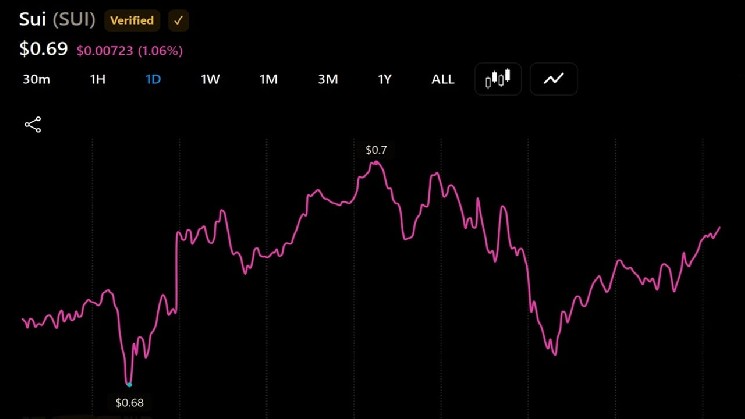
The article discusses significant token unlocks planned for this week in the crypto market. According to Cryptorank, seven assets, including $SUI and $BEAT, are set for major releases. Analyst account Top7 estimates a $74.9 million one-time unlock for $BEAT on August 1, constituting about 2.12% of its circulating supply. $EIGEN and $KITE will also unlock on the same day for $7.65M and $6.08M respectively, with $BTW and $ZAMA following on August 2 for a combined $13.24M. In contrast to these large, concentrated unlocks, the $SUI token follows a different, continuous daily vesting mechanism, distributing approximately $15.4 million worth of tokens weekly into circulation among community reserves, early contributors, and the Mysten Labs treasury. This gradual release is seen as less likely to cause immediate selling pressure compared to one-time events. As of July 29, $SUI trades at $0.69 with a market cap of around $2.78 billion. The piece explains that large unlocks are important for traders as they increase the pool of tokens available for sale, potentially creating downward price pressure if supply outpaces demand. This effect is considered strongest for "cliff" unlocks like $BEAT's. Despite being a regular feature on unlock trackers due to its volume and vesting schedule, $SUI's ecosystem has shown independent growth, including a reported influx of $65 billion in stablecoin volume following a recent fee reduction. A key test will be whether $SUI's price holds steady from August 1-2 amidst the concentrated unlocks of other tokens.

cryptonews.ruHace 24 min(s)

SUI Faces Daily $15 Million Token Unlock, While BEAT Leads $81 Million Token Release Wave This Week

cryptonews.ruHace 24 min(s)

Trading

Spot
活动图片