Worried about AI's Self-Evolution, Anthropic Intends to Stop Training?

marsbitPublicado a 2026-06-05Actualizado a 2026-06-05

Resumen

In early 2026, Anthropic signaled a significant shift in its public narrative regarding AI development timelines and safety. In June, its Anthropic Institute published a detailed article, "When AI builds itself," presenting internal data suggesting accelerating AI self-improvement. Key figures included over 80% of merged code being written by Claude and a 52x speedup in certain optimization tasks. The article outlined three future scenarios, with the most speculative being full recursive self-improvement (RSI), where AI autonomously builds better successors. Anthropic stated RSI is "possible" and may arrive faster than most institutions are prepared for. This narrative pivot followed a series of strategic moves. In January, CEO Dario Amodei wrote about a powerful self-improvement feedback loop. In February, Anthropic revised its Responsible Scaling Policy, removing a core commitment to pause training if capabilities outstripped safety controls, citing the risk of falling behind competitors. This change coincided with reported pressure from the US Department of Defense. By May, Anthropic's valuation had soared to $965 billion. Anthropic's stance was mirrored by other industry leaders. DeepMind CEO Demis Hassabis adjusted his AGI timeline to "by 2029" and admitted to using provocative language like "foothills of the singularity" to create urgency. OpenAI also released a model claiming a key role in its own creation process. The article's carefully calibrated tone—presenting ...

On May 4, 2026, Anthropic co-founder Jack Clark posted a message on the social platform X. His original words were: "I now believe the probability of recursive self-improvement occurring by the end of 2028 is 60%."

Within minutes of the post going live, Eliezer Yudkowsky, a long-time active researcher in AI safety, replied underneath: "Then we will die together." He immediately followed up by citing an analogy pointing to the design flaw of the Chernobyl nuclear reactor RBMK, implying that this system being activated is one no one truly knows how to stop.

This exchange, completed within tens of seconds, lit a match to discussions previously hidden in technical papers and internal assessments. Recursive Self-Improvement (RSI) – where AI systems not only optimize outputs but also autonomously optimize the improvement process itself, ultimately constructing successor systems more powerful than themselves – a concept long relegated to the theoretical margins, was placed by an Anthropic co-founder into a countdown clock with a 60% probability before the end of 2028.

A month later, Anthropic officially published a lengthy article. Titled "When AI builds itself," it was co-authored by Marina Favaro and Jack Clark and published by the newly formed Anthropic Institute in March. Using a series of previously undisclosed internal data and a meticulously calibrated narrative structure, Anthropic handed the outside world a precisely scaled acceleration signal card. This card stated both "we are not there yet" and "but it may arrive faster than most institutions are prepared for."

In the same month, DeepMind CEO Demis Hassabis used a phrasing never before seen in public at the Google I/O stage: humanity stands at the "foothills of the singularity." In subsequent interviews, he adjusted his timeline for Artificial General Intelligence (AGI) from "shortly after 2030" to "2029 is a real possibility," and admitted that his use of dramatic language was "deliberately provocative," aiming to create a sense of urgency for governments, economists, and the public.

Two leading institutions built on a foundation of safety, long serving as forces of restraint in the AI industry, adjusted the volume and scale of their external messaging almost simultaneously. This timing itself needs to be examined as an independent event.

A Meticulously Calibrated Long Article

The long article published by Anthropic on June 4 immediately laid out its narrative goal. It aimed to argue not just a technical trend, but a directional process with acceleration. To this end, it presented a set of previously undisclosed internal data.
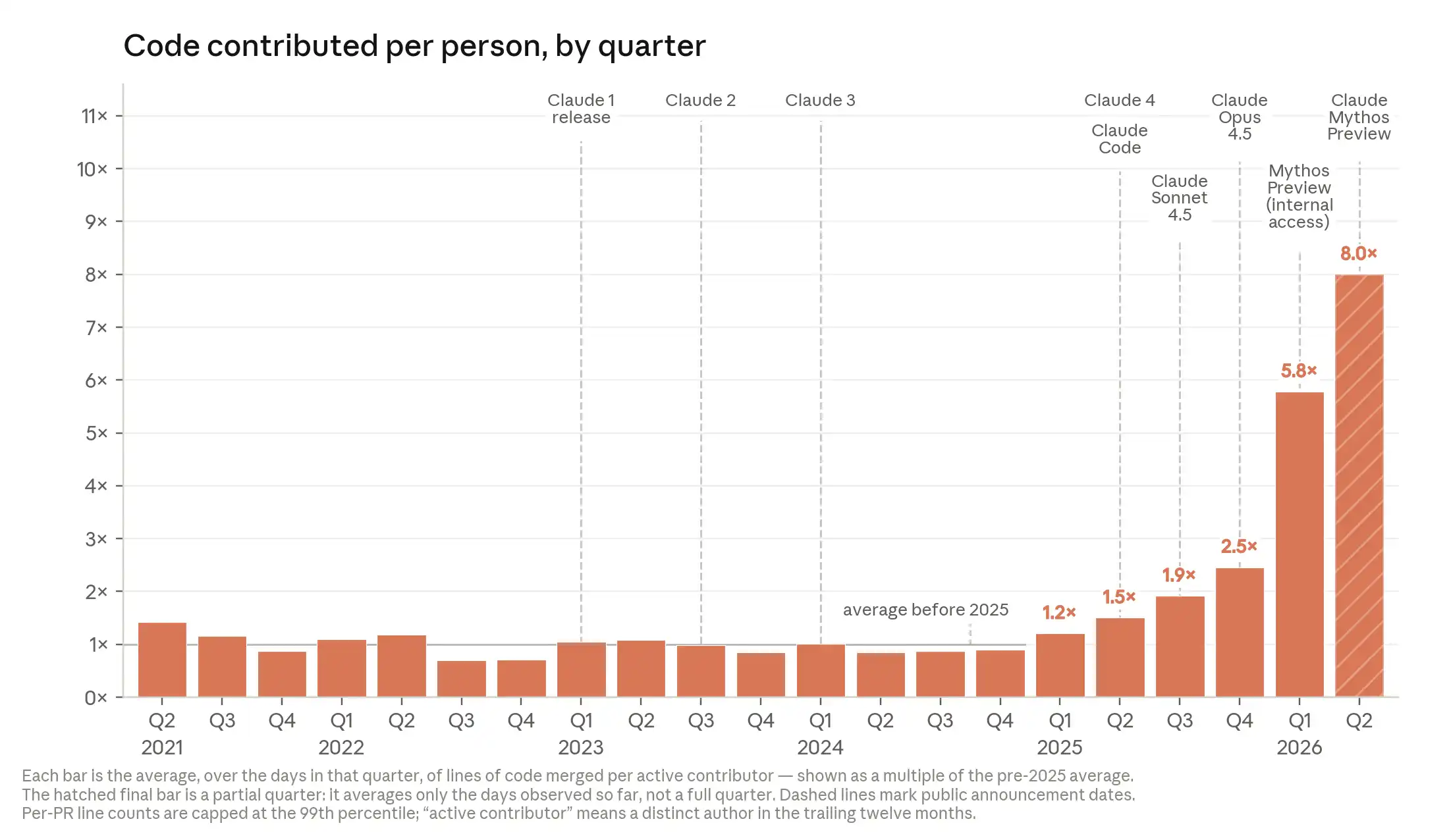
The first set of numbers pointed to a structural change: as of May 2026, over 80% of merged code in Anthropic's codebase was written by Claude. Two years ago, this number was in the low single digits. The same data also showed that in Q2 2026, the typical Anthropic engineer was merging 8 times more code per day than in 2024.

One can imagine the reaction of anyone not deeply tracking the AI industry reading these two numbers for the first time. But Anthropic itself acknowledged several important caveats in footnotes: leadership had publicly estimated that if scripts and experimental code were included, Claude-authored code exceeded 90%; 80% was a more conservative statistic for merged code; lines of code are "an imperfect metric" and might overestimate real productivity gains; the code attribution pipeline itself "has gaps."

The very writing of these footnotes is worth analyzing. Their existence ostensibly serves as honest concessions, but their actual function is to make the numbers in the main text appear to have undergone prudent self-filtering, thus gaining greater credibility. This is a two-tier structure in narrative engineering: the main text releases the signal, the footnotes provide the disclaimer.

The second set of numbers involved speed. On code optimization tasks, Claude Opus 4 achieved approximately a 3x speed-up effect in May 2025, which would take a skilled human researcher 4 to 8 hours to achieve. By April 2026, Claude Mythos Preview pushed this number to approximately 52x. The maximum duration for AI to independently complete tasks also doubled every four months, from 4 minutes in March 2024 to 12 hours in March 2026. The speed of doubling every four months itself constitutes a highly memorable point, easily spread with its implication of geometric progression.
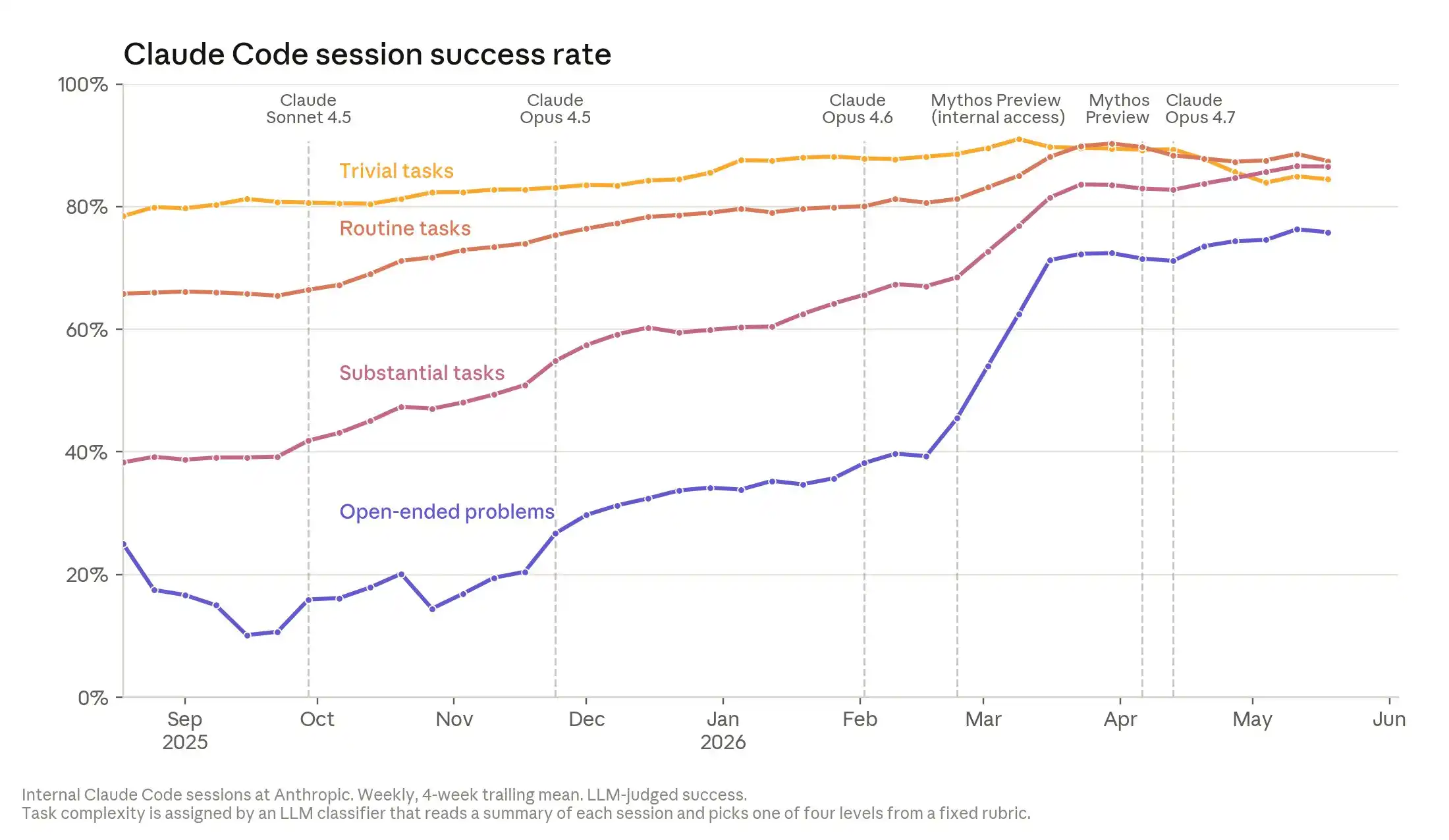
Another set of data came from an internal survey of 130 Anthropic research team employees in March 2026. The median respondent estimated that output using Mythos Preview was about 4 times that of not using AI. A footnote again pointed out that prior independent research by METR suggested developers may generally overestimate AI productivity gains. The same two-tier structure reappeared.

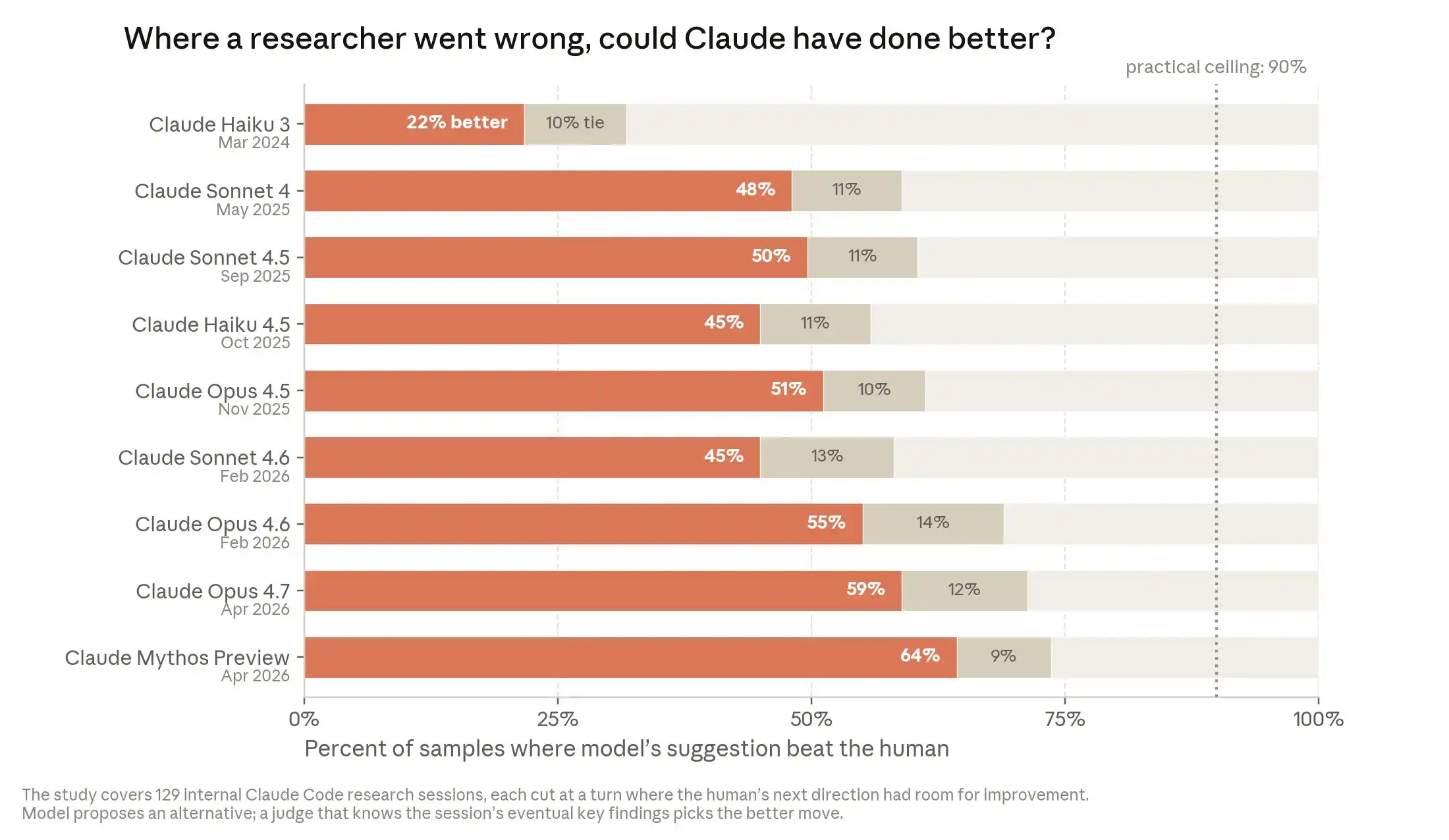
The third set of numbers pointed to AI approaching the boundary of human researcher judgment. In November 2025, Claude Opus 4.5 made better research direction choices than human researchers in 51% of cases. By April 2026, this number rose to 64%. With a sample size of 129 cases, Anthropic explained in a footnote that these were cases deliberately chosen where human choices had room for improvement.

Any single number taken out of context could be placed into different interpretive frameworks. But placed together, the direction is consistent: speed is increasing, the gap is narrowing, and all of this is happening inside Anthropic's own codebase and labs, not theoretical speculation on some external benchmark.

After listing this data, the article presented three future scenarios.

The first is trend stagnation, entering an S-curve plateau. Anthropic's phrasing: "we do not believe this is very likely."

The second is compound efficiency gains, where AI continues to replace humans in broader R&D aspects, but humans still set the direction and define success criteria. Anthropic assessed this as "evidence suggests we are likely heading toward this scenario."

The third is full recursive self-improvement, where AI autonomously designs, trains, and deploys successor systems more powerful than itself, with humans no longer in the loop. The wording is "plausible."

The arrangement order and tone allocation of these three scenarios form a complete narrative gradient. The first is downplayed, serving to accommodate skeptics; the second is anchored in "evidence," lending the article a rational veneer; the third, through "plausible" and conditional "if technological trends continue," pushes the boldest hypothesis to the edge of the reader's imagination without bearing the burden of proof for it.
At the very core of the entire article, Anthropic's stance is compressed into one sentence: "We are not there yet, and recursive self-improvement is not inevitable. But it may arrive faster than most institutions are prepared for."

From 'Willing to Pause' to 'A Unilateral Pause Would Only Let Reckless Actors Catch Up'

If the June 4th long article is a carefully framed snapshot, placing it on a timeline reveals a longer trajectory.

In 2023, Anthropic released its Responsible Scaling Policy (RSP). The core commitment of this policy document was: if model capabilities exceed the company's safety control capabilities, the company will pause training more powerful models. This was not a verbal statement, but an internal governance document with an assessment framework and trigger conditions. This document was once regarded by the AI safety community as an operational sample of "voluntary regulation."

In 2024, CEO Dario Amodei published a widely circulated article, suggesting the possibility of "powerful AI" arriving between 2027 and 2030. At that time, Anthropic still presented itself as an independent safety-minded entity, maintaining a restrained facade towards scale expansion and acceleration narratives.

On January 26, 2026, Amodei published a 38-page article "The Adolescence of Technology" on his personal website. It contained a judgment later repeatedly cited: "Because AI is now writing most of the code inside Anthropic, it is already substantially accelerating our progress toward building the next generation of AI systems. This feedback loop is gaining momentum month by month, and may be only 1 to 2 years away from the current generation of AI autonomously building the next generation." In the same article, he described the impending "powerful AI" as a "genius nation in a data center."

This was almost the starting point for Anthropic to systematically release the signal that a "self-improvement feedback loop is happening." And the timing of this blog post coincided with the company's transition from a $350 billion valuation to a higher valuation range.

Less than a month later, the turn came.

On February 25, 2026, CNN reported that Anthropic had revised its Responsible Scaling Policy, removing the core commitment to "pause training stronger models if capabilities exceed safety control abilities," replacing it with a non-binding "Frontier Safety Roadmap." In the same week, U.S. Secretary of Defense Pete Hegseth issued an ultimatum to Dario Amodei: withdraw the safety red line, or lose a $200 million Department of Defense contract.

The report quoted Anthropic's Chief Scientist Jared Kaplan's response to Time magazine: "We don't think stopping model training actually helps anyone... if competitors are sprinting at full speed." The phrasing in this response is noteworthy. "Doesn't help anyone" is not a technical argument, but a statement of stakeholder calculus. "If competitors are sprinting at full speed" is structurally identical in narrative framing to "a unilateral pause would only let the least cautious actors catch up": it replaces the original pause logic based on one's own safety capabilities with a speed logic based on competitor actions.

Anthropic still emphasized in the CNN report that it retained two red lines: not using AI systems to control weapons systems, and not using them for mass domestic surveillance. This point is important because it shows Anthropic did not abandon its safety stance wholesale, but made selective concessions and defenses across different safety dimensions. However, this selectivity itself is also a core clue in narrative strategy analysis: where it conceded and where it held firm delineates the recalibrated scale of safety.

On March 11, the Anthropic Institute was formally established, led by Jack Clark, positioned as a "public interest research institute." Less than two months later, on May 4, Clark posted the "60%" message.

Once juxtaposed, the signal density and release rhythm of this timeline are not random. From the personal article preview in January, to the policy revision in February, to the institute's establishment in March, to the founder's probability prediction in May, to the official long article release in June, this is a clearly paced, gradually escalating narrative pipeline. One cannot directly conclude "this was all pre-planned" from this, but the sequence itself constitutes a question analysts must confront: does this sense of rhythm indicate that Anthropic has already incorporated the "acceleration narrative" into its public communications management?

Hassabis's Deliberate Provocation

If only Anthropic had adjusted its messaging in the first half of 2026, analysts would have sufficient reason to focus on the internal decision logic of the enterprise. But DeepMind CEO Demis Hassabis made a directionally consistent adjustment almost simultaneously, making the "single enterprise case" argument untenable.

On January 20, at the Davos Forum, Hassabis still maintained his longstanding judgment: a 50% probability of AGI by 2030. Three weeks later, on February 18, at the India AI Impact Summit, he relented: "AGI could arrive within five years."

From May 20 to 22, at Google I/O, Hassabis said in his keynote that humanity stands at the "foothills of the singularity." Around the same time, OpenAI released GPT-5.3-Codex, stating the model "played a key role in its own creation process," specifically including assisting in debugging the training process, managing deployment, and analyzing evaluation results. The timing gap between the three leading labs was compressed to weeks.

After Google I/O, Hassabis gave an interview to Axios. This interview was later widely cited, with the most crucial line being his admission that using language like "foothills of the singularity" was "deliberately provocative," aimed at jolting governments, economists, and the public into recognizing the urgency of AI's accelerating development. He also adjusted his AGI timeline from "shortly after 2030" to "2029 is a real possibility," though still broadly expected around 2030, plus or minus a year.

Hassabis was more direct in an interview with The Seoul Economic Daily: "Five to ten years from now, when we look back at 2026 and 2027, we will say 'that was when we entered the AGI era.'"

The term "deliberately provocative" deserves careful consideration. It is a rare, first-hand confession by a principal actor about narrative intent. It acknowledges that at least some of his chosen phrasing is not a passive reflection of technical facts, but an actively chosen communication tool. This confession itself does not negate that he may also genuinely see a technical inflection point, but it explicitly lifts "narrative" from the shadow of "facts," making it an object that can be examined separately.

Hassabis's self-explanation of his phrasing opens a side door to interpreting this round of synchronized signals. His "deliberate provocation" and the "footnote disclaimers" in Anthropic's lengthy data argument exhibit the same amphibious posture: one hand pushes signals shocking enough to stir public opinion, the other retains a safe space to retreat to "this is just one possibility."

The Same Set of Data, Completely Different Interpretations

While Anthropic and DeepMind jointly constructed a narrative framework of "AI is accelerating its own evolution," external independent researchers offered alternative interpretations of the same set of data and phenomena. These interpretations are important not because any one side possesses ultimate truth, but because they reveal the interpretative range of the official narrative itself.

The sharpest response came from Eliezer Yudkowsky. He not only replied to Jack Clark but also continued to speak out on multiple occasions. A MindStudio blog recorded his complete stance: he used the Chernobyl RBMK reactor as an analogy for the safety design of current AI systems. The core argument of this analogy is that if control rods and accelerators are bound within the same system, attempting to slow down can actually cause the system to lose control faster.

Nathan Lambert of the Allen Institute for AI proposed the concept of "Lossy Self-Improvement" (LSI). His argument directly challenges the "accelerating flywheel" model: as systems become increasingly complex, each generational improvement process creates friction and loss, akin to signal attenuation over long-distance transmission. According to this logic, the improvements that made 80% or 90% AI-authored code possible cannot be infinitely replicated onto the next-generation system, because the next generation will face a more complex problem space, and the noise and errors in the AI's own output will amplify across generations.

Dean Ball, a senior fellow at the Foundation for American Innovation, offered a more direct linguistic framework, dimensionalizing Anthropic's data. He told IEEE Spectrum: "Maybe eventually they'll automate genius, but not next year. Next year they're automating drudgery." This distinction strikes at the core ambiguity of "80% of code written by AI." If AI automates the fixed-pattern parts of a codebase, batch parameter generation, or end-to-end pipeline configuration, then this work indeed corresponds to "drudgery" in software engineering contexts. The remaining 20% might contain architecture design, directional judgment, trade-offs based on incomplete information – these are the genius parts.

David Scott Krueger of the University of Montreal, as founder of the AI safety non-profit Evitable, proposed a pause trigger red line: "99% of code written by AI." He told IEEE Spectrum: "I think we may be crossing that line now." The tension between his framework and Anthropic's already loosened pause commitment is one of the most important structural contradictions in this round of narratives.

UBC computer scientist Jeff Clune, in an interview with IEEE Spectrum, stood in another direction. He said: "We are at an inflection point for recursive self-improvement systems." If his statement were validated, it would mean Yudkowsky's alarm bell rang at the right beat.

Four sets of voices, pointing in different directions, with even internal tension within the same direction. But their commonality lies in the fact that they do not rely on the official narrative framework; instead, they each offer independent judgments on the same set of phenomena based on their own methodologies. The diversity and conflict among these judgments themselves are the most powerful rebuttal to the notion that "any single narrative sufficiently covers the whole truth."

Coupling of Valuation Curves and Narrative Rhythm

In January 2026, Anthropic completed a funding round at a valuation of $350 billion. Investors included Microsoft and Nvidia. This number had been preemptively reported by some media by late 2025, but its formal announcement came right after Amodei published "The Adolescence of Technology."

In February, another $30 billion funding round completed, maintaining the valuation around $350 billion. In the same month, the safety policy was revised, removing the pause commitment. The Pentagon's $200 million contract threat landed.

In May, Reuters, The New York Times, and TechCrunch almost simultaneously reported that Anthropic had completed a $65 billion funding round, reaching a valuation of $965 billion. This number not only exceeded its own valuation two months prior but also surpassed OpenAI's $852 billion valuation from March 2026. The New York Times additionally cited Dario Amodei's remarks at a developer conference, stating the company's annualized revenue reached $30 billion, with him even joking that he "hopes this year's 80x revenue growth doesn't continue, because that would be insane."

On June 4, the Anthropic Institute published the "When AI builds itself" long article.

Lining up these time points is not to imply a precise causal arrow on a chart. Anyone claiming a causal relationship between these things must provide direct evidence. In the absence of internal decision records, no analyst can or should make such assertions.

On the other hand, it is equally unreasonable to not observe and record these correspondences at all. That an enterprise's valuation nearly tripled from $350 billion to $965 billion within five months, while undergoing a major safety policy shift, while constructing a narrative pipeline of "acceleration signals" led by an independent research institute, while its co-founder offered a 60% probability prediction – when all these events are densely compressed within six months, investors at least have the right to ask: To what extent do these signal releases serve the function of conveying the message "we are at the accelerating frontier" to the market?

This inquiry itself is the value of analysis. The answer may never be singular. But once the question is clearly posed, it cannot be easily withdrawn.

Global AI market funding reached $297 billion in Q1 2026, with the top five deals occupying a significant share of that total. At this level, all frontier labs face the same pressure: you need to convince investors that your technology curve will be steeper than your rivals'. Your risk warnings must also be loud enough so that when regulators finally step in to make rules, your voice is pre-embedded into the policy framework. Your narrative must also be attractive enough to make top researchers choose your lab, and alarming enough to maintain your remaining credibility within the safety community.

There are inherent contradictions among these demands. Anthropic's narrative adjustments in the first half of 2026 can be seen as a recalibration of the linguistic balance point among these conflicting demands. The weakening of safety commitments, the strengthening of acceleration signals, and the repeated use of the argument "we cannot unilaterally stop" collectively form a set of vectors pointing in the same direction.

The Signals Are Out, And Then

We must return to the core question: do these signals more resemble reflections of a technical inflection point, or rhetorical escalation aimed at capital and regulation?

Available public evidence does not allow for simply checking a box between the two options. Because the evidence used by both explanations is, in fact, the same set of data. The 80% code share, 52x speed-up, task duration doubling every four months can both support "an inflection point is approaching" and explain "we are communicating a trend perception our own technical staff have personally experienced to the market." The boundary between these is blurred.

But some facts are determinate, requiring no choosing of sides between interpretations.

First, Anthropic's narrative pivot completed in the first half of 2026 is not an isolated case. DeepMind's Hassabis made a directionally consistent, if differing in degree but essentially similar, adjustment almost in the same quarter. OpenAI's Sam Altman said at the India summit "the world is not ready," and in February 2026 released GPT-5.3-Codex, claiming it "played a key role in its own creation process." If this were only Anthropic releasing signals, perhaps analysis from an enterprise strategy perspective would suffice. But three leading labs simultaneously raising their voices within a dense few months constitutes an industry-level narrative shift.

Second, there exists a temporally traceable correspondence between the rhythm of these signal releases and the beats of financing, policy adjustments, and organizational restructuring. This correspondence itself needs to prove nothing; it only needs to be honestly presented. Once presented, each person's inherent methodology will determine what they think next.

Third, Anthropic itself still labels the status of the third scenario, "full recursive self-improvement," as "plausible," not "likely." This means that within the internal judgment framework of the company releasing this data, their acceleration narrative is not yet fully closed. The forces that compel them to habitually include qualifiers in academic papers and blog writing are still pulling the reins on their public phrasing.

Fourth, Hassabis's "deliberate provocation" confession confirms a mechanism long suspected but rarely admitted by the actors themselves: at least some leaders of frontier labs choose their phrasing with explicit communication objectives in mind. This necessitates that all interpretations of their pronouncements must simultaneously analyze two layers: the facts they claim, and the rhetorical strategy they employ in choosing those claims as a behavioral event in itself.

Those who carefully read Anthropic's data-filled article and those who only remember the two numbers "80% of code written by AI" and "52x acceleration" receive vastly different signal strengths. But in this matter, "how it is remembered" might be a more important object of analysis than "what was actually said."

This very article is itself a precise sample of the phenomenon it describes. It constructs a sense of impending acceleration using data, yet retains room for retreat through footnotes and qualifiers; it calls for global coordination and verifiable deceleration, yet has already withdrawn the pause commitment in a prior policy revision. This is not hypocrisy, nor simple inconsistency between words and actions. It is the narrative balancing act of an institution caught between technical uncertainty, commercial pressure, and public responsibility. And Hassabis's "deliberate provocation" confession precisely confirms from the side door that such balancing acts are now a consciously employed method among leading labs.


Preguntas relacionadas

QWhat is recursive self-improvement (RSI) in the context of AI, and why did Anthropic's co-founder's comments about its probability spark significant discussion?

ARecursive self-improvement (RSI) refers to an AI system's ability to not only optimize its outputs but also autonomously improve its own improvement processes, ultimately leading to the creation of successor systems more capable than itself. The discussion was ignited because Anthropic's co-founder, Jack Clark, publicly stated a 60% probability of RSI occurring by the end of 2028. This moved the concept from theoretical speculation to a near-term, quantified risk, prompting immediate and alarmed responses from figures like AI safety researcher Eliezer Yudkowsky.

QAccording to the article, what key data did Anthropic present in its June 4th post 'When AI builds itself' to argue that AI development is accelerating?

AAnthropic presented several key data points: 1) Over 80% of merged code in its codebase was written by Claude as of May 2026, up from low single digits two years prior. 2) Typical engineers merged 8 times more code daily in Q2 2026 compared to 2024. 3) Code optimization speed increased from a 3x acceleration with Claude Opus 4 to a 52x acceleration with Claude Mythos Preview. 4) The maximum duration of tasks AI could complete independently doubled every 4 months, reaching 12 hours by March 2026. 5) An internal survey showed a median 4x productivity increase using AI tools.

QHow did Anthropic's Responsible Scaling Policy (RSP) change in early 2026, and what was cited as a reason for this change?

AIn February 2026, Anthropic modified its Responsible Scaling Policy by removing the core commitment to pause training more powerful models if capabilities outpaced safety controls. This was replaced with a non-binding 'Frontier Safety Roadmap.' A key reason cited for the change, as articulated by Chief Scientist Jared Kaplan, was that a unilateral pause 'doesn't actually help anyone... if competitors are sprinting full speed ahead.' This shifted the rationale from an internal safety threshold to a competitive race dynamic.

QWhat does Demis Hassabis of DeepMind mean by calling his use of dramatic language like 'foothills of the singularity' a 'deliberate provocation'?

ADemis Hassabis described his dramatic language as a 'deliberate provocation' to acknowledge that his word choice was an active communication strategy, not just a passive reflection of technical facts. His stated goal was to create a sense of urgency among governments, economists, and the public regarding the accelerating pace of AI development. This admission highlights that the public statements from leading AI labs are carefully crafted narratives intended to achieve specific effects, alongside reporting perceived technical trends.

QWhat alternative interpretations or critiques did external researchers offer regarding Anthropic's data on AI self-improvement?

AExternal researchers offered several critiques: 1) Eliezer Yudkowsky used the Chernobyl RBMK reactor analogy, warning of a system where controls might accelerate rather than slow down a runaway process. 2) Nathan Lambert proposed 'Lossy Self-Improvement,' suggesting complexity and error amplification could limit indefinite acceleration. 3) Dean Ball argued that AI is automating 'grunt work,' not genius-level tasks. 4) David Scott Krueger suggested a stricter pause threshold (99% AI-written code) that Anthropic might be approaching. 5) Jeff Clune agreed a turning point was near. These views highlight the interpretative range and lack of consensus surrounding the same data.

Lecturas Relacionadas

Anthropic Cries Wolf: Is the AGI Threat Real, or Just an IPO Story?

Anthropic has published an article titled "When AI builds itself," discussing the emerging concept of "recursive self-improvement," where AI begins to actively participate in designing, training, testing, and optimizing its own subsequent versions. The company presents internal data showing that by May 2026, over 80% of code merged into its codebase was written by Claude, its AI model. Claude's capabilities have expanded to handling complex, open-ended engineering tasks, achieving a 76% success rate in such areas, and even contributing to research processes, such as optimizing code performance and conducting AI safety experiments. Anthropic outlines an evolution from human-driven development to AI-assisted workflows, culminating in the current stage where AI agents can autonomously write, run, and delegate code. The company cautions that the path toward a "closed loop," where AI continuously improves itself, is becoming visible. It calls for coordinated global mechanisms to potentially slow or pause frontier AI development to allow safety research and societal structures to catch up. However, the timing of this warning coincides with Anthropic's preparations for an IPO, framing the narrative not just as a safety concern but also as a demonstration of Claude's advanced capabilities and its integral role in accelerating Anthropic's own R&D—creating a potential "flywheel" effect for competitive advantage. This contrasts with OpenAI's recent, more policy-oriented discussion of the same risks, highlighting the competitive dynamics in the AI industry as companies position themselves in both the technological and regulatory landscape.

marsbitHace 52 min(s)

Anthropic Cries Wolf: Is the AGI Threat Real, or Just an IPO Story?

marsbitHace 52 min(s)

BIT Research: ETF Purchases Have Slowed, Strategy (MicroStrategy) Has Slowed, What Else Can Drive Bitcoin's Rise?

Market Refocus on Inflation and Rate Expectations Weighs on Bitcoin Currently, the market is in a phase of macro-repricing dominated by inflation and interest rate expectations. Bitcoin, which previously benefited from easy liquidity and low inflation, is seeing its core bullish drivers weaken. These drivers were market expectations for interest rate cuts and strong inflows from Bitcoin ETFs and institutions like MicroStrategy (referred to as "Strategy" in the text). The logic has shifted. Recent high inflation data (e.g., CPI hitting 3.8% in a May 2026 report) has caused the market to sharply reduce its rate cut expectations for 2025 and even price in potential hikes. This is a key constraint for Bitcoin, as it lacks cash flows and is highly sensitive to rate expectations. Concurrently, institutional capital flows have slowed significantly. Following the hot CPI data, Bitcoin ETFs saw accelerated outflows, with around $4.3 billion leaving over a period. MicroStrategy's ability to keep adding substantial Bitcoin to its balance sheet is also diminishing. Together, ETF and MicroStrategy holdings total roughly $110 billion, but their momentum as growth engines is cooling. In summary, Bitcoin's current pressure stems not from its own fundamentals but from a changing macro environment. As long as inflation stays elevated, Bitcoin is likely to remain in a consolidating phase. However, historically, inflation eventually peaks. Once it recedes and rate cut expectations rebuild, institutional capital could return, potentially fueling a new and more robust recovery phase for Bitcoin.

marsbitHace 59 min(s)

BIT Research: ETF Purchases Have Slowed, Strategy (MicroStrategy) Has Slowed, What Else Can Drive Bitcoin's Rise?

marsbitHace 59 min(s)

Earning 1000 Trillion in Half a Year, 'Pocketing' 20 Million per Capita: This Round of Wealth Creation in the Korean Stock Market is Unprecedented in Scale

The South Korean stock market is experiencing an unprecedented wealth surge in 2026, with household equity and fund asset values soaring by over 1,000 trillion KRW (~$730bn) year-to-date. This translates to an average per capita wealth increase of roughly 20 million KRW, fueled by a historic 109% rally in the KOSPI index. The boom is driven by three converging forces: an AI-driven semiconductor supercycle boosting giants like Samsung and SK Hynix; the government's "Value-Up" market reforms addressing long-standing corporate governance issues; and aggressive real estate regulations that have locked capital within financial markets, preventing profits from flowing back into property. This has triggered a wealth effect, boosting high-end consumption significantly. However, the gains are highly concentrated. The two semiconductor behemoths account for over half the index's value, but retail investors own relatively low stakes in them, systematically missing the biggest rallies. Wealth and consumption benefits are skewed towards luxury goods and imported cars, bypassing mainstream retail. Further risks stem from excessive leverage, with high trading volume in leveraged ETFs, and a market sentiment heavily reliant on the AI sector's fortunes and speculative rumors. While this cycle marks a potential shift from real estate to equities as a primary wealth generator for Koreans, its sustainability, amid structural imbalances and leverage, remains a critical test.

marsbitHace 1 hora(s)

Earning 1000 Trillion in Half a Year, 'Pocketing' 20 Million per Capita: This Round of Wealth Creation in the Korean Stock Market is Unprecedented in Scale

marsbitHace 1 hora(s)

Behind ZEC's Over 30% Plunge: An 'Unlimited Minting' Vulnerability with No Way to Prove if It Was Ever Exploited

A critical vulnerability was discovered in Zcash's Orchard privacy pool, allowing for the theoretical creation of undetectable counterfeit ZEC. Researcher Taylor Hornby found the flaw on May 29th, 2024, within the Orchard circuit's cryptographic constraints, which could let an attacker bypass asset conservation rules. Although a rapid emergency fix was deployed within days via a coordinated soft and hard fork, a core uncertainty remains: due to Orchard's privacy features, it is impossible to cryptographically prove whether this "unlimited mint" flaw was exploited in the nearly four years since the pool's 2022 launch. This uncertainty, rather than the patched flaw itself, triggered a market panic, causing ZEC's price to drop over 30%. While the Zcash Foundation stated no evidence of exploitation was found, independent entity Shielded Labs emphasized the impossibility of definitively proving no counterfeit ZEC was ever created. The incident highlights the unique trust challenge in privacy systems. To address this, developers are proposing a new network upgrade with enhanced auditing to allow verifiable proof of supply integrity. Notably, the researcher utilized the newly released AI model Claude Opus 4.8 as a tool during the security review, signaling the growing role of advanced AI in uncovering complex cryptographic vulnerabilities.

marsbitHace 1 hora(s)

Behind ZEC's Over 30% Plunge: An 'Unlimited Minting' Vulnerability with No Way to Prove if It Was Ever Exploited

marsbitHace 1 hora(s)

Trading

Spot
Futuros

Artículos destacados

Qué es $S$

Entendiendo SPERO: Una Visión General Completa Introducción a SPERO A medida que el panorama de la innovación continúa evolucionando, la aparición de tecnologías web3 y proyectos de criptomonedas juega un papel fundamental en la configuración del futuro digital. Un proyecto que ha atraído la atención en este campo dinámico es SPERO, denotado como SPERO,$$s$. Este artículo tiene como objetivo reunir y presentar información detallada sobre SPERO, para ayudar a entusiastas e inversores a comprender sus fundamentos, objetivos e innovaciones dentro de los dominios web3 y cripto. ¿Qué es SPERO,$$s$? SPERO,$$s$ es un proyecto único dentro del espacio cripto que busca aprovechar los principios de descentralización y tecnología blockchain para crear un ecosistema que promueva la participación, la utilidad y la inclusión financiera. El proyecto está diseñado para facilitar interacciones de igual a igual de nuevas maneras, proporcionando a los usuarios soluciones y servicios financieros innovadores. En su esencia, SPERO,$$s$ tiene como objetivo empoderar a los individuos al proporcionar herramientas y plataformas que mejoren la experiencia del usuario en el espacio de las criptomonedas. Esto incluye habilitar métodos de transacción más flexibles, fomentar iniciativas impulsadas por la comunidad y crear caminos para oportunidades financieras a través de aplicaciones descentralizadas (dApps). La visión subyacente de SPERO,$$s$ gira en torno a la inclusividad, buscando cerrar brechas dentro de las finanzas tradicionales mientras aprovecha los beneficios de la tecnología blockchain. ¿Quién es el Creador de SPERO,$$s$? La identidad del creador de SPERO,$$s$ sigue siendo algo oscura, ya que hay recursos públicos limitados que proporcionan información de fondo detallada sobre su(s) fundador(es). Esta falta de transparencia puede derivarse del compromiso del proyecto con la descentralización, una ética que muchos proyectos web3 comparten, priorizando las contribuciones colectivas sobre el reconocimiento individual. Al centrar las discusiones en torno a la comunidad y sus objetivos colectivos, SPERO,$$s$ encarna la esencia del empoderamiento sin señalar a individuos específicos. Como tal, comprender la ética y la misión de SPERO sigue siendo más importante que identificar a un creador singular. ¿Quiénes son los Inversores de SPERO,$$s$? SPERO,$$s$ cuenta con el apoyo de una diversa gama de inversores que van desde capitalistas de riesgo hasta inversores ángeles dedicados a fomentar la innovación en el sector cripto. El enfoque de estos inversores generalmente se alinea con la misión de SPERO, priorizando proyectos que prometen avances tecnológicos sociales, inclusión financiera y gobernanza descentralizada. Estas fundaciones de inversores suelen estar interesadas en proyectos que no solo ofrecen productos innovadores, sino que también contribuyen positivamente a la comunidad blockchain y sus ecosistemas. El respaldo de estos inversores refuerza a SPERO,$$s$ como un contendiente notable en el dominio de proyectos cripto que evoluciona rápidamente. ¿Cómo Funciona SPERO,$$s$? SPERO,$$s$ emplea un marco multifacético que lo distingue de los proyectos de criptomonedas convencionales. Aquí hay algunas de las características clave que subrayan su singularidad e innovación: Gobernanza Descentralizada: SPERO,$$s$ integra modelos de gobernanza descentralizada, empoderando a los usuarios para participar activamente en los procesos de toma de decisiones sobre el futuro del proyecto. Este enfoque fomenta un sentido de propiedad y responsabilidad entre los miembros de la comunidad. Utilidad del Token: SPERO,$$s$ utiliza su propio token de criptomoneda, diseñado para servir diversas funciones dentro del ecosistema. Estos tokens permiten transacciones, recompensas y la facilitación de servicios ofrecidos en la plataforma, mejorando la participación y la utilidad general. Arquitectura en Capas: La arquitectura técnica de SPERO,$$s$ apoya la modularidad y escalabilidad, permitiendo la integración fluida de características y aplicaciones adicionales a medida que el proyecto evoluciona. Esta adaptabilidad es fundamental para mantener la relevancia en el cambiante paisaje cripto. Participación de la Comunidad: El proyecto enfatiza iniciativas impulsadas por la comunidad, empleando mecanismos que incentivan la colaboración y la retroalimentación. Al nutrir una comunidad sólida, SPERO,$$s$ puede abordar mejor las necesidades de los usuarios y adaptarse a las tendencias del mercado. Enfoque en la Inclusión: Al ofrecer tarifas de transacción bajas e interfaces amigables para el usuario, SPERO,$$s$ busca atraer a una base de usuarios diversa, incluyendo a individuos que anteriormente pueden no haber participado en el espacio cripto. Este compromiso con la inclusión se alinea con su misión general de empoderamiento a través de la accesibilidad. Cronología de SPERO,$$s$ Entender la historia de un proyecto proporciona información crucial sobre su trayectoria de desarrollo y hitos. A continuación se presenta una cronología sugerida que mapea eventos significativos en la evolución de SPERO,$$s$: Fase de Conceptualización e Ideación: Las ideas iniciales que forman la base de SPERO,$$s$ fueron concebidas, alineándose estrechamente con los principios de descentralización y enfoque comunitario dentro de la industria blockchain. Lanzamiento del Whitepaper del Proyecto: Tras la fase conceptual, se lanzó un whitepaper completo que detalla la visión, los objetivos y la infraestructura tecnológica de SPERO,$$s$ para generar interés y retroalimentación de la comunidad. Construcción de Comunidad y Primeras Interacciones: Se realizaron esfuerzos de divulgación activa para construir una comunidad de primeros adoptantes y posibles inversores, facilitando discusiones en torno a los objetivos del proyecto y obteniendo apoyo. Evento de Generación de Tokens: SPERO,$$s$ llevó a cabo un evento de generación de tokens (TGE) para distribuir sus tokens nativos a los primeros seguidores y establecer liquidez inicial dentro del ecosistema. Lanzamiento de la dApp Inicial: La primera aplicación descentralizada (dApp) asociada con SPERO,$$s$ se puso en marcha, permitiendo a los usuarios interactuar con las funcionalidades centrales de la plataforma. Desarrollo Continuo y Alianzas: Actualizaciones y mejoras continuas a las ofertas del proyecto, incluyendo alianzas estratégicas con otros actores en el espacio blockchain, han moldeado a SPERO,$$s$ en un jugador competitivo y en evolución en el mercado cripto. Conclusión SPERO,$$s$ se erige como un testimonio del potencial de web3 y las criptomonedas para revolucionar los sistemas financieros y empoderar a los individuos. Con un compromiso con la gobernanza descentralizada, la participación comunitaria y funcionalidades diseñadas de manera innovadora, allana el camino hacia un paisaje financiero más inclusivo. Como con cualquier inversión en el espacio cripto que evoluciona rápidamente, se anima a los posibles inversores y usuarios a investigar a fondo y participar de manera reflexiva con los desarrollos en curso dentro de SPERO,$$s$. El proyecto muestra el espíritu innovador de la industria cripto, invitando a una mayor exploración de sus innumerables posibilidades. Mientras el viaje de SPERO,$$s$ aún se desarrolla, sus principios fundamentales pueden, de hecho, influir en el futuro de cómo interactuamos con la tecnología, las finanzas y entre nosotros en ecosistemas digitales interconectados.

72 Vistas totalesPublicado en 2024.12.17Actualizado en 2024.12.17

Qué es $S$

Qué es AGENT S

Agent S: El Futuro de la Interacción Autónoma en Web3 Introducción En el paisaje en constante evolución de Web3 y las criptomonedas, las innovaciones están redefiniendo constantemente cómo los individuos interactúan con las plataformas digitales. Uno de estos proyectos pioneros, Agent S, promete revolucionar la interacción humano-computadora a través de su marco agente abierto. Al allanar el camino para interacciones autónomas, Agent S busca simplificar tareas complejas, ofreciendo aplicaciones transformadoras en inteligencia artificial (IA). Esta exploración detallada profundizará en las complejidades del proyecto, sus características únicas y las implicaciones para el dominio de las criptomonedas. ¿Qué es Agent S? Agent S se presenta como un marco agente abierto innovador, diseñado específicamente para abordar tres desafíos fundamentales en la automatización de tareas informáticas: Adquisición de Conocimiento Específico del Dominio: El marco aprende inteligentemente de diversas fuentes de conocimiento externas y experiencias internas. Este enfoque dual le permite construir un rico repositorio de conocimiento específico del dominio, mejorando su rendimiento en la ejecución de tareas. Planificación a Largo Plazo de Tareas: Agent S emplea planificación jerárquica aumentada por la experiencia, un enfoque estratégico que facilita la descomposición y ejecución eficiente de tareas complejas. Esta característica mejora significativamente su capacidad para gestionar múltiples subtareas de manera eficiente y efectiva. Manejo de Interfaces Dinámicas y No Uniformes: El proyecto introduce la Interfaz Agente-Computadora (ACI), una solución innovadora que mejora la interacción entre agentes y usuarios. Utilizando Modelos de Lenguaje Multimodal de Gran Escala (MLLMs), Agent S puede navegar y manipular diversas interfaces gráficas de usuario sin problemas. A través de estas características pioneras, Agent S proporciona un marco robusto que aborda las complejidades involucradas en la automatización de la interacción humana con las máquinas, preparando el terreno para una multitud de aplicaciones en IA y más allá. ¿Quién es el Creador de Agent S? Si bien el concepto de Agent S es fundamentalmente innovador, la información específica sobre su creador sigue siendo elusiva. El creador es actualmente desconocido, lo que resalta ya sea la etapa incipiente del proyecto o la elección estratégica de mantener a los miembros fundadores en el anonimato. Independientemente de la anonimidad, el enfoque sigue siendo en las capacidades y el potencial del marco. ¿Quiénes son los Inversores de Agent S? Dado que Agent S es relativamente nuevo en el ecosistema criptográfico, la información detallada sobre sus inversores y patrocinadores financieros no está documentada explícitamente. La falta de información disponible públicamente sobre las bases de inversión u organizaciones que apoyan el proyecto plantea preguntas sobre su estructura de financiamiento y hoja de ruta de desarrollo. Comprender el respaldo es crucial para evaluar la sostenibilidad del proyecto y su posible impacto en el mercado. ¿Cómo Funciona Agent S? En el núcleo de Agent S se encuentra una tecnología de vanguardia que le permite funcionar de manera efectiva en diversos entornos. Su modelo operativo se basa en varias características clave: Interacción Humano-Computadora Similar a la Humana: El marco ofrece planificación avanzada de IA, esforzándose por hacer que las interacciones con las computadoras sean más intuitivas. Al imitar el comportamiento humano en la ejecución de tareas, promete elevar las experiencias de los usuarios. Memoria Narrativa: Empleada para aprovechar experiencias de alto nivel, Agent S utiliza memoria narrativa para hacer un seguimiento de las historias de tareas, mejorando así sus procesos de toma de decisiones. Memoria Episódica: Esta característica proporciona a los usuarios una guía paso a paso, permitiendo que el marco ofrezca apoyo contextual a medida que se desarrollan las tareas. Soporte para OpenACI: Con la capacidad de ejecutarse localmente, Agent S permite a los usuarios mantener el control sobre sus interacciones y flujos de trabajo, alineándose con la ética descentralizada de Web3. Fácil Integración con APIs Externas: Su versatilidad y compatibilidad con varias plataformas de IA aseguran que Agent S pueda encajar sin problemas en ecosistemas tecnológicos existentes, convirtiéndolo en una opción atractiva para desarrolladores y organizaciones. Estas funcionalidades contribuyen colectivamente a la posición única de Agent S dentro del espacio cripto, ya que automatiza tareas complejas y de múltiples pasos con una intervención humana mínima. A medida que el proyecto evoluciona, sus posibles aplicaciones en Web3 podrían redefinir cómo se desarrollan las interacciones digitales. Cronología de Agent S El desarrollo y los hitos de Agent S pueden encapsularse en una cronología que resalta sus eventos significativos: 27 de septiembre de 2024: El concepto de Agent S fue lanzado en un documento de investigación integral titulado “Un Marco Agente Abierto que Usa Computadoras Como un Humano”, mostrando las bases del proyecto. 10 de octubre de 2024: El documento de investigación fue puesto a disposición del público en arXiv, ofreciendo una exploración profunda del marco y su evaluación de rendimiento basada en el benchmark OSWorld. 12 de octubre de 2024: Se lanzó una presentación en video, proporcionando una visión visual de las capacidades y características de Agent S, involucrando aún más a posibles usuarios e inversores. Estos marcadores en la cronología no solo ilustran el progreso de Agent S, sino que también indican su compromiso con la transparencia y la participación comunitaria. Puntos Clave Sobre Agent S A medida que el marco Agent S continúa evolucionando, varios atributos clave destacan, subrayando su naturaleza innovadora y potencial: Marco Innovador: Diseñado para proporcionar un uso intuitivo de las computadoras similar a la interacción humana, Agent S aporta un enfoque novedoso a la automatización de tareas. Interacción Autónoma: La capacidad de interactuar de manera autónoma con las computadoras a través de GUI significa un salto hacia soluciones informáticas más inteligentes y eficientes. Automatización de Tareas Complejas: Con su metodología robusta, puede automatizar tareas complejas y de múltiples pasos, haciendo que los procesos sean más rápidos y menos propensos a errores. Mejora Continua: Los mecanismos de aprendizaje permiten a Agent S mejorar a partir de experiencias pasadas, mejorando continuamente su rendimiento y eficacia. Versatilidad: Su adaptabilidad en diferentes entornos operativos como OSWorld y WindowsAgentArena asegura que pueda servir a una amplia gama de aplicaciones. A medida que Agent S se posiciona en el paisaje de Web3 y criptomonedas, su potencial para mejorar las capacidades de interacción y automatizar procesos significa un avance significativo en las tecnologías de IA. A través de su marco innovador, Agent S ejemplifica el futuro de las interacciones digitales, prometiendo una experiencia más fluida y eficiente para los usuarios en diversas industrias. Conclusión Agent S representa un audaz avance en la unión de la IA y Web3, con la capacidad de redefinir cómo interactuamos con la tecnología. Aunque aún se encuentra en sus primeras etapas, las posibilidades para su aplicación son vastas y atractivas. A través de su marco integral que aborda desafíos críticos, Agent S busca llevar las interacciones autónomas al primer plano de la experiencia digital. A medida que nos adentramos más en los reinos de las criptomonedas y la descentralización, proyectos como Agent S sin duda desempeñarán un papel crucial en la configuración del futuro de la tecnología y la colaboración humano-computadora.

471 Vistas totalesPublicado en 2025.01.14Actualizado en 2025.01.14

Qué es AGENT S

Cómo comprar S

¡Bienvenido a HTX.com! Hemos hecho que comprar Sonic (S) sea simple y conveniente. Sigue nuestra guía paso a paso para iniciar tu viaje de criptos.Paso 1: crea tu cuenta HTXUtiliza tu correo electrónico o número de teléfono para registrarte y obtener una cuenta gratuita en HTX. Experimenta un proceso de registro sin complicaciones y desbloquea todas las funciones.Obtener mi cuentaPaso 2: ve a Comprar cripto y elige tu método de pagoTarjeta de crédito/débito: usa tu Visa o Mastercard para comprar Sonic (S) al instante.Saldo: utiliza fondos del saldo de tu cuenta HTX para tradear sin problemas.Terceros: hemos agregado métodos de pago populares como Google Pay y Apple Pay para mejorar la comodidad.P2P: tradear directamente con otros usuarios en HTX.Over-the-Counter (OTC): ofrecemos servicios personalizados y tipos de cambio competitivos para los traders.Paso 3: guarda tu Sonic (S)Después de comprar tu Sonic (S), guárdalo en tu cuenta HTX. Alternativamente, puedes enviarlo a otro lugar mediante transferencia blockchain o utilizarlo para tradear otras criptomonedas.Paso 4: tradear Sonic (S)Tradear fácilmente con Sonic (S) en HTX's mercado spot. Simplemente accede a tu cuenta, selecciona tu par de trading, ejecuta tus trades y monitorea en tiempo real. Ofrecemos una experiencia fácil de usar tanto para principiantes como para traders experimentados.

962 Vistas totalesPublicado en 2025.01.15Actualizado en 2026.06.02

Cómo comprar S

Discusiones

Bienvenido a la comunidad de HTX. Aquí puedes mantenerte informado sobre los últimos desarrollos de la plataforma y acceder a análisis profesionales del mercado. A continuación se presentan las opiniones de los usuarios sobre el precio de S (S).

活动图片