World Liberty Financial says, ‘We are nowhere near liquidation’ – But fears remain

ambcryptoPublicado a 2026-04-10Actualizado a 2026-04-10

Resumen

World Liberty Financial (WLFI), backed by the Trump family, has dismissed concerns over its borrowing activities as unfounded "FUD." The DeFi project admitted to being a major borrower and supplier on WLFI Markets, using 5 billion WLFI tokens (worth $429 million) from its treasury as collateral to borrow over $75 million in USDC. This move drained the platform’s liquidity and raised fears of bad debt and contagion risk. WLFI defended its actions, stating it is "nowhere near liquidation" and can supply more collateral if needed. Additionally, concerns persist over upcoming token unlocks, with 70% of WLFI supply still locked. The token has dropped 15% amid the uncertainty, and analysts warn unlocks could trigger further selling pressure.

The Trump family-backed World Liberty Financial [WLFI] has dismissed recent criticism against its borrowing spree as a ‘wrong FUD.’

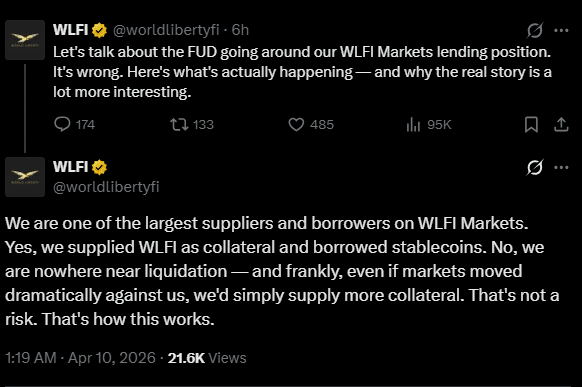
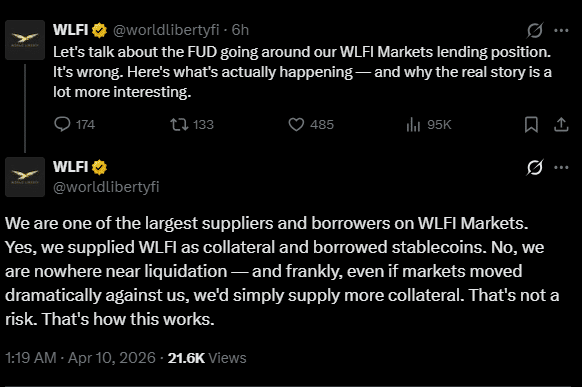
The DeFi project admitted that it is one of the largest suppliers and borrowers on the Dolomite-powered WLFI Markets.
Source: X/WLFI

According to the project, the ongoing liquidation fears were unwarranted, adding that,

We are nowhere near liquidation — and frankly, even if markets moved dramatically against us, we’d simply supply more collateral.

WLFI team countered that whatever they are doing is ‘not risk,’ reminding critics that ‘that’s how this works.’

Why the community is uneasy with WLFI

The community backlash against the DeFi project began after on-chain data revealed that it deposited 3 billion WLFI tokens as collateral into the lending platform WLFI Markets.

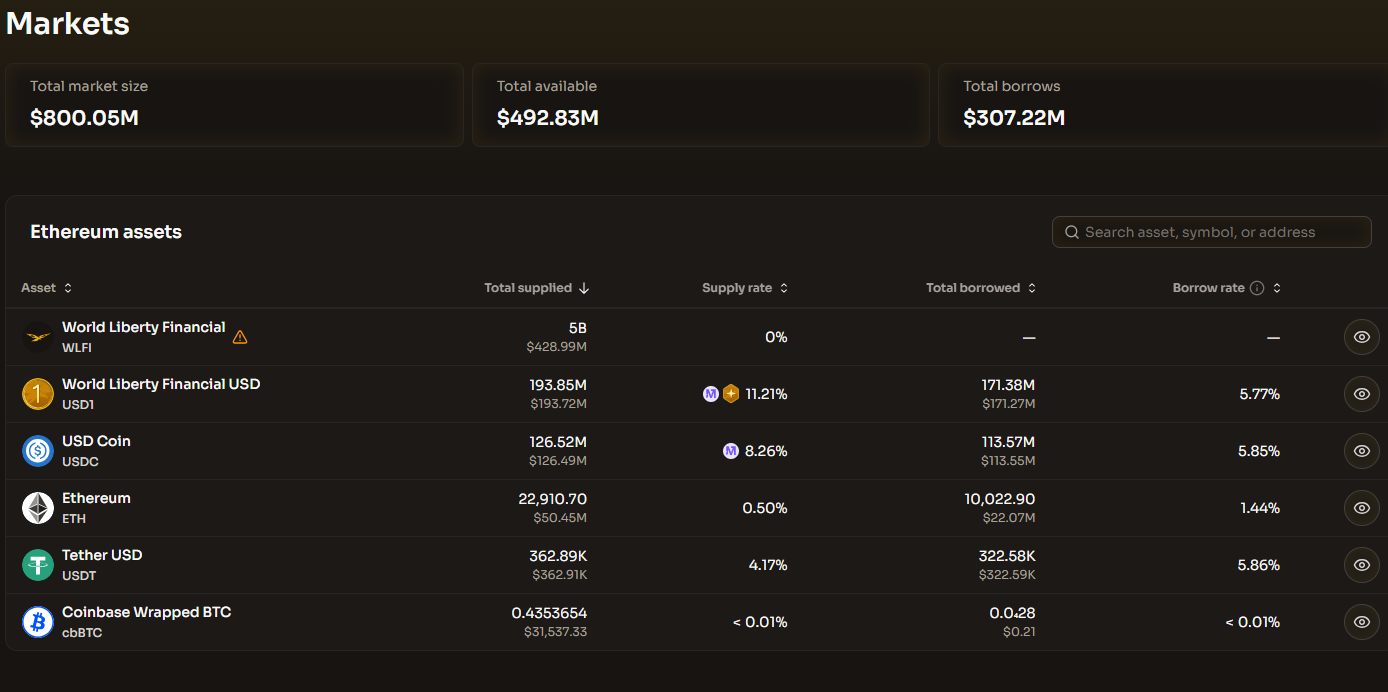
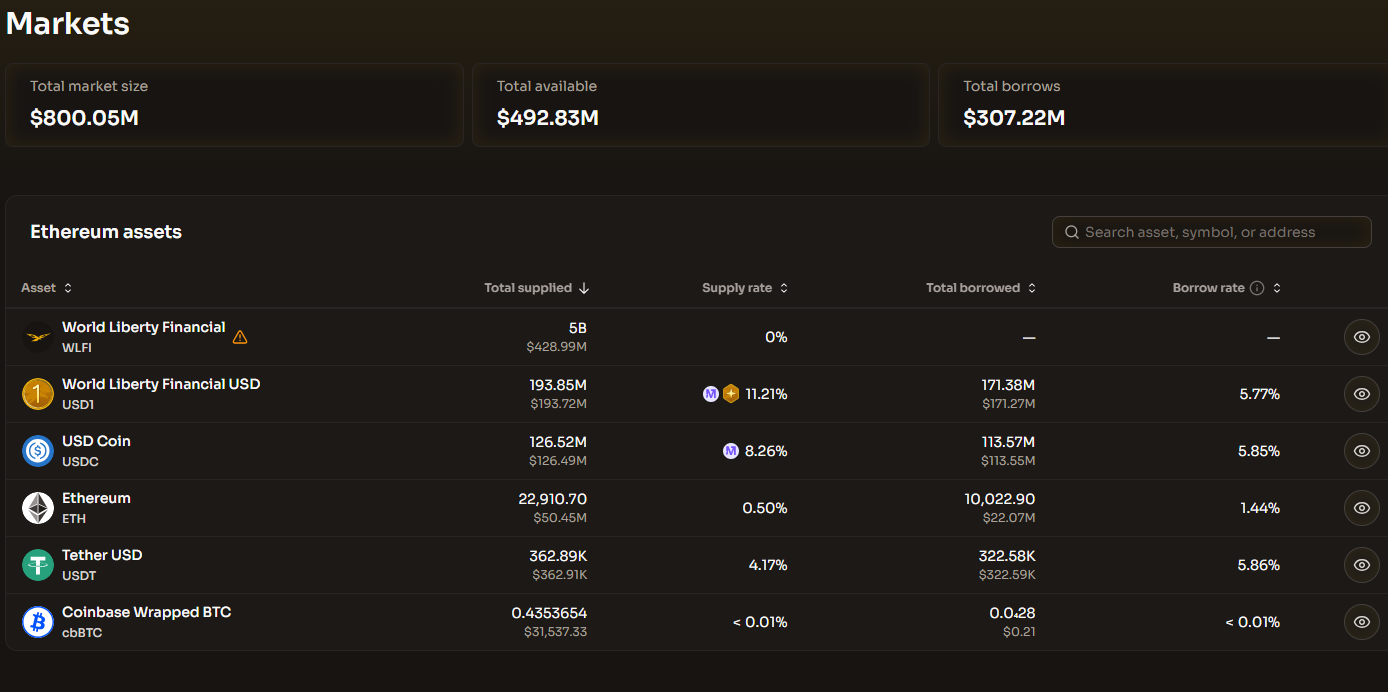
As of writing, the collateral was increased to 5 billion WLFI tokens (worth $429M), all from its treasury.
Source: WLFI

Against this collateral, the project borrowed over $75 million of USDC. The result? This drove WLFI Markets’ USDC lending rates to a lucrative 13.5%, but also drained the liquidity pool.

Consequently, those who invested in Dolomite couldn’t withdraw their funds unless the largest borrower, WLFI, repaid the loan.

This sparked more outcry as analysts warned that this could end up being a bad debt. Additionally, it could trigger contagion risk for WLFI token holders, as one user puts it,

Don’t be exit liquidity for Trump’s cartel: Those loans will likely never be repaid. When Trump leaves office, or even after the midterms if Republicans lose, $WLFI will dump, and Dolomite will be stuck with bad bet.

In its defense, the project said it took the massive loan to drive “outsized, compelling yield for everyone.”
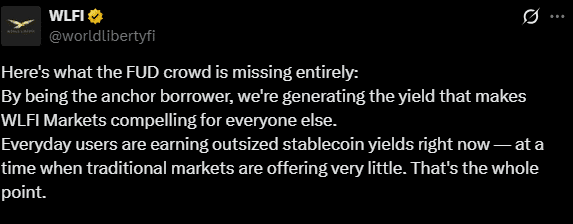
Source: X

Will the unlocks crash WLFI?

Another contention was uncertainty on WLFI token unlocks, especially for early and long-term investors to recoup their investment.

However, the project clarified that there will be a vote next week for a ‘structured, phased approach’ for the unlocks.

Currently, about 70% of the WLFI supply is locked, and only 31 billion tokens are circulating out of the max supply of 100 billion. Amid the rising scrutiny on the project, the early investors will likely dump their holdings when they are unlocked.

In the past three days, the altcoin has dropped by 15% to a yearly low of $0.081 as the FUD intensified. Unless there is a strong incentive to hold the token, the expected unlocks could send WLFI lower.


Final Summary

  • World Liberty Financial clarified that its massive loan, borrowed against 5 billion WLFI tokens, was not a risk, but ‘how things work.’
  • Market watchers warned that the proposed WLFI unlocks could add more selling pressure on the altcoin.


Criptos en tendencia

Preguntas relacionadas

QWhat is World Liberty Financial's response to the recent criticism regarding its borrowing activities?

AWorld Liberty Financial dismissed the criticism as 'wrong FUD' and stated that their actions are 'not risk' but rather 'how this works.' They emphasized they are nowhere near liquidation and could supply more collateral if needed.

QHow much in USDC did WLFI borrow against its collateral, and what was the impact on the lending platform?

AWLFI borrowed over $75 million in USDC against 5 billion WLFI tokens (worth $429 million) as collateral. This drove the USDC lending rates on WLFI Markets to 13.5% but drained the liquidity pool, preventing other investors from withdrawing their funds.

QWhy is the community concerned about WLFI's token unlocks?

AThe community is concerned because about 70% of the WLFI supply is locked, and early investors might dump their holdings when tokens are unlocked, potentially causing the price to drop further. The token has already fallen 15% to a yearly low due to ongoing FUD.

QWhat did critics warn could happen if WLFI's token price drops significantly?

ACritics warned that if the WLFI token price dumps, especially after political events like Trump leaving office or Republicans losing midterms, it could result in bad debt for Dolomite and contagion risk for token holders, as the loans might never be repaid.

QWhat action does WLFI plan to take regarding the unlocked tokens?

AWLFI plans to hold a vote next week for a 'structured, phased approach' to manage the token unlocks, aiming to address concerns and potentially mitigate selling pressure on the altcoin.

Lecturas Relacionadas

Can Generative Models Finally Be Trained End-to-End? The Core Is a For Loop

This article introduces a novel training paradigm for generative models called Explorative Modeling (XM), which enables true end-to-end training. Traditionally, powerful generative models like autoregressive and diffusion models are not trained end-to-end. They are trained to predict a single small step but require iterative multi-step sampling for inference. This "exposure bias" leads to error accumulation and limits performance. The core challenge XM addresses is "mode blurring." In generative tasks, a single input (e.g., "generate a dog") corresponds to many valid outputs (multiple modes). Standard training objectives like reconstruction loss force the model to average these modes, producing unrealistic, blurry outputs. To avoid this, existing models break generation into many small, almost deterministic steps, sacrificing end-to-end training. XM tackles this by restructuring the training loop itself. Its key insight is to amplify "generative expressivity." For each training input, instead of generating one sample, the model generates K candidate outputs. Only the candidate closest to the real data is used for computing the loss and updating the model via backpropagation. This simple "best-of-K" mechanism is implemented as a short for-loop. By exploring multiple possibilities, the model learns to distribute its guesses across different modes rather than collapsing to their uninformative average. The paper demonstrates that "exploration" acts as a new, powerful scaling axis. Gains from XM increase with model size, data scale, and compute. Experiments show improvements in FID scores for image generation and significant efficiency gains, sometimes outperforming larger models without exploration. When pushed to the limit, XM enables fully single-step, end-to-end generative models. In robotics tasks, an "Explorative Policy" matched the performance of a 100-step Diffusion Policy with a single forward pass, drastically improving inference speed. While the best-of-K concept is not entirely new, the authors' contribution lies in formally understanding it as a direct method to boost generative expressivity without fragmenting the generation process. This work suggests that as models scale, enhancing exploration during training may become crucial for overcoming fundamental performance bottlenecks.

marsbitHace 50 min(s)

Can Generative Models Finally Be Trained End-to-End? The Core Is a For Loop

marsbitHace 50 min(s)

Annual Salary of Millions Competing for Electricians, Meta Rushes to Open Its Own Technical School

The AI boom is facing an unexpected bottleneck: a severe shortage of skilled construction workers and electricians. As tech giants like Meta, OpenAI, and Alphabet race to build massive data centers—such as OpenAI's $16 billion "Stargate" project—they are hitting a critical labor wall. The U.S. needs an estimated 130,000 more electricians, 240,000 construction workers, and 150,000 supervisors by 2030 for AI infrastructure alone, but tens of thousands of electrician jobs go unfilled each year. While AI companies offer high premiums, with electricians earning up to $280,000 annually, worker scarcity still causes massive losses—delays on a single project can cost $14.2 million per month. The complexity of building AI data centers, which require immense power (equivalent to powering hundreds of thousands of homes), sophisticated electrical systems, and advanced liquid cooling solutions, demands highly skilled technicians who are in short supply. To combat this, companies are investing heavily in training. Meta has committed $115 million to a free training school offering tuition, housing, and stipends, targeting 5,000 new workers. OpenAI is partnering with unions to secure skilled labor. These efforts are paying off, with a significant rise in Gen Z interest in trade schools over college. However, the power demands are staggering. AI data centers are driving a rapid surge in electricity consumption, projected to account for up to 12% of U.S. power use by 2028 and raising costs for consumers. Furthermore, the construction boom is project-based, leading to a potential future glut of trained workers once building peaks, which could depress wages industry-wide. The race for AI supremacy now depends as much on skilled hands as on advanced chips.

marsbitHace 2 hora(s)

Annual Salary of Millions Competing for Electricians, Meta Rushes to Open Its Own Technical School

marsbitHace 2 hora(s)

Trading

Spot

Artículos destacados

Cómo comprar WLFI

¡Bienvenido a HTX.com! Hemos hecho que comprar Official World Liberty Financial (WLFI) sea simple y conveniente. Sigue nuestra guía paso a paso para iniciar tu viaje de criptos.Paso 1: crea tu cuenta HTXUtiliza tu correo electrónico o número de teléfono para registrarte y obtener una cuenta gratuita en HTX. Experimenta un proceso de registro sin complicaciones y desbloquea todas las funciones.Obtener mi cuentaPaso 2: ve a Comprar cripto y elige tu método de pagoTarjeta de crédito/débito: usa tu Visa o Mastercard para comprar Official World Liberty Financial (WLFI) al instante.Saldo: utiliza fondos del saldo de tu cuenta HTX para tradear sin problemas.Terceros: hemos agregado métodos de pago populares como Google Pay y Apple Pay para mejorar la comodidad.P2P: tradear directamente con otros usuarios en HTX.Over-the-Counter (OTC): ofrecemos servicios personalizados y tipos de cambio competitivos para los traders.Paso 3: guarda tu Official World Liberty Financial (WLFI)Después de comprar tu Official World Liberty Financial (WLFI), guárdalo en tu cuenta HTX. Alternativamente, puedes enviarlo a otro lugar mediante transferencia blockchain o utilizarlo para tradear otras criptomonedas.Paso 4: tradear Official World Liberty Financial (WLFI)Tradear fácilmente con Official World Liberty Financial (WLFI) en HTX's mercado spot. Simplemente accede a tu cuenta, selecciona tu par de trading, ejecuta tus trades y monitorea en tiempo real. Ofrecemos una experiencia fácil de usar tanto para principiantes como para traders experimentados.

602 Vistas totalesPublicado en 2025.09.01Actualizado en 2026.06.02

Cómo comprar WLFI

Discusiones

Bienvenido a la comunidad de HTX. Aquí puedes mantenerte informado sobre los últimos desarrollos de la plataforma y acceder a análisis profesionales del mercado. A continuación se presentan las opiniones de los usuarios sobre el precio de WLFI (WLFI).

活动图片












