World Liberty Financial says, ‘We are nowhere near liquidation’ – But fears remain

ambcryptoPublicado a 2026-04-10Actualizado a 2026-04-10

Resumen

World Liberty Financial (WLFI), backed by the Trump family, has dismissed concerns over its borrowing activities as unfounded "FUD." The DeFi project admitted to being a major borrower and supplier on WLFI Markets, using 5 billion WLFI tokens (worth $429 million) from its treasury as collateral to borrow over $75 million in USDC. This move drained the platform’s liquidity and raised fears of bad debt and contagion risk. WLFI defended its actions, stating it is "nowhere near liquidation" and can supply more collateral if needed. Additionally, concerns persist over upcoming token unlocks, with 70% of WLFI supply still locked. The token has dropped 15% amid the uncertainty, and analysts warn unlocks could trigger further selling pressure.

The Trump family-backed World Liberty Financial [WLFI] has dismissed recent criticism against its borrowing spree as a ‘wrong FUD.’

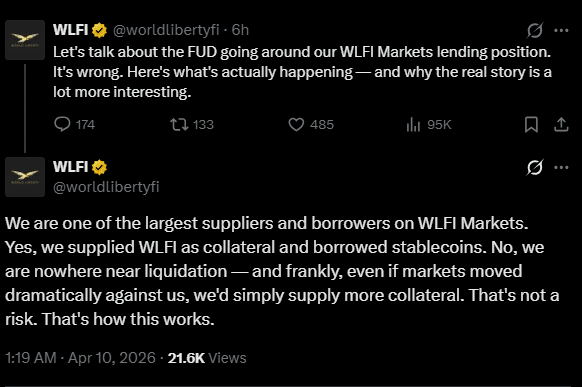
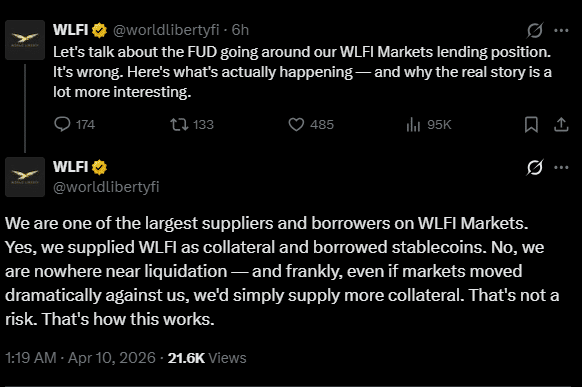
The DeFi project admitted that it is one of the largest suppliers and borrowers on the Dolomite-powered WLFI Markets.
Source: X/WLFI

According to the project, the ongoing liquidation fears were unwarranted, adding that,

We are nowhere near liquidation — and frankly, even if markets moved dramatically against us, we’d simply supply more collateral.

WLFI team countered that whatever they are doing is ‘not risk,’ reminding critics that ‘that’s how this works.’

Why the community is uneasy with WLFI

The community backlash against the DeFi project began after on-chain data revealed that it deposited 3 billion WLFI tokens as collateral into the lending platform WLFI Markets.

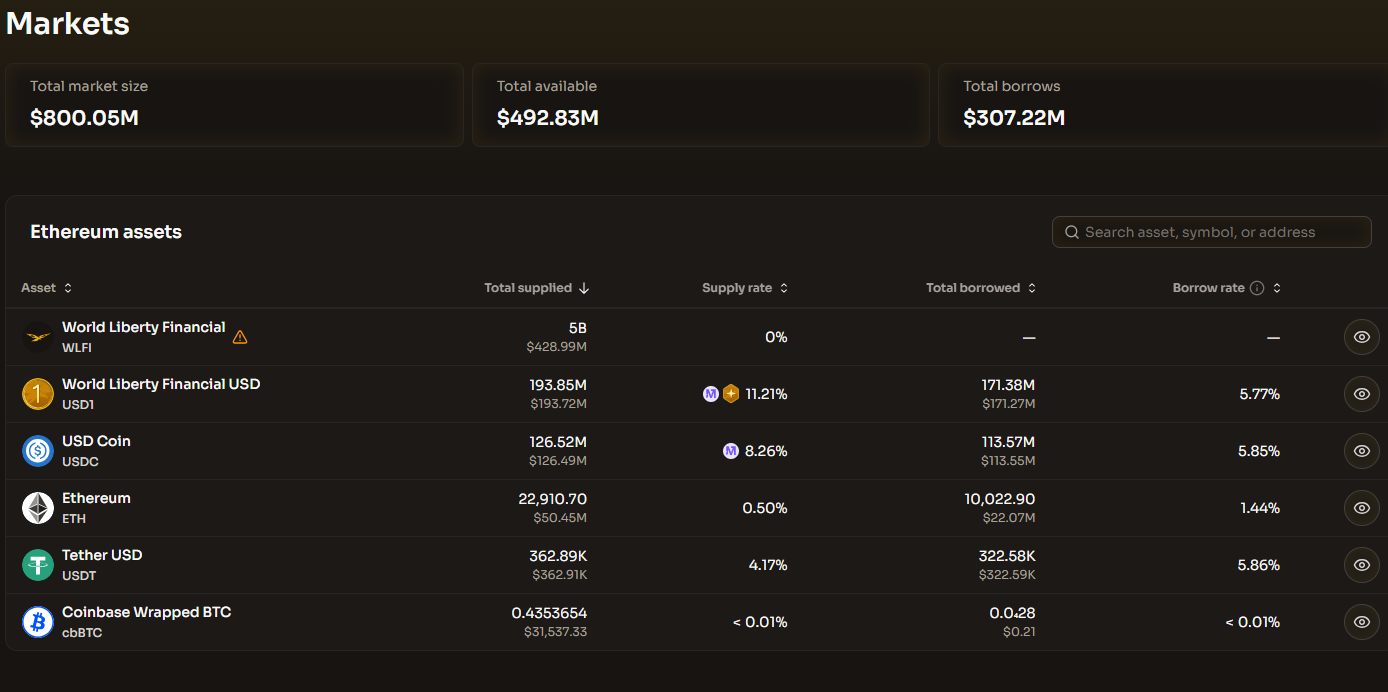
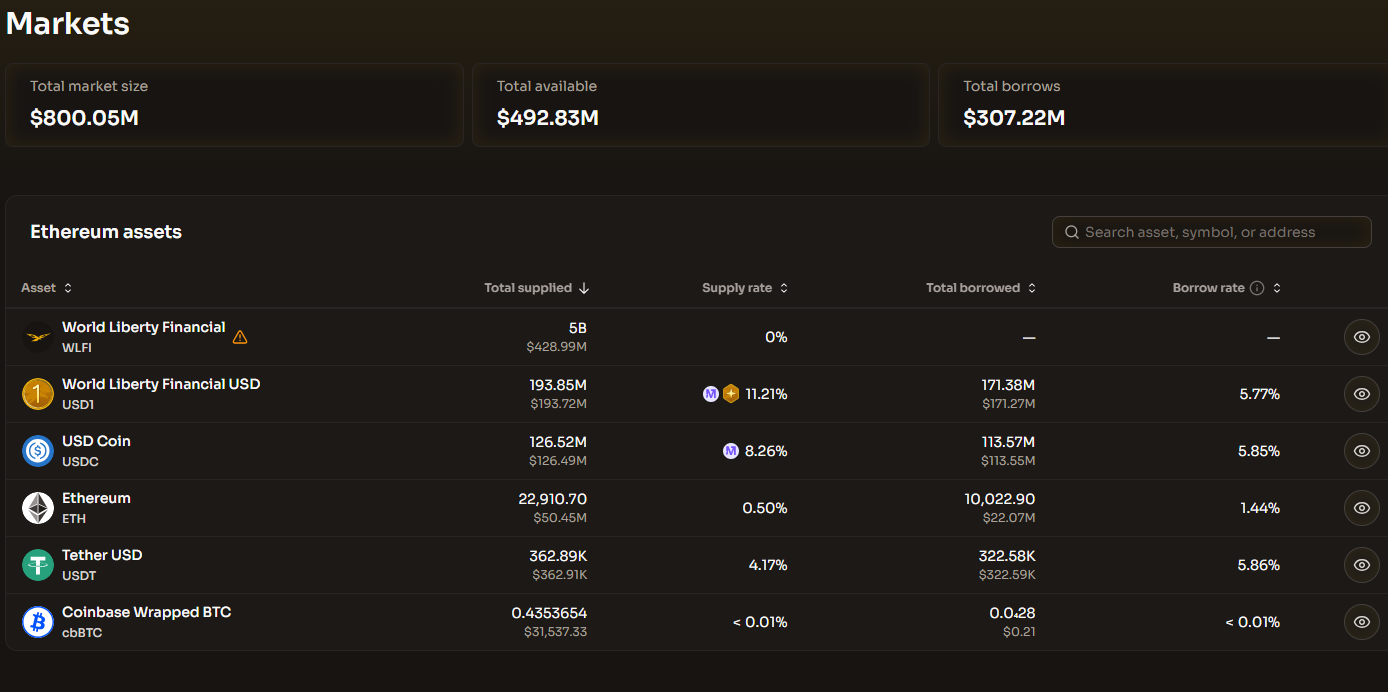
As of writing, the collateral was increased to 5 billion WLFI tokens (worth $429M), all from its treasury.
Source: WLFI

Against this collateral, the project borrowed over $75 million of USDC. The result? This drove WLFI Markets’ USDC lending rates to a lucrative 13.5%, but also drained the liquidity pool.

Consequently, those who invested in Dolomite couldn’t withdraw their funds unless the largest borrower, WLFI, repaid the loan.

This sparked more outcry as analysts warned that this could end up being a bad debt. Additionally, it could trigger contagion risk for WLFI token holders, as one user puts it,

Don’t be exit liquidity for Trump’s cartel: Those loans will likely never be repaid. When Trump leaves office, or even after the midterms if Republicans lose, $WLFI will dump, and Dolomite will be stuck with bad bet.

In its defense, the project said it took the massive loan to drive “outsized, compelling yield for everyone.”
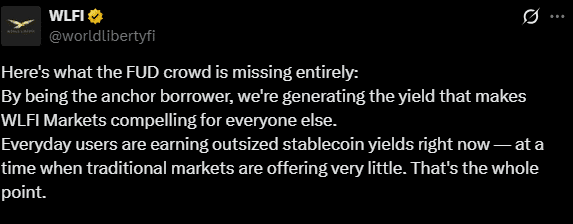
Source: X

Will the unlocks crash WLFI?

Another contention was uncertainty on WLFI token unlocks, especially for early and long-term investors to recoup their investment.

However, the project clarified that there will be a vote next week for a ‘structured, phased approach’ for the unlocks.

Currently, about 70% of the WLFI supply is locked, and only 31 billion tokens are circulating out of the max supply of 100 billion. Amid the rising scrutiny on the project, the early investors will likely dump their holdings when they are unlocked.

In the past three days, the altcoin has dropped by 15% to a yearly low of $0.081 as the FUD intensified. Unless there is a strong incentive to hold the token, the expected unlocks could send WLFI lower.


Final Summary

  • World Liberty Financial clarified that its massive loan, borrowed against 5 billion WLFI tokens, was not a risk, but ‘how things work.’
  • Market watchers warned that the proposed WLFI unlocks could add more selling pressure on the altcoin.


Preguntas relacionadas

QWhat is World Liberty Financial's response to the recent criticism regarding its borrowing activities?

AWorld Liberty Financial dismissed the criticism as 'wrong FUD' and stated that their actions are 'not risk' but rather 'how this works.' They emphasized they are nowhere near liquidation and could supply more collateral if needed.

QHow much in USDC did WLFI borrow against its collateral, and what was the impact on the lending platform?

AWLFI borrowed over $75 million in USDC against 5 billion WLFI tokens (worth $429 million) as collateral. This drove the USDC lending rates on WLFI Markets to 13.5% but drained the liquidity pool, preventing other investors from withdrawing their funds.

QWhy is the community concerned about WLFI's token unlocks?

AThe community is concerned because about 70% of the WLFI supply is locked, and early investors might dump their holdings when tokens are unlocked, potentially causing the price to drop further. The token has already fallen 15% to a yearly low due to ongoing FUD.

QWhat did critics warn could happen if WLFI's token price drops significantly?

ACritics warned that if the WLFI token price dumps, especially after political events like Trump leaving office or Republicans losing midterms, it could result in bad debt for Dolomite and contagion risk for token holders, as the loans might never be repaid.

QWhat action does WLFI plan to take regarding the unlocked tokens?

AWLFI plans to hold a vote next week for a 'structured, phased approach' to manage the token unlocks, aiming to address concerns and potentially mitigate selling pressure on the altcoin.

Lecturas Relacionadas

A Clod of Chinese Soil Chokes Two Japanese Giants

"Chinese Soil Chokes Japanese Giants" The production of a key electronic specialty gas, tungsten hexafluoride (WF6), vital for manufacturing AI chips, was halted by two leading Japanese producers—Kanto Denka and Central Glass. Their shutdown was not due to a technological failure but a sudden, critical shortage of a raw material they had long taken for granted: ultra-high-purity (6N-grade) tungsten powder, which is almost entirely sourced from China. Following a quiet Chinese export announcement in January 2026, tungsten powder shipments to Japan dropped to zero for months. Despite frantic efforts, Japanese companies found no viable alternative; imported powder was three times more expensive and lacked the required purity. Their existing stockpiles were exhausted by mid-2026. WF6 is essential for depositing tungsten into the microscopic contact holes of High Bandwidth Memory (HBM) chips, which are crucial for advanced processors like those from Nvidia. While Japanese firms had mastered producing ultra-pure WF6 gas, their entire supply chain relied on China's 6N tungsten powder—a dependency now revealed as a fatal vulnerability. China's dominance in this "soil" results from decades of painstaking R&D by companies like Xiamen Tungsten and China Tungsten & Hightech. They overcame immense technical hurdles, such as separating chemically similar molybdenum from tungsten, to achieve mass production of the world's purest tungsten powder. With their primary suppliers gone, Kanto Denka and Central Glass announced a permanent halt to WF6 production starting July 1, 2026. This immediately created a supply crisis for major semiconductor manufacturers like Samsung and SK Hynix, forcing them to urgently seek and certify new Chinese suppliers for WF6 itself. The reversal marks a dramatic shift: China has moved from exporting low-value raw materials to controlling the high-purity foundation of a critical global tech supply chain, upending a long-established industrial hierarchy.

marsbitHace 20 min(s)

A Clod of Chinese Soil Chokes Two Japanese Giants

marsbitHace 20 min(s)

Without Tencent, What's Left for Suiyuan?

The article centers on the crucial question posed in the title: what is Seyond Technology really worth if its dominant customer, Tencent, were to stop purchasing its AI chips? As the last of China's "Four AI Chip Dragons" to secure approval for a public listing, Seyond's IPO filing reveals a profound and controversial dependency. In 2025, 74.9% to over 80% of its revenue came from Tencent. The piece argues that this extreme customer concentration is not merely a vulnerability but a strategic outcome of China's AI industry evolution. It contrasts Seyond's path with its peers (Moore Thread, Biren Technology, and MetaX), noting that while others raced to market with ambitious stories, Seyond focused first on securing and delivering for a major client. Its explosive revenue growth—with Q1 2026 up 1474.85% year-on-year—is driven by concentrated orders from Tencent, which itself faces massive, escalating AI compute demands for products like its Yuanbao and Hunyuan models. The relationship is framed as a deliberate, symbiotic cultivation of a supply chain. As both a major shareholder (20.26%) and primary client, Tencent is actively fostering Seyond to build a controllable, stable alternative to NVIDIA, similar to how global tech giants historically nurtured key suppliers. The high switching costs—involving software stacks and deployed systems—create a deep "ecological moat" for Seyond within Tencent's ecosystem. The analysis positions the AI chip landscape in three tiers: NVIDIA as the global leader, Huawei's Ascend as the state-backed player, and commercial firms like Seyond competing for market orders. Seyond is increasingly seen as "Tencent's compute foundation," with its product roadmap closely aligned with the tech giant's needs. The conclusion is that the industry's metric for success is shifting from fundraising and technical specs to real orders, delivery capability, and ecosystem binding. Seyond's value, therefore, lies not just in its chips but in holding a massive, multi-year procurement order from China's largest internet company—a tangible asset arguably more telling than any technical whitepaper in the current climate. The core insight is that for domestic chips, the ultimate challenge isn't just catching up technologically with NVIDIA, but earning the trust, scenarios, and recurring orders from a major anchor client.

marsbitHace 1 hora(s)

Without Tencent, What's Left for Suiyuan?

marsbitHace 1 hora(s)

War Trade Unwinding | TradeXYZ Weekend Observations

Weekend markets saw a clear return of risk appetite. Major indices rose broadly, with significant gains in tech and precious metals, while energy sectors fell sharply on the "end of war" narrative. On June 14, oil prices initially rose on reports Iran had not yet finalized a memorandum of understanding. Later, YNET reported Trump might immediately lift the maritime blockade on Iran and the Strait of Hormuz. At 21:30, Trump confirmed on Truth Terminal that a deal with Iran was done, authorizing an immediate end to the US blockade and toll-free opening of the Strait. Iran's deputy foreign minister simultaneously announced an immediate and permanent halt to military actions on multiple fronts. Oil prices had already fallen to weekend boundaries, pre-pricing the news. The S&P 500 subsequently touched 7530. Markets will likely remain in a waiting period until the formal peace deal signing on June 19. At the moment of the deal announcement, gold jumped from ~4,221 to a high of 4,337, and silver from ~67.85 to 70.83, before stabilizing at higher levels. Individual stocks and ETFs like NBIS, RKLB, and LITE performed strongly. NBIS, added to the Nasdaq index, saw a target price increase due to strong AI cloud growth. RKLB, also added to the index, benefited from positive SpaceX valuation sentiment. LITE received a $1,130 target from JPMorgan. SPCX rose quickly after Musk tweeted SpaceX could potentially reach ~$1 trillion in revenue by 2030. In summary, the market shock from the multi-month war is beginning to dissipate. Israel's actions remain the key variable before the June 19 signing. Upcoming events like Fed Chair Warsh's debut and BoJ rate hike expectations will also significantly impact markets this week.

marsbitHace 1 hora(s)

War Trade Unwinding | TradeXYZ Weekend Observations

marsbitHace 1 hora(s)

Trading

Spot
Futuros

Artículos destacados

Cómo comprar WLFI

¡Bienvenido a HTX.com! Hemos hecho que comprar Official World Liberty Financial (WLFI) sea simple y conveniente. Sigue nuestra guía paso a paso para iniciar tu viaje de criptos.Paso 1: crea tu cuenta HTXUtiliza tu correo electrónico o número de teléfono para registrarte y obtener una cuenta gratuita en HTX. Experimenta un proceso de registro sin complicaciones y desbloquea todas las funciones.Obtener mi cuentaPaso 2: ve a Comprar cripto y elige tu método de pagoTarjeta de crédito/débito: usa tu Visa o Mastercard para comprar Official World Liberty Financial (WLFI) al instante.Saldo: utiliza fondos del saldo de tu cuenta HTX para tradear sin problemas.Terceros: hemos agregado métodos de pago populares como Google Pay y Apple Pay para mejorar la comodidad.P2P: tradear directamente con otros usuarios en HTX.Over-the-Counter (OTC): ofrecemos servicios personalizados y tipos de cambio competitivos para los traders.Paso 3: guarda tu Official World Liberty Financial (WLFI)Después de comprar tu Official World Liberty Financial (WLFI), guárdalo en tu cuenta HTX. Alternativamente, puedes enviarlo a otro lugar mediante transferencia blockchain o utilizarlo para tradear otras criptomonedas.Paso 4: tradear Official World Liberty Financial (WLFI)Tradear fácilmente con Official World Liberty Financial (WLFI) en HTX's mercado spot. Simplemente accede a tu cuenta, selecciona tu par de trading, ejecuta tus trades y monitorea en tiempo real. Ofrecemos una experiencia fácil de usar tanto para principiantes como para traders experimentados.

577 Vistas totalesPublicado en 2025.09.01Actualizado en 2026.06.02

Cómo comprar WLFI

Discusiones

Bienvenido a la comunidad de HTX. Aquí puedes mantenerte informado sobre los últimos desarrollos de la plataforma y acceder a análisis profesionales del mercado. A continuación se presentan las opiniones de los usuarios sobre el precio de WLFI (WLFI).

活动图片












