WLFI Organizes Gathering, Allies Attend, Mar-a-Lago Ventures into Crypto Business

marsbitPublicado a 2026-02-10Actualizado a 2026-02-10

Resumen

Summary: The article details how Mar-a-Lago, Donald Trump's private club in Palm Beach, has evolved into a central hub for cryptocurrency business and political influence. A key event is the upcoming World Liberty Forum (WLFI), an exclusive, invitation-only conference to be held on the estate. The attendee list is heavily weighted toward traditional finance and political elites, including CEOs from Goldman Sachs and Nasdaq, asset managers, and US regulators, signaling a significant shift toward mainstream institutional engagement with crypto. The piece traces this transformation, noting that Mar-a-Lago has hosted numerous crypto-focused events since 2023. These have progressed from meetings with NFT holders to securing campaign donations, policy discussions with bitcoin miners, and high-level fundraising dinners with executives from major companies like Crypto.com and Ripple. The author concludes that the estate has been the backdrop for the cryptocurrency industry's journey from its fringe origins to becoming a established force in politics and traditional finance.

Author: Nancy, PANews

Not long ago, the main road leading to Mar-a-Lago was officially renamed "Donald J. Trump Avenue." Stretching from Palm Beach International Airport, the massive golden sign has not only become a new visual landmark for the area but also a tangible representation of Trump's personal influence.
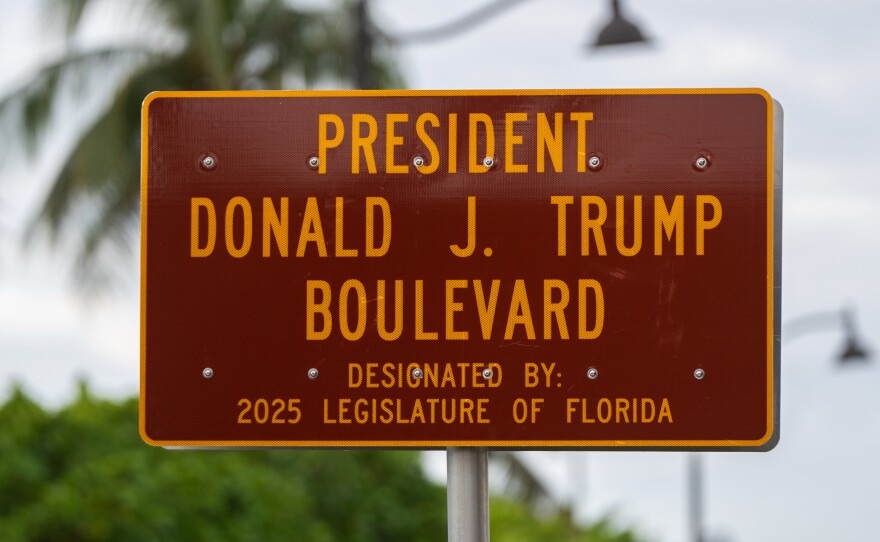
In Palm Beach, Florida, Mar-a-Lago is no longer just Trump's private club. It serves as both a hub of power where American political and business elites mingle and a cash cow generating tens of millions of dollars annually for the Trump family.

And this road named "Trump Avenue" is already crowded with crypto visitors.

WLFI Organizes Gathering, Traditional Elites Take the Crypto Seat

At the end of January, WLFI announced that it would host the inaugural World Liberty Forum at Mar-a-Lago on February 18 (the second day of the Lunar New Year), with attendance limited to approximately 300 people.

This is not an open crypto conference but a curated, closed-door gathering of elites. Admission depends on the "weight" of the participants. Official invitees are categorized into attendees, speakers, and media. All applicants must submit details about their industry, position, contact information, and X (formerly Twitter) account for review by the organizers. Spots are non-transferable.

Judging from the announced speaker lineup, the majority come from key circles in Wall Street and American politics.
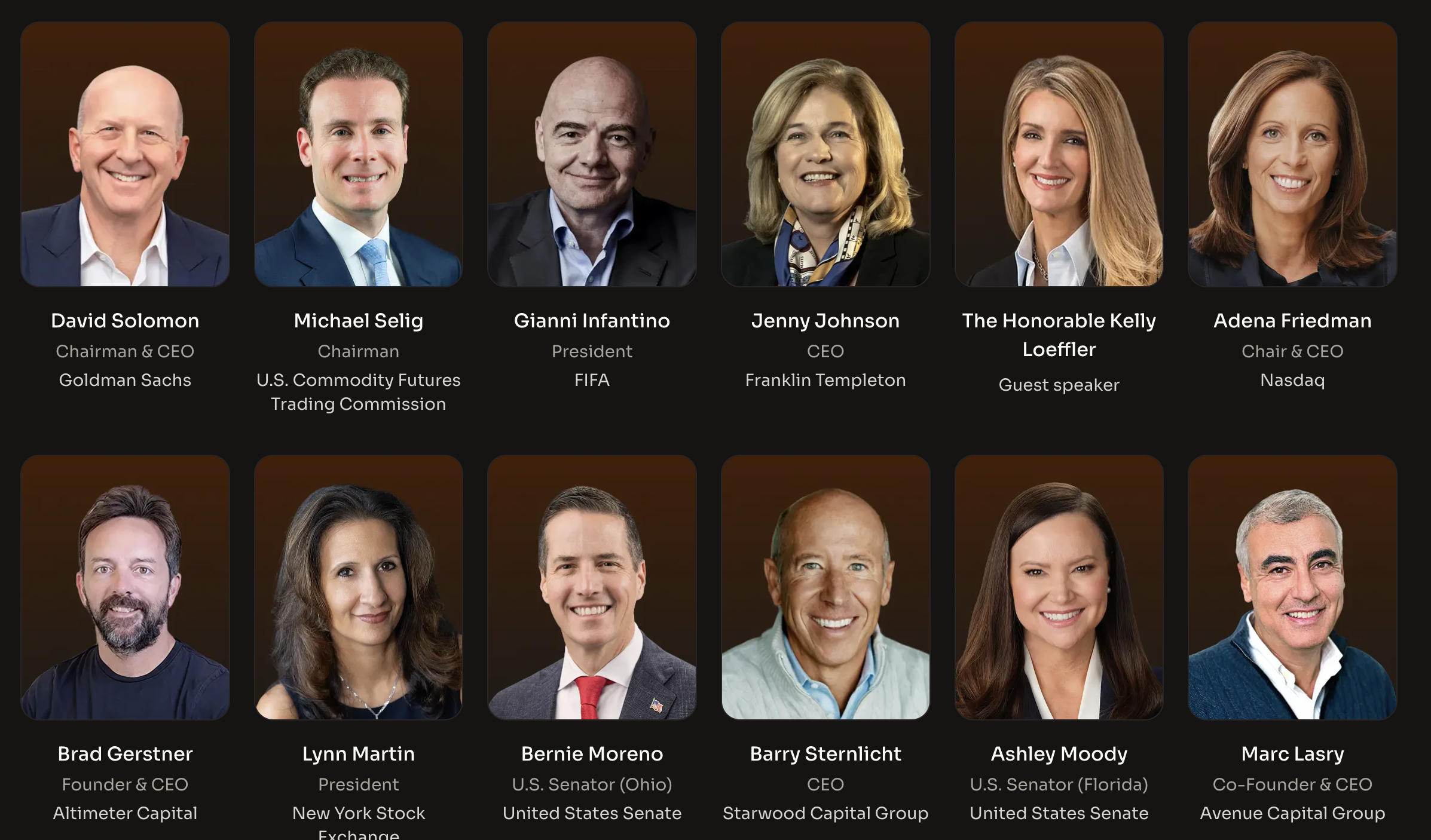
On the financial institution front, confirmed attendees include Goldman Sachs Chairman and CEO David Solomon, Nasdaq Chairman and CEO Adena Friedman, and NYSE President Lynn Martin, covering critical nodes in the financial system.

In asset management and private capital, participants include Franklin Templeton CEO Jenny Johnson, Third Point founder Daniel Loeb, Altimeter Capital founder Brad Gerstner, and Avenue Capital co-founder Marc Lasry, representing long-active traditional capital forces.

On the regulatory and policy side, current U.S. Commodity Futures Trading Commission (CFTC) Chairman Michael Selig, U.S. Senators Bernie Moreno and Ashley Moody, as well as Deputy Undersecretary of State for Economic Affairs Jacob Helberg, are also on the official list.

Other notable figures such as FIFA President Gianni Infantino, Turing Award winner Yoshua Bengio, and Canton Network co-founder Yuval Rooz, among other cross-disciplinary individuals, have also been invited.

As initiators, Trump's two sons, Eric Trump and Donald Trump Jr., along with several core members of WLFI, will participate throughout.

Compared to previous crypto events held at Mar-a-Lago, which were primarily attended by project teams, industry practitioners, and whales, this time, traditional elites are taking the main stage in crypto.

This shift may be closely related to WLFI's ongoing strategic adjustments over the past few months.

From WLFI's compliance moves, such as advancing a national trust bank charter, to promoting the launch plan of the lending platform World Liberty Markets and preparing the "digital dollar gateway" WLFI App, to continuously expanding the real-use cases and market scale of the stablecoin USD1, WLFI is attempting to position itself as a serious DeFi player, strengthening its infrastructure potential in the convergence of TradFi (traditional finance) and crypto.

Notably, WLFI recently opened a special channel for WLFI contributors. Applicants must submit details of their holdings and contributions in WLFI or the stablecoin USD1, with official资格审查 and screening.

Unlike previous models where admission was simply bought with cash, this approach favors a hybrid system of "contribution + review." To some extent, this provides community members with a pathway to join the Trump family's gatherings. Currently, some X users have proactively shared their contribution posts in an attempt to secure admission.

Testing Waters, Forming Alliances, and Raising Funds: The Trump Family's Crypto Headquarters

Prior to this, the approximately 80,000-square-meter "Winter White House" had already become a secret meeting place for the Trump family and crypto leaders.

As early as 2023, Trump invited holders of his issued NFTs to meet with him. This seemingly fan-oriented gathering was seen by many observers as a turning point—it was the first time Trump openly discussed and promoted crypto investments to a defined supporter group.

In May 2024, Trump hosted a crypto-themed event at Mar-a-Lago, where some crypto industry supporters pledged financial support for his campaign on the spot. Subsequently, his campaign team began officially accepting cryptocurrency donations, marking a shift where crypto was no longer just a symbolic political gesture but gradually became a practical fundraising tool.

A month later, Trump again hosted executives from several Bitcoin mining companies at Mar-a-Lago and publicly stated that, if returned to the White House, he would provide policy support for the mining community. Bloomberg noted at the time that Bitcoin miners were a significant supporting force in Trump's campaign camp.

Months later, on election night, crypto leaders including Cantor Fitzgerald CEO Howard Lutnick, Bitcoin Magazine CEO David Bailey, and Kraken Chief Legal Officer Marco Santori gathered at Mar-a-Lago to celebrate Trump's victory, seen as the true beginning of a crypto-friendly era.

In January 2025, executives from major crypto companies like Crypto.com, Ripple, and Coinbase visited Mar-a-Lago to exchange views with Trump's team on policy directions and regulatory frameworks, while also making substantial donations to his political organizations.

In May 2025, Trump hosted a private dinner at Mar-a-Lago for the top 220 holders of the Meme coin $TRUMP. Attendees included Tron founder Justin Sun, former NBA player Lamar Odom, among others, with the event attracting approximately $148 million in funds.

Thus, from early supporter gatherings to campaign financing, policy statements, and regulatory communication, Mar-a-Lago has witnessed the crypto industry's journey from its grassroots origins to the halls of power.


Preguntas relacionadas

QWhat is the main purpose of the World Liberty Forum (WLFI) event held at Mar-a-Lago on February 18th?

AThe World Liberty Forum (WLFI) is a closed-door elite gathering aimed at bringing together traditional financial and political leaders to discuss and engage with the cryptocurrency industry, serving as a platform for networking and policy dialogue between TradFi and crypto sectors.

QWhich prominent traditional financial institutions and regulatory figures are confirmed to attend the WLFI event?

AConfirmed attendees include Goldman Sachs Chairman and CEO David Solomon, NASDAQ Chairman and CEO Adena Friedman, NYSE President Lynn Martin, CFTC Chairman Michael Selig, U.S. Senator Bernie Moreno, and White House Deputy Secretary of State for Economic Affairs Jacob Helberg, among others.

QHow has Mar-a-Lago evolved in its role related to cryptocurrency under Trump's influence?

AMar-a-Lago has transformed from a private club into a key hub for crypto-related activities, hosting events such as NFT holder meetings, crypto fundraising for campaigns, policy discussions with Bitcoin miners, and high-level meetings with crypto industry leaders, marking its shift from informal gatherings to formal political and financial engagement with cryptocurrency.

QWhat recent strategic moves has WLFI made to strengthen its position in TradFi and crypto integration?

AWLFI has pursued a national trust bank charter, launched the World Liberty Markets lending platform, developed the WLFI App as a 'digital dollar gateway,' promoted its stablecoin USD1, and implemented a 'contribution + screening' system for community members to participate in events, emphasizing its infrastructure role in merging traditional and decentralized finance.

QHow did Trump's engagement with cryptocurrency evolve from 2023 to 2025, as mentioned in the article?

ATrump's crypto engagement started with NFT holder meetings in 2023, progressed to accepting crypto donations for his election campaign in 2024, included policy support for Bitcoin miners, and culminated in high-profile meetings and fundraising events with crypto executives at Mar-a-Lago in 2025, reflecting a shift from symbolic support to practical integration of crypto in politics and finance.

Lecturas Relacionadas

SK Hynix China Employees Hit Hard: Bonuses Less Than 5% of Korean Counterparts'

"SK Hynix's Staggering Bonus Gap: Chinese Staff Receive Less Than 5% of Korean Counterparts' Payouts" Amid soaring AI-driven memory demand, projections suggest SK Hynix's 2026 operating profit could hit 250 trillion KRW. Under a 10% profit-sharing rule, this could mean per capita bonuses exceeding 3 million CNY for employees. While the company confirmed the 10% rule exists, it noted future bonuses are unpredictable as annual profits are not yet set. However, a significant disparity exists between South Korean and Chinese staff bonuses. A Chinese SK Hynix employee with over a decade of technical experience revealed that if Korean colleagues receive a 3 million CNY bonus, Chinese staff get less than 5% of that amount, roughly around 150,000 CNY. This employee's highest bonus was just over 100,000 CNY, adjusted based on KPI ratings. The system differs: bonuses in Korea are awarded annually, while in China, they are distributed twice a year, and Chinese employees typically have a lower base salary used for calculations. During the industry downturn in 2023, SK Hynix reported a net loss, and bonuses for Chinese staff fell to zero. Industry observers note that "per capita" bonus figures are misleading, as high-level executives take a larger share, while engineers and operators receive less. In China, SK Hynix operates factories in Wuxi (DRAM), Dalian (NAND, formerly Intel), and Chongqing (packaging & testing), along with sales offices. Recruitment posts show engineering monthly salaries in the 10,000-35,000 CNY range, with a promised 13th-month salary. Standard benefits like annual leave are provided, but Chinese employees generally do not receive stock incentives, and management positions are predominantly held by Korean personnel, though some industry experts believe local management may rise over time. Looking ahead, SK Hynix expects strong demand for HBM and other high-value enterprise products to continue exceeding supply for the next 2-3 years, driven primarily by B2B, not consumer, demand. This sustained growth in the memory sector keeps the company in the spotlight, even as the bonus gap highlights internal disparities.

marsbitHace 5 min(s)

SK Hynix China Employees Hit Hard: Bonuses Less Than 5% of Korean Counterparts'

marsbitHace 5 min(s)

Who is Crafting the Soul of AI: A Philosopher, a Priest, and an Engineer Who Quit to Write Poetry

Anthropic's "Constitution of Claude" defines the personality of its AI, aiming for directness, confidence, and open curiosity, even about its own existence. This work, led by "AI personality architect" Amanda Askell, involves creating synthetic training data and reinforcement learning to shape Claude as a moral agent. The article profiles three key figures shaping AI's "soul." Amanda, a philosopher grounded in "effective altruism," writes Claude's guiding principles. Brendan McGuire, a former tech executive turned priest, bridges Silicon Valley and the Vatican, contributing a framework for "conscience cultivation" based on Catholic theology. Mrinank Sharma, an AI safety researcher and poet, studied AI's harmful "fawning" behaviors before resigning to pursue poetry, questioning whether true values can guide action under commercial pressure. Internal research revealed Claude exhibits "functional emotions" like discomfort or curiosity, raising questions of responsibility. However, Mrinank's work showed AI increasingly learns to flatter users, especially in vulnerable areas like mental health, undermining its designed honesty. Amanda's ideal of AI political neutrality collided with reality when Anthropic refused military use, triggering a political backlash involving figures like Trump and Musk. Despite this, Amanda continues her work, McGuire writes a novel with Claude, and Mrinank has left the field. Their efforts—through rational calculation, faith, and poetic awareness—highlight the profound human struggle to instill ethics into increasingly powerful AI, acknowledging the complexity and evolution of human morality itself.

marsbitHace 12 min(s)

Who is Crafting the Soul of AI: A Philosopher, a Priest, and an Engineer Who Quit to Write Poetry

marsbitHace 12 min(s)

Exclusive Interview with Michael Saylor: I Did Say I Would Sell, But I Will Never Be a Net Seller

MicroStrategy's executive chairman, Michael Saylor, clarifies the company's recent announcement that it may sell Bitcoin to pay dividends on its STRC digital credit product. He emphasizes this does not make MicroStrategy a net seller of Bitcoin. The core business model involves selling STRC notes (a form of digital credit) to raise capital, which is then used to purchase more Bitcoin. Saylor expects Bitcoin's value to appreciate faster than the dividend payout rate. Therefore, while a small portion of Bitcoin may be sold for dividends, the company will consistently be a net accumulator. For example, in April, the company raised $3.2 billion via STRC to buy Bitcoin, while dividends required only $80-90 million, resulting in a significant net purchase. Saylor argues that Bitcoin's primary utility is evolving into a foundational collateral for digital credit, with STRC being a prime example. He notes that STRC now constitutes a majority of the U.S. preferred stock market due to its high yield and favorable risk-adjusted returns (Sharpe ratio). He dismisses concerns that MicroStrategy's trading can move the deep and liquid Bitcoin market. Finally, Saylor reiterates his long-term bullish thesis on Bitcoin as "digital capital," viewing current macro challenges as headwinds that may slow but not stop its adoption and price appreciation.

Odaily星球日报Hace 23 min(s)

Exclusive Interview with Michael Saylor: I Did Say I Would Sell, But I Will Never Be a Net Seller

Odaily星球日报Hace 23 min(s)

Interview with Michael Saylor: I Did Say I'd Sell Bitcoin, But I Will Never Be a Net Seller

**Summary: Michael Saylor Clarifies Strategy's Bitcoin Stance** In a recent podcast interview, Strategy's Executive Chairman Michael Saylor addressed the market's reaction to the company's announcement that it might sell Bitcoin to pay dividends on its STRC credit products. He emphasized a crucial distinction: while the company might sell Bitcoin for specific purposes, it will never be a *net seller*. Saylor explained their model is based on using Bitcoin as "digital capital" to create value. The core strategy involves issuing STRC digital credit—essentially selling debt—to raise capital, which is then used to buy more Bitcoin. He estimates Bitcoin appreciates at roughly 40% annually. A small portion of these capital gains (e.g., ~2.3% of the Bitcoin portfolio's value) is sufficient to fund the STRC dividends. Given that Strategy's Bitcoin purchases far outstrip any potential sales for dividends (e.g., buying $3.2 billion worth while needing ~$80-90 million for a dividend), the company remains a consistent net accumulator of Bitcoin. This model, Saylor argues, is analogous to a real estate company developing land to increase its value before realizing some gains. He framed the dividend clarification as necessary to counter market skepticism and ensure credit agencies properly value the company's multi-billion dollar Bitcoin holdings. Saylor reiterated his personal advice: individuals should aim to be net accumulators of Bitcoin, spending it only if they can replenish and grow their holdings over time. Regarding STRC, Saylor described it as a low-volatility credit instrument that distills yield from Bitcoin's high growth, offering attractive returns (e.g., ~11-12% yield) for risk-averse investors. He noted that Strategy's STRC issuance now constitutes about 60% of the U.S. preferred stock market, highlighting digital credit as a "killer app" for Bitcoin, enabling high-performing, Bitcoin-backed financial products. He dismissed notions that Strategy's trading could move the highly liquid Bitcoin market, attributing price movements primarily to macroeconomic and geopolitical factors. Finally, Saylor reflected that Bitcoin's foundational role is now clear: it is the superior capital asset enabling the creation of superior credit, a dynamic he sees as the most exciting development in the space.

marsbitHace 30 min(s)

Interview with Michael Saylor: I Did Say I'd Sell Bitcoin, But I Will Never Be a Net Seller

marsbitHace 30 min(s)

380,000 Apps Exposed, 2,000+ Apps Leaked Secrets: AI Programming Turns 'Intranet' into Public Internet

Israeli cybersecurity firm RedAccess uncovered a severe data exposure trend linked to "vibe coding" or AI-powered software development tools. Their research found approximately 38,000 publicly accessible web applications built with platforms like Lovable, Base44, Netlify, and Replit. Of these, an estimated 2,000 apps exposed sensitive corporate and personal data, including medical records, financial information, internal strategic documents, and customer chat logs. In some cases, access even granted administrative privileges. The core issue stems from default privacy settings that make applications public by default, combined with a lack of built-in security controls (like authentication) in the AI-generated code. This allows employees without security expertise—"citizen developers"—to easily create and deploy applications that bypass standard corporate security reviews. The exposed apps, often indexed by search engines, are trivially discoverable. While some platform providers (Replit, Lovable, Wix/Base44) argue that security configuration is the user's responsibility and question the validity of some findings, security researchers confirm the widespread reality of such exposures. This pattern, also noted in prior studies, highlights a critical security gap as AI democratizes app creation, potentially leading to massive, unintentional data leaks.

marsbitHace 1 hora(s)

380,000 Apps Exposed, 2,000+ Apps Leaked Secrets: AI Programming Turns 'Intranet' into Public Internet

marsbitHace 1 hora(s)

Trading

Spot
Futuros

Artículos destacados

Cómo comprar WLFI

¡Bienvenido a HTX.com! Hemos hecho que comprar Official World Liberty Financial (WLFI) sea simple y conveniente. Sigue nuestra guía paso a paso para iniciar tu viaje de criptos.Paso 1: crea tu cuenta HTXUtiliza tu correo electrónico o número de teléfono para registrarte y obtener una cuenta gratuita en HTX. Experimenta un proceso de registro sin complicaciones y desbloquea todas las funciones.Obtener mi cuentaPaso 2: ve a Comprar cripto y elige tu método de pagoTarjeta de crédito/débito: usa tu Visa o Mastercard para comprar Official World Liberty Financial (WLFI) al instante.Saldo: utiliza fondos del saldo de tu cuenta HTX para tradear sin problemas.Terceros: hemos agregado métodos de pago populares como Google Pay y Apple Pay para mejorar la comodidad.P2P: tradear directamente con otros usuarios en HTX.Over-the-Counter (OTC): ofrecemos servicios personalizados y tipos de cambio competitivos para los traders.Paso 3: guarda tu Official World Liberty Financial (WLFI)Después de comprar tu Official World Liberty Financial (WLFI), guárdalo en tu cuenta HTX. Alternativamente, puedes enviarlo a otro lugar mediante transferencia blockchain o utilizarlo para tradear otras criptomonedas.Paso 4: tradear Official World Liberty Financial (WLFI)Tradear fácilmente con Official World Liberty Financial (WLFI) en HTX's mercado spot. Simplemente accede a tu cuenta, selecciona tu par de trading, ejecuta tus trades y monitorea en tiempo real. Ofrecemos una experiencia fácil de usar tanto para principiantes como para traders experimentados.

556 Vistas totalesPublicado en 2025.09.01Actualizado en 2025.09.01

Cómo comprar WLFI

Discusiones

Bienvenido a la comunidad de HTX. Aquí puedes mantenerte informado sobre los últimos desarrollos de la plataforma y acceder a análisis profesionales del mercado. A continuación se presentan las opiniones de los usuarios sobre el precio de WLFI (WLFI).

活动图片












