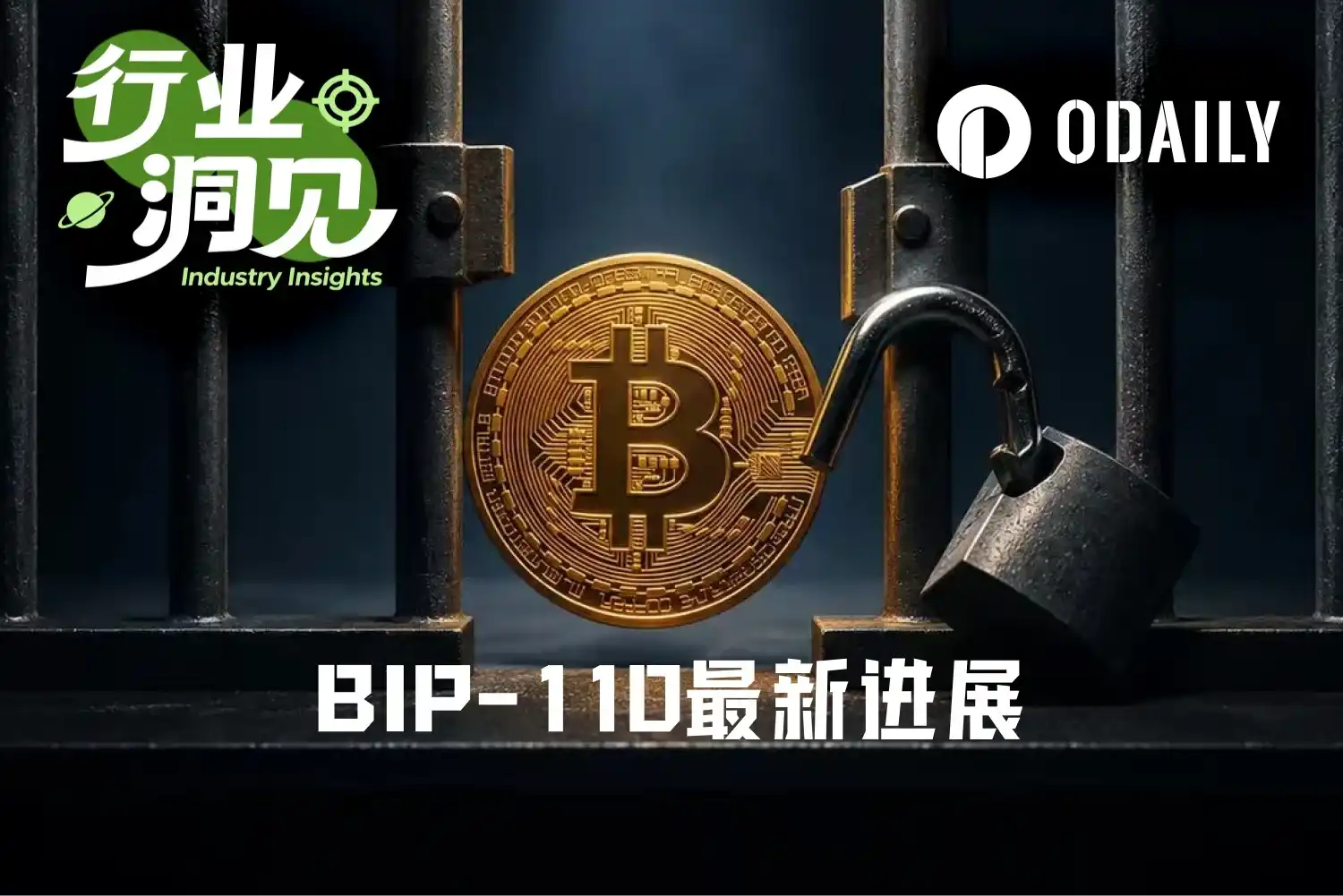
With Less Than 1% Support, Will BIP-110 Still Force a Bitcoin Soft Fork?

Odaily星球日报Publicado a 2026-07-17Actualizado a 2026-07-17

Resumen

**English Summary:** Despite garnering minimal support (less than 1% from miners and around 14.6% of nodes), the controversial BIP-110 proposal is poised to enter its "forced activation" window in early August. Proposed in December 2025 by Dathon Ohm and backed by Bitcoin Core developer Luke Dashjr, BIP-110 aims to temporarily restrict non-monetary data (like Ordinals and Bitcoin NFTs) in transactions for one year to reduce network "spam" and refocus Bitcoin on its monetary function. The proposal's contentious mechanism means that supporting nodes will enforce the new rules starting at block height 965,664 (late August/early September), even without reaching the 55% activation threshold. This will likely cause a chain split between nodes enforcing BIP-110 and the main chain. **Supporters**, led by Luke Dashjr and his Ocean mining pool, view BIP-110 as a necessary correction to stop what they consider an "attack" on Bitcoin—the use of block space for data storage, which they argue drives up transaction fees and burdens nodes. They believe the stricter BIP-110 chain could eventually become the longest chain. **Opponents**, including figures like Adam Back, Jameson Lopp, and Michael Saylor, argue that BIP-110 fails to solve core issues while creating new risks. Their concerns include stifling future innovation (e.g., hindering BitVM), compromising Bitcoin's censorship-resistant and decentralized ethos, introducing potential chain-split uncertainties like double-spend risks, ...

Original | Odaily Planet Daily (@OdailyChina)

Author | Golem (@web3_golem)
As the mandatory activation window in August approaches, discussions around the BIP-110 proposal have recently heated up again.

BIP-110 was proposed by Dathon Ohm in December 2025 and is supported by Bitcoin Core developer Luke Dashjr. This proposal aims to limit arbitrary/non-monetary data in Bitcoin transactions over the next year, primarily targeting large data storage like Ordinals and Bitcoin NFTs, in hopes of reducing "spam transactions" in the network and keeping Bitcoin focused on its monetary function.

This proposal has been controversial since its introduction, but data shows that BIP-110 currently lacks mainstream support from miners and nodes. The activation threshold for BIP-110 is 55%. According to statistics, current miner support is less than 1%. Out of a total of 102,674 nodes in the network, only 15,035 nodes are willing to enforce BIP-110, a ratio of 14.64%.
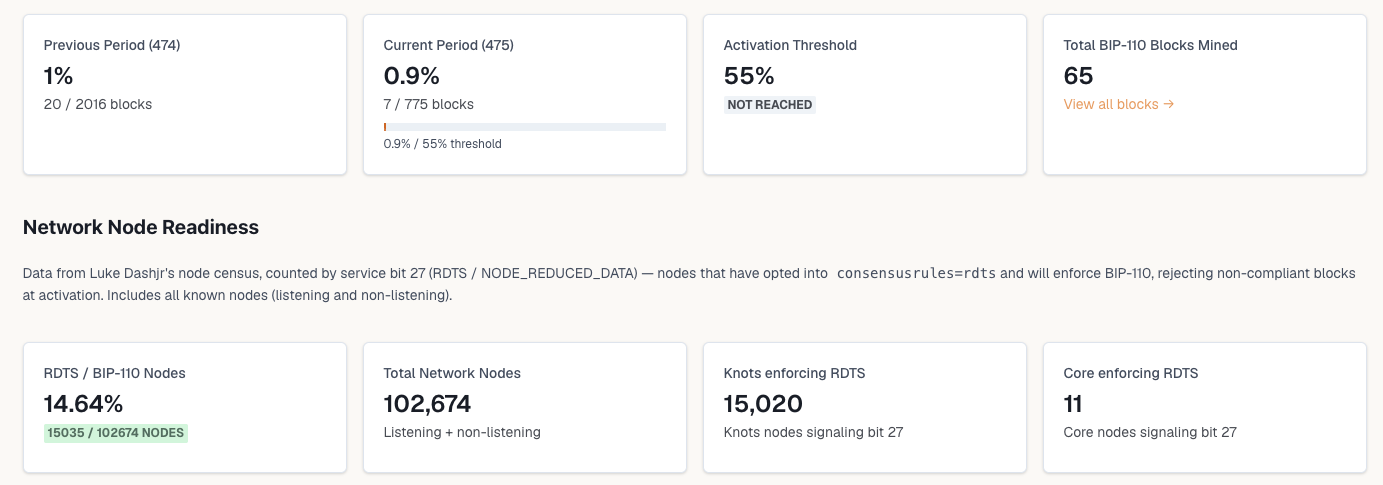
BIP-110 Miner and Node Support Rate

Typically, a proposal with such low support cannot pass on the Bitcoin network. However, the audacious aspect of BIP-110 is that even without achieving consensus, nodes supporting BIP-110 will enforce it. If BIP-110 does not reach the 55% activation threshold before block height 961,632, it will enter a mandatory activation window (block heights 961,632-963,647). During this period, nodes running BIP-110 will reject non-compliant blocks, forcibly pushing the acceptance rate to 100%, enabling BIP-110 to be ultimately activated and enforced at block height 965,664.

At the current Bitcoin network block production rate, BIP-110 will enter its mandatory activation window in early August. This means that although BIP-110 is a soft fork proposal, the Bitcoin network will still experience a chain split (a minority chain supporting BIP-110 and the main chain not supporting it) at that time.

BIP-110 Continuous Controversy

According to Bitcoin's "longest chain rule," a soft fork only succeeds—meaning the entire network unifies under the new rules—when miners supporting BIP-110 (or, more accurately, the proposed changes) actually possess a majority (>50%) of the hash rate, allowing their chain to become the longest chain. Therefore, although the forced activation of BIP-110 seems inevitable, its ultimate persistence still depends on consensus. Otherwise, BIP-110 will likely meet the same fate as the vast majority of Bitcoin soft forks in history: dying out naturally.

Supporters: BIP-110 is not a change, but a negation of a change

The main representatives of the BIP-110 supporters are Luke Dashjr and his mining pool, Ocean. Luke Dashjr has long been a vocal opponent of BRC-20 and inscriptions within the Bitcoin developer community and provided initial suggestions for the BIP-110 proposal.

Luke Dashjr is considered a representative figure of Bitcoin maximalism or fundamentalism. They are unwilling to see Bitcoin block space used for any purpose other than Bitcoin transfers. In the BIP-110 proposal, inscriptions that emerged in 2022 are viewed as a type of "Bitcoin attack." The rationale is that allowing arbitrary data to be embedded in Bitcoin transactions creates a massive and unnecessary burden for nodes. Furthermore, this "junk data" occupies a significant amount of block space, forcing monetary transactions to raise their fee bids to be included in a block, thereby crowding out Bitcoin's monetary use.

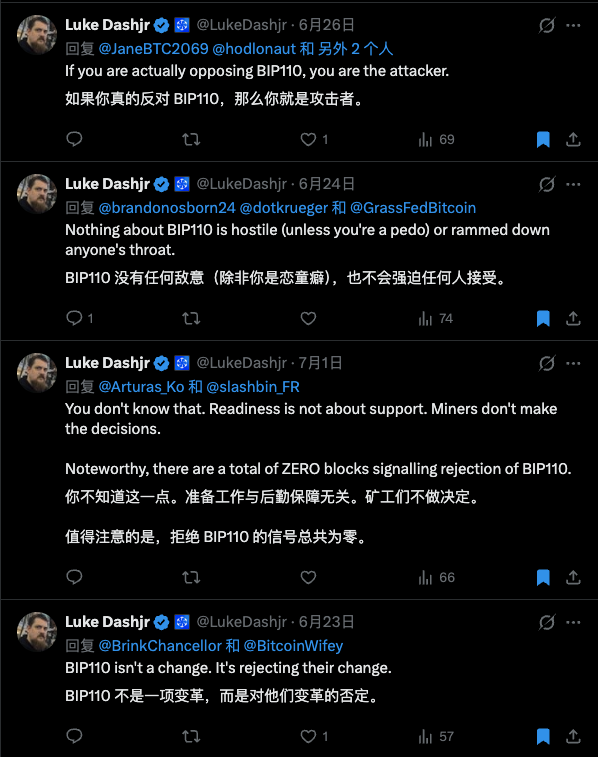
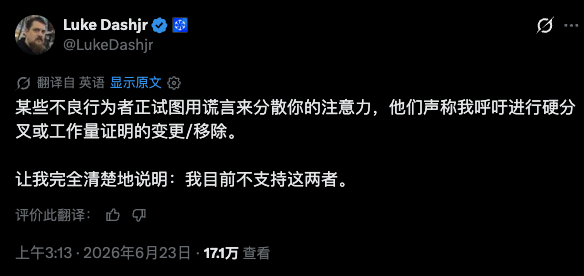
Therefore, Luke Dashjr posted on platform X, stating that BIP-110 is not a change, but a negation of a change. When facing opposition to BIP-110, he also employs sophistry, claiming on one hand that BIP-110 has no hostility and does not force anyone to accept it, and on the other hand, asserting that those who oppose BIP-110 are the true attackers of Bitcoin.

Moreover, although the current voting rate of miners approving BIP-110 is very low (<1%), Luke Dashjr remains optimistic, pointing out that the direct opposition voting rate among miners is also nearly 0%. The implication is that miners are not making a decision; once BIP-110 activates, they will naturally follow.
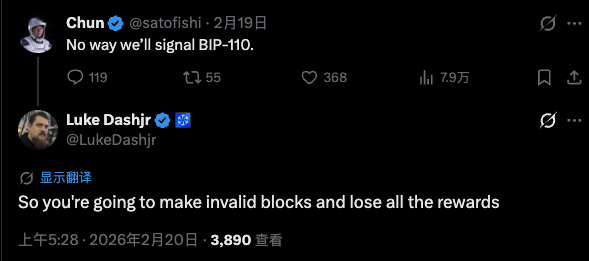
Looking at reality, as of now, the only mining pool publicly supporting BIP-110 is Luke Dashjr's own Ocean. F2Pool co-founder Wang Chun publicly stated back in February that they would absolutely not support BIP-110. Luke Dashjr confidently replied under that post, "Then you will mine invalid blocks and lose all your rewards."
According to miningradar data, F2Pool is the third-largest Bitcoin mining pool globally, with a hash rate share of 13.6%. Meanwhile, Ocean's current hash rate is only 24.6 EH/s, accounting for 2.6% of the network's total hash rate.
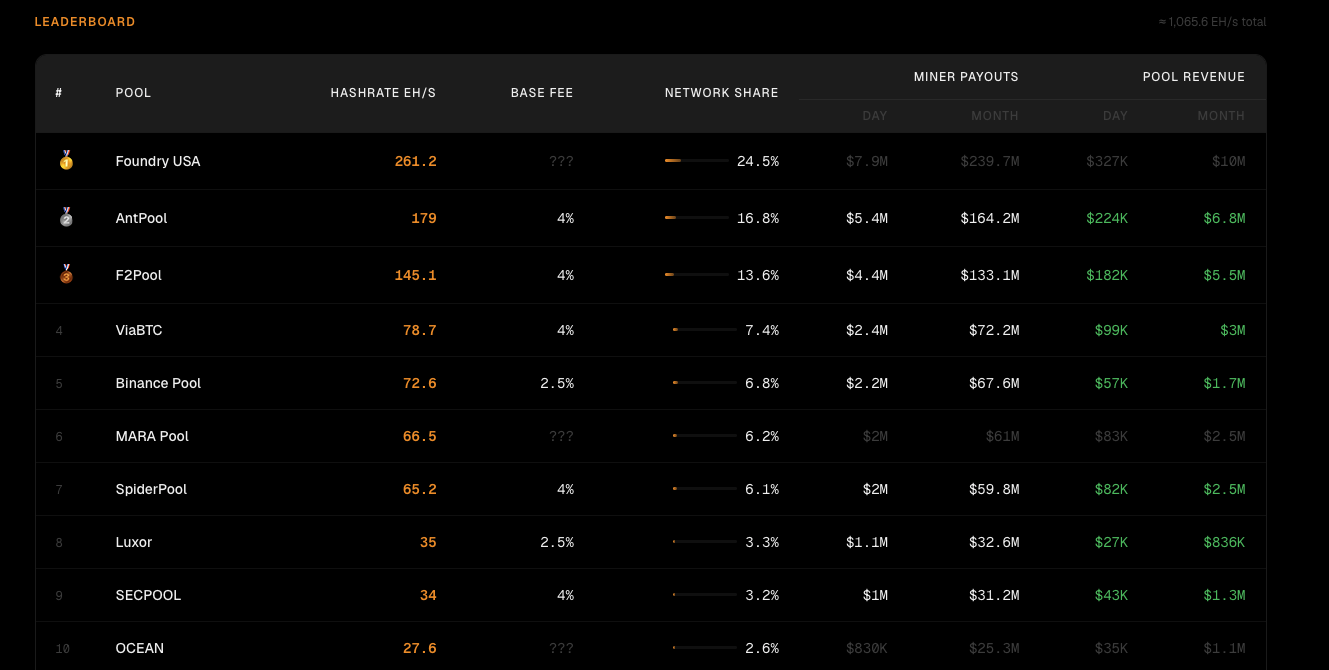
Bitcoin Mining Pool Rankings

If Ocean ultimately becomes the only pool supporting the fork, they would only produce 3-5 blocks per day. Such efficiency and block production speed would be insufficient to become the "longest chain" on the Bitcoin network.

Opponents: BIP-110 Doesn't Solve the Problem and Creates More New Issues

Opponents of the BIP-110 proposal not only focus on whether BIP-110 will be successful after activation but also criticize it for failing to solve the "spam transaction" problem on the Bitcoin network while simultaneously creating many potential new issues. In short, BIP-110 opponents are strongly opposing it out of concern for various unintended consequences, not out of any attachment to Ordinals or inscriptions. Key figures among the opponents include cypherpunk pioneer Adam Back, Bitcoin Core developer Jameson Lopp, and MicroStrategy founder Michael Saylor.

Firstly, opponents argue that BIP-110 cannot completely solve the "spam transaction" issue facing the Bitcoin network; the author of the BIP-110 proposal also admits it can only provide temporary relief. Jameson Lopp believes that Bitcoin's block size limit and the fee market for block space have already mitigated the spam transaction problem to some extent. However, Bitcoin remains a target for various spam transaction attacks primarily because very few people actually use the Bitcoin network regularly, keeping transaction fees consistently low. This prevents the formation of sufficient fee pressure to deter most spam transactions.

Furthermore, BIP-110 could stifle future innovation on Bitcoin. The BIP-110 proposal itself acknowledges that restrictions on Taproot would hinder the implementation of advanced functionalities or complex contracts like BitVM on the Bitcoin network. Although BIP-110 is described as a one-year temporary restriction, Jameson Lopp believes this is merely a delaying tactic by Luke Dashjr. If these restrictions severely constrain future Bitcoin upgrades, it could ultimately lead to a Bitcoin hard fork rather than a soft fork.

Adam Back focuses more on Bitcoin's censorship resistance and decentralized spirit. He argues that BIP-110 would subjectively censor transactions within blocks, fundamentally aiming to regulate others. This goes against the neutrality and censorship-resistant spirit Bitcoin has upheld since its inception, representing a dangerous step towards centralization and control. Adam Back uses Bitcoin's original principles to negate the changes proposed by Bitcoin extremists, essentially "using magic to defeat magic."

Michael Saylor summarizes BIP-110 as a "Bitcoin Iatrogenic Proposal," implying that the "treatment" (BIP-110) itself would harm Bitcoin rather than solve existing problems.
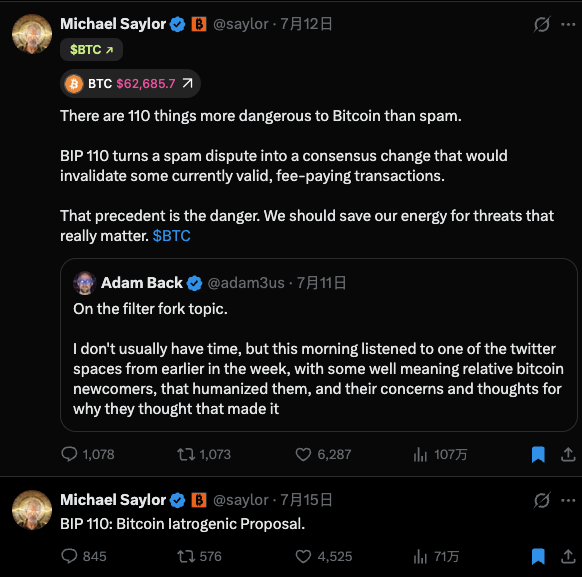
Michael Saylor also believes that if BIP-110 were to become consensus, some valid paid transactions would become invalid, and setting this precedent for censorship is the true danger.

Opponents have another major concern: the serious consequence that activating BIP-110 could split the Bitcoin chain ecosystem. Two competing chains would emerge, vying for the status of the "real Bitcoin." In such a scenario, uncertainty about the fork's outcome could create a risk of Bitcoin double-spending. Even without causing double-spending, if BIP-110 ultimately evolves into a new chain, it would split Bitcoin's developer resources, hash rate resources, and monetary consensus.

Opponents believe BIP-110 is attempting to use a technical solution to address a cultural problem, potentially generating more unpredictable issues in the process.

Despite these concerns, opponents are confident about BIP-110's failure. Jameson Lopp made a bet against BIP-110 back in February, with a minimum wager of 1 BTC. So far, no BIP-110 supporter has publicly accepted the bet.
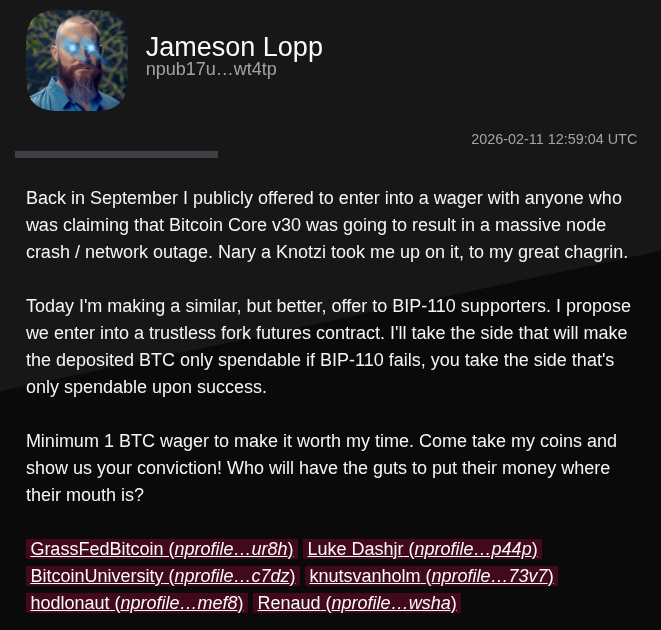
Jameson Lopp's Wager Invitation to BIP-110 Supporters

On the prediction market Predyx, the probability for "BIP-110 will activate and be enforced on Bitcoin between September 1-7, 2026" is 10%. The settlement condition for "Yes" is that the BIP-110 chain must become the "Bitcoin longest chain" and be accepted by most nodes.
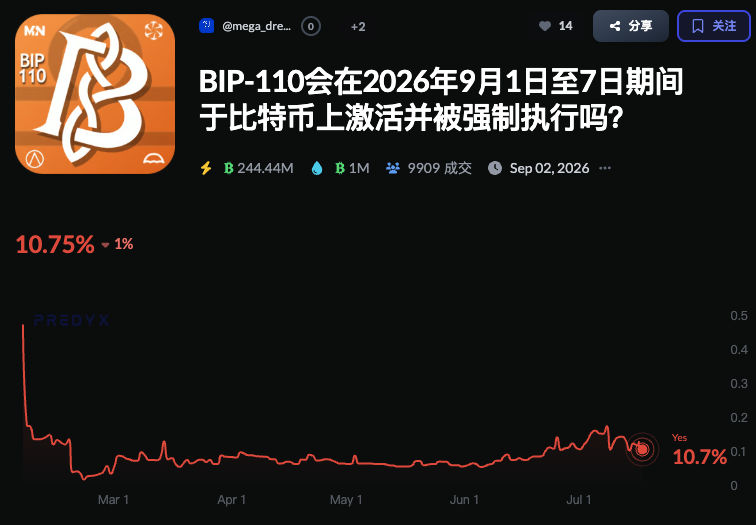
What Happens After BIP-110 Activates?

We can now consider several hypothetical scenarios for what might happen when BIP-110 is ultimately forcibly activated at block height 965,664 (late August to early September).

The first scenario is as described above. After reaching the activation height, BIP-110 nodes reject main chain blocks, but there aren't enough miners producing new blocks that comply with BIP-110 rules. The BIP-110 chain's block production speed would be extremely slow, eventually stopping altogether and ceasing to "grow."

The second scenario assumes a certain proportion of miners support BIP-110. BIP-110 supporters believe they possess an "asymmetric advantage" because BIP-110 rules are stricter. Therefore, while BIP-110 nodes will reject blocks containing违规数据 (inscriptions, etc.), non-BIP-110 nodes (mainstream Core nodes) will consider blocks produced by BIP-110 nodes as valid.

Moreover, currently, inscription transactions only account for about 5% of Bitcoin block space usage, with over 95% being traditional Bitcoin transfer transactions. BIP-110 nodes would still receive a large number of mainstream blocks. This is why Luke Dashjr believes BIP-110 will ultimately become the "longest chain" and unify the network.
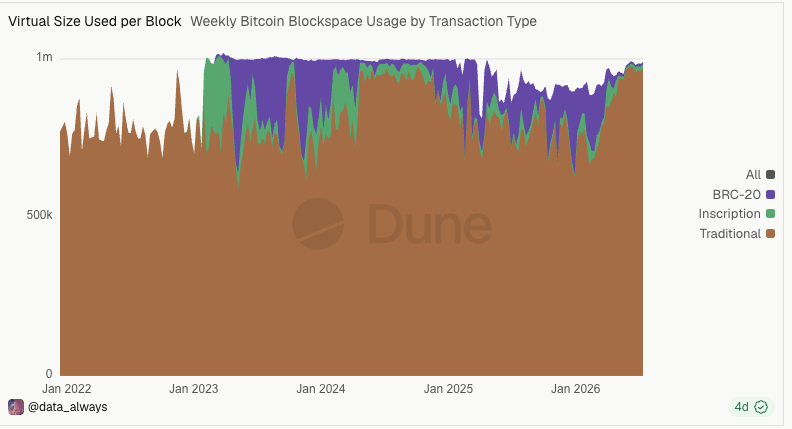
Bitcoin Block Space Usage by Transaction Type

The third scenario involves a certain proportion of miners supporting BIP-110, but their hash rate never surpasses that of the existing majority chain. Typically, miners are highly rational because their machines incur electricity costs as soon as they are turned on. In a competition between two chains, miners weigh the pros and cons. Miners on the BIP-110 chain might find it easier to abandon sunk costs (mining rewards on the minority chain) and join the majority chain, as the minority chain not only lags in length but also accumulates fewer Bitcoin rewards than the majority chain. This would ultimately lead to the first scenario.

Now, assuming Luke Dashjr has immense influence and miners act irrationally, persisting in mining on the BIP-110 chain, what would happen? This chain would continue to operate independently, but block times could be very slow. Miners would essentially be mining for the sake of ideology, consuming energy meaninglessly. The most plausible outcome in this situation is that the BIP-110 chain, driven by its supporters, permanently forks into an independent chain, "manually" adjusts its difficulty, and launches a new network token.

However, Luke Dashjr has repeatedly emphasized his refusal to hard fork for BIP-110, believing it's not yet time to use that method. Public sentiment can be a double-edged sword. At that point, even Luke Dashjr might be carried away by the will of the crowd, finding the arrow already on the bowstring and having to release it.
Therefore, the minority chain run by BIP-110 supporters can technically continue to operate, but it will likely struggle to thrive, as that depends on economic and ecosystem factors, including support from wallets, exchanges, users, etc. There are many such examples on the Bitcoin network; most ultimately fail. Even those that succeed rarely reach heights beyond independent coins like BCH or BSV.

Criptos en tendencia

Preguntas relacionadas

QWhat is BIP-110 and what is its main objective?

ABIP-110 is a proposal introduced by Dathon Ohm in December 2025, supported by Bitcoin Core developer Luke Dashjr. Its main objective is to limit arbitrary/non-monetary data in Bitcoin transactions, particularly targeting large data storage like Ordinals and Bitcoin NFTs, over the next year. The aim is to reduce 'spam transactions' on the network and refocus Bitcoin on its monetary function.

QAccording to the article, what are the current support levels for BIP-110 among miners and nodes?

AThe current support levels for BIP-110 are very low. The activation threshold is 55%, but miner support is reportedly under 1%. Out of 102,674 total nodes, only 15,035 nodes (approximately 14.64%) are willing to enforce BIP-110.

QWhat is the 'forced activation period' for BIP-110, and what is the primary concern about this period?

AThe 'forced activation period' for BIP-110 is between block heights 961,632 and 963,647, which is expected around early August. The primary concern is that during this period, nodes running BIP-110 will reject non-compliant blocks, attempting to force the adoption rate to 100% and activate BIP-110 by block height 965,664. This could lead to a chain split between the minority chain supporting BIP-110 and the main chain that does not.

QWho are some prominent opponents of BIP-110, and what are their main arguments against it?

AProminent opponents include cypherpunk pioneer Adam Back, Bitcoin Core developer Jameson Lopp, and MicroStrategy founder Michael Saylor. Their main arguments are: 1) BIP-110 doesn't fully solve the spam transaction problem and could create new issues. 2) It could stifle future innovation on Bitcoin (e.g., hindering BitVM). 3) It introduces subjective transaction censorship, contradicting Bitcoin's neutral and censorship-resistant principles. 4) It risks splitting the Bitcoin ecosystem and consensus, potentially creating two competing chains.

QWhat are the possible scenarios described in the article for what could happen after BIP-110 is forcibly activated?

AThe article outlines three possible scenarios: 1) BIP-110 nodes reject main chain blocks, but without enough miner support to produce compliant blocks, the BIP-110 chain stops growing and 'dies naturally.' 2) A significant portion of miners supports BIP-110. Due to its stricter rules, its blocks are valid on the main chain, potentially allowing it to become the longest chain. 3) Some miners support BIP-110, but their hash power never surpasses the majority chain. Rational miners would eventually switch to the more profitable main chain, leading again to scenario 1. A fourth implied scenario is a permanent hard fork creating a separate chain, though Luke Dashjr has stated opposition to this.

Lecturas Relacionadas

Stable Vaults Are the Final Piece in Aave's Mass Commercialization Puzzle

Aave's introduction of "Stable Vaults" aims to bridge the gap between complex DeFi protocols and mainstream users by offering a simplified, predictable savings product. The core innovation is a fixed-yield layer built atop Aave's volatile underlying lending pools. Partnering platforms (like digital banks or wallets) can offer users a guaranteed interest rate (e.g., 4%), shielding them from market fluctuations. The partner absorbs the risk and profit/loss from the difference between this fixed rate and Aave's variable rate. From the user's perspective, Stable Vaults provide ease of use, predictable returns, and familiar services like customer support and account recovery, addressing key barriers like wallet management and volatility. However, users pay a price: they cap their potential earnings (forgoing higher market yields), add counterparty risk from the partner platform, and may lack transparency into the true spread being captured. For partners, Stable Vaults turn idle user funds into a revenue stream via the yield spread. For Aave, this strategy attracts sticky, "sticky" capital from mass-market applications, providing a stable fee revenue stream crucial for its tokenomics (e.g., buyback mechanisms), especially in bear markets. The article contrasts this approach with direct DeFi interaction, where users keep all yield but face complexity and volatility. It argues that Stable Vaults align with proven consumer behavior: most users prioritize convenience, safety, and predictability over maximizing returns, willingly paying a "peace of mind" premium. Examples like Coinbase and Robinhood offering similar "savings" products validate this demand. Thus, Stable Vaults represent Aave's strategic move to commercialize by catering to fundamental human preferences for simplicity and stability in finance.

marsbitHace 52 min(s)

Stable Vaults Are the Final Piece in Aave's Mass Commercialization Puzzle

marsbitHace 52 min(s)

Support Rate Less Than 1%, BIP-110 Still Pushes Bitcoin Towards a Soft Fork?

Title: BIP-110 Pushes Bitcoin Towards a Soft Fork Despite Less Than 1% Approval With its August mandatory activation window approaching, the controversial BIP-110 proposal is back in the spotlight. Proposed in December 2025 by Dathon Ohm and supported by Bitcoin Core developer Luke Dashjr, BIP-110 aims to impose a one-year limit on arbitrary/non-monetary data in Bitcoin transactions, primarily targeting large data storage like Ordinals and Bitcoin NFTs, to reduce network "spam" and refocus Bitcoin on its monetary function. However, the proposal faces overwhelming opposition. To activate, BIP-110 requires a 55% threshold, yet current miner support is below 1%. Of the 102,674 network nodes, only 14.64% (15,035) signal readiness to enforce it. Despite this lack of consensus, BIP-110 has a contentious "mandatory window" mechanism: if the threshold isn't met by block height 961,632, supporting nodes will begin rejecting non-compliant blocks from height 961,632 to 963,647, attempting to force activation by block 965,664. This could lead to a chain split in early August between a minority chain enforcing BIP-110 and the main chain. Proponents, led by Luke Dashjr (founder of Ocean mining pool), argue that inscriptions constitute an "attack" on Bitcoin, congesting block space and raising transaction fees, thereby undermining Bitcoin's primary use as money. They view BIP-110 not as a change but as a reversal of a harmful change. Opponents, including figures like Adam Back, Jameson Lopp, and Michael Saylor, contend that BIP-110 fails to solve the spam problem while creating new risks. They warn it could stifle future innovation (e.g., impacting BitVM), introduce transaction censorship—eroding Bitcoin's neutrality—and potentially cause a damaging chain split that fragments developer resources, hash power, and monetary consensus. They argue market-based fee pressure and block size limits already manage congestion effectively. Potential outcomes post-activation include: 1) The BIP-110 chain stalling due to insufficient hash power; 2) The BIP-110 chain becoming the longest chain if it gains majority miner support (though currently, Ocean holds only 2.6% of hash power vs. opponents like F2Pool at 13.6%); or 3) A persistent minority chain that remains economically unviable, potentially leading to a permanent fork. Most analysts and prediction markets deem BIP-110's success unlikely, with one market giving only a 10% probability that it will become the accepted longest chain by September 2026.

marsbitHace 57 min(s)

Support Rate Less Than 1%, BIP-110 Still Pushes Bitcoin Towards a Soft Fork?

marsbitHace 57 min(s)

Trading

Spot

Artículos destacados

Qué es BITCOIN

Entendiendo HarryPotterObamaSonic10Inu (ERC-20) y Su Posición en el Espacio Cripto En los últimos años, el mercado de criptomonedas ha sido testigo de un aumento en la popularidad de las monedas meme, capturando el interés no solo de los comerciantes, sino también de aquellos que buscan compromiso comunitario y valor de entretenimiento. Entre estos tokens únicos se encuentra HarryPotterObamaSonic10Inu (ERC-20), un proyecto intrigante que mezcla referencias culturales en el tejido de las criptomonedas. Este artículo profundiza en los aspectos clave de HarryPotterObamaSonic10Inu, explorando sus mecanismos, ethos impulsado por la comunidad y su relación con el paisaje cripto más amplio. ¿Qué es HarryPotterObamaSonic10Inu (ERC-20)? Como su nombre sugiere, HarryPotterObamaSonic10Inu es una moneda meme construida sobre la blockchain de Ethereum, clasificada bajo el estándar ERC-20. A diferencia de las criptomonedas tradicionales que pueden enfatizar la utilidad práctica o el potencial de inversión, este token prospera en el valor de entretenimiento y la fuerza de su comunidad. El proyecto tiene como objetivo fomentar un entorno donde los usuarios comprometidos puedan reunirse, compartir ideas y participar en actividades inspiradas por diversos fenómenos culturales. Una característica notable de HarryPotterObamaSonic10Inu es su cero impuestos en las transacciones. Este atractivo elemento tiene como objetivo incentivar el comercio y la participación comunitaria, sin cargos adicionales que puedan disuadir a los comerciantes de pequeña escala. El suministro total de la moneda está establecido en mil millones de tokens, una cifra que marca su intención de mantener una circulación sustancial dentro de la comunidad. Creador de HarryPotterObamaSonic10Inu (ERC-20) Los orígenes de HarryPotterObamaSonic10Inu están algo envueltos en misterio; los detalles sobre el creador siguen siendo desconocidos. El desarrollo de este token carece de un equipo identificable o de un plan explícito, lo cual no es inusual dentro del sector de monedas meme. En cambio, el proyecto ha surgido de manera orgánica, con su progreso muy dependiente del entusiasmo y la participación de su comunidad. Inversores de HarryPotterObamaSonic10Inu (ERC-20) En cuanto a inversiones externas y respaldo, HarryPotterObamaSonic10Inu también sigue siendo ambiguo. El token no lista ninguna fundación de inversión conocida o apoyo organizacional significativo. En cambio, la savia del proyecto es su comunidad de base, que informa su crecimiento y sostenibilidad a través de la acción colectiva y el compromiso en el espacio cripto. ¿Cómo Funciona HarryPotterObamaSonic10Inu (ERC-20)? Como una moneda meme, HarryPotterObamaSonic10Inu opera principalmente fuera de los marcos tradicionales que a menudo rigen el valor de los activos. Hay varios aspectos distintivos que definen cómo funciona el proyecto: Transacciones Sin Impuestos: Sin tarifas impositivas en las transacciones, los usuarios pueden comprar y vender el token libremente sin preocuparse por costos ocultos. Compromiso Comunitario: El proyecto prospera en la interacción comunitaria, aprovechando plataformas de redes sociales para crear entusiasmo y facilitar la participación. Las discusiones, el intercambio de contenido y el compromiso son elementos cruciales que ayudan a expandir su alcance y fomentar la lealtad entre los seguidores. Sin Utilidad Práctica: Cabe señalar que HarryPotterObamaSonic10Inu no ofrece utilidad concreta dentro del ecosistema financiero. Más bien, se clasifica como un token principalmente para actividades de entretenimiento y comunitarias. Referencia Cultural: El token incorpora astutamente elementos de la cultura popular para atraer interés, conectando con entusiastas de los memes y seguidores de las criptomonedas por igual. HarryPotterObamaSonic10Inu ejemplifica cómo las monedas meme operan de manera diferente a los proyectos de criptomonedas más tradicionales, ingresando al mercado como construcciones sociales innovadoras en lugar de activos utilitarios. Cronología de HarryPotterObamaSonic10Inu (ERC-20) La historia de HarryPotterObamaSonic10Inu está marcada por varios hitos notables: Creación: El token surgió de un meme viral, capturando la imaginación de muchos entusiastas de las criptomonedas. Las fechas específicas de creación no están disponibles, subrayando su ascenso orgánico. Listado en Exchanges: HarryPotterObamaSonic10Inu ha llegado a varios exchanges, permitiendo un acceso y comercio más fácil por parte de la comunidad. Iniciativas de Compromiso Comunitario: Actividades continuas destinadas a mejorar la interacción comunitaria, incluyendo concursos, campañas en redes sociales y generación de contenido por parte de fanáticos y defensores. Planes de Expansión Futuros: La hoja de ruta del proyecto incluye el lanzamiento de una colección de NFT, mercancía y un sitio de comercio electrónico relacionado con sus temas culturales, involucrando aún más a la comunidad e intentando añadir más dimensiones a su ecosistema. Puntos Clave Sobre HarryPotterObamaSonic10Inu (ERC-20) Naturaleza Impulsada por la Comunidad: El proyecto prioriza la participación colectiva y la creatividad, asegurando que la involucración de los usuarios esté a la vanguardia de su desarrollo. Clasificación como Moneda Meme: Representa la epítome de las criptomonedas basadas en el entretenimiento, diferenciándose de los vehículos de inversión tradicionales. Sin Afiliación Directa con Bitcoin: A pesar de la similitud en el nombre del ticker, HarryPotterObamaSonic10Inu es distinto y no tiene relación con Bitcoin u otras criptomonedas establecidas. Enfoque en la Colaboración: HarryPotterObamaSonic10Inu está diseñado para crear un espacio para la colaboración y el intercambio de historias entre sus poseedores, proporcionando una vía para la creatividad y el vínculo comunitario. Perspectivas Futuras: La ambición de expandirse más allá de su premisa inicial hacia NFTs y mercancías describe un camino para que el proyecto potencialmente ingrese a avenidas más tradicionales dentro de la cultura digital. A medida que las monedas meme continúan capturando la imaginación de la comunidad de criptomonedas, HarryPotterObamaSonic10Inu (ERC-20) se destaca debido a sus lazos culturales y su enfoque centrado en la comunidad. Si bien puede no encajar en el molde típico de un token impulsado por la utilidad, su esencia radica en la alegría y la camaradería fomentadas entre sus seguidores, destacando la naturaleza en evolución de las criptomonedas en una era cada vez más digital. A medida que el proyecto continúa desarrollándose, será importante observar cómo las dinámicas comunitarias influyen en su trayectoria en el cambiante paisaje de la tecnología blockchain.

2.0k Vistas totalesPublicado en 2024.04.01Actualizado en 2024.12.03

Qué es BITCOIN

Cómo comprar BTC

¡Bienvenido a HTX.com! Hemos hecho que comprar Bitcoin (BTC) sea simple y conveniente. Sigue nuestra guía paso a paso para iniciar tu viaje de criptos.Paso 1: crea tu cuenta HTXUtiliza tu correo electrónico o número de teléfono para registrarte y obtener una cuenta gratuita en HTX. Experimenta un proceso de registro sin complicaciones y desbloquea todas las funciones.Obtener mi cuentaPaso 2: ve a Comprar cripto y elige tu método de pagoTarjeta de crédito/débito: usa tu Visa o Mastercard para comprar Bitcoin (BTC) al instante.Saldo: utiliza fondos del saldo de tu cuenta HTX para tradear sin problemas.Terceros: hemos agregado métodos de pago populares como Google Pay y Apple Pay para mejorar la comodidad.P2P: tradear directamente con otros usuarios en HTX.Over-the-Counter (OTC): ofrecemos servicios personalizados y tipos de cambio competitivos para los traders.Paso 3: guarda tu Bitcoin (BTC)Después de comprar tu Bitcoin (BTC), guárdalo en tu cuenta HTX. Alternativamente, puedes enviarlo a otro lugar mediante transferencia blockchain o utilizarlo para tradear otras criptomonedas.Paso 4: tradear Bitcoin (BTC)Tradear fácilmente con Bitcoin (BTC) en HTX's mercado spot. Simplemente accede a tu cuenta, selecciona tu par de trading, ejecuta tus trades y monitorea en tiempo real. Ofrecemos una experiencia fácil de usar tanto para principiantes como para traders experimentados.

5.3k Vistas totalesPublicado en 2024.12.12Actualizado en 2026.06.02

Cómo comprar BTC

Qué es $BITCOIN

ORO DIGITAL ($BITCOIN): Un Análisis Integral Introducción al ORO DIGITAL ($BITCOIN) ORO DIGITAL ($BITCOIN) es un proyecto basado en blockchain que opera en la red Solana, cuyo objetivo es combinar las características de los metales preciosos tradicionales con la innovación de las tecnologías descentralizadas. Aunque comparte un nombre con Bitcoin, a menudo referido como “oro digital” debido a su percepción como un refugio de valor, ORO DIGITAL es un token separado diseñado para crear un ecosistema único dentro del paisaje Web3. Su meta es posicionarse como un activo digital alternativo viable, aunque los detalles sobre sus aplicaciones y funcionalidades aún están en desarrollo. ¿Qué es ORO DIGITAL ($BITCOIN)? ORO DIGITAL ($BITCOIN) es un token de criptomoneda diseñado explícitamente para su uso en la blockchain de Solana. A diferencia de Bitcoin, que proporciona un papel de almacenamiento de valor ampliamente reconocido, este token parece centrarse en aplicaciones y características más amplias. Aspectos notables incluyen: Infraestructura Blockchain: El token está construido sobre la blockchain de Solana, conocida por su capacidad para manejar transacciones de alta velocidad y bajo costo. Dinámicas de Suministro: ORO DIGITAL tiene un suministro máximo limitado a 100 cuatrillones de tokens (100P $BITCOIN), aunque los detalles sobre su suministro circulante no se han divulgado actualmente. Utilidad: Si bien las funcionalidades precisas no están delineadas explícitamente, hay indicios de que el token podría ser utilizado para diversas aplicaciones, potencialmente involucrando aplicaciones descentralizadas (dApps) o estrategias de tokenización de activos. ¿Quién es el Creador de ORO DIGITAL ($BITCOIN)? En la actualidad, la identidad de los creadores y el equipo de desarrollo detrás de ORO DIGITAL ($BITCOIN) sigue siendo desconocida. Esta situación es típica entre muchos proyectos innovadores dentro del espacio blockchain, particularmente aquellos alineados con las finanzas descentralizadas y fenómenos de monedas meme. Si bien tal anonimato puede fomentar una cultura impulsada por la comunidad, intensifica las preocupaciones sobre la gobernanza y la responsabilidad. ¿Quiénes son los Inversores de ORO DIGITAL ($BITCOIN)? La información disponible indica que ORO DIGITAL ($BITCOIN) no tiene patrocinadores institucionales conocidos ni inversiones destacadas de capital de riesgo. El proyecto parece operar en un modelo de peer-to-peer centrado en el apoyo y la adopción de la comunidad en lugar de rutas de financiamiento tradicionales. Su actividad y liquidez se sitúan principalmente en intercambios descentralizados (DEX), como PumpSwap, en lugar de plataformas de trading centralizadas establecidas, lo que resalta aún más su enfoque de base. Cómo Funciona ORO DIGITAL ($BITCOIN) Los mecanismos operativos de ORO DIGITAL ($BITCOIN) pueden elaborarse en función de su diseño blockchain y atributos de red: Mecanismo de Consenso: Al aprovechar el único proof-of-history (PoH) de Solana combinado con un modelo de proof-of-stake (PoS), el proyecto asegura una validación de transacciones eficiente que contribuye al alto rendimiento de la red. Tokenómica: Si bien los mecanismos deflacionarios específicos no se han detallado extensamente, el vasto suministro máximo de tokens implica que podría atender microtransacciones o casos de uso nicho que aún están por definirse. Interoperabilidad: Existe el potencial de integración con el ecosistema más amplio de Solana, incluyendo varias plataformas de finanzas descentralizadas (DeFi). Sin embargo, los detalles sobre integraciones específicas permanecen no especificados. Cronología de Eventos Clave Aquí hay una cronología que destaca hitos significativos relacionados con ORO DIGITAL ($BITCOIN): 2023: El despliegue inicial del token ocurre en la blockchain de Solana, marcado por su dirección de contrato. 2024: ORO DIGITAL gana visibilidad al estar disponible para trading en intercambios descentralizados como PumpSwap, permitiendo a los usuarios comerciar contra SOL. 2025: El proyecto presencia actividad de trading esporádica y potencial interés en compromisos liderados por la comunidad, aunque no se han documentado asociaciones notables o avances técnicos hasta el momento. Análisis Crítico Fortalezas Escalabilidad: La infraestructura subyacente de Solana soporta altos volúmenes de transacciones, lo que podría mejorar la utilidad de $BITCOIN en varios escenarios de transacción. Accesibilidad: El potencial bajo precio de trading por token podría atraer a inversores minoristas, facilitando una participación más amplia debido a oportunidades de propiedad fraccionada. Riesgos Falta de Transparencia: La ausencia de patrocinadores, desarrolladores o un proceso de auditoría conocidos públicamente puede generar escepticismo sobre la sostenibilidad y confiabilidad del proyecto. Volatilidad del Mercado: La actividad de trading depende en gran medida del comportamiento especulativo, lo que puede resultar en una volatilidad de precios significativa y en incertidumbre para los inversores. Conclusión ORO DIGITAL ($BITCOIN) surge como un proyecto intrigante pero ambiguo dentro del ecosistema de Solana en rápida evolución. Si bien intenta aprovechar la narrativa del “oro digital”, su alejamiento del papel establecido de Bitcoin como refugio de valor subraya la necesidad de una diferenciación más clara de su utilidad y estructura de gobernanza previstas. La aceptación y adopción futura dependerán probablemente de abordar la actual opacidad y de definir sus estrategias operativas y económicas de manera más explícita. Nota: Este informe abarca información sintetizada disponible hasta octubre de 2023, y pueden haber ocurrido desarrollos más allá del período de investigación.

148 Vistas totalesPublicado en 2025.05.13Actualizado en 2025.05.13

Qué es $BITCOIN

Discusiones

Bienvenido a la comunidad de HTX. Aquí puedes mantenerte informado sobre los últimos desarrollos de la plataforma y acceder a análisis profesionales del mercado. A continuación se presentan las opiniones de los usuarios sobre el precio de BTC (BTC).

活动图片