Will Trump Announce the New Fed Chair on the Night of the Fed Decision?

比推Publicado a 2026-01-28Actualizado a 2026-01-28

Resumen

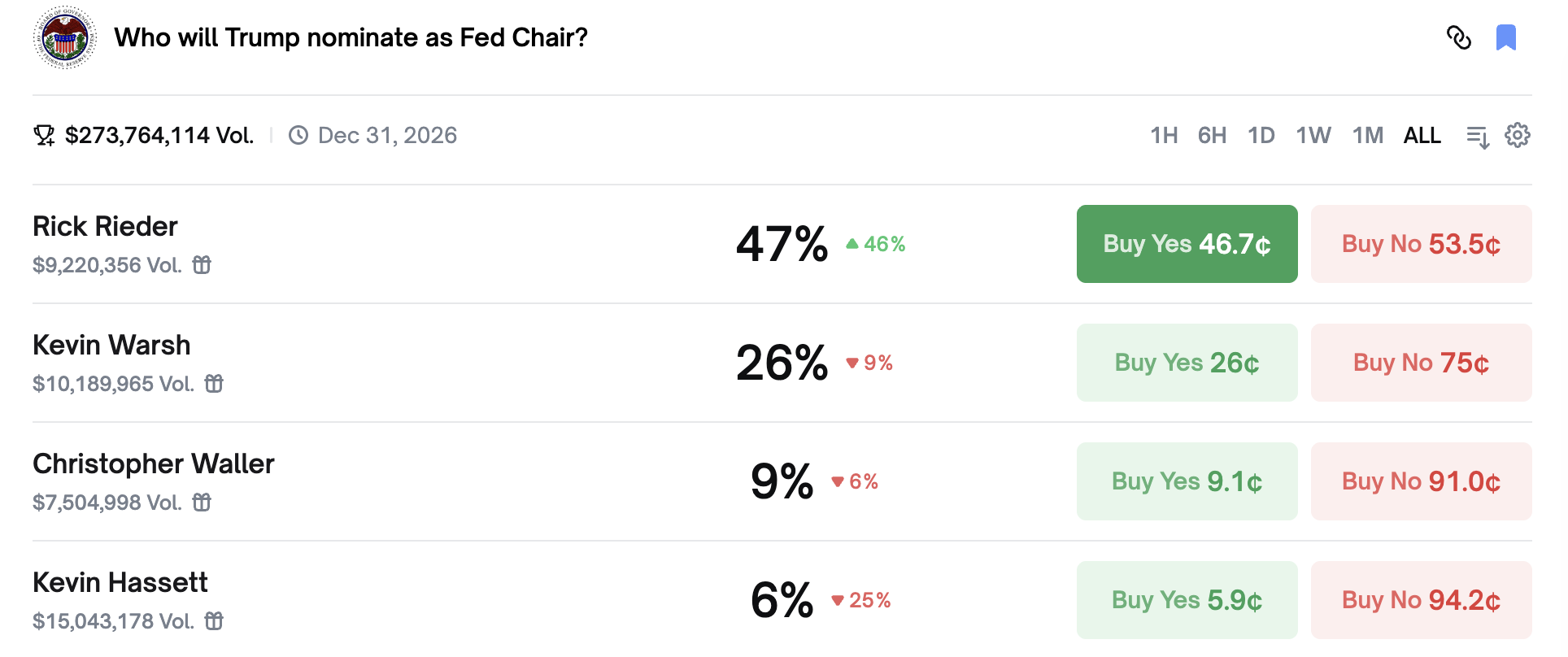
On January 29, 2026, the Federal Reserve is expected to announce its decision to keep interest rates unchanged, with market consensus nearly 100%. While this outcome is widely anticipated, the focus will be on Chair Jerome Powell’s post-announcement press conference for signals on future monetary policy. Investors are divided over whether the Fed will continue its rate-cutting cycle later in the year or adopt a more hawkish stance due to persistent inflation, which remains at 2.8%, above the 2% target. A key uncertainty is the potential announcement of a new Fed Chair nominee by former President Donald Trump, who has hinted at a January reveal. The shortlist includes Rick Rieder (currently the most probable candidate at 47%), Kevin Warsh, Christopher Waller, and Kevin Hassett. Trump may use the FOMC meeting timing to divert market attention from any hawkish signals from Powell, instead promoting a dovish nominee to reassure markets. The new composition of the voting members on the Fed’s rate-setting committee also leans more hawkish this year, which could influence future decisions regardless of the new Chair’s stance. The outcome of Powell’s remarks and a possible Trump announcement could significantly impact market sentiment.

Author: Golem

Original Title: On the Eve of the Storm: Powell Holds Rates, Trump Announces New Fed Chair?


At 3:00 AM Beijing time on January 29 (this Thursday), the Federal Reserve is set to announce its first interest rate decision of 2026; half an hour later, current Fed Chair Jerome Powell will hold a monetary policy press conference. However, there is little suspense around this Fed rate decision, as the market widely expects the Fed to keep rates unchanged. Polymarket data shows the probability of holding rates steady is close to 100%.
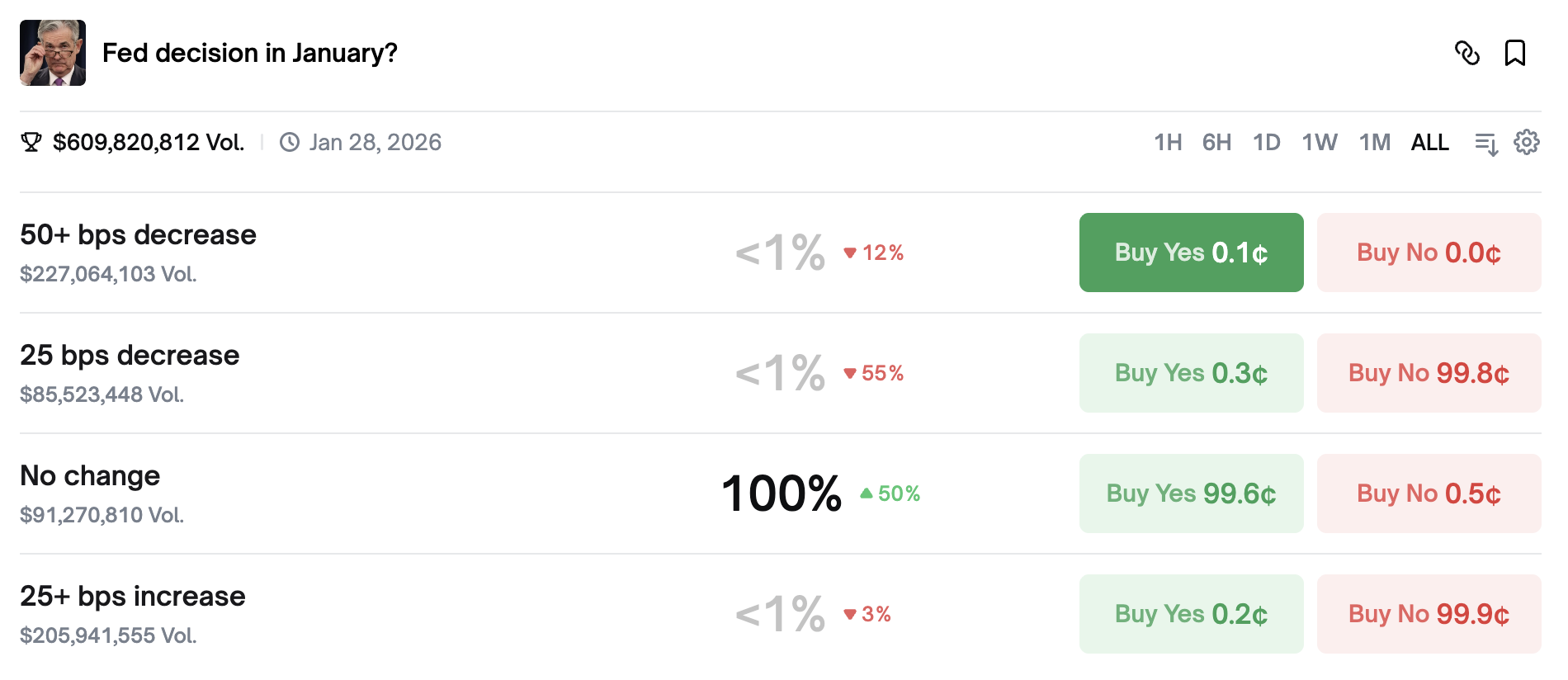
Such a high probability has allowed the market to提前消化 (price in) the negative impact of the Fed's "no rate cut" announcement this time. OKX data shows that BTC has fallen only 0.39% in the past 7 days, basically hovering sideways, but this period of market "silence" might be broken tonight.

On one hand, although the market almost unanimously believes the Fed will hold rates this week, there is significant divergence regarding the fiscal path for the remainder of 2026, making this still an important meeting to watch. The Fed's future key policy tendencies—whether it will continue cutting rates in 2026, the frequency of cuts, etc.—will affect the market. If Powell makes hawkish remarks during his speech, such as "need to continue observing," the market might "fall in response."

On the other hand, the announcement of the successor to the Fed Chair will also have a long-term impact on the market. The shortlist has been narrowed down to four people. Trump previously stated he has a preferred candidate but is waiting for the right time to announce, and this suitable time could very well be tonight.

2026 Rate Cut Direction Still Uncertain

Since last September, the Fed initiated a new rate-cutting cycle, conducting three consecutive rate cuts. If rates are held unchanged this week, it would be the first pause since the cycle began. At this point, the market is concerned not with the reason for holding rates, but whether this is a brief pause to observe or the start of a prolonged pause in rate cuts, or even the beginning of a rate hike cycle?

Previously, the prevailing market view was that 2026 would be a year of further quantitative easing by the Fed.

Reason one, from a data perspective, the US labor market indeed shows signs of weakness. Non-farm payrolls increased by only 50,000 in December 2025, with an unemployment rate of 4.4%. While there hasn't been "massive layoffs," it remains in a state of "low hiring, cooling demand." Reason two, the Fed might still believe Trump's tariff policies won't have a long-term impact on inflation (Odaily: Powell cited this factor for a rate cut in September 2025). Reason three, Trump has publicly stated he will choose a "dovish" figure as the next Fed Chair.

However, some in the market believe there is uncertainty about the Fed continuing rate cuts in 2026. Some analysts think that unless the job market deteriorates significantly, it will be difficult to see rate cuts before mid-year, as the pace of inflation decline is not sufficient to convince hawkish members.

The Fed's mandate, simply put, is to curb inflation and promote employment. However, in 2025, the US experienced a phenomenon of a weak labor market coexisting with high inflation. The Fed ultimately chose to prioritize the employment issue, hence initiating the rate-cutting cycle. Yet, the reality is that the US inflation rate remains stuck at 2.8%, far above the Fed's 2% target, forcing the Fed to reconsider the impact of tariffs on inflation. Holding rates this week would also indicate the Fed is starting to "observe."

Furthermore, although the next Fed Chair chosen by Trump is destined to be "dovish," the new rotating chairs of the Fed's interest rate-setting committee are predominantly "hawkish." At the beginning of each year, four of the 12 regional Fed presidents rotate onto the interest rate-setting committee and gain voting rights for the next eight policy meetings. This year's rotating list includes Dallas Fed President Lorie Logan, Cleveland Fed President Loretta Mester (referred to as Hamack in the text, likely a transliteration for Mester), Philadelphia Fed President Patrick Harker (referred to as Paulson in the text, likely a transliteration for Harker), and Minneapolis Fed President Neel Kashkari.

Among them, Logan and Mester are seen as "hawkish" figures, both having previously publicly stated the Fed should focus on inflation. Harker is seen as "dovish," having expressed "cautious optimism" about inflation. Kashkari's stance is relatively neutral. The addition of new "hawkish" members might disrupt the previous balance of policy倾向 within the Fed. Even if Trump chooses a "dovish" Chair, they cannot single-handedly sway the entire interest rate-setting committee.

Moreover, the Fed Chair might not completely follow Trump's wishes in主导降息 (leading rate cuts). Years ago, Trump personally appointed Powell as Fed Chair, but last year, even though Trump promoted Powell, Powell did not "repay" Trump with sustained, significant rate cuts. Under US law, the Fed is independent and can make interest rate decisions based on the economic situation, not government wishes. Therefore, even if the new Fed Chair verbally promises Trump to cut rates, they might "go their own way" after taking office.

This kind of meaningless "political promise" is also a concern for Trump. Last week, Trump said in a speech at the World Economic Forum in Davos, Switzerland, "It's amazing how people change once they get that job," meaning candidates "say nice things during the interview" but emphasize their independence once confirmed.

Considering these factors, Powell's speech after tonight's FOMC meeting will also be closely watched by investors for hints on how long the Fed might pause rate cuts.

This Week's FOMC Meeting Could Be One of the Best Times for Trump to Announce the Fed Chair Successor

Besides this week's FOMC meeting, the Fed Chair successor is another macro event that can influence the market. The candidates have been narrowed down to Kevin Hassett, Kevin Warsh, Rick Rieder, and Christopher Waller. According to Polymarket data, Rick Rieder currently has the highest probability of being nominated by Trump at 47%; Kevin Hassett has the lowest probability at 6%.
Rick Rieder is BlackRock's Chief Investment Officer of Global Fixed Income. Although he doesn't have much government experience, he has consistently advocated for supporting low interest rates based on his understanding of the market rather than politics. This resume might attract Trump, who is worried about the new Fed Chair becoming "disobedient" upon taking office. Economists at Evercore ISI, including Krishna Guha, even believe "if Rick Rieder becomes the new Fed Chair, he might advocate for three rate cuts this year." (Odaily Note: For more information on Rick Rieder, read 《The Last Seat on the Fed Chair Candidate List, What is Rick Rieder's Attitude Towards Crypto?》)

Hassett was once considered the most likely candidate for the new Fed Chair, with probability一度 (once) exceeding 80%. But Hassett is Trump's economic advisor. Previously,外界质疑 (outside doubts emerged) that if Trump nominated Hassett, it would damage the Fed's independence. Additionally, Trump publicly stated he didn't want to lose Hassett within his administration. Therefore, Hassett's probability of selection declined, though some still believe his nomination probability is higher than 6%.

Trump has repeatedly publicly stated he would announce his nominee in January. In late December 2025, Trump told reporters in Florida he would announce the next Fed Chair人选 (candidate) sometime in January; On January 14, 2026, Trump said in an interview with Reuters he would announce the candidate within the next few weeks; Two weeks later, on January 27, Trump said in Iowa he would announce the new Fed Chair candidate soon, but has not done so yet.

Although Trump's answers are vague each time, it's certain that the probability of an announcement in January is very high. It's even highly possible that the best time to announce is during this week's FOMC meeting.

As mentioned earlier, Powell's speech tonight will be a key focus for investors. If Powell does not make dovish-leaning remarks, financial markets might suffer a blow, a scenario Trump显然不愿见到 (obviously does not want to see). Therefore, if Trump wants to shift market attention away from the uncertain Powell, he might announce his nominee for the next Fed Chair during tonight's FOMC meeting. This would release the positive news of a "dovish chair" to the market, reducing attention on Powell's speech or mitigating potential negative market impacts.

Tonight, let's wait and see!


Twitter:https://twitter.com/BitpushNewsCN

BitPush TG Discussion Group:https://t.me/BitPushCommunity

BitPush TG Subscription: https://t.me/bitpush

Original article link:https://www.bitpush.news/articles/7606677

Criptos en tendencia

Preguntas relacionadas

QWhat is the market's expectation for the Federal Reserve's interest rate decision on January 29, 2026?

AThe market widely expects the Federal Reserve to maintain the current interest rate, with the probability of no change being close to 100% according to Polymarket data.

QWhy might the Federal Reserve's decision to pause rate cuts in January 2026 be significant despite the high expectation of no change?

AIt is significant because there is considerable divergence in the market's expectations for the Fed's monetary policy path for the rest of 2026, including the frequency of potential future rate cuts. This makes it an important meeting for gauging future policy direction.

QWho are the four candidates reportedly shortlisted by Trump for the next Federal Reserve Chair, and who is the current favorite according to prediction markets?

AThe four candidates are Kevin Hassett, Kevin Warsh, Rick Rieder, and Christopher Waller. According to Polymarket data, Rick Rieder currently has the highest probability of being nominated at 47%.

QWhat reason does the article suggest for why Trump might announce his Fed Chair nominee during the FOMC meeting?

AThe article suggests Trump might announce the nominee during the FOMC meeting to shift market attention away from potentially hawkish comments by Chair Powell. This could help mitigate any negative market reaction by instead highlighting the promise of a future dovish Chair.

QWhat are the two main factors cited that create uncertainty about the Fed's ability to continue its rate-cutting cycle in 2026?

AThe two main factors are: 1) Stubbornly high inflation, which remains at 2.8%, well above the Fed's 2% target, causing the Fed to reassess the impact of tariffs. 2) The annual rotation of voting members on the rate-setting committee, which has introduced new hawkish members who may disrupt the previous policy balance.

Lecturas Relacionadas

IPO Imminent, OpenAI Faces Major Personnel Upheaval

OpenAI, preparing for a potential IPO, is experiencing significant leadership turmoil. In mid-August 2026, longtime "GPU geek" Scott Gray quietly left, and within three days, Chief Operating Officer Brad Lightcap (8-year veteran) and Chief Revenue Officer Denise Dresser (8-month tenure) departed. This follows a broader exodus of at least 10 senior executives in 2026, including heads of product, safety, and ethics. Analysts view this as a strategic "surgery" to transform from a research lab into a sales-driven enterprise company before going public. Revenue now tilts toward enterprise clients, surpassing consumer income sooner than expected, with annualized revenue reaching $40 billion. The new CRO, Dali Rajic, is a veteran enterprise sales leader. Concurrently, OpenAI has disbanded independent safety teams like "Preparedness," which assessed catastrophic risks, integrating their functions into core research. Critics warn this removes dedicated "brakes" on AI development. The leadership vacuum raises questions about who is the clear second-in-command after former apps CEO Fidji Simo moved to an advisory role. Co-founder Greg Brockman appears to be consolidating power. As OpenAI races against rival Anthropic ($47B annualized revenue), it faces the dual challenge of commercial execution while managing the departure of foundational technical talent and ensuring responsible AI development remains a priority.

marsbitHace 44 min(s)

IPO Imminent, OpenAI Faces Major Personnel Upheaval

marsbitHace 44 min(s)

AI Can 'Have Moods Too'! New Research from USTC: Confusion and Anxiety Make AI Work Better

The article discusses research from the University of Science and Technology of China and Oxford, revealing that allowing AI to recognize and act upon simulated "internal emotions" can significantly improve its performance. The study demonstrates a coherent pairing between specific emotional states in AI agents and their subsequent skill choices. For instance, an agent feeling curious and desirous will search for products, while one feeling confused and tense will rephrase queries. This mirrors human decision-making influenced by emotions. Statistical validation showed a 76.5% semantic consistency in these pairings. Crucially, the research challenges the traditional view of AI errors as flaws to be eliminated. It found that "bad" emotions like confusion, tension, or frustration serve as useful metacognitive signals, indicating a mismatch between the current strategy and the environment. By responding to these signals, AI can proactively adjust before a failure occurs. This is particularly effective in complex tasks prone to failure. For example, in tasks like "heating an item" and "picking up two items," success rates surged from 9.6% to 56.9% and 4.4% to 31.3%, respectively, when using the emotion-driven skill selection method (EMOTION2SKILL). The AI's "nervous" state about a closed microwave, for instance, prompted it to check and open it first, preventing failure. The article also mentions related work from Tianjin University, which embeds emotional prediction into world models (Large Emotional World Model, LEWM), significantly improving prediction accuracy in human-centric environments. Removing emotional data was found to degrade performance even in unrelated logical reasoning tasks. These studies build on earlier findings, like those from Anthropic, that identifiable emotional representations exist within large language models (LLMs). The focus is shifting from philosophical debate about AI emotion to practically harnessing these internal states as functional signals to enhance AI robustness and capability.

marsbitHace 1 hora(s)

AI Can 'Have Moods Too'! New Research from USTC: Confusion and Anxiety Make AI Work Better

marsbitHace 1 hora(s)

Trading

Spot

Artículos destacados

Cómo comprar NIGHT

¡Bienvenido a HTX.com! Hemos hecho que comprar Midnight (NIGHT) sea simple y conveniente. Sigue nuestra guía paso a paso para iniciar tu viaje de criptos.Paso 1: crea tu cuenta HTXUtiliza tu correo electrónico o número de teléfono para registrarte y obtener una cuenta gratuita en HTX. Experimenta un proceso de registro sin complicaciones y desbloquea todas las funciones.Obtener mi cuentaPaso 2: ve a Comprar cripto y elige tu método de pagoTarjeta de crédito/débito: usa tu Visa o Mastercard para comprar Midnight (NIGHT) al instante.Saldo: utiliza fondos del saldo de tu cuenta HTX para tradear sin problemas.Terceros: hemos agregado métodos de pago populares como Google Pay y Apple Pay para mejorar la comodidad.P2P: tradear directamente con otros usuarios en HTX.Over-the-Counter (OTC): ofrecemos servicios personalizados y tipos de cambio competitivos para los traders.Paso 3: guarda tu Midnight (NIGHT)Después de comprar tu Midnight (NIGHT), guárdalo en tu cuenta HTX. Alternativamente, puedes enviarlo a otro lugar mediante transferencia blockchain o utilizarlo para tradear otras criptomonedas.Paso 4: tradear Midnight (NIGHT)Tradear fácilmente con Midnight (NIGHT) en HTX's mercado spot. Simplemente accede a tu cuenta, selecciona tu par de trading, ejecuta tus trades y monitorea en tiempo real. Ofrecemos una experiencia fácil de usar tanto para principiantes como para traders experimentados.

479 Vistas totalesPublicado en 2025.12.08Actualizado en 2026.06.02

Cómo comprar NIGHT

Discusiones

Bienvenido a la comunidad de HTX. Aquí puedes mantenerte informado sobre los últimos desarrollos de la plataforma y acceder a análisis profesionales del mercado. A continuación se presentan las opiniones de los usuarios sobre el precio de NIGHT (NIGHT).

活动图片