Will Bitcoin Return to $10,000? The Harsh Hypothesis from a Bloomberg Strategist Amid a Deflationary Cycle

marsbitPublicado a 2025-12-16Actualizado a 2025-12-16

Resumen

Bitcoin faces mounting pressure, breaking below $90,000 and testing lows around $86,000, with most major cryptocurrencies also declining. Bloomberg Intelligence senior commodity strategist Mike McGlone presents a bearish outlook, suggesting Bitcoin could fall to $10,000 by 2026. He attributes this potential decline to a macro shift from inflation to deflation, where risk assets like Bitcoin may undergo significant repricing. McGlone emphasizes that Bitcoin is highly correlated with risk appetite and speculative cycles. He points to three key factors: mean reversion after extreme wealth creation, the Bitcoin/Gold ratio (which has already declined from over 30x to around 21x), and systemic oversupply of speculative crypto assets competing for limited risk capital. Not all analysts agree. Standard Chartered has revised its Bitcoin forecast downward but still expects prices around $100,000 in 2025. Glassnode notes current market stress resembles early 2022 conditions, while 10x Research warns that Bitcoin may be in the early stages of a bear market. The broader macro environment remains critical. Upcoming central bank decisions and economic data from the U.S., Europe, and Japan may determine whether deflationary pressures intensify, influencing risk assets globally. The Fed's recent rate cut and internal dissent highlight deepening policy uncertainty, making macro trends a decisive factor for Bitcoin's trajectory.

Over the past weekend, the crypto market did not see a sentiment recovery. After several days of narrow-range fluctuations, Bitcoin came under significant pressure from Sunday evening into Monday's U.S. trading session, falling below the $90,000 mark, with its price briefly touching around $86,000 at the lowest point. ETH dropped 3.4% to $2,980; BNB fell 2.1%; XRP declined 4%; SOL decreased 1.5%, retreating to around $126. Among the top ten cryptocurrencies by market cap, only TRX recorded a slight increase of less than 1%, while the rest were in a correction phase.
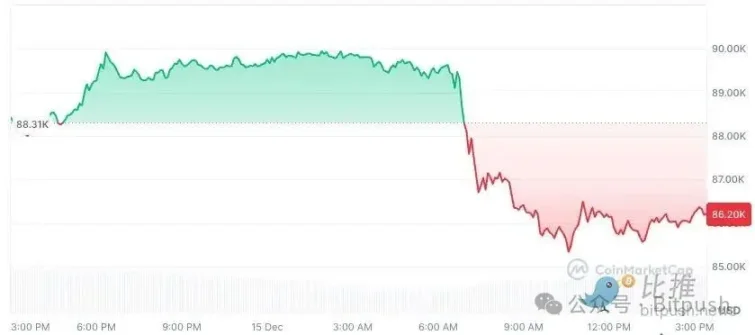
From a time perspective, this is not an isolated adjustment. Since hitting a new all-time high in mid-October, Bitcoin has accumulated a pullback of over 30%, with each rebound appearing brief and hesitant. Although ETF funds have not seen systematic outflows, marginal inflows have significantly slowed, making it difficult to provide the "sentiment foundation" for the market as before. The crypto market is transitioning from one-sided optimism to a more complex and patience-testing phase.

Against this backdrop, Mike McGlone, Senior Commodity Strategist at Bloomberg Intelligence, released a latest report, placing Bitcoin's current trend within a broader macro and cyclical framework and presenting a highly unsettling judgment: Bitcoin is highly likely to return to $10,000 by 2026. This is not alarmist but one of the potential outcomes under a special "deflationary" cycle.

The reason this view has sparked significant controversy is not just because the figure itself is "too low," but because McGlone does not treat Bitcoin as an independent crypto asset. Instead, he reexamines it within the long-term coordinate system of "global risk assets—liquidity—wealth regression."
"Deflation After Inflation"? McGlone Focuses Not on Crypto but on the Cycle Inflection Point

To understand McGlone's judgment, the key does not lie in how he views the crypto industry but in how he interprets the next phase of the macro environment.

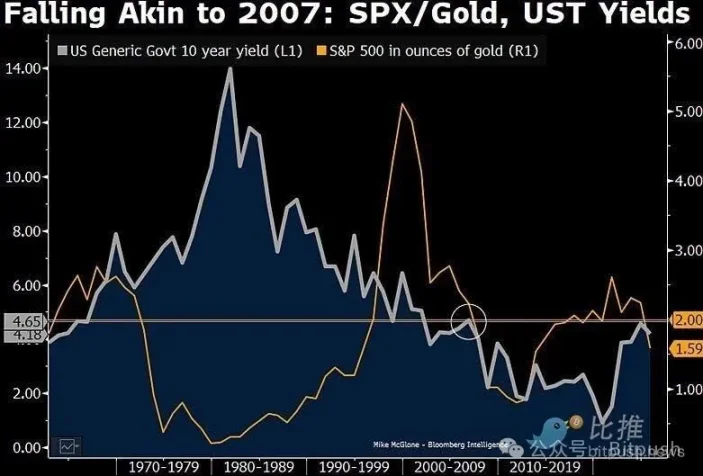
In his latest perspective, McGlone repeatedly emphasizes a concept: Inflation / Deflation Inflection (the turning point from inflation to deflation). In his view, global markets are near such a critical juncture. As inflation peaks in major economies and growth momentum slows, asset pricing logic is shifting from "fighting inflation" to coping with "deflation after inflation"—the phase of comprehensive price declines following the end of the inflation cycle. He writes: "Bitcoin's decline may resemble the stock market's response to Fed policy in 2007."

This is not the first time he has issued a bearish warning. As early as last November, he predicted Bitcoin would fall to the $50,000 mark.
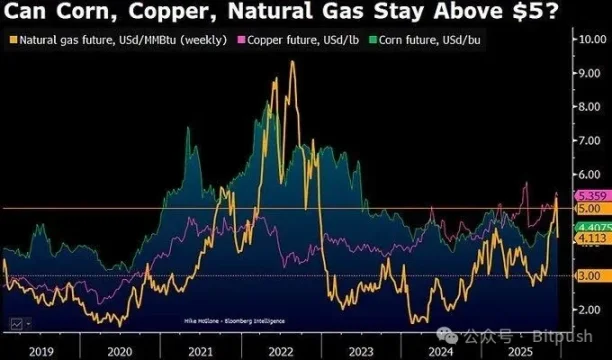
He points out that by around 2026, commodity prices may fluctuate around a key pivot—the "inflation-deflation demarcation line" for core commodities like natural gas, corn, and copper might settle near $5. Among these, only copper, with its genuine industrial demand support, might still stand above this pivot by the end of 2025.

McGlone notes: When liquidity recedes, the market will重新区分 (redistinguish) "real demand" from "financialization premium." In his framework, Bitcoin is not "digital gold" but an asset highly correlated with risk appetite and speculative cycles. When the inflation narrative recedes and macro liquidity tightens, Bitcoin tends to reflect this change earlier and more sharply.

In McGlone's view, his logic is not based on a single technical level but the叠加 (superposition) of three long-term paths.

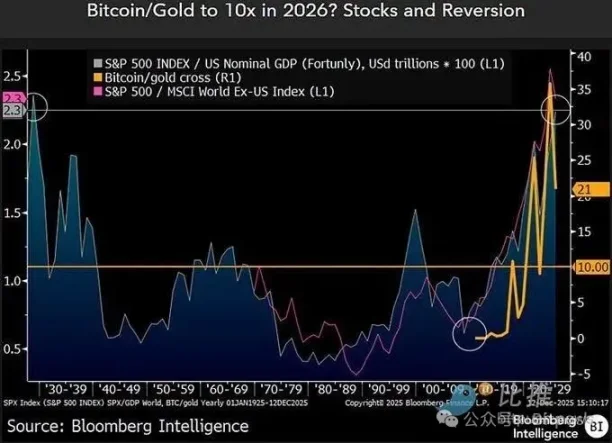
First, mean reversion after extreme wealth creation. McGlone has long emphasized that Bitcoin is one of the most extreme wealth amplifiers under the global宽松货币环境 (loose monetary environment) of the past decade. When asset price growth long outstrips实体经济增长 (real economic growth) and cash flow growth, the regression is not温和 (gentle) but剧烈 (violent). Historically, whether it was U.S. stocks in 1929 or the tech bubble in 2000, the commonality of the top phase was: the market repeatedly sought a "new paradigm" at highs, and the eventual adjustment幅度 (magnitude) often far exceeded the most pessimistic expectations at the time.

Second, the relative pricing relationship between Bitcoin and gold. McGlone特别强调 (particularly emphasizes) the Bitcoin/Gold ratio. This ratio was about 10x at the end of 2022, then expanded rapidly driven by the bull market, reaching over 30x in 2025. But this year, the ratio has fallen about 40%, dropping to around 21x. In his view, if deflationary pressures persist and gold remains firm due to safe-haven demand, a further return of the ratio to its historical range is not an激进假设 (aggressive assumption).
Third, systemic issues in the supply environment of speculative assets. Although Bitcoin itself has a clear supply cap, McGlone has多次指出 (repeatedly pointed out) that what the market is truly trading is not Bitcoin's "uniqueness" but the risk premium of the entire crypto ecosystem. When millions of tokens, projects, and narratives compete for the same risk budget, the entire sector tends to be uniformly discounted in a deflationary cycle, and Bitcoin can hardly完全脱离 (completely detach from) this revaluation process.

It should be noted that Mike McGlone is not a bull/bear spokesperson for the crypto market. As a senior commodity strategist at Bloomberg, he has studied the cyclical relationships between crude oil, precious metals, agricultural products, interest rates, and risk assets for a long time. His predictions are not always precisely timed, but their value lies in: he often raises structural contrarian questions when market sentiment is most consensus-driven.

In his latest remarks, he also主动复盘 (actively reviewed) his "errors," including underestimating the timing of gold breaking through $2,000 and misjudging the节奏 (rhythm) of U.S. Treasury yields and U.S. stocks. But in his view, these deviations反而反复印证 (instead repeatedly confirm) one point: the market is most prone to illusions about trends before cyclical inflection points.

Other Voices: Divergence Is Widening

Of course, McGlone's judgment is not market consensus. In fact, mainstream institutions' attitudes show clear分化 (divergence).

Traditional financial institutions like Standard Chartered have recently significantly lowered their medium-to-long-term target price for Bitcoin, reducing the 2025 expectation from $200,000 to about $100,000, and also adjusting the 2026 imagination space from $300,000 to about $150,000. In other words, institutions no longer assume that ETFs and corporate allocations will持续提供边际买盘 (continuously provide marginal buying) at any price range.

Research from Glassnode points out that Bitcoin's current fluctuation range between $80,000 and $90,000 has already put pressure on the market, with intensity comparable to the trend at the end of January 2022. The current market's relative unrealized loss has approached 10% of the market cap. Analysts further explain that such market dynamics reflect a state of "liquidity constraints, sensitivity to macro shocks," but it has not yet reached the level of typical bear market彻底抛售 (panic selling).
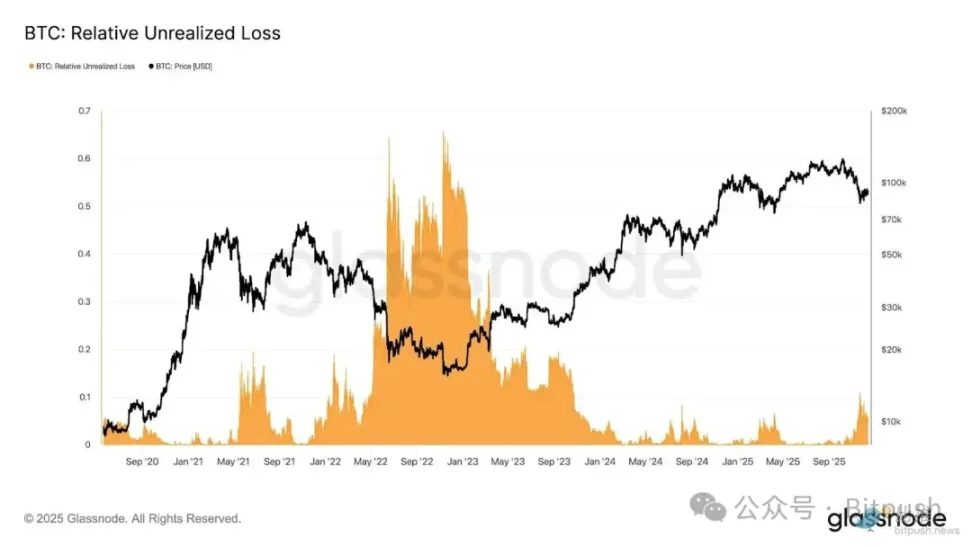
More quantitative and structure-focused 10x Research offers a more direct conclusion: they believe Bitcoin has entered the early stages of a bear market, with on-chain indicators, fund flows, and market structure all indicating that the downward cycle has not yet reached its end.

From a broader time dimension, the current uncertainty surrounding Bitcoin is no longer an issue of the crypto market itself but is firmly embedded in the global macro cycle. The upcoming week is被视为 (seen as) the most critical macro window period of the year-end by multiple strategists—the European Central Bank, the Bank of England, and the Bank of Japan will announce interest rate decisions successively, while the U.S. will迎来 (welcome) a series of delayed employment and inflation data. These data will provide a belated "reality check" for the market.

The Fed's FOMC meeting on December 10 had already released an unusual signal: not only did it cut rates by 25 basis points, but there were also three dissenting votes, and Powell直言 (stated bluntly) that job growth in previous months might have been overestimated. The密集出炉 (intensive release) of macro data this week will重塑 (reshape) the market's core expectations for 2026—whether the Fed can continue to cut rates or will have to press the pause button for a longer period. For risk assets, this answer might be more important than any bull-bear debate on a single asset.


Criptos en tendencia

Preguntas relacionadas

QWhat is the main argument made by Bloomberg Intelligence senior commodity strategist Mike McGlone regarding Bitcoin's price?

AMike McGlone argues that Bitcoin could potentially fall back to $10,000 by 2026, citing a potential global deflationary cycle following the inflation period as the primary reason. He views Bitcoin not as 'digital gold' but as a risk-on asset highly correlated with speculative cycles and liquidity conditions.

QAccording to the article, what key macroeconomic concept does McGlone emphasize to support his bearish view on Bitcoin?

AMcGlone emphasizes the concept of 'Inflation / Deflation Inflection,' suggesting that global markets are near a turning point where the pricing logic for assets is shifting from fighting inflation to dealing with deflationary pressures after inflation has peaked.

QWhat specific ratio does McGlone use to analyze Bitcoin's relative valuation, and what is its current trend?

AMcGlone uses the Bitcoin/Gold ratio for analysis. The ratio expanded to over 30 times during the bull market but has since declined by approximately 40% and is currently around 21 times. He suggests it could revert further towards its historical range if deflationary pressures persist.

QHow have other major financial institutions, like Standard Chartered, adjusted their Bitcoin price forecasts according to the article?

AStandard Chartered has significantly lowered its Bitcoin price targets, reducing its 2025 forecast from $200,000 to around $100,000 and its 2026 projection from $300,000 to approximately $150,000, reflecting reduced expectations for sustained ETF and corporate buying.

QWhat broader macroeconomic events does the article highlight as critical for risk assets like Bitcoin in the near term?

AThe article highlights upcoming interest rate decisions from the European Central Bank, Bank of England, and Bank of Japan, along with delayed U.S. employment and inflation data, as critical events that will reshape market expectations for 2026 and determine the Federal Reserve's ability to continue cutting rates.

Lecturas Relacionadas

Must-Watch Events Next Week|CLARITY Act Could Face Senate Vote; SpaceX, Circle to Report Earnings (8.3-8.9)

**Summary: Key Events and Developments to Watch (August 3-9)** The upcoming week is marked by significant financial disclosures, key legislative deadlines, and notable product updates. **Major Financial Events:** Several companies are scheduled to release their Q2 2026 earnings. American Bitcoin (ABTC) will report on August 3, followed by SpaceX and Hut 8 Mining Corp. on August 4, and Circle on August 5. Notably, a significant portion of SpaceX shares (up to 12% of total shares) will be unlocked on August 6 following their earnings release. **Key Legislative Deadline:** The U.S. Senate faces an August 7 deadline to secure 60 votes for the CLARITY Act, a bipartisan bill aiming to establish a federal regulatory framework for cryptocurrencies. The Senate may hold a full vote on the bill during the week. **Economic Data:** The U.S. July Non-Farm Payrolls report will be released on August 7, providing crucial labor market data. **Technology & Product Updates:** * **Shutdowns:** DeFi portfolio tracker Zapper and wallet app Ctrl Wallet will cease operations on August 3. * **Upgrades:** LayerZero will deprecate its v1 relayers on August 3. XRP Ledger's new version 3.3.0, featuring five new functions, is expected next week. * **AI:** Elon Musk announced that the advanced Grok 4.6 AI model is set for release around August 7. * **Bitcoin:** The BIP-110 forced signaling for a potential Bitcoin network change is scheduled to begin around August 8. **Other Notable Events:** Chinese robotics firm Unitree Tech has set its preliminary price inquiry for its IPO for August 5. South Korean exchange Upbit will delist AQT and AERGO tokens on August 3.

marsbitHace 23 min(s)

Must-Watch Events Next Week|CLARITY Act Could Face Senate Vote; SpaceX, Circle to Report Earnings (8.3-8.9)

marsbitHace 23 min(s)

Stocks Are Plummeting More Sharply Than Cryptocurrencies. Where Has the Money Gone?

Stock Markets Plunge Deeper Than Cryptocurrencies: Where Did the Money Go? In late July, Seoul's Kospi index triggered circuit breakers for two consecutive days, plummeting over 40% from its June high. The collapse was led by heavyweight stocks like SK Hynix, whose record profits still disappointed investors, and devastating leveraged ETFs, with one major product losing over 83% of its value. This signaled a global, forced deleveraging targeting the most crowded trades. Interestingly, while stocks exhibited extreme volatility akin to crypto markets, Bitcoin rose nearly 15% in July after a prior steep drop. Analysis shows the money fleeing equities did not flow into Bitcoin. Instead, Bitcoin had already absorbed its sell-off in May-June, when U.S. spot Bitcoin ETFs saw historic outflows. The true safe-haven beneficiary was gold, whose price rose over 20% year-on-year, highlighting a decoupling between Bitcoin and gold as "digital gold." The sell-off was a targeted unwinding of leveraged positions in tech and semiconductors, accelerated by broker-dealer risk management and shifts in the AI narrative, including new competition from Chinese memory chipmakers. The retreat path was clear: from high-valuation tech stocks to cash and U.S. Treasuries, then to gold. For Bitcoin to attract sustained institutional inflows, conditions like eased global liquidity pressure, a "soft-landing" Fed rate cut, and U.S. regulatory clarity via legislation like the stalled CLARITY Act are needed. Currently, Bitcoin is not a safe haven but an already-cleared asset. Its low correlation with tech stocks, however, makes it a potential diversification play for institutional portfolios once the storm passes. The money isn't here yet, but the positioning is underway.

marsbitHace 23 min(s)

Stocks Are Plummeting More Sharply Than Cryptocurrencies. Where Has the Money Gone?

marsbitHace 23 min(s)

In Conversation with Ray Dalio: We Are Currently in an AI Bubble, with 1% of My Portfolio in Bitcoin

Ray Dalio, founder of Bridgewater Associates, warns in an interview that the current AI boom shows classic bubble characteristics, which could lead to significant economic downturns as seen in past cycles like 1929 or 2000. He explains that speculative enthusiasm, fueled by debt and overvaluation, often precedes a crash when rising rates or taxation force asset sales, causing widespread losses and recession. Dalio also outlines his "Big Cycle" theory, describing an approximate 80-year pattern where widening wealth gaps, massive government deficits, and shifting geopolitical power (like China's rise) create internal conflict and global instability. He emphasizes that we are in a late-cycle, transitional phase where traditional powers like the US and UK face decline. For personal wealth protection, Dalio advises diversification beyond cash into assets like stocks, bonds, real estate, and particularly gold, which he prefers over Bitcoin. While he holds about 1% of his portfolio in Bitcoin as a non-printable hard asset, he views gold as more secure from technological or governmental threats. Regarding AI's impact, Dalio believes it will disproportionately benefit capital owners, worsening inequality by replacing both physical and cognitive labor. He suggests that human intuition and emotional intelligence, combined with AI, will be key for future workers. On taxation, Dalio argues that wealth taxes are impractical and risk triggering asset sell-offs, reducing productive investment. He points to the UK as a cautionary example of debt, low productivity, and political strife. Geopolitically, Dalio foresees a more regionalized world, with the US showing weakness in prolonged conflicts like with Iran, akin to past imperial declines. The ideal outcome, he suggests, is coexisting powerful blocs (e.g., Americas, China-Asia Pacific) without major war.

marsbitHace 4 hora(s)

In Conversation with Ray Dalio: We Are Currently in an AI Bubble, with 1% of My Portfolio in Bitcoin

marsbitHace 4 hora(s)

Daily 7.2 Trillion KRW: Foreign Capital's Record Net Buying on Friday! Wall Street Says Headwinds for Korean Stock Fund Flows Have Subsided

South Korean stock market sees a dramatic shift in fund flows. On July 31, foreign investors made a record net purchase of approximately KRW 7.2 trillion in KOSPI stocks, marking a fundamental reversal from the persistent large-scale net outflows seen in previous months. This contributed to a significant narrowing of foreign net selling in July to KRW 9.8 trillion, down sharply from KRW 48.4 trillion in June and KRW 44.5 trillion in May. Simultaneously, domestic institutional pressure eased. South Korean pension funds and asset managers turned to a net buying position in July, purchasing KRW 1.0 trillion worth of KOSPI shares, contrasting with net sales in May and June. Market volatility is expected to be dampened by new financial regulations. Effective July 31, the Financial Services Commission tightened access for retail investors to single-stock leveraged ETFs by raising the minimum cash deposit requirement. Trading volumes for these products subsequently dropped to about 50% of their monthly average. Citigroup Research maintains its year-end KOSPI target of 10,000 points. The firm cites several supportive factors: the substantial easing of headwinds from capital outflows, a robust fundamental outlook for the semiconductor sector, historically low market valuations, strong economic fundamentals, and the potential for policy support from financial authorities if needed.

marsbitHace 4 hora(s)

Daily 7.2 Trillion KRW: Foreign Capital's Record Net Buying on Friday! Wall Street Says Headwinds for Korean Stock Fund Flows Have Subsided

marsbitHace 4 hora(s)

Trading

Spot

Artículos destacados

Cómo comprar O

¡Bienvenido a HTX.com! Hemos hecho que comprar O1 exchange (O) sea simple y conveniente. Sigue nuestra guía paso a paso para iniciar tu viaje de criptos.Paso 1: crea tu cuenta HTXUtiliza tu correo electrónico o número de teléfono para registrarte y obtener una cuenta gratuita en HTX. Experimenta un proceso de registro sin complicaciones y desbloquea todas las funciones.Obtener mi cuentaPaso 2: ve a Comprar cripto y elige tu método de pagoTarjeta de crédito/débito: usa tu Visa o Mastercard para comprar O1 exchange (O) al instante.Saldo: utiliza fondos del saldo de tu cuenta HTX para tradear sin problemas.Terceros: hemos agregado métodos de pago populares como Google Pay y Apple Pay para mejorar la comodidad.P2P: tradear directamente con otros usuarios en HTX.Over-the-Counter (OTC): ofrecemos servicios personalizados y tipos de cambio competitivos para los traders.Paso 3: guarda tu O1 exchange (O)Después de comprar tu O1 exchange (O), guárdalo en tu cuenta HTX. Alternativamente, puedes enviarlo a otro lugar mediante transferencia blockchain o utilizarlo para tradear otras criptomonedas.Paso 4: tradear O1 exchange (O)Tradear fácilmente con O1 exchange (O) en HTX's mercado spot. Simplemente accede a tu cuenta, selecciona tu par de trading, ejecuta tus trades y monitorea en tiempo real. Ofrecemos una experiencia fácil de usar tanto para principiantes como para traders experimentados.

458 Vistas totalesPublicado en 2026.06.19Actualizado en 2026.06.29

Cómo comprar O

Cómo comprar PROS

¡Bienvenido a HTX.com! Hemos hecho que comprar Pharos (PROS) sea simple y conveniente. Sigue nuestra guía paso a paso para iniciar tu viaje de criptos.Paso 1: crea tu cuenta HTXUtiliza tu correo electrónico o número de teléfono para registrarte y obtener una cuenta gratuita en HTX. Experimenta un proceso de registro sin complicaciones y desbloquea todas las funciones.Obtener mi cuentaPaso 2: ve a Comprar cripto y elige tu método de pagoTarjeta de crédito/débito: usa tu Visa o Mastercard para comprar Pharos (PROS) al instante.Saldo: utiliza fondos del saldo de tu cuenta HTX para tradear sin problemas.Terceros: hemos agregado métodos de pago populares como Google Pay y Apple Pay para mejorar la comodidad.P2P: tradear directamente con otros usuarios en HTX.Over-the-Counter (OTC): ofrecemos servicios personalizados y tipos de cambio competitivos para los traders.Paso 3: guarda tu Pharos (PROS)Después de comprar tu Pharos (PROS), guárdalo en tu cuenta HTX. Alternativamente, puedes enviarlo a otro lugar mediante transferencia blockchain o utilizarlo para tradear otras criptomonedas.Paso 4: tradear Pharos (PROS)Tradear fácilmente con Pharos (PROS) en HTX's mercado spot. Simplemente accede a tu cuenta, selecciona tu par de trading, ejecuta tus trades y monitorea en tiempo real. Ofrecemos una experiencia fácil de usar tanto para principiantes como para traders experimentados.

471 Vistas totalesPublicado en 2026.06.22Actualizado en 2026.06.29

Cómo comprar PROS

Qué es VERONA

I. Introducción al Proyecto VERONA es una blockchain construida para todos, en todas partes a través de la abstracción de cadenas. Utilizando su capa de Abstracción Generalizada, VERONA se distingue por integrar funcionalidades complejas de blockchain, como cuentas, firmas e interoperabilidad, directamente a nivel de protocolo. Este enfoque permite interactuar con aplicaciones de blockchain sin necesidad de entender las tecnologías subyacentes.1) Información Básica Nombre: VERONA (VERONA)III. Enlaces Relacionados Enlace al sitio web oficial: https://xion.burnt.com/ Libro Blanco: https://xion.burnt.com/whitepaper.pdf Exploradores: https://explorer.burnt.com/ Redes Sociales: https://x.com/burnt_xion Nota: La introducción del proyecto proviene de los materiales publicados o proporcionados por el equipo oficial del proyecto, que es solo para referencia y no constituye asesoramiento de inversión. HTX no se hace responsable de ninguna pérdida directa o indirecta resultante.

554 Vistas totalesPublicado en 2026.06.22Actualizado en 2026.06.22

Qué es VERONA

Discusiones

Bienvenido a la comunidad de HTX. Aquí puedes mantenerte informado sobre los últimos desarrollos de la plataforma y acceder a análisis profesionales del mercado. A continuación se presentan las opiniones de los usuarios sobre el precio de A (A).

活动图片













