Why We No Longer Love Crypto

比推Publicado a 2026-03-11Actualizado a 2026-03-11

Resumen

The article "Why We No Longer Passionate About Crypto" explores the growing sense of disillusionment among crypto veterans. Many who once found excitement in the space now feel stuck, particularly those not working on stablecoins, financial infrastructure, or DeFi. The author notes that the previous era—where developer-focused products thrived on vibes rather than revenue—ended about 18 months ago. The crypto market for non-financial applications is now seen as limited, with an estimated annual addressable market of only $200–300 million, leading many builders to feel they have few viable paths forward. The rise of AI has intensified this frustration, as it offers faster innovation and more tangible product development compared to crypto’s current constraints. The author outlines several unappealing options for those exploring crypto-AI intersections: tokenizing traditional AI products without real utility, building decentralized AI infrastructure (which lacks immediate feedback), or competing with giants in AI-focused stablecoin infrastructure. Despite this pessimism, the author concludes with a note of optimism: Crypto’s unique value lies in its ability to serve as "capital superconductor" for growth. The convergence of AI-driven product innovation and crypto’s programmable capital mechanisms could fuel a new generation of "agent-based companies," creating a renewed sense of purpose for those who remain.

Author: Kydo (@0xkydo)

Original Title: Why crypto is not that fun anymore

Compiled and Arranged: BitpushNews


These days, a tweet struck a chord. It revealed a shared, yet rarely mentioned sense of helplessness—many of us no longer enjoy working here (in crypto) anymore.
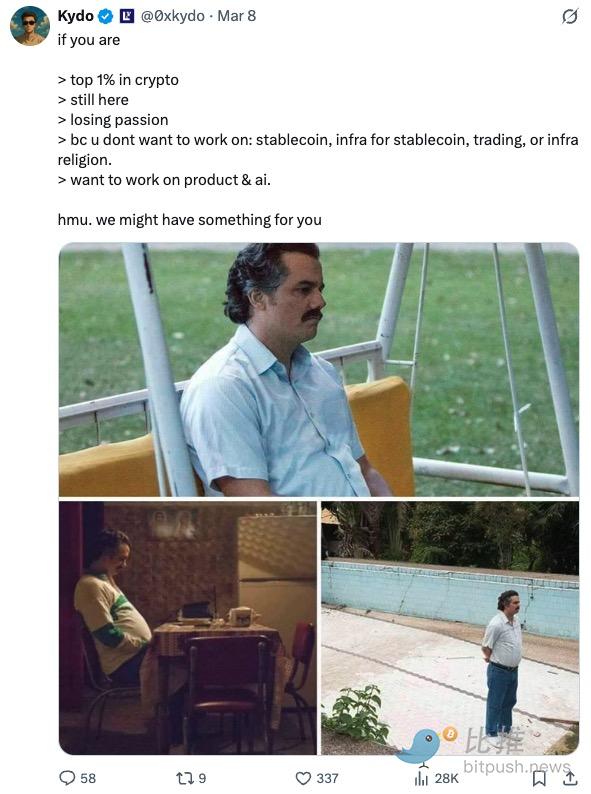
Tweet:

If you are

> in the top 1% of the crypto space

> still here

> but losing passion

> because you don't want to work on: stablecoins, stablecoin infrastructure, trading, or infrastructure-level "evangelism"

> want to build products and AI

Contact me. We might have something for you.

I want to elaborate.

If you are not working on stablecoins or are not someone extremely passionate about financial markets, you are likely not happy in the cryptocurrency space right now.

Worse, you are seeing the AI field developing at a pace and with an excitement that makes your daily work feel like standing still. I understand this all too well because that's exactly how I felt. That's why I wrote that tweet.

And the fact that it resonated with so many people (I've received 60 DMs so far) tells me that many of you feel the same way but haven't said it out loud.

So, let me say the "unsaid" things.

Selling to Crypto Developers is No Longer Viable

In the previous "meta," selling things to crypto developers worked. Back then, metrics were more important than revenue. Partner logos were more important than revenue. A "vibe" was more important than revenue. You were a cost center for others, and everyone was spending money.

That "meta" died about 18 months ago. We wish we had pivoted earlier.

There is also a growing consensus today: cryptocurrency is only suitable for finance. Haseeb from Dragonfly has said it, Kyle from Multicoin has said it, Toly from Solana has said it. Most of you think so too, even if you won't say it publicly.

I understand why people reach this conclusion. Most tokens are meme coins. They don't own anything and can't owe you anything because the only thing that can truly be "owned" is on-chain state, which is extremely limited.

This is also why crypto-native applications like trading and lending are currently the only two categories that can truly make money on-chain.

But many of us are not building in DeFi. Many of us build infrastructure to enable new use cases beyond DeFi.

Here's an uncomfortable truth: according to our analysis, the total addressable market for this kind of work is only about $200-300 million per year. This pie is to be divided among hundreds of institutions. The most successful companies can only achieve tens of millions in annual revenue. After years of maturation, this is the ceiling.

If you are building a venture-scale enterprise, this gives you a very clear set of choices. If you want to serve crypto developers, the market is small. So, you either put on a suit and sell your infrastructure to traditional finance; or, like many others, choose to pack up and switch to AI.

Many are switching to AI because they understand their strengths. They understand their team's expertise. They know their competitive advantage is not in long, complex B2B sales in traditional finance. This is why so many of you feel lost right now.
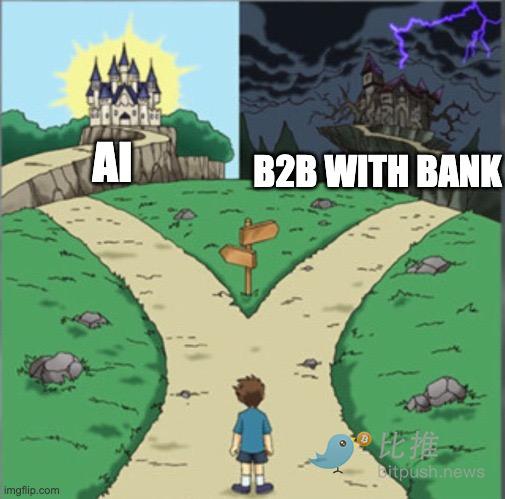
The Dead End of Crypto x AI

So you look at the only area that still feels vibrant—the intersection of crypto and AI—trying to find your footing. But the options laid out there aren't great either.

Option One: Traditional business + AI + issue a token. This token has no real utility, like most other tokens. You're essentially building a regular product and slapping a layer of financialization on top. It's frustrating because you've been playing this game for five years.

Option Two: Decentralized AI infrastructure. Privacy, security, verifiability: this is the missionary route, the old "meta." But I guess this doesn't interest many of you: not many want to embark on another long-term "building a religion" style endeavor with no immediate feedback, no revenue.

Option Three: Stablecoin infrastructure for AI agents. This is interesting from a business perspective, but extremely competitive. Circle, Stripe, and all the major stablecoin players are going all in. As a startup, going to war with them without any clear beachhead to capture is frustrating.

The Choices Faced, and Why People Are Leaving

So, these are the actual choices on the table today:

You can stay in the "religious realm" of crypto, building for a resilient, decentralized future.

You can put on a suit and join the big players to evangelize the gospel of stablecoins.

You can build a "shovel-selling" company for the stablecoin ecosystem.

You can stay in DeFi: trading, lending, and the financial plumbing of the internet.

Or, you can build a niche vertical product that, while not a billion-dollar venture target, actually makes money and satisfies real users.

Beyond that, you don't have better options. This is why you are likely to switch to AI. Honestly, I understand.

This is why cryptocurrency is no longer that fun.

The above is my diagnosis. This is the conclusion I reached after six months of feeling, analyzing, and stress-testing. If you came here for an honest take on "why crypto feels stuck," you've got it. You can close this article now. Go for a walk, touch some grass.

But I'll tell you this: I have never been so excited about the work I'm doing. The last time I felt this way was probably when I first heard about cryptocurrency and its potential. And it's not just me—everyone around me feels the same. So, if you want to hear the short version of what I believe in, read on.

Just know that from here on out, I'm selling my beliefs.

What I Truly Find Interesting

The question I've been trying to answer for the past six months is: How do you find a market large enough, with a clear business model rooted in crypto, and a product-oriented, non-financial solution that can be used by people both inside and outside the crypto space?

The answer I kept coming back to is: Cryptocurrency is a superconductor for capital. Capital fuels growth. The problem in the past was that we were fueling things that weren't growing—pouring gasoline on ice and expecting it to burn brighter.

AI has dramatically reduced the difficulty of starting and growing things—from a product perspective. Now one person can build what used to require a fifty-person team. The cost of creating a real product, a real business, is plummeting. These things are growing fast, with revenue, real users, and real feedback loops. They need fuel to accelerate. And cryptocurrency is the best fuel mechanism ever invented for this purpose.

This is the only interesting problem I see now: How do you take crypto's superpower—instant, global, programmable capital formation—and point it at things that are actually growing?

We think the answer is "agentic companies." To achieve this, you first need tokens to be able to "own" things, and coincidentally, we've spent the last five years building that foundation. Now, we're going to turn it into a product and achieve that goal.


Twitter:https://twitter.com/BitpushNewsCN

Bitpush TG Discussion Group:https://t.me/BitPushCommunity

Bitpush TG Subscription: https://t.me/bitpush

Original article link:https://www.bitpush.news/articles/7618924

Criptos en tendencia

Preguntas relacionadas

QWhy does the author believe that many people in the crypto space are no longer enjoying their work?

AThe author believes that many are no longer enjoying their work because the focus has shifted heavily towards financial applications like stablecoins and trading, which may not align with their interests. Additionally, the rapid and exciting progress in AI makes their current work in crypto feel stagnant in comparison.

QWhat are the main options available for crypto developers today, according to the article?

AThe main options are: staying in the 'religious' crypto space for a decentralized future, selling infrastructure to traditional finance, building 'picks and shovels' for the stablecoin ecosystem, continuing in DeFi (trading and lending), or creating a niche product that generates real revenue but isn't a billion-dollar venture-scale business.

QWhat is the estimated annual market size for non-DeFi crypto infrastructure work mentioned in the article?

AThe estimated annual addressable market size for non-DeFi crypto infrastructure work is about $200-300 million, which is shared among hundreds of organizations, with the most successful companies generating tens of millions in annual revenue.

QWhat does the author identify as the core problem with previous attempts to fuel growth in crypto?

AThe author states that the core problem was that capital was being provided to things that weren't growing—'pouring gasoline on ice and expecting it to burn hotter'—instead of fueling things that are actually growing.

QWhat is the author's proposed solution to make crypto fun and impactful again?

AThe author's proposed solution is to leverage crypto's superpower as an instant, global, programmable capital formation mechanism and direct it towards things that are genuinely growing, specifically 'agentic companies,' by enabling tokens to 'own' things and using this foundation to build products.

Lecturas Relacionadas

Must-Watch Events Next Week|CLARITY Act Could Face Senate Vote; SpaceX, Circle to Report Earnings (8.3-8.9)

**Summary: Key Events and Developments to Watch (August 3-9)** The upcoming week is marked by significant financial disclosures, key legislative deadlines, and notable product updates. **Major Financial Events:** Several companies are scheduled to release their Q2 2026 earnings. American Bitcoin (ABTC) will report on August 3, followed by SpaceX and Hut 8 Mining Corp. on August 4, and Circle on August 5. Notably, a significant portion of SpaceX shares (up to 12% of total shares) will be unlocked on August 6 following their earnings release. **Key Legislative Deadline:** The U.S. Senate faces an August 7 deadline to secure 60 votes for the CLARITY Act, a bipartisan bill aiming to establish a federal regulatory framework for cryptocurrencies. The Senate may hold a full vote on the bill during the week. **Economic Data:** The U.S. July Non-Farm Payrolls report will be released on August 7, providing crucial labor market data. **Technology & Product Updates:** * **Shutdowns:** DeFi portfolio tracker Zapper and wallet app Ctrl Wallet will cease operations on August 3. * **Upgrades:** LayerZero will deprecate its v1 relayers on August 3. XRP Ledger's new version 3.3.0, featuring five new functions, is expected next week. * **AI:** Elon Musk announced that the advanced Grok 4.6 AI model is set for release around August 7. * **Bitcoin:** The BIP-110 forced signaling for a potential Bitcoin network change is scheduled to begin around August 8. **Other Notable Events:** Chinese robotics firm Unitree Tech has set its preliminary price inquiry for its IPO for August 5. South Korean exchange Upbit will delist AQT and AERGO tokens on August 3.

marsbitHace 49 min(s)

Must-Watch Events Next Week|CLARITY Act Could Face Senate Vote; SpaceX, Circle to Report Earnings (8.3-8.9)

marsbitHace 49 min(s)

Stocks Are Plummeting More Sharply Than Cryptocurrencies. Where Has the Money Gone?

Stock Markets Plunge Deeper Than Cryptocurrencies: Where Did the Money Go? In late July, Seoul's Kospi index triggered circuit breakers for two consecutive days, plummeting over 40% from its June high. The collapse was led by heavyweight stocks like SK Hynix, whose record profits still disappointed investors, and devastating leveraged ETFs, with one major product losing over 83% of its value. This signaled a global, forced deleveraging targeting the most crowded trades. Interestingly, while stocks exhibited extreme volatility akin to crypto markets, Bitcoin rose nearly 15% in July after a prior steep drop. Analysis shows the money fleeing equities did not flow into Bitcoin. Instead, Bitcoin had already absorbed its sell-off in May-June, when U.S. spot Bitcoin ETFs saw historic outflows. The true safe-haven beneficiary was gold, whose price rose over 20% year-on-year, highlighting a decoupling between Bitcoin and gold as "digital gold." The sell-off was a targeted unwinding of leveraged positions in tech and semiconductors, accelerated by broker-dealer risk management and shifts in the AI narrative, including new competition from Chinese memory chipmakers. The retreat path was clear: from high-valuation tech stocks to cash and U.S. Treasuries, then to gold. For Bitcoin to attract sustained institutional inflows, conditions like eased global liquidity pressure, a "soft-landing" Fed rate cut, and U.S. regulatory clarity via legislation like the stalled CLARITY Act are needed. Currently, Bitcoin is not a safe haven but an already-cleared asset. Its low correlation with tech stocks, however, makes it a potential diversification play for institutional portfolios once the storm passes. The money isn't here yet, but the positioning is underway.

marsbitHace 49 min(s)

Stocks Are Plummeting More Sharply Than Cryptocurrencies. Where Has the Money Gone?

marsbitHace 49 min(s)

In Conversation with Ray Dalio: We Are Currently in an AI Bubble, with 1% of My Portfolio in Bitcoin

Ray Dalio, founder of Bridgewater Associates, warns in an interview that the current AI boom shows classic bubble characteristics, which could lead to significant economic downturns as seen in past cycles like 1929 or 2000. He explains that speculative enthusiasm, fueled by debt and overvaluation, often precedes a crash when rising rates or taxation force asset sales, causing widespread losses and recession. Dalio also outlines his "Big Cycle" theory, describing an approximate 80-year pattern where widening wealth gaps, massive government deficits, and shifting geopolitical power (like China's rise) create internal conflict and global instability. He emphasizes that we are in a late-cycle, transitional phase where traditional powers like the US and UK face decline. For personal wealth protection, Dalio advises diversification beyond cash into assets like stocks, bonds, real estate, and particularly gold, which he prefers over Bitcoin. While he holds about 1% of his portfolio in Bitcoin as a non-printable hard asset, he views gold as more secure from technological or governmental threats. Regarding AI's impact, Dalio believes it will disproportionately benefit capital owners, worsening inequality by replacing both physical and cognitive labor. He suggests that human intuition and emotional intelligence, combined with AI, will be key for future workers. On taxation, Dalio argues that wealth taxes are impractical and risk triggering asset sell-offs, reducing productive investment. He points to the UK as a cautionary example of debt, low productivity, and political strife. Geopolitically, Dalio foresees a more regionalized world, with the US showing weakness in prolonged conflicts like with Iran, akin to past imperial declines. The ideal outcome, he suggests, is coexisting powerful blocs (e.g., Americas, China-Asia Pacific) without major war.

marsbitHace 4 hora(s)

In Conversation with Ray Dalio: We Are Currently in an AI Bubble, with 1% of My Portfolio in Bitcoin

marsbitHace 4 hora(s)

Daily 7.2 Trillion KRW: Foreign Capital's Record Net Buying on Friday! Wall Street Says Headwinds for Korean Stock Fund Flows Have Subsided

South Korean stock market sees a dramatic shift in fund flows. On July 31, foreign investors made a record net purchase of approximately KRW 7.2 trillion in KOSPI stocks, marking a fundamental reversal from the persistent large-scale net outflows seen in previous months. This contributed to a significant narrowing of foreign net selling in July to KRW 9.8 trillion, down sharply from KRW 48.4 trillion in June and KRW 44.5 trillion in May. Simultaneously, domestic institutional pressure eased. South Korean pension funds and asset managers turned to a net buying position in July, purchasing KRW 1.0 trillion worth of KOSPI shares, contrasting with net sales in May and June. Market volatility is expected to be dampened by new financial regulations. Effective July 31, the Financial Services Commission tightened access for retail investors to single-stock leveraged ETFs by raising the minimum cash deposit requirement. Trading volumes for these products subsequently dropped to about 50% of their monthly average. Citigroup Research maintains its year-end KOSPI target of 10,000 points. The firm cites several supportive factors: the substantial easing of headwinds from capital outflows, a robust fundamental outlook for the semiconductor sector, historically low market valuations, strong economic fundamentals, and the potential for policy support from financial authorities if needed.

marsbitHace 4 hora(s)

Daily 7.2 Trillion KRW: Foreign Capital's Record Net Buying on Friday! Wall Street Says Headwinds for Korean Stock Fund Flows Have Subsided

marsbitHace 4 hora(s)

Trading

Spot

Artículos destacados

Cómo comprar FUN

¡Bienvenido a HTX.com! Hemos hecho que comprar FUNTOKEN (FUN) sea simple y conveniente. Sigue nuestra guía paso a paso para iniciar tu viaje de criptos.Paso 1: crea tu cuenta HTXUtiliza tu correo electrónico o número de teléfono para registrarte y obtener una cuenta gratuita en HTX. Experimenta un proceso de registro sin complicaciones y desbloquea todas las funciones.Obtener mi cuentaPaso 2: ve a Comprar cripto y elige tu método de pagoTarjeta de crédito/débito: usa tu Visa o Mastercard para comprar FUNTOKEN (FUN) al instante.Saldo: utiliza fondos del saldo de tu cuenta HTX para tradear sin problemas.Terceros: hemos agregado métodos de pago populares como Google Pay y Apple Pay para mejorar la comodidad.P2P: tradear directamente con otros usuarios en HTX.Over-the-Counter (OTC): ofrecemos servicios personalizados y tipos de cambio competitivos para los traders.Paso 3: guarda tu FUNTOKEN (FUN)Después de comprar tu FUNTOKEN (FUN), guárdalo en tu cuenta HTX. Alternativamente, puedes enviarlo a otro lugar mediante transferencia blockchain o utilizarlo para tradear otras criptomonedas.Paso 4: tradear FUNTOKEN (FUN)Tradear fácilmente con FUNTOKEN (FUN) en HTX's mercado spot. Simplemente accede a tu cuenta, selecciona tu par de trading, ejecuta tus trades y monitorea en tiempo real. Ofrecemos una experiencia fácil de usar tanto para principiantes como para traders experimentados.

293 Vistas totalesPublicado en 2025.06.25Actualizado en 2026.06.02

Cómo comprar FUN

Discusiones

Bienvenido a la comunidad de HTX. Aquí puedes mantenerte informado sobre los últimos desarrollos de la plataforma y acceder a análisis profesionales del mercado. A continuación se presentan las opiniones de los usuarios sobre el precio de FUN (FUN).

活动图片













