Why This Next Altcoin Season Could Be More Explosive Than 2021 As Signals Go Crazy

bitcoinistPublicado a 2026-04-04Actualizado a 2026-04-04

Resumen

Despite Bitcoin hitting new all-time highs, the crypto market has not yet experienced an altcoin season comparable to 2021. However, signals suggest the next altcoin season could be even more explosive. Analyst Mark Chadwick notes that altcoins are showing a strong bullish pattern against Bitcoin, with the ALT/BTC chart marking four consecutive green monthly candles—a pattern last seen in 2021, which led to a historic altcoin rally. Several factors support a stronger altcoin season this time: the Fed is increasing market liquidity, the Clarity ACT may provide clearer crypto regulations, and the SEC is becoming more pro-crypto under the Trump administration. Additionally, rising crypto trading activity on major exchanges like NYSE and NASDAQ, along with growing institutional adoption—such as Fannie Mae accepting Bitcoin as loan collateral and Mastercard developing blockchain payment systems—suggest a bullish setup. These catalysts could drive altcoins to outperform Bitcoin significantly.

The crypto market is yet to have an altcoin season the likes of what was seen back in 2021, despite the Bitcoin price hitting new all-time highs over the last two years. This has alluded to the fact that the Bitcoin dominance over the market remains very high, thus not leaving any room for altcoins to run. Nevertheless, this has not deterred the expectations of an altcoin season among investors, and many believe that when it finally comes, it will be more explosive than 2021.

Altcoin Market Is Winning Against Bitcoin

Bitcoin has often led the cryptocurrency and by extension, its performance has influenced the advent of altcoin seasons. This is due to the way altcoins measure up to the leading cryptocurrency with each cycle, and this one looks to be prepping for a major rally.

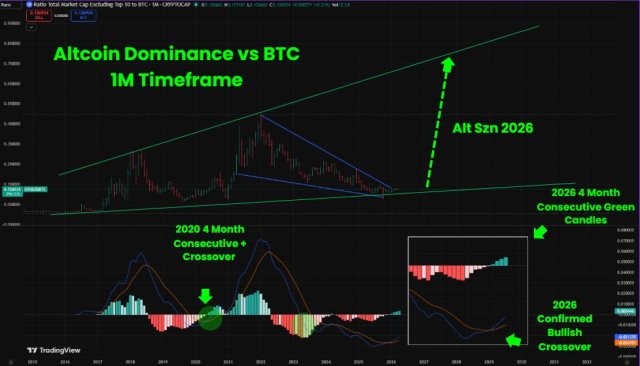
According to analyst Mark Chadwick on X, altcoins are already bringing a major bullish pattern against Bitcoin. This comes as the ALT/BTC chart has marked its fourth consecutive green monthly candle, and this has led to the confirmation of a bullish crossover.

The crypto analyst pointed out that the last time altcoins made such a bullish crossover against Bitcoin was back in 2021. The result of this was the most explosive altcoin season that the crypto market has seen to date, leading altcoins on runs that saw their values rise by many multiples.
Source: X

Why This Altcoin Season Will Be Better Than The Last

Despite the last altcoin season being one of legendary status, Mark believes that it will pale in comparison to what’s coming. A number of reasons were given for this as to why it will be a better altcoin bull market, and this has to do with the broader market optics.

Firstly, the analyst points out that the Fed is putting billions of dollars into the financial market. This is bullish as liquidity tends to drive growth. Next is that the Clarity ACT that will provide formal regulation for cryptocurrencies by putting them into categories of either securities or commodities.

Another bullish factor that the analyst points out is that the SEC is now pro-crypto with the Trump administration. Then, there is the fact that there has been rising activity from the NYSE and NASDAQ when it comes to crypto trading.

The last two of the catalysts given have to do with adoption. The first is the fact that Fannie Mae, the US Federal National Mortgage Association, announced last week that it will begin allowing Bitcoin as collateral for loans. Also, there is the fact that Mastercard is now building crypto rails to allow for payments using blockchain technology.

Taking all of these into account, Mark believes that it is a “setup of epic proportions.” If this plays out as expected, then the next altcoin season could surpass the previous one, and altcoins would end up winning against Bitcoin.

Altcoin market continues to struggle | Source: Crypto Total Market Cap Excluding BTC on Tradingview.com

Preguntas relacionadas

QAccording to the article, what is the main reason why an altcoin season hasn't occurred despite Bitcoin's new all-time highs?

AThe Bitcoin dominance over the market remains very high, not leaving any room for altcoins to run.

QWhat specific bullish pattern on the ALT/BTC chart does analyst Mark Chadwick point to as a signal for an upcoming altcoin season?

AThe ALT/BTC chart has marked its fourth consecutive green monthly candle, confirming a bullish crossover.

QName two of the regulatory or institutional factors mentioned that could make the next altcoin season more explosive than 2021.

AThe Clarity ACT providing formal cryptocurrency regulation and the SEC being pro-crypto under the Trump administration.

QWhat recent announcement from Fannie Mae is cited as a bullish catalyst for crypto adoption?

AFannie Mae announced it will begin allowing Bitcoin as collateral for loans.

QBesides regulatory changes, what other major factor does the analyst attribute to driving market growth and a potential altcoin season?

AThe Fed is putting billions of dollars into the financial market, increasing liquidity which tends to drive growth.

Lecturas Relacionadas

Lowering Expectations for BTC's Next Bull Market

The author, Alex Xu, explains his decision to significantly reduce his Bitcoin holdings (from full to ~30% of his portfolio) during the current bull cycle, citing a lowered long-term outlook for BTC's price appreciation in the next cycle. He outlines six key reasons for this reduced expectation: 1. **Diminished Growth Drivers:** The narrative of exponential user adoption has largely played out with institutional ETF adoption. The next major growth phase—adoption by sovereign national reserves or central banks—seems unlikely in the near future. 2. **Personal Opportunity Cost:** More attractive investment opportunities have emerged in other assets, such as undervalued companies. 3. **Industry-Wide Contraction:** The broader crypto industry is struggling, with most Web3 business models (SocialFi, GameFi, DePIN) failing. This overall萧条 (depression) reduces the fundamental demand and consensus for Bitcoin. 4. **Strain on Major Buyer:** MicroStrategy, a major corporate buyer of BTC, faces rising financing expenses for its debt, which could slow its purchasing rate and create significant marginal pressure on the market. 5. **Increased Competition from Gold:** The emergence of "tokenized gold" has closed the functional gap (portability, divisibility) between physical gold and Bitcoin, offering a strong competitor in the non-sovereign store-of-value space. 6. **Security Budget Concerns:** The block reward halving continues to exacerbate the long-standing issue of funding Bitcoin's network security, with new fee source explorations like Ordinals and L2s largely failing. The author's decision to hold a significant (though reduced) position reflects a cautious, not bearish, outlook. He remains open to increasing his exposure if the fundamental reasons for his skepticism change or if new positive catalysts emerge.

marsbitHace 15 min(s)

Lowering Expectations for BTC's Next Bull Market

marsbitHace 15 min(s)

Can Iran 'Control' the Strait of Hormuz?

Iran has announced a comprehensive plan to assert control over the strategic Strait of Hormuz, a critical global oil shipping chokepoint. The proposed measures include requiring all vessels to obtain Iranian permission for passage, imposing fees for security, environmental protection, and navigation management—preferably paid in Iranian rials—and absolutely banning Israeli ships. Vessels from countries deemed hostile by Iran’s top security bodies may also be barred. Analysts suggest Iran’s motives are multifaceted: increasing pressure on the U.S. and Israel by leveraging control over oil transit to influence global prices and inflation; creating a new revenue stream, potentially exceeding $7.7 billion annually, to counter Western sanctions and support postwar reconstruction; and using transit permissions as bargaining chips in future negotiations, notably with the U.S. However, the plan faces significant practical and diplomatic challenges. Enforcing comprehensive interception and fee collection in the busy waterway, patrolled by international military forces, would be difficult. The U.S. has already countering with a blockade of Iranian ports and threats to intercept any ship paying fees, potentially strangling Iran’s oil exports and fee revenue. Broad international opposition, led by European and Gulf states, and legal controversies further complicate implementation. The proposal may ultimately serve more as a negotiating tactic than a feasible policy, with its execution remaining highly uncertain.

marsbitHace 1 hora(s)

Can Iran 'Control' the Strait of Hormuz?

marsbitHace 1 hora(s)

Trading

Spot
Futuros
活动图片