Original | Odaily Planet Daily (@OdailyChina)
Author | Azuma (@azuma_eth)

With Coinbase's temporary "betrayal" and the postponement of the Senate Banking Committee's review, the cryptocurrency market structure bill (CLARITY) has once again fallen into a phase of stagnation.
- Odaily Note: For previous context, please refer to "The Biggest Variable for the Crypto Market Outlook: Can the CLARITY Bill Pass the Senate?" and "CLARITY Review Suddenly Postponed: Why Is the Industry So Divided?".
Based on current market debates, the biggest point of contention surrounding CLARITY has focused on "yield-bearing stablecoins." Specifically, the GENIUS bill passed last year, in order to gain banking industry support, explicitly prohibited yield-bearing stablecoins. However, the bill only stipulated that stablecoin issuers cannot pay holders "any form of interest or yield," but did not restrict third parties from providing yields or rewards. The banking industry is very dissatisfied with this "workaround" and is attempting to overturn it in CLARITY, banning all types of yield-bearing pathways. This has drawn strong opposition from some cryptocurrency groups, represented by Coinbase.
Why are banks so resistant to yield-bearing stablecoins, insisting on blocking all yield pathways? The goal of this article is to answer this question in detail by dissecting the profit models of large U.S. commercial banks.
Bank Deposit Outflows? Pure Nonsense
In arguments against yield-bearing stablecoins, the most common reason cited by banking representatives is "concern that stablecoins will cause bank outflows" — Brian Moynihan, CEO of Bank of America, stated in a conference call last Wednesday: "Up to $6 trillion in deposits (about 30% to 35% of all U.S. commercial bank deposits) could migrate to stablecoins, thereby limiting banks' ability to lend to the overall U.S. economy... and yield-bearing stablecoins could accelerate deposit outflows."
However, anyone with a basic understanding of how stablecoins operate can see that this statement is highly deceptive and misleading. Because when $1 flows into a stablecoin system like USDC, that $1 does not disappear into thin air; instead, it is placed in the reserve treasury of stablecoin issuers like Circle, and ultimately flows back into the banking system in the form of cash deposits or other short-term liquid assets (such as Treasury bonds).
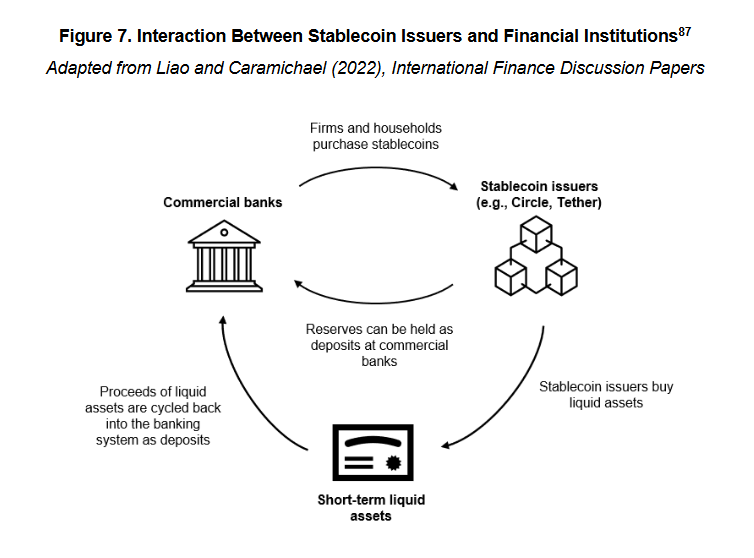
- Odaily Note: Stablecoins backed by crypto assets, futures hedging, algorithmic mechanisms, etc., are not considered here. Firstly, because such stablecoins account for a small proportion; secondly, because these stablecoins do not fall under the discussion scenario for compliant stablecoins under the U.S. regulatory framework — last year's GENIUS bill clearly defined reserve requirements for compliant stablecoins, limiting reserve assets to cash, short-term Treasury bonds, or central bank deposits, and requiring segregation from operational funds.
So the reality is clear: Stablecoins do not cause bank deposit outflows because the funds always eventually flow back to banks and can be used for credit intermediation. This depends on the business model of stablecoins and has little to do with whether they yield interest.
The real key issue lies in the change in deposit structure after the funds return.
The Cash Cow of American Megabanks
Before analyzing this change, we need to briefly introduce how large U.S. banks make money from interest.
Van Buren Capital General Partner Scott Johnsson cited a paper from the University of California, Los Angeles, stating that since the 2008 financial crisis damaged the banking industry's credibility, U.S. commercial banks have diverged into two distinct forms in deposit-taking business — high-interest banks and low-interest banks.
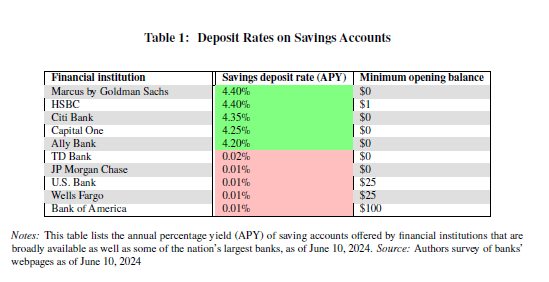
High-interest banks and low-interest banks are not formal regulatory classifications but common terms in market discourse — manifested in the fact that the deposit interest spread between high-interest banks and low-interest banks has reached over 350 basis points (3.5%).
Why is there such a significant interest spread for the same deposit? The reason is that high-interest banks are mostly digital banks or banks with business structures focused on wealth management and capital market businesses (e.g., Capital One). They rely on high interest rates to attract deposits to support their credit or investment businesses. Conversely, low-interest banks are primarily national large commercial banks that hold actual sway in the banking industry, such as Bank of America, JPMorgan Chase, and Wells Fargo. They have vast retail customer bases and payment networks, allowing them to maintain extremely low deposit costs through customer stickiness, brand effects, and branch convenience, without needing to compete for deposits with high interest rates.
From a deposit structure perspective, high-interest banks generally focus on non-transaction deposits, i.e., deposits mainly for savings or interest earnings — such funds are more sensitive to interest rates and cost more for banks; low-interest banks generally focus on transaction deposits, i.e., deposits mainly for payments, transfers, and settlements — such funds are characterized by high loyalty, frequent流动性, and extremely low interest rates, making them the most valuable liabilities for banks.
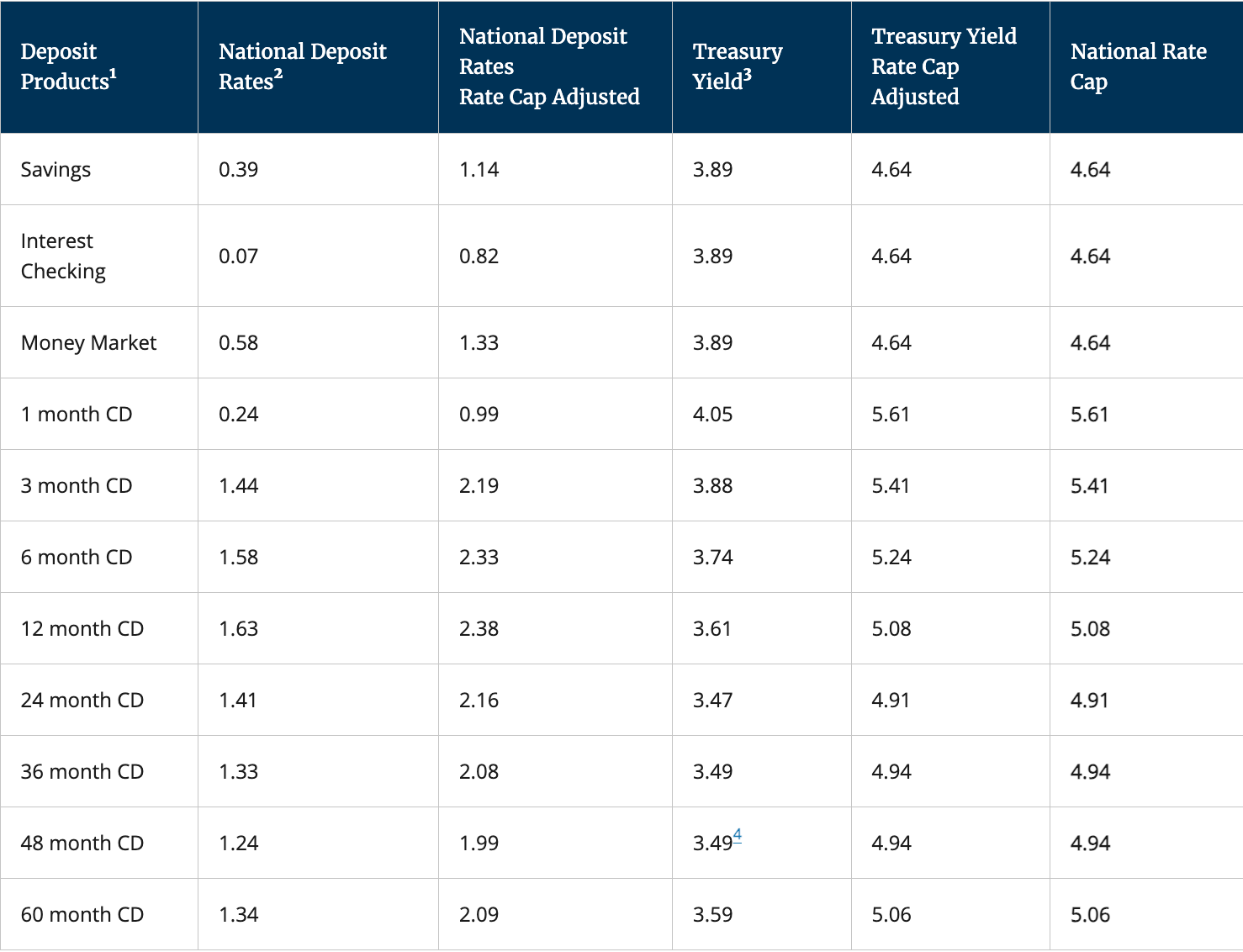
Latest data from the U.S. Federal Deposit Insurance Corporation (FDIC) shows that as of mid-December 2025, the average annual interest rate for U.S. savings accounts was only 0.39%.
Note, this is data already influenced by high-interest banks. Since mainstream U.S. banks primarily operate on a low-interest model, the actual interest they pay depositors is far lower than this level — Galaxy founder and CEO Mike Novogratz bluntly stated in a CNBC interview that large banks pay depositors almost no interest (about 1 - 11 basis points), while the同期 Federal Reserve benchmark rate was between 3.50% and 3.75%. This spread brings huge profits to banks.
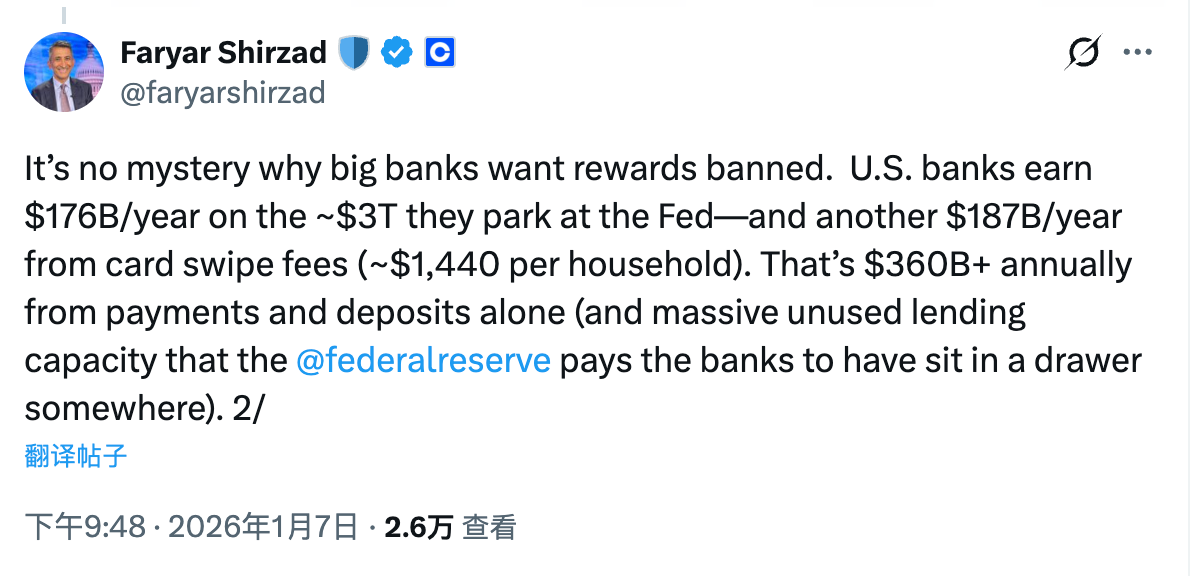
Coinbase Chief Compliance Officer Faryar Shirzad calculated a clearer account — U.S. banks profit about $176 billion annually from approximately $3 trillion in funds deposited at the Federal Reserve. Additionally, they profit about $187 billion annually from transaction fees charged to depositors. Just from deposit spreads and payment transaction环节, this brings in over $360 billion in revenue annually.
The Real Change: Deposit Structure and Profit Distribution
Back to the topic, what changes will the stablecoin system bring to bank deposit structures? How will yield-bearing stablecoins助推 this trend? The logic is actually quite simple. What are the use cases for stablecoins? The answers are无非 payments, transfers, settlements... etc. Doesn't this sound familiar!
As mentioned earlier, these functions are the core utilities of transaction deposits, which are both the main deposit type for large banks and their most valuable liabilities. Therefore, the banking industry's real concern about stablecoins is — stablecoins, as a new transaction medium, can directly compete with transaction deposits in terms of use cases.
If stablecoins did not have yield-bearing functionality, it might be manageable. Considering the usage barriers and the slight interest advantage of bank deposits (a mosquito's leg is still meat), stablecoins wouldn't pose a significant threat to this core territory of large banks. But once stablecoins are endowed with the feasibility of yielding interest, driven by the interest spread, more and more funds might shift from transaction deposits to stablecoins. Although these funds will eventually flow back into the banking system, stablecoin issuers, profit-driven, will inevitably invest most of the reserve funds into non-transaction deposits, only needing to retain a certain proportion of cash reserves for daily redemptions. This is the so-called change in deposit structure — funds remain in the banking system, but bank costs will increase significantly (interest spread compressed), and revenue from transaction fees will also shrink substantially.
At this point, the essence of the problem is very clear. The reason the banking industry fiercely opposes yield-bearing stablecoins has never been about "whether the amount of deposits within the banking system will decrease," but rather about the potential change in deposit structure and the resulting profit redistribution.
In the era without stablecoins, especially without yield-bearing stablecoins, large U.S. commercial banks firmly controlled this source of zero-cost or even negative-cost funds — transaction deposits. They could earn risk-free profits from the spread between deposit rates and benchmark rates, and also continuously charge fees for basic financial services like payments, settlements, and clearing, thus building an extremely solid闭环 that几乎不需要 sharing profits with depositors.
The emergence of stablecoins essentially dismantles this闭环. On one hand, stablecoins highly compete with transaction deposits functionally, covering core scenarios like payments, transfers, and settlements; on the other hand, yield-bearing stablecoins further introduce the variable of yield, making transaction funds, originally insensitive to interest rates,开始 have the possibility of repricing.
In this process, funds do not leave the banking system, but banks may lose control over the profits from these funds — liabilities that were almost zero-cost are forced to transform into liabilities that require paying market-based yields; payment fees that were exclusively enjoyed by banks are also开始 being分流 by stablecoin issuers, wallets, and protocol layers.
This is the change the banking industry truly cannot accept. Understanding this, it's not difficult to understand why yield-bearing stablecoins have become the most intense and最难妥协 point of controversy in CLARITY's journey through the legislative process.