Why Japan’s “Takaichi Trade” Could Pressure the Crypto Market Despite Post-Election Rebound

bitcoinistPublicado a 2026-02-10Actualizado a 2026-02-10

Resumen

Japan's snap election victory for Prime Minister Sanae Takaichi initially sparked a market surge, with the Nikkei 225 hitting record highs and Bitcoin briefly exceeding $72,000. However, the "Takaichi trade"—characterized by fiscal expansion, a weaker yen, and loose monetary policy—is now tightening global liquidity. This shift is prompting investors to rebalance portfolios, moving capital into Japanese assets as bond yields rise, which in turn contributed to recent pullbacks in U.S. equities and crypto. Bitcoin's decline is linked to futures unwinding and reduced leverage rather than on-chain weakness. Although long-term regulatory support for digital assets remains possible, short-term downside risks persist due to ongoing global risk reassessment and liquidity adjustments.

Japan’s snap election delivered a decisive mandate for Prime Minister Sanae Takaichi, triggering an immediate rally across equities, foreign exchange, and crypto markets. The Nikkei 225 surged to record highs above 57,000, the yen weakened sharply, and Bitcoin briefly climbed past $72,000 during Asian trading hours.

Related Reading: Arthur Hayes Puts $100K On Hyperliquid (HYPE) Outrunning Every $1B+ Altcoin

At first glance, the reaction looked like a classic risk-on move driven by expectations of fiscal stimulus and policy continuity. But beneath the rebound, a different dynamic is taking shape, one that could tighten global liquidity and pressure risk assets in the near term.

Traders have dubbed the shift the “Takaichi trade,” a combination of aggressive fiscal expansion, tolerance for a weaker yen, and support for loose monetary conditions. While this mix has lifted Japanese stocks and exporters, analysts warn it is also reshaping cross-border capital flows in ways that may weigh on global markets.
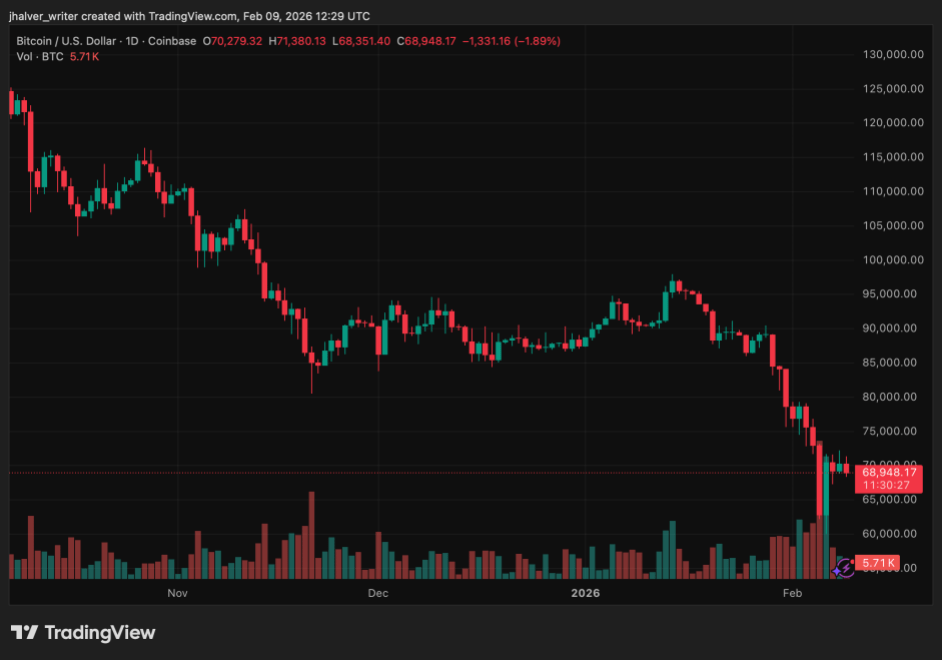
BTC's price trends sideways on low timeframes as seen on the daily chart. Source: BTCUSD on Tradingview

Portfolio Rebalancing and Liquidity Tightening

According to analysis from CryptoQuant contributor XWIN Research Japan, the main risk does not stem from capital fleeing the United States outright. Instead, global investors are rebalancing portfolios as Japanese government bonds regain appeal after years of ultra-low yields.

Expectations of higher spending and reflation have pushed yields up, drawing capital back into domestic Japanese assets. This rotation has coincided with a pullback in U.S. equities.

Over the past week, major indices, including the Nasdaq and S&P 500, slipped into correction territory, reflecting tighter financial conditions and a reassessment of risk. As inflows into U.S. equity ETFs slow, marginal liquidity across global markets has declined, amplifying volatility.

Currency dynamics add another layer of pressure. Yen weakness, persistent U.S.–Japan rate differentials, and steady demand for dollars have increased funding costs for leveraged trades. Historically, such conditions tend to push investors to de-risk across multiple asset classes simultaneously.

Equity Weakness Spills Into Bitcoin

Bitcoin’s recent pullback fits this pattern. Despite briefly reclaiming levels above $70,000 after the election, analysts note that crypto markets remain closely linked to U.S. equities during risk-off phases. When stocks weaken, portfolio managers often trim crypto exposure simultaneously to manage overall volatility.

CryptoQuant data suggests the current softness in Bitcoin prices is driven less by on-chain deterioration and more by futures unwinds and leverage reduction. Open interest has declined, and forced liquidations earlier in the month cleared out crowded long positions, leaving traders more cautious about chasing rebounds.

From a longer-term perspective, Japan’s political stability could still support digital asset adoption. Takaichi’s supermajority gives her administration room to advance tax reforms, stablecoin regulations, and Web3 initiatives later in 2026.

Related Reading: Crypto Alert: 2 Victims Lose Over $60M In Address Poisoning Scam

For now, however, the market remains vulnerable to global risk cycles. As capital continues to adjust to Japan’s fiscal pivot and U.S. equities stay under pressure, short-term downside risks are likely to persist despite the post-election bounce.

Cover image from ChatGPT, BTCUSD chart from Tradingview

Preguntas relacionadas

QWhat is the 'Takaichi trade' and what are its main components?

AThe 'Takaichi trade' refers to the market shift driven by Prime Minister Sanae Takaichi's policies, characterized by a combination of aggressive fiscal expansion, tolerance for a weaker yen, and support for loose monetary conditions.

QAccording to the analysis, what is the main risk to global markets stemming from Japan's new policies?

AThe main risk is not capital fleeing the U.S. outright, but rather global investors rebalancing their portfolios as Japanese government bonds regain appeal due to rising yields, which draws capital back into domestic Japanese assets and tightens global financial conditions.

QHow did Bitcoin's price react to the Japanese election result, and what is its current correlation?

ABitcoin briefly climbed past $72,000 following the election. However, it has since pulled back and remains closely linked to U.S. equities during risk-off phases, often moving in tandem when portfolio managers trim risk exposure.

QWhat does CryptoQuant data suggest is the primary driver of the current softness in Bitcoin prices?

ACryptoQuant data suggests the current softness is driven less by on-chain deterioration and more by futures unwinds, leverage reduction, and a decline in open interest following forced liquidations of long positions.

QWhat potential long-term positive developments for crypto could come from Takaichi's political victory?

ATakaichi's supermajority provides political stability that could allow her administration to advance supportive policies for digital assets later in 2026, including tax reforms, stablecoin regulations, and Web3 initiatives.

Lecturas Relacionadas

Why Bitcoin Holds Above $64,000 After Fed's Hard Pause

**Bitcoin Stabilizes Near $64,000 Following Hawkish Fed Pause** The cryptocurrency market, led by Bitcoin, remained stable around $64,000 despite a volatile reaction to the latest U.S. Federal Reserve meeting. The Fed paused interest rates but signaled a hawkish stance, with three committee members voting for an increase—the highest dissent since 2016. This limits risk appetite but hasn't triggered panic selling. Key market highlights include Bitcoin ETFs seeing a net inflow of $32.1 million, breaking a streak of outflows, while Ethereum ETFs experienced outflows of $18.65 million. Liquidations affected about 90,000 traders. Technically, Bitcoin finds support around $63,000-$63,500, with major resistance near $66,000. While its price is about 49% below its all-time high, institutional demand via ETFs and the absence of mass capitulation support a potential recovery scenario in the second half of the year. Major altcoins showed mixed movements, with Solana attracting capital while Ethereum faced selling pressure despite strong on-chain metrics like a growing staking queue. Regulatory news took a pause as the U.S. Senate delayed the CLARITY Act vote until at least autumn. For the final trading day of July, U.S. inflation and consumer spending data will be crucial. Bitcoin's key levels to watch are $63,000 support and $66,000 resistance. Sustained ETF inflows and Bitcoin holding above $63,000 are seen as positive signs for a potential market recovery later in the year.

cryptonews.ruHace 1 hora(s)

Why Bitcoin Holds Above $64,000 After Fed's Hard Pause

cryptonews.ruHace 1 hora(s)

Participants in XRP Fraud Scheme That Stole $9 Million from 71 Investors Arrested

South Korean police have arrested three individuals accused of operating a fraudulent investment platform that stole approximately 3.4 million XRP (worth about $9 million) from 71 investors between October 16 and 23. The suspects promoted the site Fxrpntwork.com through blogs, online articles, and YouTube videos, promising guaranteed principal and monthly returns of 1.5% to 1.8%. Investors were instructed to transfer XRP from Korean exchanges to overseas platforms and then to wallets controlled by the group before the site was shut down. The scammers copied the branding of legitimate projects Flare Network and FXRP to appear credible. Authorities warn that such impersonation frauds, which use familiar branding and urgent promises of guaranteed profits, are a common red flag. Legitimate companies do not solicit cryptocurrency transfers through unsolicited promotions. Seoul police have issued an Interpol Red Notice for a fourth suspect abroad and are investigating others involved in creating and promoting the fraudulent website. While investigators froze 17.3 billion won in assets, approximately 10 billion won was moved during the probe, with wallet analysis revealing transfers totaling 27.3 billion won, suggesting there may be additional unidentified victims and accomplices. The case underscores the organized, cross-border nature of crypto investment fraud.

cryptonews.ruHace 1 hora(s)

Participants in XRP Fraud Scheme That Stole $9 Million from 71 Investors Arrested

cryptonews.ruHace 1 hora(s)

Trading

Spot
活动图片





