Why is HYPE Still Surging? Has It Topped Out?

marsbitPublicado a 2026-05-20Actualizado a 2026-05-20

Resumen

The article analyzes the reasons behind the continued surge of the HYPE token, despite the current market conditions. The primary drivers identified are: 1. **ETF Inflows and a New Buyback Mechanism:** The launch of two ETFs (THYP by 21Shares and BHYP by Bitwise) has opened a channel for traditional capital. Crucially, Bitwise announced it will allocate 10% of BHYP's management fee income to acquire and stake HYPE, creating a potential source of recurring buy pressure linked to the ETF's growth. 2. **USDC Integration and New Revenue Stream:** The return of USDC to Hyperliquid, facilitated by Coinbase and Circle, is significant. It establishes a protocol revenue-sharing model from USDC reserve yields. Community estimates suggest this could generate substantial daily income (approx. $440k), which could be used for HYPE buybacks, decoupling token demand from just trading fees and linking it to the platform's stablecoin deposits. 3. **Expansion into New Markets:** Hyperliquid is broadening beyond being just a Perp DEX. Its HIP-4 feature launches it into the prediction market space, already showing high volume. This requires HYPE staking for market creation, directly increasing token utility and staking demand. Furthermore, the platform's Real-World Asset (RWA) trading has seen Open Interest hit a new high of $2.6B, indicating growth in trading traditional assets like stocks and commodities. 4. **Regulatory Tailwinds for RWA:** Potential SEC exemptions for tokenized stock tr...

Author | Asher(@Asher_ 0210)

In the current crypto market, if there's still an altcoin that can excite the market, it's probably HYPE.

Market data shows that the exchange rates of HYPE against BTC and BNB continue to hit new all-time highs, with HYPE/BTC currently at 0.0006249 and HYPE/BNB at 0.075. This indicates that HYPE's strength is not merely following the market rebound but is consistently outperforming major crypto assets like BTC and BNB.
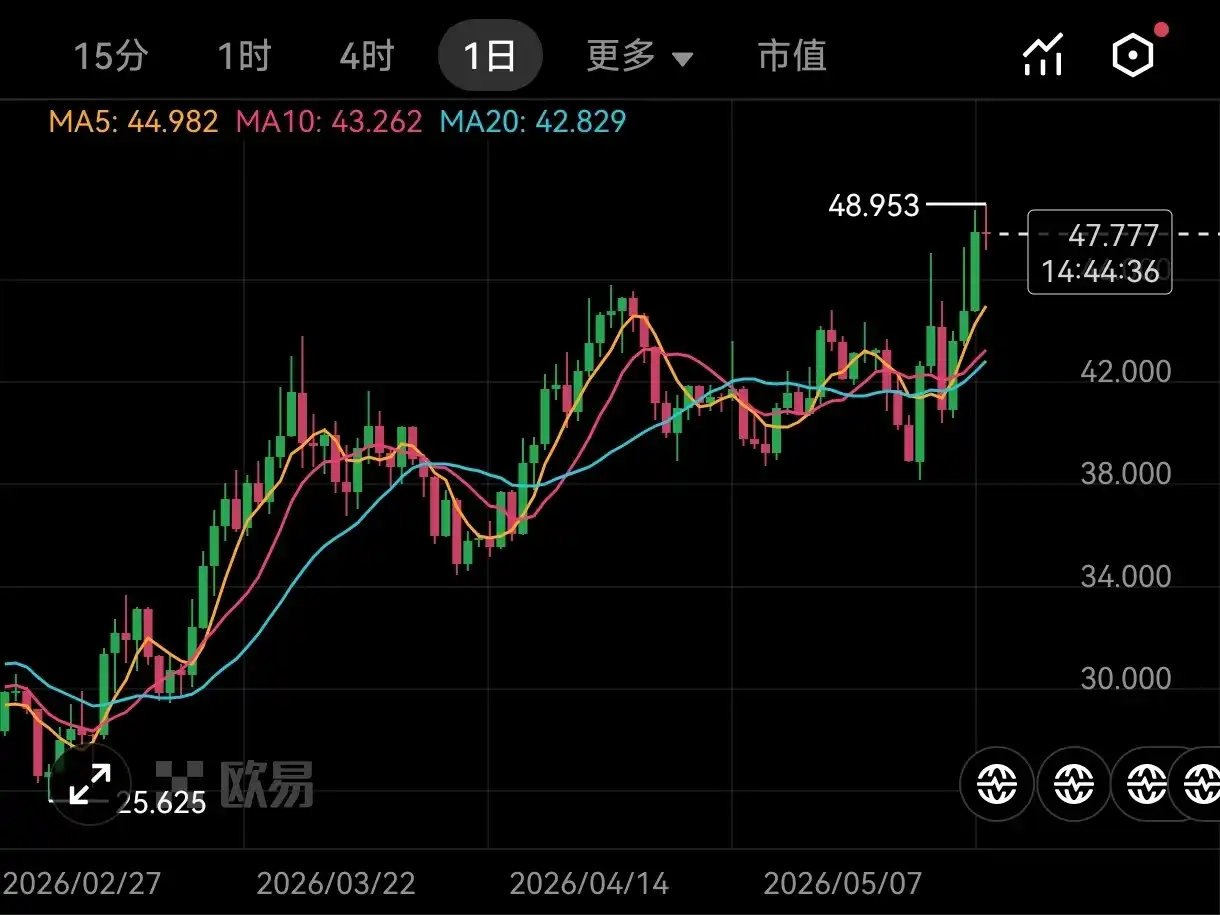
Previously, the outside world's understanding of Hyperliquid was largely confined to a high-performance Perp DEX. However, it's now evident that capital is not just buying the token of a decentralized trading platform; it's betting that Hyperliquid can integrate more asset types, more liquidity, and more trading scenarios into the same on-chain trading system.

HYPE's price performance also reflects the market's ongoing re-evaluation of Hyperliquid's value.

This article from Odaily Planet Daily will dissect its rising logic from several key changes.

From THYP to BHYP: Compliant Buying for HYPE is Opening Up

The first external catalyst for HYPE's recent surge is the opening of ETF channels.

Currently, two asset management firms have begun launching ETF products centered around Hyperliquid. On May 12th, 21Shares listed the Hyperliquid ETF under the ticker THYP; on May 15th, Bitwise listed the Hyperliquid ETF under the ticker BHYP. Data shows that as of May 18th EST, the total historical net inflows for 21Shares Hyperliquid ETF THYP reached $12.901 million; Bitwise Hyperliquid ETF BHYP reached $2.0446 million.

More crucially, Bitwise didn't stop at merely issuing an ETF. Yesterday, Bitwise announced it would allocate 10% of the management fee revenue from its BHYP Hyperliquid ETF to hold HYPE on its corporate balance sheet, with the related HYPE holdings also being staked.

This transforms the ETF narrative from a simple product listing to a potential source of continuous buying pressure. The larger the ETF size and the higher the management fee revenue, the greater the amount Bitwise could theoretically use to accumulate more HYPE. In the short term, this capital might not immediately sway prices; but in the long run, it links ETF growth, asset manager revenue, and HYPE holdings together.

In other words, ETFs are not just a one-time hype for HYPE but a new capital channel. HYPE is beginning to transition from a crypto-native asset to an on-chain trading platform token that traditional capital can also price.

USDC Returns to Hyperliquid, Adding Potential Daily Buy Pressure Exceeding $400k for HYPE

The second reason for HYPE's recent rise is that with USDC's return to Hyperliquid, the market has started to recalculate the protocol's future stable income and whether this income can continue to flow towards HYPE buybacks.

According to Hyperliquid's official announcement, Coinbase will act as the fund deployer, Circle will be responsible for CCTP and native cross-chain infrastructure deployment, and both parties have committed to staking HYPE to activate AQAv2. This means that the return of USDC is not just a simple stablecoin integration but a new mechanism established by Coinbase, Circle, and Hyperliquid around native USDC, cross-chain liquidity, and reserve yield distribution.

The key point is that Coinbase will subsequently share the majority of the USDC reserve yield with the Hyperliquid protocol. Although the specific revenue-sharing ratio has not been officially disclosed, if referencing the previous USDH yield distribution mechanism, Hyperliquid could potentially receive about 90% of the reserve yield. Therefore, the market also interprets AQAv2 as Hyperliquid establishing a protocol revenue-sharing mechanism for USDC reserve yields.

According to community estimates, based on a scale of $4.7 billion and an annualized yield of 3.8%, the USDC reserve yield corresponds to approximately $160 million in annualized revenue, translating to roughly $440,000 in potential daily HYPE buyback pressure. Once the AQAv2 interface is perfected and officially operational, Hyperliquid would no longer rely solely on trading fees to buy back HYPE but could gain an additional source of relatively stable cash flow.

This is where USDC's return truly impacts HYPE's pricing. Previously, the strength of HYPE buybacks depended mainly on trading volume: the more active the trading, the higher the protocol revenue and repurchase capability. However, with the addition of USDC reserve yields, the source of HYPE buying pressure is no longer solely dependent on trading fees but also begins to depend on how much stablecoin capital Hyperliquid can accumulate. In other words, trading fee buybacks represent platform trading activity, while USDC reserve yield buybacks represent the platform's capital accumulation capability. The market's re-pricing of HYPE might be precisely due to observing that HYPE's buyback story is no longer solely reliant on trading hype.

Hyperliquid Integrates HIP-4, Also Entering the Prediction Market Business

Beyond RWA, Hyperliquid is also reaching into one of the hottest crypto sectors this year – prediction markets.

On May 2nd, Hyperliquid launched HIP-4 Outcome Markets on its mainnet, initially introducing BTC intraday binary outcome contracts. Simply put, users can trade whether the BTC price will be above a specified price at a certain point in time. The contract price fluctuates between 0.001 and 0.999, corresponding to the market's pricing of the event's probability; it settles to 1 if the event occurs and 0 if it does not.

Predictefy data shows that on the first day of HIP-4's launch, the trading volume for BTC price-related event contracts reached $6.15 million, meaning Hyperliquid's volume in this niche market alone already far exceeded that of Kalshi, Polymarket, and other similar markets on prediction platforms.

For HYPE, the significance of HIP-4 is not just adding another product feature but connecting prediction markets to HYPE's staking, fee, and buyback mechanisms. According to the design, in the future, for permissionless deployment of prediction events, market creators will need to stake 1 million HYPE tokens, which is higher than the 500,000 HYPE required for deploying perpetual markets under HIP-3. Each staking slot can support rolling and periodic markets and can be reused after settlement; staked assets may also be slashed if issues like oracle manipulation, abnormal market states, or prolonged downtime occur.

Therefore, what HIP-4 brings to HYPE is not just a simple prediction market concept boost but a more direct value capture path. More permissionless deployment of prediction events means more demand for HYPE staking, more trading volume means more fee revenue, and this portion of fees will ultimately feed back into Hyperliquid's original buyback logic.

RWA Open Interest Hits New Highs, Hyperliquid's Ceiling is More Than Just a Perp DEX

Beyond ETF and USDC yield inflows, RWA is further expanding Hyperliquid's trading boundaries.

Data shows that the open interest for RWA trading on the Hyperliquid platform has risen to $2.6 billion, setting a new all-time high and doubling from two months ago. This data indicates that Hyperliquid is no longer just catering to crypto asset trading demand for BTC, ETH, SOL, etc.; real-world assets are also beginning to scale within its on-chain trading system.

This is crucial for HYPE's pricing. If Hyperliquid were merely a Perp DEX, its valuation anchor would primarily be the crypto cycle, trading volume, and fee revenue. But RWA opens up another dimension: stocks, commodities, precious metals, Pre-IPO assets, and more could all become subjects of 24/7 on-chain trading.

The significance of RWA for Hyperliquid isn't about adding a few more trading pairs; it's about pulling the platform out of the internal competition within the crypto market. Perp DEXes compete over who captures more crypto trading volume, but RWA competition is about who can migrate off-chain asset trading demand onto the chain. If Hyperliquid can continue to grow this part of the market, HYPE's pricing will no longer solely follow the crypto trading cycle but begin to tie into the larger demand for real asset trading.

US SEC Plans Tokenized Stock Exemption, Adding More Imagination to RWA Narrative

Potential regulatory easing by the US SEC regarding tokenized stocks is also raising Hyperliquid's long-term ceiling. According to reports, the US SEC is preparing to introduce an innovation exemption for tokenized stock trading, allowing tokens tied to publicly traded company stocks to trade on crypto platforms. In certain circumstances, related platforms might not need to fully register as broker-dealers or exchanges, and tokenized stocks issued by third parties might not even require consent from the listed companies.

For Hyperliquid, the significance of this is not starting tokenized stocks from scratch but adding regulatory imagination to the RWA direction it is already advancing. On the Hyperliquid platform, trading of real assets like stocks and Pre-IPO assets is already scaling, and RWA open interest has also reached new highs. If US regulation indeed opens a testing window for tokenized stocks, this type of on-chain trading demand could be further amplified.

For Hyperliquid, clearer regulatory boundaries could mean less resistance to bringing real asset trading on-chain; and those more likely to capture incremental growth are often not individual asset issuers but platforms capable of handling order books, liquidity, and settlement. If tokenized stocks transition from gray-area experiments to compliant growth, Hyperliquid's already operational RWA business would not just be an early attempt but could become the main battlefield in the next round of on-chain trading competition.

Fundamentals Still Strengthening, But Short-term Enters a Bull-Bear Battle Zone

The logic behind HYPE's rise is becoming clearer. ETFs open compliant capital inlets, USDC's return brings potential buyback increments, and RWA, prediction markets, and tokenized stocks continue to widen Hyperliquid's trading boundaries. These changes all point in the same direction – Hyperliquid is no longer just a Perp DEX but is expanding into a larger on-chain trading system.

However, a valid long-term logic doesn't mean short-term prices will keep rising unilaterally. According to on-chain data, HYPE is currently witnessing a massive standoff between large long and short whales, with the TOP1 and TOP2 whale positions acting as direct counterparties, with a total size exceeding $60 million. The longs are looking at Hyperliquid's subsequent growth space, while the shorts are betting on pullback pressure after rapid short-term gains. As whale position sizes expand, HYPE's short-term price may no longer be dictated solely by fundamentals but will also be influenced by leverage liquidations, funding rates, and market sentiment.

Therefore, HYPE's short-term price action is not easy to predict and depends more on which side between bulls and bears is forced to exit first. But over a longer timeframe, HYPE's fundamentals are still worthy of market optimism. Hyperliquid continues to expand tradable assets, capital inlets, and revenue sources, and HYPE plays a more central role as a value carrier within the buyback, staking, and fee capture mechanisms.

Related Content

First-Day Volume Crushes Polymarket, Hyperliquid Enters Prediction Market with BTC Binary Options

Behind USDH's Acquisition by Coinbase: Hyperliquid's Choice of Interests

Criptos en tendencia

Preguntas relacionadas

QWhat are the two new ETFs that have listed HYPE, and how could they potentially create ongoing buying pressure for the token?

AThe two new ETFs are 21Shares' THYP and Bitwise's BHYP. Specifically, Bitwise has announced that 10% of the management fee income from its BHYP ETF will be used to purchase and stake HYPE on its corporate balance sheet. This creates a scenario where the larger the ETF grows, the more fee income Bitwise generates, and the more ongoing buying pressure for HYPE.

QHow does the return of USDC to Hyperliquid create a new source of potential buy pressure for HYPE, separate from trading fees?

AThe return of USDC, facilitated by Coinbase and Circle through the AQAv2 mechanism, allows Hyperliquid to share in the reserve yield generated from USDC deposits. Community estimates suggest this could generate daily protocol revenue of around $440,000 (based on $4.7B in assets at 3.8% APY). A significant portion of this new revenue stream is expected to be used for HYPE buybacks, providing a source of buy pressure tied to stablecoin deposits rather than just trading activity.

QWhat is HIP-4 on Hyperliquid, and how does it create direct value capture for the HYPE token?

AHIP-4 Outcome Markets is Hyperliquid's new binary options (prediction market) product. It creates direct value capture for HYPE by requiring event creators to stake 1 million HYPE tokens to deploy a market (compared to 500,000 HYPE for perpetual markets). This increases staking demand. Furthermore, the trading fees generated from this new product feed into the protocol's overall revenue, which is used for HYPE buybacks.

QWhy is the growth of RWA (Real World Assets) trading on Hyperliquid significant for HYPE's valuation narrative?

AThe growth of RWA trading (with Open Interest hitting a new high of $2.6B) shifts Hyperliquid's narrative from being just a crypto-native Perp DEX to a broader chain-based trading system. It expands the potential market HYPE is tied to beyond the cyclical crypto trading demand and into the much larger market for trading traditional assets like stocks and commodities. This significantly raises the platform's long-term addressable market and potential revenue, which benefits HYPE's value capture.

QWhat recent US regulatory development could further boost the RWA narrative for Hyperliquid?

AReports suggest the U.S. SEC is preparing an innovative exemption for tokenized stock trading, potentially allowing tokenized versions of publicly traded company stocks to be traded on crypto platforms without full broker-dealer registration. This regulatory clarity could dramatically increase the demand for trading tokenized real-world assets, a market segment where Hyperliquid, with its existing RWA infrastructure and growing OI, is well-positioned to capture significant volume.

Lecturas Relacionadas

After Three Consecutive Quarters of Decline, Can the Crypto Market Find a Window for Stabilization in Q3?

The cryptocurrency market has just concluded its worst-performing quarter since 2022, with total capitalization dropping 12.6% to $2.1 trillion. All core metrics indicate capital is leaving the sector, not just rotating within it. Bitcoin fell 14.2% and Ethereum dropped 25.4% in Q2, breaking their previous correlation with US tech stocks. A key driver is the reversal in US spot Bitcoin ETF flows, which saw a net outflow of approximately $4.67 billion in Q2, including a record monthly outflow near $4.5 billion in June. While recent data suggests long-term holders are accumulating again, sustained ETF outflows mean continued selling pressure. Market focus is now singularly on the Federal Reserve. The upcoming July FOMC meeting is seen as the most critical event for Q3. A dovish signal could support Bitcoin reclaiming a $68,000-$84,000 range, while a hawkish stance might establish a new trading band around $50,000-$56,000. Additionally, regulatory uncertainty persists, with the progress of the crucial *CLARITY Act* stalling in the Senate, reducing its perceived 2026 passage probability to 40-45%. Despite the broad downturn, a few sectors showed growth. Prediction markets saw nominal volume surge 48.7% year-over-year to $113.8 billion, and tokenized collectibles transaction volume rose 143% quarterly to $1.4 billion. The Real-World Asset (RWA) tokenization sector also continued steady growth, now representing ~$28.1 billion in on-chain value. The market's foundation for an extreme crash appears limited, with Bitcoin price hovering near its 200-week moving average. However, the trading paradigm has shifted from narrative-driven speculation to decisions based on price action, policy developments, and interest rate expectations, making a broad sentiment-driven rally unlikely in the near term.

marsbitHace 3 hora(s)

After Three Consecutive Quarters of Decline, Can the Crypto Market Find a Window for Stabilization in Q3?

marsbitHace 3 hora(s)

BIT Trading Moment: BTC Still Suppressed by Weekly 200 EMA, Rejection May Restart Decline; Storage and Semiconductors that Surged Last Night Begin Falling in Evening Trading

**Crypto & Stock Market Wrap: Bitcoin Tests Resistance, Stocks Retreat After AI Surge** Bitcoin consolidates around $66,000, facing key resistance near $68,000—an area seen as a major psychological and technical hurdle where previous rallies have failed. Analysts note the cryptocurrency is caught between its 200-week moving average (~$63,333) and 200-week EMA (~$68,328). A clear break above $68k is needed to signal a stronger bullish trend, while a rejection could lead to a retest of $63k support. Market sentiment remains cautious, with low futures open interest pointing to a low-liquidity rebound rather than a full bull market. Bitcoin spot ETFs saw another $203 million inflow. US stock futures pointed lower after a strong Tuesday session led by a massive rebound in semiconductors and memory stocks. The rally was fueled by renewed optimism about AI-driven hardware demand, with Micron, SanDisk, and SK Hynix surging. However, those gains reversed in pre-market trading. Super Micro Computer (SMCI) soared over 20% after hours on strong guidance and a record backlog. Other standouts included Rocket Lab and nuclear energy plays Oklo and X-Energy. Rising oil prices (Brent above $91) and climbing Treasury yields (10-year near 4.64%), however, are reigniting inflation concerns and acting as a headwind for equities. In Asia, markets were mixed. South Korea's KOSPI pared early gains to close slightly higher as semiconductor stocks like SK Hynix gave back initial surges. Japan's Nikkei edged lower as the yen hit a fresh 38-year low against the dollar, raising fears of potential market intervention. Key events to watch include the Samsung Galaxy launch, AMD's AI event, and a slew of major tech earnings from Alphabet, Tesla, and IBM after the close on Wednesday, followed by the ECB meeting and Intel's earnings on Thursday.

marsbitHace 3 hora(s)

BIT Trading Moment: BTC Still Suppressed by Weekly 200 EMA, Rejection May Restart Decline; Storage and Semiconductors that Surged Last Night Begin Falling in Evening Trading

marsbitHace 3 hora(s)

Former CFTC Chairman, Circle President Tarbert: Preaching Long-Termism While Cashing Out $30 Million Himself

Former CFTC Chairman and Circle President Heath Tarbert has consistently advocated for a long-term vision in public, urging patience from investors as Circle’s stock price has fallen significantly from its peak. However, it has been revealed that since Circle’s IPO, Tarbert has continuously sold his CRCL shares through pre-arranged trading plans, cashing out approximately $30 million, without making any public market purchases. This contrast between his public messaging and personal actions has drawn criticism. Tarbert joined Circle in July 2023 as Chief Legal Officer, leveraging his regulatory experience to help guide the company through its IPO and expansion. Despite promoting stablecoins as long-term infrastructure, he established a 10b5-1 trading plan just before Circle went public, leading to substantial stock sales over the following year. In March 2026, he initiated another plan to sell more shares. His career trajectory highlights a pattern of moving between high-level regulatory roles and influential positions in the financial sector. After resigning as CFTC Chairman in early 2021, he joined Citadel Securities as Chief Legal Officer just 27 days later, during a period of intense regulatory scrutiny for the firm. He later joined Circle, aiding its efforts to navigate regulatory challenges for its public listing. While Tarbert's expertise in policy and compliance is valuable to companies like Circle, his actions—advocating long-term confidence while personally divesting—raise questions about the alignment between his public statements and his private financial decisions, leaving investors who followed his advice to bear the market risks.

marsbitHace 4 hora(s)

Former CFTC Chairman, Circle President Tarbert: Preaching Long-Termism While Cashing Out $30 Million Himself

marsbitHace 4 hora(s)

Gate Research Institute: The 'Wall Street-ization' Wave of Crypto Financial Products – Competition or Integration?

The article titled "Gate Research Institute: Are Crypto Financial Products Sparking a 'Wall Street' Wave—Competition or Convergence?" explores the evolving relationship between the crypto ecosystem and traditional finance (TradFi). The piece begins by reflecting on Bitcoin's original 2009 vision of decentralization, disintermediation, and moving away from banks. It then contrasts this with the 2024 landscape, where key crypto assets like Bitcoin are increasingly held through Wall Street products like ETFs issued by giants like BlackRock. The article questions whether this signifies that TradFi is systematically taking over the rights to issue, price, custody, and distribute crypto financial assets. The core argument is that this is not a zero-sum takeover but rather a bidirectional convergence where each side addresses the other's weaknesses. Crypto offers 24/7 global markets, programmable settlement, and open access but lacks compliant channels, institutional-grade custody, deep fiat liquidity, and mainstream distribution. TradFi possesses these but is constrained by legacy systems, limited operating hours, and slow settlement. Two primary convergence paths are highlighted: * **Path A (CEX to TradFi):** Exemplified by Gate, which has progressed from offering tokenized stocks and CFDs to providing direct, real stock trading (US, Hong Kong, South Korea) within its platform, using USDT. * **Path B (TradFi to Crypto):** Exemplified by Robinhood, which has integrated crypto trading, acquired exchanges like Bitstamp, and is moving traditional assets like stocks onto the blockchain via tokenization and its own Layer 2. Both paths are ultimately competing to become the next-generation, unified financial account—a "super account" where users can seamlessly trade cryptocurrencies, stocks, ETFs, RWA (Real World Assets), and tokenized treasury products in one interface. The growth of RWA and tokenized treasuries (e.g., BlackRock's BUIDL) is presented as the asset-layer fusion, providing stable, yield-bearing assets on-chain and acting as a bridge between the two worlds. In conclusion, the "Wall Street-ization" of crypto is framed as a mutual transformation. Decentralized ideals persist in the protocol layer, while at the application layer, a more efficient, global, and accessible unified capital market is emerging from this convergence. The future competition lies not between crypto exchanges and stockbrokers, but between platforms vying to offer the most comprehensive asset coverage, liquidity, and user experience within a single account.

marsbitHace 4 hora(s)

Gate Research Institute: The 'Wall Street-ization' Wave of Crypto Financial Products – Competition or Integration?

marsbitHace 4 hora(s)

Trading

Spot

Artículos destacados

Cómo comprar HYPE

¡Bienvenido a HTX.com! Hemos hecho que comprar Hyperliquid (HYPE) sea simple y conveniente. Sigue nuestra guía paso a paso para iniciar tu viaje de criptos.Paso 1: crea tu cuenta HTXUtiliza tu correo electrónico o número de teléfono para registrarte y obtener una cuenta gratuita en HTX. Experimenta un proceso de registro sin complicaciones y desbloquea todas las funciones.Obtener mi cuentaPaso 2: ve a Comprar cripto y elige tu método de pagoTarjeta de crédito/débito: usa tu Visa o Mastercard para comprar Hyperliquid (HYPE) al instante.Saldo: utiliza fondos del saldo de tu cuenta HTX para tradear sin problemas.Terceros: hemos agregado métodos de pago populares como Google Pay y Apple Pay para mejorar la comodidad.P2P: tradear directamente con otros usuarios en HTX.Over-the-Counter (OTC): ofrecemos servicios personalizados y tipos de cambio competitivos para los traders.Paso 3: guarda tu Hyperliquid (HYPE)Después de comprar tu Hyperliquid (HYPE), guárdalo en tu cuenta HTX. Alternativamente, puedes enviarlo a otro lugar mediante transferencia blockchain o utilizarlo para tradear otras criptomonedas.Paso 4: tradear Hyperliquid (HYPE)Tradear fácilmente con Hyperliquid (HYPE) en HTX's mercado spot. Simplemente accede a tu cuenta, selecciona tu par de trading, ejecuta tus trades y monitorea en tiempo real. Ofrecemos una experiencia fácil de usar tanto para principiantes como para traders experimentados.

252 Vistas totalesPublicado en 2024.12.11Actualizado en 2026.06.02

Cómo comprar HYPE

Discusiones

Bienvenido a la comunidad de HTX. Aquí puedes mantenerte informado sobre los últimos desarrollos de la plataforma y acceder a análisis profesionales del mercado. A continuación se presentan las opiniones de los usuarios sobre el precio de HYPE (HYPE).

活动图片













