Why Hyperliquid’s $48B oil-driven volume could signal a crypto reset

ambcryptoPublicado a 2026-03-20Actualizado a 2026-03-20

Resumen

Middle East tensions are causing a significant oil supply shock, driving traders to seek 24/7 exposure through perpetual contracts on Hyperliquid. This has positioned Hyperliquid as the leading perp DEX by volume, with weekly trades nearing $48 billion. The platform's native token, HYPE, has surged 30% monthly, diverging from most altcoins. However, this rally is fueled by leveraged long positions and geopolitical FOMO. Analysts suggest that an unwind of these crowded oil trades on Hyperliquid could signal easing tensions and potentially trigger a broader crypto market reset towards risk-on sentiment.

A supply shock is a strong catalyst, especially for traders chasing short-term upside.

Currently, the West Asian crisis is driving a real supply-side squeeze in the oil market. As a result, investor sentiment is shifting, with oil flows picking up and traders increasingly positioning for further upside. In short, long positions are becoming more aggressive as the narrative gains momentum.

Against this backdrop, Hyperliquid [HYPE] is starting to stand out as a key beneficiary. According to DeFiLlama data, it’s now leading perp DEX volume, with weekly volume nearing $48 billion, roughly 2x larger than the next platform in line.
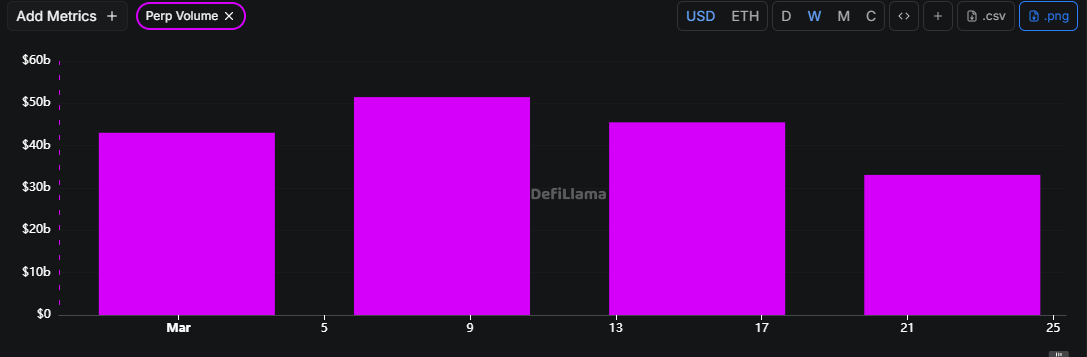
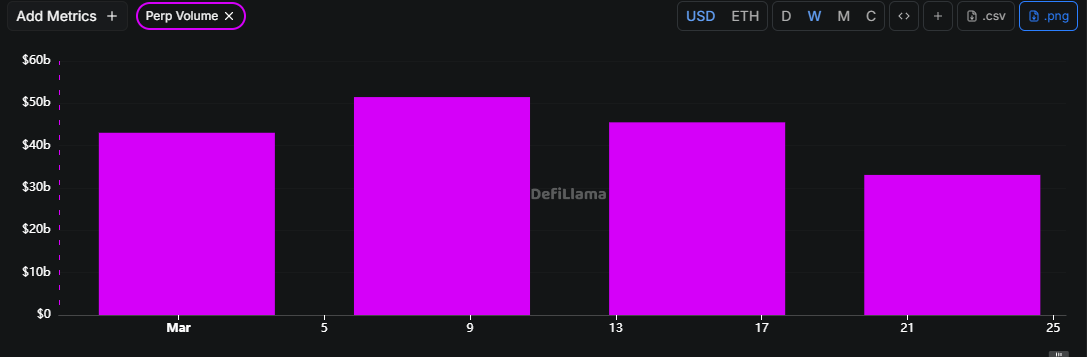
Source: DeFiLlama

Importantly, this shift is also catching the attention of major TradFi players.

JPMorgan analysts, for instance, point to traders chasing 24/7 oil exposure as the main driver behind the spike in Hyperliquid’s perp DEX volume, a gap TradFi markets still don’t cover. As a result, Hyperliquid is gaining an edge in capturing incremental flow and liquidity.

Notably, this on-chain activity is showing up in HYPE’s price action as well. On the monthly chart, HYPE is up roughly 30%, clearly diverging from other high-cap altcoins that are mostly printing single-digit gains. In short, the market is starting to price in this edge.

However, with HYPE now running into resistance around the $2.3k level, a strong case remains that macro FUD and crowded positioning are driving this move rather than a sustained trend. Consequently, if flows cool or positioning gets too crowded, it increases the risk of an unwind.

So the key question is: If we start to see large long squeezes and exits on Hyperliquid, could that flush act as a signal for a market reset and indicate when the broader crypto market flips back to risk-on?

Traders piling into oil on Hyperliquid raise the question of a reset

The conflict in the Middle East has thrown the global oil market into disarray.

According to the Kobeissi Letter, oil prices have jumped sharply since December, and Saudi Arabia’s prediction markets are calling for the war to last through April, with $180 tagged as the “base case” for oil. In short, the market is bracing for continued volatility and supply-driven moves.

In this setup, Lookonchain flagged a trader depositing 4.105 million USDC on Hyperliquid to open a 5x long on $20.19 Brent oil, showing how traders are chasing FOMO and using leverage to capture outsized returns in the oil market. The bigger picture, though? Moves like this underline Hyperliquid’s central role in enabling perp trades and explain why its DEX volume keeps hitting new highs.
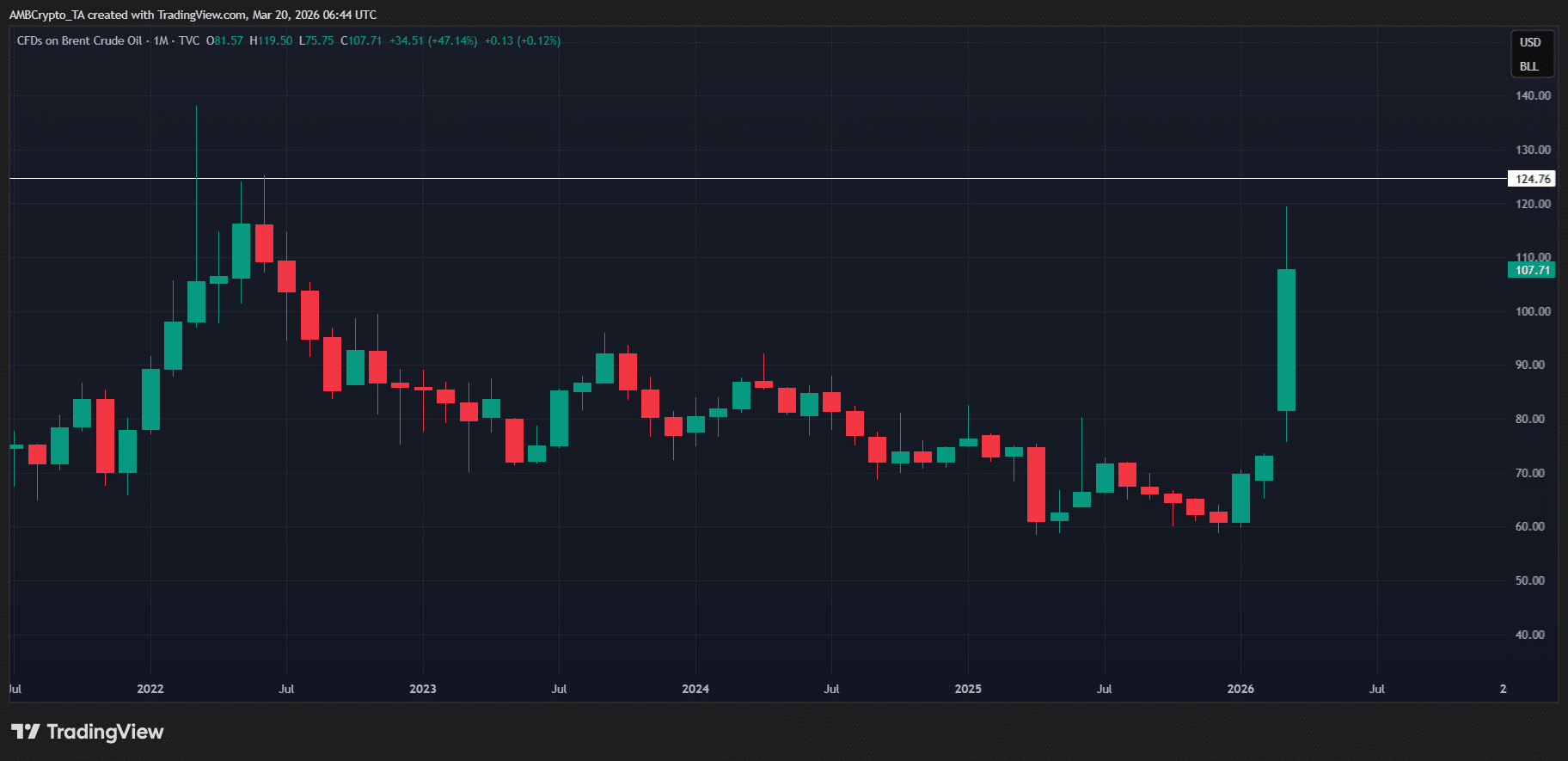
Source: TradingView (BRENT OIL/USD)

From a technical angle, these perp bets on Hyperliquid make total sense.

As the chart above shows, Brent Oil is up a massive 47% so far in March, marking its first 40%+ monthly rally since the COVID-19 crisis. Prices have already bounced back to 2022 levels around $110, with this trade’s liquidation set at $87.87, leaving the trader comfortably sitting on significant unrealized gains.

Meanwhile, the broader crypto market is still stuck around a $2.4 trillion market cap. Capital rotation into risk assets looks capped as traders chase oil momentum, with Hyperliquid standing out as the only altcoin posting double-digit gains.

According to AMBCrypto, this is a key trend to watch. The crypto market’s next risk-on move seems tied to long crowding on Hyperliquid. Once those positions start to unwind, it could signal geopolitical tensions easing and open the door for a broader risk-on rotation.


Final Summary

  • Middle East tensions are driving a supply shock in oil, fueling FOMO-driven longs on Hyperliquid and pushing HYPE up 30%, highlighting its central role in perp trading.
  • Brent oil rallies 47% in March while crypto remains stuck, showing that broader risk-on moves may hinge on potential unwind on Hyperliquid.


Preguntas relacionadas

QWhat is the main driver behind the spike in Hyperliquid's perp DEX volume according to JPMorgan analysts?

AJPMorgan analysts point to traders chasing 24/7 oil exposure as the main driver behind the spike in Hyperliquid's perp DEX volume, a gap that TradFi markets still don't cover.

QHow much has the price of HYPE increased on the monthly chart, and how does this compare to other altcoins?

AOn the monthly chart, HYPE is up roughly 30%, clearly diverging from other high-cap altcoins that are mostly printing single-digit gains.

QWhat is the 'base case' price target for oil according to Saudi Arabia's prediction markets mentioned in the article?

ASaudi Arabia's prediction markets are calling for the war to last through April, with $180 tagged as the 'base case' for oil.

QWhat specific example does Lookonchain provide to show how traders are chasing oil FOMO on Hyperliquid?

ALookonchain flagged a trader depositing 4.105 million USDC on Hyperliquid to open a 5x long on $20.19 Brent oil.

QAccording to the article, what could a potential unwind of long positions on Hyperliquid signal for the broader crypto market?

AA potential unwind of long positions on Hyperliquid could signal that geopolitical tensions are easing and open the door for a broader risk-on rotation in the crypto market.

Lecturas Relacionadas

Global Market Share Survey: Japanese Firms Lead in Semiconductor Materials

Global Market Share Survey: Japanese Firms Lead in Semiconductor Materials According to the 2025 "Major Goods and Services Market Share Survey" by Nikkei, Japanese companies maintain strong positions in semiconductor-related materials. In silicon wafers, Shin-Etsu Chemical ranks first with a 26.3% share, followed by SUMCO at 17.8%. Together, they hold 44.1% of the market, widening their lead over competitors from Taiwan, Germany, and South Korea. In photoresists, Tokyo Ohka Kogyo, JSR, and Shin-Etsu Chemical occupy the top three spots, with a combined share of 60.5%. Despite their strength in materials, Japanese firms have a weaker presence in core semiconductor segments like DRAM and NAND flash memory, where South Korean and U.S. companies dominate. For instance, SK Hynix and Samsung lead in DRAM, while China’s CXMT doubled its share to 6% in 2025. The semiconductor market is projected to grow rapidly, with WSTS forecasting a 90% increase to $1.5112 trillion by 2026. Major players like Samsung, SK Hynix, and Micron are making massive investments to expand capacity. To maintain their edge in materials, Japanese companies must similarly commit to large-scale, risk-taking investments. In contrast, Japan’s automotive sector shows stagnation. Toyota remains the global leader but with only a slight share increase to 12.3%, while Japanese brands are absent from the top five in the EV market. In shipbuilding, Imabari Shipbuilding rose to third place globally with a 7.2% share, benefiting from large container ship deliveries. However, Chinese and South Korean firms dominate the sector, holding the top two positions. Japan aims to revitalize its shipbuilding industry through government and corporate efforts, targeting a near doubling of output by 2035. Addressing labor shortages and adopting advanced technologies like physical AI will be critical for competitiveness.

marsbitHace 11 min(s)

Global Market Share Survey: Japanese Firms Lead in Semiconductor Materials

marsbitHace 11 min(s)

STRC Major De-pegging's First Financial Report, How Will Strategy Repair Its Capital Flywheel?

Bitcoin treasury company Strategy released its Q2 2026 earnings report on July 31. Despite a 6.9% year-over-year revenue increase to $122 million, the company recorded a net loss of $8.22 billion, largely due to $8.32 billion in unrealized losses from Bitcoin price fluctuations. As of quarter-end, Strategy holds 843,775 BTC with an average cost of $75,000 per coin, and Bitcoin per share increased. The report highlights a critical shift in Strategy's capital model following the de-pegging of its key financing tool, STRC (Strategic Coin), which fell below its $100 target. Management's top priority is restoring STRC to its target value, aiming for a recovery by September 8. They rule out discounted STRC issuances and plan to maintain its dividend yield at 12%, instead focusing on bolstering its $3.75 billion cash reserve. Strategy has moved from a one-way "buy-and-hold" Bitcoin strategy to active capital management. This new approach, part of its "Digital Credit Capital Framework," involves flexibly managing its balance sheet across four elements: BTC, USD cash, common stock (MSTR), and digital credit securities like STRC. This allows for BTC monetization (having sold $218.4 million in BTC so far), strategic repurchases of discounted securities, and debt optimization, as seen with a $1.5 billion convertible bond buyback. The company's future hinges on two key tests: successfully re-pegging STRC to restore market confidence in its digital credit system, and a long-term recovery in Bitcoin's price to ultimately support its growth thesis.

marsbitHace 56 min(s)

STRC Major De-pegging's First Financial Report, How Will Strategy Repair Its Capital Flywheel?

marsbitHace 56 min(s)

STRC's First Financial Report Post-Depegging, How is Strategy Restoring the Capital Flywheel?

On July 31, 2026, Bitcoin treasury company Strategy released its Q2 financial report. Despite a 6.9% year-over-year increase in revenue to $122 million, the company recorded a substantial net loss of $8.22 billion, primarily due to $8.32 billion in unrealized losses from Bitcoin holdings. While Strategy's core Bitcoin strategy remains intact—its holdings grew 11% to 843,775 BTC—the company is undergoing a fundamental shift in its capital model. Following the de-pegging of its key financing tool, the STRCoin (STRC), from its $100 target in May, Strategy has pivoted from a one-directional "raise funds, buy Bitcoin" cycle to a more dynamic, multi-asset capital management approach. A key part of this new framework is the "Monetization Program," through which Strategy has sold approximately $218.4 million worth of BTC to bolster liquidity. The company's top priority is repairing STRC's peg, committing not to issue discounted shares until it returns to its target range. It has initiated a $1 billion buyback program for discounted digital credit securities, having repurchased $28.9 million face value of STRC so far. Management aims to restore the peg around September 8, 2026. Strategy now actively manages a matrix of assets: Bitcoin (for accumulation or strategic sales), USD cash reserves (now at $3.75 billion), common stock (MSTR), and digital credit securities like STRC. This allows for tactical moves like repurchasing discounted debt or equity to capture value. The future success of Strategy's "capital flywheel" hinges on two factors: the short-term ability to successfully re-peg STRC to restore market confidence in its digital credit system, and the long-term price trajectory of Bitcoin, upon which its entire investment thesis ultimately depends.

Odaily星球日报Hace 1 hora(s)

STRC's First Financial Report Post-Depegging, How is Strategy Restoring the Capital Flywheel?

Odaily星球日报Hace 1 hora(s)

Trading

Spot
活动图片