Why Does Hyperliquid Earn Less Than Coinbase?

marsbitPublicado a 2025-12-18Actualizado a 2025-12-18

Resumen

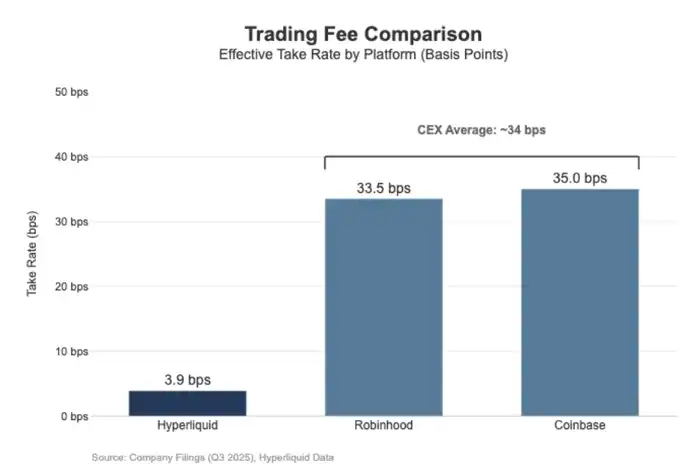
Hyperliquid, a decentralized exchange, processes near-Nasdaq-level perpetual trading volumes but captures significantly lower fees compared to centralized platforms like Coinbase and Robinhood. While Hyperliquid cleared $205.6 billion in notional volume over 30 days, it generated only $80.3 million in fees—an effective take rate of ~3.9 bps. In contrast, Coinbase and Robinhood achieve take rates of ~35.5 bps and ~33.5 bps, respectively, by operating as retail brokers that monetize multiple layers: distribution, balances, subscriptions, and order flow. This gap stems from a structural difference: Hyperliquid positions itself as a low-fee *market layer* (like Nasdaq), providing high-throughput execution and清算 infrastructure, while brokers like Coinbase control user relationships and extract value through higher-margin activities. Hyperliquid’s model includes permissionless distributor frontends (Builder Codes) and product deployment (HIP-3), which drive ecosystem growth but also create long-term fee compression risks by outsourcing high-value distribution. To defend its economics, Hyperliquid is taking steps to retain distribution control, integrate HIP-3 markets natively, and introduce balance-driven revenue streams like USDH (a native stablecoin with 50% reserve收益 sharing) and portfolio margin (10% interest fee on borrows). These moves aim to shift its model from pure exchange-level execution toward a hybrid approach that captures broker-like profit pools—without sacrificin...

Editor's Note: As Hyperliquid's trading volume approaches that of traditional exchanges, what truly warrants attention is no longer just "how large the volume is," but rather which layer of the market structure it chooses to occupy. This article uses the division of labor between "brokers vs. exchanges" in traditional finance as a reference to analyze why Hyperliquid actively adopts a low-fee market layer positioning, and how Builder Codes and HIP-3 amplify the ecosystem while simultaneously creating long-term pressure on the platform's take rate.

Hyperliquid's path reflects a core issue facing the entire crypto trading infrastructure: after scaling up, how should profits ultimately be distributed?

The original text follows:

Hyperliquid is processing perpetual contract trading volumes nearing Nasdaq levels, but its profit structure similarly exhibits "Nasdaq-level" characteristics.
Over the past 30 days, Hyperliquid cleared $205.6 billion in perpetual contract notional trading volume (approximately $617 billion annualized quarterly) but generated only $80.3 million in fee revenue, translating to a fee rate of approximately 3.9 basis points (bps).

This means Hyperliquid's monetization approach is closer to a wholesale execution venue rather than a retail-facing, high-fee trading platform.

For comparison, Coinbase recorded $295 billion in trading volume in Q3 2025 but realized $1.046 billion in trading revenue, implying a take rate of approximately 35.5 basis points.


Robinhood's monetization logic for its crypto business is similar: its $80 billion in crypto asset notional trading volume brought in $268 million in trading revenue, an implied fee rate of about 33.5 bps; meanwhile, Robinhood's stock notional volume in Q3 2025 was as high as $647 billion.

Overall, Hyperliquid has joined the ranks of top-tier trading infrastructure in terms of volume, but in terms of fee structure and business model, it resembles a low-take-rate execution layer for professional traders rather than a retail-oriented platform.
The gap is evident not only in the fee level but also in the breadth of monetization dimensions. Retail platforms often profit simultaneously across multiple revenue "interfaces." In Q3 2025, Robinhood achieved a total of $730 million in transaction-related revenue, plus $456 million in net interest income, and $88 million in other revenue (primarily from Gold subscription services).

In contrast, Hyperliquid currently relies much more heavily on trading fees, and these fees are structurally compressed into the single-digit basis point range at the protocol level. This means Hyperliquid's revenue model is more concentrated, more singular, and closer to the low-fee, high-turnover infrastructure role, rather than a retail platform that monetizes deeply through multiple product lines.
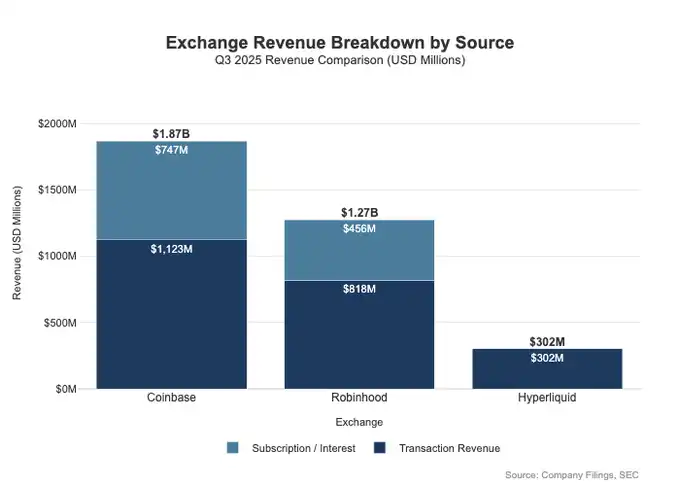
This can be explained by a fundamental positioning difference: Coinbase and Robinhood are brokerage/distribution businesses, monetizing through multiple layers leveraging their balance sheets and subscription systems; whereas Hyperliquid is closer to the exchange layer. In traditional financial market structures, the profit pool is naturally split between these two layers.

Broker-Dealer vs. Exchange Model

In traditional finance (TradFi), the core divide is the separation between the distribution layer and the market layer.
Retail platforms like Robinhood and Coinbase reside in the distribution layer, capturing high-margin monetization surfaces; whereas exchanges like Nasdaq reside in the market layer, whose pricing power is structurally constrained, and execution services are pushed by competition towards an almost commoditized economic model.

Broker/Dealer = Distribution Power + Customer Balance Sheet

Brokers control the customer relationship. Most users do not connect directly to Nasdaq but access the market through a broker. Brokers handle account opening, custody, margin and risk management, customer support, tax documents, etc., and then route orders to specific trading venues.
It is this "relationship ownership" that allows brokers to monetize in multiple ways beyond just trading:

Funds and Asset Balances: Cash sweep spreads, margin lending, securities lending

Product Bundling: Subscription services, feature packages, debit cards / advisory products

Routing Economics: Brokers control order flow and can embed payment or revenue-sharing mechanisms in the routing chain

This is why brokers often earn more than trading venues: the profit pool is truly concentrated at the "distribution + balances" location.

Exchange = Matching + Rules + Infrastructure, Take Rate Limited

Exchanges operate the trading venue itself: the matching engine, market rules, deterministic execution, and infrastructure connectivity. Their main monetization methods include:

Trading fees (continuously pressured lower in highly liquid products)

Rebates / Liquidity incentives (often returning most of the nominal fee to market makers to compete for liquidity)

Market data, network connectivity, and co-location services

Listing fees and index licensing

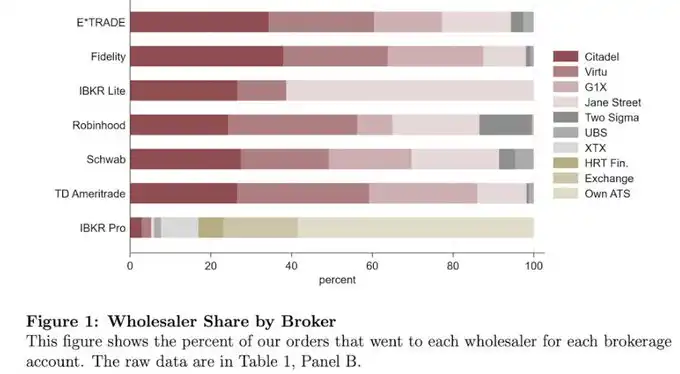
Robinhood's order routing mechanism clearly illustrates this structure: the user relationship is held by the broker (Robinhood Securities), and orders are then routed to third-party market centers, with economic benefits distributed along the routing chain.


The truly high-margin layer is at the distribution end, which controls customer acquisition, user relationships, and all monetization surfaces around execution (like payment for order flow, margin, securities lending, and subscription services).
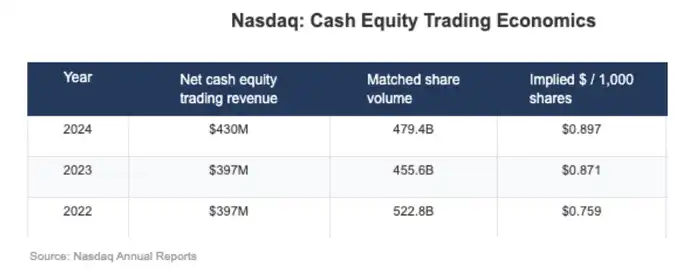
Nasdaq itself resides in the thin-margin layer. The product it provides is essentially a highly commoditized execution capability and queue access, and its pricing power is strictly limited by mechanism.

The reasons are: To compete for liquidity, trading venues often need to return a large portion of the nominal fee in the form of maker rebates; regulatory caps on access fees limit the chargeable fee space;同时, order routing is highly elastic, capital and orders can quickly switch between different trading venues, making it difficult for any single venue to raise prices.

This is reflected very直观ly in Nasdaq's disclosed financial data: the net revenue it actually captures in cash equity trading is typically on the order of a few mils per share. This is a direct写照 of the structurally compressed profit space at the market layer exchange.
The strategic consequences of this low profitability are also clearly reflected in the changes in Nasdaq's revenue structure.

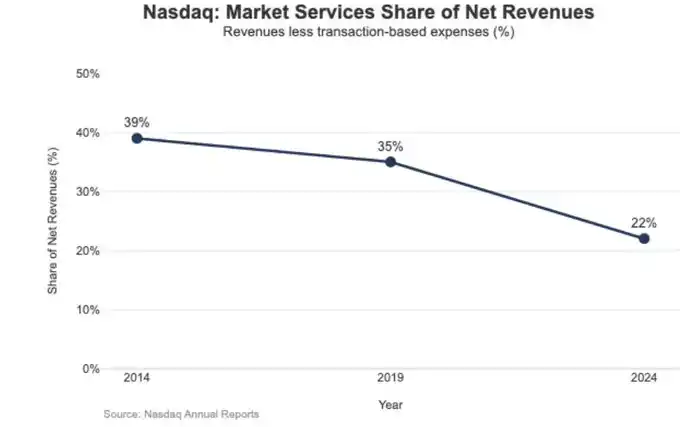
In 2024, Nasdaq's Market Services revenue was $1.020 billion, accounting for 22% of total revenue of $4.649 billion; this proportion was as high as 39.4% in 2014 and was still 35% in 2019.

This持续下滑 trend is高度一致 with Nasdaq's主动 shift from execution-based业务 highly dependent on market volatility and limited profits towards more recurring, predictable software and data businesses. In other words, it is the structurally low profit space at the exchange level that has pushed Nasdaq to gradually migrate its growth focus from "matching and execution" to "technology, data, and servitized products."
Hyperliquid as the "Market Layer"

Hyperliquid's effective take rate of approximately 4 basis points (bps) is高度一致 with its有意选择的 market layer positioning. It is building an on-chain "Nasdaq-style" trading infrastructure:

A high-throughput matching, margin, and clearing system centered on HyperCore, employing maker/taker pricing and market maker rebate mechanisms, aiming to maximize execution quality and shared liquidity, rather than multi-layer monetization面向 retail users.

In other words, Hyperliquid's design focus is not on subscriptions, balances, or distribution-based revenue, but on providing commoditized yet extremely efficient execution and settlement capabilities—this is a typical characteristic of the market layer and the inevitable result of its low-fee structure.
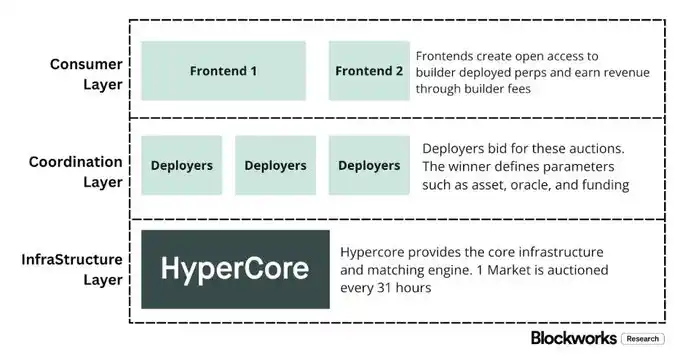
This is reflected in two types of structural splits that most crypto trading platforms have not yet truly implemented but are very typical in traditional finance (TradFi):

First, permissionless broker/distribution layer (Builder Codes).

Builder Codes allow third-party trading frontends to be built on top of the core trading venue and to charge their own economic fees. Among these, Builder fees have clear caps: up to 0.1% (10 bps) for perpetuals and up to 1% for spot, and fees can be set at the individual order level.
This mechanism thus creates a competitive market at the distribution layer, rather than having a single official application monopolize the user entry point and monetization rights.

Second, permissionless listing/product layer (HIP-3).

In traditional finance, exchanges typically control listing approvals and product creation. HIP-3 externalizes this function: developers can deploy perpetual contracts that inherit HyperCore's matching engine and API capabilities, while the definition and operation of specific markets are the responsibility of the deployer.

In terms of economic structure, HIP-3 clarifies the revenue-sharing relationship between the trading venue and the product layer: deployers of spot and HIP-3 perpetual contracts can retain up to 50% of the trading fees generated by the assets they deploy.

Builder Codes have already shown effectiveness on the distribution end: as of mid-December, approximately one-third of users trade not through the native interface but through third-party frontends.
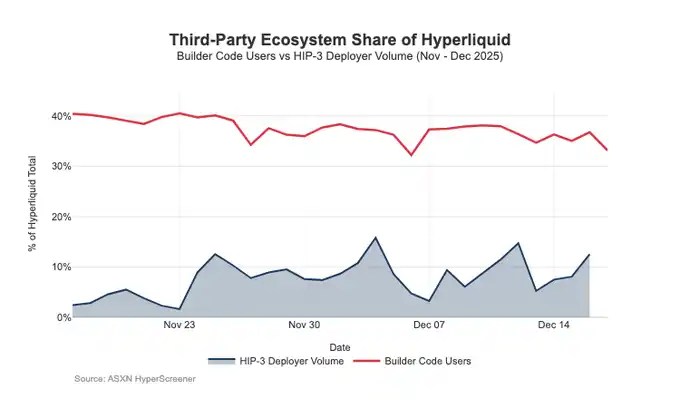
The problem is that this structure, which favors distribution expansion, itself creates持续 pressure on the trading venue layer's take rate:

1. Pricing is compressed.
Multiple frontends simultaneously selling access to the same underlying liquidity will naturally compete towards the lowest total trading cost; and Builder fees can be flexibly adjusted at the order level, further pushing prices downward.

2. Loss of monetization surfaces.
The frontend controls account opening, product bundling, subscription services, and the complete trading workflow, thereby capturing the high-margin space of the broker layer; while Hyperliquid can only retain the thinner exchange layer take rate.

3. Strategic routing risk.
Once frontends evolve into true cross-venue routers, Hyperliquid could be forced into wholesale execution competition, having to defend order flow through fee reductions or increased rebates.

Overall, Hyperliquid is consciously choosing a low-profit-margin market layer positioning (via HIP-3 and Builder Codes), while allowing a high-profit-margin broker layer to grow on top of it.


If Builder frontends continue to expand, they will increasingly determine user-facing pricing structures, control user retention and monetization interfaces, and gain bargaining power at the routing level, structurally creating long-term pressure on Hyperliquid's take rate.

Defending Distribution Rights and Introducing Non-Exchange Profit Pools

The most direct risk is commoditization.

If third-party frontends can consistently undercut the native interface on price long-term, or even ultimately achieve cross-venue routing, Hyperliquid would be pushed towards a wholesale execution economic model.

Recent design adjustments show that Hyperliquid is trying to avoid this outcome while exploring new revenue sources.

Distribution Defense: Maintaining the Native Frontend's Economic Competitiveness

A previously proposed staking discount scheme, which allowed Builders to receive up to a 40% fee discount by staking HYPE, effectively provided third-party frontends with a path to be structurally cheaper than Hyperliquid's native interface. The withdrawal of this proposal equates to canceling direct subsidies for external distribution "price undercutting."

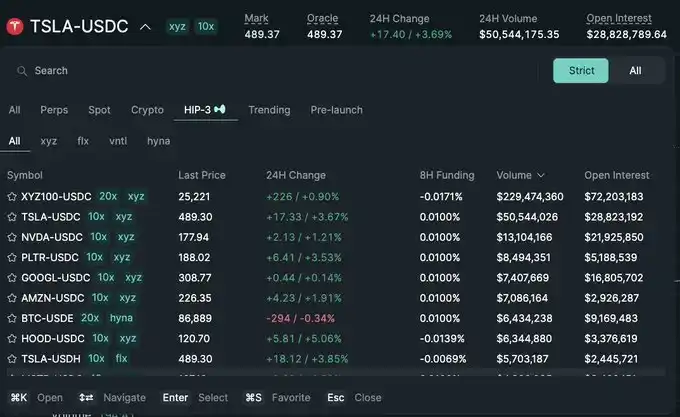
At the same time, HIP-3 markets were initially positioned to be distributed primarily through Builders and not displayed on the main frontend;但现在, these markets have begun to be displayed on Hyperliquid's native frontend, subject to strict listing standards.

This signal is very clear: Hyperliquid remains permissionless at the Builder layer but will not do so at the cost of sacrificing its core distribution rights.
USDH: Shifting from Trading Monetization to "Float" Monetization

The launch of USDH aims to recapture stablecoin reserve earnings that would otherwise be captured outside the ecosystem. Its公开 structure is a 50/50 split of reserve收益: 50% to Hyperliquid, 50% for USDH ecosystem growth.


Simultaneously, the trading fee discounts offered for USDH-related markets further reinforce this orientation: Hyperliquid is willing to concede on per-transaction economics in exchange for a larger, stickier profit pool tied to balances.


In effect, this introduces an annuity-like revenue stream for the protocol, whose growth depends on the monetary base size, not just nominal trading volume.

Portfolio Margin: Introducing Prime Broker-like Financing Economics

Portfolio margin unifies the margin for spot and perpetual contracts, allowing different exposures to offset each other, and introduces a native borrowing loop.


Hyperliquid will retain 10% of the interest paid by borrowers, making the protocol's economics increasingly dependent on leverage utilization and interest rate levels, not just trading volume. This is closer to a broker/prime revenue model than pure exchange logic.

Hyperliquid's Path Towards a "Brokerage-Style" Economic Model

In terms of throughput, Hyperliquid has already reached first-tier trading venue scale; but in terms of monetization, it still resembles the market layer: extremely high nominal trading volume paired with a single-digit basis point effective take rate. The gap with Coinbase and Robinhood is structural.

Retail platforms reside at the broker layer, controlling user relationships and fund balances, able to monetize multiple profit pools (financing, idle cash, subscriptions); whereas pure trading venues sell execution services, and under liquidity and routing competition, execution naturally tends towards commoditization, with net capture being持续 compressed. Nasdaq is the TradFi reference for this constraint.

Hyperliquid initially leaned明显 towards the trading venue prototype. By splitting the distribution layer (Builder Codes) and the product creation layer (HIP-3), it accelerated ecosystem expansion and market coverage; the cost is that this architecture could also push economics outward: once third-party frontends determine composite prices and can route cross-venue, Hyperliquid risks being squeezed into a thin-margin wholesale execution轨道.

However, recent actions show a conscious pivot: defending distribution rights and expanding revenue sources to "balance-based" profit pools, without abandoning the advantages of unified execution and clearing.

Specifically: the protocol is no longer willing to subsidize external frontends to be structurally cheaper than the native UI; HIP-3 is being displayed more natively; and balance sheet-style revenue sources are being introduced.


USDH pulls reserve earnings back into the ecosystem (50/50 split, with fee discounts for USDH markets); portfolio margin introduces financing economics through a 10% take on borrower interest.

Overall, Hyperliquid is converging towards a hybrid model: an execution rail as the foundation, overlaid with distribution defense and balance-driven profit pools. This reduces the risk of being trapped in a low-bps, wholesale-type trading venue, while moving closer to a brokerage-style revenue structure without sacrificing the advantages of unified execution and clearing.

Looking ahead to 2026, the unresolved question is: Can Hyperliquid move further towards a brokerage-style economy without破坏 its "outsourcing-friendly" model. USDH is the clearest test case: at the current supply level of approximately $100 million, expansion through外包发行 appears relatively slow when the protocol doesn't control distribution.


An obvious alternative path could have been UI-level defaults—for example, automatically converting the roughly $4 billion USDC存量 into the native stablecoin (similar to Binance's auto-conversion for BUSD).


If Hyperliquid wants to truly capture broker-layer profit pools, it might also need brokerage-style behavior: stronger control, tighter native product integration, and clearer boundaries with ecosystem teams regarding distribution and balance competition.


Preguntas relacionadas

QWhy does Hyperliquid generate less revenue than Coinbase despite having a similar trading volume?

AHyperliquid operates as a low-fee, wholesale execution venue (market layer) with an effective take rate of around 3.9 bps, while Coinbase functions as a retail-focused broker-dealer (distribution layer) with a higher take rate of 35.5 bps, leveraging multiple revenue streams like subscriptions, interest, and order flow payments.

QWhat is the key structural difference between Hyperliquid's and Coinbase's business models?

AHyperliquid is positioned as an exchange-like infrastructure layer focused on high-efficiency execution with compressed fees, whereas Coinbase is a broker-dealer that controls user relationships, balances, and multiple high-margin revenue interfaces such as custody, lending, and subscription services.

QHow do Builder Codes and HIP-3 contribute to Hyperliquid's ecosystem but also pressure its fee structure?

ABuilder Codes enable third-party frontends to compete on分销, driving down overall trading costs, while HIP-3 allows external product deployment with up to 50% fee sharing. Both expand ecosystem but structurally compress Hyperliquid's take rate by fostering competition and outsourcing high-margin分销 activities.

QWhat strategies is Hyperliquid adopting to defend its economic model and capture more value?

AHyperliquid is defending its分销 by retracting subsidies for third-party frontends, natively showcasing HIP-3 markets, and introducing balance-driven revenue pools like USDH (50%收益分成) and portfolio margin (10% interest抽成) to shift toward broker-dealer economics without sacrificing execution efficiency.

QHow does Nasdaq's financial evolution reflect the challenges Hyperliquid might face as a market-layer platform?

ANasdaq's declining reliance on market services revenue (from 39.4% in 2014 to 22% in 2024) due to structurally compressed exchange-layer fees mirrors Hyperliquid's challenge: high volume with low take rates. Both are pushed to diversify into higher-margin, non-transactional revenue streams like data, tech services, or balance-based products.

Lecturas Relacionadas

$292 Million KelpDAO Cross-Chain Bridge Hack: Who Should Foot the Bill?

On April 18, 2026, an attacker stole 116,500 rsETH (worth ~$292M) from KelpDAO’s cross-chain bridge in 46 minutes—the largest DeFi exploit of 2026. The stolen assets were deposited into Aave V3 as collateral, causing $177–200M in bad debt and triggering a cascade of losses across nine DeFi protocols. Aave’s TVL dropped by ~$6B overnight. This legal analysis argues that KelpDAO and LayerZero Labs share concurrent liability, with fault apportioned 60%/40%. KelpDAO negligently configured its bridge with a 1-of-1 decentralized verifier network (DVN)—a single point of failure—despite LayerZero’s explicit recommendation of a 2-of-3 setup. LayerZero, which operated the compromised DVN, failed to secure its RPC infrastructure against a known poisoning attack vector. Both protocols’ terms of service cap liability at $200 (KelpDAO) or $50 (LayerZero), but these limits are likely unenforceable due to unconscionability, gross negligence exceptions, and potential securities law invalidation (if rsETH is deemed a security under the Howey test). Aave’s governance also faces fiduciary duty claims for raising rsETH’s loan-to-value ratio to 93%—far above competitors’ 72–75%—without adequately assessing bridge risks, amplifying the systemic fallout. Practical recovery targets include LayerZero Labs (a registered Canadian entity), KelpDAO’s founders, auditors, and identifiable Aave governance delegates. The incident underscores escalating legal risks for DeFi protocols, infrastructure providers, and governance participants.

marsbitHace 23 min(s)

$292 Million KelpDAO Cross-Chain Bridge Hack: Who Should Foot the Bill?

marsbitHace 23 min(s)

Insider Trading in War: 5 People Involved, the Highest Earner Was Arrested

On April 24, the U.S. Department of Justice arrested U.S. Army Special Forces Staff Sergeant Gannon Ken Van Dyke for insider trading related to the capture of Venezuelan President Nicolás Maduro on January 3. Van Dyke allegedly profited over $400,000 by placing bets on a prediction market, Polymarket, using insider knowledge of the covert operation. According to the indictment, Van Dyke registered an account (0x31a5) on December 26 and made a series of bets predicting Maduro’s capture and U.S. military involvement in Venezuela. He withdrew most of his funds on the day of the operation and attempted to obscure his tracks by transferring assets through crypto and brokerage accounts. This case marks the first time the DOJ has prosecuted insider trading on Polymarket. PolyBeats had previously identified five suspicious accounts, including Van Dyke’s—the highest earner—in January. The other accounts, with profits ranging from $34,000 to $145,000, remain under unofficial scrutiny but have not been charged. Their lower profits, indirect access to information, and unclear legal boundaries may complicate prosecution. Polymarket has since strengthened its market integrity rules, explicitly prohibiting trading based on confidential or insider information. Van Dyke’s arrest, nearly four months after his trades, signals increased regulatory attention and the persistent traceability of blockchain-based transactions.

marsbitHace 25 min(s)

Insider Trading in War: 5 People Involved, the Highest Earner Was Arrested

marsbitHace 25 min(s)

Bitwise: Bullish on Bitcoin's Performance in the Second Half of the Year, AI and Regulation Will Spark a New Altcoin Season

Bitwise CIO Matt Hougan and Research Lead Ryan Rasmussen express strong bullish sentiment on Bitcoin's long-term prospects, suggesting that its $1 million price target may be too conservative. They argue Bitcoin serves a dual role: as digital gold and a potential global settlement asset, especially amid declining trust in traditional monetary systems. Despite a weak Q1 2026 where nearly all crypto assets and prices saw double-digit declines, the analysts remain optimistic due to strong forward-looking catalysts, including institutional adoption via Bitcoin ETFs from major firms like Morgan Stanley and Goldman Sachs. Geopolitical instability, such as Iran’s mention of using Bitcoin for international payments, increases the value of Bitcoin’s “out-of-the-money call option” as a non-political, global settlement currency. This enhances its appeal beyond a mere store of value. . Additionally, Hougan highlights that a clearer regulatory token framework under current SEC leadership, combined with AI efficiency gains and high-performance blockchains, could fuel a new “altseason” by late 2026. This may lead to a wave of legitimate, value-capturing token projects, unlike the earlier ICO boom. . Bitwise also announced an Avalanche ETF, citing its unique architecture and rapid growth in real-world asset (RWA) tokenization, which has surged 10x to nearly $30 billion in two years. The firm believes Layer 1 blockchains are still early in their growth cycle, with significant potential ahead.

marsbitHace 1 hora(s)

Bitwise: Bullish on Bitcoin's Performance in the Second Half of the Year, AI and Regulation Will Spark a New Altcoin Season

marsbitHace 1 hora(s)

Trading

Spot
Futuros

Artículos destacados

Qué es $S$

Entendiendo SPERO: Una Visión General Completa Introducción a SPERO A medida que el panorama de la innovación continúa evolucionando, la aparición de tecnologías web3 y proyectos de criptomonedas juega un papel fundamental en la configuración del futuro digital. Un proyecto que ha atraído la atención en este campo dinámico es SPERO, denotado como SPERO,$$s$. Este artículo tiene como objetivo reunir y presentar información detallada sobre SPERO, para ayudar a entusiastas e inversores a comprender sus fundamentos, objetivos e innovaciones dentro de los dominios web3 y cripto. ¿Qué es SPERO,$$s$? SPERO,$$s$ es un proyecto único dentro del espacio cripto que busca aprovechar los principios de descentralización y tecnología blockchain para crear un ecosistema que promueva la participación, la utilidad y la inclusión financiera. El proyecto está diseñado para facilitar interacciones de igual a igual de nuevas maneras, proporcionando a los usuarios soluciones y servicios financieros innovadores. En su esencia, SPERO,$$s$ tiene como objetivo empoderar a los individuos al proporcionar herramientas y plataformas que mejoren la experiencia del usuario en el espacio de las criptomonedas. Esto incluye habilitar métodos de transacción más flexibles, fomentar iniciativas impulsadas por la comunidad y crear caminos para oportunidades financieras a través de aplicaciones descentralizadas (dApps). La visión subyacente de SPERO,$$s$ gira en torno a la inclusividad, buscando cerrar brechas dentro de las finanzas tradicionales mientras aprovecha los beneficios de la tecnología blockchain. ¿Quién es el Creador de SPERO,$$s$? La identidad del creador de SPERO,$$s$ sigue siendo algo oscura, ya que hay recursos públicos limitados que proporcionan información de fondo detallada sobre su(s) fundador(es). Esta falta de transparencia puede derivarse del compromiso del proyecto con la descentralización, una ética que muchos proyectos web3 comparten, priorizando las contribuciones colectivas sobre el reconocimiento individual. Al centrar las discusiones en torno a la comunidad y sus objetivos colectivos, SPERO,$$s$ encarna la esencia del empoderamiento sin señalar a individuos específicos. Como tal, comprender la ética y la misión de SPERO sigue siendo más importante que identificar a un creador singular. ¿Quiénes son los Inversores de SPERO,$$s$? SPERO,$$s$ cuenta con el apoyo de una diversa gama de inversores que van desde capitalistas de riesgo hasta inversores ángeles dedicados a fomentar la innovación en el sector cripto. El enfoque de estos inversores generalmente se alinea con la misión de SPERO, priorizando proyectos que prometen avances tecnológicos sociales, inclusión financiera y gobernanza descentralizada. Estas fundaciones de inversores suelen estar interesadas en proyectos que no solo ofrecen productos innovadores, sino que también contribuyen positivamente a la comunidad blockchain y sus ecosistemas. El respaldo de estos inversores refuerza a SPERO,$$s$ como un contendiente notable en el dominio de proyectos cripto que evoluciona rápidamente. ¿Cómo Funciona SPERO,$$s$? SPERO,$$s$ emplea un marco multifacético que lo distingue de los proyectos de criptomonedas convencionales. Aquí hay algunas de las características clave que subrayan su singularidad e innovación: Gobernanza Descentralizada: SPERO,$$s$ integra modelos de gobernanza descentralizada, empoderando a los usuarios para participar activamente en los procesos de toma de decisiones sobre el futuro del proyecto. Este enfoque fomenta un sentido de propiedad y responsabilidad entre los miembros de la comunidad. Utilidad del Token: SPERO,$$s$ utiliza su propio token de criptomoneda, diseñado para servir diversas funciones dentro del ecosistema. Estos tokens permiten transacciones, recompensas y la facilitación de servicios ofrecidos en la plataforma, mejorando la participación y la utilidad general. Arquitectura en Capas: La arquitectura técnica de SPERO,$$s$ apoya la modularidad y escalabilidad, permitiendo la integración fluida de características y aplicaciones adicionales a medida que el proyecto evoluciona. Esta adaptabilidad es fundamental para mantener la relevancia en el cambiante paisaje cripto. Participación de la Comunidad: El proyecto enfatiza iniciativas impulsadas por la comunidad, empleando mecanismos que incentivan la colaboración y la retroalimentación. Al nutrir una comunidad sólida, SPERO,$$s$ puede abordar mejor las necesidades de los usuarios y adaptarse a las tendencias del mercado. Enfoque en la Inclusión: Al ofrecer tarifas de transacción bajas e interfaces amigables para el usuario, SPERO,$$s$ busca atraer a una base de usuarios diversa, incluyendo a individuos que anteriormente pueden no haber participado en el espacio cripto. Este compromiso con la inclusión se alinea con su misión general de empoderamiento a través de la accesibilidad. Cronología de SPERO,$$s$ Entender la historia de un proyecto proporciona información crucial sobre su trayectoria de desarrollo y hitos. A continuación se presenta una cronología sugerida que mapea eventos significativos en la evolución de SPERO,$$s$: Fase de Conceptualización e Ideación: Las ideas iniciales que forman la base de SPERO,$$s$ fueron concebidas, alineándose estrechamente con los principios de descentralización y enfoque comunitario dentro de la industria blockchain. Lanzamiento del Whitepaper del Proyecto: Tras la fase conceptual, se lanzó un whitepaper completo que detalla la visión, los objetivos y la infraestructura tecnológica de SPERO,$$s$ para generar interés y retroalimentación de la comunidad. Construcción de Comunidad y Primeras Interacciones: Se realizaron esfuerzos de divulgación activa para construir una comunidad de primeros adoptantes y posibles inversores, facilitando discusiones en torno a los objetivos del proyecto y obteniendo apoyo. Evento de Generación de Tokens: SPERO,$$s$ llevó a cabo un evento de generación de tokens (TGE) para distribuir sus tokens nativos a los primeros seguidores y establecer liquidez inicial dentro del ecosistema. Lanzamiento de la dApp Inicial: La primera aplicación descentralizada (dApp) asociada con SPERO,$$s$ se puso en marcha, permitiendo a los usuarios interactuar con las funcionalidades centrales de la plataforma. Desarrollo Continuo y Alianzas: Actualizaciones y mejoras continuas a las ofertas del proyecto, incluyendo alianzas estratégicas con otros actores en el espacio blockchain, han moldeado a SPERO,$$s$ en un jugador competitivo y en evolución en el mercado cripto. Conclusión SPERO,$$s$ se erige como un testimonio del potencial de web3 y las criptomonedas para revolucionar los sistemas financieros y empoderar a los individuos. Con un compromiso con la gobernanza descentralizada, la participación comunitaria y funcionalidades diseñadas de manera innovadora, allana el camino hacia un paisaje financiero más inclusivo. Como con cualquier inversión en el espacio cripto que evoluciona rápidamente, se anima a los posibles inversores y usuarios a investigar a fondo y participar de manera reflexiva con los desarrollos en curso dentro de SPERO,$$s$. El proyecto muestra el espíritu innovador de la industria cripto, invitando a una mayor exploración de sus innumerables posibilidades. Mientras el viaje de SPERO,$$s$ aún se desarrolla, sus principios fundamentales pueden, de hecho, influir en el futuro de cómo interactuamos con la tecnología, las finanzas y entre nosotros en ecosistemas digitales interconectados.

72 Vistas totalesPublicado en 2024.12.17Actualizado en 2024.12.17

Qué es $S$

Qué es AGENT S

Agent S: El Futuro de la Interacción Autónoma en Web3 Introducción En el paisaje en constante evolución de Web3 y las criptomonedas, las innovaciones están redefiniendo constantemente cómo los individuos interactúan con las plataformas digitales. Uno de estos proyectos pioneros, Agent S, promete revolucionar la interacción humano-computadora a través de su marco agente abierto. Al allanar el camino para interacciones autónomas, Agent S busca simplificar tareas complejas, ofreciendo aplicaciones transformadoras en inteligencia artificial (IA). Esta exploración detallada profundizará en las complejidades del proyecto, sus características únicas y las implicaciones para el dominio de las criptomonedas. ¿Qué es Agent S? Agent S se presenta como un marco agente abierto innovador, diseñado específicamente para abordar tres desafíos fundamentales en la automatización de tareas informáticas: Adquisición de Conocimiento Específico del Dominio: El marco aprende inteligentemente de diversas fuentes de conocimiento externas y experiencias internas. Este enfoque dual le permite construir un rico repositorio de conocimiento específico del dominio, mejorando su rendimiento en la ejecución de tareas. Planificación a Largo Plazo de Tareas: Agent S emplea planificación jerárquica aumentada por la experiencia, un enfoque estratégico que facilita la descomposición y ejecución eficiente de tareas complejas. Esta característica mejora significativamente su capacidad para gestionar múltiples subtareas de manera eficiente y efectiva. Manejo de Interfaces Dinámicas y No Uniformes: El proyecto introduce la Interfaz Agente-Computadora (ACI), una solución innovadora que mejora la interacción entre agentes y usuarios. Utilizando Modelos de Lenguaje Multimodal de Gran Escala (MLLMs), Agent S puede navegar y manipular diversas interfaces gráficas de usuario sin problemas. A través de estas características pioneras, Agent S proporciona un marco robusto que aborda las complejidades involucradas en la automatización de la interacción humana con las máquinas, preparando el terreno para una multitud de aplicaciones en IA y más allá. ¿Quién es el Creador de Agent S? Si bien el concepto de Agent S es fundamentalmente innovador, la información específica sobre su creador sigue siendo elusiva. El creador es actualmente desconocido, lo que resalta ya sea la etapa incipiente del proyecto o la elección estratégica de mantener a los miembros fundadores en el anonimato. Independientemente de la anonimidad, el enfoque sigue siendo en las capacidades y el potencial del marco. ¿Quiénes son los Inversores de Agent S? Dado que Agent S es relativamente nuevo en el ecosistema criptográfico, la información detallada sobre sus inversores y patrocinadores financieros no está documentada explícitamente. La falta de información disponible públicamente sobre las bases de inversión u organizaciones que apoyan el proyecto plantea preguntas sobre su estructura de financiamiento y hoja de ruta de desarrollo. Comprender el respaldo es crucial para evaluar la sostenibilidad del proyecto y su posible impacto en el mercado. ¿Cómo Funciona Agent S? En el núcleo de Agent S se encuentra una tecnología de vanguardia que le permite funcionar de manera efectiva en diversos entornos. Su modelo operativo se basa en varias características clave: Interacción Humano-Computadora Similar a la Humana: El marco ofrece planificación avanzada de IA, esforzándose por hacer que las interacciones con las computadoras sean más intuitivas. Al imitar el comportamiento humano en la ejecución de tareas, promete elevar las experiencias de los usuarios. Memoria Narrativa: Empleada para aprovechar experiencias de alto nivel, Agent S utiliza memoria narrativa para hacer un seguimiento de las historias de tareas, mejorando así sus procesos de toma de decisiones. Memoria Episódica: Esta característica proporciona a los usuarios una guía paso a paso, permitiendo que el marco ofrezca apoyo contextual a medida que se desarrollan las tareas. Soporte para OpenACI: Con la capacidad de ejecutarse localmente, Agent S permite a los usuarios mantener el control sobre sus interacciones y flujos de trabajo, alineándose con la ética descentralizada de Web3. Fácil Integración con APIs Externas: Su versatilidad y compatibilidad con varias plataformas de IA aseguran que Agent S pueda encajar sin problemas en ecosistemas tecnológicos existentes, convirtiéndolo en una opción atractiva para desarrolladores y organizaciones. Estas funcionalidades contribuyen colectivamente a la posición única de Agent S dentro del espacio cripto, ya que automatiza tareas complejas y de múltiples pasos con una intervención humana mínima. A medida que el proyecto evoluciona, sus posibles aplicaciones en Web3 podrían redefinir cómo se desarrollan las interacciones digitales. Cronología de Agent S El desarrollo y los hitos de Agent S pueden encapsularse en una cronología que resalta sus eventos significativos: 27 de septiembre de 2024: El concepto de Agent S fue lanzado en un documento de investigación integral titulado “Un Marco Agente Abierto que Usa Computadoras Como un Humano”, mostrando las bases del proyecto. 10 de octubre de 2024: El documento de investigación fue puesto a disposición del público en arXiv, ofreciendo una exploración profunda del marco y su evaluación de rendimiento basada en el benchmark OSWorld. 12 de octubre de 2024: Se lanzó una presentación en video, proporcionando una visión visual de las capacidades y características de Agent S, involucrando aún más a posibles usuarios e inversores. Estos marcadores en la cronología no solo ilustran el progreso de Agent S, sino que también indican su compromiso con la transparencia y la participación comunitaria. Puntos Clave Sobre Agent S A medida que el marco Agent S continúa evolucionando, varios atributos clave destacan, subrayando su naturaleza innovadora y potencial: Marco Innovador: Diseñado para proporcionar un uso intuitivo de las computadoras similar a la interacción humana, Agent S aporta un enfoque novedoso a la automatización de tareas. Interacción Autónoma: La capacidad de interactuar de manera autónoma con las computadoras a través de GUI significa un salto hacia soluciones informáticas más inteligentes y eficientes. Automatización de Tareas Complejas: Con su metodología robusta, puede automatizar tareas complejas y de múltiples pasos, haciendo que los procesos sean más rápidos y menos propensos a errores. Mejora Continua: Los mecanismos de aprendizaje permiten a Agent S mejorar a partir de experiencias pasadas, mejorando continuamente su rendimiento y eficacia. Versatilidad: Su adaptabilidad en diferentes entornos operativos como OSWorld y WindowsAgentArena asegura que pueda servir a una amplia gama de aplicaciones. A medida que Agent S se posiciona en el paisaje de Web3 y criptomonedas, su potencial para mejorar las capacidades de interacción y automatizar procesos significa un avance significativo en las tecnologías de IA. A través de su marco innovador, Agent S ejemplifica el futuro de las interacciones digitales, prometiendo una experiencia más fluida y eficiente para los usuarios en diversas industrias. Conclusión Agent S representa un audaz avance en la unión de la IA y Web3, con la capacidad de redefinir cómo interactuamos con la tecnología. Aunque aún se encuentra en sus primeras etapas, las posibilidades para su aplicación son vastas y atractivas. A través de su marco integral que aborda desafíos críticos, Agent S busca llevar las interacciones autónomas al primer plano de la experiencia digital. A medida que nos adentramos más en los reinos de las criptomonedas y la descentralización, proyectos como Agent S sin duda desempeñarán un papel crucial en la configuración del futuro de la tecnología y la colaboración humano-computadora.

341 Vistas totalesPublicado en 2025.01.14Actualizado en 2025.01.14

Qué es AGENT S

Cómo comprar S

¡Bienvenido a HTX.com! Hemos hecho que comprar Sonic (S) sea simple y conveniente. Sigue nuestra guía paso a paso para iniciar tu viaje de criptos.Paso 1: crea tu cuenta HTXUtiliza tu correo electrónico o número de teléfono para registrarte y obtener una cuenta gratuita en HTX. Experimenta un proceso de registro sin complicaciones y desbloquea todas las funciones.Obtener mi cuentaPaso 2: ve a Comprar cripto y elige tu método de pagoTarjeta de crédito/débito: usa tu Visa o Mastercard para comprar Sonic (S) al instante.Saldo: utiliza fondos del saldo de tu cuenta HTX para tradear sin problemas.Terceros: hemos agregado métodos de pago populares como Google Pay y Apple Pay para mejorar la comodidad.P2P: tradear directamente con otros usuarios en HTX.Over-the-Counter (OTC): ofrecemos servicios personalizados y tipos de cambio competitivos para los traders.Paso 3: guarda tu Sonic (S)Después de comprar tu Sonic (S), guárdalo en tu cuenta HTX. Alternativamente, puedes enviarlo a otro lugar mediante transferencia blockchain o utilizarlo para tradear otras criptomonedas.Paso 4: tradear Sonic (S)Tradear fácilmente con Sonic (S) en HTX's mercado spot. Simplemente accede a tu cuenta, selecciona tu par de trading, ejecuta tus trades y monitorea en tiempo real. Ofrecemos una experiencia fácil de usar tanto para principiantes como para traders experimentados.

714 Vistas totalesPublicado en 2025.01.15Actualizado en 2025.03.21

Cómo comprar S

Discusiones

Bienvenido a la comunidad de HTX. Aquí puedes mantenerte informado sobre los últimos desarrollos de la plataforma y acceder a análisis profesionales del mercado. A continuación se presentan las opiniones de los usuarios sobre el precio de S (S).

活动图片