Why Did Zhipu Surge Nearly 30% in a Single Day?

marsbitPublicado a 2026-05-23Actualizado a 2026-05-23

Resumen

"Global AI Model Unicorn" Zhipu's stock surged nearly 30% in a single day, reaching a new market cap high. The catalyst was the launch of its GLM-5.1-highspeed API, boasting a generation speed of **400 tokens per second**, setting a new global benchmark. This speed, roughly 3-5 times faster than industry leaders like OpenAI's GPT-4o and Anthropic's Claude, is achieved **without compromising the full-scale model's capabilities**. In the era of AI Agents requiring dozens of self-calls, such latency reduction is critical, transforming speed from a system metric into a determinant of intelligence limits. The breakthrough stems from a three-layer technical overhaul: 1. **TileRT Inference Engine**: Compiles the entire model into a continuous, always-on computation pipeline using "Warp Specialization," minimizing GPU idle time by having different processor groups handle data loading, computation, and communication in parallel. 2. **Heterogeneous Parallelism for MLA**: To efficiently run the GLM-5.1 model using the MLA attention mechanism, TileRT employs a heterogeneous strategy. One GPU handles sparse indexing/routing, while the others perform dense computation, optimizing for MLA's unique workflow. 3. **ZCube Network Architecture**: Replaces the standard Spine-Leaf (ROFT) network topology with a flat, dual-group interconnect. This design creates a single optimal path between any two GPUs, eliminating network congestion at scale and reducing latency. The business impact is sig...

By AIDeepDive

Today, Zhipu (02513.HK), hailed as the "world's first listed large language model company," surged once again.

Its intraday increase once exceeded 30%. It closed at HK$1,282, up over 26% for the day, with its market capitalization reaching HK$571.57 billion, setting another historical high.
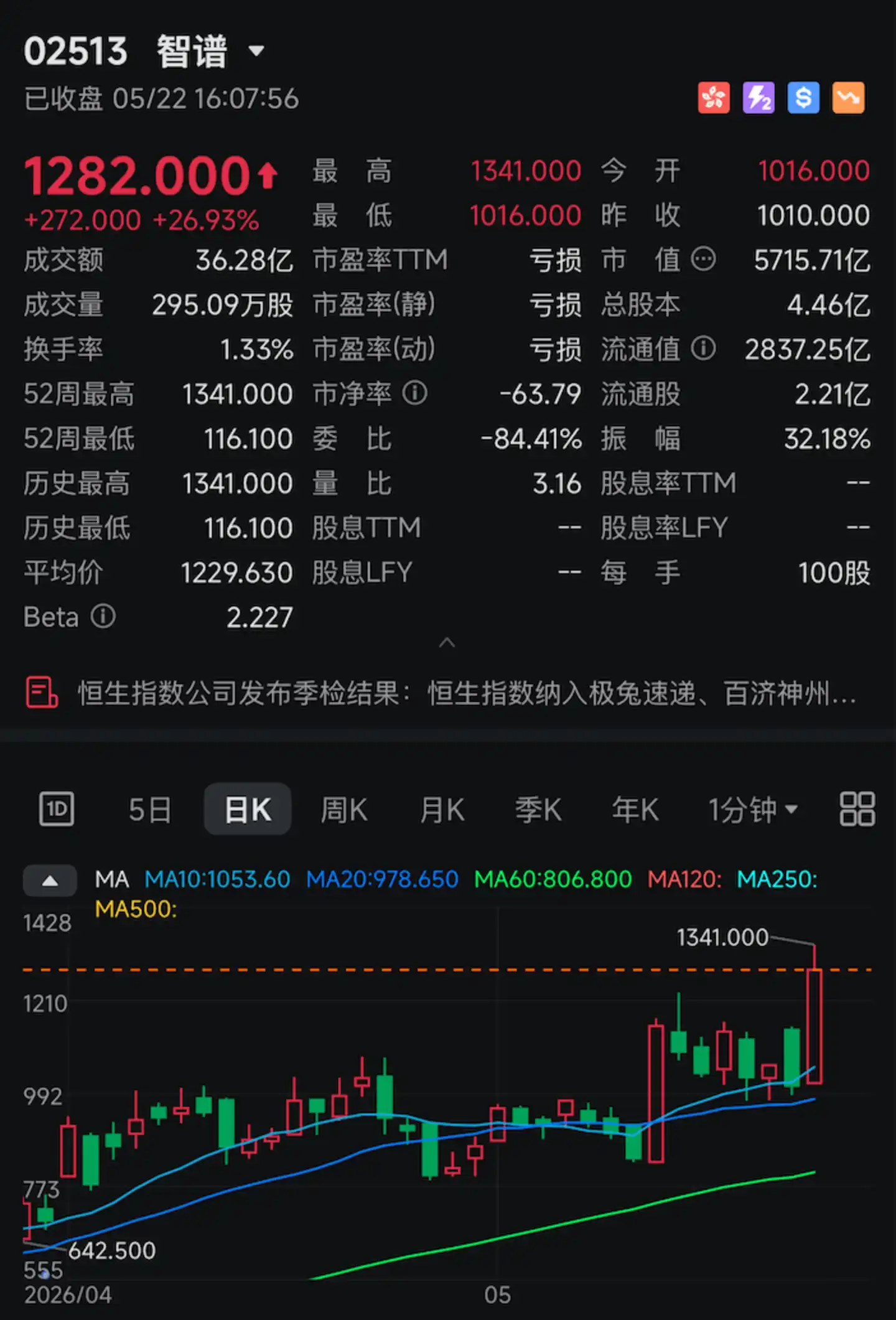
The trigger for this surge was a specific technical metric: 400 tokens/s.

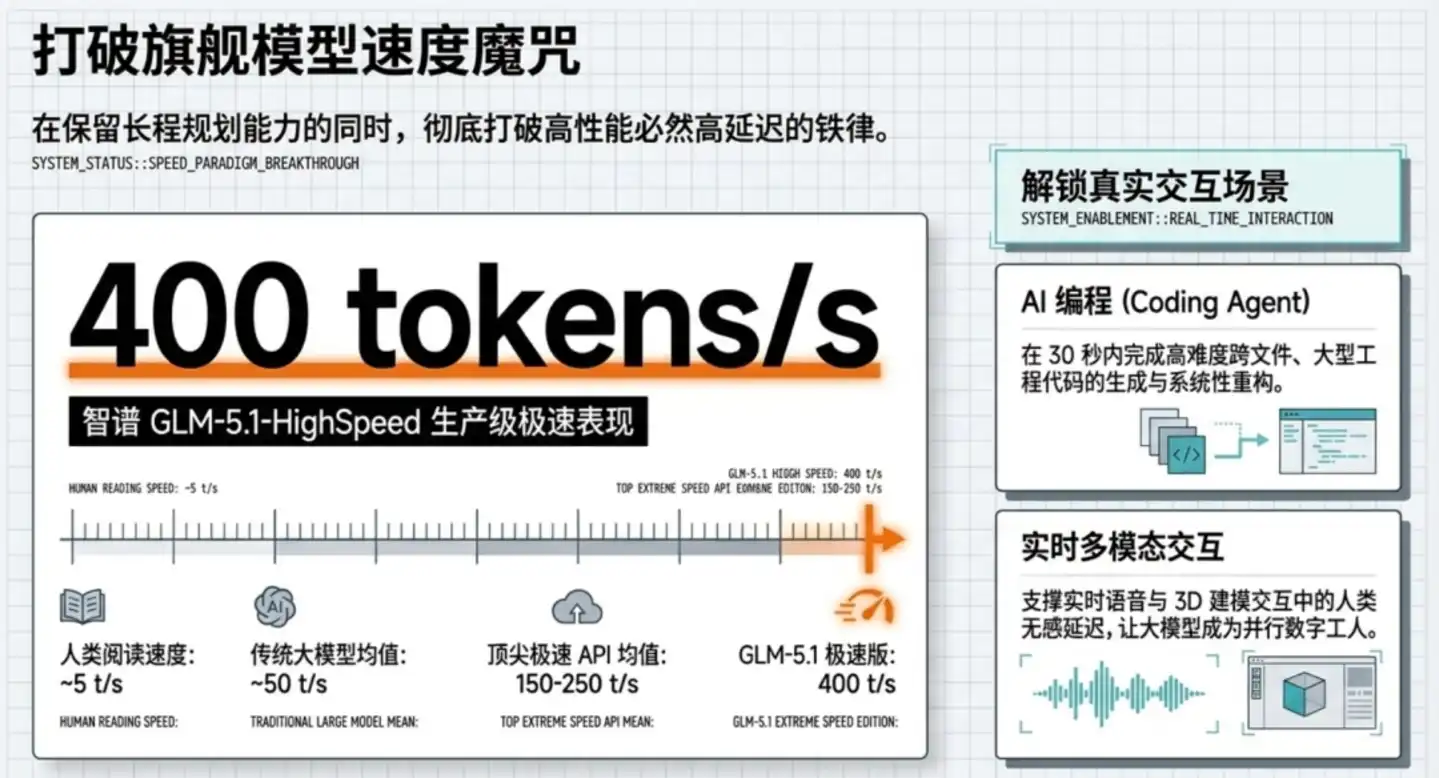
On May 22, Zhipu officially opened access to the GLM-5.1 Highspeed API (GLM-5.1-highspeed) for enterprise clients. The most critical core parameter is just one: model output speed reaching 400 tokens per second, setting a new global upper limit for API speed among major LLM providers.

I initially thought this was just another public relations stunt by a domestic LLM company, but after examining the technical details, I finally understood the logic behind the capital market's reaction.

What does 400 tokens/s mean?

The model can generate approximately 200 Chinese characters per second, equivalent to the high-intensity output of a professional writer in one minute, compressed into just one second.

A volume of text that would take a creator several days of desk work to complete can be delivered by the GLM-5.1 Highspeed in just 1 minute; a system refactoring task that would occupy an engineer for 3 days can be completed in the time it takes to drink a cup of coffee.

01 Speed Is More Important Than You Think

Speed has historically been the most easily overlooked dimension in AI model competition.

Over the past three years, the LLM arms race has centered on two tracks: parameter scale (making models larger and smarter) and price wars (making tokens cheaper and more accessible). "Speed" was never the protagonist.

This is because, in the past, "speed" was typically achieved by reducing model parameters. To increase speed, one had to use smaller, more streamlined models, at the cost of diminished capabilities.

The significance of the GLM-5.1 Highspeed lies in its achievement of pushing speed to 400 tokens/s while retaining the capabilities of the flagship full-size base model.

For both domestic and international models, "flagship-level capability" and "ultra-low latency" have been achieved without compromise for the first time.
Why is speed so critical? Because the main battlefield for AI is undergoing a fundamental shift.

As AI moves from the ChatBot era into the Agent era, Q&A is no longer the primary scenario. For an Agent to complete a task, it often requires the model to make dozens or even hundreds of self-calls: writing code, calling APIs, searching for information, utilizing tools...

In this operational mode, the latency between each call is mercilessly magnified. For a task requiring 50 calls, saving 1 second per call speeds up the entire task by nearly 1 minute. For AI programming assistants, voice interaction, and commercial decision systems, this difference can be a matter of life or death.

At a deeper level, within a fixed time budget, faster inference means the model can explore deeper reasoning paths and perform more rounds of self-verification. Speed is transforming from a system metric into an upper limit of intelligence itself.

02 How Difficult Is Achieving Speed?

So, what's the current industry standard for speed?

Among leading providers, OpenAI's GPT-4o is around 100–150 tokens/s, Anthropic's Claude Sonnet series around 80–120 tokens/s, while mainstream domestic flagship model APIs mostly fall within the 50–100 tokens/s range. 400 tokens/s is approximately 3 to 5 times the industry average.

More crucially, this gap cannot be bridged simply by throwing more computing power at it.

A server equipped with 8 H200 GPUs can theoretically move up to 38TB of data per second. For GLM-5.1, generating a single token only requires reading about 42GB of activation parameters. Purely theoretical calculation suggests it should approach 1000 tokens/s.

But real-world systems often only achieve a few dozen tokens/s.
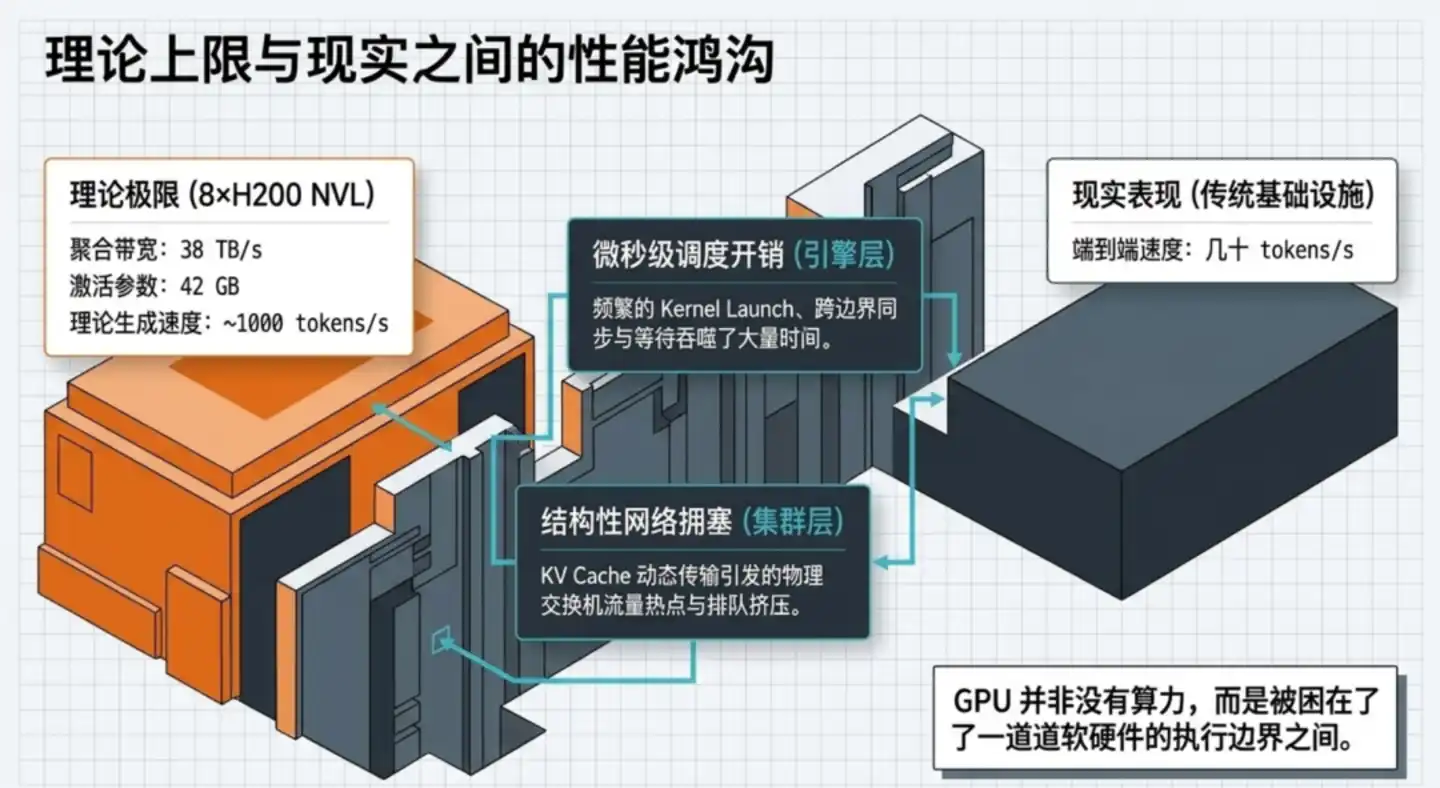
This is a gap of an order of magnitude. The GPUs aren't inherently too slow; rather, a significant amount of time is wasted on waiting, idling, and inefficient scheduling.

Zhipu's breakthrough this time stems from simultaneous innovations at three levels: the inference engine, parallelization strategy, and network architecture.
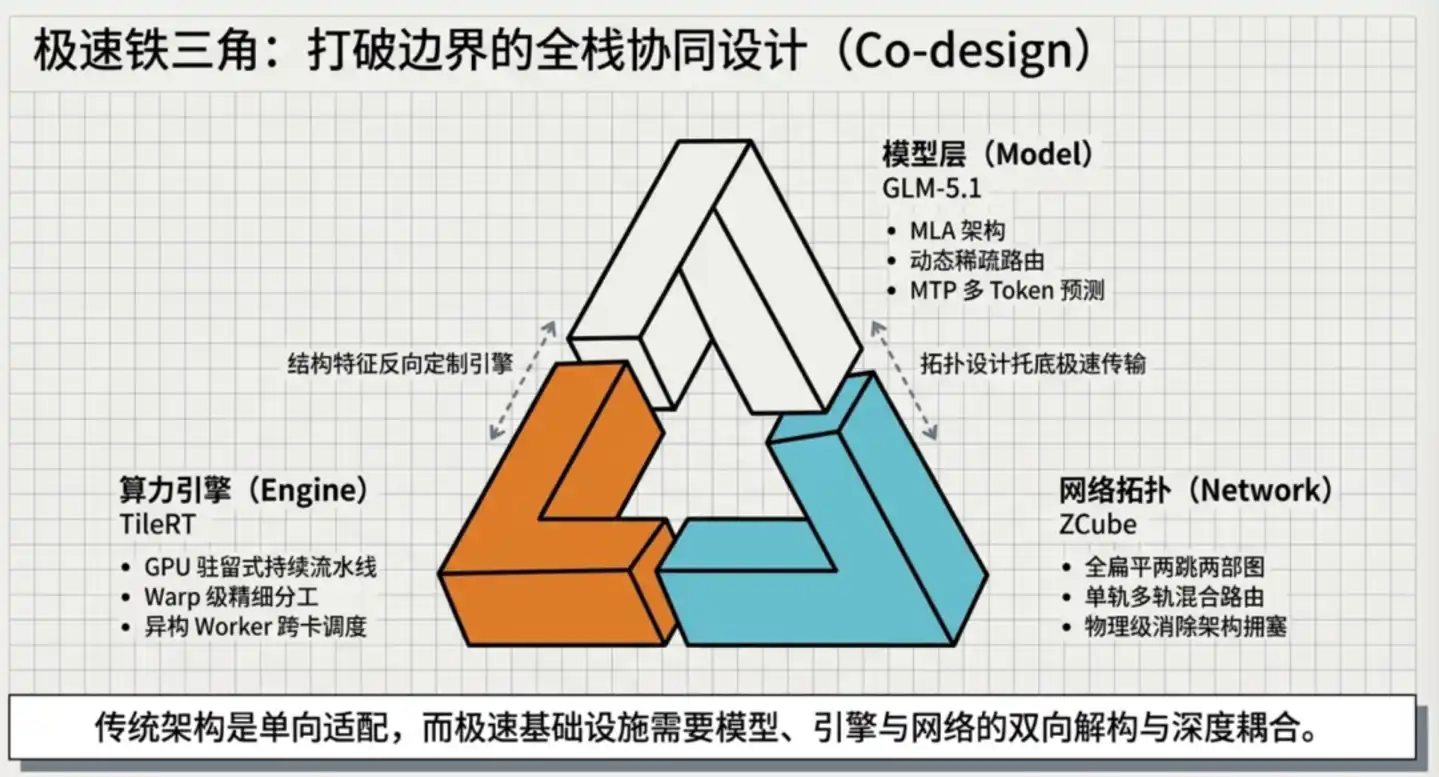
03 Three-Layer Technology Stack, Approaching Hardware Physical Limits

Here's how traditional LLMs operate: the model is decomposed into independent operators (kernels). Each operator launches a computing kernel, computes, stops, synchronizes and waits, then launches the next one.

During the training phase, each computation takes seconds or even minutes, making these startup and wait overheads negligible. But during inference, generating a single token, a key step might only require tens of microseconds, making the startup and wait overheads proportionally significant.

TileRT's Core Idea: Compile the entire model into a continuously running engine, start once, run perpetually.

TileRT statically unfolds all of the model's computational logic into a continuous pipeline during the code compilation phase. At runtime, the GPU maintains high-speed operation, with computation, data movement, and communication proceeding in parallel. Intermediate results are kept within the GPU's high-speed cache as much as possible, avoiding repeated writes to slow VRAM and subsequent re-reads.
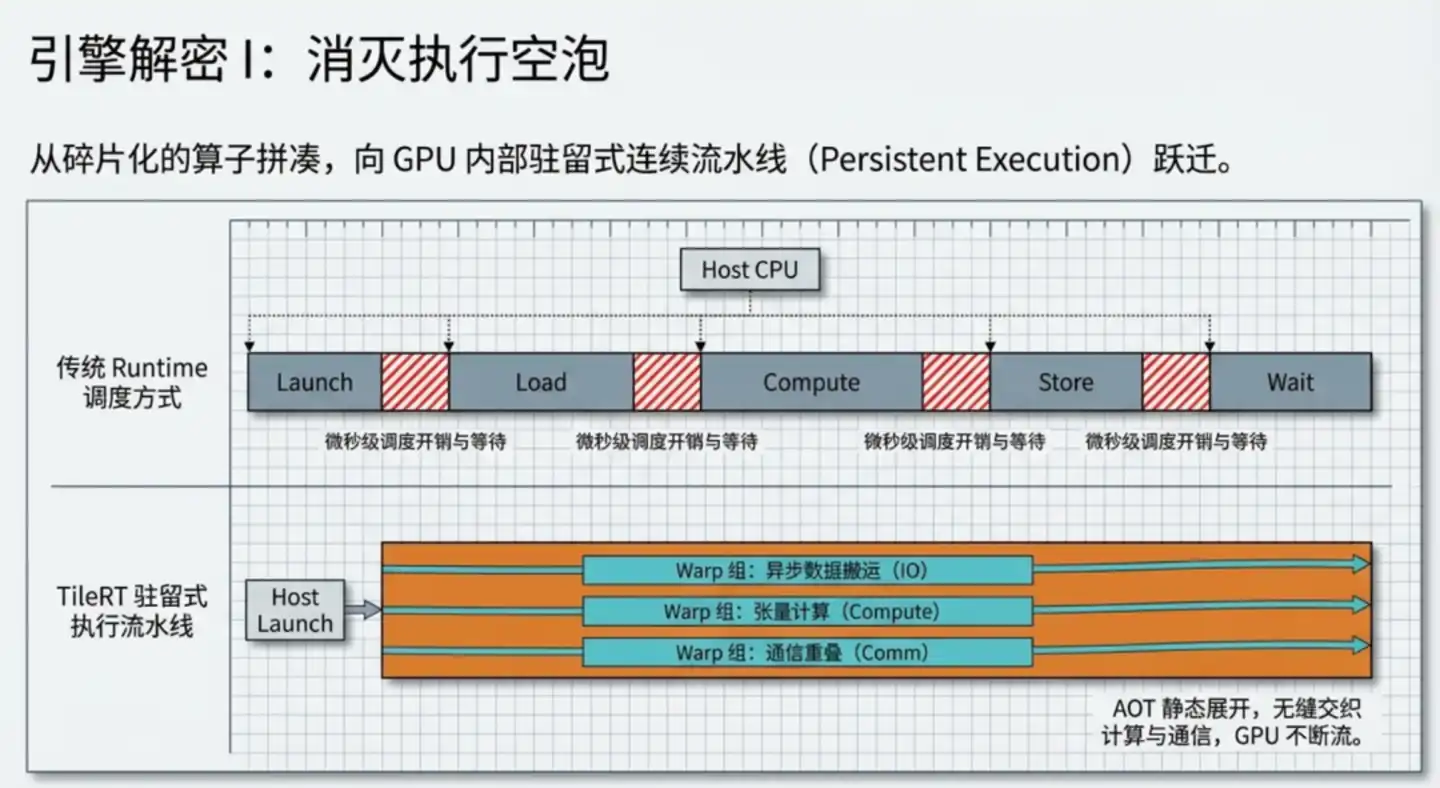
There's a crucial design detail here: Warp Specialization.

Understanding Warp requires first understanding GPU operation. The biggest difference between a GPU and a CPU is that a GPU contains thousands of relatively simple computing units, bundled together in groups of 32. This group is called a Warp.

All 32 units within the same Warp must always act synchronously, executing the same instruction, like a squad in the army where the squad leader orders everyone to perform the same action simultaneously.

In traditional frameworks, all Warps execute the same sequence of instructions. TileRT assigns different Warp groups different responsibilities: some specialize in prefetching the next batch of data, some in mathematical computation, some in communicating with other GPUs. The three groups work simultaneously, pipelining seamlessly without waiting for each other.

It's akin to moving from "one worker moving bricks, laying walls, and inspecting serially" to "a brick-moving group, a wall-laying group, and an inspection group operating concurrently."

With single-GPU efficiency solved, multi-GPU parallelism presents a new challenge.

The industry standard approach is Tensor Parallelism (TP): Split the model's weight matrices into several parts, with each GPU responsible for one part. After computing, results are aggregated via high-speed interconnects (NVLink).

This solution works well for regular, dense computations like matrix multiplication and is the standard multi-GPU solution for almost all current LLM inference frameworks.

GLM-5.1 employs **MLA (Multi-head Latent Attention), an attention mechanism proposed by DeepSeek.

Traditional attention mechanisms require storing large amounts of intermediate data (KV Cache) generated at each step for later use, which consumes significant VRAM. MLA's approach is to first compress this intermediate data into a compact "latent vector" for storage, then expand and restore it when needed, drastically reducing VRAM requirements and improving inference efficiency.

However, MLA's computational flow has a special step: performing sparse indexing from a large amount of historical information: similar to quickly finding the most relevant few books in a vast library before carefully reading them.

The "book-finding" step relies on global information and is not well-suited for distribution across multiple GPUs; the "careful reading" is the dense computation suitable for multi-GPU parallelism. If all 8 GPUs are forced to participate in "book-finding," a lot of time would be wasted on inter-GPU synchronization communication.

TileRT's solution is to have GPUs operate heterogeneously: GPU 0 specializes as the "library retriever," handling sparse indexing and routing decisions; GPUs 1–7 act as "detailed analysts," responsible for dense attention computation and matrix operations. The two types of workers each adopt the parallelization strategy best suited to them, collaborating to complete the entire computational layer.
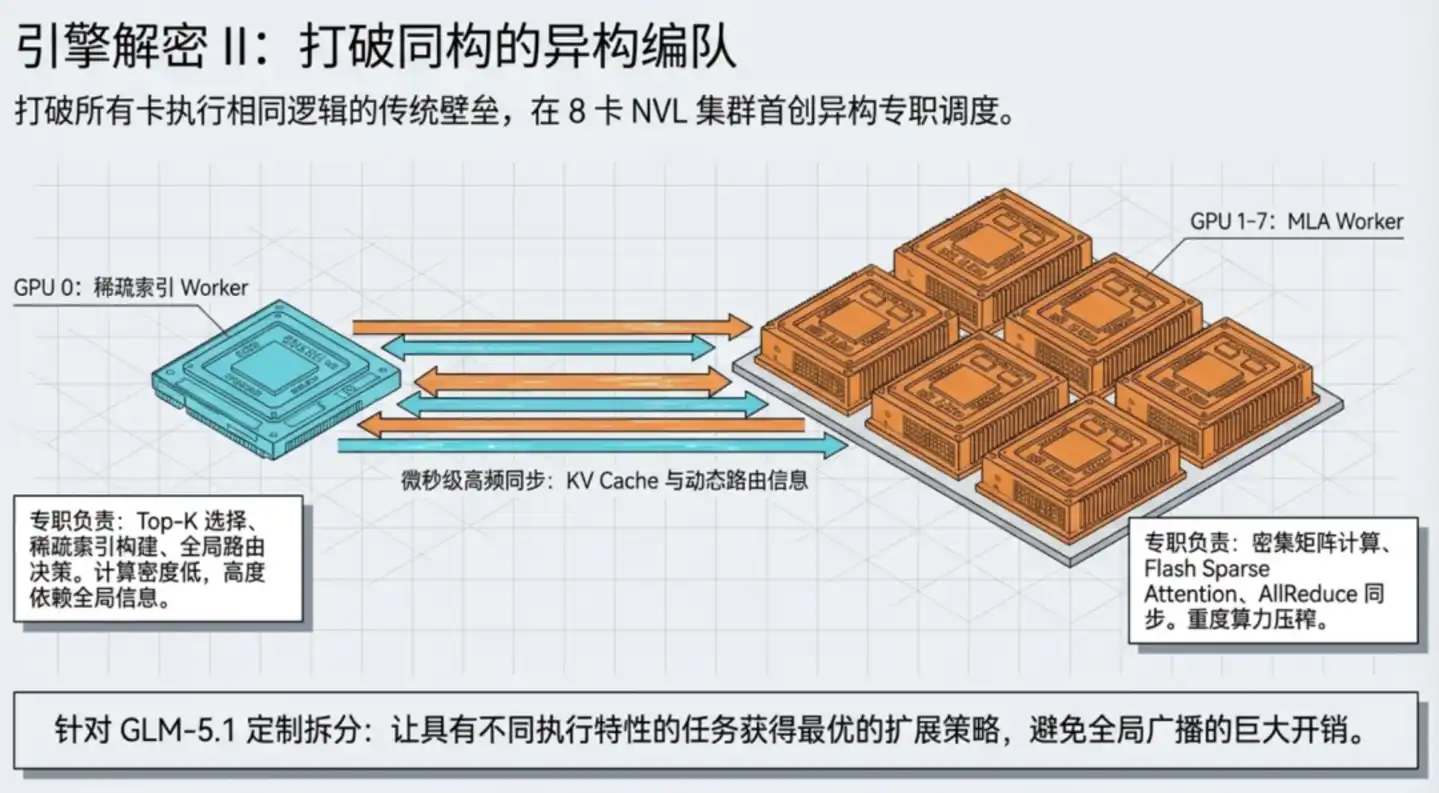
Next, TileRT embeds inter-GPU communication operations directly into the execution pipeline, no longer treating them as separate steps. Externally, the entire 8-GPU system completing one layer of attention computation requires only one kernel launch; internal communication and computation are all seamlessly completed within the continuous pipeline.

The above two layers address problems within a single server. When scaling clusters to hundreds or thousands of GPUs, data transmission between GPUs itself becomes the new bottleneck.

The industry standard approach is ROFT (Rail-Optimized Fat-Tree), NVIDIA's officially recommended solution and the absolute industry standard.

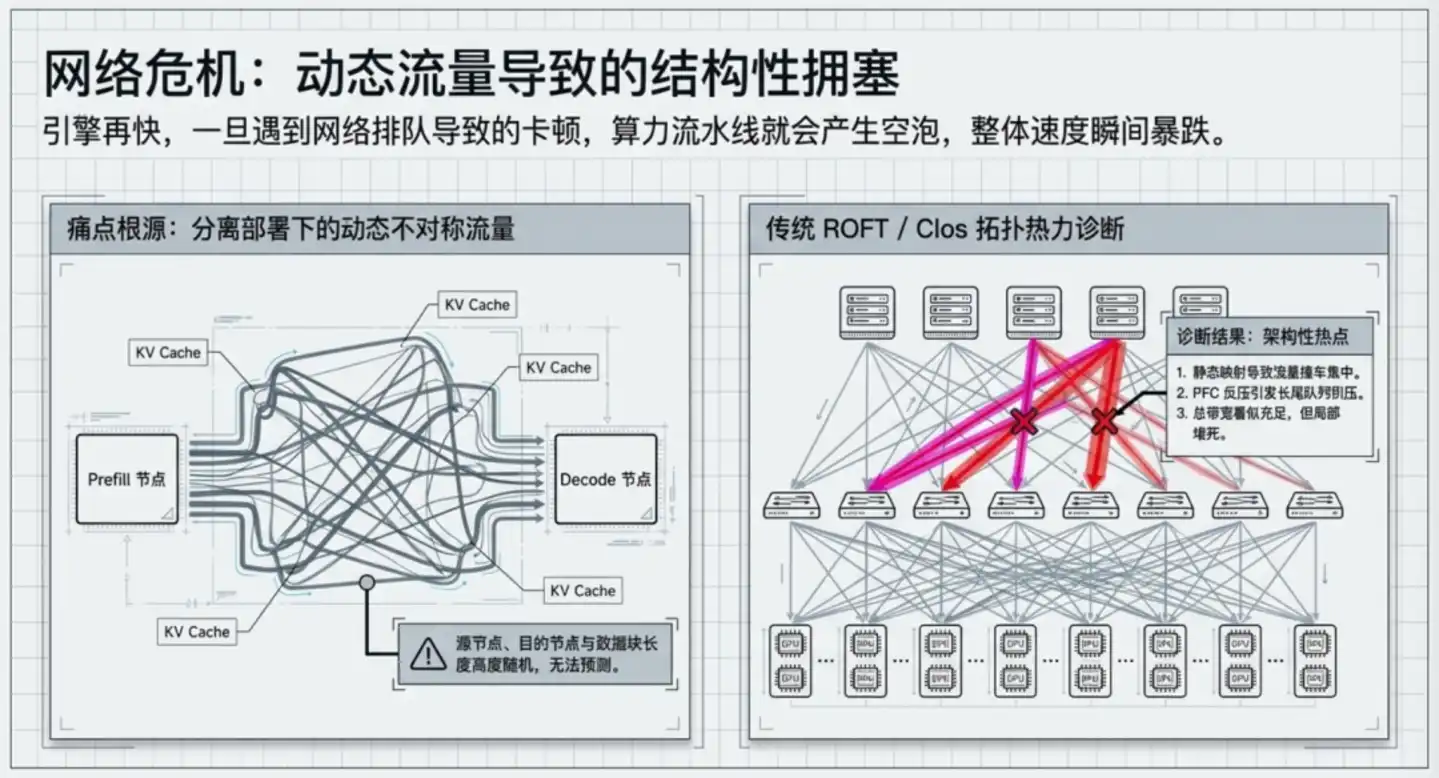
Its structure is like a tree: servers connect first to underlying Leaf switches (access layer, directly facing servers). Leaf switches then connect upward to Spine switches (backbone layer, responsible for interconnecting different Leafs, like highway hubs). Data transmission between two GPUs must "go up to a Spine, then down to the target Leaf," traversing at least 3 hops.

To prevent traffic from concentrating on a few links, this architecture relies on the ECMP algorithm to distribute data across multiple paths, functioning well under the premise of "statistically uniform" internet traffic.

But inference traffic is completely non-uniform. Context lengths between different requests can vary by tens of times, and the direction of KV Cache transmission between GPUs is almost random. A few Leaf switches periodically become hotspots, triggering backpressure mechanisms that spread congestion from local to the entire link. This congestion cannot be solved by protocol parameter tuning; it's inherent to the topology structure.
ZCube's fundamental breakthrough: Architecturally preventing this type of congestion from physically occurring.

The core design consists of two steps:

First, eliminate the Spine backbone layer, flatten the entire network. Divide all Leaf switches into two groups based on odd/even numbering, with the two groups fully interconnected. Any odd-numbered switch connects to all even-numbered switches, and vice versa. Any two GPUs can reach each other via at most two switches, reducing hops from 3 to 2.
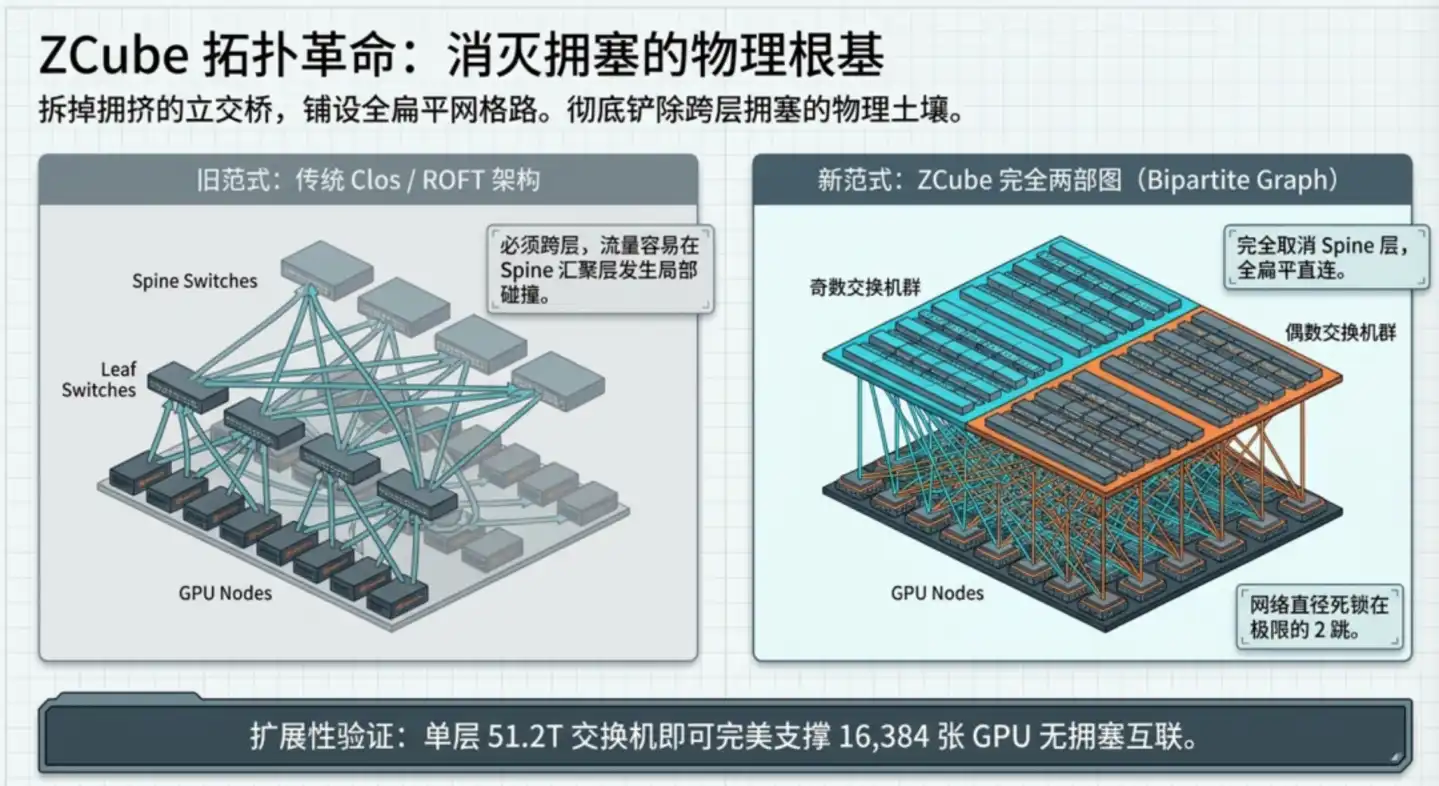
The second step, and the most ingenious part: Connect each GPU network card to the two groups of switches in two completely different ways. This special topology yields a key mathematical property: Between any two GPUs in the entire network, there is one and only one optimal path.
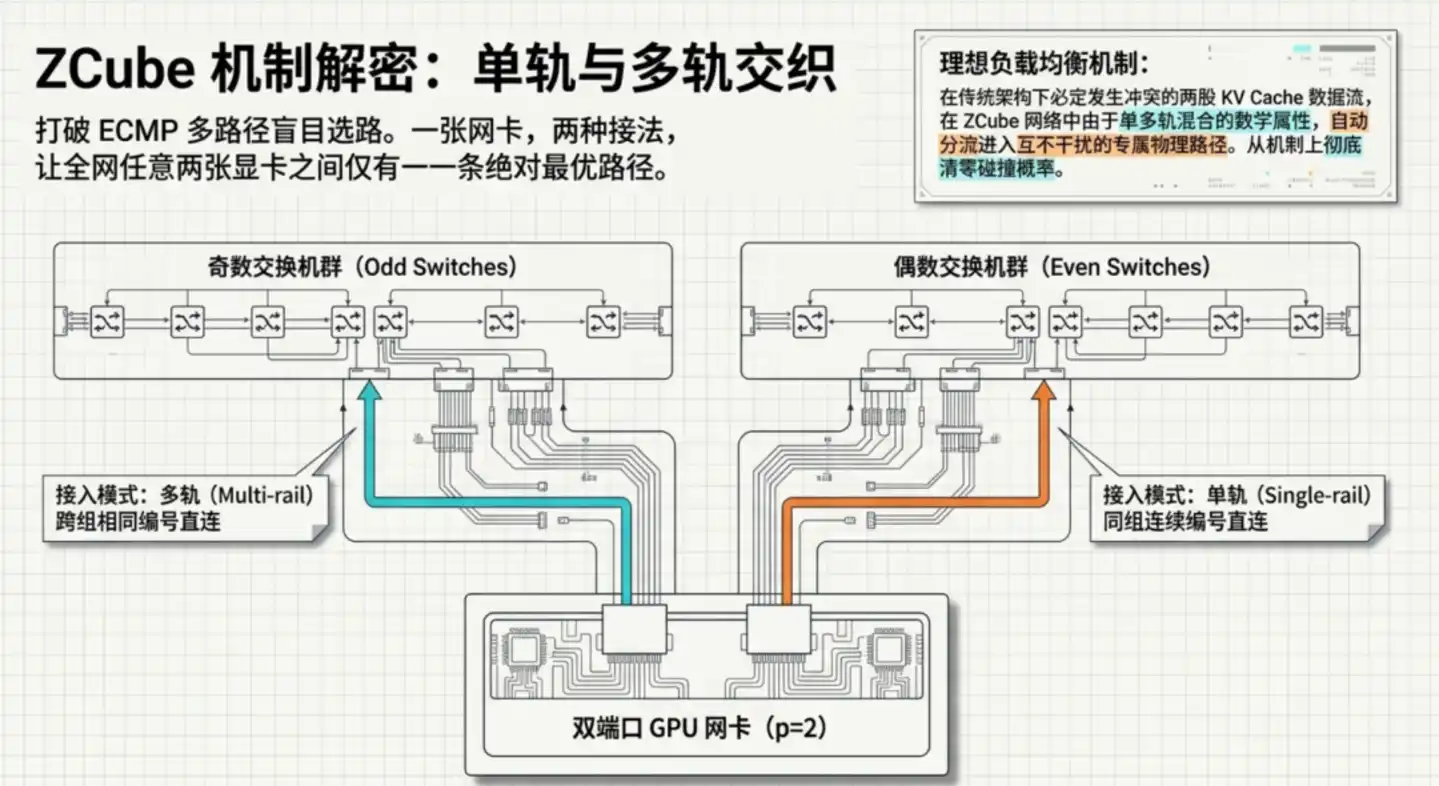
The "single path" directly eliminates the root cause of congestion. Traditional architectures are prone to hotspots precisely because there are multiple paths to choose from; if the load-balancing algorithm makes a wrong choice, traffic concentrates. ZCube eliminates "choice" itself by design: no balancing is needed because there are no forks.

04 Under the Same Hardware Conditions, How Does the Math Work?

After upgrading the GLM-5.1 production cluster from traditional ROFT to ZCube, Zhipu obtained three key numbers:

In summary, with the same GPU investment, the cluster can serve more users; with the same user experience requirements, the cluster can purchase one-third fewer network devices. Efficiency and cost are improved in both directions.
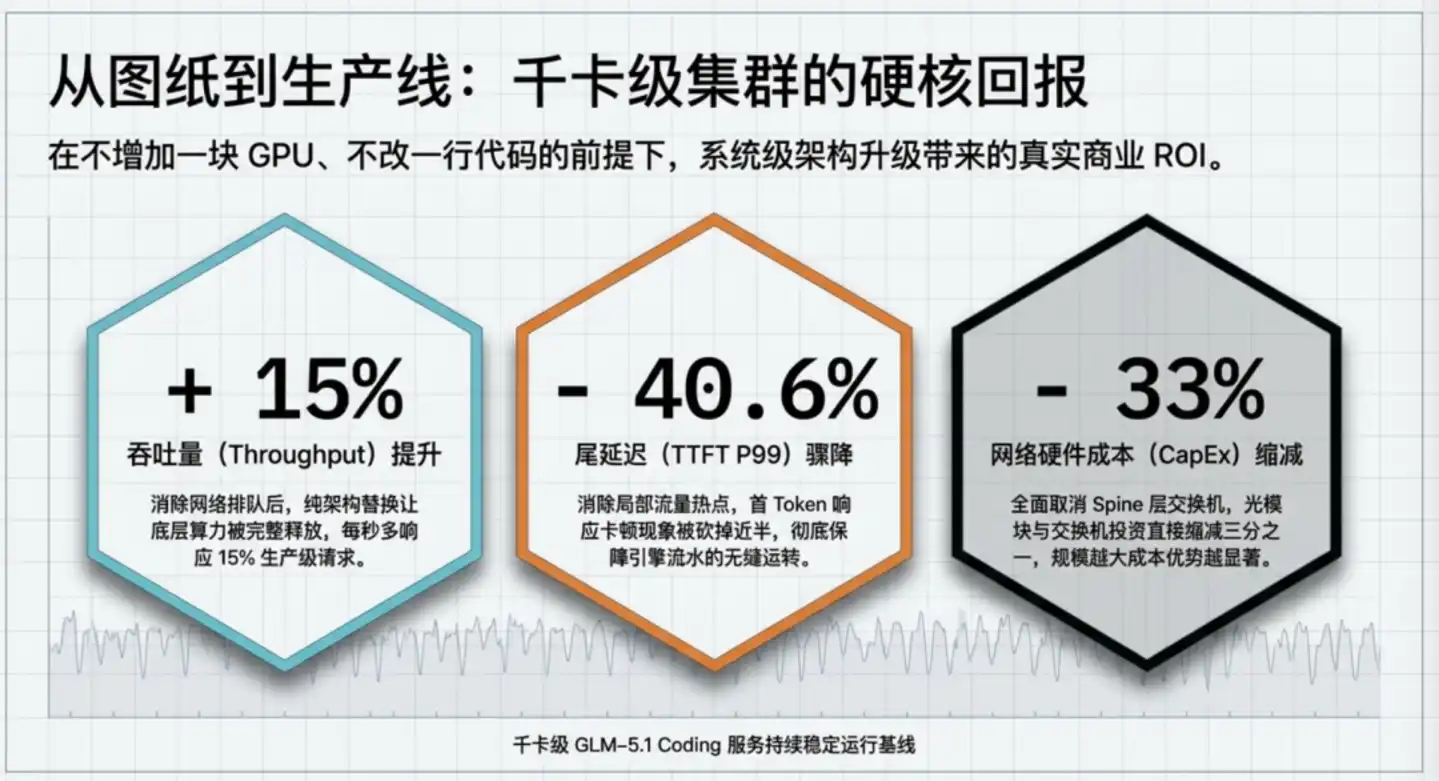
Specifically, throughput increased by 15%, equivalent to gaining 15% more computing power for free. With the same number of GPUs, a 15% higher throughput is equivalent to approximately a 13% reduction in the amortized hardware cost per token, or the ability to serve 15% more users at the same cost.

If a cluster has 1000 GPUs, this upgrade is equivalent to gaining the productive capacity of 150 additional cards for free. Based on current high-end inference GPU market prices, this represents computing power value in the billions of yuan.

A 40.6% reduction in tail latency addresses stability, not average speed. For an Agent task requiring 50 calls, if tail latency is reduced by 1 second per call, the worst-case completion time for the entire task is compressed by nearly 1 minute.

A one-third cost reduction is a direct saving at the construction level. ZCube eliminates the Spine layer, directly reducing the number of switches and optical modules required for the same cluster scale by one-third. According to Zhipu's calculations, in a ten-thousand-GPU scale cluster, this alone could save approximately 210 million to 640 million yuan.

In the long term, as cluster sizes expand exponentially, the complexity of inter-GPU communication grows manifold, and the probability and impact of congestion amplify accordingly. This means the value of architectural innovations like ZCube will accelerate as inference clusters continue to expand. The gains for tomorrow's ten-thousand-GPU clusters may far exceed today's 15%.

05 Final Thoughts

After reading Zhipu's technical report, I wondered: Could this bring a storm to the industry, much like DeepSeek's sudden emergence?

Upon careful consideration, their impacts seem to lie in different aspects. When DeepSeek emerged, it proved that the same level of intelligence could be achieved with far less computing power. The market worried that "fewer GPUs would be needed," causing NVIDIA's market cap to evaporate nearly $600 billion that day.

But Zhipu's technology today proves: The same computing power can produce more output. It is reshaping "what other infrastructure outside of GPUs should look like."

In the short term, NVIDIA may not be affected. But in the long run, the moat of GPU + NVLink interconnect + InfiniBand network + CUDA software ecosystem is being "loosened," especially the InfiniBand technology NVIDIA acquired with its $6.9 billion purchase of Mellanox in 2019. NVIDIA's premium on the network side will be significantly eroded.

Furthermore, while ZCube eliminates the Spine layer, it actually imposes higher requirements on the port density of Leaf switches. This benefits manufacturers capable of producing high-density, large-port Leaf switches (like Ruijie, Arista, Broadcom switching chips) and disadvantages those who primarily rely on high-end Spine layer switches for premium pricing.

In 2025, Celestica and NVIDIA together held about 50% of the AI backend network switch market share. This landscape faces a potential reshuffle if the ZCube paradigm proliferates.

Optical modules are the most directly beneficial segment in this industry chain change, with a very clear logic. For domestic optical module manufacturers (like Zhongji Innolight, Tianfu Communications, etc.), this is a structural positive: not only is the total volume growing, but the demand for high-speed optical modules (800G, 1.6T) under the ZCube paradigm is more concentrated and urgent compared to traditional architectures.

Whether it's TileRT or the ZCube architecture, this is a set of pure software inference engines running on standard GPUs, not reliant on NVIDIA's proprietary hardware features. In theory, they can be ported to domestic chips like Huawei's Ascend. Once this direction is viable, it will significantly lower the software stack barrier for domestic AI chips in inference scenarios.

This is perhaps the even greater significance behind this technological innovation.

Preguntas relacionadas

QWhat specific technical indicator triggered the surge in Zhipu AI's stock price?

AThe specific technical indicator that triggered the stock surge was the public availability of the GLM-5.1-highspeed API with an output speed of 400 tokens per second (tokens/s).

QWhy is the speed of 400 tokens/s considered a significant breakthrough according to the article?

AThe speed of 400 tokens/s is significant because it achieves extreme low latency while preserving the flagship-level full-scale base model capabilities, which is a first both domestically and internationally. This speed is crucial for AI Agent workflows involving many self-calls, where cumulative latency reduction directly impacts performance and user experience.

QWhat are the key technical innovations behind the GLM-5.1-highspeed performance, as mentioned in the text?

AThe key technical innovations are a three-layer optimization: 1) The TileRT inference engine, which compiles the model into a continuously running pipeline and uses Warp specialization for GPU efficiency. 2) Heterogeneous GPU parallelism strategies optimized for MLA's sparse indexing patterns. 3) The ZCube network architecture, which eliminates the Spine layer and creates a flat topology with unique optimal paths between GPUs to prevent congestion.

QWhat were the three key performance improvements Zhipu observed after upgrading to the ZCube architecture?

AAfter upgrading to the ZCube architecture, Zhipu observed three key improvements: 1) Throughput increased by 15%. 2) Tail latency decreased by 40.6%. 3) Infrastructure costs (for switches and optical modules) were reduced by approximately one-third.

QHow does the article differentiate the market impact of DeepSeek's arrival from that of Zhipu's current speed breakthrough?

AThe article differentiates the impacts as follows: DeepSeek demonstrated that the same level of AI intelligence could be achieved with significantly less computational power (fewer GPUs), which threatened the demand for Nvidia's hardware. In contrast, Zhipu's breakthrough demonstrates that the same amount of computational power (GPUs) can now produce more output, fundamentally redefining the infrastructure around the GPUs (like networks and switches) and potentially eroding the premium of Nvidia's integrated ecosystem, particularly in networking.

Lecturas Relacionadas

Three Years Later: Looking Back at My Predictions About ChatGPT in 2023

Three Years Later: Revisiting My 2023 Predictions on ChatGPT In March 2023, shortly after ChatGPT's launch, I made 20 predictions about its future. Now, in mid-2026, I've used AI agents to fact-check each one against the latest data. Overall, most major directional forecasts were correct, with only one outright error (incorrectly stating GPT-4 had 100 trillion parameters). Key successes included predicting that RAG and retrieval architectures would become the standard for handling knowledge and hallucinations, that natural language interfaces (LUI) would create a massive new industry layer beyond the models themselves, and that China would develop viable large language models, significantly closing the performance gap with Western counterparts within about three years. Predictions about the absence of mass unemployment, the rise of a new "robot network" for agent communication, and ChatGPT not possessing consciousness also held true in their core arguments. However, the "devil was in the details." Errors frequently involved specific numbers, timelines, or overlooking distributional effects. I tended to overestimate the speed of adoption (e.g., for agent networks) while underestimating the ultimate scale of capabilities or costs (e.g., AI winning IMO gold without tools, or the extreme capital required for frontier models). Other misjudgments included: underestimating how AI would reinforce, not dissolve, information filter bubbles; incorrectly assuming AI-generated content would easily circumvent copyright (it has instead triggered record-breaking settlements); and misidentifying where value would be captured (it accrued overwhelmingly to the compute layer, like Nvidia, not just the application or model layers). Key lessons from reviewing these predictions are: 1) Directional and mechanistic insights are far more reliable than precise numbers or absolute statements. 2) There's a consistent bias to overestimate short-term speed but underestimate long-term magnitude. 3) Errors often lie in missing distributional impacts within a generally correct aggregate trend. 4) Predictions phrased with nuance and caveats aged the best. 5) Some fundamental debates (e.g., on machine consciousness or the ultimate value chain) remain unresolved even after three years. This exercise is less about scoring the past and more about establishing rules for clearer thinking about the next three years of AI.

marsbitHace 3 hora(s)

Three Years Later: Looking Back at My Predictions About ChatGPT in 2023

marsbitHace 3 hora(s)

Three Years Later: Looking Back on My 2023 Predictions for ChatGPT

Looking Back After Three Years: Revisiting My 2023 Predictions on ChatGPT In March 2023, shortly after ChatGPT's debut and before GPT-4's release, I made over twenty predictions about AI's future based on limited information and intuition. Now, in May 2026, I revisited those forecasts using an AI-driven analysis with 41 Opus 4.8 agents to cross-reference them with the latest data. The assessment used symbols: ✅ Correct, 🟢 Mostly Correct, 🟡 Partially Correct, ❌ Incorrect. Overall, the directional judgments held up well, with only one major factual error regarding GPT-4's rumored parameter size (incorrectly cited as 100T). However, nuances and degrees of accuracy revealed more. **What Was Largely Correct:** Predictions about mechanisms and directions proved accurate. The rise of RAG (Retrieval-Augmented Generation) as the standard architecture for combating AI hallucination was confirmed, as was the transformative potential of LUI (Language User Interface) in creating a new industry layer atop GUIs. The emergence of "robot networks" (agent-to-agent communication protocols) and China's rapid catch-up in developing capable large models (closing the performance gap with top models to ~2.7%) were also on point. The analysis affirmed that LLMs lack consciousness and that the Turing Test merely measures perceived intelligence. **What Was Off Target:** Errors often involved specific numbers, over-optimistic timelines, or misjudged distributions. The prediction that value would primarily accrue to the application layer was half-right but missed NVIDIA's dominance as the profitable infrastructure layer. Forecasts about AI circumventing copyright issues and fostering a "global common ground" by averaging human viewpoints were incorrect; instead, major copyright settlements occurred and AI personalization is increasing. Estimates for model training costs ("$5-10 billion cap") were significantly off, underestimating frontier costs and overestimating replication costs. The notion that LLMs could never do complex math without tools was disproven by later models winning IMO gold. **Key Patterns from the Review:** 1. **Direction over precision:** Judgments about mechanisms and trends were more reliable than specific numbers or definitive statements. 2. **Timing bias:** There was a tendency to overestimate short-term speed but underestimate long-term magnitude and transformation. 3. **The distribution blind spot:** Aggregate-level correctness often masked uneven impacts (e.g., on young professionals' employment). 4. **The value of qualifiers:** Predictions framed with caution (e.g., "reportedly," "for now," "prototype in 2-3 years") aged better. 5. **Some debates continue:** Issues like the nature of "emergent abilities" or machine consciousness remain unresolved. This three-year review highlights that while seeing the big picture is crucial, humility regarding specifics, timelines, and disparate impacts is essential for future forecasting.

链捕手Hace 5 hora(s)

Three Years Later: Looking Back on My 2023 Predictions for ChatGPT

链捕手Hace 5 hora(s)

AI Bubble Warning: AI Investments Are Negative Returns for Most Tech Giants

The article issues a stark warning about a potential AI investment bubble. It notes that while the AI boom shares similarities with the TMT bubble of the late 1990s, its scale is vastly larger, currently driving 93% of U.S. GDP growth. Major hyperscale cloud providers like Microsoft, Alphabet, Amazon, Meta, and Oracle are planning to invest trillions in AI data centers over the coming years. However, calculations based on analyst projections for 2025-2030 reveal a concerning math problem: expected capital expenditure growth far outpaces projected revenue growth. Even under an extremely optimistic scenario of zero costs, the implied return on investment for most of these tech giants (except Amazon) is deeply negative. This suggests that the current trajectory could lead to one of history's largest shareholder value destruction events. The piece outlines two potential escapes: AI generating vastly more revenue than currently anticipated—a near-impossible task—or a significant cutback in the planned investment splurge. The latter scenario could trigger a domino effect, severely impacting the entire tech supply chain (from Nvidia to TSMC), potentially pushing the U.S. economy into recession, and causing a major stock market downturn. The author suggests upcoming high-profile IPOs by companies like OpenAI and Anthropic might represent a transfer of risk from early investors to public market participants. While the peak of the hype cycle might sustain investment through 2026, the fundamental financial dilemma remains unresolved, setting the stage for a potential market correction in 2027 or 2028, similar to the years following Alan Greenspan's "irrational exuberance" warning.

marsbitHace 6 hora(s)

AI Bubble Warning: AI Investments Are Negative Returns for Most Tech Giants

marsbitHace 6 hora(s)

From Tokens to Machine Labor: AI is Shifting from Tool to "Worker"

The article "From Token to Machine Labor: AI is Evolving from Tool to 'Worker'" argues that the business model for AI is shifting beyond simply selling computational resources (tokens, GPU hours) or model access. Instead, a new "machine labor market" is emerging, where the core economic transaction is the purchase of economically useful work directly performed by software. The central thesis is that AI pricing will evolve through four stages: 1) raw tokens, 2) standardized LLM capabilities (e.g., text generation), 3) industry-specific labor markets (e.g., legal review, radiology), and finally 4) a programmable results market where tasks like resolving a support ticket are bid on and priced based on outcome. In this future, buyers will care less about *which* model or GPU completes a task and more about whether the work meets specified standards for accuracy, latency, and cost. This transition reframes the impact of AI on human labor. Rather than simple replacement, it suggests a re-coordination where machines handle standardized, verifiable work, freeing humans for roles involving oversight, context management, responsibility, and final judgment. In some cases, this "last 1%" of human input becomes more valuable as it enables the other 99% to be automated. Furthermore, as AI reduces the cost of work, demand may expand, creating larger markets (e.g., 24/7 customer service) rather than just cheaper versions of existing ones. The article concludes that while infrastructure (GPUs, models, tokens) remains crucial upstream, the market is converging on a simpler, tradeable unit: machine labor that can be defined, measured, priced, and procured based on contractible specifications.

marsbitHace 6 hora(s)

From Tokens to Machine Labor: AI is Shifting from Tool to "Worker"

marsbitHace 6 hora(s)

Xiaomi MiMo's 99% Price Cut is Not Marketing! Luo Fuli Posts on X to Refute Critics

The price of Xiaomi's MiMo-V2.5 series API has been permanently reduced by up to 99%, specifically for the "Input (Cache Hit)" cost, which covers users re-reading historical context in long conversations. MiMo's head, Luo Fuli, published a detailed technical blog to clarify that this drastic price cut stems from genuine engineering breakthroughs, not a marketing stunt or a simple price war. The core of the achievement lies in six key engineering optimizations. First, the model architecture adopts a Hybrid Sliding Window Attention (SWA), reducing the memory footprint (KVCache) to 1/7th of a traditional model. Second, a dual-pool memory management system actually utilizes these savings, allowing a single GPU to handle over 5 times more concurrent users. Third, an upgraded prefix caching mechanism achieves a cache hit rate of 93-95% for repeated reads, meaning most such requests bypass GPU computation entirely. Fourth, a self-developed distributed cache (GCache) utilizes idle SSD space on existing GPU servers, eliminating additional storage costs. Fifth, an intelligent scheduling system (LLM-Router) efficiently routes requests to maximize cache reuse and performance. Sixth, Multi-Token Prediction (MTP) accelerates the model's text generation ("output") side. Together, these systemic optimizations dramatically lower the real computational cost per request, enabling the 99% price reduction for cached inputs while reportedly maintaining positive gross margins. Luo Fuli's disclosure aims to shift the narrative from "price war" to a demonstration of substantive AI engineering progress.

marsbitHace 8 hora(s)

Xiaomi MiMo's 99% Price Cut is Not Marketing! Luo Fuli Posts on X to Refute Critics

marsbitHace 8 hora(s)

Trading

Spot
Futuros

Artículos destacados

Qué es $S$

Entendiendo SPERO: Una Visión General Completa Introducción a SPERO A medida que el panorama de la innovación continúa evolucionando, la aparición de tecnologías web3 y proyectos de criptomonedas juega un papel fundamental en la configuración del futuro digital. Un proyecto que ha atraído la atención en este campo dinámico es SPERO, denotado como SPERO,$$s$. Este artículo tiene como objetivo reunir y presentar información detallada sobre SPERO, para ayudar a entusiastas e inversores a comprender sus fundamentos, objetivos e innovaciones dentro de los dominios web3 y cripto. ¿Qué es SPERO,$$s$? SPERO,$$s$ es un proyecto único dentro del espacio cripto que busca aprovechar los principios de descentralización y tecnología blockchain para crear un ecosistema que promueva la participación, la utilidad y la inclusión financiera. El proyecto está diseñado para facilitar interacciones de igual a igual de nuevas maneras, proporcionando a los usuarios soluciones y servicios financieros innovadores. En su esencia, SPERO,$$s$ tiene como objetivo empoderar a los individuos al proporcionar herramientas y plataformas que mejoren la experiencia del usuario en el espacio de las criptomonedas. Esto incluye habilitar métodos de transacción más flexibles, fomentar iniciativas impulsadas por la comunidad y crear caminos para oportunidades financieras a través de aplicaciones descentralizadas (dApps). La visión subyacente de SPERO,$$s$ gira en torno a la inclusividad, buscando cerrar brechas dentro de las finanzas tradicionales mientras aprovecha los beneficios de la tecnología blockchain. ¿Quién es el Creador de SPERO,$$s$? La identidad del creador de SPERO,$$s$ sigue siendo algo oscura, ya que hay recursos públicos limitados que proporcionan información de fondo detallada sobre su(s) fundador(es). Esta falta de transparencia puede derivarse del compromiso del proyecto con la descentralización, una ética que muchos proyectos web3 comparten, priorizando las contribuciones colectivas sobre el reconocimiento individual. Al centrar las discusiones en torno a la comunidad y sus objetivos colectivos, SPERO,$$s$ encarna la esencia del empoderamiento sin señalar a individuos específicos. Como tal, comprender la ética y la misión de SPERO sigue siendo más importante que identificar a un creador singular. ¿Quiénes son los Inversores de SPERO,$$s$? SPERO,$$s$ cuenta con el apoyo de una diversa gama de inversores que van desde capitalistas de riesgo hasta inversores ángeles dedicados a fomentar la innovación en el sector cripto. El enfoque de estos inversores generalmente se alinea con la misión de SPERO, priorizando proyectos que prometen avances tecnológicos sociales, inclusión financiera y gobernanza descentralizada. Estas fundaciones de inversores suelen estar interesadas en proyectos que no solo ofrecen productos innovadores, sino que también contribuyen positivamente a la comunidad blockchain y sus ecosistemas. El respaldo de estos inversores refuerza a SPERO,$$s$ como un contendiente notable en el dominio de proyectos cripto que evoluciona rápidamente. ¿Cómo Funciona SPERO,$$s$? SPERO,$$s$ emplea un marco multifacético que lo distingue de los proyectos de criptomonedas convencionales. Aquí hay algunas de las características clave que subrayan su singularidad e innovación: Gobernanza Descentralizada: SPERO,$$s$ integra modelos de gobernanza descentralizada, empoderando a los usuarios para participar activamente en los procesos de toma de decisiones sobre el futuro del proyecto. Este enfoque fomenta un sentido de propiedad y responsabilidad entre los miembros de la comunidad. Utilidad del Token: SPERO,$$s$ utiliza su propio token de criptomoneda, diseñado para servir diversas funciones dentro del ecosistema. Estos tokens permiten transacciones, recompensas y la facilitación de servicios ofrecidos en la plataforma, mejorando la participación y la utilidad general. Arquitectura en Capas: La arquitectura técnica de SPERO,$$s$ apoya la modularidad y escalabilidad, permitiendo la integración fluida de características y aplicaciones adicionales a medida que el proyecto evoluciona. Esta adaptabilidad es fundamental para mantener la relevancia en el cambiante paisaje cripto. Participación de la Comunidad: El proyecto enfatiza iniciativas impulsadas por la comunidad, empleando mecanismos que incentivan la colaboración y la retroalimentación. Al nutrir una comunidad sólida, SPERO,$$s$ puede abordar mejor las necesidades de los usuarios y adaptarse a las tendencias del mercado. Enfoque en la Inclusión: Al ofrecer tarifas de transacción bajas e interfaces amigables para el usuario, SPERO,$$s$ busca atraer a una base de usuarios diversa, incluyendo a individuos que anteriormente pueden no haber participado en el espacio cripto. Este compromiso con la inclusión se alinea con su misión general de empoderamiento a través de la accesibilidad. Cronología de SPERO,$$s$ Entender la historia de un proyecto proporciona información crucial sobre su trayectoria de desarrollo y hitos. A continuación se presenta una cronología sugerida que mapea eventos significativos en la evolución de SPERO,$$s$: Fase de Conceptualización e Ideación: Las ideas iniciales que forman la base de SPERO,$$s$ fueron concebidas, alineándose estrechamente con los principios de descentralización y enfoque comunitario dentro de la industria blockchain. Lanzamiento del Whitepaper del Proyecto: Tras la fase conceptual, se lanzó un whitepaper completo que detalla la visión, los objetivos y la infraestructura tecnológica de SPERO,$$s$ para generar interés y retroalimentación de la comunidad. Construcción de Comunidad y Primeras Interacciones: Se realizaron esfuerzos de divulgación activa para construir una comunidad de primeros adoptantes y posibles inversores, facilitando discusiones en torno a los objetivos del proyecto y obteniendo apoyo. Evento de Generación de Tokens: SPERO,$$s$ llevó a cabo un evento de generación de tokens (TGE) para distribuir sus tokens nativos a los primeros seguidores y establecer liquidez inicial dentro del ecosistema. Lanzamiento de la dApp Inicial: La primera aplicación descentralizada (dApp) asociada con SPERO,$$s$ se puso en marcha, permitiendo a los usuarios interactuar con las funcionalidades centrales de la plataforma. Desarrollo Continuo y Alianzas: Actualizaciones y mejoras continuas a las ofertas del proyecto, incluyendo alianzas estratégicas con otros actores en el espacio blockchain, han moldeado a SPERO,$$s$ en un jugador competitivo y en evolución en el mercado cripto. Conclusión SPERO,$$s$ se erige como un testimonio del potencial de web3 y las criptomonedas para revolucionar los sistemas financieros y empoderar a los individuos. Con un compromiso con la gobernanza descentralizada, la participación comunitaria y funcionalidades diseñadas de manera innovadora, allana el camino hacia un paisaje financiero más inclusivo. Como con cualquier inversión en el espacio cripto que evoluciona rápidamente, se anima a los posibles inversores y usuarios a investigar a fondo y participar de manera reflexiva con los desarrollos en curso dentro de SPERO,$$s$. El proyecto muestra el espíritu innovador de la industria cripto, invitando a una mayor exploración de sus innumerables posibilidades. Mientras el viaje de SPERO,$$s$ aún se desarrolla, sus principios fundamentales pueden, de hecho, influir en el futuro de cómo interactuamos con la tecnología, las finanzas y entre nosotros en ecosistemas digitales interconectados.

72 Vistas totalesPublicado en 2024.12.17Actualizado en 2024.12.17

Qué es $S$

Qué es AGENT S

Agent S: El Futuro de la Interacción Autónoma en Web3 Introducción En el paisaje en constante evolución de Web3 y las criptomonedas, las innovaciones están redefiniendo constantemente cómo los individuos interactúan con las plataformas digitales. Uno de estos proyectos pioneros, Agent S, promete revolucionar la interacción humano-computadora a través de su marco agente abierto. Al allanar el camino para interacciones autónomas, Agent S busca simplificar tareas complejas, ofreciendo aplicaciones transformadoras en inteligencia artificial (IA). Esta exploración detallada profundizará en las complejidades del proyecto, sus características únicas y las implicaciones para el dominio de las criptomonedas. ¿Qué es Agent S? Agent S se presenta como un marco agente abierto innovador, diseñado específicamente para abordar tres desafíos fundamentales en la automatización de tareas informáticas: Adquisición de Conocimiento Específico del Dominio: El marco aprende inteligentemente de diversas fuentes de conocimiento externas y experiencias internas. Este enfoque dual le permite construir un rico repositorio de conocimiento específico del dominio, mejorando su rendimiento en la ejecución de tareas. Planificación a Largo Plazo de Tareas: Agent S emplea planificación jerárquica aumentada por la experiencia, un enfoque estratégico que facilita la descomposición y ejecución eficiente de tareas complejas. Esta característica mejora significativamente su capacidad para gestionar múltiples subtareas de manera eficiente y efectiva. Manejo de Interfaces Dinámicas y No Uniformes: El proyecto introduce la Interfaz Agente-Computadora (ACI), una solución innovadora que mejora la interacción entre agentes y usuarios. Utilizando Modelos de Lenguaje Multimodal de Gran Escala (MLLMs), Agent S puede navegar y manipular diversas interfaces gráficas de usuario sin problemas. A través de estas características pioneras, Agent S proporciona un marco robusto que aborda las complejidades involucradas en la automatización de la interacción humana con las máquinas, preparando el terreno para una multitud de aplicaciones en IA y más allá. ¿Quién es el Creador de Agent S? Si bien el concepto de Agent S es fundamentalmente innovador, la información específica sobre su creador sigue siendo elusiva. El creador es actualmente desconocido, lo que resalta ya sea la etapa incipiente del proyecto o la elección estratégica de mantener a los miembros fundadores en el anonimato. Independientemente de la anonimidad, el enfoque sigue siendo en las capacidades y el potencial del marco. ¿Quiénes son los Inversores de Agent S? Dado que Agent S es relativamente nuevo en el ecosistema criptográfico, la información detallada sobre sus inversores y patrocinadores financieros no está documentada explícitamente. La falta de información disponible públicamente sobre las bases de inversión u organizaciones que apoyan el proyecto plantea preguntas sobre su estructura de financiamiento y hoja de ruta de desarrollo. Comprender el respaldo es crucial para evaluar la sostenibilidad del proyecto y su posible impacto en el mercado. ¿Cómo Funciona Agent S? En el núcleo de Agent S se encuentra una tecnología de vanguardia que le permite funcionar de manera efectiva en diversos entornos. Su modelo operativo se basa en varias características clave: Interacción Humano-Computadora Similar a la Humana: El marco ofrece planificación avanzada de IA, esforzándose por hacer que las interacciones con las computadoras sean más intuitivas. Al imitar el comportamiento humano en la ejecución de tareas, promete elevar las experiencias de los usuarios. Memoria Narrativa: Empleada para aprovechar experiencias de alto nivel, Agent S utiliza memoria narrativa para hacer un seguimiento de las historias de tareas, mejorando así sus procesos de toma de decisiones. Memoria Episódica: Esta característica proporciona a los usuarios una guía paso a paso, permitiendo que el marco ofrezca apoyo contextual a medida que se desarrollan las tareas. Soporte para OpenACI: Con la capacidad de ejecutarse localmente, Agent S permite a los usuarios mantener el control sobre sus interacciones y flujos de trabajo, alineándose con la ética descentralizada de Web3. Fácil Integración con APIs Externas: Su versatilidad y compatibilidad con varias plataformas de IA aseguran que Agent S pueda encajar sin problemas en ecosistemas tecnológicos existentes, convirtiéndolo en una opción atractiva para desarrolladores y organizaciones. Estas funcionalidades contribuyen colectivamente a la posición única de Agent S dentro del espacio cripto, ya que automatiza tareas complejas y de múltiples pasos con una intervención humana mínima. A medida que el proyecto evoluciona, sus posibles aplicaciones en Web3 podrían redefinir cómo se desarrollan las interacciones digitales. Cronología de Agent S El desarrollo y los hitos de Agent S pueden encapsularse en una cronología que resalta sus eventos significativos: 27 de septiembre de 2024: El concepto de Agent S fue lanzado en un documento de investigación integral titulado “Un Marco Agente Abierto que Usa Computadoras Como un Humano”, mostrando las bases del proyecto. 10 de octubre de 2024: El documento de investigación fue puesto a disposición del público en arXiv, ofreciendo una exploración profunda del marco y su evaluación de rendimiento basada en el benchmark OSWorld. 12 de octubre de 2024: Se lanzó una presentación en video, proporcionando una visión visual de las capacidades y características de Agent S, involucrando aún más a posibles usuarios e inversores. Estos marcadores en la cronología no solo ilustran el progreso de Agent S, sino que también indican su compromiso con la transparencia y la participación comunitaria. Puntos Clave Sobre Agent S A medida que el marco Agent S continúa evolucionando, varios atributos clave destacan, subrayando su naturaleza innovadora y potencial: Marco Innovador: Diseñado para proporcionar un uso intuitivo de las computadoras similar a la interacción humana, Agent S aporta un enfoque novedoso a la automatización de tareas. Interacción Autónoma: La capacidad de interactuar de manera autónoma con las computadoras a través de GUI significa un salto hacia soluciones informáticas más inteligentes y eficientes. Automatización de Tareas Complejas: Con su metodología robusta, puede automatizar tareas complejas y de múltiples pasos, haciendo que los procesos sean más rápidos y menos propensos a errores. Mejora Continua: Los mecanismos de aprendizaje permiten a Agent S mejorar a partir de experiencias pasadas, mejorando continuamente su rendimiento y eficacia. Versatilidad: Su adaptabilidad en diferentes entornos operativos como OSWorld y WindowsAgentArena asegura que pueda servir a una amplia gama de aplicaciones. A medida que Agent S se posiciona en el paisaje de Web3 y criptomonedas, su potencial para mejorar las capacidades de interacción y automatizar procesos significa un avance significativo en las tecnologías de IA. A través de su marco innovador, Agent S ejemplifica el futuro de las interacciones digitales, prometiendo una experiencia más fluida y eficiente para los usuarios en diversas industrias. Conclusión Agent S representa un audaz avance en la unión de la IA y Web3, con la capacidad de redefinir cómo interactuamos con la tecnología. Aunque aún se encuentra en sus primeras etapas, las posibilidades para su aplicación son vastas y atractivas. A través de su marco integral que aborda desafíos críticos, Agent S busca llevar las interacciones autónomas al primer plano de la experiencia digital. A medida que nos adentramos más en los reinos de las criptomonedas y la descentralización, proyectos como Agent S sin duda desempeñarán un papel crucial en la configuración del futuro de la tecnología y la colaboración humano-computadora.

466 Vistas totalesPublicado en 2025.01.14Actualizado en 2025.01.14

Qué es AGENT S

Cómo comprar S

¡Bienvenido a HTX.com! Hemos hecho que comprar Sonic (S) sea simple y conveniente. Sigue nuestra guía paso a paso para iniciar tu viaje de criptos.Paso 1: crea tu cuenta HTXUtiliza tu correo electrónico o número de teléfono para registrarte y obtener una cuenta gratuita en HTX. Experimenta un proceso de registro sin complicaciones y desbloquea todas las funciones.Obtener mi cuentaPaso 2: ve a Comprar cripto y elige tu método de pagoTarjeta de crédito/débito: usa tu Visa o Mastercard para comprar Sonic (S) al instante.Saldo: utiliza fondos del saldo de tu cuenta HTX para tradear sin problemas.Terceros: hemos agregado métodos de pago populares como Google Pay y Apple Pay para mejorar la comodidad.P2P: tradear directamente con otros usuarios en HTX.Over-the-Counter (OTC): ofrecemos servicios personalizados y tipos de cambio competitivos para los traders.Paso 3: guarda tu Sonic (S)Después de comprar tu Sonic (S), guárdalo en tu cuenta HTX. Alternativamente, puedes enviarlo a otro lugar mediante transferencia blockchain o utilizarlo para tradear otras criptomonedas.Paso 4: tradear Sonic (S)Tradear fácilmente con Sonic (S) en HTX's mercado spot. Simplemente accede a tu cuenta, selecciona tu par de trading, ejecuta tus trades y monitorea en tiempo real. Ofrecemos una experiencia fácil de usar tanto para principiantes como para traders experimentados.

877 Vistas totalesPublicado en 2025.01.15Actualizado en 2025.03.21

Cómo comprar S

Discusiones

Bienvenido a la comunidad de HTX. Aquí puedes mantenerte informado sobre los últimos desarrollos de la plataforma y acceder a análisis profesionales del mercado. A continuación se presentan las opiniones de los usuarios sobre el precio de S (S).

活动图片














