Why Did Market Sentiment Collapse Completely in 2025? Deciphering Messari's 100,000-Word Annual Report

marsbitPublicado a 2025-12-23Actualizado a 2025-12-23

Resumen

The 2025 crypto market experienced a historic collapse in sentiment, with the Crypto Fear & Greed Index hitting extreme fear levels of 10, despite the absence of systemic failures like exchange collapses or major bankruptcies. Messari's analysis attributes this not to industry failure, but to a deep structural shift: the market is transitioning from a speculative alpha-seeking environment to one dominated by institutional, long-term asset allocators. The core issue is a misalignment of participant identity. While institutions benefited from clear regulations, ETFs, and corporate treasury adoption (DATs), retail traders and active participants suffered from significantly reduced alpha, ineffective narrative cycles, and chronic underperformance of most assets against Bitcoin. The root cause of the emotional breakdown is identified as a crisis in the traditional global monetary system. With government debt consistently outpacing GDP growth worldwide, savers are systematically penalized through inflation, low real interest rates, and financial repression. Crypto, particularly Bitcoin, is not merely a tool for higher returns but offers a predictable, rules-based, and self-custodial monetary alternative. Bitcoin has decisively won the "monetary" competition. Its 429% price appreciation from 2022-2025 and dominant market share (57.3% of total crypto market cap) reflect its role as a non-sovereign store of value. Its "boring" reliability—lacking narratives or promises—is its great...

This article is based on the annual report "The Crypto Theses 2026" released by Messari in December 2025. The full report exceeds 100,000 words, with an official estimated reading time of 401 minutes. The information herein is for reference only and does not constitute any investment advice or offer. We are not responsible for the accuracy of the content, nor do we assume any consequences arising therefrom.

Introduction | The Worst Year for Sentiment, But Not the Most Fragile Year for the System

If we look only at sentiment indicators, the crypto market in 2025 could almost be pronounced "dead."
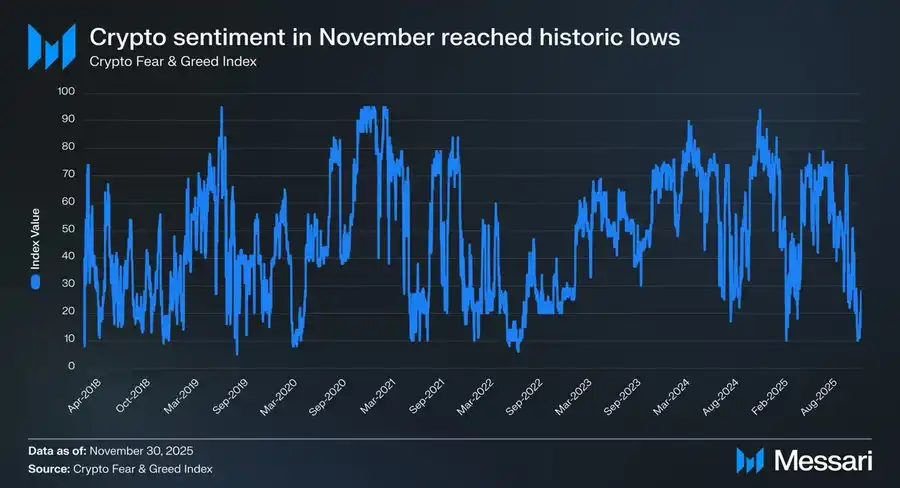
In November 2025, the Crypto Fear & Greed Index fell to 10, entering the "Extreme Fear" zone.

Historically, there have been very few moments when sentiment has fallen to this level:

· March 2020: Liquidity stampede triggered by the global pandemic

· May 2021: Chain reaction of leveraged liquidations

· May–June 2022: Systemic collapse of Luna and 3AC

· 2018–2019: Industry-wide bear market

These periods all share a commonality: the industry itself was failing, and the future was highly uncertain.

But 2025 does not fit this description. No major exchanges misappropriated user assets, no Ponzi projects with market caps of tens of billions of dollars dominated the narrative, the total market capitalization did not fall below the previous cycle's high, stablecoin scale instead hit a new all-time high, and regulatory and institutionalization processes continued to advance.

At the "fact level," this is not a year of industry collapse. However, at the "feeling level," it might be the most painful year for many practitioners, investors, and long-time users.

Why Did Sentiment Collapse?

Messari presents a highly impactful contrast at the beginning of the report:

If you were participating in crypto asset allocation from a Wall Street office building, 2025 might have been the best year since you entered the industry. But if you were staying up late watching charts and searching for Alpha in Telegram and Discord, this is probably the year you missed the "old days" the most.

The same market, two almost diametrically opposed experiences. This is not an accidental mood swing, nor a simple bull-bear switch, but a deeper structural misalignment: the market is changing participants, but most people are still participating in the new system with their old identities.

This Is Not a Market Recap

This article does not intend to discuss short-term price movements, nor does it attempt to answer "will it go up next?".

It is more like a structural explanation:

· Why, while institutions, capital, and infrastructure are continuously strengthening,

· did market sentiment slide to a historic low?

· Why do many people feel "they chose the wrong track," but the system itself has not failed?

In this 100,000-word report, Messari chooses to start from an extremely primitive question: If crypto assets are ultimately a form of "money," then who deserves to be treated as money?

Understanding this is a prerequisite for understanding the complete collapse of market sentiment in 2025.

Chapter 1 | Why Was Sentiment Abnormally Low?

If we look only at the outcome, the sentiment collapse of 2025 is almost "incomprehensible."

In the absence of exchange blow-ups, systemic credit collapses, or core narrative failures, the market nonetheless gave feedback接近 (close to) historical lows in sentiment.

Messari's judgment is very direct: This is an extreme case of "severe decoupling between sentiment and reality."

1. Sentiment Indicators Have Entered a "Historical Anomaly Zone"

The Crypto Fear & Greed Index falling to 10 is not an ordinary correction signal.

In the past decade, this value has only appeared at very few moments, and each time it appeared, it was accompanied by real and profound industry-level crises:

· Breakdown of the funding system

· Collapse of credit chains

· Market doubt about "whether the future exists"

But these problems did not appear in 2025.

No core infrastructure failed, no mainstream assets were liquidated to zero, and no systemic events occurred that could shake the industry's legitimacy. From a statistical perspective, this sentiment reading does not match any known historical template.

2. The Market Did Not Fail; "Personal Experience" Did

The collapse of sentiment did not come from the market itself, but from the subjective experience of the participants. Messari repeatedly emphasizes an overlooked fact in the report: 2025 was a year where the institutional experience was far better than the retail experience.

For institutions, this was an extremely clear, even comfortable environment:

· ETFs provided low-friction, low-risk allocation channels

· DATs (Digital Asset Treasuries) became stable, predictable long-term buyers

· Regulatory frameworks began to clarify, and compliance boundaries gradually became visible

But for a large number of participants under the old structure, this year was exceptionally brutal:

· Alpha significantly decreased

· Narrative rotation failed

· Most assets underperformed BTC for a long time

· The relationship between "degree of effort" and "results" was completely broken

The market did not reject people; it just changed the reward mechanism.

3. "Not Making Money" Was Misinterpreted as "The Industry Is Failing"

The real trigger for sentiment was not price decline, but cognitive dissonance. In past cycles, the implicit assumption of Crypto was: as long as you are diligent enough, early enough, and aggressive enough, you can obtain超额回报 (excess returns).

But 2025 was the first time this assumption was systematically broken.

· Most assets no longer gained premiums for "storytelling"

· L1 ecosystem growth no longer automatically translated into token returns

· High volatility no longer meant high returns

The result was that many participants began to have an illusion: If I didn't make money, then the entire industry must have a problem. Messari's conclusion is恰恰相反 (precisely the opposite): The industry is becoming more like a mature financial system, not a machine that continuously produces speculative红利 (dividends).

4. The Essence of the Sentiment Collapse Is Identity Misalignment

Synthesizing all phenomena, the implicit answer given by Messari is only one: The sentiment collapse of 2025 is essentially an identity misalignment.

· The market is tilting towards "asset allocators," "long-term holders," and "institutional participants"

· But a large number of participants still exist with the identity of "short-term Alpha seekers"

When the system's reward logic changes, and the participation method does not adjust同步 (synchronously), sentiment is必然 (bound to) collapse first. This is not a personal capability issue, but the friction cost of an era角色切换 (role shift).

Summary | Sentiment Did Not Tell You the Truth

The market sentiment of 2025 truly reflected the pain of the participants, but did not accurately reflect the state of the system.

· Sentiment collapse ≠ Industry failure

· Increased pain ≠ Value disappearance

It only提示 (indicated) one thing: the old way of participation is quickly becoming obsolete. Understanding this is a prerequisite for entering the next chapter.

Chapter 2 | The True Root of the Sentiment Collapse: The Monetary System Is Failing

If we stay only at the market structure level, the sentiment collapse of 2025 is still not fully explained. The real problem is not:

· Alpha decreased

· BTC is too strong

· Institutions entered

These are only superficial phenomena. The deeper judgment given by Messari in the report is: The collapse of market sentiment essentially stems from a long-ignored fact—the monetary system we are in is continuously putting pressure on savers.

A Chart That Must Be Faced: Global Government Debt Is Out of Control
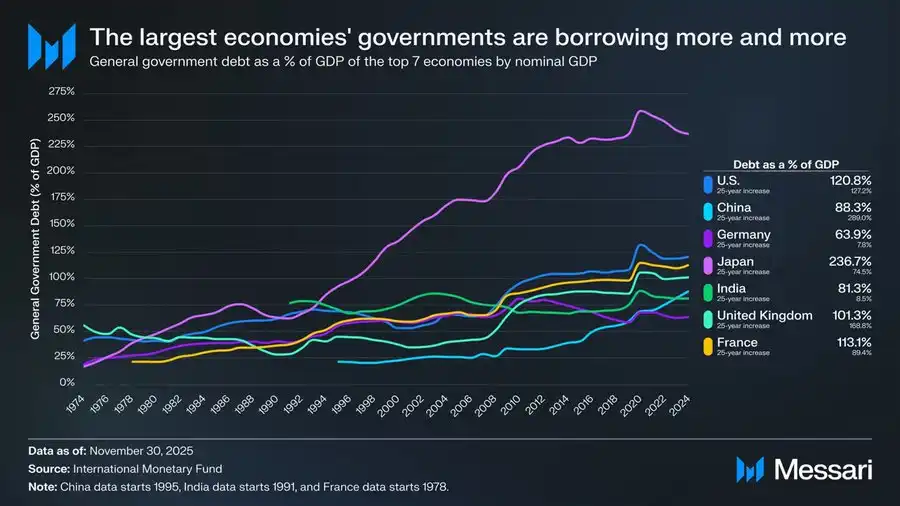
This chart is not a macro background decoration, but the logical starting point of the entire Cryptomoney argument.

Over the past 50 years, the ratio of government debt to GDP in major global economies has shown a highly consistent, almost irreversible upward trend:

· United States: 120.8%

· Japan: 236.7%

· France: 113.1%

· United Kingdom: 101.3%

· China: 88.3%

· India: 81.3%

· Germany: 63.9%

This is not the result of governance failure in a particular country, but a common outcome spanning systems, political structures, and development stages. Whether democratic countries, authoritarian states, developed economies, or emerging markets, government debt has long outpaced economic growth.

What This Chart Really Shows Is Not "High Debt," but "Savings Are Being Systematically Sacrificed"

When government debt growth长期 (long-term) outpaces economic output, the system can only maintain stability in three ways:

1. Inflation

2. Long-term low real interest rates

3. Financial repression (capital controls, withdrawal restrictions, regulatory intervention)

Regardless of which path is adopted, the ultimate cost will be borne by the same group: savers. Messari uses an extremely restrained but heavily weighted sentence in the report: When debt grows faster than economic output, the costs fall most heavily on savers. Translated: When debt outpaces growth, savings are注定 (destined) to be the sacrificed party.

Why Did Sentiment Collapse集中 (concentratedly) in 2025?

Because 2025 is the year when more and more participants clearly realized this for the first time.

Before this:

· "Inflation is only temporary"

· "Cash is always safe"

· "Fiat currency is stable in the long run"

And reality is constantly否定 (negating) these assumptions.

When people发现 (discover):

· Hard work ≠ Wealth preservation

· The act of saving itself is continuously shrinking

· The difficulty of asset allocation has significantly increased

The collapse of sentiment does not come from Crypto, but from a shaken confidence in the entire financial system. Crypto is just where this impact is felt first.

The Significance of Cryptomoney Is Not "Higher Returns"

This is also a point that Messari repeatedly emphasizes but is极易 (very easily) misinterpreted. Cryptomoney does not exist to promise higher returns.

Its core value lies in:

· Predictable rules

· Monetary policy not arbitrarily changed by a single institution

· Assets can be self-custodied

· Value can be transferred cross-border without permission

In other words, what it provides is not a "money-making tool," but: In a world of high debt and low certainty, it重新给予 (re-grants) individuals the right to choose their money.

The Sentiment Collapse Is Actually a Form of "Sobering Up"

When you place this debt chart alongside the 2025 market sentiment, you find a counterintuitive conclusion: The extreme pessimism of sentiment does not mean industry failure, but means more and more people are beginning to realize that the problems of the old system are real.

The problem with Crypto has never been "useless." The real problem is: It no longer produces easy excess returns for everyone.

Summary | From Sentiment, to Structure, to Money Itself

This chapter addresses a fundamental question: Why did market sentiment fall to a historic low in the absence of a systemic crash? The answer is not in the K-line charts, but in the monetary structure.

· Sentiment collapse is the表象 (surface phenomenon)

· Paradigm shift is the过程 (process)

· Monetary system imbalance is the根因 (root cause)

And this is precisely why Messari chose to start the entire report with "money" rather than "applications."

Chapter 3 | Why Only BTC Is Treated as "Real Money"

If you have read this far, you can easily have a question: If the problem lies in the monetary system, then why is the answer BTC, and not something else?

Messari's judgment in the report is exceptionally clear: BTC is no longer on the same competitive dimension as other Crypto assets.

1. Money Is Not a Technical Problem, but a Consensus Problem

This is the first key to understanding BTC. Messari repeatedly emphasizes a fact容易被工程师忽略 (easily overlooked by engineers) in the original text: Money is a social consensus, not a technical optimization problem. In other words:

· Money is not about "who is faster"

· Not "who is cheaper"

· Nor "who has more functions"

But rather who is长期稳定地 (long-term and stably) treated as a store of value. From this perspective, Bitcoin's victory is not mysterious.

2. Three Years of Data Have Written the Answer on Its Face
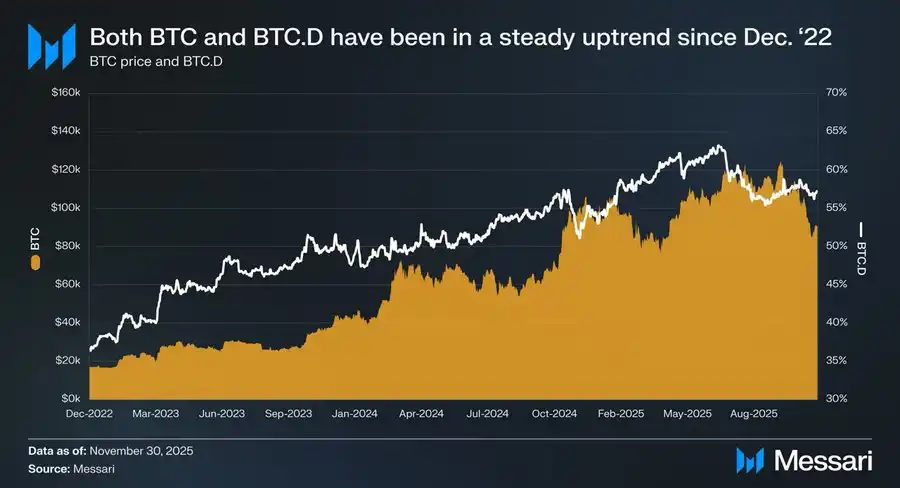
From December 1, 2022, to November 2025:

· BTC rose 429%

· Market cap from $318 billion → $1.81 trillion

· Global asset ranking entered the top ten

And more importantly, the relative performance: BTC.D (Bitcoin Dominance) from 36.6% → 57.3%. In a cycle where "theoretically, altcoins should soar," funds instead持续回流 (continuously flowed back) to BTC. This is not the偶然结果 (accidental result) of a market cycle; this is the market重新做资产分类 (re-categorizing assets).

3. ETFs and DATs Are Essentially "Institutionalizing Consensus"

Messari's evaluation of ETFs is very restrained, but the conclusion is extremely weighty. Bitcoin ETFs are not simply "new buying pressure"; what they truly change is: who is buying + why they are buying + how long they can hold

· ETFs turned BTC into a compliant asset

· DATs made BTC part of corporate balance sheets

· National reserves elevated BTC to the "strategic asset" level

When BTC is held by these actors, it is no longer: "a high-volatility risk asset that can be abandoned at any time" but rather: a monetary asset that must be held long-term and cannot afford to make mistakes. Money, once treated this way,很难再退回去 (is difficult to go back).

4. Why BTC, the More "Boring" It Is, the More It Resembles Money

This might be the most counterintuitive point of 2025:

· BTC has no applications

· No narrative rotation

· No ecosystem stories

· Not even "new things"

But precisely because of this, it meets all the characteristics of "money":

· Does not rely on future promises

· Does not need growth narratives

· Does not require teams to持续交付 (continuously deliver)

It only needs to not fail.

And in a world of high debt and low certainty, "not failing" is itself a scarce asset.

5. BTC's Strength Is Not a Market Failure

Many people's pain comes from an illusion: "BTC's strength means the market is not right." Messari's judgment is恰好相反 (precisely the opposite): BTC's strength is the market becoming more rational.

When the system begins to reward:

· Stability

· Predictability

· Long-term credibility

Then all strategies relying on "high volatility for high returns" will appear increasingly painful. This is not BTC's problem; this is a participation method problem.

Summary | BTC Didn't Win; It Was Chosen

BTC did not "defeat" other assets. It was just repeatedly verified by the market in an era of continuous monetary system failure as:

· The asset that needs the least explanation

· The asset that relies the least on trust

· The asset that needs the fewest promises about the future

This is not the result of a market cycle, but a kind of role confirmation.

Chapter 4 | When the Market Only Needs One Kind of "Money," the L1 Story Begins to Fail

After confirming that BTC has been selected by the market as the "primary Cryptomoney," one question cannot be avoided: If the answer for money already exists, then what is left for Layer 1? Messari does not directly give a conclusion, but after reading this section, a trend is very clear: L1 valuations are being forced to move from "future narratives" back to "real-world constraints."

1. A Harsh but True Fact: 81% of the Market Cap Is in the "Money" Narrative
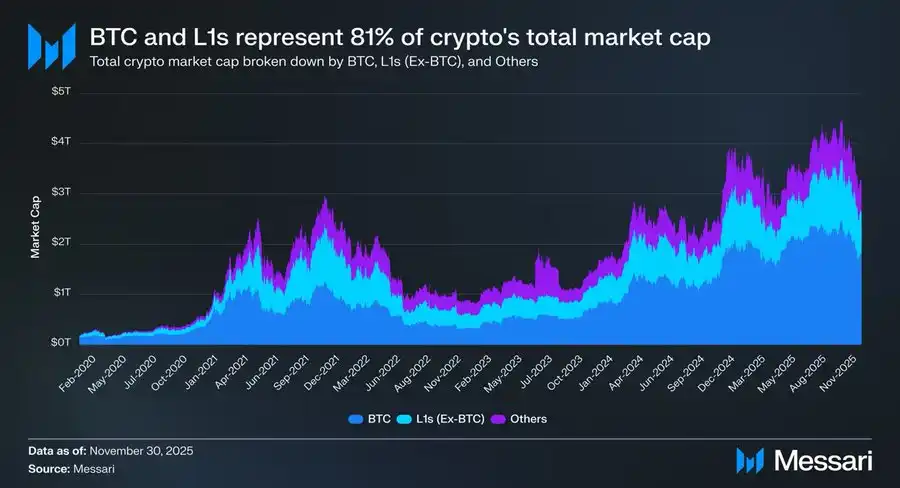
As of the end of 2025, the entire crypto market cap is approximately $3.26T:

· BTC: $1.80T

· Other L1s: approx. $0.83T

· Remaining assets: less than $0.63T

Combined: approximately 81% of the crypto asset market cap is being priced by the market as "money" or "potential money." What does this mean? It means that L1 valuations are早已不是 (long since not) priced on the logic of "application platforms," but on the logic of "does it qualify to be money?"

2. The Problem Is: Most L1s Do Not Qualify

The data provided by Messari is very direct and very冷酷 (cold).
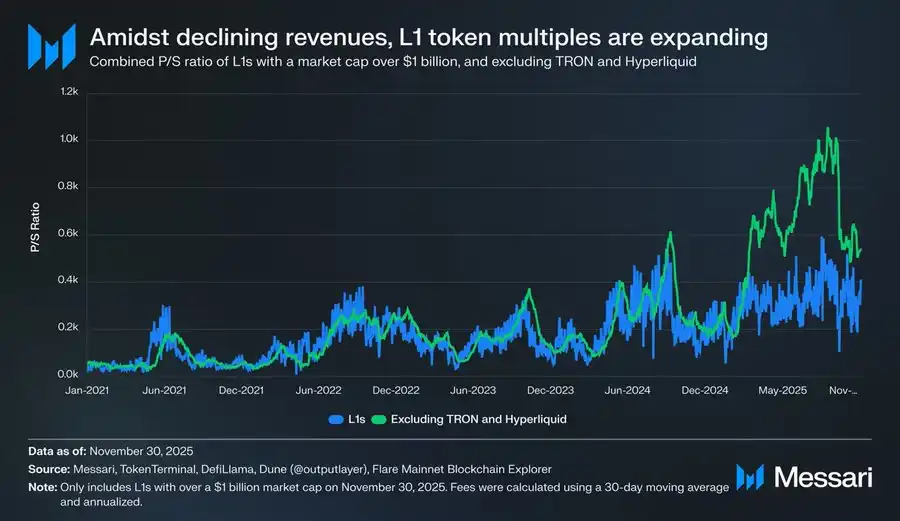
After剔除 (excluding) outliers with abnormally high revenue like TRON and Hyperliquid:

· The overall revenue of L1s continues to decline

· But valuation multiples are却在 (instead) continually rising

The adjusted P/S ratios are as follows:

· 2021: 40x

· 2022: 212x

· 2023: 137x

· 2024: 205x

· 2025: 536x

Meanwhile, total L1 revenue:

· 2021: $12.3B

· 2022: $4.9B

· 2023: $2.7B

· 2024: $3.6B

· 2025 (annualized): $1.7B

This is a剪刀差 (scissors gap) that cannot be reasonably explained by "future growth."

3. L1s Are Not "Undervalued"; They Are "Reclassified"

Many people's pain stems from a misunderstanding: "Are L1s being错杀 (wrongfully killed) by the market?". Messari's judgment is恰恰相反 (precisely the opposite): The market is not wrongfully killing L1s; it is reducing their "monetary imagination space."

If an asset:

· Cannot store value stably

· Cannot be held long-term

· And cannot provide certain cash flow

Then it ultimately only has one pricing method left: high beta risk asset.

4. The Example of Solana Actually Explains Everything

SOL was one of the few L1s that outperformed BTC in 2025. But Messari points out a highly damaging fact:

· SOL ecosystem data grew by 20–30 times

· The price only outperformed BTC by an additional 87%

In other words: to obtain "significant excess returns" relative to BTC, an L1 needs an生态爆发 (ecosystem explosion) of orders of magnitude. This is not "not trying hard enough," but the回报函数 (return function) has been rewritten.

5. When BTC Becomes "Money," the Burden on L1s Actually Becomes Heavier

This is a structural change that many people have not realized. Before BTC's monetary status was clear:

· L1s could tell the story of "becoming money in the future"

· The market was willing to pay提前付费 (prepay) for this possibility

Now:

· BTC has solidified its position

· The market is no longer willing to pay the same premium for a "second money"

Thus, L1s face a more difficult question: If not money, then what exactly are you?

Summary | The Problem of L1s Is Not Competition, but Positioning

L1s did not "lose to BTC." What they lost is:

· In the dimension of money

· The market no longer needs more answers

And once they lose the shelter of the "monetary narrative," all valuations must重新接受现实约束 (re-accept real-world constraints).

This is the direct source of the sentiment collapse for a large number of participants in 2025.

Preguntas relacionadas

QWhy did market sentiment in the crypto space collapse in 2025, according to the Messari report?

AThe collapse in market sentiment was not due to a systemic failure of the industry, but rather a structural shift where the market began rewarding stability, predictability, and long-term credibility (like BTC) over high-risk, high-reward strategies. This caused a severe cognitive and identity mismatch for participants still using old, speculative methods.

QWhat fundamental issue does the Messari report identify as the root cause of the 2025 sentiment crash?

AThe root cause is the ongoing failure of the global traditional monetary system, where government debt growth has consistently outpaced economic output for decades. This systemically sacrifices savers through inflation, low real interest rates, and financial repression, eroding confidence in traditional finance.

QHow does the report explain Bitcoin's (BTC) dominant performance and its role in the 2025 market?

ABTC is no longer competing on the same plane as other crypto assets. It has been selected by the market as 'money' due to its predictable rules, immutable monetary policy, self-custody, and permissionless value transfer. Its 'boring' and reliable nature makes it a scarce asset in a high-debt, low-certainty world, and it is now treated as a long-term hold by institutions, corporations (DATs), and even national reserves.

QWhat does the data show about the valuation of Layer 1 (L1) blockchains compared to their fundamentals in 2025?

AThe data shows a severe and growing disconnect. The aggregate Price-to-Sales (P/S) ratio for L1s skyrocketed to 536x in 2025, while their total annualized revenue plummeted to $1.7B. This indicates that their valuations were not based on current fundamentals or cash flow but on a narrative that has now been reclassified by the market.

QWhy did the strong performance of Bitcoin (BTC) cause pain for many investors and participants in 2025?

AThe pain was caused by a paradigm shift in the market's reward mechanism. Participants who were accustomed to earning alpha through aggressive speculation, narrative trading, and investing in altcoins found that these strategies failed. The market began systematically rewarding long-term holders and institutional asset allocators instead, making the 'old way' of participating ineffective and emotionally painful.

Lecturas Relacionadas

Trading

Spot
Futuros

Artículos destacados

Qué es $S$

Entendiendo SPERO: Una Visión General Completa Introducción a SPERO A medida que el panorama de la innovación continúa evolucionando, la aparición de tecnologías web3 y proyectos de criptomonedas juega un papel fundamental en la configuración del futuro digital. Un proyecto que ha atraído la atención en este campo dinámico es SPERO, denotado como SPERO,$$s$. Este artículo tiene como objetivo reunir y presentar información detallada sobre SPERO, para ayudar a entusiastas e inversores a comprender sus fundamentos, objetivos e innovaciones dentro de los dominios web3 y cripto. ¿Qué es SPERO,$$s$? SPERO,$$s$ es un proyecto único dentro del espacio cripto que busca aprovechar los principios de descentralización y tecnología blockchain para crear un ecosistema que promueva la participación, la utilidad y la inclusión financiera. El proyecto está diseñado para facilitar interacciones de igual a igual de nuevas maneras, proporcionando a los usuarios soluciones y servicios financieros innovadores. En su esencia, SPERO,$$s$ tiene como objetivo empoderar a los individuos al proporcionar herramientas y plataformas que mejoren la experiencia del usuario en el espacio de las criptomonedas. Esto incluye habilitar métodos de transacción más flexibles, fomentar iniciativas impulsadas por la comunidad y crear caminos para oportunidades financieras a través de aplicaciones descentralizadas (dApps). La visión subyacente de SPERO,$$s$ gira en torno a la inclusividad, buscando cerrar brechas dentro de las finanzas tradicionales mientras aprovecha los beneficios de la tecnología blockchain. ¿Quién es el Creador de SPERO,$$s$? La identidad del creador de SPERO,$$s$ sigue siendo algo oscura, ya que hay recursos públicos limitados que proporcionan información de fondo detallada sobre su(s) fundador(es). Esta falta de transparencia puede derivarse del compromiso del proyecto con la descentralización, una ética que muchos proyectos web3 comparten, priorizando las contribuciones colectivas sobre el reconocimiento individual. Al centrar las discusiones en torno a la comunidad y sus objetivos colectivos, SPERO,$$s$ encarna la esencia del empoderamiento sin señalar a individuos específicos. Como tal, comprender la ética y la misión de SPERO sigue siendo más importante que identificar a un creador singular. ¿Quiénes son los Inversores de SPERO,$$s$? SPERO,$$s$ cuenta con el apoyo de una diversa gama de inversores que van desde capitalistas de riesgo hasta inversores ángeles dedicados a fomentar la innovación en el sector cripto. El enfoque de estos inversores generalmente se alinea con la misión de SPERO, priorizando proyectos que prometen avances tecnológicos sociales, inclusión financiera y gobernanza descentralizada. Estas fundaciones de inversores suelen estar interesadas en proyectos que no solo ofrecen productos innovadores, sino que también contribuyen positivamente a la comunidad blockchain y sus ecosistemas. El respaldo de estos inversores refuerza a SPERO,$$s$ como un contendiente notable en el dominio de proyectos cripto que evoluciona rápidamente. ¿Cómo Funciona SPERO,$$s$? SPERO,$$s$ emplea un marco multifacético que lo distingue de los proyectos de criptomonedas convencionales. Aquí hay algunas de las características clave que subrayan su singularidad e innovación: Gobernanza Descentralizada: SPERO,$$s$ integra modelos de gobernanza descentralizada, empoderando a los usuarios para participar activamente en los procesos de toma de decisiones sobre el futuro del proyecto. Este enfoque fomenta un sentido de propiedad y responsabilidad entre los miembros de la comunidad. Utilidad del Token: SPERO,$$s$ utiliza su propio token de criptomoneda, diseñado para servir diversas funciones dentro del ecosistema. Estos tokens permiten transacciones, recompensas y la facilitación de servicios ofrecidos en la plataforma, mejorando la participación y la utilidad general. Arquitectura en Capas: La arquitectura técnica de SPERO,$$s$ apoya la modularidad y escalabilidad, permitiendo la integración fluida de características y aplicaciones adicionales a medida que el proyecto evoluciona. Esta adaptabilidad es fundamental para mantener la relevancia en el cambiante paisaje cripto. Participación de la Comunidad: El proyecto enfatiza iniciativas impulsadas por la comunidad, empleando mecanismos que incentivan la colaboración y la retroalimentación. Al nutrir una comunidad sólida, SPERO,$$s$ puede abordar mejor las necesidades de los usuarios y adaptarse a las tendencias del mercado. Enfoque en la Inclusión: Al ofrecer tarifas de transacción bajas e interfaces amigables para el usuario, SPERO,$$s$ busca atraer a una base de usuarios diversa, incluyendo a individuos que anteriormente pueden no haber participado en el espacio cripto. Este compromiso con la inclusión se alinea con su misión general de empoderamiento a través de la accesibilidad. Cronología de SPERO,$$s$ Entender la historia de un proyecto proporciona información crucial sobre su trayectoria de desarrollo y hitos. A continuación se presenta una cronología sugerida que mapea eventos significativos en la evolución de SPERO,$$s$: Fase de Conceptualización e Ideación: Las ideas iniciales que forman la base de SPERO,$$s$ fueron concebidas, alineándose estrechamente con los principios de descentralización y enfoque comunitario dentro de la industria blockchain. Lanzamiento del Whitepaper del Proyecto: Tras la fase conceptual, se lanzó un whitepaper completo que detalla la visión, los objetivos y la infraestructura tecnológica de SPERO,$$s$ para generar interés y retroalimentación de la comunidad. Construcción de Comunidad y Primeras Interacciones: Se realizaron esfuerzos de divulgación activa para construir una comunidad de primeros adoptantes y posibles inversores, facilitando discusiones en torno a los objetivos del proyecto y obteniendo apoyo. Evento de Generación de Tokens: SPERO,$$s$ llevó a cabo un evento de generación de tokens (TGE) para distribuir sus tokens nativos a los primeros seguidores y establecer liquidez inicial dentro del ecosistema. Lanzamiento de la dApp Inicial: La primera aplicación descentralizada (dApp) asociada con SPERO,$$s$ se puso en marcha, permitiendo a los usuarios interactuar con las funcionalidades centrales de la plataforma. Desarrollo Continuo y Alianzas: Actualizaciones y mejoras continuas a las ofertas del proyecto, incluyendo alianzas estratégicas con otros actores en el espacio blockchain, han moldeado a SPERO,$$s$ en un jugador competitivo y en evolución en el mercado cripto. Conclusión SPERO,$$s$ se erige como un testimonio del potencial de web3 y las criptomonedas para revolucionar los sistemas financieros y empoderar a los individuos. Con un compromiso con la gobernanza descentralizada, la participación comunitaria y funcionalidades diseñadas de manera innovadora, allana el camino hacia un paisaje financiero más inclusivo. Como con cualquier inversión en el espacio cripto que evoluciona rápidamente, se anima a los posibles inversores y usuarios a investigar a fondo y participar de manera reflexiva con los desarrollos en curso dentro de SPERO,$$s$. El proyecto muestra el espíritu innovador de la industria cripto, invitando a una mayor exploración de sus innumerables posibilidades. Mientras el viaje de SPERO,$$s$ aún se desarrolla, sus principios fundamentales pueden, de hecho, influir en el futuro de cómo interactuamos con la tecnología, las finanzas y entre nosotros en ecosistemas digitales interconectados.

72 Vistas totalesPublicado en 2024.12.17Actualizado en 2024.12.17

Qué es $S$

Qué es AGENT S

Agent S: El Futuro de la Interacción Autónoma en Web3 Introducción En el paisaje en constante evolución de Web3 y las criptomonedas, las innovaciones están redefiniendo constantemente cómo los individuos interactúan con las plataformas digitales. Uno de estos proyectos pioneros, Agent S, promete revolucionar la interacción humano-computadora a través de su marco agente abierto. Al allanar el camino para interacciones autónomas, Agent S busca simplificar tareas complejas, ofreciendo aplicaciones transformadoras en inteligencia artificial (IA). Esta exploración detallada profundizará en las complejidades del proyecto, sus características únicas y las implicaciones para el dominio de las criptomonedas. ¿Qué es Agent S? Agent S se presenta como un marco agente abierto innovador, diseñado específicamente para abordar tres desafíos fundamentales en la automatización de tareas informáticas: Adquisición de Conocimiento Específico del Dominio: El marco aprende inteligentemente de diversas fuentes de conocimiento externas y experiencias internas. Este enfoque dual le permite construir un rico repositorio de conocimiento específico del dominio, mejorando su rendimiento en la ejecución de tareas. Planificación a Largo Plazo de Tareas: Agent S emplea planificación jerárquica aumentada por la experiencia, un enfoque estratégico que facilita la descomposición y ejecución eficiente de tareas complejas. Esta característica mejora significativamente su capacidad para gestionar múltiples subtareas de manera eficiente y efectiva. Manejo de Interfaces Dinámicas y No Uniformes: El proyecto introduce la Interfaz Agente-Computadora (ACI), una solución innovadora que mejora la interacción entre agentes y usuarios. Utilizando Modelos de Lenguaje Multimodal de Gran Escala (MLLMs), Agent S puede navegar y manipular diversas interfaces gráficas de usuario sin problemas. A través de estas características pioneras, Agent S proporciona un marco robusto que aborda las complejidades involucradas en la automatización de la interacción humana con las máquinas, preparando el terreno para una multitud de aplicaciones en IA y más allá. ¿Quién es el Creador de Agent S? Si bien el concepto de Agent S es fundamentalmente innovador, la información específica sobre su creador sigue siendo elusiva. El creador es actualmente desconocido, lo que resalta ya sea la etapa incipiente del proyecto o la elección estratégica de mantener a los miembros fundadores en el anonimato. Independientemente de la anonimidad, el enfoque sigue siendo en las capacidades y el potencial del marco. ¿Quiénes son los Inversores de Agent S? Dado que Agent S es relativamente nuevo en el ecosistema criptográfico, la información detallada sobre sus inversores y patrocinadores financieros no está documentada explícitamente. La falta de información disponible públicamente sobre las bases de inversión u organizaciones que apoyan el proyecto plantea preguntas sobre su estructura de financiamiento y hoja de ruta de desarrollo. Comprender el respaldo es crucial para evaluar la sostenibilidad del proyecto y su posible impacto en el mercado. ¿Cómo Funciona Agent S? En el núcleo de Agent S se encuentra una tecnología de vanguardia que le permite funcionar de manera efectiva en diversos entornos. Su modelo operativo se basa en varias características clave: Interacción Humano-Computadora Similar a la Humana: El marco ofrece planificación avanzada de IA, esforzándose por hacer que las interacciones con las computadoras sean más intuitivas. Al imitar el comportamiento humano en la ejecución de tareas, promete elevar las experiencias de los usuarios. Memoria Narrativa: Empleada para aprovechar experiencias de alto nivel, Agent S utiliza memoria narrativa para hacer un seguimiento de las historias de tareas, mejorando así sus procesos de toma de decisiones. Memoria Episódica: Esta característica proporciona a los usuarios una guía paso a paso, permitiendo que el marco ofrezca apoyo contextual a medida que se desarrollan las tareas. Soporte para OpenACI: Con la capacidad de ejecutarse localmente, Agent S permite a los usuarios mantener el control sobre sus interacciones y flujos de trabajo, alineándose con la ética descentralizada de Web3. Fácil Integración con APIs Externas: Su versatilidad y compatibilidad con varias plataformas de IA aseguran que Agent S pueda encajar sin problemas en ecosistemas tecnológicos existentes, convirtiéndolo en una opción atractiva para desarrolladores y organizaciones. Estas funcionalidades contribuyen colectivamente a la posición única de Agent S dentro del espacio cripto, ya que automatiza tareas complejas y de múltiples pasos con una intervención humana mínima. A medida que el proyecto evoluciona, sus posibles aplicaciones en Web3 podrían redefinir cómo se desarrollan las interacciones digitales. Cronología de Agent S El desarrollo y los hitos de Agent S pueden encapsularse en una cronología que resalta sus eventos significativos: 27 de septiembre de 2024: El concepto de Agent S fue lanzado en un documento de investigación integral titulado “Un Marco Agente Abierto que Usa Computadoras Como un Humano”, mostrando las bases del proyecto. 10 de octubre de 2024: El documento de investigación fue puesto a disposición del público en arXiv, ofreciendo una exploración profunda del marco y su evaluación de rendimiento basada en el benchmark OSWorld. 12 de octubre de 2024: Se lanzó una presentación en video, proporcionando una visión visual de las capacidades y características de Agent S, involucrando aún más a posibles usuarios e inversores. Estos marcadores en la cronología no solo ilustran el progreso de Agent S, sino que también indican su compromiso con la transparencia y la participación comunitaria. Puntos Clave Sobre Agent S A medida que el marco Agent S continúa evolucionando, varios atributos clave destacan, subrayando su naturaleza innovadora y potencial: Marco Innovador: Diseñado para proporcionar un uso intuitivo de las computadoras similar a la interacción humana, Agent S aporta un enfoque novedoso a la automatización de tareas. Interacción Autónoma: La capacidad de interactuar de manera autónoma con las computadoras a través de GUI significa un salto hacia soluciones informáticas más inteligentes y eficientes. Automatización de Tareas Complejas: Con su metodología robusta, puede automatizar tareas complejas y de múltiples pasos, haciendo que los procesos sean más rápidos y menos propensos a errores. Mejora Continua: Los mecanismos de aprendizaje permiten a Agent S mejorar a partir de experiencias pasadas, mejorando continuamente su rendimiento y eficacia. Versatilidad: Su adaptabilidad en diferentes entornos operativos como OSWorld y WindowsAgentArena asegura que pueda servir a una amplia gama de aplicaciones. A medida que Agent S se posiciona en el paisaje de Web3 y criptomonedas, su potencial para mejorar las capacidades de interacción y automatizar procesos significa un avance significativo en las tecnologías de IA. A través de su marco innovador, Agent S ejemplifica el futuro de las interacciones digitales, prometiendo una experiencia más fluida y eficiente para los usuarios en diversas industrias. Conclusión Agent S representa un audaz avance en la unión de la IA y Web3, con la capacidad de redefinir cómo interactuamos con la tecnología. Aunque aún se encuentra en sus primeras etapas, las posibilidades para su aplicación son vastas y atractivas. A través de su marco integral que aborda desafíos críticos, Agent S busca llevar las interacciones autónomas al primer plano de la experiencia digital. A medida que nos adentramos más en los reinos de las criptomonedas y la descentralización, proyectos como Agent S sin duda desempeñarán un papel crucial en la configuración del futuro de la tecnología y la colaboración humano-computadora.

332 Vistas totalesPublicado en 2025.01.14Actualizado en 2025.01.14

Qué es AGENT S

Cómo comprar S

¡Bienvenido a HTX.com! Hemos hecho que comprar Sonic (S) sea simple y conveniente. Sigue nuestra guía paso a paso para iniciar tu viaje de criptos.Paso 1: crea tu cuenta HTXUtiliza tu correo electrónico o número de teléfono para registrarte y obtener una cuenta gratuita en HTX. Experimenta un proceso de registro sin complicaciones y desbloquea todas las funciones.Obtener mi cuentaPaso 2: ve a Comprar cripto y elige tu método de pagoTarjeta de crédito/débito: usa tu Visa o Mastercard para comprar Sonic (S) al instante.Saldo: utiliza fondos del saldo de tu cuenta HTX para tradear sin problemas.Terceros: hemos agregado métodos de pago populares como Google Pay y Apple Pay para mejorar la comodidad.P2P: tradear directamente con otros usuarios en HTX.Over-the-Counter (OTC): ofrecemos servicios personalizados y tipos de cambio competitivos para los traders.Paso 3: guarda tu Sonic (S)Después de comprar tu Sonic (S), guárdalo en tu cuenta HTX. Alternativamente, puedes enviarlo a otro lugar mediante transferencia blockchain o utilizarlo para tradear otras criptomonedas.Paso 4: tradear Sonic (S)Tradear fácilmente con Sonic (S) en HTX's mercado spot. Simplemente accede a tu cuenta, selecciona tu par de trading, ejecuta tus trades y monitorea en tiempo real. Ofrecemos una experiencia fácil de usar tanto para principiantes como para traders experimentados.

707 Vistas totalesPublicado en 2025.01.15Actualizado en 2025.03.21

Cómo comprar S

Discusiones

Bienvenido a la comunidad de HTX. Aquí puedes mantenerte informado sobre los últimos desarrollos de la plataforma y acceder a análisis profesionales del mercado. A continuación se presentan las opiniones de los usuarios sobre el precio de S (S).

活动图片