Why Crypto Cards Are Doomed to Fail?

marsbitPublicado a 2025-12-12Actualizado a 2025-12-12

Resumen

Crypto cards are a temporary solution designed to bridge traditional payment systems with the cryptocurrency world, but they are ultimately doomed to fail. They rely on centralized banking infrastructure, depend on compliance with traditional financial regulations, and lack the privacy and decentralization that are core to crypto values. These cards function as an abstraction layer, adding extra fees and complexity while still being controlled by entities like Visa or Mastercard. They do not replace traditional payment systems but instead reinforce them. Most crypto cards operate like liquidity bridges, converting crypto to fiat for spending, which incurs taxable events and additional costs. They also fail to provide true financial inclusivity, as users from restricted countries cannot access them, contradicting crypto’s ethos of equality. While companies continue developing crypto cards to lock users into their ecosystems (e.g., MetaMask using Linea), these efforts are largely superficial, relying on third-party services like Rain for infrastructure. The only model that aligns with crypto principles is EtherFi, which allows users to spend against crypto collateral without selling assets, avoiding taxable events and embodying a true DeFi-TradFi hybrid. Ultimately, crypto cards are a flawed transitional product, not a long-term innovation.

Editor's Note: Crypto cards were once seen as a bridge connecting the traditional payment system with the crypto world, but as the industry develops, the limitations of this model have become increasingly apparent: centralization, reliance on compliance, lack of privacy, additional fees, and even a departure from the core spirit of cryptocurrency.

This article provides an in-depth analysis of the nature of crypto cards, pointing out that they are merely transitional solutions, not true innovations in decentralized payments. At the same time, the article presents EtherFi as one of the few models that aligns with crypto values, demonstrating the potential for DeFi and TradFi integration.

Below is the original text:

My overall view is that crypto cards are only a temporary solution to address two problems we all know well: first, bringing cryptocurrency to the masses; second, ensuring that cryptocurrency can be accepted as a payment method globally.

Crypto cards are still cards after all. If someone truly identifies with the core values of cryptocurrency but believes that the future will be dominated by cards, then you might need to rethink your vision.

All Crypto Card Companies Will Eventually Fail


In the long run, crypto cards will likely die out, but traditional cards will not. Crypto cards just add a layer of abstraction; they are not pure cryptocurrency use cases. The card issuer is still a bank. Yes, they may have different logos, different designs, different user experiences, but as I said before, this is just abstraction. Abstraction makes things more convenient for users, but the underlying process hasn't changed.

Different public chains and Rollups have been obsessed with comparing their TPS and infrastructure to Visa and Mastercard. This goal has existed for years: either "replace" or, more aggressively, "disrupt" Visa, Mastercard, AmEx, and other payment processors.

But this goal cannot be achieved through crypto cards—they are not replacements; instead, they bring more value to Visa and Mastercard.

These institutions are still the critical "gatekeepers." They have the power to set rules, define compliance standards, and even ban your card, company, or even bank if necessary.

Why would an industry that has always pursued "permissionless" and "decentralized" ideals now hand everything over to payment processors?

Your card is Visa, not Ethereum. Your card is a traditional bank, not MetaMask. You are spending fiat, not cryptocurrency.

Your favorite crypto card companies have done almost nothing except put their logo on the card. They are just riding the narrative and will disappear in a few years, and those digital cards issued until 2030 won't actually function by then.

I'll explain later how easy it is to make a crypto card now—in the future, you might even make one yourself!

The Same Problems + More Fees

The best analogy I can think of is "Application-Specific Sequencing." Yes, it's cool that applications can process transactions themselves and profit from it, but it's only temporary: infrastructure costs are falling, communication is maturing, and the economic issues exist at a higher level, not a lower one. (If you're interested, check out @mvyletel_jr's great talk on ASS.)

The same goes for crypto cards. Yes, you can top up with cryptocurrency, and the card will convert it to fiat for payment, but the problems of centralization and permissioned access remain.

It does help in the short term: merchants don't need to adopt new payment methods, and crypto spending is almost "invisible."

But this is just a transitional step toward what most crypto believers truly want:
Demand: Pay directly with stablecoins, Solana, Ethereum, Zcash
No need: The indirect path of USDT → Crypto Card → Bank → Fiat

Adding a layer of abstraction adds a layer of fees: spread fees, withdrawal fees, transfer fees, and sometimes even custody earnings. These fees may seem insignificant, but they compound: a penny saved is a penny earned.

Using a Crypto Card Doesn't Mean You Are "Unbanked" or "Debanked"

Another misconception I've observed is that people think using a crypto card means they are unbanked or debanked. Of course, this isn't true. Under the label of a crypto card, there is still a bank, and the bank must report some of your information to the local government. Not all data, but at least some key data.

If you are an EU citizen or resident, the government will know your bank account earnings, large suspicious transactions, certain investment income, account balances, etc. If the underlying bank is in the US, they know even more.

From a crypto perspective, this has both pros and cons. The pro is transparency and verifiability, but the same rules apply when you use a standard debit or credit card from your local bank. The con is that it is not anonymous or pseudonymous: the bank still sees your name, not an EVM or SVM address, and you still need to do KYC.

Limitations Still Exist

You might say that crypto cards are great because they are really easy to set up: download the app, complete KYC, wait 1–2 minutes for verification, top up with cryptocurrency, and then you're ready to use it. Yes, this is indeed a killer feature, extremely convenient, but not everyone can use it.

Russia, Ukraine, Syria, Iraq, Iran, Myanmar, Lebanon, Afghanistan, and half of Africa—citizens of these countries cannot use cryptocurrency for daily spending without residency in another country.

But hey, it's only 10–20 countries that don't qualify, what about the other 150+ countries? The issue is not whether the majority can use it, but the core value of crypto: a decentralized network with equal nodes, financial equality, and equal rights for all. This does not exist in crypto cards because they are not "crypto" at all.

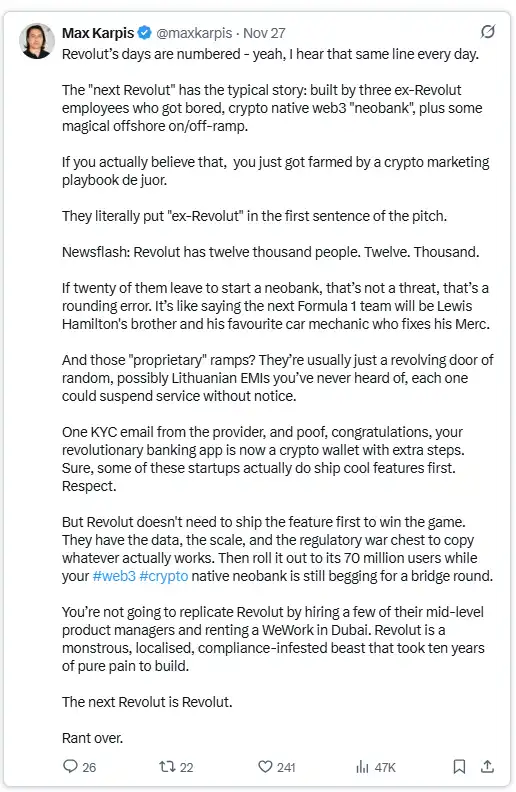
Max Karpis perfectly explains here why "neo-banks" are doomed to fail from the start.
For reference, a real scenario where I used cryptocurrency for payment was when booking a flight on Trip.com. They recently added an option to pay with stablecoins, directly from your wallet, and of course, it's available to anyone in the world.
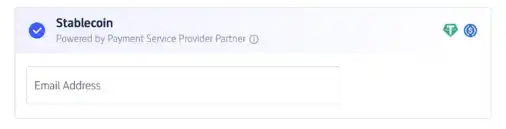
This is the real cryptocurrency use case and a true crypto payment. I believe the final form will be like this: wallets will be specifically optimized for the user experience of payments and spending, or (less likely) wallets will evolve into crypto cards, if crypto payments are somehow widely adopted.

Crypto Cards Function Similarly to Liquidity Bridges (Rain)

I have an interesting observation: self-custody crypto cards operate very similarly to cross-chain bridges.

This only applies to self-custody cards: cards issued by centralized exchanges (CEX) are not self-custody, so exchanges like Coinbase have no obligation to make users think the funds are under their control.

A legitimate use case for CEX cards is that they can serve as proof of funds for government, visa applications, or similar scenarios. When you use a crypto card tied to your CEX balance, you are still within the same ecosystem.

Self-custody crypto cards are different: they operate like liquidity bridges, where you lock funds (cryptocurrency) on chain A (crypto balance), and then unlock funds (fiat) on chain B (the real world).

This "bridge" in the crypto card space is like the shovel during the California Gold Rush: it is the key secure channel connecting crypto-native users and businesses that want to issue their own cards.

@stablewatchHQ's analysis of this bridge is spot-on, considering it essentially a Card-as-a-Service (CaaS) model. This is the most overlooked aspect by everyone discussing crypto cards. These CaaS platforms provide the infrastructure for businesses to launch their own branded cards.
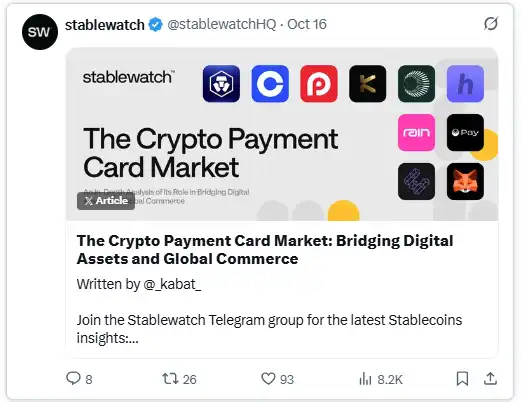
Rain: How Crypto Cards Are Born

About half of your favorite crypto cards are probably powered by @raincards, and you may never have heard of it. Rain is one of the most fundamental protocols in the neo-banking system because it handles almost all the core components behind crypto cards. All that's left for the remaining companies to do is slap their logo on it (sounds harsh, but it's close to the truth).
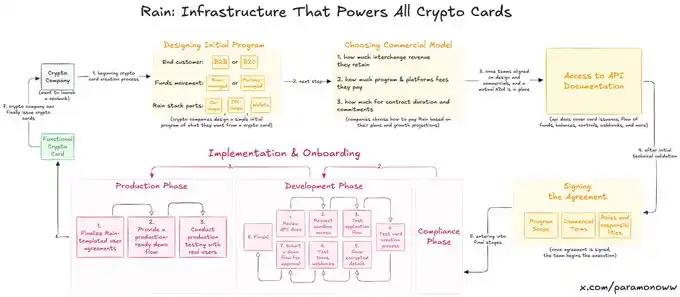
Rain enables companies to quickly launch their own crypto cards, and frankly, Rain's execution capabilities could even allow it to exist long-term outside the crypto space. So, stop fantasizing that teams need to raise tens of millions of dollars to issue a crypto card—they don't need that capital; they just need Rain.

The reason I emphasize Rain so much is that people generally overestimate the effort required to issue a crypto card. Maybe I'll write a separate article about Rain in the future because it is truly a severely underestimated technology.

Crypto Cards Have No Privacy or Anonymity

The lack of privacy or anonymity in crypto cards is not a problem with the cards themselves, but rather an issue deliberately ignored by those promoting them, hiding behind so-called "crypto values."


Privacy is not a widely used feature in the crypto space; pseudoprivacy (pseudonymity) does exist because we see addresses, not names. However, if you are ZachXBT, Wintermute's Igor Igamberdiev, Paradigm's Storm, or someone else with strong on-chain analysis capabilities, you can significantly narrow down the real identity corresponding to an address.

Of course, crypto cards don't even have the pseudonymity of traditional cryptocurrencies because you must complete KYC to activate a crypto card (actually, you're not activating a crypto card; you're opening a bank account).

If you are in the EU, the company providing the crypto card will still send some of your data to the government for tax purposes or other reasons the government needs to know. Now, you've given regulators a new opportunity to track you: linking your crypto address to your real identity.

Personal Data: The Currency of the Future

Cash still exists (the only form of anonymity, except the seller seeing you) and will exist for a long time. But eventually, everything will be digitized. The current digital system does not offer any benefits to consumers in terms of privacy: the more you spend, the higher the fees you pay, and in exchange, they know more about you. What a "great deal"!


Privacy is a luxury, and in the crypto card space, it will remain so. An interesting idea is that if we achieve truly good privacy, even to the point where businesses and institutions are willing to pay for it (not like Facebook, but with our consent), it could become the currency of the future, or even the only currency in a jobless, AI-driven world.

If Everything Is Doomed to Fail, Why Are Tempo, Arc Plasma, Stable Still Being Built?

The answer is simple—to lock users into the ecosystem.

Most non-custodial cards choose L2s (e.g., MetaMask uses @LineaBuild) or independent L1s (e.g., Plasma Card uses @Plasma). Due to high costs and finality issues, Ethereum or Bitcoin are generally not suitable for such operations. Some cards use Solana, but this is still a minority.

Of course, companies choose different blockchains not only for infrastructure but also for economic benefits.

MetaMask uses Linea not because Linea is the fastest or most secure, but because both Linea and MetaMask belong to the ConsenSys ecosystem.

I specifically use MetaMask as an example because it uses Linea. Everyone knows that almost no one uses Linea; it is far behind Base or Arbitrum in the L2 competition.

But ConsenSys made a smart decision to put Linea underneath their card because it locks users into the ecosystem. Users get accustomed to a good user experience through something they use daily. Linea naturally attracts liquidity, trading volume, and other metrics, rather than relying on liquidity mining campaigns or begging users to bridge.

This strategy is similar to what Apple did when it launched the iPhone in 2007, keeping users on iOS until they become so habituated they can't switch to another ecosystem. Never underestimate the power of habit.

EtherFi Is the Only Viable Crypto Card

After all this thinking, I've concluded that: @ether_fi is probably the only crypto card that truly aligns with the crypto spirit (this research is not sponsored by EtherFi, and even if it were, I wouldn't mind).

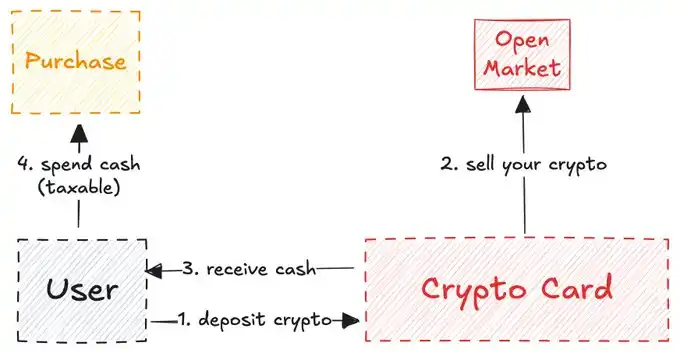
In most crypto cards, the cryptocurrency you top up is sold, and then your balance is replenished with cash (similar to the liquidity bridge I described earlier).

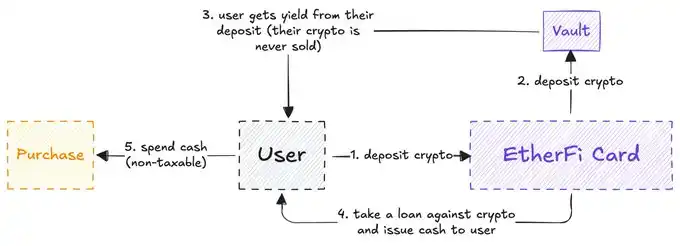
EtherFi is different: the system never sells your cryptocurrency; instead, it gives you a cash loan and uses your crypto assets to earn yield.

EtherFi's model is similar to Aave. Most DeFi users dream of seamlessly taking out cash loans collateralized by their crypto assets, and this capability has emerged. You might ask: "Isn't this the same? I can top up with crypto and spend with a crypto card like a normal debit card; is this extra step necessary?"
The problem is that selling your cryptocurrency is a taxable event, sometimes even more taxable than daily spending. And in most cards, every operation you do might be taxed, leading to you paying more taxes (again, using a crypto card does not mean being debanked).

EtherFi solves this problem to some extent because you are not actually selling cryptocurrency; you are just using it as collateral for a loan.

For this reason alone (plus no foreign exchange fees on USD, cashback, and other benefits), EtherFi becomes the best example of the convergence of DeFi and TradFi.

Most cards try to pretend they are crypto products but are actually just liquidity bridges, while EtherFi is truly for crypto users, not just for bringing cryptocurrency to the masses: it allows crypto users to spend locally until the masses realize how cool this model is. Among all crypto cards, EtherFi might be the only one that can survive long-term.

I think crypto cards are an experimental field, but unfortunately, most teams you see are just riding the narrative without giving due recognition to the underlying systems and developers.

Let's see where progress and innovation take us. Currently, we are seeing the globalization of crypto cards (horizontal growth), but there is a lack of vertical growth, which is precisely what this payment technology needs in its early stages.


Preguntas relacionadas

QWhy does the author believe that crypto cards are ultimately doomed to fail?

AThe author argues that crypto cards are merely a temporary solution that adds a layer of abstraction without addressing the core values of cryptocurrency, such as decentralization and permissionless access. They rely on traditional banking systems and payment processors like Visa and Mastercard, which centralize control, impose fees, and require KYC, contradicting crypto's foundational principles.

QWhat is the fundamental issue with the privacy and anonymity of crypto cards?

ACrypto cards lack privacy and anonymity because they require KYC (Know Your Customer) verification, linking users' real identities to their transactions. Unlike pseudonymous crypto transactions using addresses, crypto cards expose personal data to banks and governments, eliminating any form of financial privacy.

QHow does the author describe the operational model of most self-custody crypto cards?

AThe author compares self-custody crypto cards to liquidity bridges: users lock funds in cryptocurrency on one chain (e.g., a blockchain), and the card unlocks fiat currency in the real world for spending. This model involves intermediaries and fees, similar to a cross-chain bridge, rather than enabling direct crypto payments.

QWhat makes EtherFi's crypto card different from others according to the author?

AEtherFi's card differs by not selling users' cryptocurrency for fiat. Instead, it provides cash loans collateralized by crypto assets, allowing users to spend without triggering taxable events. This model aligns with DeFi principles, such as earning yield on locked assets, and avoids the pitfalls of traditional crypto cards that rely on selling crypto.

QWhy do companies build crypto cards despite their perceived limitations and inevitable failure?

ACompanies build crypto cards primarily to lock users into their ecosystems, leveraging habit and convenience to retain them. For example, MetaMask uses Linea to integrate users into ConsenSys' ecosystem. This strategy mimics Apple's approach with iOS, fostering user dependency rather than genuinely advancing crypto payment innovation.

Lecturas Relacionadas

iQiyi Is Too Impatient

The article "iQiyi Is Too Impatient" discusses the controversy surrounding the Chinese streaming platform IQiyi's recent announcement of an "AI Actor Library" during its 2026 World Conference. IQiyi claimed over 100 actors, including well-known names like Zhang Ruoyun and Yu Hewei, had joined the initiative. CEO Gong Yu suggested AI could enable actors to "star in 14 dramas a year instead of 4" and that "live-action filming might become a world cultural heritage." The announcement quickly sparked backlash. Multiple actors named in the list issued urgent statements denying they had signed any AI-related authorization agreements. This forced IQiyi to clarify that inclusion in the library only indicated a willingness to *consider* AI projects, with separate negotiations required for any specific role. The incident, which trended on social media with hashtags like "IQiyi is crazy," is presented as a sign of the company's growing desperation. Facing intense competition from short-video platforms like Douyin and Kuaishou, as well as Bilibili and Xiaohongshu, IQiyi's financial performance has weakened, with revenues declining for two consecutive years. The author argues that IQiyi is "too impatient" to tell a compelling AI story to reassure the market, especially as it pursues a listing on the Hong Kong stock exchange. The piece concludes by outlining three key "AI questions" IQiyi must answer: defining its role as a tool provider versus a content creator, balancing the "coldness" of AI with the human element audiences desire, and properly managing the interests of platforms, actors, and viewers. The core dilemma is that while AI can reduce costs and increase efficiency, it risks creating homogenized, formulaic content and devaluing human performers.

marsbitHace 34 min(s)

iQiyi Is Too Impatient

marsbitHace 34 min(s)

Trading

Spot
Futuros

Artículos destacados

Qué es $S$

Entendiendo SPERO: Una Visión General Completa Introducción a SPERO A medida que el panorama de la innovación continúa evolucionando, la aparición de tecnologías web3 y proyectos de criptomonedas juega un papel fundamental en la configuración del futuro digital. Un proyecto que ha atraído la atención en este campo dinámico es SPERO, denotado como SPERO,$$s$. Este artículo tiene como objetivo reunir y presentar información detallada sobre SPERO, para ayudar a entusiastas e inversores a comprender sus fundamentos, objetivos e innovaciones dentro de los dominios web3 y cripto. ¿Qué es SPERO,$$s$? SPERO,$$s$ es un proyecto único dentro del espacio cripto que busca aprovechar los principios de descentralización y tecnología blockchain para crear un ecosistema que promueva la participación, la utilidad y la inclusión financiera. El proyecto está diseñado para facilitar interacciones de igual a igual de nuevas maneras, proporcionando a los usuarios soluciones y servicios financieros innovadores. En su esencia, SPERO,$$s$ tiene como objetivo empoderar a los individuos al proporcionar herramientas y plataformas que mejoren la experiencia del usuario en el espacio de las criptomonedas. Esto incluye habilitar métodos de transacción más flexibles, fomentar iniciativas impulsadas por la comunidad y crear caminos para oportunidades financieras a través de aplicaciones descentralizadas (dApps). La visión subyacente de SPERO,$$s$ gira en torno a la inclusividad, buscando cerrar brechas dentro de las finanzas tradicionales mientras aprovecha los beneficios de la tecnología blockchain. ¿Quién es el Creador de SPERO,$$s$? La identidad del creador de SPERO,$$s$ sigue siendo algo oscura, ya que hay recursos públicos limitados que proporcionan información de fondo detallada sobre su(s) fundador(es). Esta falta de transparencia puede derivarse del compromiso del proyecto con la descentralización, una ética que muchos proyectos web3 comparten, priorizando las contribuciones colectivas sobre el reconocimiento individual. Al centrar las discusiones en torno a la comunidad y sus objetivos colectivos, SPERO,$$s$ encarna la esencia del empoderamiento sin señalar a individuos específicos. Como tal, comprender la ética y la misión de SPERO sigue siendo más importante que identificar a un creador singular. ¿Quiénes son los Inversores de SPERO,$$s$? SPERO,$$s$ cuenta con el apoyo de una diversa gama de inversores que van desde capitalistas de riesgo hasta inversores ángeles dedicados a fomentar la innovación en el sector cripto. El enfoque de estos inversores generalmente se alinea con la misión de SPERO, priorizando proyectos que prometen avances tecnológicos sociales, inclusión financiera y gobernanza descentralizada. Estas fundaciones de inversores suelen estar interesadas en proyectos que no solo ofrecen productos innovadores, sino que también contribuyen positivamente a la comunidad blockchain y sus ecosistemas. El respaldo de estos inversores refuerza a SPERO,$$s$ como un contendiente notable en el dominio de proyectos cripto que evoluciona rápidamente. ¿Cómo Funciona SPERO,$$s$? SPERO,$$s$ emplea un marco multifacético que lo distingue de los proyectos de criptomonedas convencionales. Aquí hay algunas de las características clave que subrayan su singularidad e innovación: Gobernanza Descentralizada: SPERO,$$s$ integra modelos de gobernanza descentralizada, empoderando a los usuarios para participar activamente en los procesos de toma de decisiones sobre el futuro del proyecto. Este enfoque fomenta un sentido de propiedad y responsabilidad entre los miembros de la comunidad. Utilidad del Token: SPERO,$$s$ utiliza su propio token de criptomoneda, diseñado para servir diversas funciones dentro del ecosistema. Estos tokens permiten transacciones, recompensas y la facilitación de servicios ofrecidos en la plataforma, mejorando la participación y la utilidad general. Arquitectura en Capas: La arquitectura técnica de SPERO,$$s$ apoya la modularidad y escalabilidad, permitiendo la integración fluida de características y aplicaciones adicionales a medida que el proyecto evoluciona. Esta adaptabilidad es fundamental para mantener la relevancia en el cambiante paisaje cripto. Participación de la Comunidad: El proyecto enfatiza iniciativas impulsadas por la comunidad, empleando mecanismos que incentivan la colaboración y la retroalimentación. Al nutrir una comunidad sólida, SPERO,$$s$ puede abordar mejor las necesidades de los usuarios y adaptarse a las tendencias del mercado. Enfoque en la Inclusión: Al ofrecer tarifas de transacción bajas e interfaces amigables para el usuario, SPERO,$$s$ busca atraer a una base de usuarios diversa, incluyendo a individuos que anteriormente pueden no haber participado en el espacio cripto. Este compromiso con la inclusión se alinea con su misión general de empoderamiento a través de la accesibilidad. Cronología de SPERO,$$s$ Entender la historia de un proyecto proporciona información crucial sobre su trayectoria de desarrollo y hitos. A continuación se presenta una cronología sugerida que mapea eventos significativos en la evolución de SPERO,$$s$: Fase de Conceptualización e Ideación: Las ideas iniciales que forman la base de SPERO,$$s$ fueron concebidas, alineándose estrechamente con los principios de descentralización y enfoque comunitario dentro de la industria blockchain. Lanzamiento del Whitepaper del Proyecto: Tras la fase conceptual, se lanzó un whitepaper completo que detalla la visión, los objetivos y la infraestructura tecnológica de SPERO,$$s$ para generar interés y retroalimentación de la comunidad. Construcción de Comunidad y Primeras Interacciones: Se realizaron esfuerzos de divulgación activa para construir una comunidad de primeros adoptantes y posibles inversores, facilitando discusiones en torno a los objetivos del proyecto y obteniendo apoyo. Evento de Generación de Tokens: SPERO,$$s$ llevó a cabo un evento de generación de tokens (TGE) para distribuir sus tokens nativos a los primeros seguidores y establecer liquidez inicial dentro del ecosistema. Lanzamiento de la dApp Inicial: La primera aplicación descentralizada (dApp) asociada con SPERO,$$s$ se puso en marcha, permitiendo a los usuarios interactuar con las funcionalidades centrales de la plataforma. Desarrollo Continuo y Alianzas: Actualizaciones y mejoras continuas a las ofertas del proyecto, incluyendo alianzas estratégicas con otros actores en el espacio blockchain, han moldeado a SPERO,$$s$ en un jugador competitivo y en evolución en el mercado cripto. Conclusión SPERO,$$s$ se erige como un testimonio del potencial de web3 y las criptomonedas para revolucionar los sistemas financieros y empoderar a los individuos. Con un compromiso con la gobernanza descentralizada, la participación comunitaria y funcionalidades diseñadas de manera innovadora, allana el camino hacia un paisaje financiero más inclusivo. Como con cualquier inversión en el espacio cripto que evoluciona rápidamente, se anima a los posibles inversores y usuarios a investigar a fondo y participar de manera reflexiva con los desarrollos en curso dentro de SPERO,$$s$. El proyecto muestra el espíritu innovador de la industria cripto, invitando a una mayor exploración de sus innumerables posibilidades. Mientras el viaje de SPERO,$$s$ aún se desarrolla, sus principios fundamentales pueden, de hecho, influir en el futuro de cómo interactuamos con la tecnología, las finanzas y entre nosotros en ecosistemas digitales interconectados.

72 Vistas totalesPublicado en 2024.12.17Actualizado en 2024.12.17

Qué es $S$

Qué es AGENT S

Agent S: El Futuro de la Interacción Autónoma en Web3 Introducción En el paisaje en constante evolución de Web3 y las criptomonedas, las innovaciones están redefiniendo constantemente cómo los individuos interactúan con las plataformas digitales. Uno de estos proyectos pioneros, Agent S, promete revolucionar la interacción humano-computadora a través de su marco agente abierto. Al allanar el camino para interacciones autónomas, Agent S busca simplificar tareas complejas, ofreciendo aplicaciones transformadoras en inteligencia artificial (IA). Esta exploración detallada profundizará en las complejidades del proyecto, sus características únicas y las implicaciones para el dominio de las criptomonedas. ¿Qué es Agent S? Agent S se presenta como un marco agente abierto innovador, diseñado específicamente para abordar tres desafíos fundamentales en la automatización de tareas informáticas: Adquisición de Conocimiento Específico del Dominio: El marco aprende inteligentemente de diversas fuentes de conocimiento externas y experiencias internas. Este enfoque dual le permite construir un rico repositorio de conocimiento específico del dominio, mejorando su rendimiento en la ejecución de tareas. Planificación a Largo Plazo de Tareas: Agent S emplea planificación jerárquica aumentada por la experiencia, un enfoque estratégico que facilita la descomposición y ejecución eficiente de tareas complejas. Esta característica mejora significativamente su capacidad para gestionar múltiples subtareas de manera eficiente y efectiva. Manejo de Interfaces Dinámicas y No Uniformes: El proyecto introduce la Interfaz Agente-Computadora (ACI), una solución innovadora que mejora la interacción entre agentes y usuarios. Utilizando Modelos de Lenguaje Multimodal de Gran Escala (MLLMs), Agent S puede navegar y manipular diversas interfaces gráficas de usuario sin problemas. A través de estas características pioneras, Agent S proporciona un marco robusto que aborda las complejidades involucradas en la automatización de la interacción humana con las máquinas, preparando el terreno para una multitud de aplicaciones en IA y más allá. ¿Quién es el Creador de Agent S? Si bien el concepto de Agent S es fundamentalmente innovador, la información específica sobre su creador sigue siendo elusiva. El creador es actualmente desconocido, lo que resalta ya sea la etapa incipiente del proyecto o la elección estratégica de mantener a los miembros fundadores en el anonimato. Independientemente de la anonimidad, el enfoque sigue siendo en las capacidades y el potencial del marco. ¿Quiénes son los Inversores de Agent S? Dado que Agent S es relativamente nuevo en el ecosistema criptográfico, la información detallada sobre sus inversores y patrocinadores financieros no está documentada explícitamente. La falta de información disponible públicamente sobre las bases de inversión u organizaciones que apoyan el proyecto plantea preguntas sobre su estructura de financiamiento y hoja de ruta de desarrollo. Comprender el respaldo es crucial para evaluar la sostenibilidad del proyecto y su posible impacto en el mercado. ¿Cómo Funciona Agent S? En el núcleo de Agent S se encuentra una tecnología de vanguardia que le permite funcionar de manera efectiva en diversos entornos. Su modelo operativo se basa en varias características clave: Interacción Humano-Computadora Similar a la Humana: El marco ofrece planificación avanzada de IA, esforzándose por hacer que las interacciones con las computadoras sean más intuitivas. Al imitar el comportamiento humano en la ejecución de tareas, promete elevar las experiencias de los usuarios. Memoria Narrativa: Empleada para aprovechar experiencias de alto nivel, Agent S utiliza memoria narrativa para hacer un seguimiento de las historias de tareas, mejorando así sus procesos de toma de decisiones. Memoria Episódica: Esta característica proporciona a los usuarios una guía paso a paso, permitiendo que el marco ofrezca apoyo contextual a medida que se desarrollan las tareas. Soporte para OpenACI: Con la capacidad de ejecutarse localmente, Agent S permite a los usuarios mantener el control sobre sus interacciones y flujos de trabajo, alineándose con la ética descentralizada de Web3. Fácil Integración con APIs Externas: Su versatilidad y compatibilidad con varias plataformas de IA aseguran que Agent S pueda encajar sin problemas en ecosistemas tecnológicos existentes, convirtiéndolo en una opción atractiva para desarrolladores y organizaciones. Estas funcionalidades contribuyen colectivamente a la posición única de Agent S dentro del espacio cripto, ya que automatiza tareas complejas y de múltiples pasos con una intervención humana mínima. A medida que el proyecto evoluciona, sus posibles aplicaciones en Web3 podrían redefinir cómo se desarrollan las interacciones digitales. Cronología de Agent S El desarrollo y los hitos de Agent S pueden encapsularse en una cronología que resalta sus eventos significativos: 27 de septiembre de 2024: El concepto de Agent S fue lanzado en un documento de investigación integral titulado “Un Marco Agente Abierto que Usa Computadoras Como un Humano”, mostrando las bases del proyecto. 10 de octubre de 2024: El documento de investigación fue puesto a disposición del público en arXiv, ofreciendo una exploración profunda del marco y su evaluación de rendimiento basada en el benchmark OSWorld. 12 de octubre de 2024: Se lanzó una presentación en video, proporcionando una visión visual de las capacidades y características de Agent S, involucrando aún más a posibles usuarios e inversores. Estos marcadores en la cronología no solo ilustran el progreso de Agent S, sino que también indican su compromiso con la transparencia y la participación comunitaria. Puntos Clave Sobre Agent S A medida que el marco Agent S continúa evolucionando, varios atributos clave destacan, subrayando su naturaleza innovadora y potencial: Marco Innovador: Diseñado para proporcionar un uso intuitivo de las computadoras similar a la interacción humana, Agent S aporta un enfoque novedoso a la automatización de tareas. Interacción Autónoma: La capacidad de interactuar de manera autónoma con las computadoras a través de GUI significa un salto hacia soluciones informáticas más inteligentes y eficientes. Automatización de Tareas Complejas: Con su metodología robusta, puede automatizar tareas complejas y de múltiples pasos, haciendo que los procesos sean más rápidos y menos propensos a errores. Mejora Continua: Los mecanismos de aprendizaje permiten a Agent S mejorar a partir de experiencias pasadas, mejorando continuamente su rendimiento y eficacia. Versatilidad: Su adaptabilidad en diferentes entornos operativos como OSWorld y WindowsAgentArena asegura que pueda servir a una amplia gama de aplicaciones. A medida que Agent S se posiciona en el paisaje de Web3 y criptomonedas, su potencial para mejorar las capacidades de interacción y automatizar procesos significa un avance significativo en las tecnologías de IA. A través de su marco innovador, Agent S ejemplifica el futuro de las interacciones digitales, prometiendo una experiencia más fluida y eficiente para los usuarios en diversas industrias. Conclusión Agent S representa un audaz avance en la unión de la IA y Web3, con la capacidad de redefinir cómo interactuamos con la tecnología. Aunque aún se encuentra en sus primeras etapas, las posibilidades para su aplicación son vastas y atractivas. A través de su marco integral que aborda desafíos críticos, Agent S busca llevar las interacciones autónomas al primer plano de la experiencia digital. A medida que nos adentramos más en los reinos de las criptomonedas y la descentralización, proyectos como Agent S sin duda desempeñarán un papel crucial en la configuración del futuro de la tecnología y la colaboración humano-computadora.

330 Vistas totalesPublicado en 2025.01.14Actualizado en 2025.01.14

Qué es AGENT S

Cómo comprar S

¡Bienvenido a HTX.com! Hemos hecho que comprar Sonic (S) sea simple y conveniente. Sigue nuestra guía paso a paso para iniciar tu viaje de criptos.Paso 1: crea tu cuenta HTXUtiliza tu correo electrónico o número de teléfono para registrarte y obtener una cuenta gratuita en HTX. Experimenta un proceso de registro sin complicaciones y desbloquea todas las funciones.Obtener mi cuentaPaso 2: ve a Comprar cripto y elige tu método de pagoTarjeta de crédito/débito: usa tu Visa o Mastercard para comprar Sonic (S) al instante.Saldo: utiliza fondos del saldo de tu cuenta HTX para tradear sin problemas.Terceros: hemos agregado métodos de pago populares como Google Pay y Apple Pay para mejorar la comodidad.P2P: tradear directamente con otros usuarios en HTX.Over-the-Counter (OTC): ofrecemos servicios personalizados y tipos de cambio competitivos para los traders.Paso 3: guarda tu Sonic (S)Después de comprar tu Sonic (S), guárdalo en tu cuenta HTX. Alternativamente, puedes enviarlo a otro lugar mediante transferencia blockchain o utilizarlo para tradear otras criptomonedas.Paso 4: tradear Sonic (S)Tradear fácilmente con Sonic (S) en HTX's mercado spot. Simplemente accede a tu cuenta, selecciona tu par de trading, ejecuta tus trades y monitorea en tiempo real. Ofrecemos una experiencia fácil de usar tanto para principiantes como para traders experimentados.

704 Vistas totalesPublicado en 2025.01.15Actualizado en 2025.03.21

Cómo comprar S

Discusiones

Bienvenido a la comunidad de HTX. Aquí puedes mantenerte informado sobre los últimos desarrollos de la plataforma y acceder a análisis profesionales del mercado. A continuación se presentan las opiniones de los usuarios sobre el precio de S (S).

活动图片