Why 21Shares believes ‘passive strategies’ for crypto ETFs are outdated

ambcryptoPublicado a 2026-03-26Actualizado a 2026-03-26

Resumen

21Shares President Duncan Moir argues that passive 'HODL' strategies for crypto ETFs are becoming outdated. Instead, the firm advocates for active management to capture yield and diversification opportunities in the growing asset class. Key strategies include yield-generating products like a preferred stock ETP offering an 11.5% dividend, staking rewards in ETFs, and thematic offerings such as a Bitcoin-and-gold ETP. While U.S. investor interest remains focused on large coins, European institutions are exploring newer assets and application layers. Despite a decline in total crypto ETF AUM to $130 billion, active strategies aim to drive future demand.

For most Bitcoin OGs in the space, the main crypto investment strategy has always been ‘HODL,’ which has been enough to outperform most assets in certain periods.

Early asset managers who entered the sector also adopted a similar passive strategy for their respective crypto ETFs (exchange-traded funds). They have been holding the crypto assets in the hope that, in three, six, or 12 months, their value would appreciate.

According to 21Shares president Duncan Moir, however, crypto ETFs are transitioning from passive management to active strategies. Moir noted that the sector was a ‘nascent’ and ‘growing asset class’ that fits perfectly with active management.

At the core of this new strategy is scaling yield streams and extra earning opportunities beyond just holding the crypto assets. From a regional crypto ETF demand, Moir said,

The interest is still concentrated in the larger coins in the US. In Europe, institutional clients are more interested in newer assets and the application layer beyond the Layer-1.
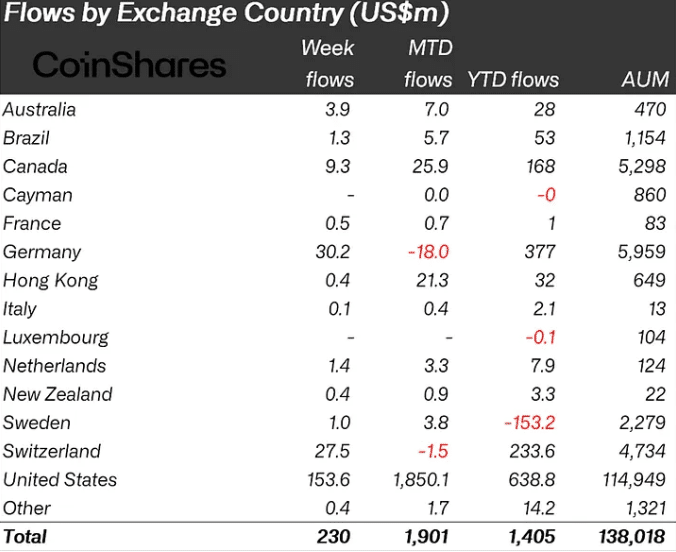
Source: CoinShares

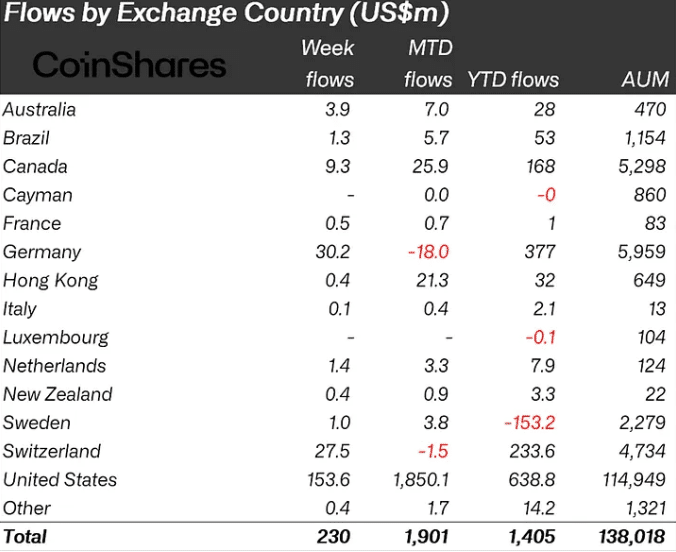
In fact, on a year-to-date (YTD) basis, the U.S. leads with $638 million in crypto inflows, followed closely by Germany at $377 million and Switzerland at $233 million.

Crypto ETFs evolution and diversification

For Moir, the mature investor base in Europe, who already hold Bitcoin and Ethereum, is looking to expand their crypto allocation with better offerings.

This led to 21Shares launching an ETP tied to Strategy’s preferred stock, Stretch (STRC), which offers an annual dividend yield of up to 11.5% payable monthly. This is one of the Strategy’s ways of raising capital for Bitcoin buys.

Moir noted that the product has been an instant success across several regions, underscoring a strong appetite for yield-bearing assets that are feasibly accessible via traditional platforms.

Additionally, crypto ETF staking rewards have become another active strategy to maximize investors’ returns.

Grayscale and BlackRock’s push for staking rewards in their respective Spot ETH ETFs is one example of asset managers seeking more opportunities for investors.

Finally, Moir said they also look for major thematic trends or future shifts that can be maximized. The approach informed the launch of 21Shares’ Bitcoin-and-gold ETP, based on the rising demand for safe havens amid debasement trade and rising U.S. fiscal debt.

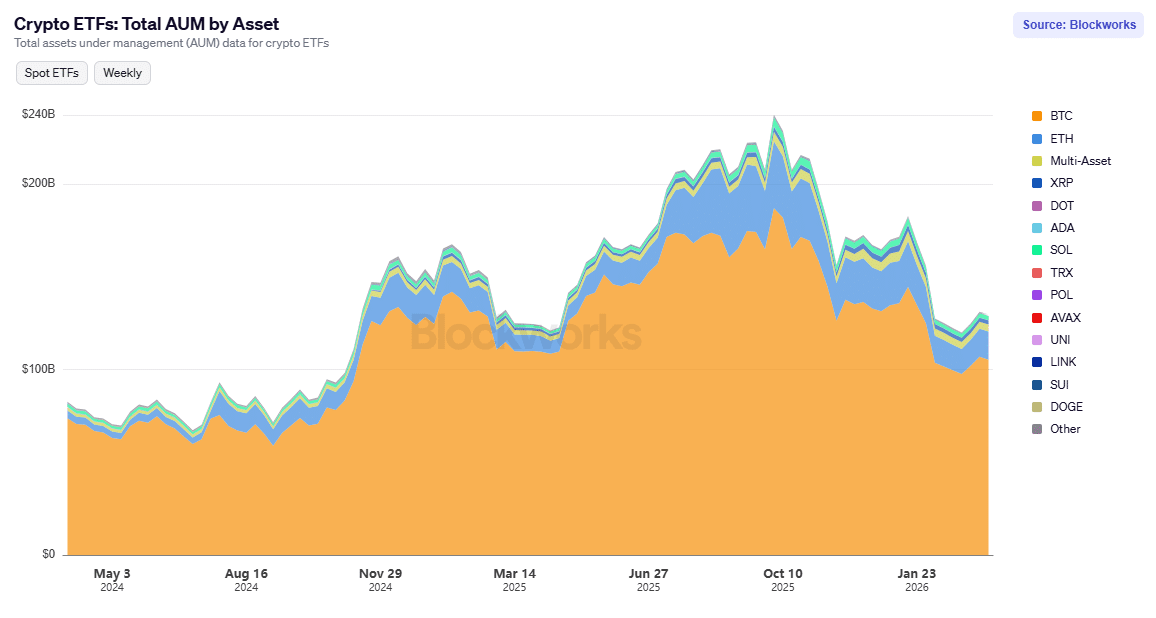
It remains to be seen how the new active strategy will drive demand into crypto ETFs. As of writing, the total crypto ETF assets under management (AUM) were about $130 billion, down from nearly $240 billion at the peak of 2025.
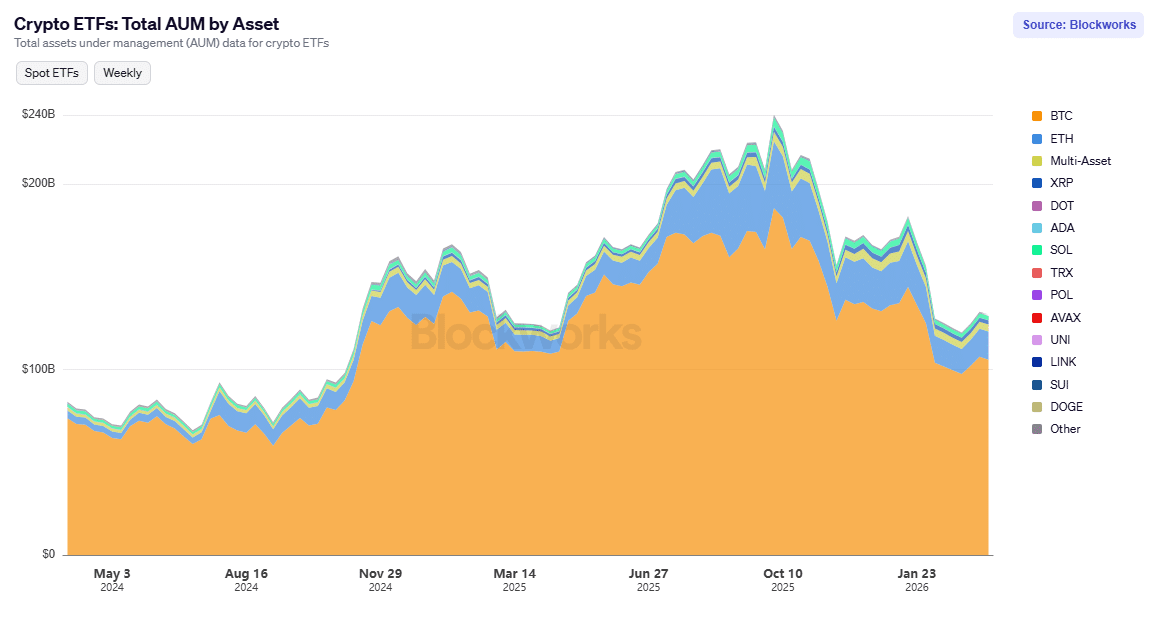
Source: Blockworks

Final Summary

  • 21Shares’ Duncan Moir said that active strategies will be at the center of the next crypto ETF management.
  • Yield-focused wrappers and staking rewards are some active strategies asset managers are deploying for investors.


Preguntas relacionadas

QAccording to 21Shares president Duncan Moir, why are crypto ETFs transitioning from passive to active strategies?

ABecause crypto sector is a 'nascent' and 'growing asset class' that fits perfectly with active management, focusing on scaling yield streams and extra earning opportunities beyond just holding crypto assets.

QWhat regional differences in crypto ETF demand does Duncan Moir highlight between the US and Europe?

AIn the US, interest is concentrated in larger coins, while in Europe, institutional clients are more interested in newer assets and the application layer beyond Layer-1.

QWhat are two specific active strategies mentioned that asset managers are using to maximize investor returns?

AYield-focused wrappers (like the ETP tied to Stretch offering 11.5% annual dividend) and staking rewards in crypto ETFs.

QWhat was the rationale behind 21Shares launching a Bitcoin-and-gold ETP?

AIt was based on the rising demand for safe havens amid debasement trade and rising U.S. fiscal debt, capitalizing on major thematic trends.

QWhat is the current total assets under management (AUM) for crypto ETFs as mentioned in the article?

AAbout $130 billion, down from nearly $240 billion at the peak of 2025.

Lecturas Relacionadas

Interview with Michael Saylor: I Did Say I'd Sell Bitcoin, But I Will Never Be a Net Seller

**Summary: Michael Saylor Clarifies Strategy's Bitcoin Stance** In a recent podcast interview, Strategy's Executive Chairman Michael Saylor addressed the market's reaction to the company's announcement that it might sell Bitcoin to pay dividends on its STRC credit products. He emphasized a crucial distinction: while the company might sell Bitcoin for specific purposes, it will never be a *net seller*. Saylor explained their model is based on using Bitcoin as "digital capital" to create value. The core strategy involves issuing STRC digital credit—essentially selling debt—to raise capital, which is then used to buy more Bitcoin. He estimates Bitcoin appreciates at roughly 40% annually. A small portion of these capital gains (e.g., ~2.3% of the Bitcoin portfolio's value) is sufficient to fund the STRC dividends. Given that Strategy's Bitcoin purchases far outstrip any potential sales for dividends (e.g., buying $3.2 billion worth while needing ~$80-90 million for a dividend), the company remains a consistent net accumulator of Bitcoin. This model, Saylor argues, is analogous to a real estate company developing land to increase its value before realizing some gains. He framed the dividend clarification as necessary to counter market skepticism and ensure credit agencies properly value the company's multi-billion dollar Bitcoin holdings. Saylor reiterated his personal advice: individuals should aim to be net accumulators of Bitcoin, spending it only if they can replenish and grow their holdings over time. Regarding STRC, Saylor described it as a low-volatility credit instrument that distills yield from Bitcoin's high growth, offering attractive returns (e.g., ~11-12% yield) for risk-averse investors. He noted that Strategy's STRC issuance now constitutes about 60% of the U.S. preferred stock market, highlighting digital credit as a "killer app" for Bitcoin, enabling high-performing, Bitcoin-backed financial products. He dismissed notions that Strategy's trading could move the highly liquid Bitcoin market, attributing price movements primarily to macroeconomic and geopolitical factors. Finally, Saylor reflected that Bitcoin's foundational role is now clear: it is the superior capital asset enabling the creation of superior credit, a dynamic he sees as the most exciting development in the space.

marsbitHace 5 min(s)

Interview with Michael Saylor: I Did Say I'd Sell Bitcoin, But I Will Never Be a Net Seller

marsbitHace 5 min(s)

380,000 Apps Exposed, 2,000+ Apps Leaked Secrets: AI Programming Turns 'Intranet' into Public Internet

Israeli cybersecurity firm RedAccess uncovered a severe data exposure trend linked to "vibe coding" or AI-powered software development tools. Their research found approximately 38,000 publicly accessible web applications built with platforms like Lovable, Base44, Netlify, and Replit. Of these, an estimated 2,000 apps exposed sensitive corporate and personal data, including medical records, financial information, internal strategic documents, and customer chat logs. In some cases, access even granted administrative privileges. The core issue stems from default privacy settings that make applications public by default, combined with a lack of built-in security controls (like authentication) in the AI-generated code. This allows employees without security expertise—"citizen developers"—to easily create and deploy applications that bypass standard corporate security reviews. The exposed apps, often indexed by search engines, are trivially discoverable. While some platform providers (Replit, Lovable, Wix/Base44) argue that security configuration is the user's responsibility and question the validity of some findings, security researchers confirm the widespread reality of such exposures. This pattern, also noted in prior studies, highlights a critical security gap as AI democratizes app creation, potentially leading to massive, unintentional data leaks.

marsbitHace 1 hora(s)

380,000 Apps Exposed, 2,000+ Apps Leaked Secrets: AI Programming Turns 'Intranet' into Public Internet

marsbitHace 1 hora(s)

Attracting Global Capital, Asia's New 'Super Cycle' Is Unfolding

Investors are turning to Asia as the next frontier for global equity growth, with a new "super cycle" unfolding across the region. Driven by the AI revolution, Asian markets, particularly South Korea, have seen significant rallies. According to Morgan Stanley analysis, the underlying drivers of Asia's industrial cycle are shifting from traditional sectors like real estate and manufacturing to massive investments in AI infrastructure, energy security and transition, and supply chain resilience. Fixed asset investment in Asia is projected to grow from around $11 trillion in 2025 to $16 trillion by 2030, with a 7% annual growth rate from 2026-2030. The AI wave is a primary catalyst, driving immense capital expenditure for chips, servers, data centers, and power systems. Asia is central to this hardware supply chain. In China, AI investment is focused on building a full-system domestic capability, with the local AI chip market potentially reaching $86 billion by 2030. Beyond AI, China's export story is expanding from EVs and batteries to robotics. The country already captures about half of new global industrial robot demand and over 90% of humanoid robot shipments. This growth phase mirrors the early stages of China's EV export boom. Simultaneously, energy security investments, spurred by AI's massive power needs, are rising, with China benefiting from its leadership in solar, batteries, and EVs. Regional defense spending is also increasing structurally, supporting demand for advanced manufacturing. The main beneficiaries are China, South Korea, and Japan, positioned in core supply chain areas. However, risks remain, including potential overcapacity, profit margin pressures from competition, persistent technological restrictions, geopolitical friction, and workforce displacement due to AI-driven automation. Market volatility is also expected to increase as investor expectations diverge on the realization of these capital investment and export themes.

marsbitHace 1 hora(s)

Attracting Global Capital, Asia's New 'Super Cycle' Is Unfolding

marsbitHace 1 hora(s)

Trading

Spot
Futuros
活动图片




