Whoever Defines Token Holds the Minting Power in the AI Era

比推Publicado a 2026-03-23Actualizado a 2026-03-23

Resumen

The article discusses the intense debate in China over the Chinese translation of "Token," a fundamental unit in AI and computing. Previously an obscure technical term, Token has become economically significant as it is now used in cloud service billing, AI model revenue metrics, and national AI industry statistics. With China's daily Token consumption soaring, the naming contest has attracted various stakeholders. Proposals include "智元" (intelligence unit), promoted by an AI media company for brand alignment; "模元" (model unit), emphasizing model ownership; and "符元" (symbol unit), a technically accurate but less popular term. The academic translation "词元" (word unit), established in 2021, is now overlooked due to Token's newfound economic value. The author argues that naming Token is not merely a linguistic issue but a struggle for narrative control and economic influence, akin to minting currency in the AI era. The piece highlights that whoever defines Token shapes the industry's future direction and financial flows.

Author: Kuli, Shenchao TechFlow

Original Title: Token Doesn't Need a Chinese Name, But the Business Behind It Does


Recently, you may have noticed something: people have started discussing what Token should be called.

Professor Yang Bin from Tsinghua University published an article titled "It's Already Urgent to Determine the Chinese Translation for Token"; on Zhihu, related translation questions have garnered 250,000 views, with comment sections buzzing with ideas.

Over the past two to three years, the domestic AI circle has been using the term Token directly without any issue. Why the sudden need for a Chinese name?

The immediate reason might be that, after this year's Spring Festival, the general public learned for the first time that Tokens cost money.

OpenClaw turned AI from chatting to working, with tasks burning through hundreds of thousands of Tokens, and bills skyrocketing; various cloud providers have also announced price increases, with Token as the billing unit.

At the same time, Token has begun appearing in places it never did before.

At the GTC conference, NVIDIA CEO Jensen Huang mentioned that in Silicon Valley, people are already asking in interviews, "How many Tokens does this job offer?" He suggested incorporating Tokens into engineers' compensation;

OpenAI founder Sam Altman took it even further, suggesting that Tokens will replace universal basic income, with everyone receiving computing power instead of money.

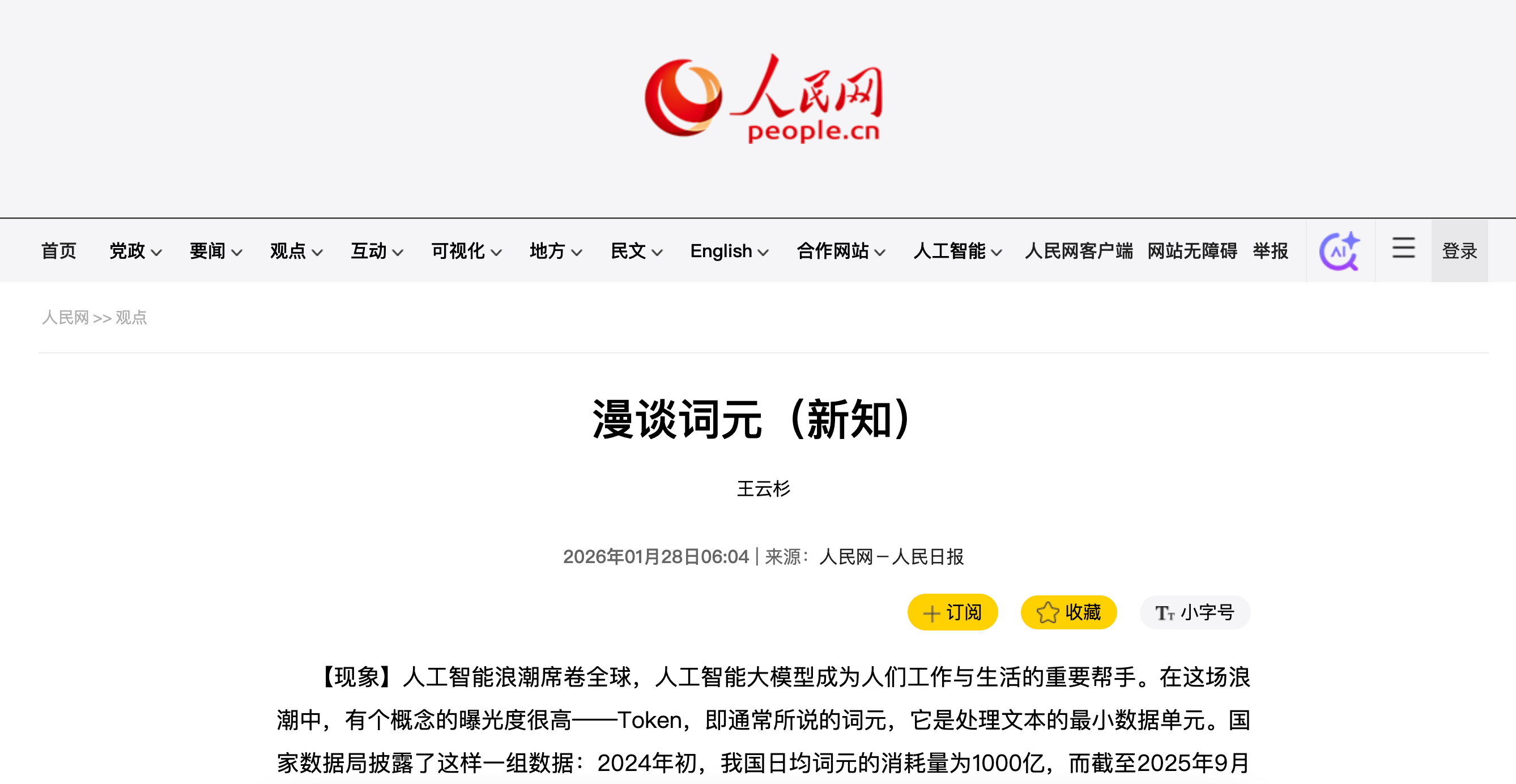
Data from the National Data Bureau shows that China's daily Token consumption surged from 100 billion in early 2024 to over 40 trillion by September 2025, reaching 180 trillion this February. At the beginning of the year, the People's Daily published an article titled "A Casual Talk on Ciyuan (词元)" to explain the term to readers.
Once a technical term enters cloud service bills, compensation packages, and official statistics, it can no longer remain in English.

The question is, what to call it?

If this were merely a translation issue, there would already be an answer. In 2021, the domestic academic community settled on a name for Token: 词元 (Ciyuan).

But no one paid attention because, back then, Token was just an internal term within technical circles.

Now, it's different.

The word Token itself is a universal container. People in the crypto world call it 代币 (daibi, token), those in security call it 令牌 (lingpai, token), and those in AI call it 词元 (ciyuan, lexeme). The same English word, depending on which direction the Chinese translation leans, determines whose territory it belongs to.

Thus, a battle over naming Token has begun.

Business Needs Discourse Power

How a word is translated is usually a matter for linguists. But this time, almost no linguists are involved in the naming.

The most prominent name currently is "智元" (Zhiyuan).

It's being pushed most vigorously by an AI media outlet called "新智元" (Xin Zhiyuan). If Token's Chinese name becomes "智元", this company's brand name would coincide with the industry's fundamental term, meaning every article discussing Token would provide free advertising for them.

Their own promotional article ends candidly: "We suggest translating Token as the industry's new consensus: 智元 (Zhiyuan), leaving the '新' (Xin, new) for us."

According to the same article, Baichuan Intelligent founder Wang Xiaochuan commented: "Calling it 智元 is quite good."

As a maker of large models, it's certainly good for him if Token is called 智元. Each operation of the model would then produce not just a billing unit, but a "basic unit of intelligence."

Selling Token is selling traffic; selling 智元 is selling intelligence—a completely different valuation story.

Professor Yang Bin from Tsinghua University proposed "模元" (Moyuan), with "模" (mo) corresponding to model. Whoever owns the large model holds the production rights to "模元". Leaning the term towards models directs pricing power to the model companies.

Some advocate for "符元" (Fuyuan), returning to the most fundamental definition in computer science—Token is simply a symbol processing unit, unrelated to intelligence or models.

Technically the purest, but the proposer is an independent technical writer without corporate backing or capital push, rendering this proposal almost inaudible in the discussion.

Which direction the name leans, the industry narrative moves in that direction, and money flows accordingly.

A distant example: the day Facebook renamed itself Meta, "metaverse" transformed from a sci-fi concept into a valuation story for a company. A recent example: China consumes 180 trillion Tokens daily, ranking first globally, but what to call this term, how to define it, and who defines it remain undecided...

The world's largest consumer of Tokens hasn't even decided what to call what it consumes.

However, this term actually already had a Chinese name.

In 2021, Professor Qiu Xipeng from Fudan University's School of Computer Science translated Token as "词元" (Ciyuan). The academic community accepted it and wrote it into textbooks. No one discussed it then because Token wasn't valuable at the time.

Now, Token is valuable.

It's the billing unit for cloud services, the revenue source for large model companies, and a core metric for measuring the scale of the AI industry at the national level. So the media arrived, the big shots arrived, the professors arrived, each bringing their preferred name and the rationale behind it.

Translation was never the issue. The issue is when this term started becoming valuable.
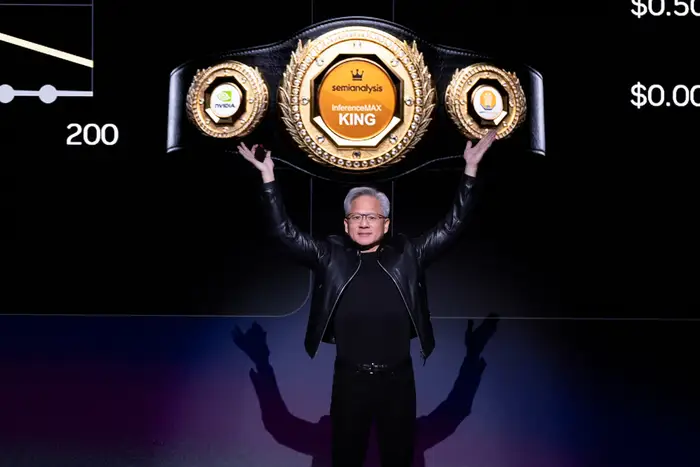
Jensen Huang didn't participate in the Chinese naming discussion at GTC. He did something simpler: held up a championship belt inscribed with "Token King" and declared that data centers are Token factories.

Whoever produces Tokens defines Tokens. He doesn't care about the name.

Token, Land Grabbing, and Minting

Therefore, the part truly worth serious thought isn't which translation is better.

After the term "calorie" was established, the entire food industry's pricing, labeling, and regulatory systems were built around it. After the definition of "流量" (liuliang, data traffic) was established in China's telecom industry, operators billed, competed, and designed packages based on it—the entire business model revolved around these two words for over a decade.

Token is now on the same path.

It's already the billing unit for cloud services, the revenue metric for large model companies, and a core indicator for measuring the AI industry at the national level. The VC circle is even discussing whether investment funds can be disbursed directly in Tokens.

Once a word becomes a measure of money, naming it is no longer translation—it's minting currency.

Call it "智元" (Zhiyuan), and the minting power goes to the AI narrative; whoever tells the story of intelligence benefits. Call it "模元" (Moyuan), and the minting power goes to the model companies; whoever has large models prints money. Call it "符元" (Fuyuan), and the minting power returns to the technology itself, but technology doesn't speak for itself.

The academic community's 2021 term "词元" (Ciyuan) was ignored not because the translation was poor, but because this "currency" wasn't valuable then.

Now it's valuable, and everyone wants to carve their name on it.


Twitter:https://twitter.com/BitpushNewsCN

Bitpush TG Discussion Group:https://t.me/BitPushCommunity

Bitpush TG Subscription: https://t.me/bitpush

Original link:https://www.bitpush.news/articles/7622494

Preguntas relacionadas

QWhy has there been a recent push to give Token a Chinese name, according to the article?

ABecause Token has become a unit of billing for cloud services, part of compensation packages, and a core metric for national AI industry statistics, making it necessary to have a standardized Chinese term as it enters everyday economic and official use.

QWhat are some of the proposed Chinese translations for 'Token' mentioned in the article, and who supports them?

A'智元' (Zhi Yuan) is promoted by the AI media '新智元' and supported by Wang Xiaochuan of Baichuan AI; '模元' (Mo Yuan) was proposed by Professor Yang Bin of Tsinghua University; '符元' (Fu Yuan) was suggested by an independent technical writer but has little traction.

QHow does the article compare the naming of 'Token' to historical examples like 'calories' or '流量' (data流量)?

AThe article compares it to how 'calories' defined the food industry's pricing and labeling system, and how '流量' (data流量) became the central unit for telecom billing and business models, indicating that naming Token is like establishing a new monetary standard for the AI economy.

QWhat does the article suggest is the real significance behind the debate over Token's Chinese name?

AThe debate is not about translation accuracy but about 'minting currency'—whoever defines the term gains narrative control and economic influence, shaping where money flows in the AI industry, whether toward AI intelligence stories, model companies, or pure technology.

QWhat was the academic translation for Token proposed in 2021, and why did it gain little attention at the time?

AIn 2021, Professor Qiu Xipeng of Fudan University translated Token as '词元' (Ci Yuan), which was accepted in academia and textbooks. It gained little attention because Token was not yet valuable as an economic unit at that time.

Lecturas Relacionadas

KOL's Perspective: Why Is SOL Set to Rise from This Point?

**Summary: Why SOL is Positioned for Growth at This Level** The article argues that SOL is poised for an upward move from its current price point, citing several key factors. Primarily, SOL has just broken out of a 4-month consolidation phase. This breakout signals a return of risk appetite to the broader crypto market, as SOL is seen as a key indicator of overall crypto health. The token's ownership has reportedly shifted from short-term traders and tourists to long-term accumulators, leading to low volume. Any meaningful increase in trading activity could thus trigger significant upward momentum. Fundamental strengths include strong institutional adoption, integration with DeFi and RWAs (Real-World Assets), and the potential benefits from the Clarity Act. Despite its high volatility—having dropped 70% from its all-time high but still up 12x from its bear market low—SOL is highlighted as one of the few tokens from the last cycle to reach new highs. It boasts a robust ecosystem of applications, users, and protocols. Future catalysts include the expected influx of AI developers following the Miami Accelerate conference, which focused on AI on Solana. Furthermore, Solana is positioned as the premier chain for memecoin activity, a trend expected to continue and drive network usage and fees. The article concludes that recent price action reflects a healthy transfer to long-term holders, setting the stage for growth.

marsbitHace 33 min(s)

KOL's Perspective: Why Is SOL Set to Rise from This Point?

marsbitHace 33 min(s)

Those Pre-Bitcoin PoW Protocols Have Recently Been Reimplemented

This article details a recent surge in replicating pre-Bitcoin Proof-of-Work (PoW) protocols, specifically focusing on Hal Finney's 2004 RPOW (Reusable Proofs of Work). Within five days in May 2026, multiple independent builders in the Bitcoin/cypherpunk community launched projects inspired by this early electronic cash proposal. The initiative began with Fred Krueger's `rpow2.com`, a centralized but auditable system that replaced RPOW's original IBM 4758 hardware with Ed25519 signatures. Initially a faithful replica, it later adopted Bitcoin-like features (21M supply cap, difficulty adjustment) and a controversial 5.24% founder allocation. This sparked rapid forks, including `rpow4.com` which incorporated full Bitcoin parameters, a prediction market (`rpowmarket.com`), and a DEX (`rpow2swap.com`). Concurrently, Mike In Space created a prototype of Wei Dai's 1998 b-money proposal (`b-money.replit.app`), pushing the historical exploration even further back. The article contrasts these centralized, server-dependent experiments with Bitcoin's core innovation of decentralized, trustless consensus. It also highlights a parallel development: the `HASH` project on Ethereum, which uses smart contract hooks to enable a purely fair-launch, browser-mineable PoW token with 0% allocations to team or VCs. The collective activity is framed as a meme-driven, educational exploration of cypherpunk history rather than a serious financial movement, with all projects heavily disclaiming any investment value.

marsbitHace 38 min(s)

Those Pre-Bitcoin PoW Protocols Have Recently Been Reimplemented

marsbitHace 38 min(s)

South Korean Exchanges 'Battle' Regulators, Challenging the Boundaries of Enforcement and Legislation

South Korea's cryptocurrency industry is engaged in a rare, direct confrontation with regulators. The Financial Intelligence Unit (FIU), the primary anti-money laundering (AML) watchdog, has recently imposed heavy penalties on major exchanges like Upbit and Bithumb for alleged violations involving unregistered overseas VASPs and AML procedures. However, exchanges are now actively challenging these actions in court and through industry associations. In a significant shift, the Seoul Administrative Court ruled in favor of Upbit's operator, Dunamu, overturning part of an FIU-ordered business suspension. The court found the FIU's penalty criteria and justification insufficiently clear. Similarly, the court suspended the enforcement of a six-month business suspension against Bithumb pending a final ruling, citing potential irreversible harm to the exchange. Beyond legal battles, the industry is contesting proposed legislative amendments. The Digital Asset eXchange Alliance (DAXA) strongly opposes a draft rule that would mandate Suspicious Transaction Reports (STRs) for all crypto transfers over 10 million KRW (~$6,800). DAXA argues this "poison pill" clause violates legal principles and would overwhelm the STR system, increasing reports from 63,000 to an estimated 5.45 million annually for major exchanges, thereby crippling effective AML monitoring. This conflict highlights a structural tension in South Korea's crypto governance: comprehensive digital asset laws are still developing, while regulators rely heavily on AML enforcement. The industry's move from passive compliance to active legal and legislative challenges signifies a new phase, pressing for clearer rules and more proportionate enforcement. While short-term disputes may intensify, this clash could ultimately lead to a more mature and sustainable regulatory framework for South Korea's vibrant crypto market.

marsbitHace 1 hora(s)

South Korean Exchanges 'Battle' Regulators, Challenging the Boundaries of Enforcement and Legislation

marsbitHace 1 hora(s)

After 50x Storage Surge, Justin Sun Always Looks to the Next Decade

Sun Yuchen, known for his controversial stunts like a $30 million lunch with Warren Buffett (canceled due to a kidney stone) and eating a $6.2 million duct-taped banana, is often overshadowed by a significant fact: his decade-long track record of spotting major investment trends. In 2016, he famously advised young people to invest in Bitcoin, Nvidia, Tesla, and Tencent instead of buying property. A hypothetical $20,000 investment in Nvidia and Tesla from that list would now be worth over 50 million RMB. His latest major call was on November 6, 2025, predicting a "50x storage opportunity" tied to the AI boom, which materialized with Sandisk's stock surging nearly 50-fold by 2026. Looking ahead, Sun now focuses on the next frontier: Physical AI. He identifies four key areas: 1. **Embodied AI/Robotics**: He sees this reaching its "iPhone moment," with companies like UBTech and Galaxy General leading in commercialization. 2. **Drones**: Viewed as the first commercially viable form of Physical AI, revolutionizing sectors from warfare (e.g., AeroVironment's Switchblade) to logistics. 3. **Spatial Computing**: Beyond VR, it's about AI understanding physical space, a foundational technology for robotics and autonomous systems, exemplified by Apple's Vision Pro. 4. **Space Exploration**: After a 2025 suborbital flight with Blue Origin, Sun advocates for space as the ultimate frontier, discussing blockchain's potential role in space asset management and data transactions. His investment philosophy involves betting on entire, inevitable trends rather than single companies. For robotics, he sees Tesla (the body/manufacturer) and Nvidia (the brain/AI platform) as complementary plays. In defense drones, he highlights companies making tanks obsolete (AeroVironment) and those augmenting fighter jets (Kratos). For space, he participated in Blue Origin's flight and anticipates SpaceX's potential IPO to redefine the sector's valuation. Sun Yuchen's vision frames the next two decades not as a revolution in information flow (like the internet), but in the fundamental operation of the physical world through AI-powered robots, autonomous systems, and spatial intelligence, ultimately extending human and AI activity into space. While many still focus on conventional assets, he continues to look toward the next technological horizon.

marsbitHace 2 hora(s)

After 50x Storage Surge, Justin Sun Always Looks to the Next Decade

marsbitHace 2 hora(s)

Trading

Spot
Futuros

Artículos destacados

Cómo comprar ERA

¡Bienvenido a HTX.com! Hemos hecho que comprar Caldera (ERA) sea simple y conveniente. Sigue nuestra guía paso a paso para iniciar tu viaje de criptos.Paso 1: crea tu cuenta HTXUtiliza tu correo electrónico o número de teléfono para registrarte y obtener una cuenta gratuita en HTX. Experimenta un proceso de registro sin complicaciones y desbloquea todas las funciones.Obtener mi cuentaPaso 2: ve a Comprar cripto y elige tu método de pagoTarjeta de crédito/débito: usa tu Visa o Mastercard para comprar Caldera (ERA) al instante.Saldo: utiliza fondos del saldo de tu cuenta HTX para tradear sin problemas.Terceros: hemos agregado métodos de pago populares como Google Pay y Apple Pay para mejorar la comodidad.P2P: tradear directamente con otros usuarios en HTX.Over-the-Counter (OTC): ofrecemos servicios personalizados y tipos de cambio competitivos para los traders.Paso 3: guarda tu Caldera (ERA)Después de comprar tu Caldera (ERA), guárdalo en tu cuenta HTX. Alternativamente, puedes enviarlo a otro lugar mediante transferencia blockchain o utilizarlo para tradear otras criptomonedas.Paso 4: tradear Caldera (ERA)Tradear fácilmente con Caldera (ERA) en HTX's mercado spot. Simplemente accede a tu cuenta, selecciona tu par de trading, ejecuta tus trades y monitorea en tiempo real. Ofrecemos una experiencia fácil de usar tanto para principiantes como para traders experimentados.

303 Vistas totalesPublicado en 2025.07.17Actualizado en 2025.07.17

Cómo comprar ERA

Discusiones

Bienvenido a la comunidad de HTX. Aquí puedes mantenerte informado sobre los últimos desarrollos de la plataforma y acceder a análisis profesionales del mercado. A continuación se presentan las opiniones de los usuarios sobre el precio de ERA (ERA).

活动图片