Who is Selling, Who is Holding, Who is Still Buying? The Divergence of U.S. Old Money's Crypto ETF Holdings

marsbitPublicado a 2026-05-22Actualizado a 2026-05-22

Resumen

"American Institutional Crypto ETF Holdings Show Divergence in Q1 2026. Amidst a quarter of market pullback, major institutional 13F filings reveal distinct strategies towards crypto ETFs. Key sell-offs/trimming: Harvard Management cut its iShares Bitcoin Trust (IBIT) holdings by ~43% and fully exited its iShares Ethereum Trust (ETHA) position, reallocating some funds toward AI/tech stocks. Goldman Sachs reduced its overall crypto ETF exposure, notably clearing its XRP and Solana ETF holdings while adding to selected crypto-related equities like Circle and Galaxy Digital. Hedge funds Millennium Management and Capula Management also significantly reduced or fully exited major Bitcoin and Ethereum ETF positions. Holders maintaining positions: Brown University kept its IBIT stake unchanged, demonstrating a long-term allocation approach. Dartmouth College maintained its core Bitcoin ETF holding while shifting some Ethereum exposure to a staking ETF and initiating a position in a Bitwise Solana Staking ETF. Strategic buyers increasing exposure: Sovereign wealth fund Mubadala increased its IBIT holdings by ~16%. JPMorgan significantly boosted its IBIT stake by 174%, while Wells Fargo raised its Ethereum ETF allocations. Market maker Jane Street rebalanced, cutting Bitcoin ETF holdings but adding ~$82 million in Ethereum ETF exposure. The filings indicate institutions are actively sorting crypto assets by perceived risk and liquidity, with Bitcoin often treated as a 'core' holding, ...

Original Author: KarenZ, Foresight News

The most noteworthy aspect of Q1 is not how much the price fell, but how institutions navigated through this pullback.

If you only look at the market performance, crypto ETFs in Q1 2026 did not have it easy. Bitcoin and Ethereum faced pressure during the quarter, the book value of spot ETFs generally declined, and many positions, even if not sold, would look difficult by the quarter's end. However, the truly interesting part of a downturn is never the NAV curve itself, but what different types of institutions did on the same pullback chart.

By the latest round of 13F filings disclosed as of mid-May 2026, the market can already see a group of institutions' holdings as of the quarter-end, March 31, 2026. University endowments, large investment banks, sovereign wealth funds, market makers, and wealth management firms have provided several starkly different answers.

Those Reducing Holdings: Risk Contraction First

First, let's look at the reducers.

Harvard Management, which manages Harvard University's endowment and related financial assets, is one of the most typical examples in this round. According to its filed 13F report, its holdings in IBIT (iShares Bitcoin Trust ETF) decreased from 5,353,612 shares at the end of Q4 2025 to 3,044,612 shares at the end of Q1 2026, a reduction of approximately 43%, with the corresponding book value dropping from about $266 million to about $117 million. Meanwhile, its holdings in ETHA (iShares Ethereum Trust), which it still held last quarter, were completely exited this quarter. This indicates that Harvard is not merely reacting to price pullbacks but is actively compressing its public exposure to Bitcoin and Ethereum spot ETFs.
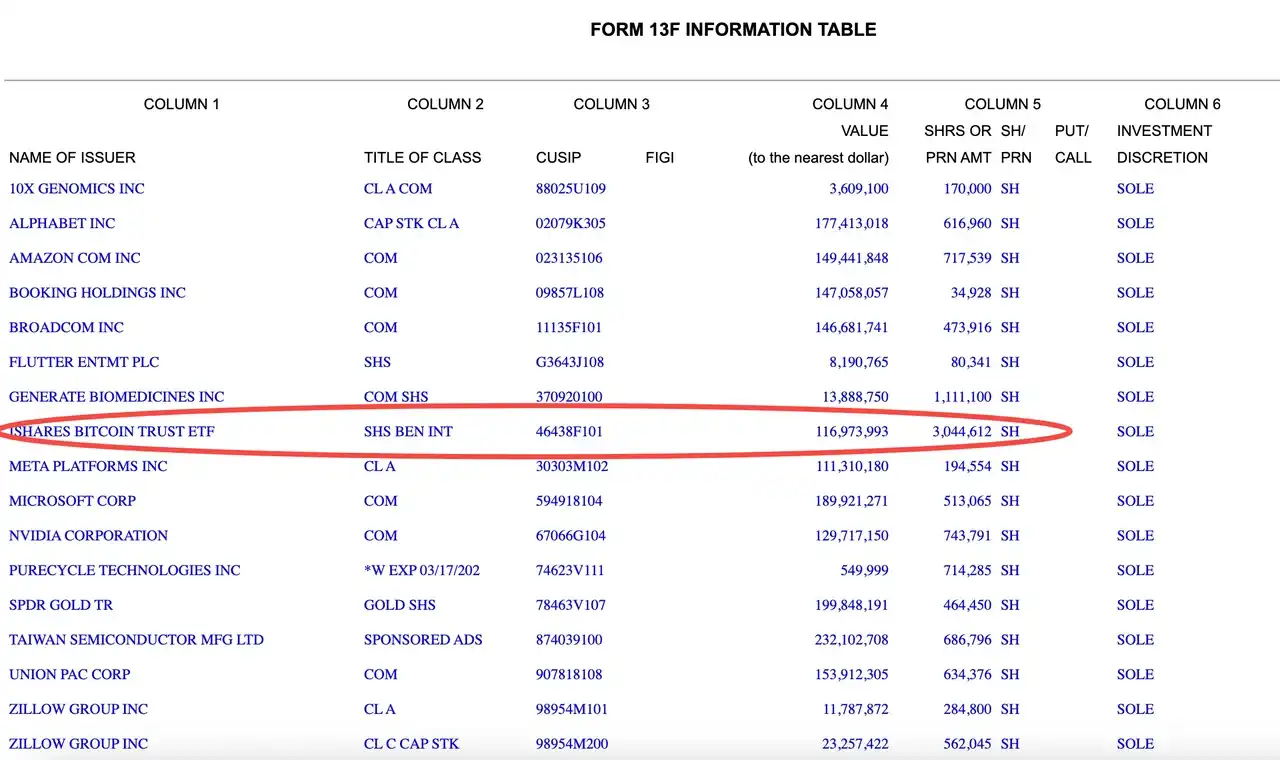
This change in holdings carries another layer of meaning. Harvard did not turn entirely defensive overall but instead reallocated part of its portfolio to assets related to the AI and computing power chain, increasing holdings in stocks like NVIDIA, Broadcom, and TSMC. Taken together, these moves look more like a structural rebalancing act of "reducing crypto, adding AI," rather than a comprehensive risk reduction.

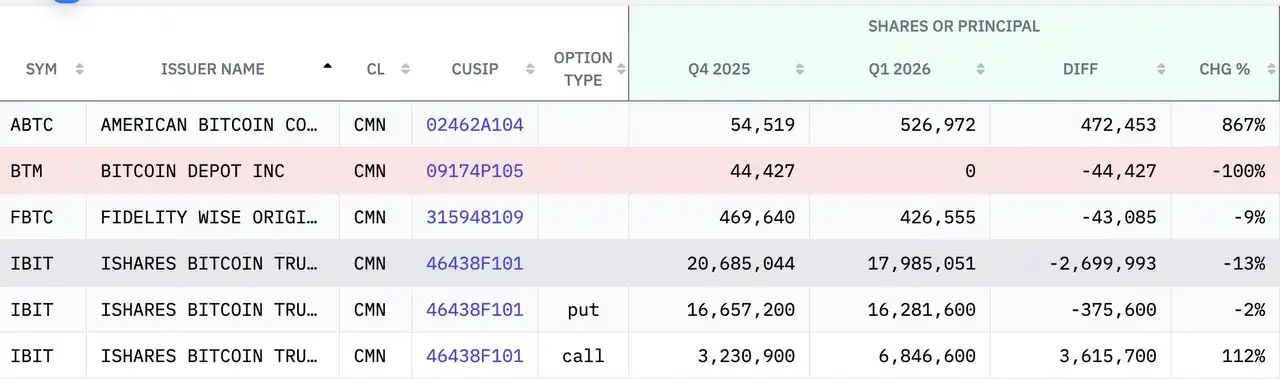
Goldman Sachs's strategy is broadly similar, albeit with more complex tactics. Comparing the latest two 13F reports, Goldman Sachs still held approximately $690 million worth of IBIT and about $25.18 million worth of FBTC (Fidelity Wise Origin Bitcoin Fund) at the end of Q1 2026, with both showing reductions from the previous quarter. More noteworthy than the simple reduction is its position structure: Goldman holds spot, call options, and put options on IBIT simultaneously, indicating this is not merely a directional bet but carries clear trading and hedging characteristics.
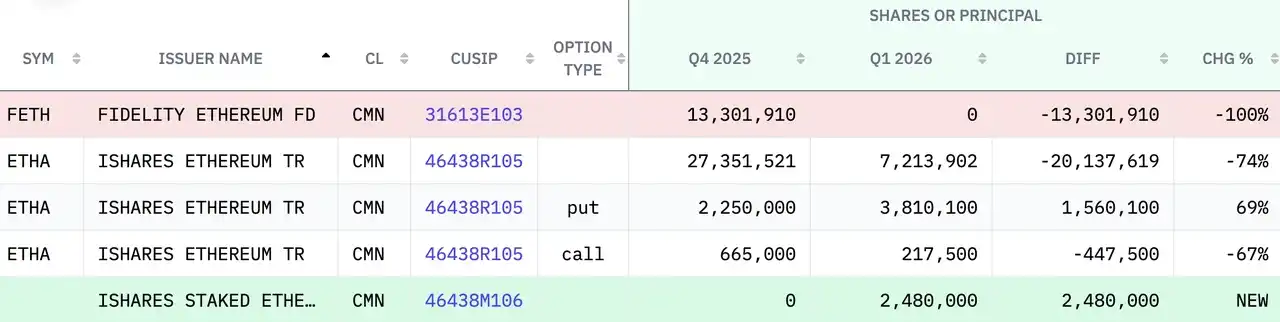
Goldman's handling of Ethereum was even more aggressive. It not only completely exited its position in the Fidelity Ethereum Fund (holding a value of $394 million at the end of Q4 2025) but also significantly reduced its spot position in iShares Ethereum Trust (ETHA) by about 74%, leaving a remaining position of about $114 million. Additionally, it newly acquired a position worth approximately $66.885 million in the iShares Staked Ethereum Trust ETF.
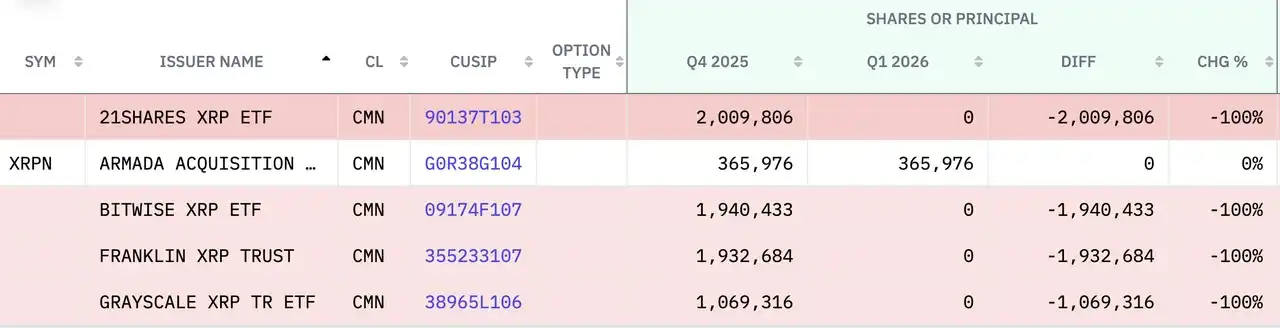
Meanwhile, Goldman Sachs has liquidated all its XRP and Solana-related ETFs. By the end of Q4 2025, it held a combined value of about $152 million in XRP ETFs from Bitwise, Franklin Templeton, Grayscale, and 21shares, and also liquidated all Solana ETFs/Trusts from Grayscale, Bitwise, and Fidelity (valued at $109 million at the end of Q4 2025).
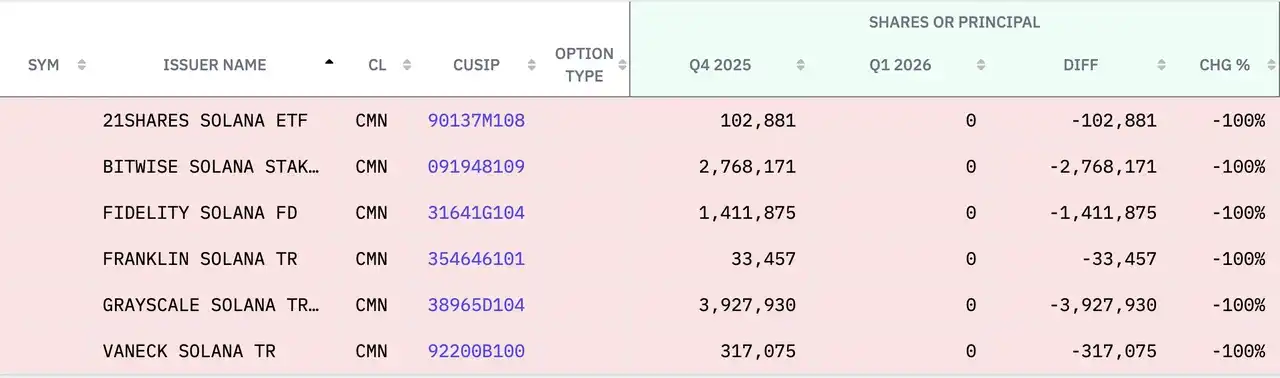
Regarding crypto-related stocks, Goldman Sachs increased its position in Circle by 249% to around $140 million, and its position in Galaxy Digital also rose by 205% (to $41.48 million). Holdings in Coinbase (+65%), Robinhood (+35%), and PayPal also increased. Meanwhile, it reduced holdings in Strategy and Riot Platforms. Overall, this resembles an internal rotation of "compressing ETF risk and shifting to selected individual stocks."

Among hedge funds, Millennium Management also gave a similar signal. Publicly compiled data shows its IBIT holdings decreased from 34.334 million shares to 19.287 million shares, a reduction of approximately 43.8%. Its ETHA holdings also declined synchronously (by about 34.3%), indicating a clear reduction in exposure to both Bitcoin and Ethereum spot ETFs.

London-based hedge fund manager Capula Management Ltd went even further. As of December 30, 2025, it held $470 million worth of IBIT, $160 million worth of FBTC, $207 million worth of ETHA, and $61.43 million worth of FETH. However, its latest 13F report shows these ETFs have been completely liquidated. Concurrently, Capula Management Ltd has also completely liquidated its Coinbase position (retaining a small options position).

Standing Pat Is Also an Attitude

The second category is those standing pat.

Brown University's IBIT holdings remain at 212,500 shares, with no increase or decrease. Calculated by disclosed market value, this position fell from about $10.551 million at the end of 2025 to about $8.164 million at the end of Q1 2026. Such university endowments do not directly convert a quarter's price volatility into trading instructions, instead emphasizing portfolio discipline and long-term allocation rhythm.

Dartmouth College's handling of crypto assets in Q1 2026 resembles a mild expansion rather than an aggressive rotation. Comparing its 13F with the previous quarter, the college retained its core Bitcoin ETF positions. The share count of IBIT remained largely unchanged, though the book value dropped from over $10 million to about $7.7 million due to the Q1 price pullback. For Ethereum exposure, it performed a product switch, replacing the previous Grayscale Ethereum Mini Trust with the staking-enabled Grayscale Ethereum Staking ETF, holding about 178,100 shares. It also newly established a position in the Bitwise Solana Staking ETF, approximately 304,803 shares, with a book value of about $3.3 million.

A Different Playbook: Buying the Dip

The third category consists of those increasing their holdings against the trend.

The Abu Dhabi sovereign wealth fund Mubadala is one of the most prominent names. Its IBIT holdings increased from 12,702,323 shares to 14,721,917 shares, a rise of about 15.9%. However, even though the share count increased, the quarter-end holding value still fell from about $631 million to about $566 million. This set of numbers is quite telling. The act of increasing holdings does not automatically lead to profits, especially when the market is still in a downtrend. Adding to positions first brings greater exposure, and only secondly might it bring higher future elasticity.

The moves by JPMorgan Chase can also be understood within this logic. The latest 13F data shows JPMorgan increased its IBIT holdings from about 3.028 million shares to about 8.30 million shares, a surge of 174%. It also increased exposure to some FBTC, BITB, and Ethereum ETFs. Judging by the share count change, it has clearly become more active; but this does not mean it has locked in excess returns during this volatility. For major banks, increasing ETF holdings is often about expanding the product shelf, meeting client allocation needs, and balancing liquidity and book risk, not just a one-way bullish bet.

The position changes at Wells Fargo are also worth examining separately. Comparing the two periods, the bank retained its core IBIT position while increasing allocations to products like BITB and the Grayscale Bitcoin Mini Trust. More notably, it significantly increased its Ethereum ETF exposure. Its ETHA holdings rose from about 672.6k shares to about 1.10 million shares, and its ETHW holdings also increased. In other words, Wells Fargo adopted a strategy of "retaining Bitcoin core positions and increasing Ethereum weight."

Market maker Jane Street showcases another typical style. Comparing the two 13F periods, it significantly reduced its Bitcoin spot ETF exposure in Q1, with IBIT holdings dropping from about 20.30 million shares to about 5.90 million shares, and FBTC also showing a clear decline. However, concurrently, it newly added about $82 million in Ethereum ETF exposure. On the crypto stock side, Jane Street increased holdings in Galaxy Digital (8746%), Circle (1162%), Coinbase (+14%), BitMine (+47%), and others. This combination looks more like a typical trading rebalancing: reducing Bitcoin ETFs, adding Ethereum ETFs, while seeking higher elasticity on the individual stock side.

Bitcoin, Ethereum, and Solana: Institutions Are Making Finer Risk Rankings

Another signal worth unpacking from this round of 13Fs is that institutional attitudes towards BTC ETFs, ETH ETFs, and even Solana ETFs are no longer uniform. The more pertinent question now is: which crypto asset are institutions prepared to keep as a core position, which one to place in an elastic position, and which one to simply remove for now.

Taking Harvard Management as an example, while it reduced IBIT, it completely exited ETHA. This resembles a risk ranking. The Bitcoin ETF still retains a relatively core position, while the Ethereum ETF was prioritized for reduction in the portfolio rebalancing.

Goldman Sachs's approach also indicates that large financial institutions are taking this ranking to an even more refined level. It still maintained a relatively large Bitcoin ETF exposure in Q1, but its contraction of Ethereum-related products was noticeably faster, while it essentially liquidated XRP and Solana-related ETFs. Taken together, Goldman is re-concentrating its portfolio onto the layer of assets it considers most liquid, easiest to hedge, and most easily incorporated into institutional risk models. Bitcoin here looks more like a "base position," Ethereum falls into the compressible category, and products like Solana and XRP are closer to peripheral experimental positions. Once market volatility amplifies, these are often the first to be cut.

On the other hand, Wells Fargo and Dartmouth College present completely different answers. Wells Fargo actively increased the weight of Ethereum ETFs, suggesting that within its internal framework, Ethereum is more like a secondary position worth increasing allocation during a pullback to capture potential upside. Dartmouth College's strategy is even more representative: it left its Bitcoin ETF core untouched but extended its new elastic exposure to Solana-related ETFs, especially those with staking attributes.

13F Gives the Market a Snapshot, But Also Leaves Blanks

This is also where the most restraint is needed when looking at institutional holdings.

13F filings allow the outside world to see, under a unified standard, how mainstream institutions allocate to crypto ETFs. But they also have very clear boundaries. First, there is a time lag. What investors see in May is only a snapshot of institutions' positions as of March 31, the quarter-end. If significant adjustments were made in Q2, the tables won't show it in advance. Second, 13F only shows holdings, not the actual purchase cost. A decline in an institution's holding value over a quarter does not necessarily mean an overall loss, as it might have bought earlier, or may have reduced and re-added positions during the quarter.

Furthermore, for institutions like Goldman Sachs, positions in spot ETFs are often overlaid with options, hedging, and market-making related positions. Looking at the table alone can easily mistake trading behavior for a long-term stance.

Yet, precisely because it is incomplete, the 13F is more like a window into institutional sentiment, not a conclusion table. Seeing Abu Dhabi's Mubadala increase holdings while its book value declined shows the patience of sovereign wealth. Seeing Brown University stand pat while enduring a pullback shows long-term allocation discipline. Seeing Harvard University reduce Bitcoin and exit Ethereum ETFs reveals the real sensitivity of university endowments to volatility. And seeing JPMorgan, Wells Fargo, and Jane Street continue to adjust exposure on certain products indicates that Wall Street still treats crypto ETFs as a category that needs to remain on the shelf and be constantly repriced.


Preguntas relacionadas

QWhat does the article reveal about the different strategies of major institutional investors regarding crypto ETF holdings during the first quarter of 2026?

AThe article reveals a clear divergence in strategies among U.S. institutional investors during the Q1 2026 market pullback. Some, like Harvard Management and Goldman Sachs, actively reduced their exposure to crypto ETFs, particularly those tied to Ethereum and altcoins like XRP and Solana, often reallocating towards assets like AI and selected crypto equities. Others, such as Brown University, maintained their holdings, reflecting a long-term discipline. Conversely, institutions like the Abu Dhabi sovereign fund Mubadala and JPMorgan increased their holdings, viewing the dip as an opportunity to expand exposure, though not necessarily signaling immediate bullishness but rather actions related to client servicing and portfolio rebalancing.

QHow did Harvard Management adjust its crypto and AI-related investments in Q1 2026, according to the 13F filings?

AAccording to 13F filings, Harvard Management significantly reduced its exposure to crypto ETFs. It cut its holdings in the iShares Bitcoin Trust (IBIT) by approximately 43% and completely exited its position in the iShares Ethereum Trust (ETHA). Concurrently, it reallocated capital into AI and computing-related assets, increasing its holdings in companies like NVIDIA, Broadcom, and TSMC. This indicates a strategic portfolio rebalancing, shifting away from crypto assets towards the AI sector, rather than a broad-based risk reduction.

QWhat specific actions did Goldman Sachs take regarding its Ethereum and altcoin ETF holdings in the reported quarter?

AGoldman Sachs took aggressive actions on its Ethereum and altcoin ETF holdings. It completely exited its position in the Fidelity Ethereum Fund and significantly reduced its holding in the iShares Ethereum Trust (ETHA) by about 74%. It also introduced a new position in the iShares Staked Ethereum Trust ETF. Furthermore, Goldman Sachs completely liquidated all its holdings in XRP and Solana-related ETFs from various issuers like Bitwise, Franklin Templeton, Grayscale, and 21Shares, which were valued at hundreds of millions of dollars at the end of Q4 2025.

QWhich institutions were cited as examples of "buying the dip" or increasing their crypto ETF exposure in Q1 2026, and what does the article suggest about their motivation?

AInstitutions cited as increasing their crypto ETF exposure include the Abu Dhabi sovereign fund Mubadala, JPMorgan, and Wells Fargo. Mubadala increased its IBIT holdings by about 15.9%, while JPMorgan dramatically boosted its IBIT position by 174%. Wells Fargo increased its holdings in Ethereum ETFs. The article suggests that for these large institutions, such increases are not solely a directional bullish bet on price. Motivations are more complex, involving expanding product offerings for clients, meeting allocation demands, balancing liquidity, managing book risk, or strategically increasing exposure to assets perceived to have higher future elasticity during a market downturn.

QWhat are the key limitations of 13F filings as a tool for understanding institutional investment behavior, as highlighted in the article?

AThe article highlights several key limitations of 13F filings. First, they have a significant time lag, showing only a snapshot of holdings at the quarter's end (e.g., March 31st), which may not reflect subsequent trades within the new quarter. Second, 13Fs show only holdings, not the actual purchase cost or the profitability of positions. A decline in reported value doesn't necessarily mean an overall loss. Third, for firms like Goldman Sachs, the reported ETF holdings are often part of a complex strategy involving options, hedging, and market-making activities. Therefore, viewing the static data alone can lead to misinterpreting tactical trades as long-term investment convictions.

Lecturas Relacionadas

Warsh's First Day in Office, Markets Deliver a 'Wake-up Call': Rate Hike Expected This Year

On his first day in office, newly inaugurated Federal Reserve Chairman Warsh received a stark market warning, with expectations now fully pricing in a 25-basis-point interest rate hike this year. The shift was triggered by hawkish remarks from Fed Governor Waller, who stated that inflation is now the key policy "driver" and that the odds of a hike or cut are evenly split. This sent short-term Treasury yields higher. Waller signaled a significant pivot in his stance, citing disappointing inflation and labor data. He suggested removing "easing bias" language from Fed statements and did not rule out future rate increases if inflation fails to recede, though he noted immediate action isn't warranted without signs of unanchored inflation expectations. Chairman Warsh faces immediate pressure at his first FOMC meeting in June. With the preferred inflation gauge at a three-year high, analysts warn that failing to hike could be interpreted as an implicit easing of policy. The geopolitical situation in the Middle East is adding to existing price pressures. The market's expectation for a hike contrasts sharply with earlier forecasts for multiple cuts. While long-term Treasury yields have been contained by lower energy prices recently, analysts note they remain under structural upward pressure. Warsh's swearing-in at the White House highlights political scrutiny over Fed independence. However, the market has made it clear that inflation is the most urgent challenge, leaving the new chairman little time to settle in.

marsbitHace 10 hora(s)

Warsh's First Day in Office, Markets Deliver a 'Wake-up Call': Rate Hike Expected This Year

marsbitHace 10 hora(s)

Has Microsoft Lost Its Way in the AI Race, and Can Copilot Bring It Back on Track?

Microsoft, once seen as an early AI frontrunner due to its investment in OpenAI, is navigating a strategic shift amid increased competition. Its initial reliance on OpenAI’s GPT models has been complicated by OpenAI’s growing ambitions as a direct competitor, rapid advancements from rivals like Claude and Gemini, and the disruptive rise of AI agents, which challenge its traditional SaaS business model. These factors contributed to stock declines and slower-than-expected adoption of its flagship Copilot products. In response, CEO Satya Nadella has taken a hands-on role in product development, signaling the urgency of change. Microsoft is pivoting from a model-centric strategy to a "model-agnostic" enterprise platform approach. It aims to become the foundational layer connecting various AI models—from OpenAI, Anthropic, or its own new "Superintelligence" team—with enterprise workflows, data, security, and cloud services. Recent organizational changes merged consumer and enterprise Copilot teams to accelerate innovation, exemplified by new products like Copilot Tasks and Copilot Cowork. However, this transformation comes at a high cost. Microsoft faces massive capital expenditures, potentially reaching ~$190 billion by 2026, to support AI infrastructure. While its platform strategy shows early signs of traction with growing Azure AI revenue, it must balance startup-like agility with the reliability expected by enterprise clients. The core challenge is no longer being the sole AI winner but defending its position as the essential enterprise software entry point amidst rapid technological commoditization and the shift towards always-on AI agents.

marsbitHace 10 hora(s)

Has Microsoft Lost Its Way in the AI Race, and Can Copilot Bring It Back on Track?

marsbitHace 10 hora(s)

Trading

Spot
Futuros

Artículos destacados

Qué es $S$

Entendiendo SPERO: Una Visión General Completa Introducción a SPERO A medida que el panorama de la innovación continúa evolucionando, la aparición de tecnologías web3 y proyectos de criptomonedas juega un papel fundamental en la configuración del futuro digital. Un proyecto que ha atraído la atención en este campo dinámico es SPERO, denotado como SPERO,$$s$. Este artículo tiene como objetivo reunir y presentar información detallada sobre SPERO, para ayudar a entusiastas e inversores a comprender sus fundamentos, objetivos e innovaciones dentro de los dominios web3 y cripto. ¿Qué es SPERO,$$s$? SPERO,$$s$ es un proyecto único dentro del espacio cripto que busca aprovechar los principios de descentralización y tecnología blockchain para crear un ecosistema que promueva la participación, la utilidad y la inclusión financiera. El proyecto está diseñado para facilitar interacciones de igual a igual de nuevas maneras, proporcionando a los usuarios soluciones y servicios financieros innovadores. En su esencia, SPERO,$$s$ tiene como objetivo empoderar a los individuos al proporcionar herramientas y plataformas que mejoren la experiencia del usuario en el espacio de las criptomonedas. Esto incluye habilitar métodos de transacción más flexibles, fomentar iniciativas impulsadas por la comunidad y crear caminos para oportunidades financieras a través de aplicaciones descentralizadas (dApps). La visión subyacente de SPERO,$$s$ gira en torno a la inclusividad, buscando cerrar brechas dentro de las finanzas tradicionales mientras aprovecha los beneficios de la tecnología blockchain. ¿Quién es el Creador de SPERO,$$s$? La identidad del creador de SPERO,$$s$ sigue siendo algo oscura, ya que hay recursos públicos limitados que proporcionan información de fondo detallada sobre su(s) fundador(es). Esta falta de transparencia puede derivarse del compromiso del proyecto con la descentralización, una ética que muchos proyectos web3 comparten, priorizando las contribuciones colectivas sobre el reconocimiento individual. Al centrar las discusiones en torno a la comunidad y sus objetivos colectivos, SPERO,$$s$ encarna la esencia del empoderamiento sin señalar a individuos específicos. Como tal, comprender la ética y la misión de SPERO sigue siendo más importante que identificar a un creador singular. ¿Quiénes son los Inversores de SPERO,$$s$? SPERO,$$s$ cuenta con el apoyo de una diversa gama de inversores que van desde capitalistas de riesgo hasta inversores ángeles dedicados a fomentar la innovación en el sector cripto. El enfoque de estos inversores generalmente se alinea con la misión de SPERO, priorizando proyectos que prometen avances tecnológicos sociales, inclusión financiera y gobernanza descentralizada. Estas fundaciones de inversores suelen estar interesadas en proyectos que no solo ofrecen productos innovadores, sino que también contribuyen positivamente a la comunidad blockchain y sus ecosistemas. El respaldo de estos inversores refuerza a SPERO,$$s$ como un contendiente notable en el dominio de proyectos cripto que evoluciona rápidamente. ¿Cómo Funciona SPERO,$$s$? SPERO,$$s$ emplea un marco multifacético que lo distingue de los proyectos de criptomonedas convencionales. Aquí hay algunas de las características clave que subrayan su singularidad e innovación: Gobernanza Descentralizada: SPERO,$$s$ integra modelos de gobernanza descentralizada, empoderando a los usuarios para participar activamente en los procesos de toma de decisiones sobre el futuro del proyecto. Este enfoque fomenta un sentido de propiedad y responsabilidad entre los miembros de la comunidad. Utilidad del Token: SPERO,$$s$ utiliza su propio token de criptomoneda, diseñado para servir diversas funciones dentro del ecosistema. Estos tokens permiten transacciones, recompensas y la facilitación de servicios ofrecidos en la plataforma, mejorando la participación y la utilidad general. Arquitectura en Capas: La arquitectura técnica de SPERO,$$s$ apoya la modularidad y escalabilidad, permitiendo la integración fluida de características y aplicaciones adicionales a medida que el proyecto evoluciona. Esta adaptabilidad es fundamental para mantener la relevancia en el cambiante paisaje cripto. Participación de la Comunidad: El proyecto enfatiza iniciativas impulsadas por la comunidad, empleando mecanismos que incentivan la colaboración y la retroalimentación. Al nutrir una comunidad sólida, SPERO,$$s$ puede abordar mejor las necesidades de los usuarios y adaptarse a las tendencias del mercado. Enfoque en la Inclusión: Al ofrecer tarifas de transacción bajas e interfaces amigables para el usuario, SPERO,$$s$ busca atraer a una base de usuarios diversa, incluyendo a individuos que anteriormente pueden no haber participado en el espacio cripto. Este compromiso con la inclusión se alinea con su misión general de empoderamiento a través de la accesibilidad. Cronología de SPERO,$$s$ Entender la historia de un proyecto proporciona información crucial sobre su trayectoria de desarrollo y hitos. A continuación se presenta una cronología sugerida que mapea eventos significativos en la evolución de SPERO,$$s$: Fase de Conceptualización e Ideación: Las ideas iniciales que forman la base de SPERO,$$s$ fueron concebidas, alineándose estrechamente con los principios de descentralización y enfoque comunitario dentro de la industria blockchain. Lanzamiento del Whitepaper del Proyecto: Tras la fase conceptual, se lanzó un whitepaper completo que detalla la visión, los objetivos y la infraestructura tecnológica de SPERO,$$s$ para generar interés y retroalimentación de la comunidad. Construcción de Comunidad y Primeras Interacciones: Se realizaron esfuerzos de divulgación activa para construir una comunidad de primeros adoptantes y posibles inversores, facilitando discusiones en torno a los objetivos del proyecto y obteniendo apoyo. Evento de Generación de Tokens: SPERO,$$s$ llevó a cabo un evento de generación de tokens (TGE) para distribuir sus tokens nativos a los primeros seguidores y establecer liquidez inicial dentro del ecosistema. Lanzamiento de la dApp Inicial: La primera aplicación descentralizada (dApp) asociada con SPERO,$$s$ se puso en marcha, permitiendo a los usuarios interactuar con las funcionalidades centrales de la plataforma. Desarrollo Continuo y Alianzas: Actualizaciones y mejoras continuas a las ofertas del proyecto, incluyendo alianzas estratégicas con otros actores en el espacio blockchain, han moldeado a SPERO,$$s$ en un jugador competitivo y en evolución en el mercado cripto. Conclusión SPERO,$$s$ se erige como un testimonio del potencial de web3 y las criptomonedas para revolucionar los sistemas financieros y empoderar a los individuos. Con un compromiso con la gobernanza descentralizada, la participación comunitaria y funcionalidades diseñadas de manera innovadora, allana el camino hacia un paisaje financiero más inclusivo. Como con cualquier inversión en el espacio cripto que evoluciona rápidamente, se anima a los posibles inversores y usuarios a investigar a fondo y participar de manera reflexiva con los desarrollos en curso dentro de SPERO,$$s$. El proyecto muestra el espíritu innovador de la industria cripto, invitando a una mayor exploración de sus innumerables posibilidades. Mientras el viaje de SPERO,$$s$ aún se desarrolla, sus principios fundamentales pueden, de hecho, influir en el futuro de cómo interactuamos con la tecnología, las finanzas y entre nosotros en ecosistemas digitales interconectados.

72 Vistas totalesPublicado en 2024.12.17Actualizado en 2024.12.17

Qué es $S$

Qué es AGENT S

Agent S: El Futuro de la Interacción Autónoma en Web3 Introducción En el paisaje en constante evolución de Web3 y las criptomonedas, las innovaciones están redefiniendo constantemente cómo los individuos interactúan con las plataformas digitales. Uno de estos proyectos pioneros, Agent S, promete revolucionar la interacción humano-computadora a través de su marco agente abierto. Al allanar el camino para interacciones autónomas, Agent S busca simplificar tareas complejas, ofreciendo aplicaciones transformadoras en inteligencia artificial (IA). Esta exploración detallada profundizará en las complejidades del proyecto, sus características únicas y las implicaciones para el dominio de las criptomonedas. ¿Qué es Agent S? Agent S se presenta como un marco agente abierto innovador, diseñado específicamente para abordar tres desafíos fundamentales en la automatización de tareas informáticas: Adquisición de Conocimiento Específico del Dominio: El marco aprende inteligentemente de diversas fuentes de conocimiento externas y experiencias internas. Este enfoque dual le permite construir un rico repositorio de conocimiento específico del dominio, mejorando su rendimiento en la ejecución de tareas. Planificación a Largo Plazo de Tareas: Agent S emplea planificación jerárquica aumentada por la experiencia, un enfoque estratégico que facilita la descomposición y ejecución eficiente de tareas complejas. Esta característica mejora significativamente su capacidad para gestionar múltiples subtareas de manera eficiente y efectiva. Manejo de Interfaces Dinámicas y No Uniformes: El proyecto introduce la Interfaz Agente-Computadora (ACI), una solución innovadora que mejora la interacción entre agentes y usuarios. Utilizando Modelos de Lenguaje Multimodal de Gran Escala (MLLMs), Agent S puede navegar y manipular diversas interfaces gráficas de usuario sin problemas. A través de estas características pioneras, Agent S proporciona un marco robusto que aborda las complejidades involucradas en la automatización de la interacción humana con las máquinas, preparando el terreno para una multitud de aplicaciones en IA y más allá. ¿Quién es el Creador de Agent S? Si bien el concepto de Agent S es fundamentalmente innovador, la información específica sobre su creador sigue siendo elusiva. El creador es actualmente desconocido, lo que resalta ya sea la etapa incipiente del proyecto o la elección estratégica de mantener a los miembros fundadores en el anonimato. Independientemente de la anonimidad, el enfoque sigue siendo en las capacidades y el potencial del marco. ¿Quiénes son los Inversores de Agent S? Dado que Agent S es relativamente nuevo en el ecosistema criptográfico, la información detallada sobre sus inversores y patrocinadores financieros no está documentada explícitamente. La falta de información disponible públicamente sobre las bases de inversión u organizaciones que apoyan el proyecto plantea preguntas sobre su estructura de financiamiento y hoja de ruta de desarrollo. Comprender el respaldo es crucial para evaluar la sostenibilidad del proyecto y su posible impacto en el mercado. ¿Cómo Funciona Agent S? En el núcleo de Agent S se encuentra una tecnología de vanguardia que le permite funcionar de manera efectiva en diversos entornos. Su modelo operativo se basa en varias características clave: Interacción Humano-Computadora Similar a la Humana: El marco ofrece planificación avanzada de IA, esforzándose por hacer que las interacciones con las computadoras sean más intuitivas. Al imitar el comportamiento humano en la ejecución de tareas, promete elevar las experiencias de los usuarios. Memoria Narrativa: Empleada para aprovechar experiencias de alto nivel, Agent S utiliza memoria narrativa para hacer un seguimiento de las historias de tareas, mejorando así sus procesos de toma de decisiones. Memoria Episódica: Esta característica proporciona a los usuarios una guía paso a paso, permitiendo que el marco ofrezca apoyo contextual a medida que se desarrollan las tareas. Soporte para OpenACI: Con la capacidad de ejecutarse localmente, Agent S permite a los usuarios mantener el control sobre sus interacciones y flujos de trabajo, alineándose con la ética descentralizada de Web3. Fácil Integración con APIs Externas: Su versatilidad y compatibilidad con varias plataformas de IA aseguran que Agent S pueda encajar sin problemas en ecosistemas tecnológicos existentes, convirtiéndolo en una opción atractiva para desarrolladores y organizaciones. Estas funcionalidades contribuyen colectivamente a la posición única de Agent S dentro del espacio cripto, ya que automatiza tareas complejas y de múltiples pasos con una intervención humana mínima. A medida que el proyecto evoluciona, sus posibles aplicaciones en Web3 podrían redefinir cómo se desarrollan las interacciones digitales. Cronología de Agent S El desarrollo y los hitos de Agent S pueden encapsularse en una cronología que resalta sus eventos significativos: 27 de septiembre de 2024: El concepto de Agent S fue lanzado en un documento de investigación integral titulado “Un Marco Agente Abierto que Usa Computadoras Como un Humano”, mostrando las bases del proyecto. 10 de octubre de 2024: El documento de investigación fue puesto a disposición del público en arXiv, ofreciendo una exploración profunda del marco y su evaluación de rendimiento basada en el benchmark OSWorld. 12 de octubre de 2024: Se lanzó una presentación en video, proporcionando una visión visual de las capacidades y características de Agent S, involucrando aún más a posibles usuarios e inversores. Estos marcadores en la cronología no solo ilustran el progreso de Agent S, sino que también indican su compromiso con la transparencia y la participación comunitaria. Puntos Clave Sobre Agent S A medida que el marco Agent S continúa evolucionando, varios atributos clave destacan, subrayando su naturaleza innovadora y potencial: Marco Innovador: Diseñado para proporcionar un uso intuitivo de las computadoras similar a la interacción humana, Agent S aporta un enfoque novedoso a la automatización de tareas. Interacción Autónoma: La capacidad de interactuar de manera autónoma con las computadoras a través de GUI significa un salto hacia soluciones informáticas más inteligentes y eficientes. Automatización de Tareas Complejas: Con su metodología robusta, puede automatizar tareas complejas y de múltiples pasos, haciendo que los procesos sean más rápidos y menos propensos a errores. Mejora Continua: Los mecanismos de aprendizaje permiten a Agent S mejorar a partir de experiencias pasadas, mejorando continuamente su rendimiento y eficacia. Versatilidad: Su adaptabilidad en diferentes entornos operativos como OSWorld y WindowsAgentArena asegura que pueda servir a una amplia gama de aplicaciones. A medida que Agent S se posiciona en el paisaje de Web3 y criptomonedas, su potencial para mejorar las capacidades de interacción y automatizar procesos significa un avance significativo en las tecnologías de IA. A través de su marco innovador, Agent S ejemplifica el futuro de las interacciones digitales, prometiendo una experiencia más fluida y eficiente para los usuarios en diversas industrias. Conclusión Agent S representa un audaz avance en la unión de la IA y Web3, con la capacidad de redefinir cómo interactuamos con la tecnología. Aunque aún se encuentra en sus primeras etapas, las posibilidades para su aplicación son vastas y atractivas. A través de su marco integral que aborda desafíos críticos, Agent S busca llevar las interacciones autónomas al primer plano de la experiencia digital. A medida que nos adentramos más en los reinos de las criptomonedas y la descentralización, proyectos como Agent S sin duda desempeñarán un papel crucial en la configuración del futuro de la tecnología y la colaboración humano-computadora.

454 Vistas totalesPublicado en 2025.01.14Actualizado en 2025.01.14

Qué es AGENT S

Cómo comprar S

¡Bienvenido a HTX.com! Hemos hecho que comprar Sonic (S) sea simple y conveniente. Sigue nuestra guía paso a paso para iniciar tu viaje de criptos.Paso 1: crea tu cuenta HTXUtiliza tu correo electrónico o número de teléfono para registrarte y obtener una cuenta gratuita en HTX. Experimenta un proceso de registro sin complicaciones y desbloquea todas las funciones.Obtener mi cuentaPaso 2: ve a Comprar cripto y elige tu método de pagoTarjeta de crédito/débito: usa tu Visa o Mastercard para comprar Sonic (S) al instante.Saldo: utiliza fondos del saldo de tu cuenta HTX para tradear sin problemas.Terceros: hemos agregado métodos de pago populares como Google Pay y Apple Pay para mejorar la comodidad.P2P: tradear directamente con otros usuarios en HTX.Over-the-Counter (OTC): ofrecemos servicios personalizados y tipos de cambio competitivos para los traders.Paso 3: guarda tu Sonic (S)Después de comprar tu Sonic (S), guárdalo en tu cuenta HTX. Alternativamente, puedes enviarlo a otro lugar mediante transferencia blockchain o utilizarlo para tradear otras criptomonedas.Paso 4: tradear Sonic (S)Tradear fácilmente con Sonic (S) en HTX's mercado spot. Simplemente accede a tu cuenta, selecciona tu par de trading, ejecuta tus trades y monitorea en tiempo real. Ofrecemos una experiencia fácil de usar tanto para principiantes como para traders experimentados.

869 Vistas totalesPublicado en 2025.01.15Actualizado en 2025.03.21

Cómo comprar S

Discusiones

Bienvenido a la comunidad de HTX. Aquí puedes mantenerte informado sobre los últimos desarrollos de la plataforma y acceder a análisis profesionales del mercado. A continuación se presentan las opiniones de los usuarios sobre el precio de S (S).

活动图片













