Who is Placing Counterintuitive Bets in Prediction Markets?

Odaily星球日报Publicado a 2026-01-08Actualizado a 2026-01-08

Resumen

Who Bets Against Common Sense in Prediction Markets? This article explores the counterintuitive players who provide liquidity by betting "Yes" on seemingly improbable events on prediction markets like Polymarket. Contrary to appearing irrational, these participants are often driven by calculated strategies. Three key groups are identified: 1. **The Lottery Players:** These individuals focus on high odds, betting small amounts for a potentially large payoff. They capitalize on the small but non-zero chance of a black swan event or a market settlement error, making such high-risk, high-reward bets a rational part of a diversified strategy. 2. **Bots:** Automated trading algorithms are significant liquidity providers. They quickly engage in new markets, scooping up ultra-cheap "Yes" shares and then placing slightly higher sell orders to profit from subsequent buyers (like lottery players or other bots). Some bots also trade to generate volume, potentially aiming to qualify for future airdrops. 3. **The Prediction Platforms:** Polymarket itself incentivizes liquidity through programs like maker incentives and holding rewards (e.g., a 4% APY for holding shares in specific markets). These financial incentives make providing liquidity on unlikely outcomes attractive, as rewards can offset potential losses or enhance gains, contributing significantly to market depth and volume. The analysis concludes that those betting against the consensus are not merely "stupid" but are often...

Original | Odaily Planet Daily (@OdailyChina)

Author | Golem (@web3_golem)

This week, I wrote an article reviewing the absurd event contracts on Polymarket, pointing out that betting on some seemingly outrageous contracts at this time would be profitable.

This made me wonder: who is going against "common sense" to provide "free money" for the market?

Bets that oppose our smart choices aren't completely without a chance of happening; there are certainly some people who firmly believe in their judgments (for example, some still believe the Earth is flat). But prediction markets aren't a "greater fool market." I believe that when players use real money to predict whether an event will occur, they will do their best to think as a "rational person," meaning their decisions are the most economical and profitable. Therefore, from this perspective, those users betting "Yes" on seemingly impossible event contracts must also have some kind of profit strategy; they aren't fools providing us with "high-certainty" financial opportunities for free.

After thinking and discussing, I believe that those providing counterparty liquidity in these absurd event markets likely fall into the following three categories (this article is meant to spark discussion, welcome feedback and corrections, X@web3_golem):

Lottery Players

The logic of lottery players is simple: they focus only on the odds, aiming for a small stake to win big.

Sometimes, real life is far more surreal than we imagine; even events that seem outrageous can happen. Moreover, although prediction markets settle based on the real world, settlement results can sometimes be distorted due to settlement conditions, system failures, and other factors. Polymarket has had instances where settlement results did not match reality due to issues with UMA's dispute resolution mechanism. A recent example is Polymarket ruling that the US military action in Venezuela did not constitute an "invasion."

Therefore, long-tail odds偏差 (bias) appear. Even for events with a very small probability of occurring, the Yes side still has a price of 1%-3%. As long as the odds are high enough, "lottery players" will buy, becoming one of the firm bottom buy supports.

But actually, this psychology of "lottery players" is also rational. For example, in the event contract "Will Putin step down before the end of 2026?", driven by common sense, most people will buy "No," and the probability already shows people's attitude. But the Yes side still has a 10% probability, meaning if you bet $10, you could get $100 back if Putin really steps down before the end of 2026—a 10x return. So, why not gamble?
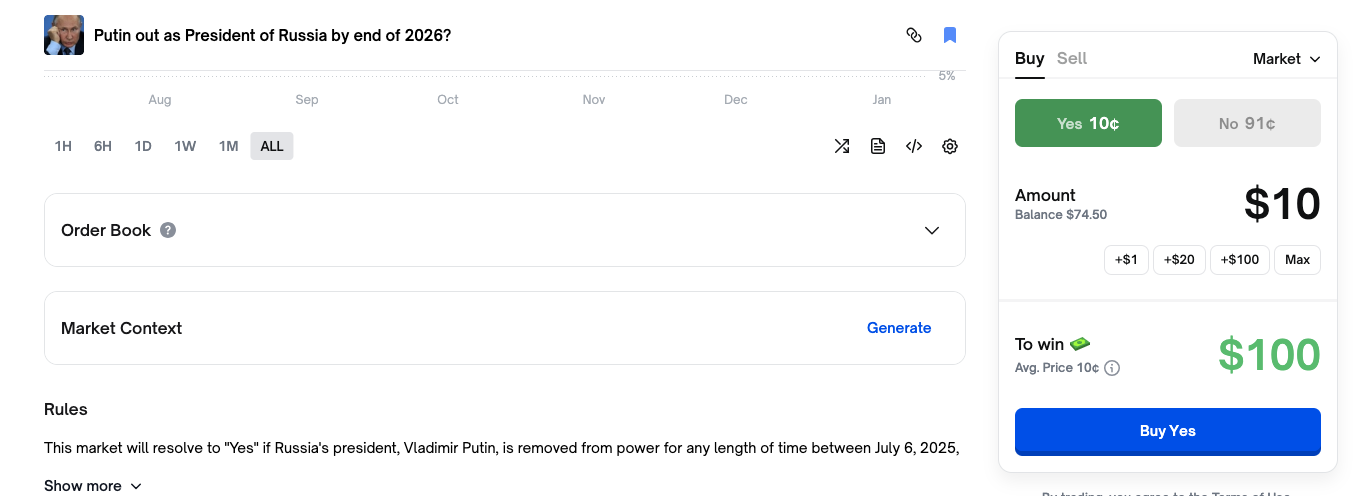
Furthermore, lottery players don't necessarily place heavy bets on a single market. Since prediction markets are不缺 (not short of) such high-odds events, by casting a wide net and hitting the jackpot a few times, there's still a chance to recoup costs and even profit.

They anticipate black swan events more than normal people. Therefore, they are happy to provide buy-side liquidity on the Yes side of "counterintuitive" markets (In some markets, Polymarket provides placing rewards and holding rewards, but this is not the main factor driving lottery players).

Bots

If an event contract itself has strong certainty, the intervention of players sweeping the尾盘 (end-of-market) will push the probability on one side to 99%-100% before settlement. The existence of "lottery players" can partially explain why these "counterintuitive" markets still have players taking the Yes sell orders (Odaily Note: Because Polymarket uses a shared order book, meaning when the No side has a buy order for 1 share at $0.99, the Yes side will correspondingly have a sell order for 1 share at $0.01), but they are always a minority group and cannot explain why these markets still have large trading volumes and good depth.

So, who else is injecting large amounts of liquidity into these markets? The answer is bots.

Market-making bots on Polymarket have developed very rapidly. Bots that trade automatically through the Polymarket API actively monitor all newly created markets and are often among the first participants. These bots can profit by actively trading in these markets.

In these "counterintuitive" markets, when the No side price is $0.99, due to the shared order book, the Yes side will have sell orders listed at $0.01. Market-making bots, like "lottery players," will also eat these $0.01 sell orders. But immediately after, they will list sell orders on the Yes side at $0.02, $0.03, or even higher, waiting for "lottery players" or other bots to成交 (execute the trade). The No side will also see buy orders at $0.98, $0.97, or even lower (Odaily Note: again due to the shared order book). Thus, the order book gains significant depth.

However, after communicating with the crypto VC Jsquare team (they invested in prediction market aggregator Rocket), they believe there aren't many bots executing this strategy on the market. In these "counterintuitive" markets, the speculative psychology of "lottery players" or regular players is enough to support most of the opposing orders.

The existence of some wash trading bots also provides market liquidity and trading volume for these "counterintuitive" and somewhat niche markets (compared to events like the US election). A wash trading bot places a buy order on the Yes side at $0.02, and another wash trading bot places a buy order on the No side at $0.98 to execute the trade.

This behavior is mainly to qualify for future prediction market airdrops. In high-frequency markets, orders might be matched by other players, so these "counterintuitive" event contracts are the ideal tools for wash trading.

Prediction Platforms

In addition to the above "lottery players" and bots, the prediction platforms themselves also contribute greatly to the liquidity of these markets.

Polymarket's mechanism includes two liquidity incentives: placing rewards and holding rewards. Placing rewards mean that in some specific markets, players can get rewards simply by placing orders within the maximum stipulated spread. Holding rewards mean that in some specific markets, players holding shares, whether Yes or No, can receive a 4% annualized holding reward.
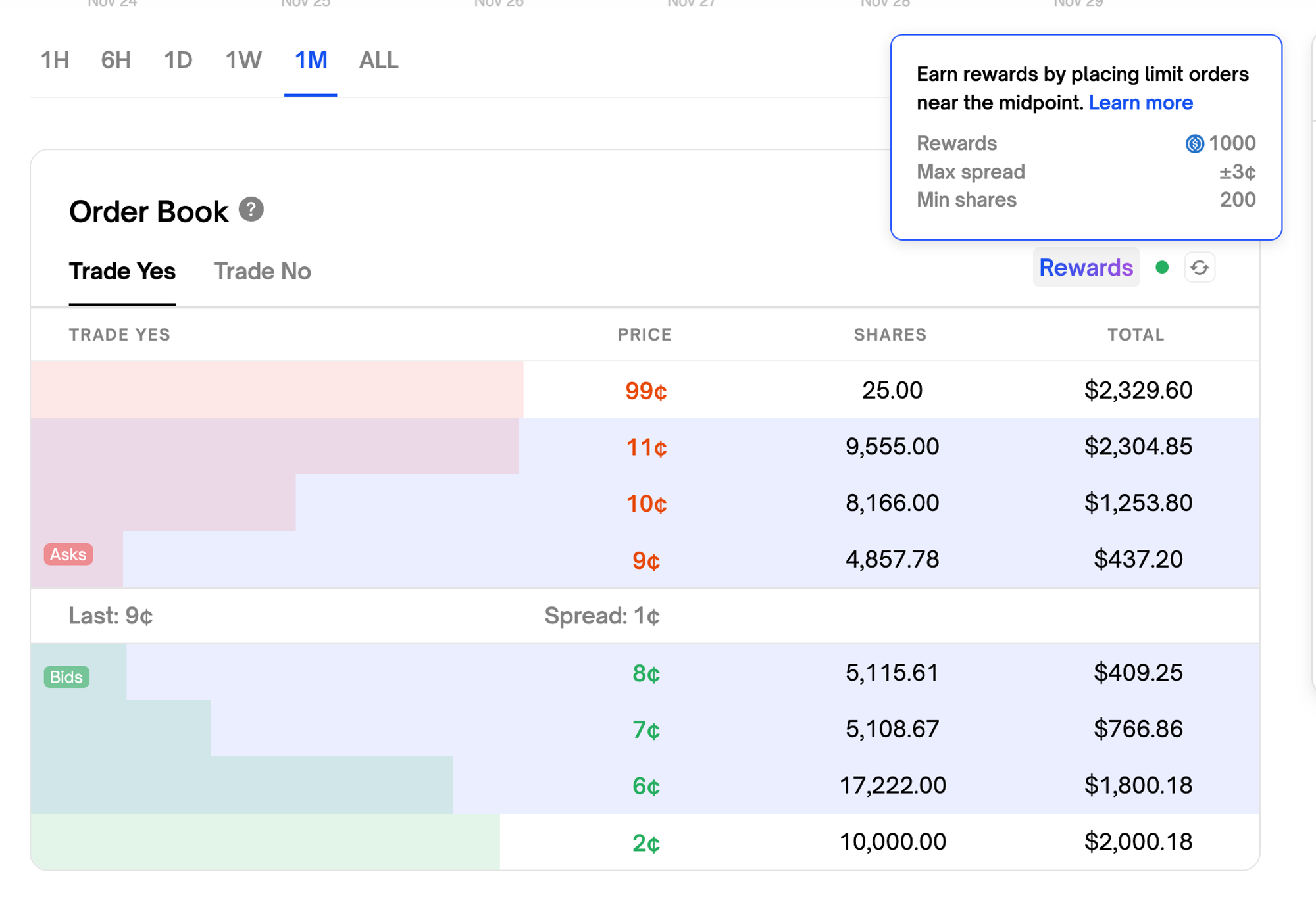
The highlighted part indicates the maximum spread range for placing rewards

According to statistics, Polymarket has invested about $10 million in market maker incentives, paying over $50,000 daily at its peak to maintain order book liquidity. These incentives have now decreased to just $0.025 per $100 traded.

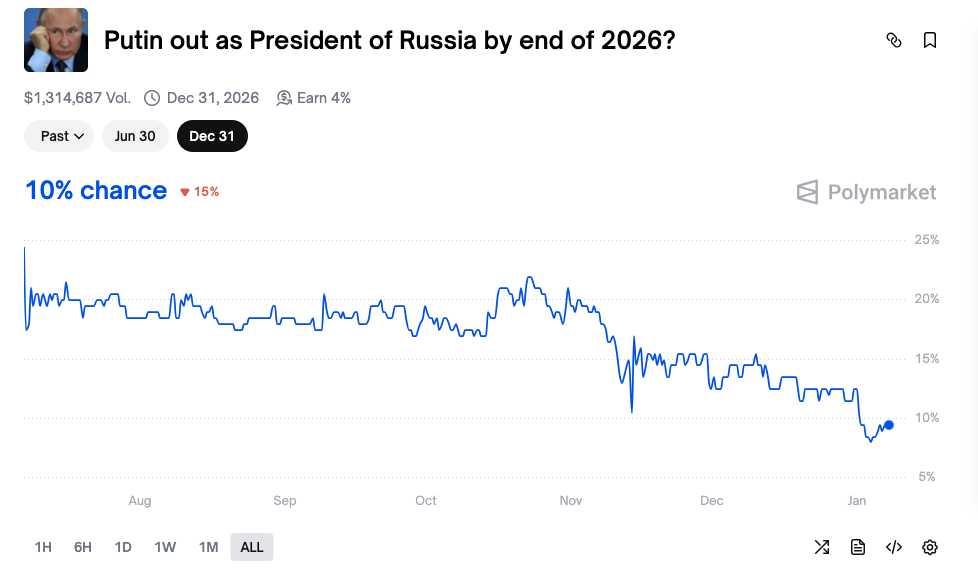
These investments have indeed been effective, driving trading in many "counterintuitive" markets. For example, the event contract "Will Putin step down before the end of 2026?" has already seen over $1.3 million in trading volume. Holding shares in this contract yields a 4% annualized return. For players holding Yes shares, this equates to an ultimate annualized return of 14% (10% tail-end收益 (profit) + 4% platform reward), which is hugely attractive. For players holding No shares, the placing rewards and holding rewards also hedge some of the risk.
There is also speculation that, in addition to openly providing liquidity incentives, prediction markets themselves act as market makers, providing liquidity for these "counterintuitive" and niche markets to achieve advertising and marketing effects. But this is pure speculation, open for discussion.

Preguntas relacionadas

QWho are the three types of participants providing liquidity in seemingly absurd prediction market contracts on Polymarket?

AThe three types are lottery players (who bet on high odds for small probabilities), trading bots (which automate trading for profits or airdrop farming), and the prediction platform itself (through incentives like order rewards and holding rewards).

QWhat is the primary motivation for 'lottery players' to bet on the 'Yes' side of low-probability events?

AThey are motivated by the high potential returns from low-probability events, akin to buying a lottery ticket, where a small bet could yield significant profits if the unlikely event occurs.

QHow do trading bots contribute to liquidity in 'anti-common sense' markets on Polymarket?

ATrading bots use APIs to automate trading, capturing low-priced orders and providing liquidity by placing higher sell orders or engaging in volume farming to qualify for potential airdrops.

QWhat role does Polymarket play in incentivizing liquidity for these markets?

APolymarket offers order rewards and holding rewards, such as annualized yields for holding shares, to encourage participation and liquidity provision in these markets.

QWhy might some participants believe that betting on unlikely events is rational despite low probabilities?

AThey view it as a calculated risk where the potential high returns, combined with platform incentives, justify the bet, especially if they diversify across multiple high-odds events.

Lecturas Relacionadas

OpenAI Post-Training Engineer Weng Jiayi Proposes a New Paradigm Hypothesis for Agentic AI

OpenAI engineer Weng Jiayi's "Heuristic Learning" experiments propose a new paradigm for Agentic AI, suggesting that intelligent agents can improve not just by training neural networks, but also by autonomously writing and refining code based on environmental feedback. In the experiment, a coding agent (powered by Codex) was tasked with developing and maintaining a programmatic strategy for the Atari game Breakout. Starting from a basic prompt, the agent iteratively wrote code, ran the game, analyzed logs and video replays to identify failures, and then modified the code. Through this engineering loop of "code-run-debug-update," it evolved a pure Python heuristic strategy that achieved a perfect score of 864 in Breakout and performed competitively with deep reinforcement learning (RL) algorithms in MuJoCo control tasks like Ant and HalfCheetah. This approach, termed Heuristic Learning (HL), contrasts with Deep RL. In HL, experience is captured in readable, modifiable code, tests, logs, and configurations—a software system—rather than being encoded solely into opaque neural network weights. This offers potential advantages in explainability, auditability for safety-critical applications, easier integration of regression tests to combat catastrophic forgetting, and more efficient sample use in early learning stages, as demonstrated in broader tests on 57 Atari games. However, the blog acknowledges clear limitations. Programmatic strategies struggle with tasks requiring long-horizon planning or complex perception (e.g., Montezuma's Revenge), areas where neural networks excel. The future vision is a hybrid architecture: specialized neural networks for fast perception (System 1), HL systems for rules, safety, and local recovery (also System 1), and LLM agents providing high-level feedback and learning from the HL system's data (System 2). The core proposition is that in the era of capable coding agents, a significant portion of an AI's learned experience could be maintained as an auditable, evolving software system.

marsbitHace 23 min(s)

OpenAI Post-Training Engineer Weng Jiayi Proposes a New Paradigm Hypothesis for Agentic AI

marsbitHace 23 min(s)

Your Claude Will Dream Tonight, Don't Disturb It

This article explores the recent phenomenon of AI companies increasingly using anthropomorphic language—like "thinking," "memory," "hallucination," and now "dreaming"—to describe machine learning processes. Focusing on Anthropic's newly announced "Dreaming" feature for its Claude Agent platform, the piece explains that this function is essentially an automated, offline batch processing of an agent's operational logs. It analyzes past task sessions to identify patterns, optimize future actions, and consolidate learnings into a persistent memory system, akin to a form of reinforcement learning and self-correction. The article draws parallels to similar features in other AI agent systems like Hermes Agent and OpenClaw, which also implement mechanisms for reviewing historical data, extracting reusable "skills," and strengthening long-term memory. It notes a key difference from human dreaming: these AI "dreams" still consume computational resources and user tokens. Further context is provided by discussing the technical challenges of managing AI "memory" or context, highlighting the computational expense of large context windows and innovations like Subquadratic's new model claiming drastically longer contexts. The core critique argues that this strategic use of human-centric vocabulary does more than market products; it subtly reshapes user perception. By framing algorithms with terms associated with consciousness, companies blur the line between tool and autonomous entity. This linguistic shift can influence user expectations, tolerance for errors, and even perceptions of responsibility when systems fail, potentially diverting scrutiny from the companies and engineers behind the technology. The article concludes by speculating that terms like "daydreaming" for predictive task simulation might be next, continuing this trend of embedding the idea of an "inner life" into computational processes.

marsbitHace 25 min(s)

Your Claude Will Dream Tonight, Don't Disturb It

marsbitHace 25 min(s)

Trading

Spot
Futuros
活动图片