While Bitcoin ETFs bled, Solana and XRP won the week – Here’s the data!

ambcryptoPublicado a 2026-03-01Actualizado a 2026-03-01

Resumen

The final week of February 2026 saw crypto markets under pressure due to geopolitical tensions. Bitcoin ETFs showed mixed signals, starting with a significant $203.8 million outflow, including a major exit from BlackRock's IBIT. However, sentiment reversed mid-week with $1.1 billion in inflows before slowing again. Ethereum ETFs mirrored this volatility, with outflows followed by inflows, but ended the week showing hesitation. In contrast, Solana ETFs recorded five consecutive days of steady inflows, including a notable $30.9 million on February 25th. XRP ETFs also showed resilience with four days of consistent inflows, totaling over $9.5 million. Despite overall market fear, the data indicates a strategic shift where investors are diversifying into altcoin ETFs like Solana and XRP, moving beyond just Bitcoin and Ethereum.

The final week of February 2026 saw renewed pressure across crypto markets. Rising geopolitical tensions weighed on global risk assets, including digital currencies.

However, ETF flow data painted a more nuanced picture.

Bitcoin ETF shows mixed signals

The week began badly.

On the 23rd of February alone, $203.8 million flowed out of Bitcoin ETFs. The biggest shock came from BlackRock’s IBIT, which saw a sharp $116.4 million exit. But the story didn’t end there.

Over the next three days, sentiment flipped.

Bitcoin ETFs recorded a massive $1.1 billion in inflows. By the end of the week, however, momentum slowed again. The inflows cooled, and the market tone turned cautious.

While Bitcoin [BTC] grabbed most of the attention, the altcoin ETF market told a very different story.

Ethereum follows Bitcoin’s mood swings

Ethereum ETFs mostly moved in the same unstable pattern as Bitcoin.

The week started with a sharp $49.5 million outflow on the 23rd of February. Almost all of it came from BlackRock’s ETHA, which alone saw $45.4 million leave the fund.

But that fear didn’t last long. Mid-week, buyers stepped in.

Fidelity’s FBTC saw $61.9 million in inflows, and even Grayscale’s ETHE, which rarely sees strong positive flows, recorded a $33.8 million inflow on the 25th of February.

This pushed Ethereum ETFs back into positive territory for the week.

However, the momentum faded again by the 27th of February, with $43 million flowing out. Just like Bitcoin, Ethereum [ETH] ended the week showing hesitation rather than confidence.

Solana and XRP ETFs show consistent flows

On the other hand, Solana ETFs told a calmer story.

They recorded inflows for five straight days. Daily numbers were smaller, between $0.5 million and $8 million, but they stayed positive throughout the week.

On the 25th of February, inflows jumped to $30.9 million, suggesting that larger investors may be slowly building positions.

Not only Solana, but also Ripple ETFs showed resilience.

After a quiet 23rd of February, they recorded four consecutive days of inflows starting on the 24th of February. Total inflows crossed $9.5 million for the week.

While the numbers weren’t huge, the consistency stood out.

Needless to say, the winners of the past week were Solana [SOL] and Ripple [XRP]. Even when Bitcoin ETFs were losing hundreds of millions, these altcoin ETFs stayed positive.

Unfortunately, the losers were BlackRock’s IBIT and ETHA.

What’s more?

Now, as we move into March, the crypto market feels confusing. The Crypto Fear and Greed Index is still stuck in “Extreme Fear.”

However, while retail investors hesitate, the online conversation is shifting.

According to LunarCrush data, social media dominance is no longer about memecoins or quick gains. Instead, traditional finance giants like Vanguard and BlackRock are leading the discussion, thanks to the ETFs.

All in all, the steady inflows into Solana and XRP ETFs suggest that ETFs still run the game; it’s just that instead of focusing only on Bitcoin and Ethereum, investors are spreading exposure.


Final Summary

  • While sentiment screams “risk,” ETF flows suggest strategic repositioning.
  • The quick rebound after heavy outflows proves liquidity remains strong.

Preguntas relacionadas

QWhich two cryptocurrencies were highlighted as the winners of the week based on ETF flow data?

ASolana (SOL) and Ripple (XRP) were the winners of the week.

QWhat was the week's total net flow result for Bitcoin ETFs after the initial outflows and subsequent massive inflows?

AThe article states Bitcoin ETFs recorded a massive $1.1 billion in inflows over three days after the initial outflows, but it ended the week with cooled inflows and a cautious tone, not providing a precise final net figure.

QWhich specific ETFs were named as the losers of the past week?

ABlackRock’s IBIT (Bitcoin ETF) and ETHA (Ethereum ETF) were named as the losers.

QAccording to LunarCrush data, what is the new focus of social media dominance in crypto discussions?

ASocial media dominance is no longer about memecoins or quick gains but is instead led by traditional finance giants like Vanguard and BlackRock, thanks to the ETFs.

QWhat does the consistent inflow into Solana and XRP ETFs suggest about investor strategy?

AThe steady inflows suggest that investors are spreading their exposure and are not focusing only on Bitcoin and Ethereum, indicating a strategic repositioning within the crypto ETF market.

Lecturas Relacionadas

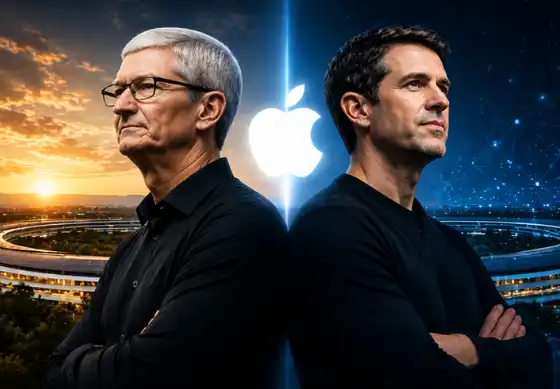
Cook's Curtain Call and Ternus Takes the Helm: The Disruption and Reboot of Apple's 4 Trillion Dollar Empire

Tim Cook has officially announced he will step down as CEO of Apple in September, transitioning to executive chairman after a 15-year tenure during which he grew the company’s market value from around $350 billion to nearly $4 trillion. He will be succeeded by John Ternus, a 50-year-old hardware engineering veteran who has been groomed for the role through increasing public visibility and internal responsibility. Ternus’s appointment signals a strategic shift toward hardware and engineering leadership, with Johny Srouji—head of Apple Silicon—taking on an expanded role as Chief Hardware Officer. This consolidation aims to strengthen Apple’s core technological capabilities. However, Cook’s departure highlights a significant unresolved issue: Apple’s delayed and fragmented approach to artificial intelligence. Despite early efforts, such as hiring John Giannandrea from Google in 2018, Apple’s AI initiatives—particularly around Siri—have struggled with internal restructuring and reliance on external partnerships, including with Google. The transition comes at a critical moment as Apple faces paradigm shifts with the rise of artificial general intelligence (ASI). The company’s closed ecosystem of hardware, software, and services—once a major advantage—now presents challenges in adapting to an AI-centric world where intelligence may matter more than the device itself. Ternus must quickly articulate a clear AI strategy, possibly starting at WWDC, to reassure markets and redefine Apple’s role in a new technological era. His task is not only to maintain Apple’s operational excellence but also to reinvigorate its capacity to innovate and lead in the age of AI.

marsbitHace 20 min(s)

Cook's Curtain Call and Ternus Takes the Helm: The Disruption and Reboot of Apple's 4 Trillion Dollar Empire

marsbitHace 20 min(s)

Trading

Spot
Futuros

Artículos destacados

Qué es XRP 2.0

XRP 2.0: Una Nueva Frontera en el Panorama de las Criptomonedas Introducción a XRP 2.0 En el siempre cambiante ámbito de las criptomonedas, nuevos proyectos surgen continuamente, compitiendo por atención y adopción. Una de estas iniciativas prometedoras es XRP 2.0, un nuevo proyecto de criptomoneda diseñado para aprovechar la tecnología blockchain avanzada y metodologías de encriptación robustas. Aunque el nombre establece paralelismos con el XRP de Ripple, es crucial señalar que XRP 2.0 opera de manera independiente, enfocándose en mejorar la seguridad de las transacciones, la privacidad y la escalabilidad. A medida que el panorama financiero digital abraza cada vez más soluciones descentralizadas, XRP 2.0 busca contribuir de manera significativa a web3 y a la expansión general de los proyectos de criptomonedas. ¿Qué es XRP 2.0? En esencia, XRP 2.0 es un proyecto de criptomoneda que busca crear un ecosistema de moneda digital seguro y descentralizado. Su tecnología fundamental integra principios avanzados de blockchain con técnicas de encriptación de vanguardia. El objetivo principal de XRP 2.0 es establecerse como una plataforma confiable y eficiente que permita la ejecución rápida de transacciones mientras prioriza la protección de la privacidad de sus usuarios. El proyecto se promociona como una solución a muchas limitaciones enfrentadas por las criptomonedas existentes, proponiendo un sistema que puede manejar un mayor volumen de transacciones con mejor velocidad y privacidad. Esta versatilidad posiciona a XRP 2.0 como un competidor significativo en un mercado plagado de diversas monedas digitales. ¿Quién es el Creador de XRP 2.0? La identidad del creador detrás de XRP 2.0 ha sido señalada como 'Wilbur.' Sin embargo, los detalles completos sobre Wilbur o su entidad asociada siguen siendo elusivos. La anonimidad de muchos creadores de criptomonedas no es un fenómeno poco común en la industria, a menudo diseñado para mantener un grado de privacidad y seguridad. ¿Quiénes son los Inversores de XRP 2.0? Hasta ahora, la información específica relacionada con las fundaciones o organizaciones de inversión que apoyan a XRP 2.0 no está disponible públicamente. En el sector de las criptomonedas, el respaldo de inversores respetables puede influir significativamente en la credibilidad y el éxito de un proyecto, sin embargo, la transparencia sobre los patrocinadores financieros de XRP 2.0 no se ha establecido. ¿Cómo Funciona XRP 2.0? XRP 2.0 se destaca al emplear una combinación de tecnología blockchain y algoritmos de encriptación avanzados que aseguran transacciones seguras y descentralizadas. Su estructura innovadora incluye características únicas diseñadas para fomentar el compromiso del usuario y ampliar las funcionalidades más allá de las transacciones convencionales de criptomonedas. Entre estas características, XRP 2.0 incorpora capacidades impulsadas por IA, como funcionalidades de texto a imagen y de texto a voz. Estas adiciones están diseñadas para mejorar la experiencia interactiva de los usuarios, promoviendo una mayor aplicabilidad en diversos sectores. Al unir avances tecnológicos con un diseño centrado en el usuario, XRP 2.0 busca captar la atención de una amplia gama de individuos y empresas que buscan integrar soluciones de criptomonedas en sus marcos operativos. Cronología de XRP 2.0 Entender XRP 2.0 requiere examinar los hitos que han definido su viaje hasta ahora: 23 de julio de 2023: Se presenta XRP 2.0 como un nuevo proyecto de criptomonedas, con el objetivo de revolucionar las capacidades de transacciones seguras y descentralizadas en el ámbito de blockchain. 8 de septiembre de 2023: Se lanza otro proyecto, XRP20, marcando la aparición de un token ERC-20 en la blockchain de Ethereum que no guarda relación con XRP 2.0. 13 de noviembre de 2023: El Libro Mayor de XRP experimenta una actualización significativa con el lanzamiento de la versión 2.0.0 del software del servidor rippled. Es esencial señalar que este desarrollo está desconectado del proyecto de criptomonedas XRP 2.0. Puntos Clave sobre XRP 2.0 Para destilar la esencia de XRP 2.0, surgen varios factores críticos: Características Únicas: La inclusión de características como texto a imagen y texto a voz impulsadas por IA diversifica aún más las aplicaciones potenciales de XRP 2.0. Tecnología Blockchain: El marco utiliza mecanismos avanzados de blockchain y protocolos de encriptación, asegurando un entorno seguro y descentralizado para las transacciones. Escalabilidad y Privacidad: XRP 2.0 prioriza la protección mejorada de la privacidad en los procesos de transacción y la escalabilidad necesaria para acomodar una base de usuarios creciente. No Afiliación con Ripple: Es importante destacar que, a pesar de su nombre, XRP 2.0 no tiene ninguna lealtad ni colaboración con el XRP de Ripple, diferenciando su marco operativo y objetivos dentro del ecosistema de criptomonedas. Conclusión XRP 2.0 representa una ambiciosa aventura en la esfera de las criptomonedas, buscando ofrecer una combinación de seguridad, privacidad y eficiencia en las transacciones digitales. Al integrar tecnologías sofisticadas y características amigables para el usuario, el proyecto se propone ampliar los horizontes de lo que la criptomoneda puede lograr en la economía digital de hoy. Si bien la anonimidad de su creador y la falta de inversores revelados pueden generar cuestionamientos para algunos, el enfoque de XRP 2.0 en funcionalidades avanzadas y descentralización realza su atractivo en un mercado de criptomonedas cada vez más abarrotado. A medida que el paisaje de las criptomonedas sigue evolucionando, XRP 2.0 podría emerger como un jugador crucial en la expansión de soluciones blockchain seguras y escalables.

174 Vistas totalesPublicado en 2024.04.05Actualizado en 2024.12.03

Qué es XRP 2.0

Cómo comprar XRP

¡Bienvenido a HTX.com! Hemos hecho que comprar XRP (XRP) sea simple y conveniente. Sigue nuestra guía paso a paso para iniciar tu viaje de criptos.Paso 1: crea tu cuenta HTXUtiliza tu correo electrónico o número de teléfono para registrarte y obtener una cuenta gratuita en HTX. Experimenta un proceso de registro sin complicaciones y desbloquea todas las funciones.Obtener mi cuentaPaso 2: ve a Comprar cripto y elige tu método de pagoTarjeta de crédito/débito: usa tu Visa o Mastercard para comprar XRP (XRP) al instante.Saldo: utiliza fondos del saldo de tu cuenta HTX para tradear sin problemas.Terceros: hemos agregado métodos de pago populares como Google Pay y Apple Pay para mejorar la comodidad.P2P: tradear directamente con otros usuarios en HTX.Over-the-Counter (OTC): ofrecemos servicios personalizados y tipos de cambio competitivos para los traders.Paso 3: guarda tu XRP (XRP)Después de comprar tu XRP (XRP), guárdalo en tu cuenta HTX. Alternativamente, puedes enviarlo a otro lugar mediante transferencia blockchain o utilizarlo para tradear otras criptomonedas.Paso 4: tradear XRP (XRP)Tradear fácilmente con XRP (XRP) en HTX's mercado spot. Simplemente accede a tu cuenta, selecciona tu par de trading, ejecuta tus trades y monitorea en tiempo real. Ofrecemos una experiencia fácil de usar tanto para principiantes como para traders experimentados.

1.3k Vistas totalesPublicado en 2024.12.10Actualizado en 2025.03.21

Cómo comprar XRP

Discusiones

Bienvenido a la comunidad de HTX. Aquí puedes mantenerte informado sobre los últimos desarrollos de la plataforma y acceder a análisis profesionales del mercado. A continuación se presentan las opiniones de los usuarios sobre el precio de XRP (XRP).

活动图片