Which Way the Fish Head Points, There's Also Shandong-Style Learning in the Crypto World

marsbitPublicado a 2026-01-08Actualizado a 2026-01-08

Resumen

The article "Where the Fish Head Points: The 'Shandong Rule' in Crypto" uses the metaphor of a Shandong dining custom — where the fish head is oriented towards the guest of honor — to critique the culture of influence and favor-seeking in the crypto industry, particularly around Binance. It highlights how a casual New Year’s tweet by Binance co-founder He Yi, saying “我踏马来了” (I’ve arrived), quickly led to the creation and listing of a meme token with the same name on Binance Alpha — without any direct instruction from her. The author argues that this reflects a deeper cultural issue: instead of transparent, rule-based processes, success increasingly depends on anticipating and pleasing key decision-makers. The piece contrasts this with sectors like AI, where technical merit drives advancement, and suggests that crypto’s reliance on insider access and social signaling — rather than innovation — may signal industry decline. While He Yi may not be directly involved, the system incentivizes sycophancy and information asymmetry, making “reading the room” more valuable than building value.

Written by: Curry, Deep Tide TechFlow

There's a rule at Shandong banquet tables: when the fish is served, the head must point toward the seat of honor.

Whoever it points to is the main guest and must drink first. This isn't written down anywhere, but everyone in Shandong knows it. No one teaches it; you just pick it up.

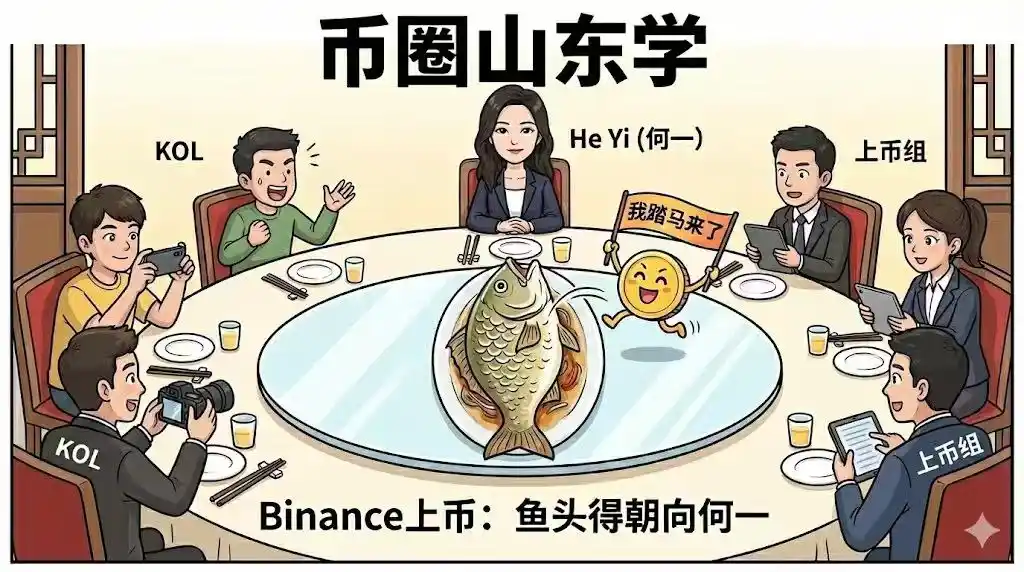
Recently, someone drew a picture called "Crypto Circle Shandong-Style Learning." A group of people sit around a table eating fish, with Yi He in the seat of honor, and KOLs, the listing team, and editors gathered on either side.

The caption: When Binance lists a coin, the fish head must point toward Yi He.
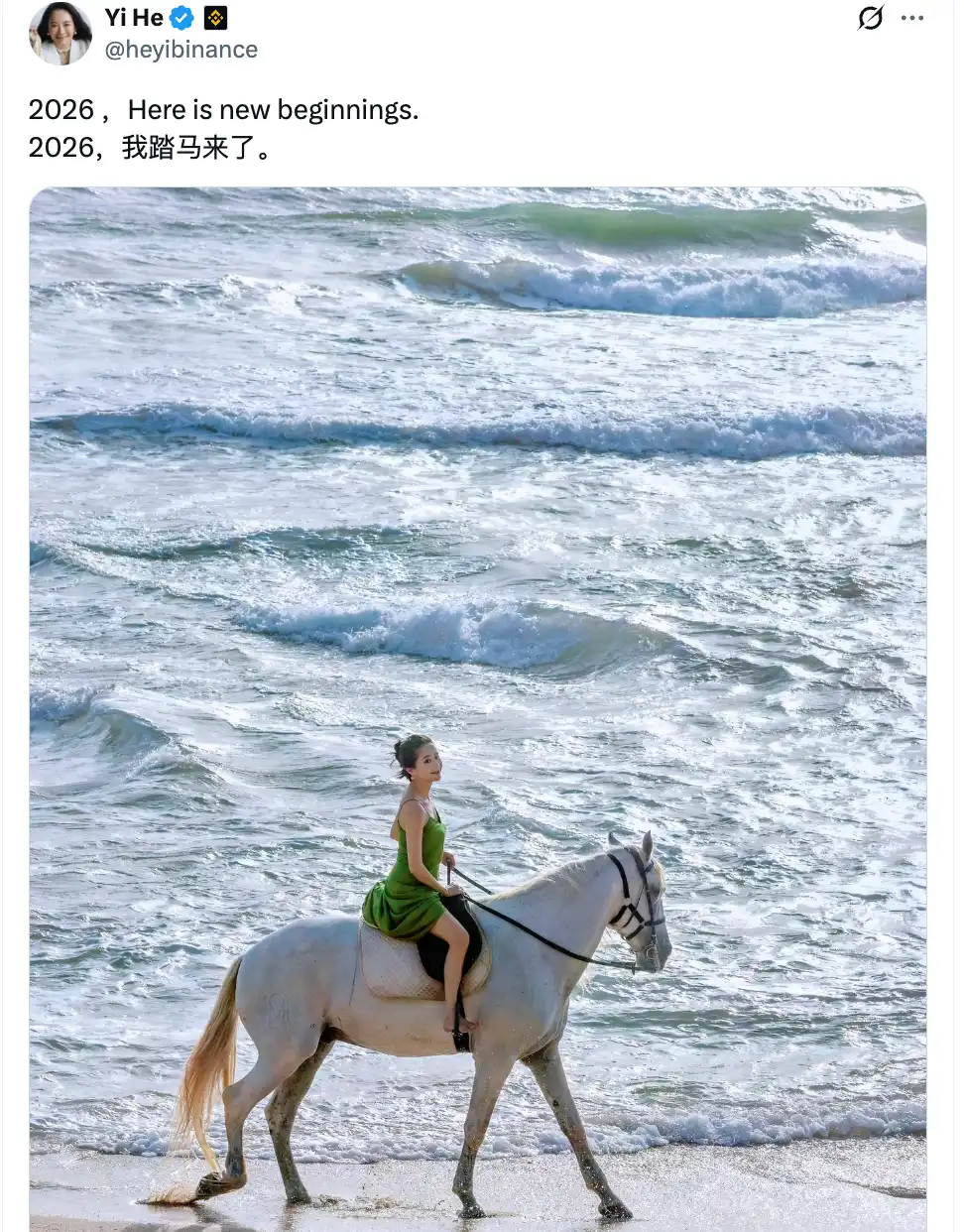
On January 1, Yi He posted a New Year's tweet. Riding a white horse by the sea, with a caption:

I'm fucking coming.

A fine New Year's greeting—"fucking coming," the Year of the Horse, with a bit of homophonic wit.
Today, Binance Alpha listed a new coin called "I'm Fucking Coming." It was community-made, with no direct connection to Yi He.

But look at this chain: Sister Yi posts a tweet, the community creates a coin, Alpha lists it.

No one needs to give any orders in between.

Last year, Binance was chased and criticized over "girlfriend coins," accused of shady listing practices and利益输送 (interest transfer). Yi He responded several times, saying they were reflecting, adjusting, and even created Alpha as a screening pool.

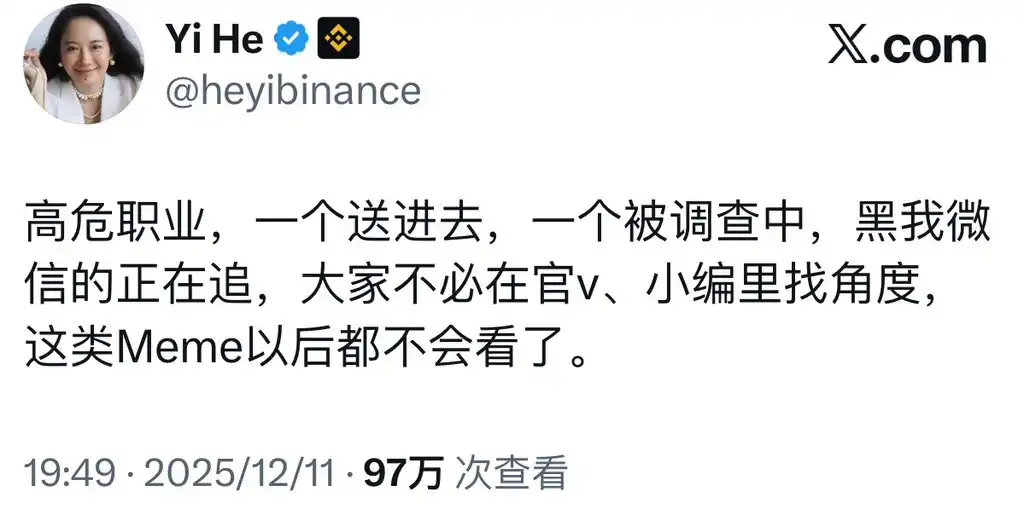
In December, she also tweeted saying, don't try to find angles in our official tweets, we won't pay attention to these kinds of Memes anymore.

Twenty-eight days later, her New Year's tweet became a new coin on Alpha.
What was the problem with girlfriend coins? It was about backdoor deals, favoritism,利益输送 (interest transfer).

These require evidence, a trail, a specific "girlfriend."

But "I'm Fucking Coming" doesn't need any of that.

No backdoor, no favoritism, no利益输送. Sister Yi posted a picture, and the people below just started moving on their own.

This perhaps touches on the essence of Shandong-style learning: The leader doesn't need to say anything; you have to figure it out yourself.

Some in the community commented that Alpha is now just a tool for currying favor, its purpose is to make Sister Yi happy.

Crude wording, but it describes an atmosphere.

When a platform's direction starts revolving around someone's social media, when "which coin to list" becomes "guess what she likes," rules cease to matter.

What matters is揣摩 (speculation/figuring out).

Some put it more harshly: If you want to know if an industry has a future, ask one question—In this industry, do people who are good at flattery succeed more easily than people who are good at doing things?

If the answer is "yes," then this industry is on the decline.

In the crypto world, this trick really works. And the most successful ones, everyone knows who the flattery should be directed toward.
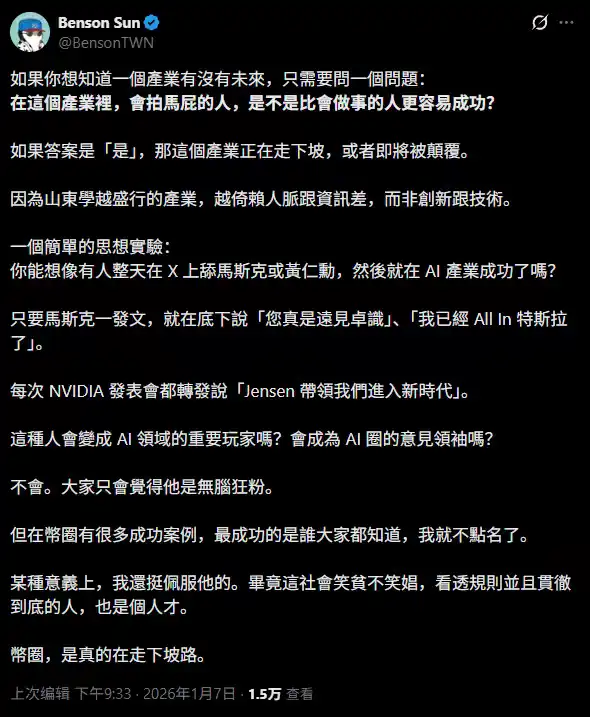
The core resources in the AI circle are technology and products; you have to deliver. Jensen Huang won't give you GPUs just because you call him daddy every day.

The core resources in the crypto circle are listing rights, traffic, who knows the news first. These things aren't in the code; they're in people's hands.

Things in people's hands must be obtained through human methods.

The more prevalent Shandong-style learning is, the more it relies on connections and information asymmetry, not innovation and technology.

Yi He might not even know about this. A small MEME worth a few million market cap isn't enough to bother the Co-CEO.

But that's precisely the problem.

She doesn't need to know. The fish head will turn by itself.

This is really much more efficient than girlfriend coins.

Girlfriend coins at least required a girlfriend. Shandong-style learning only requires an atmosphere.

And those who see through this set of rules and implement them thoroughly are, in a sense, also talented.

After all, in this society, people laugh at the poor, not the prostitute.

Preguntas relacionadas

QWhat is the core concept of 'Shandong Study' in the crypto world as described in the article?

AThe core concept of 'Shandong Study' in the crypto world refers to an unwritten rule where individuals or groups instinctively align their actions to please key figures in power, such as Binance's He Yi, without explicit instructions. It emphasizes intuition and揣摩 (speculation) over formal rules, particularly in contexts like token approvals on platforms.

QHow did the meme token '我踏马来了' (I'm Coming on Horseback) get listed on Binance Alpha according to the article?

AThe meme token '我踏马来了' was created by the community after He Yi, Binance's co-CEO, posted a New Year's tweet with the phrase '我踏马来了' and an image of herself on a horse. The community independently developed and listed the token on Binance Alpha, without direct involvement or instructions from He Yi, demonstrating the 'Shandong Study' phenomenon.

QWhat criticism does the article level against the crypto industry's reliance on 'Shandong Study' dynamics?

AThe article criticizes that such dynamics prioritize flattery and connections over innovation and technology, suggesting that an industry where 'bootlicking' is more rewarded than actual work is in decline. It highlights how resources like token listing privileges and information asymmetry are controlled by people rather than code, leading to a culture of揣摩 (speculation) rather than merit-based success.

QHow does the 'Shandong Study' approach differ from the previous '闺蜜币' (close-friend coin) issue at Binance?

AThe '闺蜜币' issue involved alleged backdoor dealings and explicit利益输送 (benefit transfers) through personal relationships, requiring evidence of specific connections. In contrast, 'Shandong Study' operates implicitly—no direct orders or relationships are needed; instead, participants intuitively act to align with the preferences of powerful figures like He Yi, creating a self-driven culture of compliance without formal corruption.

QWhat broader implication does the article suggest about power and decision-making in crypto platforms like Binance?

AThe article implies that decision-making in crypto platforms can become overly centralized around key individuals, where informal influence and social media activity shape outcomes like token listings. This shifts focus from transparent, rule-based systems to a culture of揣摩 (speculation) and alignment with personal whims, potentially undermining innovation and fairness in the industry.

Lecturas Relacionadas

The Era Has Arrived Where Human Writers Must Prove They Are Not Machines

The article describes an era where AI-generated content is flooding the market, forcing human authors to prove they are not machines. It begins with the example of dozens of AI-written, error-ridden biographies of Henry Kissinger appearing on Amazon within hours of his death, a pattern repeated for other deceased celebrities and even living experts who find fraudulent books under their names. This spam content has exploded, with monthly new book releases on platforms like Amazon reaching 300,000 by late 2025. The issue spans genres, from suspiciously high proportions of AI-written teen romance and self-help books to dangerous, AI-generated foraging guides containing lethal advice. The platforms' automated review systems, designed to catch plagiarism and banned words, are ill-equipped to detect AI-generated text that avoids these pitfalls while being nonsensical or fraudulent. The problem has infiltrated traditional publishing. A major publisher, Hachette, had to recall a bestselling horror novel after AI detection tools suggested 78% of its content was machine-generated. An acclaimed European philosophy book was later revealed to be entirely written by AI under a fake author persona. In response, authors are fighting back. At the 2026 London Book Fair, 10,000 writers published a blank book titled "Don't Steal This Book" containing only their signatures—using emptiness as a protest weapon in an age of AI overproduction. Initiatives like the "Human Author Certification" program have emerged, ironically placing the burden on humans to prove their work is not machine-made. The article warns of a vicious cycle: AI-generated low-quality books pollute the data used to train future AI models, leading to "model collapse" and an ever-worsening flood of digital waste, eroding trust in publishing and devaluing human creativity.

marsbitHace 13 min(s)

The Era Has Arrived Where Human Writers Must Prove They Are Not Machines

marsbitHace 13 min(s)

The King of Blind Date Attire in Korea: How SK Hynix Made a Comeback Against Samsung?

In South Korea's dating scene, SK Hynix employees are now highly sought after, a status shift fueled by the company's astronomical profits and employee bonuses, projected to reach up to 6.1 million RMB per person by 2027. This marks a dramatic reversal for the long-time second-place player in memory semiconductors, which has now surpassed its rival Samsung in annual operating profit. The turnaround story began in 2008 when a struggling Hynix, emerging from bankruptcy restructuring, took a risky bet by agreeing to develop High Bandwidth Memory (HBM) with AMD. At the time, HBM had no clear market beyond high-end graphics cards and was a costly, complex technology. Major players like Samsung, pursuing its own HMC technology, declined. For Hynix, with only memory as its core business, it was a gamble born of necessity. The pivotal moment came in 2012 when SK Group Chairman Chey Tae-won acquired Hynix. Defying industry downturns, he invested heavily in R&D and fabrication, sustaining the HBM project through over a decade of commercial uncertainty and internal challenges. A key break occurred around 2016-2017 when Samsung faced production issues supplying HBM2 for Google's TPU, allowing SK Hynix to gain a crucial foothold in the data center market. The AI explosion post-ChatGPT in 2022 was the catalyst, turning HBM into a critical bottleneck for AI accelerators like NVIDIA's GPUs. By 2025, SK Hynix captured 62% of the global HBM market, leaving Samsung at 17%. For the first time, its annual operating profit exceeded Samsung's. Analysts point to the "innovator's dilemma" to explain Samsung's miss: its vast, successful business portfolio made it risk-averse, preventing an all-in bet on the initially niche HBM technology. In contrast, SK Hynix, as a challenger with its back against the wall, had no choice but to commit fully. The story highlights how Korea's chaebol system allows for ultra-long-term bets beyond quarterly pressures. However, SK Hynix's lead isn't guaranteed. Samsung is aggressively catching up on HBM4, and challenges like customer concentration (heavy reliance on NVIDIA) and technical hurdles in advanced packaging remain. The narrative underscores a market truth: the greatest alpha often comes from betting on uncertain, long-term directions others dismiss, much like HBM in 2008.

marsbitHace 53 min(s)

The King of Blind Date Attire in Korea: How SK Hynix Made a Comeback Against Samsung?

marsbitHace 53 min(s)

Trading

Spot
Futuros
活动图片





