Written by: Curry, Deep Tide TechFlow
There's a rule at Shandong banquet tables: when the fish is served, the head must point toward the seat of honor.
Whoever it points to is the main guest and must drink first. This isn't written down anywhere, but everyone in Shandong knows it. No one teaches it; you just pick it up.
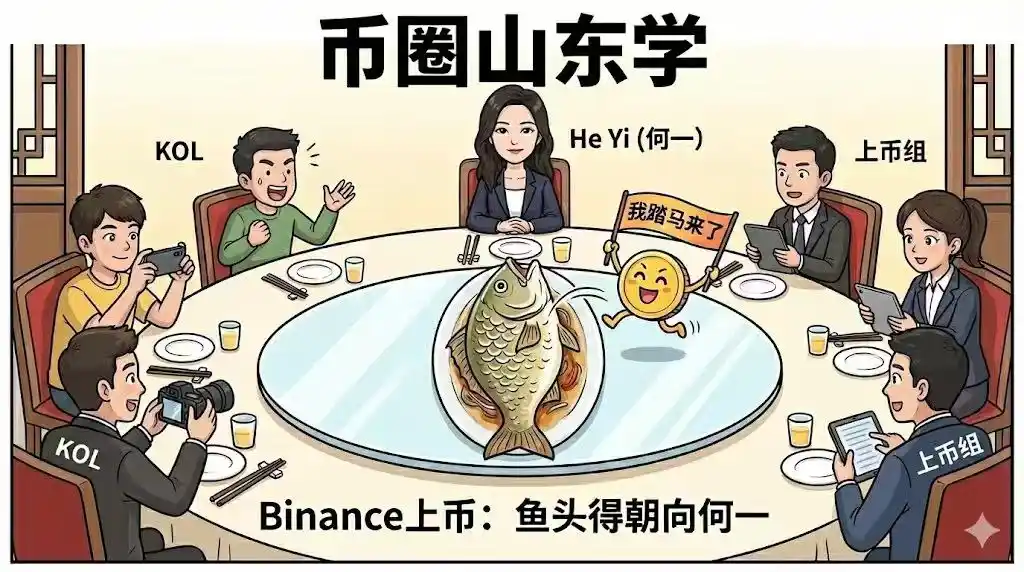
Recently, someone drew a picture called "Crypto Circle Shandong-Style Learning." A group of people sit around a table eating fish, with Yi He in the seat of honor, and KOLs, the listing team, and editors gathered on either side.
The caption: When Binance lists a coin, the fish head must point toward Yi He.
On January 1, Yi He posted a New Year's tweet. Riding a white horse by the sea, with a caption:
I'm fucking coming.
A fine New Year's greeting—"fucking coming," the Year of the Horse, with a bit of homophonic wit.

Today, Binance Alpha listed a new coin called "I'm Fucking Coming." It was community-made, with no direct connection to Yi He.
But look at this chain: Sister Yi posts a tweet, the community creates a coin, Alpha lists it.
No one needs to give any orders in between.
Last year, Binance was chased and criticized over "girlfriend coins," accused of shady listing practices and利益输送 (interest transfer). Yi He responded several times, saying they were reflecting, adjusting, and even created Alpha as a screening pool.
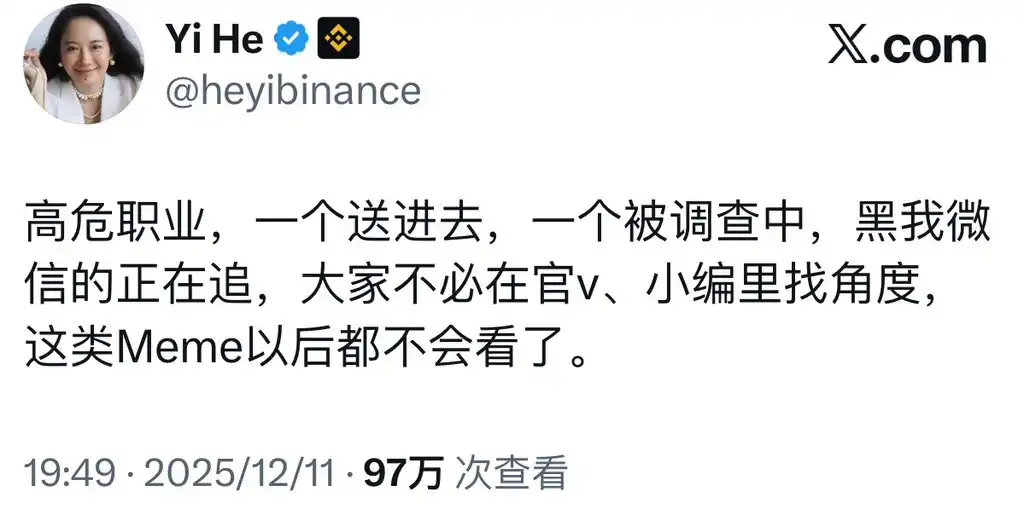
In December, she also tweeted saying, don't try to find angles in our official tweets, we won't pay attention to these kinds of Memes anymore.
Twenty-eight days later, her New Year's tweet became a new coin on Alpha.
What was the problem with girlfriend coins? It was about backdoor deals, favoritism,利益输送 (interest transfer).
These require evidence, a trail, a specific "girlfriend."
But "I'm Fucking Coming" doesn't need any of that.
No backdoor, no favoritism, no利益输送. Sister Yi posted a picture, and the people below just started moving on their own.
This perhaps touches on the essence of Shandong-style learning: The leader doesn't need to say anything; you have to figure it out yourself.
Some in the community commented that Alpha is now just a tool for currying favor, its purpose is to make Sister Yi happy.
Crude wording, but it describes an atmosphere.
When a platform's direction starts revolving around someone's social media, when "which coin to list" becomes "guess what she likes," rules cease to matter.
What matters is揣摩 (speculation/figuring out).
Some put it more harshly: If you want to know if an industry has a future, ask one question—In this industry, do people who are good at flattery succeed more easily than people who are good at doing things?
If the answer is "yes," then this industry is on the decline.
In the crypto world, this trick really works. And the most successful ones, everyone knows who the flattery should be directed toward.
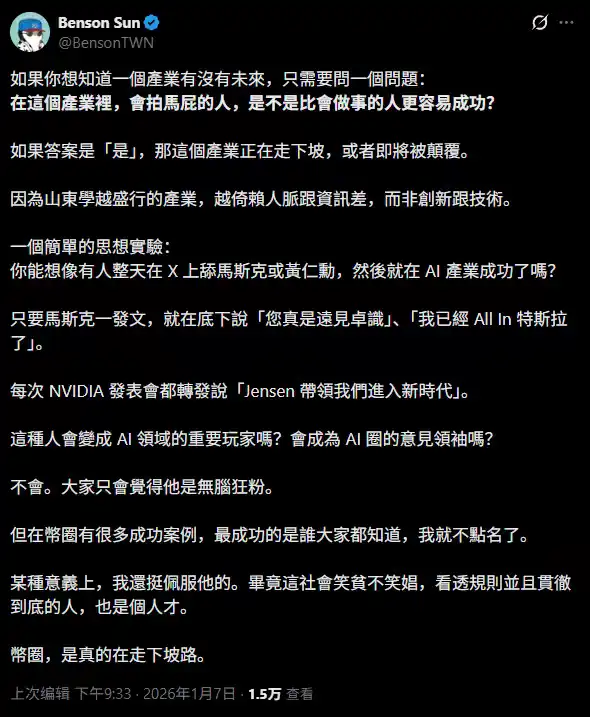
The core resources in the AI circle are technology and products; you have to deliver. Jensen Huang won't give you GPUs just because you call him daddy every day.
The core resources in the crypto circle are listing rights, traffic, who knows the news first. These things aren't in the code; they're in people's hands.
Things in people's hands must be obtained through human methods.
The more prevalent Shandong-style learning is, the more it relies on connections and information asymmetry, not innovation and technology.
Yi He might not even know about this. A small MEME worth a few million market cap isn't enough to bother the Co-CEO.
But that's precisely the problem.
She doesn't need to know. The fish head will turn by itself.
This is really much more efficient than girlfriend coins.
Girlfriend coins at least required a girlfriend. Shandong-style learning only requires an atmosphere.
And those who see through this set of rules and implement them thoroughly are, in a sense, also talented.
After all, in this society, people laugh at the poor, not the prostitute.