Where Will DeFi Go Next?

marsbitPublicado a 2026-01-12Actualizado a 2026-01-12

Resumen

The DeFi sector has approached its previous all-time high in Total Value Locked (TVL), reaching $225 billion in late 2025, yet growth has stagnated with only a 10% increase over four years. This indicates that the current user base—largely crypto-native—may have reached saturation. The next phase of growth must come from attracting mainstream users. Stablecoins have seen significant expansion, with USDT and USDC surpassing $260 billion in combined market cap, exceeding the entire DeFi TVL. The rise of yield-bearing stablecoins and Real-World Assets (RWA), now over $20 billion, reflects strong demand for on-chain yield. However, these products remain largely confined to crypto-savvy users. Compared to the fintech sector, which manages over $2 trillion in customer assets, DeFi remains a niche. To break through, DeFi must prioritize simple, secure, and收益-focused products that appeal to ordinary users, rather than complex financial structures or speculative mechanisms. Embedded DeFi integrations within fintech apps could help bridge this gap, but consumer-facing protocols that simplify access to yield will be key to capturing the next wave of adoption.

Editor's Note: DeFi is once again approaching its historical high but has failed to break through significantly, revealing not a lack of products but a bottleneck in user growth. The expansion of stablecoins, yield-bearing stablecoins, and RWA indicates that the demand for moving funds on-chain and earning yields remains strong, yet it has not been truly brought to the mass market.

This article argues that the next step for DeFi lies not in more complex structures or speculative designs, but in simple, secure, yield-focused products, along with user-friendly access and distribution methods for ordinary users. Only when DeFi begins to target fintech users, rather than solely serving crypto-native audiences, can a new growth cycle truly begin.

Below is the original text:

Current Situation

In 2025, DeFi's total value locked (TVL) reached a new historical high, but it did not significantly exceed the peak of 2021. As the market gradually cools, a question worth revisiting is: where will the next wave of capital and users come from?

Driven by DeFi Summer, TVL climbed to $204 billion by the end of 2021. Subsequently, following the collapse of events like FTX and the market entering a bear phase, the capital scale declined steadily. Later, DeFi struggled to recover, reaching $225 billion in October 2025. However, a mere 10% growth over four years can hardly be considered explosive. The earliest participants in DeFi—primarily crypto-native users and traders—may have nearly reached the "ceiling."
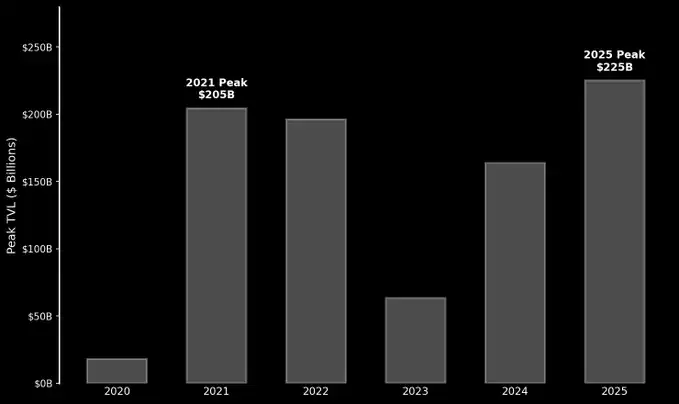
The proximity of these two peaks is indeed cause for caution, but it does not yet constitute a "survival crisis." The current user base—though highly engaged and loyal—is not large enough to propel DeFi to the next level on its own.

To achieve a breakthrough, DeFi needs to reach a larger audience. The good news is that such an audience does exist—it is still on the sidelines, waiting to be properly "onboarded" with the right tools and products.

A Glimmer of Hope

Over the past year, the stablecoin market has been one of the biggest beneficiaries. The amount of USD on-chain has reached a historical high, more than ever before. USDT and USDC have continued to grow steadily, with their combined market capitalization exceeding $260 billion—meaning that the scale of stablecoins alone is already larger than the entire DeFi market.
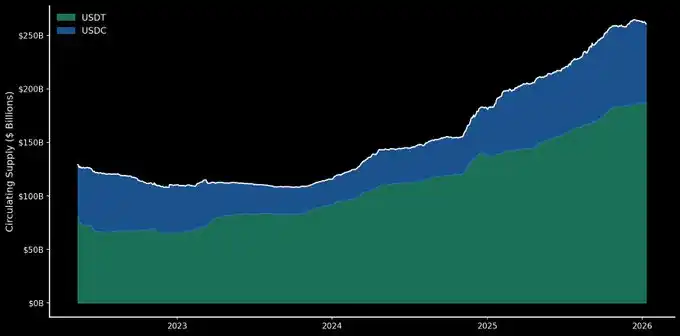
Even without parabolic growth in DeFi, people continue to mint stablecoins, indicating that the demand for moving funds on-chain remains strong. At the same time, an increasing number of users are beginning to access the yields provided by DeFi, and the growth in this area points to where the next breakthrough may come from.

The rise of yield-bearing stablecoins and RWA (real-world assets) further confirms this trend. According to @stablewatchHQ data, the scale of yield-bearing stablecoins has exceeded $20 billion, with products like sUSDS and sUSDe gaining significant adoption over the past year or so. Parallel to yield-bearing stablecoins, RWA has also made progress on-chain: these products, backed by traditional assets such as treasury bonds, offer real yields and are growing rapidly.

The problem is that they currently primarily cater to crypto-native users and large on-chain holders. As long as this remains the case, their potential will be underestimated. If they can be productized and packaged in a way that is more accessible to everyday users, yield-bearing stablecoins and RWA present enormous opportunities in the mass market.

Retail Has Not Yet Arrived

To understand the scale of this opportunity, it is helpful to compare DeFi with fintech. Currently, the entire DeFi TVL is approximately $164 billion. In contrast, global mobile fintech apps manage over $2 trillion in customer assets; the top 100 neobanks alone have assets totaling $2.4 trillion. By comparison, DeFi is currently almost a negligible fraction.
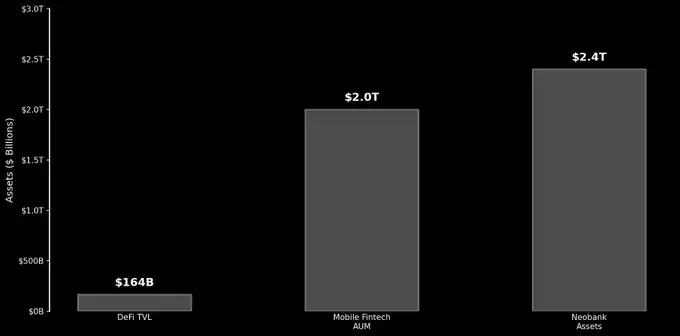
The notion that "if you build it, they will come" can only drive limited growth. If DeFi wants to continue expanding, it must compete for the ordinary users that have made fintech so vast.

In 2025, the success of protocols like Aave, Ethena, and Pendle has demonstrated a strong demand for yield among market participants. They were the highlights of the year, attracting significant capital and attention. If such products can be delivered to the masses in a clear, understandable, and low-barrier manner, the potential encompasses (literally) trillions of dollars in capital and tens of millions of potential users.

The Path Forward

The real test for DeFi in the coming year is whether it can make yield opportunities easily and safely accessible to ordinary people. Growth will not come from more complex financial structures, the 100th liquidity mining pool, the 100th perpetual futures DEX, or the millionth airdrop. Growth will come from simple, reliable products—built on decentralized protocols—that solve real problems for ordinary people. And yield should be center stage (ahem, Aave App, ahem).

Today, hundreds of millions of people use banking and fintech apps daily, already accustomed to managing their funds on their phones. If DeFi can capture even a small share of this, it will be enough to trigger a new wave of growth, and it will not once again stall at the $200 billion TVL level.

Embedded DeFi will play a crucial role in this—fintech companies and neobanks integrating on-chain yield capabilities directly into their products. But teams should not stop there. The protocols that are truly consumer-facing and at the forefront will capture the greatest upside; those that continue to optimize only for crypto-native users will ultimately be competing for a pie that may no longer be expanding.

DeFi will win.

Preguntas relacionadas

QWhat is the main reason DeFi has not experienced explosive growth despite reaching a new TVL high in 2025?

AThe main reason is that DeFi has primarily served crypto-native users and traders, who are nearing their 'ceiling,' and has failed to attract a broader audience of ordinary users.

QWhat evidence suggests that there is still strong demand for moving funds on-chain?

AThe stablecoin market has reached a new all-time high, with USDT and USDC combined市值 exceeding $260 billion, which is larger than the entire DeFi market.

QWhat types of products have shown significant growth and adoption in the past year, indicating potential for broader appeal?

AYield-bearing stablecoins (like sUSDS and sUSDe) and Real World Assets (RWA) have seen substantial growth, offering real yields and attracting significant adoption.

QHow does the size of DeFi's TVL compare to the assets managed by fintech applications and neobanks?

ADeFi's TVL is about $164 billion, while global mobile fintech apps manage over $2 trillion in customer assets, and the top 100 neobanks alone hold $2.4 trillion in assets, making DeFi a negligible fraction in comparison.

QWhat is the key challenge for DeFi to achieve its next growth cycle and attract mainstream users?

AThe key challenge is to create simple, secure, and收益-focused products that are easy for ordinary users to understand and use, rather than developing complex financial structures or relying solely on crypto-native optimizations.

Lecturas Relacionadas

Gate Research Institute: The 'Wall Street-ization' Wave of Crypto Financial Products – Competition or Integration?

The article titled "Gate Research Institute: Are Crypto Financial Products Sparking a 'Wall Street' Wave—Competition or Convergence?" explores the evolving relationship between the crypto ecosystem and traditional finance (TradFi). The piece begins by reflecting on Bitcoin's original 2009 vision of decentralization, disintermediation, and moving away from banks. It then contrasts this with the 2024 landscape, where key crypto assets like Bitcoin are increasingly held through Wall Street products like ETFs issued by giants like BlackRock. The article questions whether this signifies that TradFi is systematically taking over the rights to issue, price, custody, and distribute crypto financial assets. The core argument is that this is not a zero-sum takeover but rather a bidirectional convergence where each side addresses the other's weaknesses. Crypto offers 24/7 global markets, programmable settlement, and open access but lacks compliant channels, institutional-grade custody, deep fiat liquidity, and mainstream distribution. TradFi possesses these but is constrained by legacy systems, limited operating hours, and slow settlement. Two primary convergence paths are highlighted: * **Path A (CEX to TradFi):** Exemplified by Gate, which has progressed from offering tokenized stocks and CFDs to providing direct, real stock trading (US, Hong Kong, South Korea) within its platform, using USDT. * **Path B (TradFi to Crypto):** Exemplified by Robinhood, which has integrated crypto trading, acquired exchanges like Bitstamp, and is moving traditional assets like stocks onto the blockchain via tokenization and its own Layer 2. Both paths are ultimately competing to become the next-generation, unified financial account—a "super account" where users can seamlessly trade cryptocurrencies, stocks, ETFs, RWA (Real World Assets), and tokenized treasury products in one interface. The growth of RWA and tokenized treasuries (e.g., BlackRock's BUIDL) is presented as the asset-layer fusion, providing stable, yield-bearing assets on-chain and acting as a bridge between the two worlds. In conclusion, the "Wall Street-ization" of crypto is framed as a mutual transformation. Decentralized ideals persist in the protocol layer, while at the application layer, a more efficient, global, and accessible unified capital market is emerging from this convergence. The future competition lies not between crypto exchanges and stockbrokers, but between platforms vying to offer the most comprehensive asset coverage, liquidity, and user experience within a single account.

marsbitHace 2 min(s)

Gate Research Institute: The 'Wall Street-ization' Wave of Crypto Financial Products – Competition or Integration?

marsbitHace 2 min(s)

Claude's Major New Feature: Screen Recording + Voice, Distilling Your Skills into AI Tasks in One Click

Claude has introduced a major new feature called "Record a Skill," available for Pro, Max, and Team users. This function, found in the Claude desktop app's CoWork menu, allows users to create reusable AI skills simply by recording their screen and providing voice narration while performing a task. Claude then automatically analyzes the recording and generates a functional Skill. A hands-on test confirmed the feature works seamlessly. Users start recording via the Skills manager, perform their workflow while verbally explaining the steps and logic, and avoid including sensitive information. After recording, Claude processes the content and creates the Skill, which can be saved and later invoked with a slash command (/). This eliminates the need for manual adjustments or writing complex instruction files. The innovation goes beyond mere efficiency. Previously, creating a Skill required writing a detailed SKILL.md file in Markdown—a significant barrier for non-technical users. "Record a Skill" bypasses this by directly capturing both actions and the implicit reasoning shared in the narration. This lowers the barrier to knowledge transfer and automation, addressing a core challenge in corporate knowledge management: the difficulty of getting experts to write and maintain documentation. However, the feature also highlights a shift in the nature of work. A case study from March 2026 showed a freelancer whose five-year client relationship was effectively replaced by a hand-coded Claude Skill automating their content workflow. With the even lower barrier of screen recording, the ability to distill personal expertise into automatable skills accelerates this trend. The "moat" for work is moving from simply knowing how to do a task to mastering tasks that are difficult or impossible to automate.

marsbitHace 6 min(s)

Claude's Major New Feature: Screen Recording + Voice, Distilling Your Skills into AI Tasks in One Click

marsbitHace 6 min(s)

Feeding AI "Noise" Can Also Boost Scores, This Work Enables Positive Transfer with Noise

Feeding "Noise" to AI Can Improve Performance: A Method Enables Positive Transfer from Noise This work, Semi-Supervised Noise Adaptation (SSNA), introduces a Noise Adaptation Framework (NAF) that challenges traditional transfer learning. Instead of requiring a labeled source domain of real data (e.g., images, text), NAF uses randomly generated Gaussian noise as the source. For a target task with C classes, it constructs C noise clusters by sampling from Gaussian distributions. Although this synthetic noise contains no semantic meaning, NAF trains it to form a discriminative class structure in a shared representation space—clustering same-class noise and separating different classes. The key is aligning this learned structure from the noise domain to the real, sparsely labeled target domain. A small number of target labels are still essential to establish the correspondence between noise clusters and actual classes. The training objective combines: 1) supervised loss on the few labeled target samples, 2) classification loss for the noise to build its structure, and 3) a distribution alignment loss (using Negative Domain Similarity) to minimize the gap between the noise and target domains in the shared space. Experiments show significant gains in few-label settings. With just 4 labels per class, NAF with a ResNet-18 backbone improves accuracy over a standard supervised baseline (ERM) by +12.35% on CIFAR-10, +7.61% on CIFAR-100, +4.38% on DTD-47, and +2.74% on Caltech-101. It also benefits fine-grained datasets and scales to ImageNet-1K (with 100 labels/class) and text classification (AG News). NAF can be integrated into existing semi-supervised methods like FixMatch for further gains. Ablation studies confirm the transferred benefit comes from the discriminative structure of the noise, not randomness itself. Collapsing all noise into a single point causes negative transfer, while increasing separation between noise cluster centers improves performance. The amount of noise per class is less critical once a basic structure forms. In conclusion, this work demonstrates that for positive transfer, the semantic content of source data may not be necessary. What can be effectively transferred is the *organizational structure* of categories within a representation space. This offers a promising alternative for scenarios where real source data is unavailable due to privacy, copyright, or procurement constraints.

marsbitHace 8 min(s)

Feeding AI "Noise" Can Also Boost Scores, This Work Enables Positive Transfer with Noise

marsbitHace 8 min(s)

Trading

Spot
活动图片





