Where Are the Sellers? Low Bitcoin Inflows Hint At Holder Conviction Amid Deepest Pullback of 2025

bitcoinistPublished on 2025-12-09Last updated on 2025-12-09

Abstract

Bitcoin is attempting to recover toward $92,000 after a significant 36% pullback, its deepest of 2025. Despite the sharp decline, a CryptoQuant report highlights an unusual trend: cryptocurrency inflows to Binance remain extremely low. Historically, large corrections trigger high exchange inflows as investors rush to sell, indicating fear or capitulation. This time, however, investors are holding rather than offloading assets, showing patience and lack of panic. The current inflow levels are five times lower than during past sell-offs, suggesting strong holder conviction and a resilient market structure. This restraint may signal underlying strength and support a potential bullish recovery once the correction ends.

Bitcoin is attempting to reclaim the $92,000 level as bullish momentum gradually returns after weeks of uncertainty. The market has spent nearly two months in a corrective phase, shedding roughly 36% from its highs, yet signs of stabilization are beginning to emerge. A new CryptoQuant report from analyst Darkfost highlights a striking deviation from typical mid-cycle correction behavior—one that may explain why sentiment is starting to shift.

According to the report, inflows of cryptocurrencies onto Binance remain unusually low, even as Bitcoin has experienced one of its deepest pullbacks of the cycle. Historically, during significant corrections, investors tend to send large amounts of BTC and other assets to exchanges, signaling growing willingness to sell and escalating market fear. This pattern appeared repeatedly in past downturns, often marking periods of capitulation.

But this time, the data suggests something different: investors are not rushing to offload their holdings. Instead, they appear more comfortable holding through volatility, showing patience rather than panic. Such low inflows contrast sharply with prior mid-cycle resets and hint at a more resilient market structure beneath the surface—one where holders may be preparing for the next phase rather than abandoning ship.

A Shift in Inflows Reveals Unusual Investor Behavior

Darkfost notes that today’s data shows a markedly different behavior from what Bitcoin typically displays during major corrections. Instead of focusing on BTC alone, the analysis aggregates total inflows of all cryptocurrencies sent to Binance, offering a broader view of market intent. The logic behind this metric is straightforward: rising inflows signal growing selling pressure, while shrinking inflows indicate that investors prefer to hold rather than exit their positions.
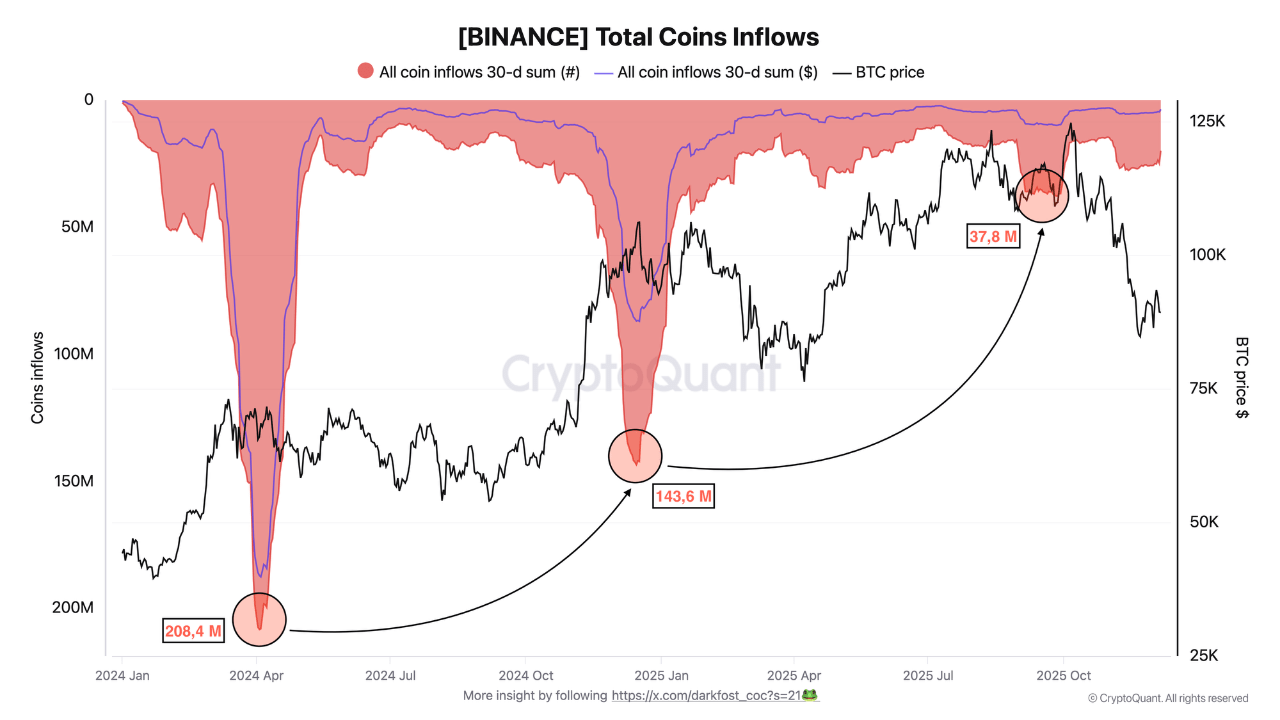
Binance Total Coins Inflows | Source: CryptoQuant

During previous downturns, inflows surged. In April 2024, right after Bitcoin hit a new all-time high at $73,800, total inflows exceeded 200 million coins, reflecting intense selling pressure. A similar spike appeared in December 2024, as BTC broke above $100,000, signaling that investors were preparing to lock in profits.

Today’s environment looks nothing like those periods. Despite experiencing a much deeper correction, inflows are five times lower—and notably stable. Investors are not sending coins to exchanges, which means they’re not eager to sell. Instead, they are sitting through the decline, showing patience rather than panic.

This unusual calm suggests a more confident market structure. If selling pressure continues to fade, this investor restraint could become one of the most constructive signals supporting a future bullish recovery once the correction runs its course.


Related Reads

Mars Morning Post | After Fed Rate Cut, US Dollar Records Worst Single-Day Performance Since September; Trump: Rate Cut Too Small, Could Have Been Doubled

Mars News, Dec 11 — Following the Fed’s decision to cut interest rates by 25 basis points, the US dollar recorded its worst single-day performance since September, with the dollar index falling 0.4%. Fed Chair Powell emphasized labor market risks and downplayed inflation concerns, contributing to the decline. President Trump criticized the move, calling the cut “too small” and suggesting it should have been doubled. In other developments, Stripe acquired the team behind crypto wallet Valora to expand its stablecoin services. The CFTC launched an innovation council with members including Polymarket, Kraken, and Gemini. GameStop reported a $9.4 million decrease in its Bitcoin holdings in Q3. Elon Musk hinted at a potential SpaceX IPO, while Michael Saylor argued that limiting passive Bitcoin investment would be counterproductive. A new wallet accumulated 1,200 BTC, and the crypto fear and greed index rose to 29, a one-month high. Meanwhile, the Norwegian central bank announced it sees no current need for a CBDC, citing an already efficient payment system. Paxful agreed to plead guilty to U.S. charges and will pay $7.5 million in fines. a16z Crypto opened its first office in Seoul. Analysts noted the Fed’s dovish tone, projecting 100 basis points in rate cuts next year, though internal divisions remain. Powell stated that further rate hikes are not the base case, and the focus is on whether to hold or cut rates.

marsbitHace 2 min(s)

Mars Morning Post | After Fed Rate Cut, US Dollar Records Worst Single-Day Performance Since September; Trump: Rate Cut Too Small, Could Have Been Doubled

marsbitHace 2 min(s)

A Brief History of the Encrypted Future: Seven Major Trends Reshaping the Industry Narrative in 2026

"Crypto Future: 7 Trends Reshaping the Industry Narrative in 2026" This article outlines seven key trends expected to define the crypto industry in 2026. First, **Appchains** will see a major breakthrough, as applications built on custom, purpose-specific blockchains optimized for unique user experiences and cultures will flourish, enabled by modular infrastructure. Second, **prediction markets** will continue to innovate, with success hinging on solutions that reduce spreads, increase open interest, and capture specific categories of volume. Third, **Agentic Curators** will emerge, using AI agents (LLMs with tools) to manage DeFi risk and strategies through reasoning, not just fixed algorithms, competing directly with human managers. Fourth, **short-form video** will become the dominant traffic and commerce gateway, with platforms blurring the lines between content and payment. Crypto is essential for enabling microtransactions and tracking complex revenue sharing. Fifth, **new AI Scaling Laws** will be driven by blockchain, as decentralized training and inference networks move from testing to production, offering verifiable, confidential computation and challenging centralized AI development. Sixth, **RWA (Real World Assets)** will achieve real-world adoption at scale. Tokenization will expand beyond stablecoins to assets like commodities, credit, and equities, upgrading global capital markets through on-chain transparency and DeFi composability. Finally, an **Agent-driven product renaissance** will begin, shifting the internet's core from apps we use to agents we converse with. These AI agents will manage complex on-chain tasks, filter information, and execute strategies, reducing friction and unlocking a new era of user empowerment.

Odaily星球日报Hace 6 min(s)

A Brief History of the Encrypted Future: Seven Major Trends Reshaping the Industry Narrative in 2026

Odaily星球日报Hace 6 min(s)

Shorting the Dip, Buying the Rally? FOMC Outcome Reveals the Truth Behind Bitcoin (BTC) Price Trends

Based on historical data from 2025, Bitcoin's (BTC) price action around FOMC meetings reveals a distinct pattern: the market often prices in macroeconomic expectations in advance, leading to a "buy the rumor, sell the news" dynamic. Despite the actual policy decisions, BTC typically experiences selling pressure post-announcement, even during rate-cut cycles. Key findings show that BTC declined after most FOMC events in 2025, with the sharpest seven-day drops (-6.9% and -8%) occurring after the two 25-basis-point rate cuts in September and October. In contrast, meetings with unchanged rates resulted in mixed performance, ranging from +6.92% to -4.58%. This counterintuitive reaction is attributed to structural market dynamics rather than macroeconomic fundamentals. Before FOMC meetings, especially in July, September, and October, significant capital inflows and leveraged long positions were observed, leading to reduced spot liquidity. This over-leveraging often meant that any "hawkish" momentum was already priced in, leaving the market vulnerable to a sell-off once the actual decision was announced. Analysts note that FOMC events act more as market reset points than directional catalysts. When policy outcomes are highly anticipated, pre-meeting volatility compresses, and post-announcement volatility expands, creating predictable short-term dislocations. The data suggests that traders should prepare for heightened volatility, with potential retests of key support levels, such as $88,000, following the typical post-FOMC decline.

cointelegraph_中文Hace 25 min(s)

Shorting the Dip, Buying the Rally? FOMC Outcome Reveals the Truth Behind Bitcoin (BTC) Price Trends

cointelegraph_中文Hace 25 min(s)

Trading

Spot
Futures
活动图片