When Token Issuance Becomes an Assembly Line, Some Are Paying Bitcoin Developers

marsbitPublicado a 2025-12-13Actualizado a 2025-12-13

Resumen

The article highlights the often-overlooked efforts of organizations and individuals who support Bitcoin's core infrastructure, focusing on a report by 1A1z about Bitcoin Core developers and sponsors. Bitcoin Core, described as Bitcoin's "operating system," relies on volunteer work and external funding for critical tasks like security, network optimization, and code maintenance. The report identifies 13 key long-term sponsors, including OKX as the only exchange consistently funding developers since 2019, with nearly $2 million in contributions to individuals and nonprofits. Beyond core protocol support, the piece emphasizes the importance of user-facing infrastructure, such as OKX Wallet's features that simplify Web3 access by eliminating seed phrases and streamlining cross-chain transactions. It also notes OKX's investments in developer ecosystems, test networks, and security audits—efforts that don't generate immediate returns but are vital for sustainable growth. The article contrasts these long-term, low-profile investments with the industry's trend of rapid token launches and marketing-heavy projects. It argues that such foundational work, though less visible, builds competitive advantages through technical efficiency, user experience, and future capacity—ultimately shaping the industry's trajectory toward real-world adoption.

A couple of days ago, Bitcoin ecosystem research and consulting team 1A1z published an in-depth report on Bitcoin Core contributors.

While the article might seem like a typical developer interview, it reveals one of the most overlooked realities in the crypto industry: there is a group of people, far from the spotlight, who avoid hype and marketing, and instead focus on long-term maintenance of the industry's most fundamental and critical infrastructure.

On the list of sponsors supporting Bitcoin Core, OKX's name isn't in a prominent position. It's precisely because of this low profile that many are realizing for the first time: within this industry, there are still major platforms allocating resources to "public R&D"—efforts that offer little short-term return but ultimately shape the industry's long-term direction.

After the article was published, OKX Star reposted it and quoted an internal team statement: "From the earliest days, we have insisted on contributing our modest strength to Bitcoin's underlying development. For over a decade, we have never hyped it, never promoted it, because we firmly believe in the future of blockchain."

Similar sentiments aren't rare in the industry. But when placed in the context of Bitcoin Core, its meaning shifts—this isn't a marketing slogan, but a value choice: the willingness to invest time, resources, and patience in areas that receive little attention.

01. Those Paying the Salaries for Bitcoin's "Operating System"

To understand the significance of this, we must first answer a core question: What exactly is Bitcoin Core?

Simply put, Bitcoin Core is Bitcoin's "operating system." It's the software run by full nodes, the rule enforcer for the entire network, the transaction validator, and the foundation maintaining Bitcoin's security, network consensus, and censorship resistance.

The BTC price, block height, transaction confirmations, and network stability we are familiar with—all these metrics mentioned daily by countless people—rely entirely on the correct operation of the Bitcoin Core codebase.

More importantly, Bitcoin Core has never been a commercial project since its inception. It has no CEO, no KPIs, no profit model, and no "return on investment cycle." It relies on contributions from global contributors and long-term support from external sponsors.

Some developers focus on network performance optimization, some research validation rules and security, some work on privacy improvements and user experience, and others do work that ordinary users will never see, but which the entire ecosystem depends on.

Precisely because Bitcoin Core has no profit model and no corporate backing, it needs external financial support. The 1A1z report shows that sponsors supporting Bitcoin Core include foundations, research institutions, infrastructure companies, and a few exchanges. These funds are primarily used for node performance optimization, security research, network synchronization, privacy enhancements, code review, and other areas.

It's fair to say that without this sustained support, Bitcoin Core would struggle to maintain stable development over more than a decade.

The report identified 13 major sponsoring organizations: Blockstream, Chaincode Labs, MIT, Spiral (formerly Square Crypto), OKX, Human Rights Foundation, Brink, Btrust, OpenSats, Vinteum, Maelstrom, B4OS, and 2140.
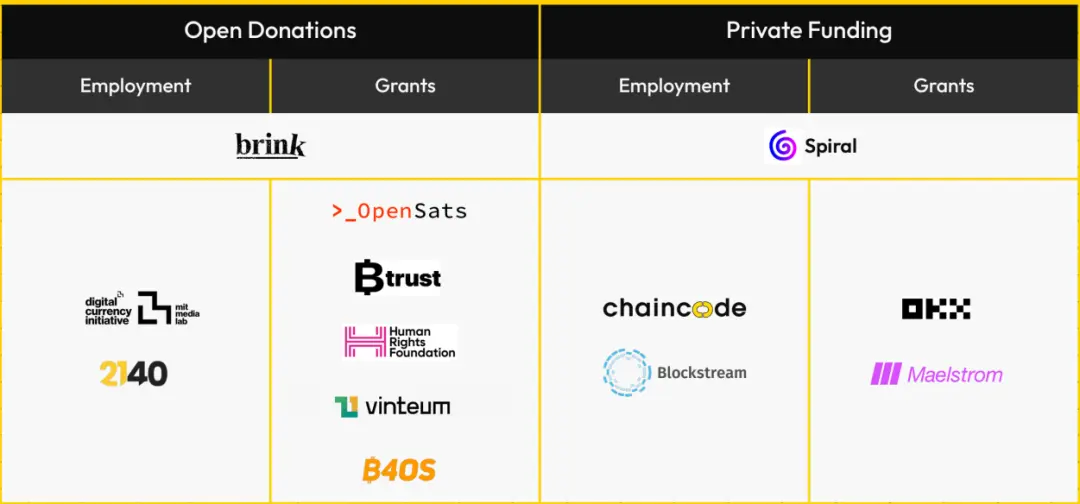
Figure: Major Bitcoin Core Sponsoring Organizations, Source: 1A1z

The criteria for making this core list are clear: long-term, stable, low-key.

This is also why, although exchanges like Coinbase, Kraken, and Gemini have historically had developer grant programs, they were not listed as core sponsors—the report notes these programs are currently either inactive, infrequent, or no longer focused on Bitcoin development. In contrast, OKX's grant program, started in 2019, has continued to this day, making it the only exchange among the 13 core sponsors.

Take Marco Falke as an example. He was one of only six core maintainers globally with the authority to approve or reject changes to Bitcoin's underlying code (he resigned in February 2023). His work involves rigorous review of every proposal for the codebase to prevent malicious or flawed code from entering the Bitcoin protocol. This is a job crucial to the global crypto economy, yet it was unpaid.

Starting in 2019, OKX (and its predecessor Okcoin) provided continuous grants to Falke, ensuring he could work full-time on this security-critical task. Beyond Falke, OKX has funded Bitcoin Core developer Amiti Uttarwar, Lightning Network developer Antoine Riard, as well as non-profit organizations like Brink and Vinteum.

To date, OKX's funding for these projects has approached $2 million. In fact, even before 2019, Okcoin had already established an open-source developer grant program.

Notably, this kind of resources went largely unpublicized for a long time. It wasn't until the recent 1A1z report was published that many people realized so many organizations and companies were quietly supporting Bitcoin's foundational development.

In an industry where most companies chase trends and create narratives, these sponsors choose to pay for the things that "must be done, but no one is obligated to do."

02. Beyond the Base Layer, the "Last Mile"

Support for the underlying protocol is just one aspect. Even more easily overlooked is the infrastructure that might seem less "glamorous" but determines whether users can actually use the technology.

User-Side Barriers

Take OKX Wallet as an example. It has become the starting point for many entering Web3. Supporting hundreds of chains, multiple account models, self-custody and MPC technology, ecosystem integration speed, compliant chain support—these sound more like "product details," but they are essentially "user-side infrastructure."

For an industry aiming for mass adoption, these details determine whether the last mile can be successfully crossed.

Ordinary users won't care about your consensus algorithm or how advanced your Layer 2 technology is; they care about: Is it simple to use? Will I lose my coins? Are the fees high?

The design of CeDeFi is meant to solve these problems—combining the advantages of centralized and decentralized exchanges. Users can access over 100 decentralized liquidity pools without leaving the platform, with the system automatically finding the best price. More crucially, they don't need to remember seed phrases (using Passkey authentication) or deal with cross-chain bridges (routed directly within the platform), solving the two biggest headaches for DeFi users: losing coins and getting hacked.

These features might not seem sexy, but for mass adoption, they are more important than the technology itself.

Long-Termism in Developer Ecosystems

Beyond the user side, OKX has also been continuously promoting developer ecosystems, testnets, cross-chain infrastructure, hackathons, research collaborations, audit systems, and other foundational work over the years.

These investments might be far from the hype, but they are more critical for the healthy development of the industry.

Hackathons don't directly bring users, testnets don't generate trading volume, and audit systems don't create buzz. But without these, developer ecosystems won't flourish, security incidents will be frequent, and the entire industry's foundation of trust will be eroded.

In a way, the force driving the crypto industry isn't just the trading volumes on leaderboards or the weekly rotation of new narratives, but those who write code, run nodes, test protocols, and fund infrastructure.

03. The Value of Long-Termism

The phrase "a decade of cultivation" might sound like marketing speak in the crypto industry. But look at the numbers, and something is indeed happening.

Consider the state of the industry in 2025:

  • The number of tokens exploded from hundreds of thousands in 2021 to tens of millions in 2025 (over 50 million)
  • The token issuance cycle compressed from two years to 3-6 months
  • A project spending less than 20% of its total budget on technology, with the rest poured into listing fees, market makers, KOLs, and media promotion (ICODA DeFi Marketing Budget Guide)

In such an environment, choosing to invest resources in underlying protocols, developer ecosystems, and user infrastructure—areas with "invisible returns"—is difficult because: the short-term payoff isn't visible, but it determines long-term survival.

This sustained investment ultimately translates into competitiveness:

Technical efficiency brings cost advantages. When your system processes fast enough and costs little enough, you naturally have room to offer users better prices. This isn't a price war; it's a technology dividend.

User experience determines mass adoption. Not needing to remember seed phrases, not worrying about cross-chain hacks, the system automatically finding you the best price—these features solve real pain points. Get the details right, and users are willing to stay.

Infrastructure development determines future capacity. When the RWA market truly reaches a scale of $600 billion by 2030 (Boston Consulting Group prediction), the infrastructure capable of handling the flow of these assets will become the scarcest resource. Then, those who laid the groundwork early will have the greatest first-mover advantage.

This is the value of long-termism: laying the foundation while others chase trends, building the skyscraper by the time others wake up.

04. Summary

Industry hype has cycles, but Bitcoin's development does not.

Market noise may rise and fall, but foundational infrastructure needs to be built and maintained over decades. This is perhaps the hardest, yet most important, aspect of the industry.

In this sense, participants like OKX are noteworthy not because of promotion, but because they choose to do things that "the industry must have done" but "no one is obligated to do."

Builders might not need applause, but they deserve to be seen.

And where the crypto industry ultimately goes depends largely on these invisible choices.

Preguntas relacionadas

QWhat is Bitcoin Core and why is it considered the 'operating system' of Bitcoin?

ABitcoin Core is the software that runs full nodes, acting as the rule enforcer and transaction validator for the entire network. It is the foundation for Bitcoin's security, network consistency, and censorship resistance. It maintains critical metrics like transaction confirmations and network stability, making it the essential 'operating system' of Bitcoin.

QWhich organizations are listed as the main sponsors supporting Bitcoin Core development according to the 1A1z report?

AThe 13 main sponsor organizations are Blockstream, Chaincode Labs, MIT, Spiral (formerly Square Crypto), OKX, Human Rights Foundation, Brink, Btrust, OpenSats, Vinteum, Maelstrom, B4OS, and 2140.

QWhy is OKX notable among Bitcoin Core sponsors, and what makes its support unique?

AOKX is notable because it is the only exchange among the 13 core sponsors. Its support is unique due to its long-term, stable, and low-key funding since 2019, focusing on critical but unglamorous areas like node performance, security research, and developer grants, unlike other exchanges whose programs are inactive or less focused.

QHow does OKX's approach to infrastructure investment differ from typical industry trends?

AOKX invests in long-term, non-glamorous infrastructure like Bitcoin Core development, user-side features (e.g., OKX Wallet with multi-chain support and MPC technology), and developer ecosystems (e.g., hackathons, testnets). This contrasts with the industry trend of chasing narratives and spending heavily on marketing, listing fees, and KOLs rather than technical foundations.

QWhat are the potential long-term benefits of investing in blockchain infrastructure, as highlighted in the article?

ALong-term benefits include technical efficiency leading to cost advantages, improved user experience driving mass adoption, and infrastructure readiness for future growth (e.g., handling a projected $6000 billion RWA market by 2030). This approach creates sustainable competitiveness by building foundations while others focus on short-term trends.

Lecturas Relacionadas

AI "Transfer Station" Earning Millions Monthly? Five Questions Uncover the Truth of Token Arbitrage

The article "AI 'Transfer Station' Earns Millions Monthly? Five Questions Uncover the Truth of Token Arbitrage" explores the emerging business of API token transfer stations, which profit from global AI service price disparities and access barriers. These intermediaries purchase low-cost tokens from overseas AI providers (e.g., OpenAI, Claude) through grey-market methods—such as exploiting enterprise credits, bulk accounts, or subscription benefits—and resell them to Chinese users at a markup. Key drivers include the high cost of using top AI models (e.g., Claude Code costs ~$5 per million tokens), the performance gap between domestic and foreign models, and mismatches between subscription and API pricing. However, the practice carries significant risks: upstream token sources may be unstable or illegal; user data passing through intermediaries can be harvested or injected with hidden prompts; and models might be downgraded without disclosure. The market is evolving, with some operators now exporting cheaper Chinese models (e.g., Qwen3.5 at ~$0.11 per million tokens) to overseas users, leveraging price gaps. Yet, sustainability is low due to compliance crackdowns, instability, and reputational risks. Users are advised to employ detection methods (e.g., prompt adherence tests) and avoid sensitive data usage. The authors caution that while transfer stations offer short-term arbitrage, they lack long-term reliability and security compared to official APIs.

marsbitHace 12 min(s)

AI "Transfer Station" Earning Millions Monthly? Five Questions Uncover the Truth of Token Arbitrage

marsbitHace 12 min(s)

The Cost of an 11.5% Annualized Return: Will MicroStrategy's STRC Face a Moment of Reckoning?

This article analyzes the potential risks associated with MicroStrategy's (MSTR) use of structured financial products like STRC to leverage its BTC exposure. While these tools have enabled impressive returns (e.g., 11.5% annualized) and fueled significant capital inflows ($13.5B outstanding), they also create substantial annual dividend obligations (~$400M). The author argues that this structure, while effective in a bull market, could become a liability if BTC price stagnates or declines. The core risk is a potential negative feedback loop: the growing dividend burden from continued STRC issuance may eventually outweigh the benefits of increased BTC holdings. To meet these obligations, MicroStrategy might need to use new issuance proceeds for dividends instead of buying more BTC, which could disappoint equity investors. If the market capitalization (mNAV) falls below the value of its BTC holdings, the company could be forced to sell BTC instead of issuing new shares, potentially triggering a panic. The author estimates a potential inflection point in 6 months, where annual dividend costs reach $3-4B. At that stage, CEO Michael Saylor might face a difficult choice: sell BTC to meet obligations or sacrifice the credibility of the preferred shares by halting dividends. The article concludes that this financial engineering, while powerful, could ultimately "backfire" on MicroStrategy if market conditions turn.

marsbitHace 1 hora(s)

The Cost of an 11.5% Annualized Return: Will MicroStrategy's STRC Face a Moment of Reckoning?

marsbitHace 1 hora(s)

Trading

Spot
Futuros

Artículos destacados

Qué es BITCOIN

Entendiendo HarryPotterObamaSonic10Inu (ERC-20) y Su Posición en el Espacio Cripto En los últimos años, el mercado de criptomonedas ha sido testigo de un aumento en la popularidad de las monedas meme, capturando el interés no solo de los comerciantes, sino también de aquellos que buscan compromiso comunitario y valor de entretenimiento. Entre estos tokens únicos se encuentra HarryPotterObamaSonic10Inu (ERC-20), un proyecto intrigante que mezcla referencias culturales en el tejido de las criptomonedas. Este artículo profundiza en los aspectos clave de HarryPotterObamaSonic10Inu, explorando sus mecanismos, ethos impulsado por la comunidad y su relación con el paisaje cripto más amplio. ¿Qué es HarryPotterObamaSonic10Inu (ERC-20)? Como su nombre sugiere, HarryPotterObamaSonic10Inu es una moneda meme construida sobre la blockchain de Ethereum, clasificada bajo el estándar ERC-20. A diferencia de las criptomonedas tradicionales que pueden enfatizar la utilidad práctica o el potencial de inversión, este token prospera en el valor de entretenimiento y la fuerza de su comunidad. El proyecto tiene como objetivo fomentar un entorno donde los usuarios comprometidos puedan reunirse, compartir ideas y participar en actividades inspiradas por diversos fenómenos culturales. Una característica notable de HarryPotterObamaSonic10Inu es su cero impuestos en las transacciones. Este atractivo elemento tiene como objetivo incentivar el comercio y la participación comunitaria, sin cargos adicionales que puedan disuadir a los comerciantes de pequeña escala. El suministro total de la moneda está establecido en mil millones de tokens, una cifra que marca su intención de mantener una circulación sustancial dentro de la comunidad. Creador de HarryPotterObamaSonic10Inu (ERC-20) Los orígenes de HarryPotterObamaSonic10Inu están algo envueltos en misterio; los detalles sobre el creador siguen siendo desconocidos. El desarrollo de este token carece de un equipo identificable o de un plan explícito, lo cual no es inusual dentro del sector de monedas meme. En cambio, el proyecto ha surgido de manera orgánica, con su progreso muy dependiente del entusiasmo y la participación de su comunidad. Inversores de HarryPotterObamaSonic10Inu (ERC-20) En cuanto a inversiones externas y respaldo, HarryPotterObamaSonic10Inu también sigue siendo ambiguo. El token no lista ninguna fundación de inversión conocida o apoyo organizacional significativo. En cambio, la savia del proyecto es su comunidad de base, que informa su crecimiento y sostenibilidad a través de la acción colectiva y el compromiso en el espacio cripto. ¿Cómo Funciona HarryPotterObamaSonic10Inu (ERC-20)? Como una moneda meme, HarryPotterObamaSonic10Inu opera principalmente fuera de los marcos tradicionales que a menudo rigen el valor de los activos. Hay varios aspectos distintivos que definen cómo funciona el proyecto: Transacciones Sin Impuestos: Sin tarifas impositivas en las transacciones, los usuarios pueden comprar y vender el token libremente sin preocuparse por costos ocultos. Compromiso Comunitario: El proyecto prospera en la interacción comunitaria, aprovechando plataformas de redes sociales para crear entusiasmo y facilitar la participación. Las discusiones, el intercambio de contenido y el compromiso son elementos cruciales que ayudan a expandir su alcance y fomentar la lealtad entre los seguidores. Sin Utilidad Práctica: Cabe señalar que HarryPotterObamaSonic10Inu no ofrece utilidad concreta dentro del ecosistema financiero. Más bien, se clasifica como un token principalmente para actividades de entretenimiento y comunitarias. Referencia Cultural: El token incorpora astutamente elementos de la cultura popular para atraer interés, conectando con entusiastas de los memes y seguidores de las criptomonedas por igual. HarryPotterObamaSonic10Inu ejemplifica cómo las monedas meme operan de manera diferente a los proyectos de criptomonedas más tradicionales, ingresando al mercado como construcciones sociales innovadoras en lugar de activos utilitarios. Cronología de HarryPotterObamaSonic10Inu (ERC-20) La historia de HarryPotterObamaSonic10Inu está marcada por varios hitos notables: Creación: El token surgió de un meme viral, capturando la imaginación de muchos entusiastas de las criptomonedas. Las fechas específicas de creación no están disponibles, subrayando su ascenso orgánico. Listado en Exchanges: HarryPotterObamaSonic10Inu ha llegado a varios exchanges, permitiendo un acceso y comercio más fácil por parte de la comunidad. Iniciativas de Compromiso Comunitario: Actividades continuas destinadas a mejorar la interacción comunitaria, incluyendo concursos, campañas en redes sociales y generación de contenido por parte de fanáticos y defensores. Planes de Expansión Futuros: La hoja de ruta del proyecto incluye el lanzamiento de una colección de NFT, mercancía y un sitio de comercio electrónico relacionado con sus temas culturales, involucrando aún más a la comunidad e intentando añadir más dimensiones a su ecosistema. Puntos Clave Sobre HarryPotterObamaSonic10Inu (ERC-20) Naturaleza Impulsada por la Comunidad: El proyecto prioriza la participación colectiva y la creatividad, asegurando que la involucración de los usuarios esté a la vanguardia de su desarrollo. Clasificación como Moneda Meme: Representa la epítome de las criptomonedas basadas en el entretenimiento, diferenciándose de los vehículos de inversión tradicionales. Sin Afiliación Directa con Bitcoin: A pesar de la similitud en el nombre del ticker, HarryPotterObamaSonic10Inu es distinto y no tiene relación con Bitcoin u otras criptomonedas establecidas. Enfoque en la Colaboración: HarryPotterObamaSonic10Inu está diseñado para crear un espacio para la colaboración y el intercambio de historias entre sus poseedores, proporcionando una vía para la creatividad y el vínculo comunitario. Perspectivas Futuras: La ambición de expandirse más allá de su premisa inicial hacia NFTs y mercancías describe un camino para que el proyecto potencialmente ingrese a avenidas más tradicionales dentro de la cultura digital. A medida que las monedas meme continúan capturando la imaginación de la comunidad de criptomonedas, HarryPotterObamaSonic10Inu (ERC-20) se destaca debido a sus lazos culturales y su enfoque centrado en la comunidad. Si bien puede no encajar en el molde típico de un token impulsado por la utilidad, su esencia radica en la alegría y la camaradería fomentadas entre sus seguidores, destacando la naturaleza en evolución de las criptomonedas en una era cada vez más digital. A medida que el proyecto continúa desarrollándose, será importante observar cómo las dinámicas comunitarias influyen en su trayectoria en el cambiante paisaje de la tecnología blockchain.

1.3k Vistas totalesPublicado en 2024.04.01Actualizado en 2024.12.03

Qué es BITCOIN

Cómo comprar BTC

¡Bienvenido a HTX.com! Hemos hecho que comprar Bitcoin (BTC) sea simple y conveniente. Sigue nuestra guía paso a paso para iniciar tu viaje de criptos.Paso 1: crea tu cuenta HTXUtiliza tu correo electrónico o número de teléfono para registrarte y obtener una cuenta gratuita en HTX. Experimenta un proceso de registro sin complicaciones y desbloquea todas las funciones.Obtener mi cuentaPaso 2: ve a Comprar cripto y elige tu método de pagoTarjeta de crédito/débito: usa tu Visa o Mastercard para comprar Bitcoin (BTC) al instante.Saldo: utiliza fondos del saldo de tu cuenta HTX para tradear sin problemas.Terceros: hemos agregado métodos de pago populares como Google Pay y Apple Pay para mejorar la comodidad.P2P: tradear directamente con otros usuarios en HTX.Over-the-Counter (OTC): ofrecemos servicios personalizados y tipos de cambio competitivos para los traders.Paso 3: guarda tu Bitcoin (BTC)Después de comprar tu Bitcoin (BTC), guárdalo en tu cuenta HTX. Alternativamente, puedes enviarlo a otro lugar mediante transferencia blockchain o utilizarlo para tradear otras criptomonedas.Paso 4: tradear Bitcoin (BTC)Tradear fácilmente con Bitcoin (BTC) en HTX's mercado spot. Simplemente accede a tu cuenta, selecciona tu par de trading, ejecuta tus trades y monitorea en tiempo real. Ofrecemos una experiencia fácil de usar tanto para principiantes como para traders experimentados.

4.7k Vistas totalesPublicado en 2024.12.12Actualizado en 2025.03.21

Cómo comprar BTC

Qué es $BITCOIN

ORO DIGITAL ($BITCOIN): Un Análisis Integral Introducción al ORO DIGITAL ($BITCOIN) ORO DIGITAL ($BITCOIN) es un proyecto basado en blockchain que opera en la red Solana, cuyo objetivo es combinar las características de los metales preciosos tradicionales con la innovación de las tecnologías descentralizadas. Aunque comparte un nombre con Bitcoin, a menudo referido como “oro digital” debido a su percepción como un refugio de valor, ORO DIGITAL es un token separado diseñado para crear un ecosistema único dentro del paisaje Web3. Su meta es posicionarse como un activo digital alternativo viable, aunque los detalles sobre sus aplicaciones y funcionalidades aún están en desarrollo. ¿Qué es ORO DIGITAL ($BITCOIN)? ORO DIGITAL ($BITCOIN) es un token de criptomoneda diseñado explícitamente para su uso en la blockchain de Solana. A diferencia de Bitcoin, que proporciona un papel de almacenamiento de valor ampliamente reconocido, este token parece centrarse en aplicaciones y características más amplias. Aspectos notables incluyen: Infraestructura Blockchain: El token está construido sobre la blockchain de Solana, conocida por su capacidad para manejar transacciones de alta velocidad y bajo costo. Dinámicas de Suministro: ORO DIGITAL tiene un suministro máximo limitado a 100 cuatrillones de tokens (100P $BITCOIN), aunque los detalles sobre su suministro circulante no se han divulgado actualmente. Utilidad: Si bien las funcionalidades precisas no están delineadas explícitamente, hay indicios de que el token podría ser utilizado para diversas aplicaciones, potencialmente involucrando aplicaciones descentralizadas (dApps) o estrategias de tokenización de activos. ¿Quién es el Creador de ORO DIGITAL ($BITCOIN)? En la actualidad, la identidad de los creadores y el equipo de desarrollo detrás de ORO DIGITAL ($BITCOIN) sigue siendo desconocida. Esta situación es típica entre muchos proyectos innovadores dentro del espacio blockchain, particularmente aquellos alineados con las finanzas descentralizadas y fenómenos de monedas meme. Si bien tal anonimato puede fomentar una cultura impulsada por la comunidad, intensifica las preocupaciones sobre la gobernanza y la responsabilidad. ¿Quiénes son los Inversores de ORO DIGITAL ($BITCOIN)? La información disponible indica que ORO DIGITAL ($BITCOIN) no tiene patrocinadores institucionales conocidos ni inversiones destacadas de capital de riesgo. El proyecto parece operar en un modelo de peer-to-peer centrado en el apoyo y la adopción de la comunidad en lugar de rutas de financiamiento tradicionales. Su actividad y liquidez se sitúan principalmente en intercambios descentralizados (DEX), como PumpSwap, en lugar de plataformas de trading centralizadas establecidas, lo que resalta aún más su enfoque de base. Cómo Funciona ORO DIGITAL ($BITCOIN) Los mecanismos operativos de ORO DIGITAL ($BITCOIN) pueden elaborarse en función de su diseño blockchain y atributos de red: Mecanismo de Consenso: Al aprovechar el único proof-of-history (PoH) de Solana combinado con un modelo de proof-of-stake (PoS), el proyecto asegura una validación de transacciones eficiente que contribuye al alto rendimiento de la red. Tokenómica: Si bien los mecanismos deflacionarios específicos no se han detallado extensamente, el vasto suministro máximo de tokens implica que podría atender microtransacciones o casos de uso nicho que aún están por definirse. Interoperabilidad: Existe el potencial de integración con el ecosistema más amplio de Solana, incluyendo varias plataformas de finanzas descentralizadas (DeFi). Sin embargo, los detalles sobre integraciones específicas permanecen no especificados. Cronología de Eventos Clave Aquí hay una cronología que destaca hitos significativos relacionados con ORO DIGITAL ($BITCOIN): 2023: El despliegue inicial del token ocurre en la blockchain de Solana, marcado por su dirección de contrato. 2024: ORO DIGITAL gana visibilidad al estar disponible para trading en intercambios descentralizados como PumpSwap, permitiendo a los usuarios comerciar contra SOL. 2025: El proyecto presencia actividad de trading esporádica y potencial interés en compromisos liderados por la comunidad, aunque no se han documentado asociaciones notables o avances técnicos hasta el momento. Análisis Crítico Fortalezas Escalabilidad: La infraestructura subyacente de Solana soporta altos volúmenes de transacciones, lo que podría mejorar la utilidad de $BITCOIN en varios escenarios de transacción. Accesibilidad: El potencial bajo precio de trading por token podría atraer a inversores minoristas, facilitando una participación más amplia debido a oportunidades de propiedad fraccionada. Riesgos Falta de Transparencia: La ausencia de patrocinadores, desarrolladores o un proceso de auditoría conocidos públicamente puede generar escepticismo sobre la sostenibilidad y confiabilidad del proyecto. Volatilidad del Mercado: La actividad de trading depende en gran medida del comportamiento especulativo, lo que puede resultar en una volatilidad de precios significativa y en incertidumbre para los inversores. Conclusión ORO DIGITAL ($BITCOIN) surge como un proyecto intrigante pero ambiguo dentro del ecosistema de Solana en rápida evolución. Si bien intenta aprovechar la narrativa del “oro digital”, su alejamiento del papel establecido de Bitcoin como refugio de valor subraya la necesidad de una diferenciación más clara de su utilidad y estructura de gobernanza previstas. La aceptación y adopción futura dependerán probablemente de abordar la actual opacidad y de definir sus estrategias operativas y económicas de manera más explícita. Nota: Este informe abarca información sintetizada disponible hasta octubre de 2023, y pueden haber ocurrido desarrollos más allá del período de investigación.

83 Vistas totalesPublicado en 2025.05.13Actualizado en 2025.05.13

Qué es $BITCOIN

Discusiones

Bienvenido a la comunidad de HTX. Aquí puedes mantenerte informado sobre los últimos desarrollos de la plataforma y acceder a análisis profesionales del mercado. A continuación se presentan las opiniones de los usuarios sobre el precio de BTC (BTC).

活动图片














