When Hyperliquid Steals Solana's 'Internet Capital Market' Script

marsbitPublicado a 2026-05-19Actualizado a 2026-05-19

Resumen

The article "When Hyperliquid Steals Solana's 'Internet Capital Markets' Playbook" discusses Solana's struggles to maintain its "internet capital markets" narrative by 2026. Despite its initial success as a high-performance "Ethereum killer," SOL's price has underperformed, dropping significantly compared to other major cryptocurrencies. Solana's vision of a global, on-chain trading network for all assets is being challenged not primarily by Ethereum, but by Hyperliquid. Hyperliquid, evolving from a perpetual contracts platform into a dedicated financial infrastructure Layer 1, has become a major beneficiary of the shift of derivatives trading from centralized exchanges to on-chain. The article argues that for high-frequency financial trading, a specialized, performance-focused chain like Hyperliquid may be more suitable than a general-purpose ecosystem like Solana. Further compounding Solana's issues was a major $200+ million exploit on its key perpetual protocol, Drift, in April, which damaged market confidence. In response, Solana founder Anatoly Yakovenko heavily promoted the protocol Phoenix as a replacement, boosting its visibility but not its trading volume, which remains far behind leading platforms. Solana supporters have launched a public critique of Hyperliquid's decentralization, pointing to its limited validators and closed-source code. Critics, however, note Solana's own declining validator count and centralization metrics. This strategy has also caused inter...

Author: Hu Tao

In the cyclical shifts of the cryptocurrency market, Solana once returned to its peak with the narrative of an 'Ethereum killer' and extreme performance. However, as of 2026, this once high-performance 'computer' running at full throttle is facing unprecedented pressure to slow down, first reflected in its price.

Over the past year, the maximum price drop of SOL from its high point reached 73.5%, the largest decline among all mainstream cryptocurrencies. In the recent month of market correction, SOL's rally has also been notably weak, significantly underperforming other mainstream cryptocurrencies like BTC and ETH.

Furthermore, Solana's core 'Internet Capital Markets' vision has suffered a heavy blow amidst internal and external troubles, forcing the Solana Foundation's senior team to frequently speak out recently, creating momentum for its ecosystem in the court of public opinion.

Solana's Core Narrative Suffers Setbacks

Over the past few years, Solana has consistently attempted to tell a story far grander than just a 'high-performance public chain.'

In the definition of the Solana Foundation, Solana's endgame has transformed into 'Internet Capital Markets'—a global trading network that brings stocks, commodities, futures, perpetual contracts, and even all real-world assets on-chain.

If you open the Solana official homepage today, the most prominent slogan that immediately catches your eye is still: 'Capital markets for every asset on Earth.'
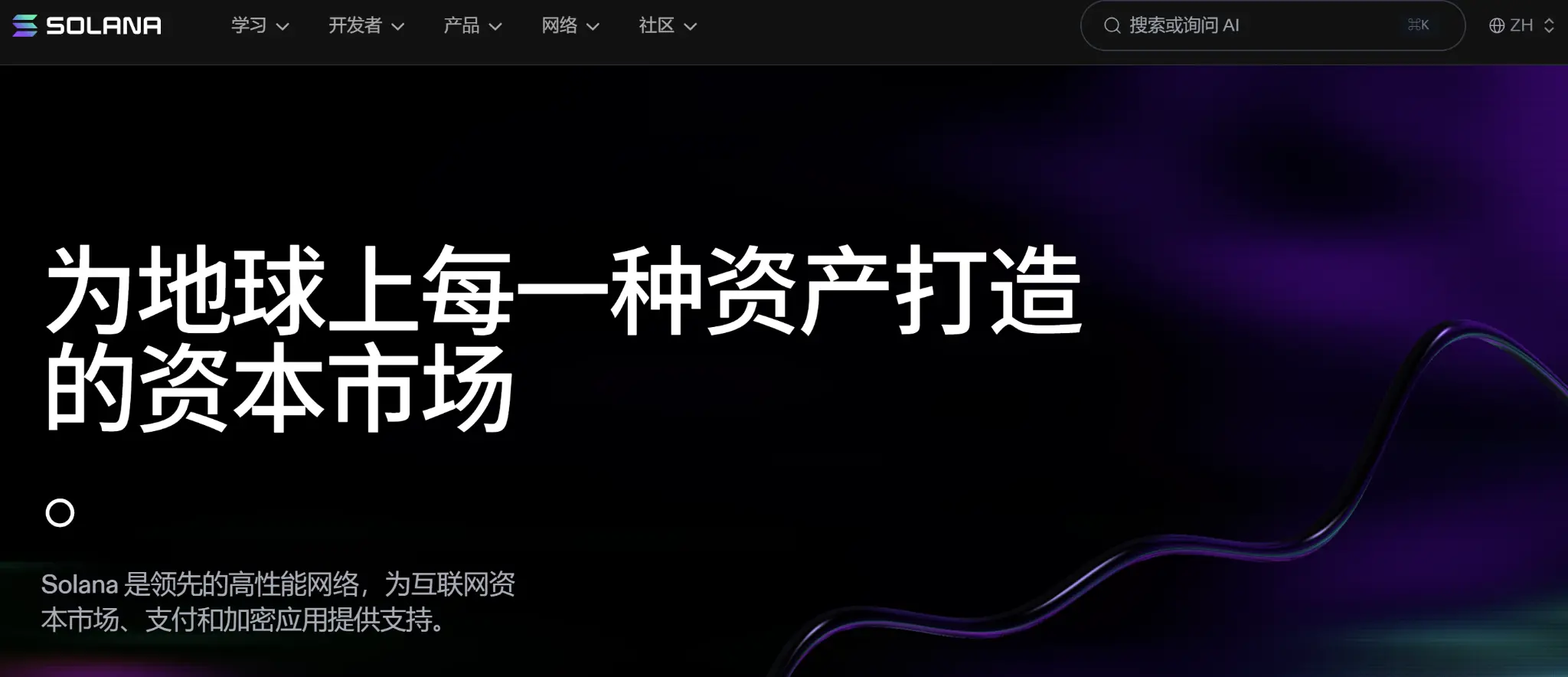
It means that Solana not only aims to challenge Ethereum but also attempts to replace traditional exchanges, brokers, and clearing systems, becoming the on-chain version of Nasdaq. High speed, low fees, high throughput, relatively mature user experience, and the strong endorsement of Wall Street capital once positioned Solana as the public chain closest to achieving this goal.

The problem, however, is that when the 'Internet Capital Markets' truly began to take shape, the market discovered that Solana might not necessarily occupy the core position.

The Unexpected Impact of Hyperliquid

One of the biggest structural changes in the crypto industry over the past year is the migration of the perpetual contracts market away from traditional CEXs to on-chain platforms.

And the biggest beneficiary of this trend is not Solana, nor Ethereum, Sui, or other networks, but Hyperliquid.

Initially, Hyperliquid was just an on-chain perpetual contracts trading platform. However, with the advancement of its Layer1 strategy, it has gradually evolved into a complete financial infrastructure network. Compared to Solana's broad and abstract 'capital markets' vision, Hyperliquid has chosen a more focused, transaction-driven path.

For a long time, although the Solana ecosystem has hosted numerous DeFi projects, its core liquidity has always leaned more towards spot trading, Meme Coins, and on-chain speculation. Infrastructure truly capable of supporting institutional-grade trading depth, risk management, and high-frequency trading needs has never been mature.

More critically, Hyperliquid has gradually proven something many previously overlooked: the 'Internet Capital Markets' might not necessarily require a general-purpose ecosystem.

For high-frequency financial trading, the importance of performance, matching, liquidity, and trading experience far outweighs 'richness of on-chain applications.' This implies that a vertical Layer1 specifically designed for financial trading might be more suitable as the core of on-chain capital markets than a general-purpose public chain like Solana.

This is also why an increasing amount of capital, traders, and attention are converging towards Hyperliquid.

After the Drift Incident, Solana Forced to Adjust Its Perpetual Contracts Market Strategy

If Hyperliquid is squeezing Solana's 'capital markets' strategic space from the outside, then the attack on Drift Protocol tore open a significant gap from within.

In early April this year, the Solana DeFi protocol Drift suffered a governance and oracle attack, resulting in losses exceeding $200 million.

As one of the most important perpetual contracts protocols on Solana, Drift had always played a core liquidity role in Solana DeFi. After the hacker attack, the protocol's functions were directly paralyzed. A large number of assets, vaults, and associated protocols within the Solana ecosystem were affected, and market confidence rapidly deteriorated.

Perpetual contracts are a fiercely contested territory in the DeFi field. Facing the market vacuum left by Drift and Solana's strategic gap in on-chain derivatives, the Solana team had to heavily promote new alternatives to capture users and market share in the front lines of the 'Internet Capital Markets' strategy.

At this point, the choices before the Solana team included a series of products like Pacifica, Phoenix, Jupiter, GMTrade, Bullet, and Blink. However, Solana founder Anatoly Yakovenko firmly chose Phoenix.

Over the past five days, Toly (Anatoly) has posted at least twenty tweets or retweets related to Phoenix, either sharing other industry professionals' testing experiences with Phoenix, directly recommending its use, or discussing his views on Phoenix.

Regarding this 'favoritism,' Toly has also explained multiple times that Pacifica does not execute trades on the Solana chain—its compatibility with Solana is as good as Hyperliquid's—and that Jupiter is already mature, so he is focusing more on early-stage teams from 0 to 1. Meanwhile, Phoenix is decentralized and can atomically combine with all other applications on Solana.

Driven by Toly, Phoenix's popularity has remained in the top three of RootData's trending projects list for several consecutive days, reaching a historical peak in its heat index.

However, in terms of trading volume, Phoenix still lags far behind other established perpetual contracts platforms. According to DeFillama data, Phoenix's daily trading volume previously remained under $4 million for a long time. Recently, riding the market hype, its daily trading volume surpassed $80 million for the first time, but it still ranks outside the top 20 among all perpetual contracts platforms, with a gap of more than 20 times compared to platforms in the top 5 (minimum $1.6 billion).

Solana's Public Opinion Offensive and Internal Rifts

Faced with Hyperliquid's strong rise and the trauma within its own ecosystem, Solana supporters have chosen a seemingly 'using their own spear against their own shield' path—using decentralization as a weapon to launch a public opinion attack on Hyperliquid.

Solana Foundation member @harkl_ tweeted that Hyperliquid markets itself as a decentralized exchange platform, but the reality is 24 validator nodes, closed-source node code, a single bridge handling tens of billions of dollars in funds, and a record of forced settlements during market volatility.

'Can you participate in any part of the protocol stack with your own resources, without approval from a trusted third party? If not, it's not permissionless. No matter what you do, you cannot run a Hyperliquid sequencer,' Toly further stated.

This argument sparked intense debate in the crypto community. Supporters believe Toly hit Hyperliquid's core weakness—if there are less than 30 validator nodes, the node code is not public, and the bridge is highly centralized, then what is the essential difference between the so-called 'on-chain capital market' and the custodial model of a CEX?

Opponents pointed out that Solana's own number of validators has sharply dropped from 2560 to about 756, its Nakamoto Coefficient has fallen from 31 to 20, and the top twenty validators control over one-third of the staked share. Against this backdrop, discussing 'decentralization' carries a hint of 'the pot calling the kettle black.'

A more thorny issue comes from within the Solana ecosystem. The consistent 'favoritism' shown by many Solana Foundation executives has caused dissatisfaction among developers of other protocols.

'They will promote what they think is most beneficial for themselves. Just because a team meets a certain standard and pushing others away is turning friends into enemies,' said kdotcrypto, co-founder of Bulk.

The comment from Pacifica founder Constance was more restrained but equally impactful: 'We chose Solana in 2025, haven't taken any funding from the Foundation, haven't raised from investors, just wanted to build the product first and let the market decide.' Behind the phrase 'let the market decide' lies a subtle protest against the Solana Foundation's role as both 'referee and player.'

The most brutal truth in the crypto market is this: users don't care about grand narratives; they only care about depth, liquidity, and security. The rise of Hyperliquid is not just a technical victory but also a dimensional reduction attack on the 'general-purpose public chain' narrative—it proves that building the core of capital markets may not require a vast, complex ecosystem but rather an ultimate matching engine.

Now, Solana is mired in a quagmire of comparing 'decentralization metrics' with its competitors, and the Phoenix platform it heavily promotes still has a 20-fold trading volume gap compared to mainstream derivatives platforms.

In this battle for the endgame of 'Internet Capital Markets,' if Solana cannot regain its dominance in the derivatives field in the second half of 2026, it may remain an excellent Meme playground, but it will only drift further away from that dream of 'carrying global assets.'

Preguntas relacionadas

QAccording to the article, what is the core vision that Solana has been promoting in recent years?

ASolana has been promoting a vision far grander than just being a 'high-performance public chain.' Its ultimate goal, as defined by the Solana Foundation, is to become the 'Internet Capital Markets'—a global trading network that brings stocks, commodities, futures, perpetual contracts, and all real-world assets on-chain. The slogan on its official homepage reads: 'Capital markets for every asset on earth.'

QWhich project is presented in the article as a major challenger to Solana's 'Internet Capital Markets' vision, and why?

AHyperliquid is presented as a major challenger. It started as an on-chain perpetual contract trading platform but has evolved into a full financial infrastructure network. The article argues that for high-frequency financial transactions, a specialized, vertical Layer 1 designed for trading (like Hyperliquid) may be more suitable than a general-purpose public chain like Solana, as performance, matching, liquidity, and trading experience are more critical than a wide variety of on-chain applications.

QWhat internal event significantly weakened Solana's position in the on-chain derivatives market, according to the article?

AThe attack on the Solana DeFi protocol Drift in early April significantly weakened Solana's position. The governance and oracle attack caused over $200 million in losses, paralyzing the protocol's functions. As one of the most important perpetual contract protocols on Solana, its failure impacted a large number of assets, vaults, and associated protocols within the ecosystem, rapidly deteriorating market confidence.

QWhich protocol did Solana founder Anatoly Yakovenko (Toly) strongly endorse to fill the gap left by Drift, and what was his stated reasoning?

AAnatoly Yakovenko strongly endorsed the protocol Phoenix. His stated reasoning was that Pacifica does not execute trades on the Solana chain (its compatibility with Solana is similar to Hyperliquid's), Jupiter is already mature, and he prefers to focus on early-stage teams building from scratch. He emphasized that Phoenix is decentralized and can be atomically composed with all other applications on Solana.

QWhat criticism did Solana supporters level against Hyperliquid, and what counter-criticism was mentioned in the article regarding Solana itself?

ASolana supporters, including founder Toly, criticized Hyperliquid for its lack of true decentralization, pointing to its 24 validator nodes, closed-source node code, a single bridge handling tens of billions in funds, and a record of forced settlements during market volatility. The counter-criticism mentioned is that Solana's own validator count has sharply decreased from 2,560 to about 756, its Nakamoto coefficient has dropped from 31 to 20, and the top 20 validators control over one-third of the staked SOL, making Solana's focus on 'decentralization' seem hypocritical or like 'the pot calling the kettle black.'

Lecturas Relacionadas

A Nation Blocks Chips, a Giant Buys a Nuclear Power Plant: Why It's Time to Seriously Consider DeAI

**Title: Great Powers Blockade Chips, Giants Buy Nuclear Plants: Why It's Time to Seriously Consider DeAI** In May 2026, the US closed loopholes for Chinese firms to acquire advanced NVIDIA chips via overseas subsidiaries. That same month, Kenya halted a $1B geothermal data center project involving Microsoft, fearing its immense energy consumption. Meanwhile, Huawei announced mass production of its Ascend AI chip. These disparate events underscore a new reality: the competition for computing power ("compute") has escalated beyond the tech industry, becoming a geopolitical and infrastructural battleground. A new era of oligopoly is forming, with control over the AI stack—from GPU chips (NVIDIA) and cloud platforms (AWS, Azure, Google Cloud) to foundational models (OpenAI, Anthropic)—concentrating in a few Western "AI Octopus" corporations. This centralization creates systemic risks: pricing power and platform lock-in for users, infrastructure fragility, and a widening "compute divide" that threatens to marginalize nations without independent AI capacity. An "AI Iron Curtain" is deepening through export controls. In response, some nations like Saudi Arabia and the UAE are investing heavily to buy compute power, aiming to transition from oil to AI economies. The EU seeks to triple its compute capacity by 2030 to reduce dependency. However, the spending gap is vast, with four US tech giants alone planning ~$750B in AI capex for 2026. The race is increasingly constrained by energy, with AI tasks consuming up to 1000x more power than web searches, pushing firms to even acquire nuclear plants. This landscape is fueling interest in Decentralized AI (DeAI). It proposes a third way: using open protocols to coordinate a global network of idle GPUs, independent developers, and data centers, creating an AI infrastructure without a single controlling entity. Leveraging blockchain and cryptographic verification, DeAI aims to break market concentration, disperse energy demands, reduce geopolitical dependencies, and enhance transparency. While still nascent in performance and stability, DeAI's core promise is not immediate superiority but providing a crucial alternative architecture to resist monopoly, censorship, and centralized power. As specialized AI hardware costs fall and open-source models flourish, the window to build this foundation is open. The very existence of such competition serves as a vital check against the inevitable abuse of concentrated power.

marsbitHace 4 min(s)

A Nation Blocks Chips, a Giant Buys a Nuclear Power Plant: Why It's Time to Seriously Consider DeAI

marsbitHace 4 min(s)

Outpoll Review: A Prediction Market Platform Built for Active Traders

Outpoll Review: A Prediction Market Platform Built for Active Traders In recent years, prediction markets have grown from a niche sector to a mainstream arena, attracting billions in trading volume and institutional capital. However, the user experience and tools for traders have not kept pace. Outpoll, a new global prediction market platform, aims to fill this gap by providing enhanced trading infrastructure for active and professional traders. Built on standard prediction market principles, Outpoll allows users to trade on the outcome of specific events. It uses fully collateralized contracts with USDC settlement, charges a competitive 0.1% fee per trade, and provides clear settlement rules upfront to minimize disputes. A key focus for Outpoll is its professional-grade trading tools. The platform supports limit and market orders, as well as take-profit and stop-loss orders for open positions—features uncommon in prediction markets. For automated trading, Outpoll offers comprehensive REST and WebSocket APIs, enabling portfolio management, price arbitrage, and integration with existing tools. The platform also features a creator-led market model, where approved experts and community leaders can create and manage markets for niche topics under platform supervision. Its integrated interface combines news feeds directly with trading functions, allowing users to monitor events and manage positions seamlessly. Outpoll launched with a native Android app (available on Google Play) and plans an iOS version later this year. In summary, Outpoll distinguishes itself with trader-focused tools, practical APIs, transparent and collateralized markets, integrated news, and an expanding creator program. For active traders, its advanced order types and API access alone make it a platform worth watching. Outpoll is now globally accessible via outpoll.com and Google Play.

marsbitHace 12 min(s)

Outpoll Review: A Prediction Market Platform Built for Active Traders

marsbitHace 12 min(s)

Bitwise: Crypto Becomes a Contrarian Investment, Three Logics to Understand the Current Market

**Summary** Matt Hougan, Bitwise's CIO, analyzes the current crypto market through three key lenses, arguing it has shifted from a momentum-driven to a contrarian investment. **1) Crypto Becomes a Contrarian Play:** The market is weak, with major assets like Bitcoin and Ethereum down significantly. Capital has moved to hot sectors like AI, leaving crypto as an "unloved" asset class. This transforms crypto investing from trend-following to a test of patience and fundamental analysis. Investors now favor projects with solid fundamentals (e.g., Hyperliquid) over speculative ones. **2) Regulatory Overhang:** The uncertain fate of the U.S. CLARITY Act, a major crypto regulatory framework, is a key headwind. With its passage in 2024 seen as far from guaranteed (estimates range from 30-55%), institutional capital remains on the sidelines, choosing less risky alternatives like AI stocks. The market needs clarity—whether the bill passes or fails—more than any specific outcome to move decisively. **3) Capital Rotates to New Fundamentals:** This cycle differs from past bear markets where money fled to Bitcoin. Now, capital seeks smaller assets with strong use cases. While major cryptos fell in May 2024, tokens like Hyperliquid (+72%), Zcash (+50%), and XLM (+44%) rallied on their specific fundamentals. This rotation confirms the new contrarian, fundamentals-driven logic and signals the bear market may be in its later stages. **Conclusion:** Short-term pressure persists due to regulatory uncertainty and competition from AI narratives. Investing in crypto now requires a contrarian mindset—acting against the crowd and focusing on fundamental value. Patience and targeting high-quality projects based on their merits are essential for capturing long-term gains.

marsbitHace 55 min(s)

Bitwise: Crypto Becomes a Contrarian Investment, Three Logics to Understand the Current Market

marsbitHace 55 min(s)

ChatGPT Might Be Disappearing Soon

OpenAI announced at its "Intelligence at Work" event that its coding assistant, Codex, will be fully integrated into the ChatGPT app within weeks. This move marks a strategic shift from a conversational AI (Chat) towards a unified "agentic" platform capable of execution. Codex, originally launched to compete with Anthropic's Claude Code, has grown rapidly to 5 million weekly active users, with 20% being non-developers like analysts and designers. Its enterprise revenue now constitutes 40% of OpenAI's total. The integration is the first step in creating a super-app combining ChatGPT (interface), Codex (execution engine), and the Atlas browser (web access). OpenAI also unveiled new Codex features: specialized Agent plugins for six professional roles, an "Annotations" tool for direct document editing, and a "Sites" function to turn work into shareable web apps. Internally, this reflects a power shift; the Codex team now leads core product strategy. While the ChatGPT brand remains for its vast user base, the platform's future is focused on autonomous agents that perform tasks, not just chat. The article notes that competition with Claude Code pushed OpenAI's development, with Codex competing on cost-effectiveness and accessibility rather than raw coding quality. It concludes that the essence of "ChatGPT" is evolving from a chatbot into an AI agent platform, with the name potentially becoming a legacy symbol of its original function.

marsbitHace 1 hora(s)

ChatGPT Might Be Disappearing Soon

marsbitHace 1 hora(s)

Trading

Spot
Futuros
活动图片