When DeFi Enters the "Exchange Era": The Ambition and Boundaries of Hyperliquid

比推Publicado a 2026-02-25Actualizado a 2026-02-25

Resumen

Hyperliquid is a specialized Layer 1 blockchain designed to bring a centralized exchange-like experience to on-chain perpetual contract trading. It places order books, matching, execution, and liquidation primarily on-chain while achieving performance and usability comparable to major CEXs. Its native token, HYPE, captures value from trading fees and embodies a hybrid narrative of both exchange and blockchain utility. Key innovations include the HLP (Hyperliquid Liquidity Provider) mechanism, which incentivizes liquidity provision and supports market-making activities. However, Hyperliquid faces challenges including decentralization trade-offs, systemic risks from derivatives, potential HLP user misunderstandings, and future regulatory pressures. It represents a significant shift in DeFi towards exchange-grade usability but remains a high-risk, complex financial experiment.

Author: Climber, CryptoPulse Labs

Original Title: In-Depth Analysis of Hyperliquid: The King of On-Chain Perpetuals—Pushing DeFi into the "Exchange Era"


Over the past few years, DeFi has given birth to countless trading products, but few projects have truly managed to bring professional trading on-chain. To some extent, Hyperliquid has changed this landscape.

It didn't just build a perpetual DEX on Ethereum; instead, it created a Layer1 blockchain specifically for trading. It places order books, matching, execution, and liquidation as much as possible on-chain, while refining the user experience to a level close to that of centralized exchanges. As a result, a massive market that originally belonged to CEXs—perpetual contracts—is finally being genuinely disrupted by on-chain forces.

Hyperliquid is regarded as the king of on-chain perpetuals, but it also faces controversy over risk control, degree of decentralization, and systemic risks. Does it represent the next leap forward for DeFi, or is it a more complex risk experiment? This article will dissect Hyperliquid's true strengths and weaknesses along three main lines: product logic, token value, and potential risks.

I. Hyperliquid: Making On-Chain Perpetuals "As User-Friendly as an Exchange"

If we view the history of DeFi as a single narrative, a harsh truth emerges: most on-chain financial products fail not because of their ideas, but because of their user experience.
On-chain lending, DEX swaps, yield aggregators—these are naturally better suited for slow, low-frequency operations. Users can accept slower confirmations, higher slippage, and more expensive fees.

But perpetual contracts are entirely different. They are a classic high-frequency financial product. Traders demand millisecond-level responsiveness, stable liquidity depth, smooth order placement and cancellation, and a system that doesn't crash during extreme market conditions.

This is where Hyperliquid's core value lies. It is arguably the first platform to offer ordinary users an on-chain order book perpetual contract experience that approaches the level of CEXs.

First-time users of Hyperliquid experience a strong illusion. It doesn't feel like DeFi; it feels more like Binance or OKX. The interface, order placement logic, market depth, and execution speed all approach the experience range of centralized exchanges.

More importantly, this isn't achieved by sacrificing transparency. Instead, it places key actions like order book management, matching, execution, and liquidation on-chain as much as possible, making the trading process verifiable. This is also why Hyperliquid suddenly gained prominence between 2024 and 2026.

The derivatives market is the largest cash flow entry point in the crypto world. The majority of CEX fee revenue comes from contract trading, and DeFi has long lacked products that can meet this demand.

Historically, the mainstream approaches for on-chain perpetual contracts were either the AMM model, like GMX, which relies on liquidity pools for pricing, or the order book model with off-chain matching, which results in a fragmented experience and compromised decentralization.

The problem with AMMs is their lack of friendliness to professional traders. Depth, pricing, and slippage are often unsatisfactory for large positions. The problem with off-chain matching is insufficient transparency, as users always suspect the platform of operating in a black box.

Thus, Hyperliquid chose the most radical path: if the on-chain environment struggles to handle the high-frequency nature of order books, then build a blockchain specifically designed for trading.

It treats the exchange as the primary purpose of the blockchain, rather than forcing a trading application onto a general-purpose chain.

Beyond user experience, another thing Hyperliquid got right is successfully solving the classic challenge of order book DEXs—liquidity.

Hyperliquid's HLP (Hyperliquid Liquidity Provider) mechanism essentially productizes market-making capabilities. It allows users to deposit funds into a market-making pool, where the system executes market-making strategies, sharing fee revenue and spread profits with the platform.

This means the platform's liquidity no longer relies entirely on external market makers but forms an endogenous cycle. Higher trading volume leads to more fees, which strengthens market-making profits. More capital is incentivized to enter, improving depth and user experience, which in turn drives further volume growth.

Therefore, Hyperliquid's rise is no mystery. It is essentially a rare product-driven project in the DeFi world, built up by real traders.

II. Behind the HYPE Hype—The Equity Narrative of an On-Chain Exchange

Discussing Hyperliquid inevitably involves HYPE. Many people's understanding of HYPE stops at "just another platform token." But if viewed solely through the lens of a platform token, its valuation logic appears quite ordinary.

So HYPE is more like a hybrid asset. It simultaneously carries the value capture expectations of a trading platform and the network effect expectations of a native public chain asset, primarily backed by derivatives trading.
Derivatives are the engine of the crypto world. The spot market is more about buying and selling assets, while the contract market is a continuous fee-collecting casino—higher trading frequency, more stable fee income, and stronger user stickiness.

CEX dominance largely stems from perpetual contracts. Hyperliquid's significance lies in it being the first to show the market that contract trading doesn't have to be provided solely by centralized exchanges. As long as the experience is good enough, the depth is strong enough, and the liquidation is stable enough, on-chain platforms can also meet large-scale perpetual contract trading demand.

This opens up the market imagination for HYPE. If Hyperliquid captures a larger share of the on-chain perpetuals market, it could become a "Binance on-chain" entity, and HYPE would naturally be analogized to an asset like BNB.

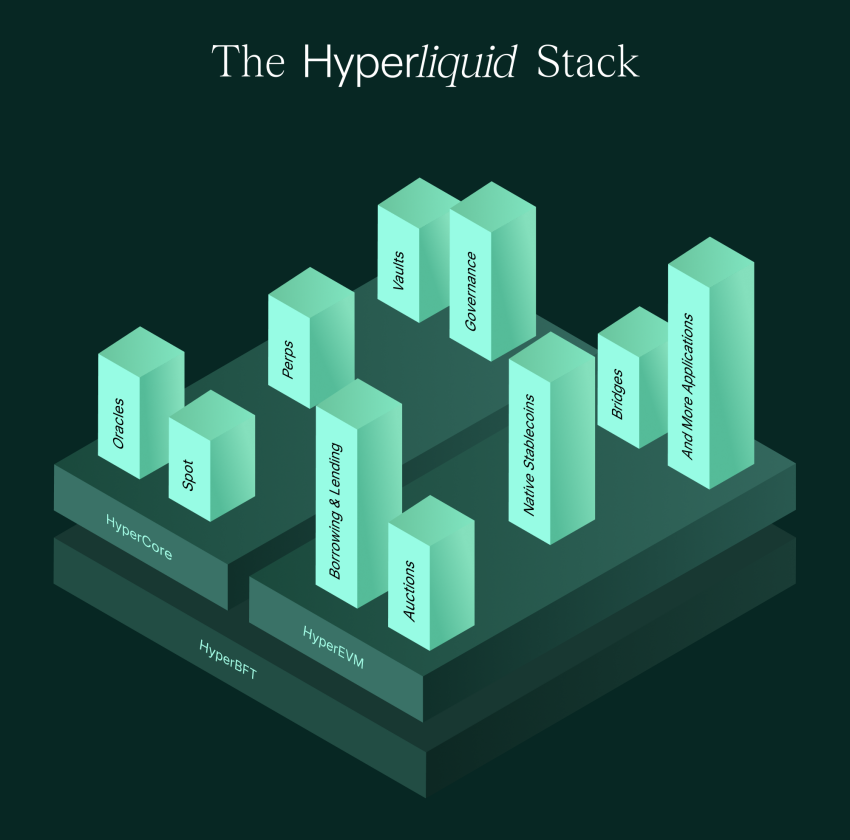
But Hyperliquid isn't content with being just a perpetuals platform. Its push for HyperEVM in 2025-2026 indicates its ambition to expand from an exchange to an on-chain financial ecosystem.

The significance of EVM compatibility is simple: it can attract Ethereum ecosystem developers, allowing various DeFi Lego blocks to be built on the Hyperliquid chain.

The exchange provides traffic and capital; the ecosystem provides applications and stickiness. This is the most successful path CEXs have taken over the past decade: use trading as the entry point, then use the ecosystem to widen the moat. Hyperliquid is now moving this path on-chain.

Furthermore, Hyperliquid's dissemination style is more "crypto purist," emphasizing the product, traders, and community drive. Consequently, its user base includes a large number of professional traders and high-frequency players, not just retail users looking to farm airdrops.

This user structure sends a strong signal: this is not a fake prosperity built on subsidies, but a real, sustainable trading venue. This sense of authenticity feels particularly valuable after experiencing so many bubble projects.

III. Hyperliquid's Dilemmas: The Decentralization Contradiction, Systemic Risk, HLP Mechanism, and Regulation

If you only look at Hyperliquid's growth curve, many might think the king of on-chain perpetuals has arrived. But in reality, Hyperliquid's controversies are very focused, primarily stemming from contradictions inherent in its business model.

The biggest contradiction is the issue of decentralization. Hyperliquid is often called the "Binance on-chain." This phrase is both praise and criticism. The praise lies in its极致 (ultimate) user experience; the criticism lies in its behavior sometimes resembling a centralized platform more, such as in risk control, account bans, and address restrictions.

Hyperliquid currently follows a pragmatic middle path. To ensure the stability of the trading system and reduce attacks and abnormal fund flows, it may employ stronger risk control measures.

The problem is, the stronger the risk control, the more it resembles a CEX. The more it resembles a CEX, the more its decentralization narrative is weakened. This contradiction won't disappear; it will only become more acute as the platform scales. Because the larger the trading volume and influence, the more risk management it requires, and the more external pressure it will face to take responsibility.

The second risk comes from the derivatives system itself. Perpetual contracts are highly complex financial products where systemic risk always exists. Examples include extreme market conditions, cascading liquidations, insufficient insurance funds, bad debt, and failure of forced reduction mechanisms. A problem in any one link could trigger a crisis of confidence.

Hyperliquid's challenge is to maintain on-chain transparency while ensuring reliable liquidation during extreme行情 (market conditions).

CEXs have many "off-chain means" to put out fires during black swan events, such as suspending trading, adjusting risk controls, forced position reduction, and temporary rule changes.

On-chain systems find this harder to do. They require stronger mechanism design and greater resilience under pressure. Has Hyperliquid truly undergone sufficient extreme stress tests? This is a question that demands caution.

The third risk comes from HLP. Many new users see HLP and mistakenly think it's a "stable yield pool." But in fact, it's more like a market-making fund.

Its收益 (profits) come from fee sharing and market-making spreads, but its risks come from the counterparty advantage of traders and one-sided impacts during extreme markets. Market making is never a risk-free business; it's a professional field. The essence of HLP is entrusting your funds to the system for market making, while you bear the risk of being "harvested by skilled traders."

In a bull market, high trading volume and plentiful fees make HLP's returns look attractive. But in certain market conditions, it can also experience significant drawdowns. For ordinary users, the biggest risk isn't the loss itself, but misunderstanding the risk and treating it as low-risk wealth management.

The final risk is the collision with regulation and the real world. Derivatives are a heavily regulated area in traditional finance, and perpetual contracts are particularly sensitive products in many countries.

As an on-chain platform, Hyperliquid might operate in a gray area in the short term. But when it grows large enough to enter the mainstream spotlight, regulatory pressure is almost inevitable.

Conclusion

Hyperliquid is not a myth; it is a symbol of DeFi entering the "exchange era."

Hyperliquid is important not because it made some token pump, but because it proves one thing: on-chain derivatives don't have to remain forever in the "usable but not user-friendly" stage. They can achieve an experience close to centralized exchanges and attract real traders to migrate.

But from an investment perspective, the platform remains a high-risk derivatives system. It still faces decentralization controversies, and it still needs to confront extreme market conditions and regulatory reality as it scales.

If the past DeFi era belonged to protocols, then what Hyperliquid represents is the era where DeFi goes to market. It is not the endpoint, but it might be a turning point.


Twitter:https://twitter.com/BitpushNewsCN

Bitpush TG Discussion Group:https://t.me/BitPushCommunity

Bitpush TG Subscription: https://t.me/bitpush

Original Link:https://www.bitpush.news/articles/7614336

Criptos en tendencia

Preguntas relacionadas

QWhat is Hyperliquid and how does it aim to change the DeFi landscape?

AHyperliquid is a Layer 1 blockchain specifically built for trading, designed to bring a near-centralized exchange (CEX) experience to on-chain perpetual contracts. It places order books, matching, execution, and liquidation primarily on-chain, aiming to capture the massive derivatives market traditionally dominated by CEXs by offering superior user experience and transparency.

QWhat mechanism does Hyperliquid use to solve the liquidity problem common in order book DEXs?

AHyperliquid employs the HLP (Hyperliquid Liquidity Provider) mechanism, which productizes market-making capabilities. It allows users to deposit funds into a market-making pool where the system executes strategies, enabling users to share in the platform's fee and spread revenue, thus creating an endogenous liquidity cycle that improves with increased trading volume.

QHow does the HYPE token function beyond being a typical platform token?

AThe HYPE token is a hybrid asset that captures value from both the trading platform and the network effects of its native blockchain. It is likened to 'equity' in a chain-based exchange, with its valuation tied to the growth of on-chain perpetual contract trading and the expansion of the Hyperliquid ecosystem, including its HyperEVM compatibility for broader DeFi application development.

QWhat are the main controversies or risks associated with Hyperliquid?

AKey controversies include its pragmatic approach to decentralization, which involves centralized-like risk management practices such as address restrictions; systemic risks inherent in complex perpetual contracts, such as cascading liquidations during extreme volatility; the potential misunderstanding of HLP's risks as a low-yield product rather than a market-making fund; and impending regulatory scrutiny as the platform scales.

QWhy is Hyperliquid considered a sign of DeFi entering the 'exchange era'?

AHyperliquid signifies the 'exchange era' of DeFi by demonstrating that on-chain derivatives can achieve a user experience comparable to centralized exchanges, attracting real traders. It moves beyond the protocol-focused DeFi of the past, focusing on market-driven growth, ecosystem expansion, and capturing value from high-frequency financial products like perpetual contracts.

Lecturas Relacionadas

Two Legends Lost in Three Days: Is Google's AI Talent Dam Cracking?

In three days, Google lost two AI legends. On June 18, Noam Shazeer, co-author of the seminal "Attention is All You Need" paper and Gemini co-lead, left for OpenAI. Just 48 hours later, John Jumper, 2024 Nobel laureate and AlphaFold lead, departed DeepMind for Anthropic. This follows Andrej Karpathy joining Anthropic in May. These moves highlight a structural trend: top AI talent is concentrating at mission-driven, pre-IPO firms like OpenAI and Anthropic, while Google becomes a primary source. The exodus stems from a core mission mismatch. Google's ad-centric model often subordinates AI research to product and revenue goals, creating friction for pioneers like Shazeer, who returned in 2024 only to leave again. In contrast, OpenAI and Anthropic offer singular focus on pushing AI boundaries, whether towards AGI or safety-aligned models, which deeply appeals to top researchers like Jumper. Financial incentives amplify the pull. With both OpenAI and Anthropic nearing IPO, employees stand to gain immensely from equity, an upside Google's mature stock cannot match. Furthermore, the 2023 merger of Google Brain and DeepMind, intended to consolidate strength, has instead created cultural tension and slowed the path from research to product, as evidenced by Gemini's pace. This talent redistribution is reshaping the AI landscape. While Google retains vast data and compute resources, its true crisis is the quiet, continuous loss of the people who define the field's future. The real moat in AI is not infrastructure, but the concentration of brilliant minds—a battle Google is currently losing.

marsbitHace 2 hora(s)

Two Legends Lost in Three Days: Is Google's AI Talent Dam Cracking?

marsbitHace 2 hora(s)

Behind the AI Report Card, Lies a Chinese 'Exam Setter'

Beyond the familiar performance charts like MMLU-Pro and MMMU, which major AI models strive to ace, stands a key "examiner": Chinese-Canadian researcher Wenhu Chen. An assistant professor at the University of Waterloo and founder of TIGERLab, Chen addresses the crucial need for more rigorous AI evaluation. As models like GPT-4 began scoring near-perfect results on older benchmarks like MMLU, it became difficult to distinguish their true capabilities. In response, Chen introduced MMLU-Pro in 2024, featuring harder, more reasoning-focused questions with more answer choices, successfully reintroducing meaningful performance gaps. His work extends to multi-modal evaluation with MMMU and its enhanced version, MMMU-Pro. These benchmarks test a model's ability to understand and reason with complex information from images, charts, and text across diverse academic subjects, exposing the significant challenges even top models face in genuine comprehension. Chen's background in complex QA, table reasoning, and his experience at Google DeepMind on projects like Gemini inform his approach. He understands that effective benchmarks must anticipate how models might "cheat" by memorizing data or avoiding visual analysis. His lab also actively researches video understanding and generation models (e.g., UniVideo, Vamba), ensuring his evaluation work is grounded in practical model-building challenges. Now at Meta's Super Intelligence Lab, Chen continues his focus on multi-modal data and evaluation, representing the deep yet often unseen contributions of Chinese talent in shaping the fundamental tools of the AI industry.

marsbitHace 2 hora(s)

Behind the AI Report Card, Lies a Chinese 'Exam Setter'

marsbitHace 2 hora(s)

Alliance Co-founder's Letter to Entrepreneurs: Written at the Moment Cursor Sold for $600 Billion

Alliance Co-founder's Letter to Entrepreneurs: On Cursor's $60 Billion Sale Many aspiring founders see massive exits like Cursor's $60B sale and wonder why they can't achieve the same, often concluding opportunities are exhausted. But great companies aren't built in obvious, crowded spaces. Cursor, like Stripe, Figma, and Shopify before it, started with a non-consensus belief about the future. Before ChatGPT, they believed AI would transform knowledge work. They focused on a genuinely exciting domain, became their own customer, and obsessed over power users. Their journey involved years of "glass-chewing" effort before the market was ready. The pattern is consistent: identify a long-term technological shift, find a missed entry point, and execute for years before the trend becomes obvious. First-generation products (PayPal, Adobe, Amazon) prove a market exists. Second-generation winners (Stripe, Figma, Shopify) rebuild that market around new insights, technology, or changing customer behaviors. Founders must identify their phase in the cycle. Early entrants like Coinbase or Cursor focus on making new technology usable for power users. Later entrants find the "yin" to the established "yang"—the blind spots incumbents miss as they grow distant from individual users. The key is deep market immersion. Use every product in your space. Talk to users. Build an audience. Stop looking for ideas and start *seeing* them everywhere. Then, choose one. The idea must offer a 10x improvement or solve a "hair-on-fire" pain point—something severe enough that users are already crafting workarounds. When building, avoid feature bloat. Ask: why would someone switch? Great startups rarely force new behaviors; they improve familiar workflows with drastically lower friction (e.g., Cursor forked VS Code instead of creating a new editor). Distribution is the underestimated moat. Before product-market fit, achieve distribution-market fit. How do customers discover new tools? Founders like those at Airbnb, Stripe, and Cursor did unscalable, manual work to recruit early users. The final, unteachable ingredient is resilience. Cursor built for years pre-market, faced rejection, and persisted. So did Airbnb, Nvidia, and Rain (which launched post-FTX collapse). The lesson isn't that these founders were smarter, but that they stayed in the game long enough for their insights to compound. Framework: Spot technological cycles. Cultivate unique insight. Obsess over your market. Talk to customers. Find a hair-on-fire problem. Build the simplest wedge. Win your distribution channel. Above all, don't quit when it gets hard. Most people won't do these things consistently. The few who do build the next generation of great companies. Go build.

marsbitHace 2 hora(s)

Alliance Co-founder's Letter to Entrepreneurs: Written at the Moment Cursor Sold for $600 Billion

marsbitHace 2 hora(s)

Weekly Editor's Picks (0613-0619)

Weekly Editor's Picks (0613-0619): Market Insights & Analysis This weekly digest curates in-depth analysis often lost in the information flow, focusing on key insights across macro trends, investment, and technology. **Macro & Geopolitics:** With the Strait of Hormuz reopening and military conflict shifting to negotiation, markets are pivoting from "war shock" to "supply restoration." Trades include shorting crude risk premiums, longing airlines/tourism, Asian energy importers, and bond duration, while shorting inflation expectations. LNG, fertilizer, and chemical chains are also being repriced. **Investment & VC:** Ray Dalio advises against betting on concentrated AI giants dominating indices, advocating for diversified portfolios of high-quality, low-correlation assets instead. Analysis covers the 4-year crypto cycle, predicting the core surviving product by 2029 will be asset trading markets. Current BTC metrics suggest a potential bottoming zone, presenting a patient accumulation window. SpaceX's high-profile IPO at a $2.1T valuation faces scrutiny over fundamentals, with key watchpoints being its likely inclusion in the Nasdaq index and Q2 earnings. Concerns are raised about potential "gamma squeeze" and systemic risks if its narrative-driven valuation gets amplified by passive index funds. Robinhood (HOOD) is noted for breaking its high correlation with crypto, bolstered by its stock trading and new underwriting business. **Web3 & AI:** A warning highlights ~$1.8T in off-balance-sheet AI infrastructure commitments (purchase commitments, leases) as a potential systemic risk if AI monetization lags. AI models are being used for World Cup predictions, adding a new layer for betting markets. A cost breakdown of a $20 AI subscription reveals the supply chain from model companies to cloud, GPUs, and power. **Prediction Markets:** The emergence of prediction market "concept stocks" is noted, with Robinhood developing its own platform, Rothera, signaling a shift from market competition to a "channel war" for user access. **CeFi & DeFi:** The SpaceX IPO tested perpetual contract mechanisms for pre-IPO assets, highlighting challenges in handling corporate actions like stock splits on-chain. The de-pegging of STRC (Strategy's preferred share) to ~$89 reflects market concerns over MicroStrategy's capital structure and BTC-backed leverage model. BlackRock's covered-call Bitcoin ETF (BITA) offers yield but caps upside, appealing to yield-seeking institutions. **Ethereum:** An opinion piece argues Ethereum's core strength is its vast developer community and composability, solidifying its role as the default operating system for the financial internet. **Weekly Hot Topics:** Include the US-Iran deal reopening the Strait of Hormuz, Fed's hawkish hold, Anthropic restricting model access, SpaceX acquiring Cursor, and a humorous stock surge for "Liuliumei" due to its "LLM" ticker.

marsbitHace 2 hora(s)

Weekly Editor's Picks (0613-0619)

marsbitHace 2 hora(s)

Alliance's Co-Founder's Letter to Entrepreneurs: Written on the Occasion of Cursor's $60 Billion Sale

In this letter to entrepreneurs, Alliance reflects on the success of Cursor's $60 billion sale to Elon Musk, using it as a case study to counter the misconception that opportunities in crowded fields like AI or crypto are exhausted. The piece argues that great companies like Cursor, Stripe, Figma, and Shopify are not built by geniuses with perfect ideas, but by founders who start with a non-consensus belief about the future and build for years before that future becomes obvious to everyone. They identify long-term shifts, find overlooked entry points, and execute relentlessly. The framework for success involves: 1. **Identifying your place in the technology cycle**: Early-stage opportunities focus on making new tech usable for power users (e.g., Coinbase, Cursor). Later-stage opportunities involve finding the "yin" to an existing "yang"—the blind spots of first-generation players (e.g., Stripe vs. PayPal, Figma vs. Adobe). 2. **Cultivating unique insights**: Immerse yourself deeply in the market. Use every product, talk to users, and build an audience. Insights will emerge naturally from deep engagement. 3. **Finding a "hair-on-fire" problem**: Look for a 10x improvement or a severe, urgent pain point. The strongest signal is people already building clumsy workarounds. 4. **Building a focused MVP**: Don't just add features because you can. Ask why users would abandon their current tool for yours. The best startups rarely force new behaviors; they improve familiar workflows with drastically lower friction. 5. **Winning a distribution channel**: Distribution is often the moat. Before product-market fit, achieve channel-market fit. Find where your customers are and build an engine to reach them, even through unscalable, manual efforts initially. 6. **Persistence**: The final, unteachable ingredient is resilience. Success stories like Cursor, Airbnb, and Nvidia involved years of grinding, rejection, and perseverance when the path forward seemed unclear. The conclusion is that there is no secret. Most people fail to consistently execute these steps over the long term. The few who do build the companies that define the next era. The world is yours to create.

链捕手Hace 2 hora(s)

Alliance's Co-Founder's Letter to Entrepreneurs: Written on the Occasion of Cursor's $60 Billion Sale

链捕手Hace 2 hora(s)

Trading

Spot
Futuros

Artículos destacados

Cómo comprar ERA

¡Bienvenido a HTX.com! Hemos hecho que comprar Caldera (ERA) sea simple y conveniente. Sigue nuestra guía paso a paso para iniciar tu viaje de criptos.Paso 1: crea tu cuenta HTXUtiliza tu correo electrónico o número de teléfono para registrarte y obtener una cuenta gratuita en HTX. Experimenta un proceso de registro sin complicaciones y desbloquea todas las funciones.Obtener mi cuentaPaso 2: ve a Comprar cripto y elige tu método de pagoTarjeta de crédito/débito: usa tu Visa o Mastercard para comprar Caldera (ERA) al instante.Saldo: utiliza fondos del saldo de tu cuenta HTX para tradear sin problemas.Terceros: hemos agregado métodos de pago populares como Google Pay y Apple Pay para mejorar la comodidad.P2P: tradear directamente con otros usuarios en HTX.Over-the-Counter (OTC): ofrecemos servicios personalizados y tipos de cambio competitivos para los traders.Paso 3: guarda tu Caldera (ERA)Después de comprar tu Caldera (ERA), guárdalo en tu cuenta HTX. Alternativamente, puedes enviarlo a otro lugar mediante transferencia blockchain o utilizarlo para tradear otras criptomonedas.Paso 4: tradear Caldera (ERA)Tradear fácilmente con Caldera (ERA) en HTX's mercado spot. Simplemente accede a tu cuenta, selecciona tu par de trading, ejecuta tus trades y monitorea en tiempo real. Ofrecemos una experiencia fácil de usar tanto para principiantes como para traders experimentados.

396 Vistas totalesPublicado en 2025.07.17Actualizado en 2026.06.02

Cómo comprar ERA

Discusiones

Bienvenido a la comunidad de HTX. Aquí puedes mantenerte informado sobre los últimos desarrollos de la plataforma y acceder a análisis profesionales del mercado. A continuación se presentan las opiniones de los usuarios sobre el precio de ERA (ERA).

活动图片