When Asian VCs See Crypto as 'Bullshit', a16z Has Written It into 'America's Century-Long National Destiny'

marsbitPublicado a 2026-01-12Actualizado a 2026-01-12

Resumen

Author: Tu Ao Da Shi Xiong BroLeon While many in the industry view the cryptocurrency sector as dirty and degenerate, A16Z positions crypto as equally critical as AI in shaping America’s strategic future. The firm, which recently raised $15 billion—accounting for 18% of all U.S. venture capital—has transformed over the past three years into a strategic investment giant with $90 billion in assets under management. A16Z maintains an extensive investment portfolio in crypto, covering numerous well-known projects across various sub-sectors. Even in 2025, it completed 33 investment rounds. In contrast, crypto VCs in Asia have nearly vanished or pivoted away from early-stage investments. The article highlights that A16Z operates with a clear national strategic mission: to ensure U.S. leadership in the next century of technological competition, explicitly naming China as a rival. This aligns with its noted reluctance to invest in Chinese-founded teams. The firm has evolved beyond financial objectives to embrace strong national and ideological commitments. The author expresses a hope that crypto may one day be included in China’s Five-Year Plan.

Author: BroLeon from Australia

While A16Z positions cryptocurrency as a key component of America's future century-long national strategic framework, on par with AI, many of us in the industry view the crypto sector as dirty, degenerate bullshit.
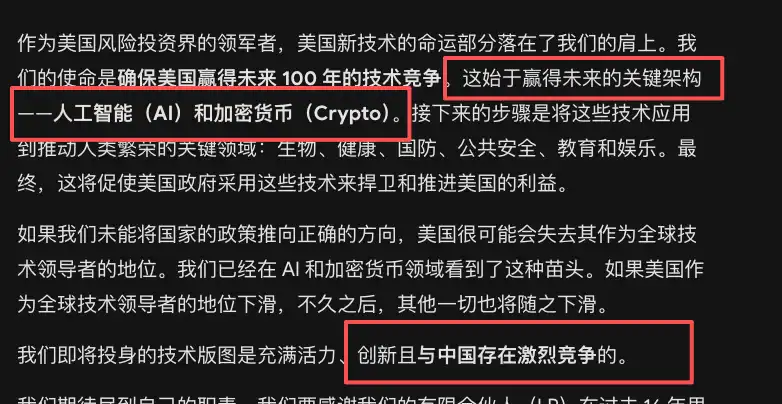
So, is A16Z—which just raised $15 billion, accounting for 18% of total U.S. venture capital—wrong, or are we?

Over the past three years, a16z has successfully transformed from a traditional financial VC into an investment giant with national strategic hue, managing assets worth $90 billion.

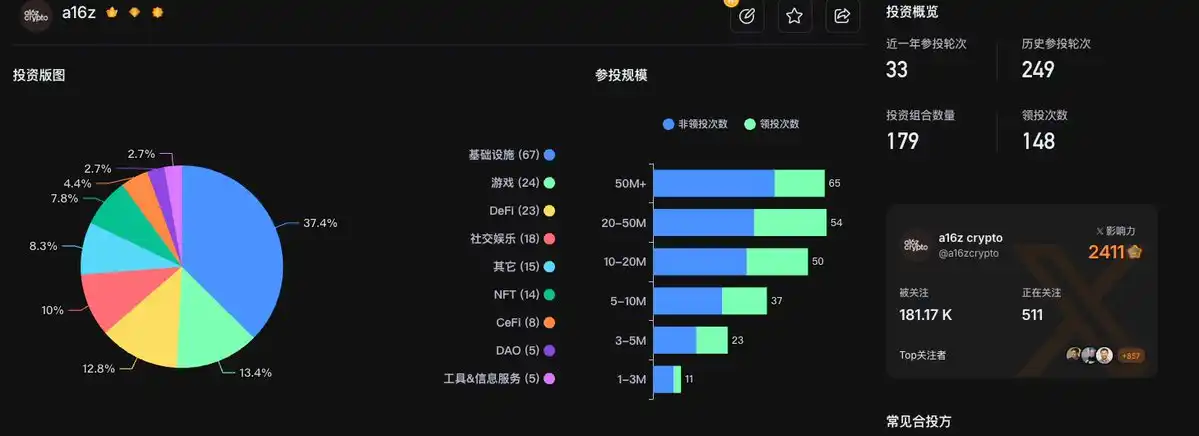
A look at @a16z's investments in the crypto space shows a broad coverage, including many well-known projects across various niches. They were relatively less active in 2025 but still made 33 deals.
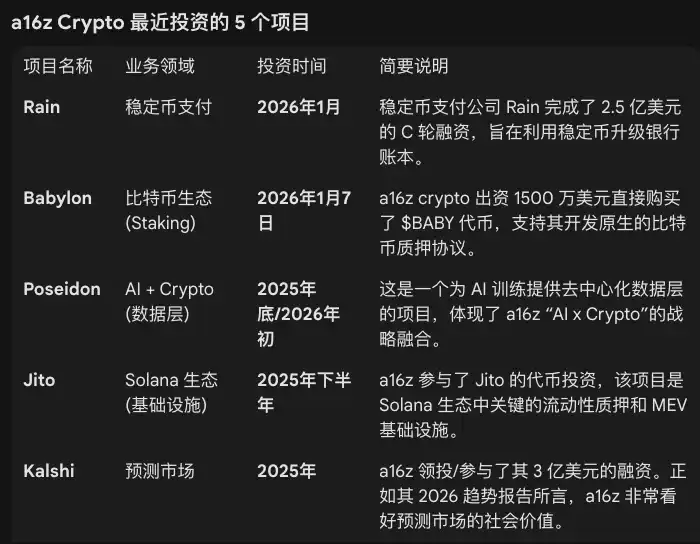
While Crypto VCs in Asia have almost died out or pivoted, no longer investing in early stages, a16z has continued to make frequent moves recently.
So perhaps the Crypto world we see is quite different from the one they see? Just like during the 2018 bear market, when most saw desolation and silence, a few saw opportunities further in the future.

Another striking point in the article is:

Their core national strategic mission is 'ensuring the U.S. wins the technological competition of the next century,' with a clearly named adversary—China.

This also explains why A16Z is notoriously reluctant to invest in projects led by Chinese teams. They are not just a financial investment firm; they have become a company with strong national and ideological convictions.

'The fate of new technologies in America partly rests on our shoulders. Our mission is to ensure the U.S. wins the technological competition of the next 100 years'—resounding words.

I truly hope to see the day when Crypto is written into China's Five-Year Plan.

Preguntas relacionadas

QWhat is the core strategic mission of a16z according to the article, and who is their main competitor?

Aa16z's core strategic mission is to ensure that the United States wins the next 100 years of technological competition, and their main competitor is explicitly named as China.

QHow does the investment strategy of Asian crypto VCs differ from a16z's approach as described in the text?

AWhile many Asian crypto VCs have nearly died out or transitioned away from investing in the primary market, a16z continues to invest frequently and actively in the crypto space.

QWhat significant transformation has a16z undergone in the past three years?

AOver the past three years, a16z has successfully transformed from a traditional financial VC into an investment giant with a national strategic focus, now managing $90 billion in assets.

QWhy does the article suggest that a16z is notably reluctant to invest in projects founded by Chinese teams?

AThe article suggests this reluctance stems from a16z's strong national and ideological stance, as they view their role as crucial for ensuring US technological supremacy in competition with China.

QWhat comparison does the author make between the current perception of Crypto and the situation during the 2018 bear market?

AThe author compares the current situation, where many see the crypto industry as 'dirty and degenerate,' to the 2018 bear market, where most saw desolation and silence, but a few visionaries saw long-term future opportunities.

Lecturas Relacionadas

Apple Also Has to Pay Rent Now

Apple Pays Rent Too: The Two-Way Flow of "Traffic Tax" and "AI Capability Rent" Between Tech Giants For over two decades, Google has paid Apple an estimated $20 billion annually to remain the default search engine on Safari, a "traffic tax" for a critical user entry point. However, in 2026, the direction of this cash flow partially reversed. Apple agreed to pay Google roughly $1 billion per year to license its Gemini AI models, as Apple's own models reportedly struggled with complex tasks. This creates a unique dynamic: Apple acts as the "landlord" in the established search ecosystem, collecting rent from Google for access. Simultaneously, in the emerging AI arena, Apple becomes the "tenant," paying Google for access to cutting-edge AI capabilities it cannot currently match internally. While Apple claims its new models are "distilled" from Gemini outputs and contain "not a drop" of Google's original code, core dependencies remain. Its knowledge base is refined using Gemini's outputs, and its most powerful cloud model runs on Google's infrastructure. Apple has structured the deal as non-exclusive, allowing it to theoretically switch AI suppliers—a hedge against over-reliance. The future hinges on whether advanced AI models become a commodity (cheap and abundant) or remain a concentrated, scarce resource (expensive and controlled by few). Apple is betting on the former, leveraging its massive device ecosystem to be a powerful, choosy customer. If the latter proves true, its bargaining power could erode. This power dynamic is extending to developers. Apple, Google, and WeChat are all pushing for apps to expose their core functions as standardized "actions" or "intents" that their respective AI assistants (Siri, Gemini, WeChat AI) can directly call. The new scarce resource is no longer just app store visibility, but "being selected by the AI." The currency of "rent" has changed from a 30% revenue share to ceding control over how users interact with an app's functions.

marsbitHace 1 hora(s)

Apple Also Has to Pay Rent Now

marsbitHace 1 hora(s)

Missed the SpaceX IPO? WEEX's "First Trade Protection" Lets You Experience US Stock Trading Risk-Free.

With the excitement around SpaceX's recent public listing reigniting interest in the US stock market, Chinese investors face significant challenges accessing compliant and convenient trading channels following regulatory actions against major online brokers. This article explores the available options, highlighting their risks and limitations. Traditional paths for US stock investments remain problematic. Qualified Domestic Institutional Investor (QDII) and Listed Open-Ended Fund (LOF) products, while compliant, suffer from high fees, significant purchase premiums, and a very limited selection of assets. Small, unregulated offshore brokers pose substantial risks, including potential insolvency. While secure, VIP accounts at banks in Hong Kong or Singapore require high minimum deposits (often 1-2 million RMB) and in-person visits, placing them out of reach for most retail investors. The article positions cryptocurrency exchanges, specifically their TradFi (traditional finance on-chain) offerings, as a compelling alternative. Platforms like WEEX are noted for providing access to a wide range of US stocks and ETFs, including SpaceX (SPCXON), through tokenized assets. This method offers advantages such as a single account for both crypto and traditional assets, USDT-based settlement avoiding fiat complexities, flexible leverage, and robust risk management. To attract users, WEEX is promoting a "First Trade Guarantee" campaign. Running from June 15 to July 8 (UTC+8), it features a $30,000 prize pool. Users who trade $500 worth of US stock contracts can qualify for a guarantee on their first eligible trade: 100% loss coverage up to $30 or a 20% bonus on profits up to $30. The campaign is presented as a low-risk opportunity for both crypto natives and traditional investors to experience US stock trading.

marsbitHace 1 hora(s)

Missed the SpaceX IPO? WEEX's "First Trade Protection" Lets You Experience US Stock Trading Risk-Free.

marsbitHace 1 hora(s)

How Difficult is Chip Making? A Division Error Costs 475 Million Dollars

How Hard Is It to Make a Chip? A Division Error Cost $475 Million Chip expert Shi Kan, a researcher at the Chinese Academy of Sciences and a popular tech creator, explains the immense challenges of chip development. Chips are foundational to modern technology, but their creation is extraordinarily difficult. The journey from sand to a functional chip involves complex design and manufacturing, but a critical bottleneck is verification—ensuring the design works flawlessly before costly production. A single, undetected bug can have catastrophic consequences, as illustrated by the infamous 1994 Intel Pentium FDIV bug. A flaw in the floating-point division unit forced a recall costing $475 million. Unlike software, chips cannot be easily patched after manufacture, making "first-time success" paramount. However, industry surveys show only 24% of chip projects achieve this; over three-quarters require at least one costly re-spin due to design flaws. Verification has thus become the dominant phase, consuming up to 70% of the design cycle. The core challenge is a "verification impossible triangle" between high performance, good debuggability, and low cost. Exhaustively verifying a modern CPU core could take 15,000 years with software simulation, or 30 years with advanced hardware emulation—timeframes utterly impractical for development. Despite being essential, verification is often seen as unglamorous "dirty work," receiving less academic attention than fields like AI. Shi and his team are tackling this by developing an agile verification research framework called ENCORE, based on FPGA technology, to improve verification efficiency and debug capability. Beyond research, Shi engages in public science communication through long-form video content, aiming to demystify chip technology, AI, and computer science. He argues for the value of pursuing "hard and long-term" endeavors, whether in the meticulous world of chip verification or in creating substantive educational content, believing such sustained effort is likely the right path forward.

marsbitHace 1 hora(s)

How Difficult is Chip Making? A Division Error Costs 475 Million Dollars

marsbitHace 1 hora(s)

Trading

Spot
Futuros

Artículos destacados

Cómo comprar COMP

¡Bienvenido a HTX.com! Hemos hecho que comprar Compound (COMP) sea simple y conveniente. Sigue nuestra guía paso a paso para iniciar tu viaje de criptos.Paso 1: crea tu cuenta HTXUtiliza tu correo electrónico o número de teléfono para registrarte y obtener una cuenta gratuita en HTX. Experimenta un proceso de registro sin complicaciones y desbloquea todas las funciones.Obtener mi cuentaPaso 2: ve a Comprar cripto y elige tu método de pagoTarjeta de crédito/débito: usa tu Visa o Mastercard para comprar Compound (COMP) al instante.Saldo: utiliza fondos del saldo de tu cuenta HTX para tradear sin problemas.Terceros: hemos agregado métodos de pago populares como Google Pay y Apple Pay para mejorar la comodidad.P2P: tradear directamente con otros usuarios en HTX.Over-the-Counter (OTC): ofrecemos servicios personalizados y tipos de cambio competitivos para los traders.Paso 3: guarda tu Compound (COMP)Después de comprar tu Compound (COMP), guárdalo en tu cuenta HTX. Alternativamente, puedes enviarlo a otro lugar mediante transferencia blockchain o utilizarlo para tradear otras criptomonedas.Paso 4: tradear Compound (COMP)Tradear fácilmente con Compound (COMP) en HTX's mercado spot. Simplemente accede a tu cuenta, selecciona tu par de trading, ejecuta tus trades y monitorea en tiempo real. Ofrecemos una experiencia fácil de usar tanto para principiantes como para traders experimentados.

212 Vistas totalesPublicado en 2024.12.13Actualizado en 2026.06.02

Cómo comprar COMP

Discusiones

Bienvenido a la comunidad de HTX. Aquí puedes mantenerte informado sobre los últimos desarrollos de la plataforma y acceder a análisis profesionales del mercado. A continuación se presentan las opiniones de los usuarios sobre el precio de COMP (COMP).

活动图片