What’s the truth behind RWA tokenization? ‘More friction, more cost’

ambcryptoPublicado a 2026-03-04Actualizado a 2026-03-04

Resumen

The article examines the debate surrounding the real-world asset (RWA) tokenization trend, questioning whether it truly adds value. Analyst Anndy Lian criticizes the sector for contradicting core crypto principles like decentralization and trust minimization, arguing that it introduces more intermediaries, friction, and costs. He believes only tokenized stocks offer a clear advantage over traditional crypto products. Despite these concerns, major institutions like BlackRock and platforms like Robinhood are actively pursuing tokenization, highlighting its potential to democratize access to financial markets. The RWA market has grown to $26 billion, with increasing user adoption. The recent Iran tensions demonstrated the utility of 24/7 trading platforms like Hyperliquid for price discovery and hedging. While challenges remain, the trend appears resilient and may evolve to address existing risks.

Is tokenization, wrapping a real-world asset (RWA) and offering it via crypto rail, really worth it?

There’s been sharp debate over the efficacy of the overall RWA trend after analyst Anndy Lian poked holes into the sector’s value proposition.

For Lian, the sector lacks key crypto ethos (trust minimization, permissionless, and decentralization).

In contrast, it just adds a new layer of middleman and more overhead costs to run 24/7.

For him, the only segment that makes sense is tokenized stock, which is a better offering than crypto perps (perpetual contracts with no expiry dates).

However, in general, the additional layer with similar traditional disclosure requirements just adds to operational cost, warned Lian.

“Reality: tokenizing RWAs adds intermediaries: Legal wrapper entities, custody providers, compliance oracles, insurance layers, off-chain dispute resolution. More parties, more friction, more cost.”

Do benefits outweigh costs?

While Lian’s argument is plausible, the fact that major players like BlackRock are still betting on it means that the benefits could outweigh the mentioned costs.

In fact, the main argument by supporters is that tokenization democratizes access to financial markets.

And Robinhood is already giving European citizens access to U.S. stock markets via crypto rails. Securitize, Ondo Finance, and other issuers have also ramped up scaling.

As of writing, the global RWA market has hit $26 billion, up 8% in the past 30 days of trading. Over the same period, the total asset holders have crossed half a million to 657K users.

And the growth has been tremendous even as the broader crypto rout deepened, underscoring the demand for these RWA products.

Interestingly, the Iran escalations over the weekend reinforced the need for 24/7 markets, especially for hedging purposes.

According to Bloomberg, Hyperliquid was one of the select available and liquid platforms for traders (including speculators) to express their macro views over the weekend as global tensions heightened.

During the tensions, oil, gold, silver, and other derivatives tracking traditional assets hit record highs on Hyperliquid.

For Flowdesk OTC trader Karim Dandashy, Hyperliquid acted as the ‘price discovery over the weekend.’

Put differently, the RWA trend may be here to stay despite the inherent issues highlighted by Lian. Perhaps, it will evolve to better handle the risks raised rather than be stifled by the perceived cost implications.


Final Summary

  • Analyst discredited the tokenization trend as ‘non-crypto’ that adds more friction and cost rather than offering any ‘real value.’
  • BlackRock and Robinhood are still positioning themselves for the tokenization boom, suggesting that the benefits may outweigh the perceived risks.

Lecturas Relacionadas

Circle CEO's Seoul Visit: No Korean Won Stablecoin Issuance, But Met All Major Korean Banks

Circle CEO Jeremy Allaire's recent activities in Seoul indicate a strategic shift for the company, moving away from issuing a Korean won-backed stablecoin and instead focusing on embedding itself as a key infrastructure provider within Korea’s financial and crypto ecosystem. Despite Korea accounting for nearly 30% of global crypto trading volume—with a market characterized by high retail participation and altcoin dominance—Circle has chosen not to compete for the role of stablecoin issuer. Instead, Allaire met with major Korean banks (including Shinhan, KB, and Woori), financial groups, leading exchanges (Upbit, Bithumb, Coinone), and tech firms like Kakao. This approach reflects a broader industry transition: the core of stablecoin competition is shifting from issuance rights to systemic positioning. With Korean regulators still debating whether banks or tech companies should issue stablecoins, Circle is avoiding regulatory uncertainty by strengthening its role as a service and technology partner. The company is deepening integration with trading platforms, building connections, and promoting stablecoin infrastructure. This positions Circle to benefit regardless of which entity eventually issues a won stablecoin. Allaire also noted the potential for a Chinese yuan stablecoin in the next 3–5 years, underscoring a regional trend of stablecoins becoming more regulated and integrated with traditional finance. Ultimately, Circle’s strategy highlights that future influence in the stablecoin market will belong not necessarily to the issuers, but to the foundational infrastructure layers that enable cross-system transactions.

marsbitHace 5 min(s)

Circle CEO's Seoul Visit: No Korean Won Stablecoin Issuance, But Met All Major Korean Banks

marsbitHace 5 min(s)

SpaceX Ties Up with Cursor: A High-Stakes AI Gambit of 'Lock First, Acquire Later'

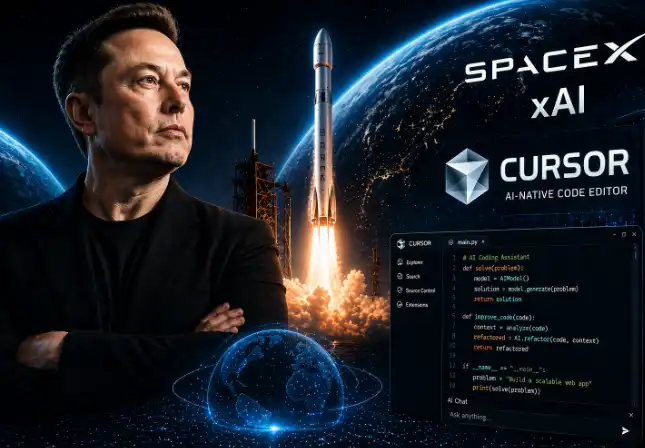
SpaceX has secured an option to acquire AI programming company Cursor for $60 billion, with an alternative clause requiring a $10 billion collaboration fee if the acquisition does not proceed. This structure is not merely a potential acquisition but a strategic move to control core access points in the AI era. The deal is designed as a flexible, dual-path arrangement, allowing SpaceX to either fully acquire Cursor or maintain a binding partnership through high-cost collaboration. This "option-style" approach minimizes immediate regulatory and integration risks while ensuring long-term alignment between the two companies. At its core, the transaction exchanges critical AI-era resources: SpaceX provides its Colossus supercomputing cluster—one of the world’s most powerful AI training infrastructures—while Cursor contributes its AI-native developer environment and strong product adoption. This synergy connects compute power, models, and application layers, forming a closed-loop AI capability stack. Cursor, founded in 2022, has achieved rapid growth with over $1 billion in annual revenue and widespread enterprise adoption. Its value lies in transforming software development through AI agents capable of coding, debugging, and system design—positioning it as a gateway to future software production. For SpaceX, this move is part of a broader strategy to evolve from a aerospace company into an AI infrastructure empire, integrating xAI, supercomputing, and chip manufacturing. Controlling Cursor fills a gap in its developer tooling layer, strengthening its AI narrative ahead of a potential IPO. The deal reflects a shift in AI competition from model superiority to ecosystem and entry-point control. With programming tools as a key battleground, securing developer loyalty becomes crucial for dominating the software production landscape. Risks include questions around Cursor’s valuation, technical integration challenges, and potential regulatory scrutiny. Nevertheless, the deal underscores a strategic bet: controlling both compute and software development access may redefine power dynamics in the AI-driven future.

marsbitHace 45 min(s)

SpaceX Ties Up with Cursor: A High-Stakes AI Gambit of 'Lock First, Acquire Later'

marsbitHace 45 min(s)

Trading

Spot
Futuros
活动图片