What Will End the AI Bull Market: Positioning or Narrative?

marsbitPublicado a 2026-05-14Actualizado a 2026-05-14

Resumen

Who Will End the AI Bull Market: Overcrowded Positions or the Narrative Itself? The US stock market's relentless rally, led by AI-themed stocks, faces a growing contradiction. Technically, positioning appears dangerously stretched: the S&P 500's six-week winning streak is historically extreme, and Goldman Sachs's Risk Appetite Indicator signals potential for a pullback. Many hot sectors are in extreme overbought territory, with mechanical fund flows suggesting the market is at or near maximum long positioning, limiting upside and creating pressure for a reset. However, shorting is difficult due to volatile exit timing and the risk of a sharp short squeeze. Fundamentally, the AI narrative remains robust, propping up sentiment. Strong corporate earnings, contained inflation concerns, and absorbed geopolitical risks provide no clear catalyst for a bear market. Yet, market performance has become excessively concentrated. Without AI contributions, broader market returns would be mediocre; semiconductors alone accounted for nearly 40% of gains since March. The market has shifted into a "greed mode," overlooking previous concerns about AI costs, energy bottlenecks, pricing wars, and security issues. The core risk is the interplay between these two factors. Nomura strategist Charlie McElligott warns that a sudden, DeepSeek-style negative catalyst could trigger a Nasdaq limit-down event, with semiconductor ETFs potentially plunging 15% in a day. The same mechanical flows that fuele...

Author: Long Yue

Source: Wall Street News

The sharper the market rallies, the harder it becomes to find reasons for a decline — but the risks have not disappeared; they are merely hidden deeper.

On May 14, Bloomberg market analyst Jon-Patrick Barnert pointed out in an article that while the current U.S. stock market rally has surged significantly, the cost and timing for shorting remain difficult to gauge. More troublingly, even the question of "what the most compelling reason to short is" has become blurry.

The core contradiction of this rally is: positioning has become extremely crowded, yet the fundamental narrative — especially AI — continues to support market sentiment. Between these two, which will crack first?

Positioning: The Market is Approaching "Max Long"

From a pure price action perspective, signals for a pullback are already quite evident.

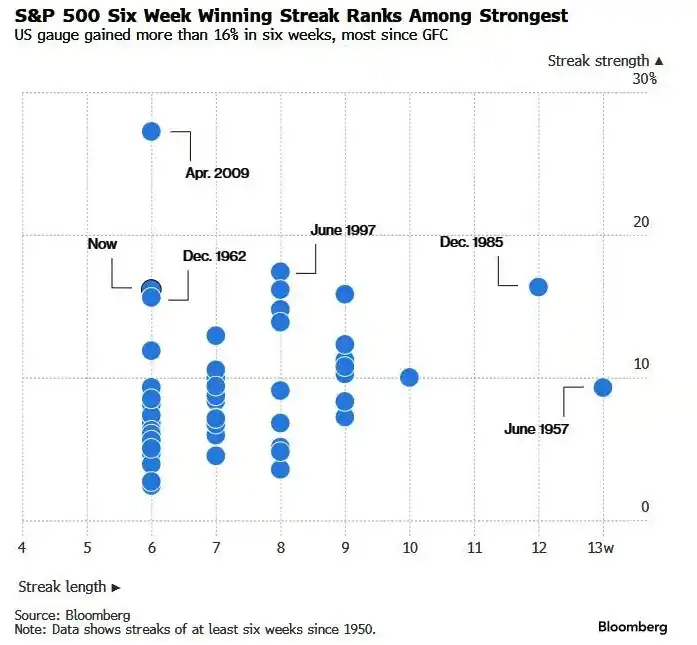
The S&P 500's six-week winning streak is not only one of the longest such runs in over 70 years, but the magnitude of gains also ranks among the strongest in history. Barnert stated that "taking a breather" would be perfectly normal for this market.
Goldman Sachs's Risk Appetite Indicator has risen back to 1, the first time since the beginning of the year. It is extremely rare for this indicator to exceed 1, and historically, it has often signaled a potential pullback. The last time it breached this threshold was in 2021, after which the market entered a bear phase.

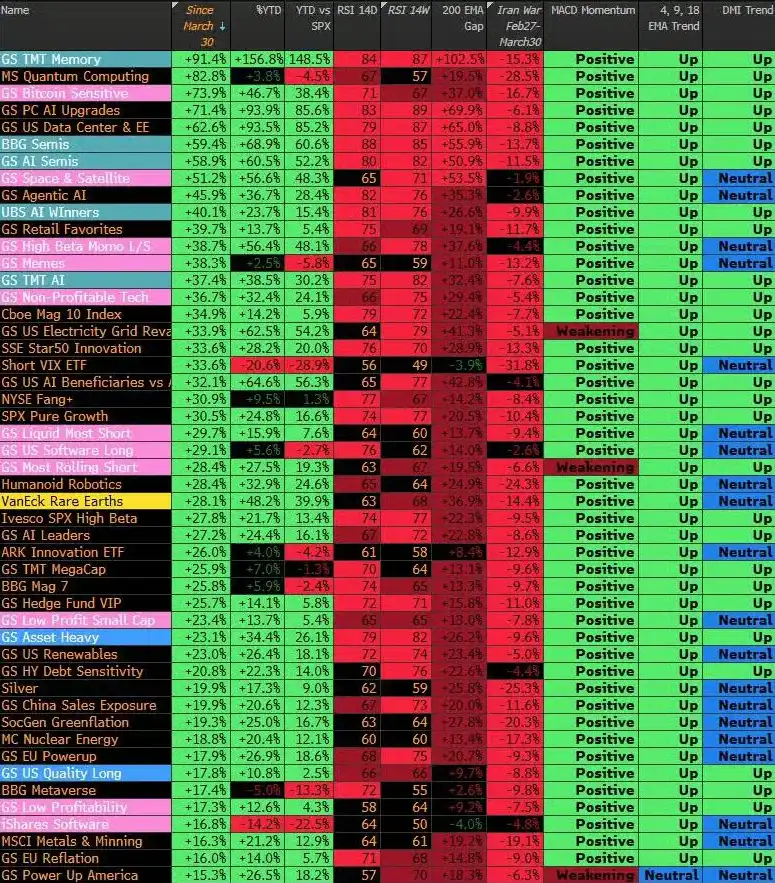
Looking at the hottest thematic stocks, Barnert describes a market where "everything is overbought," with some of the most popular sectors reaching extreme overbought levels. Combined with mechanical fund inflows — which currently appear to be at or near maximum long positioning — the overall picture is: limited upside, and significant potential pressure from positioning resets.
However, shorting is not easy. Barnert points out that position adjustments can be completed within a single day, making the entry and exit timing for short trades extremely difficult to manage. If the market chooses to "decline slowly," volatility positions would quietly become ineffective in a mild environment. A more likely scenario is: overall sentiment remains bullish, and if short sellers are forced to cover their positions, it could trigger another round of short squeezes, pushing prices higher and faster than anyone expected.

Fund flows in some popular ETFs have begun to show subtle shifts — leaning towards "locking in gains" rather than "chasing highs." But Barnert also admits this trend has persisted for weeks and has not yet had a material impact on market direction.

Narrative: Without AI, The Market is Nothing

If positioning is a technical vulnerability, the narrative level currently appears even more solid.

Barnert notes that there is currently a lack of clear signals triggering a fundamental bear market. Corporate earnings remain strong, inflation expectations have risen slightly but not to extreme levels. The market has digested the shocks of high oil prices and Middle East tensions, and the latest U.S. jobs data has alleviated recession fears. As for interest rate hike expectations, they are no longer a catalyst suppressing stocks.
But one issue cannot be ignored: the concentration of this rally has become highly focused on "the concentration itself."

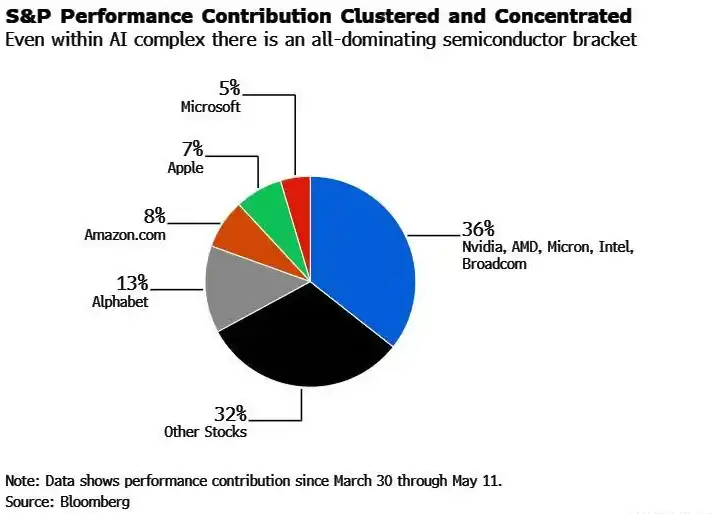
Barnert points out that whether comparing the performance of indices with and without AI, or dissecting the sources of gains since March, the conclusion points in the same direction: without AI, this market's performance can only be described as "mediocre." More notably, the semiconductor sector alone contributed nearly 40% of the gains since March.
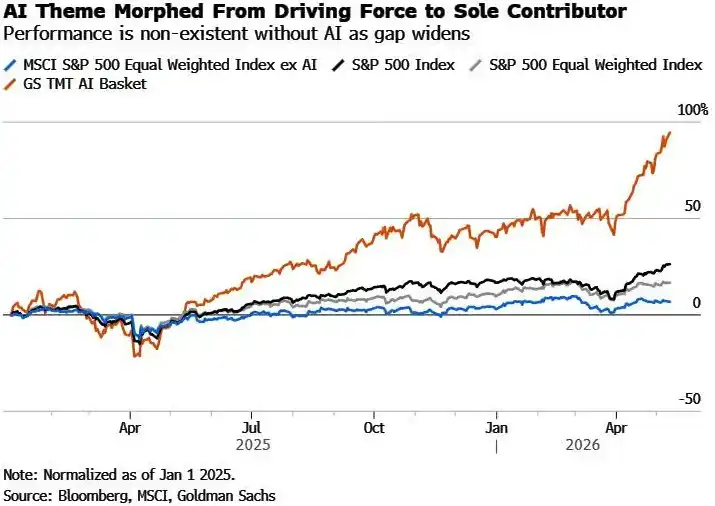
The market narrative surrounding AI has once again entered a "greed mode," a stage of pursuing unreasonable returns rather than rational, reasonable gains. The concerns widely discussed just months ago — whether AI computing costs can be offset by layoff savings, data center energy supply bottlenecks, AI pricing wars eroding profit margins, new competitors disrupting the landscape with lower costs, massive growth in capital expenditures while stock buybacks stall, AI security risks — now seem to have been collectively forgotten by the market.

The Risk of a "DeepSeek Moment" Repeat

Nomura Securities strategist Charlie McElligott issued the most direct warning on this matter.

He stated: "Given the current market structure and thematic overlap, if another fully-fledged, system-wide shock catalyst like a 'DeepSeek-style' event emerges one day, it could directly trigger a Nasdaq-level limit-down style of trade."

McElligott further noted that in such a scenario, semiconductor ETFs could easily drop 15% in a single day — because "the hypothetical reversal of reflexive, mechanical fund flows would create large-scale overshooting on the downside."

In other words, the very same mechanical fund flows (like CTA strategies, risk parity funds, etc.) that kept buying on the way up would, once triggered to reverse, become amplifiers accelerating the decline.

The AI bull market faces two major risks: one technical (overly crowded positioning), and one narrative-based (whether the AI story can hold). The former could trigger at any time; the latter, once broken, would deliver a deeper shock. Combined, they constitute the most noteworthy structural vulnerability in the current market.


Preguntas relacionadas

QAccording to the article, what are the two core competing factors that could end the current AI bull market?

AThe two core competing factors are: 1) Market Positioning / Overcrowded long positions, and 2) The Sustainability of the Fundamental AI Narrative.

QWhat does the Goldman Sachs Risk Appetite Indicator reading of 1, and its historical behavior, suggest about the market's near-term risk?

AThe Goldman Sachs Risk Appetite Indicator reaching 1, its highest level since the start of the year, is an extremely rare occurrence. Historically, readings above this threshold have often signaled an impending market correction. The last time it breached this level was in 2021, which preceded a bear market.

QHow does the article describe the market's dependence on AI-related stocks for its overall performance?

AThe article states that the market's performance is highly concentrated on AI. It points out that without AI, the market's performance would be 'mediocre' or 'nothing'. Specifically, the semiconductor sector alone contributed nearly 40% of the market's gains since March.

QWhat scenario does Nomura strategist Charlie McElligott warn could trigger a severe market downturn?

ACharlie McElligott warns that another widespread 'DeepSeek-style' shock catalyst could directly trigger a Nasdaq-level limit-down (trading halt) event. In such a scenario, semiconductor ETFs could easily fall 15% in a single day due to a reversal of reflexive, mechanical capital flows leading to a large-scale overshoot on the downside.

QWhy is it difficult to profit from a short-selling strategy in the current market environment, as per analyst Jon-Patrick Barnert?

AShort-selling is difficult because: 1) Position adjustments could happen within a single day, making timing entry and exit extremely hard. 2) If the market declines slowly, volatility-based short positions could quietly expire worthless. 3) The prevailing bullish sentiment means any short squeeze could trigger another rapid rally, moving faster than expected and causing losses for shorts.

Lecturas Relacionadas

Will the Fed Definitely Raise Interest Rates in September? How Will Crypto and U.S. Stocks Withstand the Pressure?

The market's expectation for a September Fed rate hike surged dramatically in early August, jumping from under 50% to over 80% within a week. This shift followed a contentious July FOMC meeting, where a 9-3 vote to hold rates revealed growing dissent from hawkish members advocating for an immediate hike to combat persistent inflation. The primary catalyst for this repricing is rising oil prices, driven by renewed geopolitical tensions around the Strait of Hormuz, which threaten global supply. Energy costs directly influence inflation metrics, making the upcoming July CPI report (due August 12th) a critical data point. If it shows inflation reaccelerating, the probability of a September hike will solidify. For Bitcoin and crypto assets, this is typically bearish news. Bitcoin continues to behave as a high-beta, liquidity-sensitive risk asset. A rate hike raises the opportunity cost of holding non-yielding assets and could drive capital toward money markets, pressuring crypto prices in the short term. However, historical patterns suggest that if a hike is perceived as the end of a tightening cycle rather than the start, any negative price impact may be brief. U.S. stocks, particularly crypto-linked equities like Coinbase and growth-oriented tech stocks, are also vulnerable. Higher rates increase discount rates in valuation models, putting pressure on high-multiple companies. This coincides with a pivotal tech earnings season where investor focus has shifted from massive AI capital expenditure to tangible revenue and cash flow generation. Companies with negative cash flow and weak growth narratives could face heightened volatility if borrowing costs rise in September. In summary, a September Fed hike has evolved into a mainstream market scenario. Key factors to watch are oil prices, the July CPI report, and Fed communications, which will determine the final decision and its impact on volatile crypto and equity markets.

marsbitHace 3 min(s)

Will the Fed Definitely Raise Interest Rates in September? How Will Crypto and U.S. Stocks Withstand the Pressure?

marsbitHace 3 min(s)

A 'Overlooked' Market Event: Joint US-Japan-South Korea Intervention, Rare US Treasury Involvement, and Bessent's Quiet 'Market Rescue'?

Summary: The United States, Japan, and South Korea executed their largest coordinated foreign exchange intervention in nearly 30 years. The action targeted depreciation pressure on the Japanese yen and South Korean won. This move is seen as a significant effort by the US to stabilize the financial markets of its key allies and prevent the spillover of risks. Key details: * Japan reportedly intervened on July 30 using approximately 8.45 trillion yen (about $52.8 billion). South Korean authorities also intervened that day, selling dollars to support the won. * Notably, the US Treasury Department intervened directly in yen markets for the first time in roughly 30 years. The New York Fed, reportedly acting on behalf of the Treasury, sold euros to buy yen via Goldman Sachs and Morgan Stanley on July 31. Analysts view the use of the euro-yen pair as a way to alleviate yen pressure without adding selling pressure to the US dollar. * Prior to the action, the New York Fed conducted "rate checks" on both USD/JPY and EUR/JPY, a newer signaling tool that falls between verbal and physical intervention. The intervention is interpreted as going beyond traditional currency stabilization. Analysts, such as Michael Hartnett of Bank of America, suggest it resembles a "Price Keeping Operation" for the AI era. The core US objectives are perceived to be: 1. Preventing rapid yen depreciation from triggering a sharp rise in Japanese government bond yields. 2. Containing financial stress from spreading across Asian markets like South Korea and Japan. 3. Reducing the risk of disorderly capital flows impacting the US bond market. This coordinated action underscores the importance of Japan and South Korea as critical partners in the US semiconductor and AI supply chain. Stabilizing their financial markets is seen as vital to mitigating risks to the broader tech industry and the US market itself. The intervention coincides with market pressures, including the KOSDAQ index hitting a low since October 2022. While seen as a move to control volatility, some analysts caution it may not fundamentally reverse existing market trends.

marsbitHace 7 min(s)

A 'Overlooked' Market Event: Joint US-Japan-South Korea Intervention, Rare US Treasury Involvement, and Bessent's Quiet 'Market Rescue'?

marsbitHace 7 min(s)

Will the Federal Reserve Definitely Raise Interest Rates in September? How Will Cryptocurrencies and US Stocks Bear the Pressure?

In early August 2024, market expectations for a September Federal Reserve rate hike surged dramatically, from below 50% to over 80%, driven by renewed inflation concerns. This shift followed a contentious July FOMC meeting where a 9-3 vote to hold rates revealed a growing hawkish faction advocating for an immediate hike, citing prolonged above-target inflation. The key catalyst is escalating conflict near the Strait of Hormuz, which has pushed oil prices up approximately 20% in July, threatening to reignite inflation. The next critical data point is the July CPI report on August 12th; a hot reading could solidify hike expectations. For crypto assets, particularly Bitcoin, this represents near-term pressure. Bitcoin continues to exhibit high-beta, risk-on characteristics, making it sensitive to tightening liquidity and higher opportunity costs. However, historical precedent suggests that if a hike is perceived as the cycle's end rather than its start, the negative impact may be brief, with markets quickly pivoting to anticipate future rate cuts. U.S. stocks, especially crypto-linked equities like Coinbase and high-valuation tech stocks, face amplified volatility. Higher rates increase discount rates in valuation models, pressuring growth stocks. This coincides with a pivotal tech earnings season where investor focus has shifted from massive AI capital expenditures to demonstrable revenue and cash flow generation. Companies with negative cash flows and weak growth narratives could see severe pressure if a September hike materializes, as financing costs would rise. Key indicators to watch include oil prices, upcoming inflation data, and Fed commentary at events like the Jackson Hole symposium.

Odaily星球日报Hace 7 min(s)

Will the Federal Reserve Definitely Raise Interest Rates in September? How Will Cryptocurrencies and US Stocks Bear the Pressure?

Odaily星球日报Hace 7 min(s)

Trading

Spot
活动图片