What? Lighter Won't Airdrop Today

Odaily星球日报Publicado a 2025-12-29Actualizado a 2025-12-29

Resumen

Rumors and market sentiment around a potential LIT token airdrop from the decentralized exchange Lighter have shifted dramatically, with prediction platform Polymarket showing the probability of an airdrop on December 29 plummeting from 87% to 25% in just four days. Despite earlier expectations, Lighter team has not released a detailed tokenomics model, and no official TGE or airdrop announcement has been made. Market uncertainty is compounded by Lighter’s aggressive anti-Sybil campaign, which has removed a significant number of suspected bot and wash-trading accounts—reportedly up to 70-90% of studio addresses—sparking community backlash. The lack of transparency in the screening process and unclear appeal mechanisms have further eroded trust. Additionally, concerns are rising over Lighter’s valuation. Pre-launch FDV estimates around $3.3 billion have been met with skepticism due to potential sell pressure from the airdrop (reportedly 25% of total supply, unlocked) and limited initial exchange listings. Despite this, some large traders remain bullish, with open interest on Hyperliquid showing balanced whale activity.

Original | Odaily Planet Daily (@OdailyChina)

Author | Golem (@web3_golem)

Data from the prediction platform Polymarket shows that the expected probability of "Lighter will airdrop on December 29" has plummeted from 87% four days ago to 25%, nearly halving.

Although the drop in probability does not directly equate to the cancellation of the airdrop, market sentiment has clearly cooled. As of the time of writing, Lighter has still not announced a detailed token economic model, which doesn't feel at all like the atmosphere leading up to a TGE and airdrop. Interestingly, LIT spot trading is already be seen on the Lighter Staging page today, but no one knows how long this testing phase will last.(Odaily Note: Staging is a pre-release environment in the product development process, situated between the Testing environment and the Production (live) environment, generally seen as the final rehearsal before a product's official launch.)

It is important to note that the Polymarket prediction regarding the Lighter airdrop uses Eastern Time (ET) for settlement. Therefore, for investors in the UTC+8 time zone, for the "Lighter will airdrop on December 29" market to settle as "no," Lighter must not airdrop before 13:00 on December 30. Investors in other time zones should convert the time accordingly.

Although Lighter's Head of Market, Pilla.eth, had previously clearly stated in an AMA that both the TGE and airdrop would occur in 2025, under the influence of panic sentiment, the probability on Polymarket for "Lighter will airdrop before December 31, 2025" has dropped from 94% to 64%. The highly-upvoted analyses from players betting "No" below lack reasonable analysis or insider information, mostly consisting of emotional bets or focusing on semantics:

  • "It's confirmed that the airdrop will be in 2026"
  • "I still can't understand why these fools didn't mention TGE at all, and the probability actually reached 94%. This was the worst AMA of my life, wasted 45 minutes listening to a bunch of nonsense, not a single useful piece of information."
  • "TGE is not the same as an airdrop; they are two different things. There are many examples of this. Read the rules clearly first."
  • "According to the settlement rules, locked tokens or non-tradable tokens do not qualify as conditions for a 'Yes' outcome. Even if the project releases an airdrop checker and shows your allocation, as long as the tokens cannot be freely traded on the market, the result is 'No'."

Of course, besides the unclear airdrop date, Lighter also faces concerns such as anti-sybil questioning and a valuation trap, with several dark clouds looming. Coinciding with the overall market cooling down at the end of the year, any movement from any project will attract extra attention from the community—Lighter's current动向 is可谓 "born at the right time".

The Strictest Anti-Sybil Measures of 2025

Lighter has caught the tailwind of two of the hottest narratives of 2025 (Pre-DEX and RWA), so investors quite看好 it. In early December, market whispers suggested that Lighter would conduct its TGE and airdrop within 2025, further boosting investor enthusiasm. Some users with high积分 even began "popping the champagne halfway through the game" on social media.
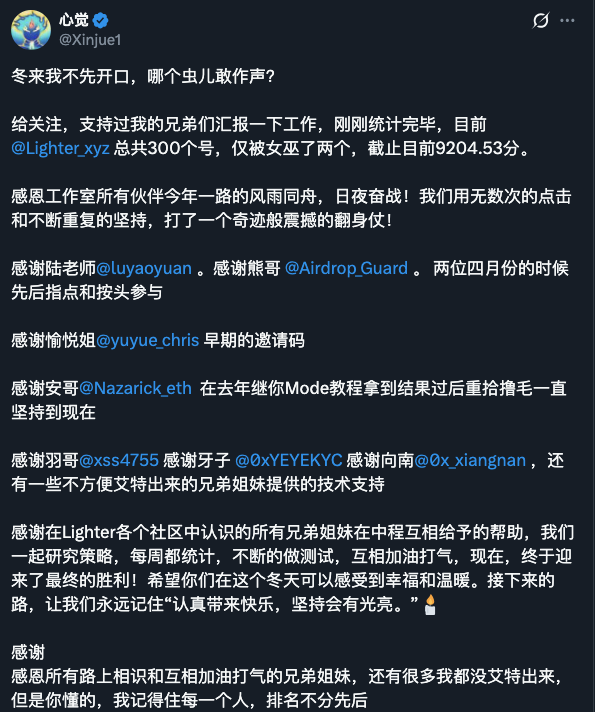
Lighter points leader提前发布获奖感言 (pre-releasing a victory speech)

But as the old saying goes, success comes from secrecy, failure from leakage. Many blamed the subsequent stringent sybil screening launched by Lighter on these boastful users (although this might not be the事实).

On December 23, Lighter announced in its official Discord the commencement of a massive sybil screening, removing积分 obtained by sybil addresses, wash trading, and volume manipulation. However, these deducted积分 (including portions already removed) would be redistributed to the community.

The community instantly in an uproar. After Lighter began its sybil screening, large numbers of studio accounts had their积分 deducted. Some bloggers claimed that Lighter's anti-sybil measures were extremely strict, with an estimated 70-90% of studio accounts being caught. Ordinary airdrop farmers were not spared either, with social media filled with "wails of grief".

Some even compared Lighter to the LayerZero of 2025. In 2024, LayerZero identified over 800,000 wallet addresses before its airdrop. Although the number of sybil addresses for Lighter might not be as high as LayerZero's, the severity might be comparable.

Such stringent anti-sybil actions undoubtedly put Lighter at odds with the community.

According to some users flagged as sybils, the reason given by Lighter was simply "abnormal trading," with no further explanation. The sybil rules were not transparent, meaning users didn't even know how they "died."

However, facing community质疑, Lighter's founder and CEO, Vladimir Novakovski, remained confident in this rather arbitrary sybil screening and stated that the anti-sybil algorithm would not be made public. His explanation was "to avoid targeted optimization," and he also mentioned an appeals mechanism was in place, but so far, the number of appeals was much lower than expected.

But some community members didn't believe Vladimir's excuses, suspecting that Lighter's harsh anti-sybil measures were to protect their own insider (rat)仓, and that even the off-market积分 price might have been secretly pumped by the Lighter team.

After all, since ancient times in the crypto world, the principle has been that the biggest airdrops are simple. The more complex the interaction requirements and the stricter the anti-sybil measures, the more likely something fishy is going on. Even peers in the same赛道 as Lighter, like Hyperliquid and Aster, were not this tedious and "stingy" during their airdrops.

The Lighter community currently resembles students checking their exam results after the gaokao (college entrance exam). Every day Lighter continues its sybil screening is another day of煎熬 (agony) for them.

Is the FDV Overvalued?

Amid the already depressed market environment and fueled by negative community sentiment, the market也开始思考 (began to ponder), is Lighter already overvalued?

On Polymarket, the probability for "Lighter's FDV will be greater than $1 billion on the first day of trading" has dropped from 90% to 72%, and the probability for "Lighter's FDV will be greater than $2 billion on the first day of trading" has also fallen from 87% to 68%. This indicates declining market confidence in Lighter's valuation.

Referring to the first-day market capitalizations of the other two major Pre-DEXs (Hyperliquid and Aster), Hyperliquid's FDV was approximately $3.6 billion at its opening on November 29, 2024, while Aster's opening FDV was around $10.8 billion on September 17, 2024. According to Binance Pre-Market data, Lighter's current pre-market FDV is approximately $3.3 billion, having previously peaked at $4.3 billion.

From this perspective, the valuation for Lighter on Polymarket seems reasonable, so why is market confidence still falling?

One reason is that the selling pressure from the airdrop cannot be ignored, especially after Lighter's widespread sybil screening has damaged community goodwill. Most users will likely sell immediately upon receiving the airdrop. According to the Lighter team, the airdrop ratio might be 25% of the total token supply, with no lock-up restrictions. Therefore, the selling pressure from the airdrop will undoubtedly pose significant resistance to any increase in Lighter's market cap.

The second reason is that for a period after the token launch, LIT will only be traded on its own platform and will not主动上线 (actively list on) other exchanges. The Lighter team has also stated that they have not paid listing fees to any trading platform. This means that for some time after launch, Lighter will not have access to the full liquidity of CEXs, thereby limiting the upside potential for the LIT token post-launch.

Nevertheless, some whales remain confident in Lighter. On Hyperliquid, the long-short forces for Lighter are still relatively balanced. Since the pre-market contracts went live, 10 whales with positions exceeding $1 million have entered the market, equally split between longs and shorts.

Andy, founder of The Rollup, also stated that although Lighter's open interest (OI) would likely drop by more than 20% and trading volume could decline by over 30% after the initial token volatility subsides, he would still choose to buy if LIT's fully diluted valuation (FDV) is around $2 billion.


Preguntas relacionadas

QWhat is the current probability on Polymarket for Lighter conducting an airdrop on December 29th, and how has it changed?

AThe probability for 'Lighter conducting an airdrop on December 29th' on Polymarket has dropped sharply from 87% four days ago to 25%.

QWhat major action has the Lighter team taken that has caused significant community backlash?

AThe Lighter team has initiated a very strict Sybil screening process, removing points from addresses identified as Sybils, self-trading, and volume farming, which has caused widespread complaints and backlash from the community.

QAccording to the article, what are the two main reasons for the declining market confidence in Lighter's valuation?

AThe two main reasons are: 1) The significant selling pressure expected from the airdrop, especially after the Sybil screening damaged community sentiment. 2) The token will initially only be traded on its own platform, lacking liquidity from centralized exchanges (CEXs), which limits its upside potential.

QWhat is the Fully Diluted Valuation (FDV) of Lighter in the pre-market on Binance, according to the article?

AAccording to Binance's pre-market data, Lighter's current pre-market FDV is approximately $3.3 billion, having previously reached a high of $4.3 billion.

QHow did the Lighter team's CEO, Vladimir Novakovski, justify the decision not to make the anti-Sybil algorithm public?

ACEO Vladimir Novakovski justified the decision by stating that they did not want the algorithm to be 'targetedly optimized' by others, and he expressed confidence in the process, noting that the number of appeals has been lower than expected.

Lecturas Relacionadas

Single-Day Plunge of 30%, Arthur Hayes Suddenly Liquidates: Why Did ZEC Get Exploded by Security Issues?

On June 5th, Zcash founder Zooko Wilcox disclosed a critical soundness vulnerability in the project's latest Orchard privacy pool. This flaw, found in the elliptic curve multiplication constraints, could allow an attacker to create unlimited counterfeit ZEC within the shielded pool, with transactions appearing valid. The vulnerability was discovered in late May by security researcher Taylor Hornby, who utilized Anthropic's new Opus 4.8 AI model for a targeted audit. The Zcash ecosystem had already performed an emergency network upgrade to patch the issue. However, the detailed disclosure triggered severe market panic, causing ZEC's price to plummet over 30% in a single day. Notably, prominent investor Arthur Hayes announced he had sold his entire ZEC position following the news. The incident starkly challenges the "technological trust" narrative central to privacy coins. Despite years of top-tier cryptographic audits, the bug persisted until uncovered with advanced AI-assisted research. This highlights the growing gap between theoretical perfection and practical implementation in privacy technology. The event serves as a industry-wide warning: in an AI-driven security landscape, the assumption that "undiscovered equals safe" is obsolete. It underscores the urgent need for continuous, proactive security practices combining AI audits, formal verification, and rapid response mechanisms.

foresightnews_apiHace 49 min(s)

Single-Day Plunge of 30%, Arthur Hayes Suddenly Liquidates: Why Did ZEC Get Exploded by Security Issues?

foresightnews_apiHace 49 min(s)

Breaking the Curse of DeFi Cascading Liquidations, Vitalik Proposes a New Solution

**Vitalik Buterin Proposes New DeFi Design to Eliminate Forced Liquidations** Ethereum co-founder Vitalik Buterin has published a proposal for a new decentralized finance (DeFi) architecture aimed at removing the automatic liquidation mechanisms prevalent in current lending protocols. The core idea involves creating synthetic assets using options as building blocks, fundamentally avoiding the抵押借贷结构 that triggers forced sell-offs. The proposal responds to a recurring flaw in DeFi: during sharp market downturns, mass自动清算 of under-collateralized positions can exacerbate price declines, creating systemic selling pressure and market instability, as evidenced by recent crypto market volatility. Buterin's model would split an asset like 1 ETH into two option-like derivatives, P and N, pegged to a price index with a set strike price and expiration. At expiry, an oracle determines the settlement price to allocate the underlying ETH between P and N holders. This design eliminates the "cliff" of instant liquidation. Instead, a position's value would gradually drift from its target peg if not actively rebalanced by the user, transferring the rebalancing decision from the protocol to the user or automated tools. A key advantage is the reduced reliance on high-frequency, real-time oracle price feeds, which are vulnerable to manipulation and errors in current systems. The delayed settlement in the options model allows for more robust, fault-tolerant oracle designs. However, significant challenges remain for practical adoption. High transaction costs (slippage) from frequent rebalancing on automated market makers (AMMs) could erode user funds. The model may not be suitable for stablecoins requiring a strict 1:1 dollar peg, as it inherently allows for value drift. Success would depend on developing new liquidity provisioning models and deep markets for these synthetic assets. The proposal represents a fundamental rethinking of DeFi risk management, challenging the industry to explore alternatives to被动集中平仓 rather than merely optimizing existing liquidation processes. It remains a theoretical framework awaiting implementation and testing by development teams.

foresightnews_apiHace 52 min(s)

Breaking the Curse of DeFi Cascading Liquidations, Vitalik Proposes a New Solution

foresightnews_apiHace 52 min(s)

Bitcoin's Decline Marks the Transformation of Crypto

Title: The Decline of Bitcoin Marks the Transformation of Crypto While Bitcoin's price recently fell below $70,000, down approximately 45% from its peak, the broader crypto industry is not following it into decline. Instead, crypto is maturing and evolving beyond its dependence on Bitcoin's price movements. Two of Bitcoin's core functions are being usurped. First, AI has captured its role as the primary speculative asset. AI, with its tangible revenue, explosive demand, and massive capital inflows ($700-830 billion in 2024), is siphoning off the speculative "hot money" that once drove Bitcoin. It also contributes to a sustained high-interest-rate environment, further tightening liquidity for assets like Bitcoin. Second, dollar-pegged stablecoins like USDC and USDT have replaced Bitcoin as the crypto market's foundational currency and primary on/off-ramp. Most trading pairs and on-chain transactions are now settled in stablecoins, severing the historical link where all capital inflows had to pass through Bitcoin first. This decoupling allows projects to thrive based on their own fundamentals rather than Bitcoin's price. Examples include Hyperliquid, an on-chain derivatives exchange with annual revenues of $8-13 billion, and prediction market platform Polymarket, valued at $200 billion with $3.65 billion in annual fees. These projects are evaluated on traditional metrics like revenue and user growth. New opportunities are emerging, particularly around privacy. Privacy coins like Zcash (ZEC) are seeing surging demand, while infrastructure like NEAR enables private, cross-chain asset transfers without requiring users to hold a specific token—privacy becomes a universal service layer. In this new paradigm, stablecoins are the universal cash, various project tokens represent equity, and privacy-enabled cross-chain coordination layers (like NEAR) act as the critical infrastructure connecting a fragmented, multi-chain ecosystem. Bitcoin is now just one asset among many. The era where the entire crypto market moved in lockstep with Bitcoin is over. The industry's health should now be judged by project fundamentals—real revenue, active users, and tokenomics that capture value—and the development of the underlying infrastructure enabling a mature, dollar-denominated crypto economy.

foresightnews_apiHace 55 min(s)

Bitcoin's Decline Marks the Transformation of Crypto

foresightnews_apiHace 55 min(s)

Lightspark CEO: In Ten Years, Bitcoin Will Be as Invisible as TCP/IP, Yet Power Trillions in Daily Transactions

A decade from now, Bitcoin will function like TCP/IP — invisible yet foundational, supporting trillions in daily transactions globally, according to Lightspark CEO David Marcus. In this future, a coffee shop in Lagos receives instant payment, a manufacturer in São Paulo settles an invoice with a supplier in Ho Chi Minh City, and a freelancer in Bangalore gets paid weekly from an Austin startup — all via Bitcoin's settlement layer, with none of the parties consciously interacting with it. This vision parallels the adoption of open protocols: first driven by necessity where existing systems fail, then scaling rapidly as tools mature and economic benefits become clear. The structural shift begins with wallets. Modern non-custodial wallets, like Spark, allow users to hold dollars, local currency, and Bitcoin in a single address, seamlessly switching between them. This eliminates friction and revolutionizes global custody, moving significant deposits to user-controlled keys not by ideology, but by superior utility. As a result, Bitcoin becomes the default savings layer for billions, as its fixed supply and appreciating value make it a rational choice for savers holding it alongside stablecoins in their everyday wallets. Businesses follow a similar path, from small companies in emerging markets to multinational corporations, holding Bitcoin alongside operational stablecoins. The latest trend is direct Bitcoin transactions for commerce. When both parties hold Bitcoin, transacting in it becomes the simplest option — no conversions, no intermediary currency. This starts in niche areas like high-value B2B settlements but grows as infrastructure makes sending Bitcoin as easy as stablecoins. An accelerating force is AI agents. By 2036, AI agents conducting commerce on behalf of individuals and firms will increasingly choose Bitcoin for settlement. Optimizing for speed, finality, and minimal counterparty risk across jurisdictions, they find Bitcoin's global, neutral, and programmable network ideal for netting and settling obligations. Thus, Bitcoin is becoming the native currency for machine commerce, just as it has become a native savings asset for humans. The global monetary system is being rebuilt from the protocol layer: open infrastructure, default self-custody, Bitcoin settling everything underneath, with stablecoins as the interface. Most users won't think about Bitcoin when they transact — and they won't need to.

foresightnews_apiHace 59 min(s)

Lightspark CEO: In Ten Years, Bitcoin Will Be as Invisible as TCP/IP, Yet Power Trillions in Daily Transactions

foresightnews_apiHace 59 min(s)

Trading

Spot
Futuros

Artículos destacados

Cómo comprar T

¡Bienvenido a HTX.com! Hemos hecho que comprar Threshold Network Token (T) sea simple y conveniente. Sigue nuestra guía paso a paso para iniciar tu viaje de criptos.Paso 1: crea tu cuenta HTXUtiliza tu correo electrónico o número de teléfono para registrarte y obtener una cuenta gratuita en HTX. Experimenta un proceso de registro sin complicaciones y desbloquea todas las funciones.Obtener mi cuentaPaso 2: ve a Comprar cripto y elige tu método de pagoTarjeta de crédito/débito: usa tu Visa o Mastercard para comprar Threshold Network Token (T) al instante.Saldo: utiliza fondos del saldo de tu cuenta HTX para tradear sin problemas.Terceros: hemos agregado métodos de pago populares como Google Pay y Apple Pay para mejorar la comodidad.P2P: tradear directamente con otros usuarios en HTX.Over-the-Counter (OTC): ofrecemos servicios personalizados y tipos de cambio competitivos para los traders.Paso 3: guarda tu Threshold Network Token (T)Después de comprar tu Threshold Network Token (T), guárdalo en tu cuenta HTX. Alternativamente, puedes enviarlo a otro lugar mediante transferencia blockchain o utilizarlo para tradear otras criptomonedas.Paso 4: tradear Threshold Network Token (T)Tradear fácilmente con Threshold Network Token (T) en HTX's mercado spot. Simplemente accede a tu cuenta, selecciona tu par de trading, ejecuta tus trades y monitorea en tiempo real. Ofrecemos una experiencia fácil de usar tanto para principiantes como para traders experimentados.

599 Vistas totalesPublicado en 2024.12.10Actualizado en 2026.06.02

Cómo comprar T

Discusiones

Bienvenido a la comunidad de HTX. Aquí puedes mantenerte informado sobre los últimos desarrollos de la plataforma y acceder a análisis profesionales del mercado. A continuación se presentan las opiniones de los usuarios sobre el precio de T (T).

活动图片