What Kind of DeFi Does Wall Street Want?

marsbitPublicado a 2026-04-02Actualizado a 2026-04-02

Resumen

Wall Street's vision for DeFi has shifted from simple asset tokenization to building a programmable, restructurable fixed-income infrastructure that enables yield financialization. The key driver is no longer retail speculation but institutional capital and Real-World Assets (RWA), with DeFi TVL surging from ~$115B to over $237B in 2025, while active wallets declined—indicating large, infrequent institutional inflows. RWA, now valued at $27.5B (up 2.4x YoY), is used as collateral in protocols like Aave Horizon, Maple Finance, and Centrifuge, creating an on-chain repo and rehypothecation flywheel. These structures function like institutional money-market funds, offering 4–6% yields from tokenized treasuries and stablecoin pools. Crucially, institutions are moving beyond holding assets to actively managing yield and risk. Protocols like Pendle Finance allow yield tokenization—splitting assets into Principal Tokens (PT) and Yield Tokens (YT)—enabling fixed-rate exposure, speculation, and on-chain interest rate hedging using mechanisms like yield AMMs. However, major barriers remain: public blockchain transparency exposes positions and liquidation levels, creating adversarial risks, and compliance (KYC, sanctions screening, audit trails) must be natively embedded into protocols—not added externally. Zero-knowledge proofs could offer a solution by enabling regulatory verification without leaking sensitive data. In summary, Wall Street wants a DeFi that integrates with global c...

Author: Chloe, ChainCatcher

For years, tokenization has been positioned as the bridge for cryptocurrencies to reach Wall Street. The logic behind putting treasury bonds on-chain, issuing tokenized funds, and digitizing stocks has always pointed to one idea: once assets are on-chain, institutional capital will naturally follow.

But tokenization itself has never been the endgame. DWF Ventures believes that the real key to unlocking the institutional market is not digitizing assets, but financializing yield.

Since 2025, the Total Value Locked (TVL) in DeFi has climbed from approximately $115 billion to over $237 billion. The main driver behind this is no longer purely speculative retail investors, but real institutional capital and Real-World Assets (RWA). Institutions are no longer just watching; they are starting to see DeFi as infrastructure for deploying capital.

It can be said that the DeFi Wall Street truly wants to see has shifted from "putting assets on-chain" to a "programmable, recomposable, interest-rate-risk-hedgeable" fixed-income infrastructure. Today, we can glimpse this transformation through TVL and RWA data, institutional protocol examples, yield tokenization theory, and the implementation of privacy and compliance.

TVL and Institutional Data: Which Layer Are Institutions Filling?

In Q3 2025, DeFi's TVL climbed from about $115 billion at the start of the year to $237 billion. Meanwhile, the number of active wallets on-chain decreased by 22% in the same period. DappRadar data clearly shows that the push behind this rally is not from retail investors, but from "high-value, low-frequency" institutional capital.

In this structure, the most crucial part is RWA: As of the end of March 2026, the total value of RWA had reached $27.5 billion, a growth of over 2.4 times compared to $8 billion in March 2025. These assets are primarily used by institutions as collateral for stablecoin loans through protocols like Aave Horizon, Maple Finance, and Centrifuge, forming an "on-chain repo (repurchase agreement)" re-collateralization flywheel.
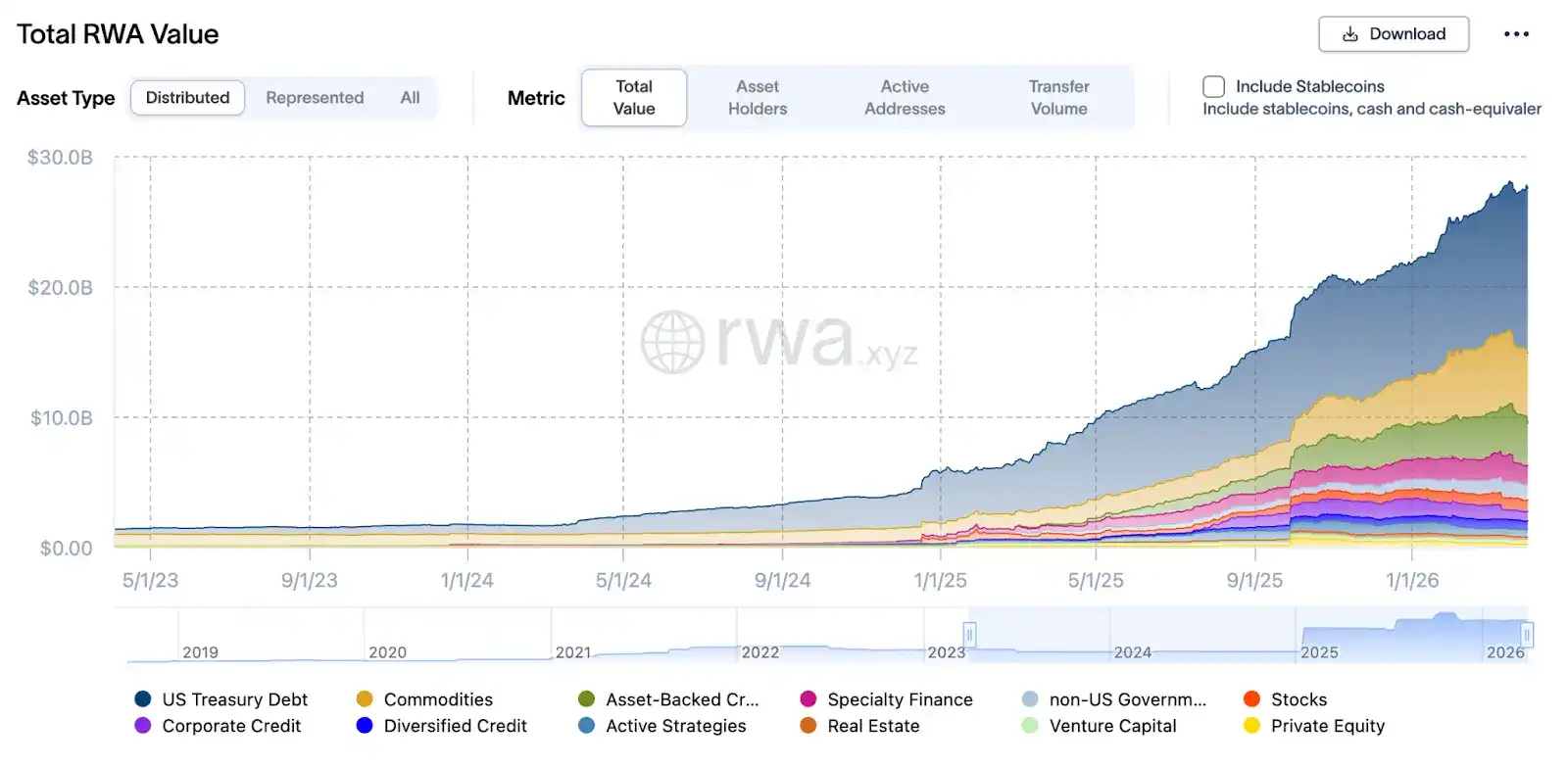
Taking Aave Horizon as an example, its RWA market had accumulated an asset size of about $540 million by the end of 2025. This includes stablecoins like Superstate's USCC, RLUSD, and Aave's GHO, as well as various US Treasury assets (like VBILL), with annualized yields ranging between 4-6%. This structure is essentially an "institutional version of a money market fund": the front end consists of tokenized treasury bonds and bills, the back end is a stablecoin liquidity pool, and smart contracts automatically handle interest payments, refinancing, and liquidation in the middle.

From "Holding" to "Operating": Are Institutions Playing On-Chain Repo or Fixed Income?

In the traditional fixed income market, bonds are not just tools for holding and collecting interest; they are used for repo (repurchase agreements), re-collateralization, splitting, and embedding into structured products, forming a flywheel of capital efficiency. By 2025, DeFi had begun replicating this logic.

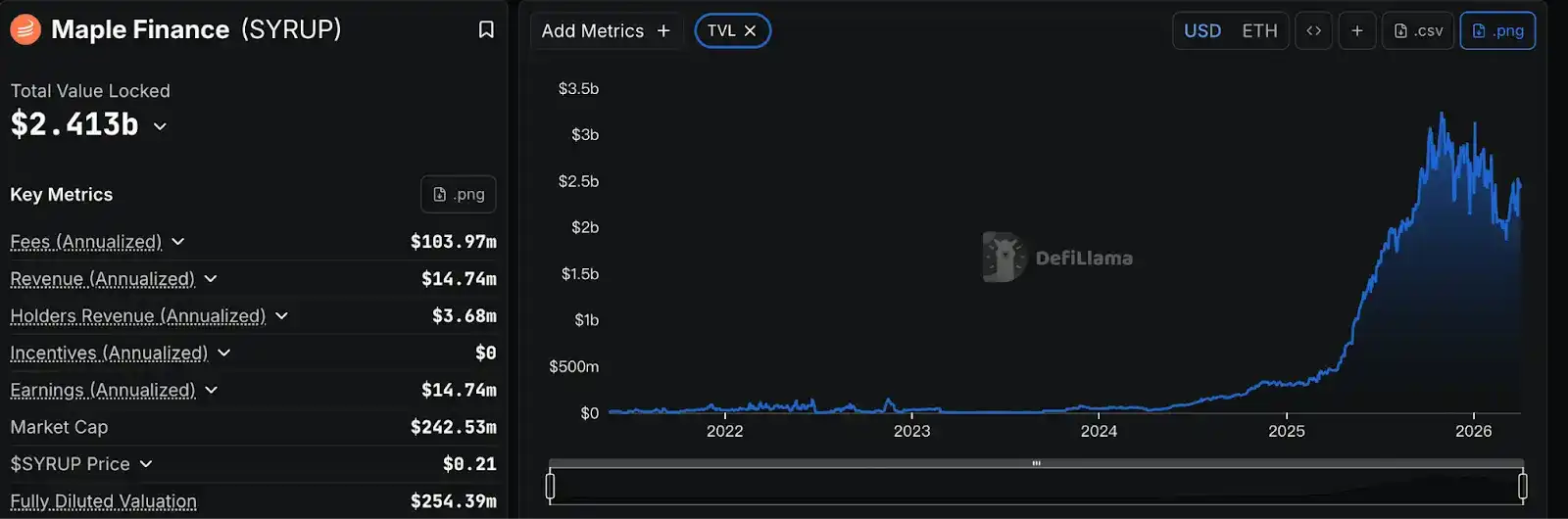
Maple Finance's TVL surged from $297 million in 2025 to over $3.1 billion, at times approaching $3.3 billion. The main driver was institutions entering the RWA lending market, tokenizing private loans and corporate loans for "over-the-counter" stablecoin lending and refinancing.
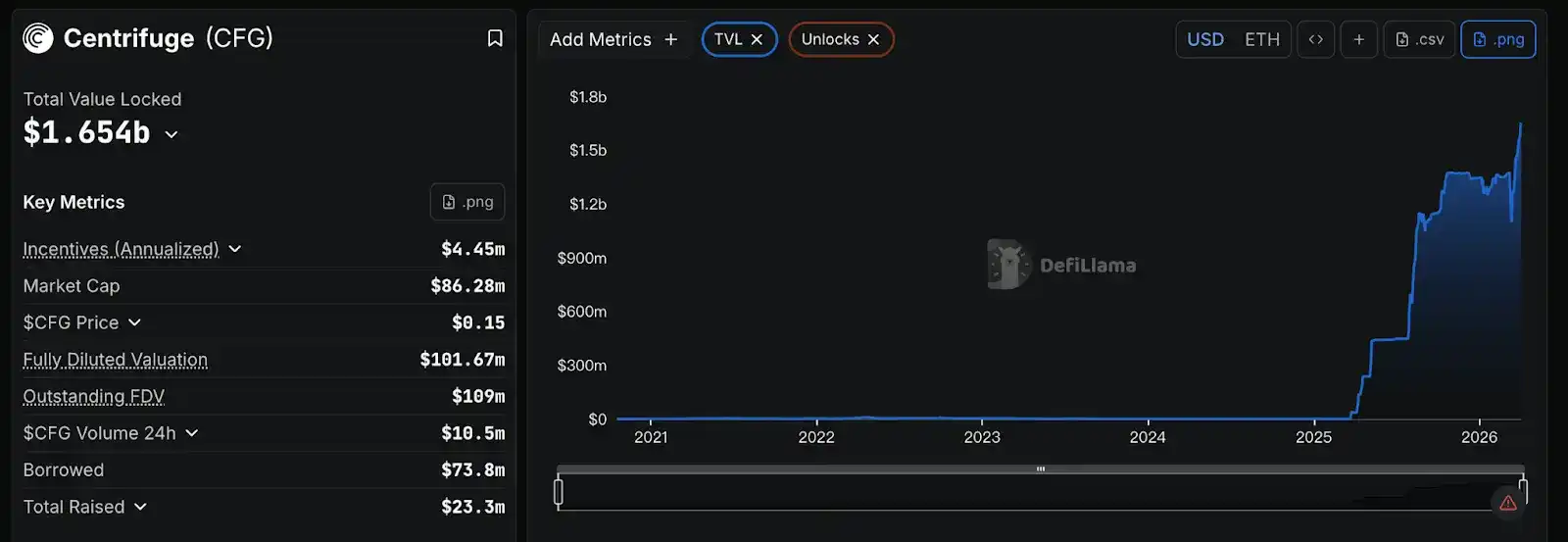
Centrifuge, on the other hand, focuses on converting Small and Medium Enterprise (SME) loans, trade finance, and accounts receivable into on-chain assets. To date, its ecosystem manages over $1 billion in TVL and has successfully developed multiple diversified asset pools, extending from private credit to highly liquid US Treasury bonds.

Simultaneously, Centrifuge has also integrated deeply with top DeFi protocols, such as Sky (formerly MakerDAO). Through its collaboration with Centrifuge, MakerDAO can invest its reserves in real-world enterprise loans, providing substantial yield support for the stablecoin DAI. There's also Aave; the two joined forces to create a dedicated RWA market, allowing KYCed institutional investors to use Centrifuge's asset tokens as collateral, achieving cross-protocol liquidity cycles.
Yield Tokenization and Yield Trading Markets: Can Interest Rate Risk Be Hedged?

If you were to map the structure of Wall Street's fixed income market, you would see several key modules: principal and interest can be separated (e.g., zero-coupon bonds, stripped coupons), interest rate risk can be independently traded and hedged, and liquidity and compliance can be separated but reconnected through middleware.

In May 2025, a paper titled "Split the Yield, Share the Risk: Pricing, Hedging and Fixed rates in DeFi" on arXiv first proposed a formal framework for "yield tokenization": splitting yield-bearing assets into "Principal Tokens (PT)" and "Yield Tokens (YT)", and using SDEs (Stochastic Differential Equations) and a no-arbitrage framework to price and hedge interest rate risk.

This design has already been implemented in some protocols. Take Pendle Finance as an example. Pendle uses a specially designed Yield AMM whose price curve adjusts over time (time decay factor), ensuring the PT price converges to its redemption value at maturity. These mechanisms allow market participants to allocate liquidity based on risk preferences (e.g., fixed-rate seekers buy PT, yield speculators buy YT).

For institutions, this means yield structures can be "modularized" and directly plugged into traditional asset allocation models (e.g., duration, DV01, interest rate risk contribution); interest rate risk no longer needs to be hedged solely with off-chain futures or IRS (Interest Rate Swaps). Instead, it can be adjusted directly on-chain by trading "yield tokens," enabling instant and transparent interest rate risk hedging and significantly improving capital efficiency.

Two Major Real-World Challenges: Privacy and Compliance

Even as DeFi's TVL breaks through tens of billions of dollars, the large-scale inflow of institutional capital is still hindered by two key challenges: privacy and compliance.

First Challenge: Public Chain Holdings Are Transparent, Liquidation Points Are Exposed

On mainstream public chains, every transaction and address's holdings are publicly visible, which poses an extremely high risk for institutions. Trading strategies, leverage levels, and liquidation points can be completely known by counterparties, potentially leading to targeted shorting and liquidation. Once a liquidity crunch or price volatility occurs, malicious actors can place orders targeting specific addresses, amplifying losses. This is one reason institutional capital is hesitant to fully commit to DeFi.

Here, zero-knowledge proofs (ZKPs) may become a key solution. They would allow institutions to prove their legitimacy to regulators without leaking information publicly. Specifically, regulators could verify that an institution complies with regulatory requirements, while other market participants cannot see the institution's complete holdings or liquidation points. This is the privacy layer Wall Street truly wants—not "complete anonymity," but "meeting compliance requirements without disclosing business secrets."

Second Challenge: KYC, Sanctions Screening, and Auditing Must Be Embedded in the Protocol Itself

Another red line for institutions is: compliance is not an afterthought patch, but natively built-in. In traditional finance, KYC, sanctions screening, and audit requirements are already embedded in settlement systems and trading processes. But in many DeFi protocols, these checks still remain at the "front-end gateway" or rely on "intermediary institutions," rather than being written directly into the protocol logic.

What institutions expect is: KYC and sanctions screening are no longer just about "users uploading ID documents, followed by pure trust," but rather a module or middleware that can verify identity and sanctions lists on-chain without exposing complete data; and audit and regulatory requirements can also be directly written as "verifiable rules," e.g., a transaction must execute only under certain compliance conditions, or an address's exposure must not exceed a certain limit.

The IOSCO, in its November 2025 report "Tokenization of Financial Assets," explicitly emphasized the need to establish "verifiable compliance rules" and "transparent but controlled audit trails" on DLT (Distributed Ledger Technology). Some institutional DeFi platforms have begun experimenting with "compliance modules," embedding KYC, AML, sanctions screening, and regulatory reporting directly into the protocol layer, rather than relying on external tools or post-hoc patches.

Conclusion: What Kind of DeFi Does Wall Street Want?

Returning to the initial question, what kind of DeFi does Wall Street want? First, a more advanced asset clearing and servicing system that can seamlessly integrate with global compliance infrastructure, building an institutional-grade moat. Second, in terms of yield structure, the ability to precisely replicate the traditional fixed income market's logic of yield decomposition and hedging, achieving risk modularization. Third, in terms of compliance and security, using zero-knowledge proofs to embed "verifiable compliance" and "programmatic risk control" into the protocol's foundation, achieving a balance between privacy and regulation.

Replacing traditional finance has never been an option for Wall Street. Instead, it's about having an additional parallel world where capital, risk, and returns can be reassembled more flexibly in a programmable way.


Preguntas relacionadas

QWhat is the key factor that DWF Ventures believes is crucial for unlocking the institutional market in DeFi, according to the article?

ADWF Ventures believes the key to unlocking the institutional market is not the digitization of assets, but the financialization of yield.

QWhat does the data from DappRadar indicate about the recent surge in DeFi's Total Value Locked (TVL)?

ADappRadar data shows that the recent surge in DeFi TVL, which rose from about $115 billion to over $237 billion, was driven by 'high-value, low-frequency' institutional capital, not retail speculators, as the number of active wallets decreased by 22% in the same period.

QHow does the article describe the role of protocols like Pendle Finance in addressing institutional needs?

AProtocols like Pendle Finance implement a 'yield tokenization' framework, splitting yield assets into Principal Tokens (PT) and Yield Tokens (YT). This allows for the modularization of yield structures, enabling institutions to directly hedge interest rate risk on-chain by trading these tokens, which improves capital efficiency and fits into traditional asset allocation models.

QWhat are the two main obstacles preventing large-scale institutional inflow into DeFi, as outlined in the article?

AThe two main obstacles are privacy and compliance. Specifically: 1) The transparency of public blockchains exposes institutional trading strategies and liquidation points. 2) The need for KYC, sanctions screening, and auditing to be natively embedded into the protocol logic itself, not just handled at the front-end or by intermediaries.

QAccording to the article's conclusion, what does Wall Street ultimately want from DeFi?

AWall Street wants a DeFi that is a more advanced asset clearing and servicing system that can seamlessly integrate with global compliance infrastructure. It also seeks a yield architecture that can replicate the interest rate decomposition and hedging logic of traditional fixed-income markets for modular risk, and it requires embedded 'verifiable compliance' and 'programmatic risk control' at the protocol level using technologies like zero-knowledge proofs to balance privacy and regulation.

Lecturas Relacionadas

Will the Fed Definitely Raise Interest Rates in September? How Will Crypto and U.S. Stocks Withstand the Pressure?

The market's expectation for a September Fed rate hike surged dramatically in early August, jumping from under 50% to over 80% within a week. This shift followed a contentious July FOMC meeting, where a 9-3 vote to hold rates revealed growing dissent from hawkish members advocating for an immediate hike to combat persistent inflation. The primary catalyst for this repricing is rising oil prices, driven by renewed geopolitical tensions around the Strait of Hormuz, which threaten global supply. Energy costs directly influence inflation metrics, making the upcoming July CPI report (due August 12th) a critical data point. If it shows inflation reaccelerating, the probability of a September hike will solidify. For Bitcoin and crypto assets, this is typically bearish news. Bitcoin continues to behave as a high-beta, liquidity-sensitive risk asset. A rate hike raises the opportunity cost of holding non-yielding assets and could drive capital toward money markets, pressuring crypto prices in the short term. However, historical patterns suggest that if a hike is perceived as the end of a tightening cycle rather than the start, any negative price impact may be brief. U.S. stocks, particularly crypto-linked equities like Coinbase and growth-oriented tech stocks, are also vulnerable. Higher rates increase discount rates in valuation models, putting pressure on high-multiple companies. This coincides with a pivotal tech earnings season where investor focus has shifted from massive AI capital expenditure to tangible revenue and cash flow generation. Companies with negative cash flow and weak growth narratives could face heightened volatility if borrowing costs rise in September. In summary, a September Fed hike has evolved into a mainstream market scenario. Key factors to watch are oil prices, the July CPI report, and Fed communications, which will determine the final decision and its impact on volatile crypto and equity markets.

marsbitHace 4 min(s)

Will the Fed Definitely Raise Interest Rates in September? How Will Crypto and U.S. Stocks Withstand the Pressure?

marsbitHace 4 min(s)

A 'Overlooked' Market Event: Joint US-Japan-South Korea Intervention, Rare US Treasury Involvement, and Bessent's Quiet 'Market Rescue'?

Summary: The United States, Japan, and South Korea executed their largest coordinated foreign exchange intervention in nearly 30 years. The action targeted depreciation pressure on the Japanese yen and South Korean won. This move is seen as a significant effort by the US to stabilize the financial markets of its key allies and prevent the spillover of risks. Key details: * Japan reportedly intervened on July 30 using approximately 8.45 trillion yen (about $52.8 billion). South Korean authorities also intervened that day, selling dollars to support the won. * Notably, the US Treasury Department intervened directly in yen markets for the first time in roughly 30 years. The New York Fed, reportedly acting on behalf of the Treasury, sold euros to buy yen via Goldman Sachs and Morgan Stanley on July 31. Analysts view the use of the euro-yen pair as a way to alleviate yen pressure without adding selling pressure to the US dollar. * Prior to the action, the New York Fed conducted "rate checks" on both USD/JPY and EUR/JPY, a newer signaling tool that falls between verbal and physical intervention. The intervention is interpreted as going beyond traditional currency stabilization. Analysts, such as Michael Hartnett of Bank of America, suggest it resembles a "Price Keeping Operation" for the AI era. The core US objectives are perceived to be: 1. Preventing rapid yen depreciation from triggering a sharp rise in Japanese government bond yields. 2. Containing financial stress from spreading across Asian markets like South Korea and Japan. 3. Reducing the risk of disorderly capital flows impacting the US bond market. This coordinated action underscores the importance of Japan and South Korea as critical partners in the US semiconductor and AI supply chain. Stabilizing their financial markets is seen as vital to mitigating risks to the broader tech industry and the US market itself. The intervention coincides with market pressures, including the KOSDAQ index hitting a low since October 2022. While seen as a move to control volatility, some analysts caution it may not fundamentally reverse existing market trends.

marsbitHace 8 min(s)

A 'Overlooked' Market Event: Joint US-Japan-South Korea Intervention, Rare US Treasury Involvement, and Bessent's Quiet 'Market Rescue'?

marsbitHace 8 min(s)

Will the Federal Reserve Definitely Raise Interest Rates in September? How Will Cryptocurrencies and US Stocks Bear the Pressure?

In early August 2024, market expectations for a September Federal Reserve rate hike surged dramatically, from below 50% to over 80%, driven by renewed inflation concerns. This shift followed a contentious July FOMC meeting where a 9-3 vote to hold rates revealed a growing hawkish faction advocating for an immediate hike, citing prolonged above-target inflation. The key catalyst is escalating conflict near the Strait of Hormuz, which has pushed oil prices up approximately 20% in July, threatening to reignite inflation. The next critical data point is the July CPI report on August 12th; a hot reading could solidify hike expectations. For crypto assets, particularly Bitcoin, this represents near-term pressure. Bitcoin continues to exhibit high-beta, risk-on characteristics, making it sensitive to tightening liquidity and higher opportunity costs. However, historical precedent suggests that if a hike is perceived as the cycle's end rather than its start, the negative impact may be brief, with markets quickly pivoting to anticipate future rate cuts. U.S. stocks, especially crypto-linked equities like Coinbase and high-valuation tech stocks, face amplified volatility. Higher rates increase discount rates in valuation models, pressuring growth stocks. This coincides with a pivotal tech earnings season where investor focus has shifted from massive AI capital expenditures to demonstrable revenue and cash flow generation. Companies with negative cash flows and weak growth narratives could see severe pressure if a September hike materializes, as financing costs would rise. Key indicators to watch include oil prices, upcoming inflation data, and Fed commentary at events like the Jackson Hole symposium.

Odaily星球日报Hace 8 min(s)

Will the Federal Reserve Definitely Raise Interest Rates in September? How Will Cryptocurrencies and US Stocks Bear the Pressure?

Odaily星球日报Hace 8 min(s)

Trading

Spot
活动图片




