What Impact Does Interest-Bearing Digital Yuan Have on Hong Kong's Digital Finance?

marsbitPublicado a 2026-01-01Actualizado a 2026-01-01

Resumen

China's digital yuan (e-CNY) has entered a new phase with the introduction of interest-bearing wallets starting January 2026, transitioning from a "digital cash" to a "digital deposit currency" model. This makes it the world’s first CBDC to pay interest to general users, fundamentally changing its legal nature from a central bank liability to a commercial bank liability, while still backed by sovereign credit. This innovation addresses a core challenge faced by global CBDC initiatives: avoiding financial disintermediation while promoting adoption. By allowing commercial banks to manage and profit from e-CNY deposits, China has turned a potential competitor into a integrated part of the banking system, creating sustainable incentives for adoption and enabling new monetary policy tools. For Hong Kong, interest-bearing e-CNY is transformative development. It enhances the city’s role as an offshore RMB hub by encouraging longer-term retention of digital yuan within its financial system, especially through platforms like mBridge. It also strengthens Hong Kong’s digital asset ecosystem by providing a high-credit settlement option for tokenized assets, enables new fintech innovations around programmable money, and complements—rather than competes with—Hong Kong’s own wholesale-focused digital Hong Kong dollar strategy. Together, these advances support Hong Kong’s ambition to become an international digital asset center.

Jason Jiang|Web3.01

By the end of 2025, the introduction of the People's Bank of China's "Action Plan on Further Strengthening the Digital Yuan Management Service System and Related Financial Infrastructure Construction" marked the official transition of the digital yuan from "Digital Cash 1.0" to the era of "Digital Deposit Currency 2.0".

The core change is that, starting from January 1, 2026, digital yuan wallet balances will begin to accrue interest, and its legal attribute has shifted from a direct liability of the central bank to a legal tender with the attributes of commercial bank liabilities.

Common Dilemmas of Global CBDCs and the Digital Yuan's Breakthrough

Over 130 monetary authorities worldwide exploring CBDC practices are generally caught in a difficult paradox: how to introduce a digital currency while preventing it from shaking the foundations of the traditional banking system? The root cause lies in the vigilance against financial disintermediation—the concern that the central bank directly providing the public with a safe and convenient digital legal tender could trigger a drain on commercial bank deposits and impact credit creation functions.

Therefore, whether it's the European Central Bank's discussions on setting holding limits for the digital euro or the clear warnings from the Bank of Japan, the underlying logic is defensive. They strictly define retail CBDC as non-interest-bearing digital cash (M0), reducing its appeal to bank deposits to ensure financial stability. However, this often leads to CBDCs struggling to gain traction due to a lack of incentives for both users and banks, falling into a dilemma where functionality and goals diverge.

Building on this, the digital yuan will become the world's first CBDC to pay interest on ordinary user wallet balances. Digital Yuan 2.0 attempts to resolve risks and create new momentum within the banking system through institutional innovation that reconstructs monetary creditor-debtor relationships. Its difference from other global retail CBDCs lies in:
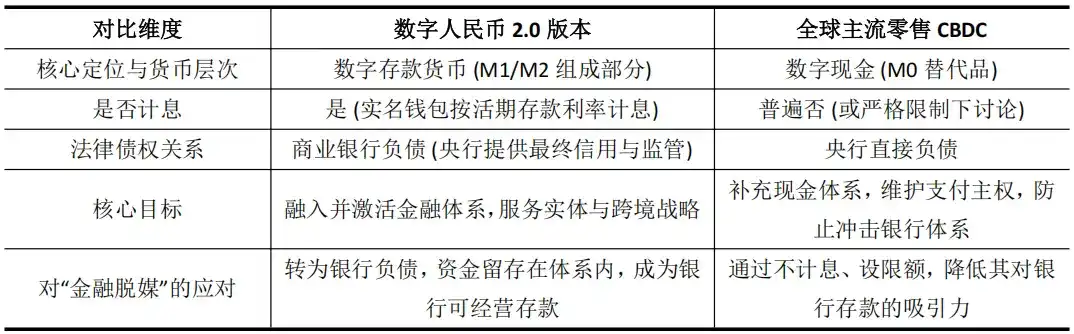
This model transforms the digital yuan from a tool that could potentially impact banks through "external circulation" into "internal blood" deeply integrated into the banks' balance sheets.

Commercial banks have management rights and profit rights over digital yuan deposits, shifting their promotion motivation from "passive duty fulfillment" to "active operation," forming a sustainable market-driven promotion mechanism. Simultaneously, clear deposit insurance guarantees eliminate credit concerns on the user side.

This not only solves the incentive problem but also means the digital yuan is formally incorporated into the traditional monetary creation and regulation framework, providing the central bank with a new, directly actionable policy variable (digital yuan interest rate). Its transaction traceability also creates conditions for implementing precise structural monetary policies.

Defining a New Form: The "Hybrid" of CBDC and Tokenized Deposits

Digital Yuan 2.0, due to its interest-bearing and bank-operated characteristics, bears some resemblance to tokenized deposits promoted by commercial banks. The latter are digital representations of bank deposits on the blockchain (e.g., JPMorgan's JPM Coin), aimed at improving inter-institutional settlement efficiency. However, this similarity is superficial; they are fundamentally different in their credit foundation and strategic level.

Digital Yuan 2.0 actually creates a new hybrid form: it adopts the efficiency appearance of tokenized deposits, but its core is the complete credit of a sovereign national currency.
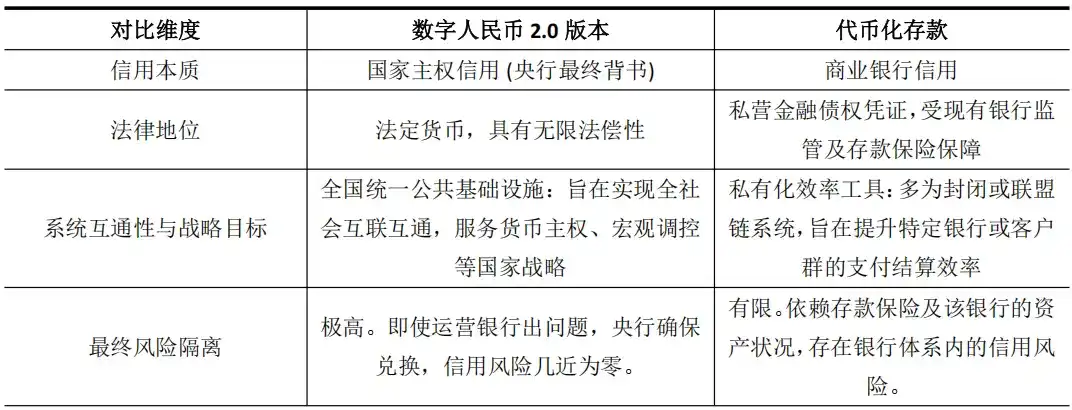
This distinction is crucial. The credit of a tokenized deposit is deeply tied to the balance sheet of its issuing bank; its essence is an efficiency tool optimizing existing financial intermediation. In contrast, the credit cornerstone of Digital Yuan 2.0 remains national sovereignty, with the goal of building foundational financial infrastructure to support the future digital economy.

A report from the Tsinghua University PBC School of Finance also pointed out that this type of programmable digital currency, backed by national credit, provides a core pivot for constructing a dual-platform model of "blockchain + digital assets."

Therefore, the upgrade of Digital Yuan 2.0 is far more than the evolution of a payment tool; it is pre-laying a "settlement track" with the highest credit rating for the upcoming era of large-scale asset tokenization.

Empowering Hong Kong's Digital Finance Ecosystem with Interest-Bearing Digital Yuan

The strategic elevation of the digital yuan has the most direct and profound impact on Hong Kong, given its unique geopolitical and institutional position.

The key variable of interest-bearing fundamentally changes the nature of the digital yuan in cross-border and financial scenarios, transforming it from a "payment channel" into a "strategic asset," thereby providing substantive empowerment for Hong Kong's construction of an "International Digital Asset Center" on multiple levels.

First, interest-bearing solves the motivation problem for cross-border funds to remain, directly strengthening Hong Kong's function as an offshore RMB funding pool.

In cross-border payment networks based on the multi-CBDC bridge (mBridge), non-interest-bearing digital currency is merely a circulation medium, and companies are motivated to settle quickly to reduce capital occupancy costs. After becoming interest-bearing, the digital yuan gains attributes competitive with Hong Kong's offshore RMB deposits. Multinational corporate treasury centers can use it as an interest-bearing liquidity management tool, staying within Hong Kong's compliance system for longer periods.

Currently, the digital yuan accounts for over 95% of mBridge transactions. The interest-bearing policy is expected to transform this flow advantage into a stock advantage, helping to expand and deepen Hong Kong's offshore RMB funding pool and consolidate its hub status.

Second, interest-bearing enhances the credit appeal of the digital yuan as a currency for issuing and settling tokenized assets in Hong Kong.

Hong Kong is actively promoting the tokenization of assets like bonds. In such Delivery versus Payment (DvP) settlements, the credit rating of the settlement currency directly affects the product's risk pricing and market acceptance. The interest-bearing digital yuan, backed by national credit, has a credit rating far exceeding that of any single bank's tokenized deposit.

The Hong Kong Monetary Authority's Ensemble project has explored the interoperability of tokenized deposits, and Digital Yuan 2.0 could be接入 (access) this ecosystem as a higher-level settlement asset. Utilizing the programmability of the digital yuan, processes like bond coupon payments or trade finance conditions can be automated, greatly improving efficiency and reducing operational risks.

This provides a potential, superior underlying financial infrastructure option for Hong Kong to issue high-end products like tokenized government green bonds.

Third, interest-bearing activates the space for financial service innovation围绕 (surrounding) the digital yuan, bringing synergistic opportunities for Hong Kong's fintech sector.

When the digital yuan becomes a bank-manageable, interest-bearing liability, services围绕 it—such as deposits, wealth management, financing, and smart contract management—will emerge.

Hong Kong, with its common law system aligned with international standards and active financial market, is an ideal "sandbox" for testing such innovative services. For example, compliant gateways connecting digital yuan wallets with virtual asset platforms could be developed, or structured wealth management products based on its interest-bearing特性 (characteristics) could be designed.

This innovative synergistic effect will allow Hong Kong to gain a first-mover advantage in the product design and rule-making of digital finance.

Fourth, interest-bearing deepens the differentiated协同 (synergy) strategy between the digital yuan and Hong Kong's "e-HKD".

Hong Kong has clearly prioritized developing the wholesale-type "e-HKD", focusing on large-value transactions between financial institutions and capital market applications. The interest-bearing Digital Yuan 2.0 can focus on serving cross-border retail payments, trade settlement, and related derivative financial services closely connected to the Mainland's real economy.

The two are not substitutes but form a clear complementary pattern: the e-HKD optimizes local wholesale financial efficiency, while the digital yuan deepens cross-border economic ties. This synergy enables Hong Kong to simultaneously strengthen its local financial infrastructure and its function as a cross-border bridge.

Preguntas relacionadas

QWhat is the core change in the Digital Yuan 2.0 that distinguishes it from its previous version?

AThe core change is that starting from January 1, 2026, Digital Yuan wallet balances will accrue interest, and its legal attribute has shifted from being a direct liability of the central bank to a legal currency with the attributes of a commercial bank liability.

QHow does the interest-bearing feature of the Digital Yuan help solve the common dilemma faced by global CBDC initiatives?

AIt addresses the 'financial disintermediation' dilemma by transforming the Digital Yuan from a potential tool that could impact banks into a 'blood within the body' deeply integrated into bank balance sheets. This gives commercial banks management rights and profit rights over Digital Yuan deposits, turning their promotion motive from passive compliance to active operation, thus creating a sustainable market-driven promotion mechanism.

QWhat new hybrid form does the Digital Yuan 2.0 create, and how does it differ from tokenized deposits like JPM Coin?

AThe Digital Yuan 2.0 creates a hybrid form that adopts the efficiency appearance of tokenized deposits but is backed by the full credit of the national sovereign currency. The key difference lies in their credit foundation: tokenized deposits are tied to the issuing bank's balance sheet and are efficiency tools, whereas the Digital Yuan 2.0 is built on national sovereign credit and aims to be a foundational financial infrastructure for the future digital economy.

QWhat are the key impacts of the interest-bearing Digital Yuan on Hong Kong's digital financial ecosystem?

AThe key impacts are: 1) It strengthens Hong Kong's offshore RMB fund pool by providing an incentive for cross-border funds to remain. 2) It enhances the Digital Yuan's credit appeal as a settlement currency for tokenized assets in Hong Kong. 3) It activates financial service innovation space around the Digital Yuan, creating synergistic opportunities for Hong Kong's fintech sector. 4) It deepens the differentiated synergy strategy between the Digital Yuan and Hong Kong's proposed 'digital Hong Kong dollar' (wHKD).

QHow does the interest-bearing feature of the Digital Yuan specifically benefit the mBridge cross-border payment network?

AThe interest-bearing feature changes the Digital Yuan from merely a flow medium into an interest-bearing asset. This gives multinational corporate treasury centers an incentive to hold it as a liquidity management tool for longer periods within Hong Kong's compliant system. As the Digital Yuan already constitutes over 95% of mBridge transactions, this interest policy is expected to transform this flow advantage into a stock advantage, helping to expand and deepen Hong Kong's offshore RMB fund pool and consolidate its hub status.

Lecturas Relacionadas

Three Scenarios for BTC's Future Direction and a Duel Between Two Strong Forces | Special Invited Analysis

**Title: Three Scenarios for BTC's Future Trajectory and a Key Duel | Invited Analysis** The market remains at a critical juncture. Over the past week, Bitcoin (BTC) consolidated broadly between $79,500 and $80,600, validating previous technical analysis. The current focus is on whether this marks the start of a new uptrend or a pause within a larger correction. **BTC Multi-Cycle Analysis & Three Possible Scenarios** BTC's daily chart structure, following its peak at $126,200 in October 2025, presents three primary technical scenarios based on Elliott Wave theory: 1. **Bullish Scenario (End of Correction):** The corrective A-B-C wave from $126,200 ended at the $60,000 low in February 2026. The current price action is the start of a major Wave I uptrend. A subsequent Wave II pullback would not break below $60,000. 2. **Bearish Scenario 1 (Complex Correction):** The correction is unfolding as an A-B-C-D-E pattern. The current move from $60,000 is a D-wave rally. After its completion, a final E-wave decline could potentially breach the $60,000 level. 3. **Bearish Scenario 2 (Larger Correction):** The entire move down from $126,200 to $60,000 was a large A-wave. The current rally is a B-wave correction within a larger A-B-C structure, to be followed by a C-wave decline below $60,000. *Analysis suggests Scenario 2 is less probable due to time disproportions between waves. The battle is effectively between the Bullish Scenario (1) and Bearish Scenario (3).* **Key BTC Levels & Weekly Strategy** On the 4-hour chart, BTC trades above a crucial consolidation zone ("Central Pivot C"). * **Key Resistance:** $83,500-$84,500; $89,000-$90,500. * **Key Support:** $78,500-$79,500 (pivot upper bound); $73,500-$75,000; $69,500-$70,500. **Weekly Outlook:** The market direction hinges on BTC's ability to hold above or break below the $78,500-$79,500 support zone. * **Mid-term Strategy:** Neutral/Wait-and-see stance due to unclear direction. * **Short-term Tactics:** Two contingency plans using 30% max capital: * **Plan A (Bullish):** Look for long entries if price holds above $78,500-$79,500 with confirming signals. Initial stop-loss below $78,500. * **Plan B (Bearish):** Consider short positions if price breaks below $73,500-$75,000 with confirming signals. Initial stop-loss above $76,500. **HYPE Analysis & Strategy** HYPE's daily chart shows a seven-segment structure from its January low of $20.46, forming a "rising pivot" zone. * **Key Level to Watch:** $45.76 (previous high). A break above would confirm the bullish structure remains intact. * **Short-term Strategy:** Focus on pivot zone boundaries ($38.41 upper, $34.44 lower). * **Long:** Consider on support near $38.41 with bullish confirmation signals. * **Short:** Consider on a break below $34.44 with bearish confirmation signals. * Position size must be below 30% with strict stop-loss discipline. **Risk Management Reminder:** Always set an initial stop-loss upon entry. Move stop-loss to breakeven at +1% profit, then trail it upwards to lock in profits dynamically. All views are based on technical analysis for informational purposes only and do not constitute investment advice. The market is inherently risky.

Odaily星球日报Hace 9 min(s)

Three Scenarios for BTC's Future Direction and a Duel Between Two Strong Forces | Special Invited Analysis

Odaily星球日报Hace 9 min(s)

Sequoia Interview with Hassabis: Information is the Essence of the Universe, AI Will Open Up Entirely New Scientific Branches

Demis Hassabis, co-founder and CEO of Google DeepMind and Nobel laureate, discusses the path to AGI and its profound implications in a Sequoia Capital interview. He outlines his lifelong dedication to AI, tracing his journey from game development (e.g., *Theme Park*)—a perfect AI testing ground—to neuroscience and finally founding DeepMind in 2009. He emphasizes the critical lesson of being "5 years, not 50 years, ahead of time" for successful entrepreneurship. Hassabis reiterates DeepMind's two-step mission: first, solve intelligence by building AGI; second, use AGI to tackle other complex problems. He highlights the transformative potential of "AI for Science," particularly in biology where tools like AlphaFold have revolutionized protein folding. He envisions AI-powered simulations drastically shortening drug discovery from years to weeks and enabling personalized medicine. Furthermore, he predicts AI will spawn new scientific disciplines, such as an engineering science for understanding complex AI systems (mechanistic interpretability) and novel fields enabled by high-fidelity simulators for complex systems like economics. He posits a fundamental worldview where information, not just matter or energy, is the essence of the universe, making AI's information-processing core uniquely suited to understanding reality. He defends classical Turing machines as potentially sufficient for modeling complex phenomena, including quantum systems, as demonstrated by AlphaFold. On consciousness, Hassabis suggests first building AGI as a powerful tool, then using it to explore deep philosophical questions. He believes components like self-awareness and temporal continuity are necessary for consciousness but that defining it fully remains an open challenge. He predicts AGI could arrive around 2030 and, once achieved, would be used to probe the deepest questions of science and reality, much as envisioned in David Deutsch's *The Fabric of Reality*.

链捕手Hace 27 min(s)

Sequoia Interview with Hassabis: Information is the Essence of the Universe, AI Will Open Up Entirely New Scientific Branches

链捕手Hace 27 min(s)

Morgan Stanley 2026 Semiconductor Report: Buy Packaging, Buy Testing, Buy China Chips, Avoid Traditional Tracks

Morgan Stanley 2026 Semiconductor Report: Buy Packaging, Buy Testing, Buy Chinese Chips; Avoid Traditional Segments. The core theme is the shift in AI compute supply from NVIDIA dominance to a three-track system of GPU + ASIC + China-local chips. The key opportunity is capturing share in this expansion, while non-AI semiconductors face marginalization due to resource reallocation to AI. Key investment conclusions, in order of priority: 1. **Advanced Packaging (CoWoS/SoIC) - Highest Conviction**: TSMC is the primary beneficiary of explosive demand, driven by massive cloud capex. Its pricing power and AI revenue share are rising significantly. 2. **Test Equipment - Undervalued & High-Growth Certainty**: Chip complexity is causing test times to double generationally, structurally driving handler/socket/probe card demand. Companies like Hon Hai Precision (Foxconn), WinWay, and MPI offer compelling value. 3. **China AI Chips (GPU/ASIC) - Long-Term Irreversible Trend**: Export controls are accelerating domestic substitution. Companies like Cambricon, with firm customer orders and SMIC's 7nm capacity support, are positioned to benefit from lower TCO (30-60% vs NVIDIA) and growing local cloud demand. 4. **Avoid Non-AI Semiconductors (Consumer/Auto/Industrial)**: These segments face a weak, structurally hindered recovery due to AI's resource "crowding-out" effect on capacity and supply chains. 5. **Memory - Severe Internal Divergence**: Strongly favor HBM (Hynix primary beneficiary) and NOR Flash (Macronix). Be cautious on interpreting price rises in DDR4/NAND as true demand recovery. The report emphasizes a 2026-2027 time window, stating the AI capital expenditure cycle is far from over. Key macro variables include persistent export controls and AI's systemic "crowding-out" effect on traditional semiconductor supply chains.

marsbitHace 1 hora(s)

Morgan Stanley 2026 Semiconductor Report: Buy Packaging, Buy Testing, Buy China Chips, Avoid Traditional Tracks

marsbitHace 1 hora(s)

Circle:Sluggish Market? The Top Stablecoin Stock Continues to Expand

Circle, the issuer of the stablecoin USDC, reported its Q1 2026 earnings on May 11th, Eastern Time. Against a backdrop of weak crypto market sentiment, USDC's average circulation in Q1 was $752 billion, with a modest 2% sequential increase to $770 billion by quarter-end. New minting volumes declined due to the poor crypto market, but remained high, indicating demand expansion beyond crypto trading. USDC's market share remained stable at 28% of the total stablecoin market, while competition from Tether's USDT persists. A key highlight was "Other Revenue," which reached $42 million, more than doubling year-over-year, though sequential growth slowed to 13%. This revenue stream, including fees from services like Web3 software, the Cipher payment network (CPN), and the Arc blockchain, is critical for diversifying away from interest income. Circle's internally held USDC share increased to 18%, helping to improve gross margin by 130 basis points to 41.4% by reducing external sharing costs. However, profitability was pressured as total revenue growth slowed, primarily due to the significant weight of interest income, which is tied to USDC规模 and Treasury rates. Adjusted EBITDA was $133 million with a 19.2% margin. Management maintained its full-year 2026 guidance for adjusted operating expenses ($570-$585 million) and other revenue ($150-$170 million). The long-term target for USDC's CAGR remains 40%, though near-term volatility is expected. The article concludes that while Circle's current valuation of $28 billion appears reasonable after a recent recovery, further upside depends on the pace of stable币 adoption and potential positive sentiment from the advancement of regulatory clarity acts like CLARITY.

链捕手Hace 1 hora(s)

Circle:Sluggish Market? The Top Stablecoin Stock Continues to Expand

链捕手Hace 1 hora(s)

Tech Stocks' Narrative Is Increasingly Relying on Anthropic

The narrative of tech stocks is increasingly relying on Anthropic. Anthropic, the AI company behind Claude, has become central to the financial stories of major tech giants. Elon Musk dissolved xAI, merging it into SpaceX as SpaceXAI, and secured an exclusive deal to rent the massive "Colossus 1" supercomputing cluster to Anthropic. In return, Anthropic expressed interest in future space-based compute collaborations. Google and Amazon are also deeply invested. Google plans to invest up to $40 billion and provide significant compute power, while Amazon holds a 15-16% stake. Both companies reported massive quarterly profit surges largely due to valuation gains from their Anthropic holdings. Crucially, Anthropic has committed to multi-billion dollar cloud compute contracts with both Google Cloud and AWS. This creates a clear divide: the "A Camp" (Anthropic-Google-Musk) versus the "O Camp" (OpenAI-Microsoft). The A Camp's strategy intertwines equity, compute orders, and profits, making Anthropic a "systemic financial node." Its performance directly impacts its partners' financials and stock prices. In contrast, OpenAI, while leading in user traffic, faces commercialization challenges, lower per-user revenue, and a recently restructured relationship with Microsoft. The AI industry is shifting from a race for raw compute (symbolized by Nvidia) to a focus on monetizable applications, where Anthropic currently excels. However, this concentration of market hope on one company amplifies systemic risk. The rise of powerful open-source models like DeepSeek-V4 poses a significant threat, as they could undermine the value proposition of closed-source models like Claude. The article suggests ongoing geopolitical efforts to suppress such competitors will be a long-term strategic focus for Anthropic's allies.

marsbitHace 1 hora(s)

Tech Stocks' Narrative Is Increasingly Relying on Anthropic

marsbitHace 1 hora(s)

Trading

Spot
Futuros

Artículos destacados

Qué es $S$

Entendiendo SPERO: Una Visión General Completa Introducción a SPERO A medida que el panorama de la innovación continúa evolucionando, la aparición de tecnologías web3 y proyectos de criptomonedas juega un papel fundamental en la configuración del futuro digital. Un proyecto que ha atraído la atención en este campo dinámico es SPERO, denotado como SPERO,$$s$. Este artículo tiene como objetivo reunir y presentar información detallada sobre SPERO, para ayudar a entusiastas e inversores a comprender sus fundamentos, objetivos e innovaciones dentro de los dominios web3 y cripto. ¿Qué es SPERO,$$s$? SPERO,$$s$ es un proyecto único dentro del espacio cripto que busca aprovechar los principios de descentralización y tecnología blockchain para crear un ecosistema que promueva la participación, la utilidad y la inclusión financiera. El proyecto está diseñado para facilitar interacciones de igual a igual de nuevas maneras, proporcionando a los usuarios soluciones y servicios financieros innovadores. En su esencia, SPERO,$$s$ tiene como objetivo empoderar a los individuos al proporcionar herramientas y plataformas que mejoren la experiencia del usuario en el espacio de las criptomonedas. Esto incluye habilitar métodos de transacción más flexibles, fomentar iniciativas impulsadas por la comunidad y crear caminos para oportunidades financieras a través de aplicaciones descentralizadas (dApps). La visión subyacente de SPERO,$$s$ gira en torno a la inclusividad, buscando cerrar brechas dentro de las finanzas tradicionales mientras aprovecha los beneficios de la tecnología blockchain. ¿Quién es el Creador de SPERO,$$s$? La identidad del creador de SPERO,$$s$ sigue siendo algo oscura, ya que hay recursos públicos limitados que proporcionan información de fondo detallada sobre su(s) fundador(es). Esta falta de transparencia puede derivarse del compromiso del proyecto con la descentralización, una ética que muchos proyectos web3 comparten, priorizando las contribuciones colectivas sobre el reconocimiento individual. Al centrar las discusiones en torno a la comunidad y sus objetivos colectivos, SPERO,$$s$ encarna la esencia del empoderamiento sin señalar a individuos específicos. Como tal, comprender la ética y la misión de SPERO sigue siendo más importante que identificar a un creador singular. ¿Quiénes son los Inversores de SPERO,$$s$? SPERO,$$s$ cuenta con el apoyo de una diversa gama de inversores que van desde capitalistas de riesgo hasta inversores ángeles dedicados a fomentar la innovación en el sector cripto. El enfoque de estos inversores generalmente se alinea con la misión de SPERO, priorizando proyectos que prometen avances tecnológicos sociales, inclusión financiera y gobernanza descentralizada. Estas fundaciones de inversores suelen estar interesadas en proyectos que no solo ofrecen productos innovadores, sino que también contribuyen positivamente a la comunidad blockchain y sus ecosistemas. El respaldo de estos inversores refuerza a SPERO,$$s$ como un contendiente notable en el dominio de proyectos cripto que evoluciona rápidamente. ¿Cómo Funciona SPERO,$$s$? SPERO,$$s$ emplea un marco multifacético que lo distingue de los proyectos de criptomonedas convencionales. Aquí hay algunas de las características clave que subrayan su singularidad e innovación: Gobernanza Descentralizada: SPERO,$$s$ integra modelos de gobernanza descentralizada, empoderando a los usuarios para participar activamente en los procesos de toma de decisiones sobre el futuro del proyecto. Este enfoque fomenta un sentido de propiedad y responsabilidad entre los miembros de la comunidad. Utilidad del Token: SPERO,$$s$ utiliza su propio token de criptomoneda, diseñado para servir diversas funciones dentro del ecosistema. Estos tokens permiten transacciones, recompensas y la facilitación de servicios ofrecidos en la plataforma, mejorando la participación y la utilidad general. Arquitectura en Capas: La arquitectura técnica de SPERO,$$s$ apoya la modularidad y escalabilidad, permitiendo la integración fluida de características y aplicaciones adicionales a medida que el proyecto evoluciona. Esta adaptabilidad es fundamental para mantener la relevancia en el cambiante paisaje cripto. Participación de la Comunidad: El proyecto enfatiza iniciativas impulsadas por la comunidad, empleando mecanismos que incentivan la colaboración y la retroalimentación. Al nutrir una comunidad sólida, SPERO,$$s$ puede abordar mejor las necesidades de los usuarios y adaptarse a las tendencias del mercado. Enfoque en la Inclusión: Al ofrecer tarifas de transacción bajas e interfaces amigables para el usuario, SPERO,$$s$ busca atraer a una base de usuarios diversa, incluyendo a individuos que anteriormente pueden no haber participado en el espacio cripto. Este compromiso con la inclusión se alinea con su misión general de empoderamiento a través de la accesibilidad. Cronología de SPERO,$$s$ Entender la historia de un proyecto proporciona información crucial sobre su trayectoria de desarrollo y hitos. A continuación se presenta una cronología sugerida que mapea eventos significativos en la evolución de SPERO,$$s$: Fase de Conceptualización e Ideación: Las ideas iniciales que forman la base de SPERO,$$s$ fueron concebidas, alineándose estrechamente con los principios de descentralización y enfoque comunitario dentro de la industria blockchain. Lanzamiento del Whitepaper del Proyecto: Tras la fase conceptual, se lanzó un whitepaper completo que detalla la visión, los objetivos y la infraestructura tecnológica de SPERO,$$s$ para generar interés y retroalimentación de la comunidad. Construcción de Comunidad y Primeras Interacciones: Se realizaron esfuerzos de divulgación activa para construir una comunidad de primeros adoptantes y posibles inversores, facilitando discusiones en torno a los objetivos del proyecto y obteniendo apoyo. Evento de Generación de Tokens: SPERO,$$s$ llevó a cabo un evento de generación de tokens (TGE) para distribuir sus tokens nativos a los primeros seguidores y establecer liquidez inicial dentro del ecosistema. Lanzamiento de la dApp Inicial: La primera aplicación descentralizada (dApp) asociada con SPERO,$$s$ se puso en marcha, permitiendo a los usuarios interactuar con las funcionalidades centrales de la plataforma. Desarrollo Continuo y Alianzas: Actualizaciones y mejoras continuas a las ofertas del proyecto, incluyendo alianzas estratégicas con otros actores en el espacio blockchain, han moldeado a SPERO,$$s$ en un jugador competitivo y en evolución en el mercado cripto. Conclusión SPERO,$$s$ se erige como un testimonio del potencial de web3 y las criptomonedas para revolucionar los sistemas financieros y empoderar a los individuos. Con un compromiso con la gobernanza descentralizada, la participación comunitaria y funcionalidades diseñadas de manera innovadora, allana el camino hacia un paisaje financiero más inclusivo. Como con cualquier inversión en el espacio cripto que evoluciona rápidamente, se anima a los posibles inversores y usuarios a investigar a fondo y participar de manera reflexiva con los desarrollos en curso dentro de SPERO,$$s$. El proyecto muestra el espíritu innovador de la industria cripto, invitando a una mayor exploración de sus innumerables posibilidades. Mientras el viaje de SPERO,$$s$ aún se desarrolla, sus principios fundamentales pueden, de hecho, influir en el futuro de cómo interactuamos con la tecnología, las finanzas y entre nosotros en ecosistemas digitales interconectados.

72 Vistas totalesPublicado en 2024.12.17Actualizado en 2024.12.17

Qué es $S$

Qué es AGENT S

Agent S: El Futuro de la Interacción Autónoma en Web3 Introducción En el paisaje en constante evolución de Web3 y las criptomonedas, las innovaciones están redefiniendo constantemente cómo los individuos interactúan con las plataformas digitales. Uno de estos proyectos pioneros, Agent S, promete revolucionar la interacción humano-computadora a través de su marco agente abierto. Al allanar el camino para interacciones autónomas, Agent S busca simplificar tareas complejas, ofreciendo aplicaciones transformadoras en inteligencia artificial (IA). Esta exploración detallada profundizará en las complejidades del proyecto, sus características únicas y las implicaciones para el dominio de las criptomonedas. ¿Qué es Agent S? Agent S se presenta como un marco agente abierto innovador, diseñado específicamente para abordar tres desafíos fundamentales en la automatización de tareas informáticas: Adquisición de Conocimiento Específico del Dominio: El marco aprende inteligentemente de diversas fuentes de conocimiento externas y experiencias internas. Este enfoque dual le permite construir un rico repositorio de conocimiento específico del dominio, mejorando su rendimiento en la ejecución de tareas. Planificación a Largo Plazo de Tareas: Agent S emplea planificación jerárquica aumentada por la experiencia, un enfoque estratégico que facilita la descomposición y ejecución eficiente de tareas complejas. Esta característica mejora significativamente su capacidad para gestionar múltiples subtareas de manera eficiente y efectiva. Manejo de Interfaces Dinámicas y No Uniformes: El proyecto introduce la Interfaz Agente-Computadora (ACI), una solución innovadora que mejora la interacción entre agentes y usuarios. Utilizando Modelos de Lenguaje Multimodal de Gran Escala (MLLMs), Agent S puede navegar y manipular diversas interfaces gráficas de usuario sin problemas. A través de estas características pioneras, Agent S proporciona un marco robusto que aborda las complejidades involucradas en la automatización de la interacción humana con las máquinas, preparando el terreno para una multitud de aplicaciones en IA y más allá. ¿Quién es el Creador de Agent S? Si bien el concepto de Agent S es fundamentalmente innovador, la información específica sobre su creador sigue siendo elusiva. El creador es actualmente desconocido, lo que resalta ya sea la etapa incipiente del proyecto o la elección estratégica de mantener a los miembros fundadores en el anonimato. Independientemente de la anonimidad, el enfoque sigue siendo en las capacidades y el potencial del marco. ¿Quiénes son los Inversores de Agent S? Dado que Agent S es relativamente nuevo en el ecosistema criptográfico, la información detallada sobre sus inversores y patrocinadores financieros no está documentada explícitamente. La falta de información disponible públicamente sobre las bases de inversión u organizaciones que apoyan el proyecto plantea preguntas sobre su estructura de financiamiento y hoja de ruta de desarrollo. Comprender el respaldo es crucial para evaluar la sostenibilidad del proyecto y su posible impacto en el mercado. ¿Cómo Funciona Agent S? En el núcleo de Agent S se encuentra una tecnología de vanguardia que le permite funcionar de manera efectiva en diversos entornos. Su modelo operativo se basa en varias características clave: Interacción Humano-Computadora Similar a la Humana: El marco ofrece planificación avanzada de IA, esforzándose por hacer que las interacciones con las computadoras sean más intuitivas. Al imitar el comportamiento humano en la ejecución de tareas, promete elevar las experiencias de los usuarios. Memoria Narrativa: Empleada para aprovechar experiencias de alto nivel, Agent S utiliza memoria narrativa para hacer un seguimiento de las historias de tareas, mejorando así sus procesos de toma de decisiones. Memoria Episódica: Esta característica proporciona a los usuarios una guía paso a paso, permitiendo que el marco ofrezca apoyo contextual a medida que se desarrollan las tareas. Soporte para OpenACI: Con la capacidad de ejecutarse localmente, Agent S permite a los usuarios mantener el control sobre sus interacciones y flujos de trabajo, alineándose con la ética descentralizada de Web3. Fácil Integración con APIs Externas: Su versatilidad y compatibilidad con varias plataformas de IA aseguran que Agent S pueda encajar sin problemas en ecosistemas tecnológicos existentes, convirtiéndolo en una opción atractiva para desarrolladores y organizaciones. Estas funcionalidades contribuyen colectivamente a la posición única de Agent S dentro del espacio cripto, ya que automatiza tareas complejas y de múltiples pasos con una intervención humana mínima. A medida que el proyecto evoluciona, sus posibles aplicaciones en Web3 podrían redefinir cómo se desarrollan las interacciones digitales. Cronología de Agent S El desarrollo y los hitos de Agent S pueden encapsularse en una cronología que resalta sus eventos significativos: 27 de septiembre de 2024: El concepto de Agent S fue lanzado en un documento de investigación integral titulado “Un Marco Agente Abierto que Usa Computadoras Como un Humano”, mostrando las bases del proyecto. 10 de octubre de 2024: El documento de investigación fue puesto a disposición del público en arXiv, ofreciendo una exploración profunda del marco y su evaluación de rendimiento basada en el benchmark OSWorld. 12 de octubre de 2024: Se lanzó una presentación en video, proporcionando una visión visual de las capacidades y características de Agent S, involucrando aún más a posibles usuarios e inversores. Estos marcadores en la cronología no solo ilustran el progreso de Agent S, sino que también indican su compromiso con la transparencia y la participación comunitaria. Puntos Clave Sobre Agent S A medida que el marco Agent S continúa evolucionando, varios atributos clave destacan, subrayando su naturaleza innovadora y potencial: Marco Innovador: Diseñado para proporcionar un uso intuitivo de las computadoras similar a la interacción humana, Agent S aporta un enfoque novedoso a la automatización de tareas. Interacción Autónoma: La capacidad de interactuar de manera autónoma con las computadoras a través de GUI significa un salto hacia soluciones informáticas más inteligentes y eficientes. Automatización de Tareas Complejas: Con su metodología robusta, puede automatizar tareas complejas y de múltiples pasos, haciendo que los procesos sean más rápidos y menos propensos a errores. Mejora Continua: Los mecanismos de aprendizaje permiten a Agent S mejorar a partir de experiencias pasadas, mejorando continuamente su rendimiento y eficacia. Versatilidad: Su adaptabilidad en diferentes entornos operativos como OSWorld y WindowsAgentArena asegura que pueda servir a una amplia gama de aplicaciones. A medida que Agent S se posiciona en el paisaje de Web3 y criptomonedas, su potencial para mejorar las capacidades de interacción y automatizar procesos significa un avance significativo en las tecnologías de IA. A través de su marco innovador, Agent S ejemplifica el futuro de las interacciones digitales, prometiendo una experiencia más fluida y eficiente para los usuarios en diversas industrias. Conclusión Agent S representa un audaz avance en la unión de la IA y Web3, con la capacidad de redefinir cómo interactuamos con la tecnología. Aunque aún se encuentra en sus primeras etapas, las posibilidades para su aplicación son vastas y atractivas. A través de su marco integral que aborda desafíos críticos, Agent S busca llevar las interacciones autónomas al primer plano de la experiencia digital. A medida que nos adentramos más en los reinos de las criptomonedas y la descentralización, proyectos como Agent S sin duda desempeñarán un papel crucial en la configuración del futuro de la tecnología y la colaboración humano-computadora.

432 Vistas totalesPublicado en 2025.01.14Actualizado en 2025.01.14

Qué es AGENT S

Cómo comprar S

¡Bienvenido a HTX.com! Hemos hecho que comprar Sonic (S) sea simple y conveniente. Sigue nuestra guía paso a paso para iniciar tu viaje de criptos.Paso 1: crea tu cuenta HTXUtiliza tu correo electrónico o número de teléfono para registrarte y obtener una cuenta gratuita en HTX. Experimenta un proceso de registro sin complicaciones y desbloquea todas las funciones.Obtener mi cuentaPaso 2: ve a Comprar cripto y elige tu método de pagoTarjeta de crédito/débito: usa tu Visa o Mastercard para comprar Sonic (S) al instante.Saldo: utiliza fondos del saldo de tu cuenta HTX para tradear sin problemas.Terceros: hemos agregado métodos de pago populares como Google Pay y Apple Pay para mejorar la comodidad.P2P: tradear directamente con otros usuarios en HTX.Over-the-Counter (OTC): ofrecemos servicios personalizados y tipos de cambio competitivos para los traders.Paso 3: guarda tu Sonic (S)Después de comprar tu Sonic (S), guárdalo en tu cuenta HTX. Alternativamente, puedes enviarlo a otro lugar mediante transferencia blockchain o utilizarlo para tradear otras criptomonedas.Paso 4: tradear Sonic (S)Tradear fácilmente con Sonic (S) en HTX's mercado spot. Simplemente accede a tu cuenta, selecciona tu par de trading, ejecuta tus trades y monitorea en tiempo real. Ofrecemos una experiencia fácil de usar tanto para principiantes como para traders experimentados.

849 Vistas totalesPublicado en 2025.01.15Actualizado en 2025.03.21

Cómo comprar S

Discusiones

Bienvenido a la comunidad de HTX. Aquí puedes mantenerte informado sobre los últimos desarrollos de la plataforma y acceder a análisis profesionales del mercado. A continuación se presentan las opiniones de los usuarios sobre el precio de S (S).

活动图片